

COMAC C919 production has reached 32 delivered aircraft — but can China’s state-backed narrowbody truly disrupt the Airbus-Boeing stranglehold on commercial aviation?

COMAC C919: The Commercial Aircraft Corporation of China (COMAC) entered 2026 with momentum on multiple fronts. Indeed, three of China’s largest airlines now fly the type across 46 domestic routes. Furthermore, the European Union Aviation Safety Agency (EASA) dispatched test pilots to Shanghai in November 2025 for verification flights. In addition, a shortened plateau variant rolled out of the factory. Meanwhile, the indigenous CJ-1000A engine exceeded expectations during flight testing. Yet behind the ambition lies a sobering reality. Specifically, production targets have been missed by wide margins, Western supply-chain dependencies remain deep, and a five-week suspension of United States engine exports in 2025 exposed just how vulnerable this programme truly is.
COMAC C919 Deliveries: Ambitions Versus Hard Numbers
By the end of 2025, COMAC had delivered 32 C919 aircraft to Chinese carriers, according to Flight Master data cited by China Daily at the Singapore Airshow 2026. Certainly, that figure represents genuine progress from the single delivery made in December 2022. However, it also represents a dramatic shortfall against the company’s own targets.
A Pattern of Missed C919 Programme Targets
COMAC originally aimed to deliver 75 C919s in 2025. Subsequently, it slashed that figure to 25. Even so, the actual result was approximately 16, only marginally ahead of the 13 delivered in 2024. According to Bloomberg reporting via Cirium data, the company missed even its revised target by nearly half. In total, China’s Big Three carriers — China Eastern Airlines, Air China, and China Southern Airlines — had collectively planned for 32 new C919 deliveries in 2025. Ultimately, they received roughly a dozen.
The year-by-year COMAC C919 delivery record tells its own story. First, one aircraft arrived in 2022. Then, two followed in 2023. Next, approximately 13 were handed over in 2024. Finally, 2025 brought a disappointing total of approximately 16. For an aircraft programme with over 1,000 orders on its books, this pace remains glacial. In short, one might say COMAC is building jets the way some people build IKEA furniture — with great confidence and very little speed.
Who Flies the COMAC C919 Today?
China Eastern Airlines serves as the launch operator with roughly 11 aircraft in its fleet. Similarly, Air China operates between three and five units of the extended-range variant. Likewise, China Southern Airlines flies approximately four to six standard models. Additionally, COMAC Express — the manufacturer’s own demonstration carrier — operates a single airframe.
Notably, by the second anniversary of commercial service on May 28, 2025, China Eastern reported carrying over 1.57 million passengers across 11,400 commercial flights. By year-end 2025, the combined fleet had served more than 2.3 million passengers. Furthermore, on January 1, 2025, the C919 made its first scheduled commercial flight outside mainland China — China Eastern flight MU721 from Shanghai Hongqiao to Hong Kong.
China’s Narrowbody Utilisation Remains Below Average
Nevertheless, daily COMAC C919 aircraft utilisation trails the industry norm. The C919 averages roughly 5.2 hours per day in service, compared to a narrowbody industry average of approximately seven hours, according to IBA Group analysis. That gap suggests airlines are still learning how to integrate the type into their networks efficiently.
Moreover, the order book deserves scrutiny. COMAC claims more than 1,000 orders, with some sources citing 1,200. However, independent verification by Cirium places the number near 1,000. Indeed, a significant portion consists of letters of intent and framework agreements from state-linked leasing companies. As a result, firm commitments from identified airline customers sit closer to 300–400 aircraft. Notably, the sole international order comes from GallopAir of Brunei — a startup airline backed by Chinese investors that has not yet taken delivery of any aircraft.
COMAC C919 Variants: From Plateau to Stretched
COMAC is developing the C919 into a full family spanning roughly 140 to 240 seats. In particular, this expansion reflects a deliberate strategy to cover a broader market segment and challenge the Airbus A220 and A320neo families as well as the Boeing 737 MAX lineup.
There is an irony in the A220’s presence on this competitive list. The aircraft began life as the Bombardier CSeries, and Bombardier was one of COMAC’s early international partners. Beginning in 2008, Bombardier collaborated with Shenyang Aircraft Corporation (SAC) on seven structural work packages for the CSeries, including the aircraft’s doors. Chinese employees working under this arrangement designed a door that later surfaced on the C919 — without Bombardier’s knowledge or consent. Bombardier had entered the partnership expecting that its manufacturing presence in China would open the door — figuratively, this time — to CSeries orders from Chinese airlines. Those orders never came.
Extract from the upcoming book on the complete history of the CSeries/A220:
The intricate dance between Bombardier and China has left an indelible mark on the company’s strategic blueprint. Reflecting upon the partnership, it becomes evident that Bombardier’s association with China was not merely a chapter of collaboration but a lesson in the complexities of international business relations.
The aftermath of their dealings has culminated in a newfound wariness for Bombardier. With the clarity of hindsight, Bombardier now perceives their interactions with China as an avenue that allowed the latter to gain vital knowledge. This knowledge, obtained both through legitimate means and otherwise, was pivotal for China’s development of the COMAC C919 aircraft and subsequent aeronautic endeavours.
The sobering reality that emerges is that despite the collaborative facade, China might have never had any genuine intent to incorporate the CSeries into its domestic airline fleets.
Still, COMAC’s own description of the C919, published on its official website, reads: “The C919 large passenger aircraft is my country’s first domestically developed jet airliner with independent intellectual property rights, built in accordance with internationally accepted airworthiness standards.”
The C919 Programme’s Standard and Extended-Range Models
The C919-100 STD forms the baseline. Specifically, it seats 158 to 168 passengers in a two-class configuration, with a range of 4,075 kilometres. In total, two CFM International LEAP-1C28 engines power the aircraft. Accordingly, the list price sits at approximately US$99 million. This variant has been in commercial service since May 28, 2023.
Its sibling, the C919-100 ER, extends the range to 5,555 kilometres through a higher maximum take-off weight and more powerful LEAP-1C30 engines. Currently, Air China operates this variant exclusively, having received its first airframe on August 28, 2024. By comparison, the extended-range model carries a list price of roughly US$108 million.
The C919-600: Built for High Plateaux
Perhaps the most intriguing variant is the C919-600, a shortened fuselage model designed for high-altitude airport operations. Essentially, the airframe removes six fuselage frames, reducing length to approximately 34 metres. As such, it targets airports as high as 14,472 feet — including Daocheng Yading Airport (DCY), currently the world’s highest commercial aerodrome.
This is a niche market where the C919-600’s direct competitor is the Airbus A319neo, not the larger A320neo family.
Consequently, the first C919-600 prototype rolled out on January 8, 2026, in Shanghai Pudong. Subsequently, photographers spotted the aircraft with test registration B-002U on January 21, 2026. Notably, Tibet Airlines, the launch customer, holds orders for 40 units under a joint development agreement signed on December 17, 2023. Overall, entry into service is projected for approximately 2030.
The Stretched C919-800
Meanwhile, COMAC is also developing the C919-800 stretched variant. Specifically, this model seats up to 210 passengers in two-class configuration and targets the competitive segment occupied by the Airbus A321neo and Boeing 737 MAX 10. At the 2025 Paris Air Show, COMAC disclosed that it aims for entry into service by 2030, according to Aviation Week. Currently, China Eastern Airlines serves as the development partner. However, no prototype timeline has been announced. If COMAC can produce both a high-altitude variant and a stretched version simultaneously, the company will have demonstrated ambition — even if the execution timeline remains, to put it charitably, aspirational.
The Engine Vulnerability: Export Controls and the CJ-1000A
The COMAC C919 programme’s most consequential weakness is its deep reliance on Western suppliers. According to analysis by the Centre for Strategic and International Studies (CSIS), the aircraft’s supply chain includes 48 American companies, 26 European firms, and 14 Chinese entities. Consequently, by value, approximately 60 per cent of the C919 comes from Western components. Indeed, the CFM International LEAP-1C engine alone represents roughly 30 per cent of total aircraft cost.
The 2025 Export Suspension: A C919 Programme Wake-Up Call
That dependence became operationally consequential for the COMAC C919 on May 28, 2025. The United States Department of Commerce suspended export licences for LEAP-1C engines destined for COMAC, alongside CF34-10A engines for the C909 regional jet. Components from Honeywell and Collins Aerospace also fell under the ban.
The suspension lasted approximately five weeks before licences were restored in early July 2025. Its impact was immediate and severe. As The Air Current reported, the restriction struck at the core of China’s strategic aerospace ambitions. Without engines and avionics from American suppliers, C919 production halts entirely. COMAC has stockpiled engines and critical components, yet those buffers cover months of production — not years.
Geopolitical Tightrope
The geopolitical context intensifies the risk. Specifically, on January 6, 2025, the Pentagon re-added COMAC to its Chinese Military Companies list under Section 1260H. Admittedly, COMAC is not currently on the Commerce Department’s Entity List, which would impose the strictest licensing requirements. Still, the May 2025 suspension demonstrated that Washington can and will use this leverage. Similarly, an attempt by COMAC to import LEAP-1C engines through our Fliegerfaust analysis of tariffs and aerospace trade encountered complex regulatory obstacles, further underscoring the programme’s exposure.
CJ-1000A: China’s Homegrown Jet Engine Answer
China’s drive to replace foreign components — known as Sinicization — centres on the engine. The CJ-1000A, developed by the Aero Engine Corporation of China (AECC), represents the indigenous replacement for the LEAP-1C.
Specifications are promising on paper. The engine produces approximately 13.5 tonnes of thrust with a bypass ratio exceeding 9:1. AECC claims fuel efficiency three to eight per cent better than the LEAP-1C. Flight testing on a modified Y-20 military transport began in March 2023 and was completed by March 2025.
Shi Jianzhong, honorary president of the Shanghai Society of Aeronautics, told the South China Morning Post that the engine performed better than his most optimistic expectations. Separately, analyst Mayur Patel of aviation data consultancy OAG projected certification and initial deliveries by 2027–2028, with mass production from approximately 2030. By contrast, Western sceptics push that timeline to 2030–2035. Regardless of which estimate proves correct, the CJ-1000A remains years from production readiness. Ultimately, full Sinicization of the aircraft’s avionics, flight controls, and landing gear is likely a decade or more away.
COMAC C919 Certification: CAAC Done, EASA Years Away
The C919 received its type certificate from the Civil Aviation Administration of China (CAAC) on September 29, 2022. A production certificate followed on November 29, 2022. Domestically, the aircraft is fully certified for commercial operations.
EASA Validation for China’s Narrowbody: Three to Six Years Out
International certification tells a different story. EASA Executive Director Florian Guillermet stated in April 2025 that the C919 would not receive European validation in 2025. He projected a timeline of three to six years from that point, placing certification somewhere between 2028 and 2031. Guillermet noted that of the four years of formal cooperation, two had been particularly intensive (Avitrader, 2025).
A significant milestone came in late 2025. In November, two EASA test pilots arrived in Shanghai and conducted verification flights of the C919-100, accompanied by senior foreign pilots working in China. Sources told Aviation A2Z that EASA found the aircraft safe, with some teething problems requiring minor adjustments.
No FAA Pathway, But New Doors Opening
COMAC is not pursuing certification from the Federal Aviation Administration (FAA) as of April 2025, given US-China tensions and COMAC’s placement on the Pentagon’s military companies list. Instead, several countries have begun accepting CAAC certification directly. Brunei officially adopted CAAC airworthiness standards in October 2025 — previously recognising only EASA, FAA, and Transport Canada (South China Morning Post, 2025). Vietnam has also added CAAC to its list of approved regulators. These steps are modest, but they chip away at the certification wall that constrains international sales. Think of it as COMAC collecting passport stamps — slowly, but deliberately.
Export Ambitions: Interest Without Deliveries
As of March 2026, no non-Chinese airline has taken delivery of a COMAC C919. All 32 deliveries have gone to Chinese carriers and COMAC Express. The international market remains aspirational.
Who Is Interested?
Exploratory talks or expressions of interest have surfaced from Indonesia, Malaysia, Kazakhstan, Cambodia, Vietnam, and Brazil. In a widely noted moment, Ryanair Chief Executive Officer Michael O’Leary stated in May 2025 that he would consider COMAC assembled in China aircraft if prices were 10 to 20 per cent cheaper — a remark widely interpreted as leverage against Boeing rather than genuine purchase intent.
In fact, the only confirmed international order belongs to GallopAir of Brunei, a startup backed by Chinese investors. Specifically, the carrier ordered 15 C919s as part of a US$2 billion deal signed in September 2023. Subsequently, GallopAir operated its first flight on December 31, 2024, using a chartered C909 from China Southern. However, no C919 deliveries have materialised.
Barriers to International COMAC Airliner Sales
Rob Morris, Global Head of Consultancy at Cirium, highlighted the support challenge. He noted that Airbus and Boeing spent 50 years building worldwide customer support networks. That third leg of a successful aircraft programme remains absent for COMAC. Similarly, Steven Udvar-Házy, Chairman of Air Lease Corporation, drew a comparison to Russia’s Sukhoi Superjet 100, pointing out that supporting a fleet outside the home state is a challenge that few manufacturers have ever conquered.
Willie Walsh, Director General of the International Air Transport Association (IATA), stated in April 2025 that COMAC remains decades away from breaking the global dominance of Boeing and Airbus (Newsweek, 2025). Beyond certification gaps, international sales face the absence of a global spare parts network, no C919 flight simulators outside China, insurance and financing challenges without EASA or FAA validation, and a limited operational track record. Without a doubt, these are not trivial obstacles. Rather, they are structural.
The C929 Widebody: COMAC Goes Solo After Russia’s Exit
While the COMAC C919 dominates headlines, the company’s most audacious programme may be the C929 widebody. This long-range twinjet is now entirely Chinese-led following Russia’s departure from the former joint venture.
From CR929 to C929
The programme originated as a 50/50 partnership between COMAC and Russia’s United Aircraft Corporation (UAC), launched in May 2017 through the China–Russia Commercial Aircraft International Corporation (CRAIC). However, Russia’s invasion of Ukraine in February 2022 triggered Western sanctions that fundamentally disrupted the collaboration. In truth, disputes over work share, intellectual property rights, and engine selection had already plagued the partnership.
In August 2023, UAC Chief Executive Officer Yury Slyusar confirmed Russia’s withdrawal. By November 2023, COMAC officially designated the aircraft as the C929 and confirmed it was being independently developed by China. The “R” for Russia had been quietly deleted — along with any pretence of shared ambition.
Current Development and the Engine Challenge
The C929 entered the detailed design phase by early 2026. At the Singapore Airshow in February 2026, COMAC signed a letter of intent with Aviage Systems for the core avionics processing system. Preliminary wind tunnel testing commenced in recent months. Fuselage manufacturer Huarui Aero plans to deliver the first middle fuselage section by September 1, 2027.
Competition with the Boeing 787 and Airbus A330neo
The baseline C929-600 targets 280 seats in a two-class layout with a range of 12,000 kilometres. This places it in direct competition with the Boeing 787 and Airbus A330neo. Air China signed a preliminary agreement as launch customer at the November 2024 Zhuhai Airshow.
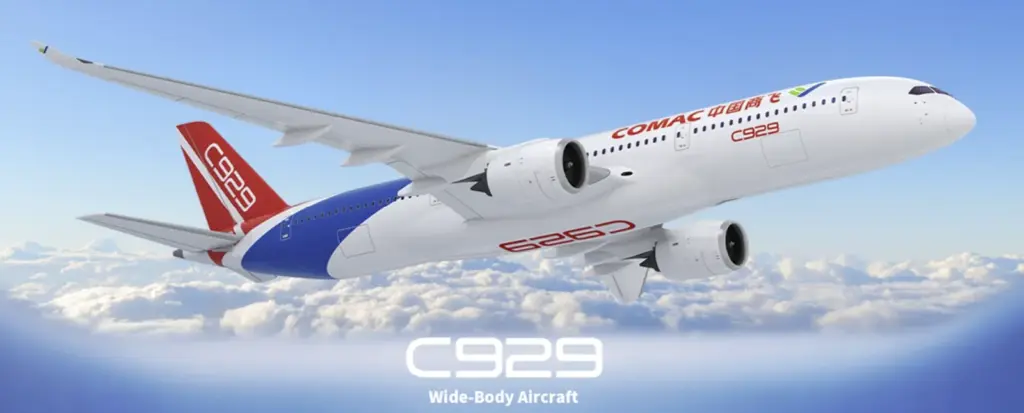
However, the engine remains the programme’s biggest technical hurdle. Specifically, the CJ-2000, AECC’s indigenous widebody turbofan, reached 35.2 tonnes of thrust in January 2026 testing — placing it in the performance class of the GE GEnx-1B and Rolls-Royce Trent 1000 (Aerospace Global News, 2026). Nevertheless, achieving thrust in a test cell differs enormously from having a flight-certified, production-ready engine. As of early 2026, COMAC has not announced a powerplant selection. At the 2025 Paris Air Show, a senior COMAC official stated that the company targets a type certificate by 2032, with first commercial service by approximately 2035.
Crucially, the C929 is currently the only widebody passenger aircraft programme formally in development globally. Neither Boeing nor Airbus has launched a new widebody. That distinction alone makes the programme strategically significant — regardless of its timeline uncertainties.
Competitive Landscape: Pricing, Performance, and Market Projections
The COMAC C919 competes on price, but it concedes ground on performance. Understanding both dimensions is essential for assessing the programme’s trajectory.
China’s Narrowbody Technical Comparison With the A320neo and 737 MAX
Range is the C919′s most significant competitive weakness. In particular, the standard variant’s 4,075-kilometre range is approximately 35 per cent less than the A320neo’s 6,300 kilometres and the 737 MAX 8’s 6,570 kilometres. Even the extended-range model at 5,555 kilometres falls meaningfully short. As a result, analysts describe the C919 as comparable to the older A320ceo rather than the current A320neo — a conservative design that trails the latest Western narrowbodies in efficiency.
On the other hand, pricing offers a meaningful advantage. The C919’s list price of US$99–108 million provides a 10 to 20 per cent discount versus the A320neo at roughly US$111 million. The gap widens further against the 737 MAX 8 at approximately US$121.6 million. China Eastern reportedly received roughly a 50 per cent discount on its 100-unit order. Furthermore, China’s 125 per cent retaliatory tariffs on American imports — imposed in April 2025 — dramatically raised Boeing costs for Chinese airlines, as detailed in our Fliegerfaust coverage of China’s Boeing delivery ban.
COMAC Narrowbody Market Share Forecasts
Cirium projects the C919 will capture approximately 25 per cent of new single-aisle deliveries to Chinese operators through 2043, versus Boeing at 30 per cent and Airbus at 45 per cent. Over 6,000 new single-aisle aircraft are expected for China during that period. IBA Group forecasts a more aggressive scenario, with COMAC’s share rising to roughly 65 per cent of new narrowbody deliveries to Chinese operators by 2030. However, that figure represents only about seven per cent of the total in-service narrowbody fleet in China when existing Airbus and Boeing aircraft are counted.
Globally, the picture remains modest. In total, the C919 and C909 combined would constitute approximately two per cent of the world fleet by 2030. Furthermore, Cirium projects fewer than 250 C919s sold outside China, primarily to Belt and Road Initiative (BRI) nations. The BRI is China’s global infrastructure and investment programme, launched in 2013, which spans more than 140 countries across Southeast Asia, Central Asia, the Middle East, Africa, and Latin America. In aviation terms, these are countries where Chinese financing and political relationships may smooth the path to aircraft orders. Notably, Cathay Pacific Chief Executive Officer Ronald Lam predicted a future defined by three letters: A for Airbus, B for Boeing, and C for COMAC. Ultimately, whether that alphabet materialises depends on execution — not aspiration.
Panama became the first Latin American country to leave the BRI in February 2025, and Argentina has signalled distancing from China and refused BRICS membership.
Airbus and Boeing Respond
Airbus is not standing still. On October 22, 2025, the European manufacturer opened its second A320 Family Final Assembly Line in Tianjin, China, doubling the Airbus Chinese assembly capacity. Tianjin will contribute 20 per cent of Airbus’s total A320 global production capacity — a clear strategic hedge. Chief Executive Officer Guillaume Faury acknowledged COMAC’s growing presence and described it as a third player entering international markets with deep government pockets.
Conversely, Boeing faces mounting challenges in China by not having a final assembly line located in the country. Specifically, the 125 per cent tariffs raised costs sharply. As a result, several Chinese airlines suspended Boeing deliveries. In addition, the company has reportedly begun redirecting jets originally intended for Chinese carriers. Overall, Boeing’s market share in China, once near parity with Airbus, is declining steadily. While our Fliegerfaust report on Airbus trade headwinds, it simultaneously benefits from Boeing’s deteriorating position in the world’s fastest-growing aviation market.
The divergence in strategy traces back to 2008, when Airbus established its first commercial aircraft assembly line outside Europe in Tianjin — a joint venture with Aviation Industry Corporation of China (AVIC) and the Tianjin Free Trade Zone. Boeing, by contrast, resisted structural assembly in China for a decade longer. In 2018, it opened a completion and delivery centre in Zhoushan — a joint venture with COMAC — but that facility only installs interiors and paints liveries on 737 MAXs fully assembled in Renton, Washington. No airframe assembly takes place there. The Zhoushan centre has been largely idle since, first due to the global 737 MAX grounding and then due to US-China tensions.
The results speak for themselves. As Aviation Week analysis documented, Airbus’s market share in China surged from roughly 15 per cent before the Tianjin line opened to over 50 per cent today — entirely at Boeing’s expense. Analyst Sash Tusa of Agency Partners observed that assembling aircraft in China delivers a stronger market position than flying them in for delivery, calling it an industrial policy that Airbus executed correctly and Boeing did not.
However, that deeper industrial footprint carries a cost. As the Jamestown Foundation documented, industry insiders noted that China’s aerospace sector gave the country “incredible leverage” over foreign investors — exchanging market access for the critical know-how and expertise that accelerated domestic aircraft development. More than 200 Chinese suppliers now support Airbus production in China, and the knowledge gained by Chinese through decades of joint manufacturing has directly strengthened the domestic aerospace capabilities that underpin the COMAC C919 programme — the very competitor Airbus now faces.
Production Ramp-Up: Can COMAC Scale?
The gap between COMAC C919 production ambitions and actual output represents the programme’s most pressing operational challenge.
Chinese Commercial Aircraft Manufacturing Infrastructure
COMAC’s primary facility is the Final Assembly and Manufacturing Centre at Shanghai Pudong International Airport (PVG). In addition, a second assembly line is under construction in the Lin-gang Special Area of Pudong. Altogether, the new facility covers approximately 330,000 square metres, with expected full capacity by 2027 targeting 150 or more aircraft per year.
Shanghai’s municipal government has committed 70 billion yuan (roughly US$9.7 billion) to local C919-related industrial chains. The goal is to establish 60 key enterprises by the end of 2026. In February 2026, COMAC received a separate 44 billion yuan capital injection from investors led by the State-owned Assets Supervision and Administration Commission (SASAC). Money, at least, is not the constraint when the state writes the cheques.
Analyst Forecasts Versus COMAC C919 Targets
The disconnect between manufacturer targets and independent forecasts is stark. COMAC targets production of 150 C919s per year by 2029. By contrast, IBA Group forecasts 25 deliveries in 2026 and approximately 45 in 2027. As South China Morning Post reported in January 2026, COMAC is targeting 28 or more C919 deliveries for the year, with two units already assembled in the first three weeks of January.
Indeed, a manager briefed on COMAC’s plans noted that supply chain conditions improved substantially in the final quarter of 2025 with the arrival of more engines and parts. Certainly, that is encouraging. Yet the fundamental bottleneck — dependence on CFM International for engines, in a market where CFM already struggles to meet demand from Airbus and Boeing — remains unresolved.
Government Backing and Strategic Context
COMAC has received an estimated US$49 to 72 billion in state-related support through 2020, according to CSIS analysis. In particular, that figure includes financing from state banks, corporate bonds, and seed capital from government entities. Moreover, the February 2026 capital injection of 44 billion yuan adds roughly US$6 billion more. Without a doubt, the true cumulative total is almost certainly higher than any publicly available estimate.
Made in China 2025 and Beyond
Aviation ranks among 10 priority sectors under China’s Made in China 2025 industrial policy. COMAC’s stated goals include a C919 stretched variant in service by 2030, a C929 type certificate by 2032, and a target of 90 per cent domestic content for the C929. China’s broader green aviation manufacturing strategy envisions domestically produced large civil aircraft forming the backbone of the national aviation ecosystem through 2035.
This level of state commitment to the COMAC C919 and its successor programmes distinguishes COMAC from virtually every other challenger programme in commercial aviation history. Earlier attempts — from Indonesia’s IPTN to Japan’s Mitsubishi SpaceJet — lacked either the financial depth or the domestic market scale to sustain a decades-long development arc. China possesses both. Whether it can convert that advantage into a technically competitive product remains the central question. As one industry veteran observed, money can buy engineers and factories, but it cannot buy decades of accumulated institutional knowledge overnight, really?
Beyond the C919: The Broader COMAC Portfolio
The COMAC C919 does not exist in isolation. It sits within an expanding family of Chinese commercial aircraft programmes.
The C909 Regional Jet Goes International
The C909, formerly known as the ARJ21, has quietly become COMAC’s primary export product. By the end of 2025, over 182 airframes had been delivered. Currently, nine C909s operate across Southeast Asia on more than 20 routes, having carried a cumulative 700,000 passengers in the region. Notably, TransNusa of Indonesia, Lao Airlines, and VietJet of Vietnam all fly the type.

Furthermore, at the Singapore Airshow 2026, COMAC signed an order for six C909 firefighting aircraft from Shanxi Victory General Aviation.
Additionally, COMAC invested 634 million yuan in Chengdu Airlines — its subsidiary carrier — to strengthen international C909 operations (Aviation A2Z, 2026). This move nearly tripled the airline’s registered capital and positions it as a showcase platform for the aircraft in Central Asian and Southeast Asian markets.
Future Ambitions: C939, C949, and Blended Wings
COMAC’s roadmap extends further still.
The C939, a larger widebody targeting the Boeing 777X and Airbus A350-1000 segment, has entered preliminary design.
A supersonic transport concept designated C949 — with a target market entry symbolically set for 2049, the centenary of the People’s Republic of China — has been outlined through academic papers. Northwestern Polytechnical University has collaborated with COMAC on blended wing body aircraft designs. These remain in early research phases, but they signal the breadth of China’s aerospace ambitions.
Conclusion – COMAC C919: A Domestic Champion With a Long Road Ahead
The COMAC C919 has crossed the threshold from development programme to operational aircraft. It flies revenue passengers on 46 routes. Three major Chinese carriers are building fleets. The variant family is expanding. The C929 widebody — the only new widebody formally in development anywhere in the world — advances through design milestones.
Yet the hard data tells a more sober story than COMAC’s ambitions suggest. Specifically, production remains at roughly 15 aircraft per year. Moreover, the programme’s existential vulnerability to US export controls was demonstrated in stark terms during 2025. Although the CJ-1000A indigenous engine shows genuine promise, it remains years from production readiness. Similarly, competitive domestic replacements for avionics, flight controls, and landing gear do not yet exist.
Internationally, EASA certification is three to six years away. Furthermore, there is no FAA pathway. Indeed, the global support infrastructure that Airbus and Boeing have built over half a century simply does not exist for COMAC. For the near term, the C919’s competitive arena is exclusively domestic — a market where state-directed procurement, punitive tariffs on Boeing, and aggressive financing can substitute for technical parity with the A320neo and 737 MAX.
The duopoly is not breaking yet. The foundations for a three-player market are physically flying — but only within China’s borders.
The COMAC C919 Outlook: Ambition Versus Reality
Critical opinion demands honesty: COMAC has accomplished something remarkable in building a certified, passenger-carrying narrowbody. However, calling the C919 a true competitor to the A320neo or 737 MAX overstates its current capabilities by a considerable margin. The aircraft is closer to challenging a generation-old A320ceo than its contemporary rivals. Success will require not just more deliveries, but a fundamental leap in production discipline, supply-chain independence, and global support capacity.
Question for you
Can COMAC translate China’s vast domestic market and bottomless state funding into a genuinely competitive aircraft programme, or will the C919 remain a national project that flies mostly on political will?
Leave your answers and comments below and on our Fliegerfaust Facebook page.
COMAC C919: Sources
- China Daily — COMAC secures order for firefighting aircraft (February 5, 2026)
- Bloomberg via Yahoo Finance — China’s Comac on track to miss C919 delivery target by half (December 23, 2025)
- BusinessWire / China Eastern — Two-Year Anniversary of CEA’s C919 Operations (May 29, 2025)
- IBA Group — COMAC Aircraft Programmes – Status & Outlook (August 2025)
- Aviation Week — Comac Wants Stretched C919 In Service By 2030, C929 By 2035 (June 16, 2025)
- Simple Flying — COMAC C919 Variants Guide (2025)
- The Air Current — U.S. engine and component ban poised to cripple China’s commercial aircraft manufacturing (June 6, 2025)
- South China Morning Post — Home-grown CJ-1000 engine to soon be tested on China’s C919 passenger jet (March 29, 2025)
- Avitrader — EASA: COMAC’s C919 certification could take up to six years (April 29, 2025)
- Aviation A2Z — EASA Pilots Take China’s New C919 to the Skies in Crucial Certification Test (January 17, 2026)
- South China Morning Post — In an international win for China’s C919, Brunei accepts Chinese aviation rules (2025)
- Fortune — Ryanair threatens to ‘reassess’ a $30 billion Boeing order (May 2, 2025)
- Newsweek — China Mounts Fresh Challenge to Boeing and Airbus (November 2025)
- South China Morning Post — China’s C929 widebody lands partner to power next-gen flight mind (February 2026)
- Aerospace Global News — COMAC C929 programme advances with CJ-2000 thrust milestone (January 12, 2026)
- Airbus — Airbus opens second A320 Family Final Assembly Line in China (October 22, 2025)
- South China Morning Post — Maker of China’s C919 jet set to pick up production pace after delay (January 26, 2026)
- CSIS — China’s COMAC: An Aerospace Minor Leaguer (2020)
- Aviation A2Z — Comac Pumps $92 Million Into Chengdu Airlines to Fast-Track C909 Global Expansion (February 24, 2026)
- AirInsight — COMAC – Moving Forward in Multiple Directions (March 31, 2025)
For full details, please refer to our Disclaimer page.