
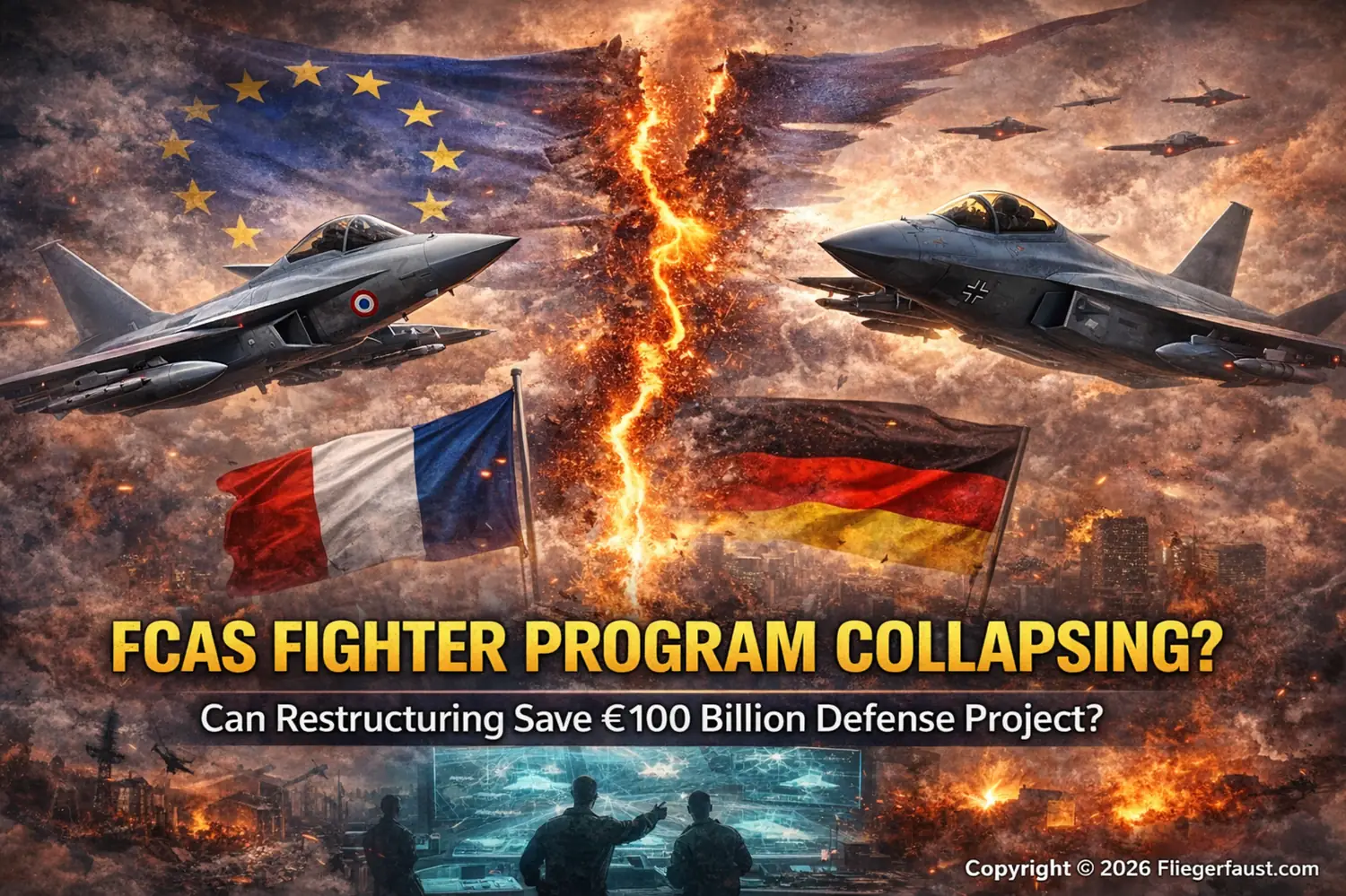
FCAS fighter program — is Europe’s most ambitious defence project collapsing under the weight of its own ambition, or can a last-minute restructuring save it from a €100 billion industrial divorce?
FCAS fighter program: On February 19, 2026, Airbus Chief Executive Officer (CEO) Guillaume Faury offered a remarkably candid proposal. He told reporters in Toulouse that Airbus would support a “two-fighter solution” if governments requested one. Separately, Airbus Defence and Space CEO Michael Schoellhorn told Deutsche Welle (DW Business) that the Future Combat Air System (FCAS) “partially needs restructuring.” Meanwhile, German Chancellor Friedrich Merz questioned whether Berlin even needs a joint sixth-generation fighter with France.
Consequently, Belgian Defence Minister Theo Francken posted a blunt verdict on X: “SCAF is dead” — using the French acronym for Système de Combat Aérien du Futur (SCAF), the same programme known internationally as FCAS.
SCAF (FCAS) is dead
The FCAS fighter program now faces an existential reckoning. Europe’s €100 billion plan to build a next-generation combat air system for France, Germany, and Spain has fractured beyond diplomatic repair. After nine years of planning and more than €4 billion spent, not a single demonstrator exists. If that sounds like an expensive group project where nobody agreed on the font, the real consequences run far deeper.
What Sparked the FCAS Fighter Program Crisis
The immediate trigger arrived between February 13 and February 19, 2026. However, the rot had festered for years. Understanding the collapse requires tracing two pivotal moments in that single week.
How Schoellhorn Reshaped the European Fighter Jet Debate
In his DW Business interview (interviewer Arthur Sullivan, broadcast around February 19, 2026), Schoellhorn did not mince words. He acknowledged that Airbus and its French partner Dassault Aviation “have a problem related to the fighter.” Still, he insisted the broader FCAS programme would endure.
“There will be an FCAS. However, certain parts of the project will need to be restructured.” — Michael Schoellhorn, Airbus Defence and Space CEO, Militarnyi
Moreover, Schoellhorn reframed the European fighter jet debate away from the troubled manned-jet pillar. He stated the programme is “far more than just an aircraft.” Furthermore, he argued that “at its core, it is a combat cloud.” He also noted that precise 15-year requirement lists belong to a past era, according to Militär Aktuell.
This was not his first salvo. Previously, in August 2025, German newsletter Griephan Briefe reported a striking exchange. Schoellhorn had told Chancellor Merz directly that Airbus “no longer see[s] any reason to continue the FCAS.” That message, reported by AeroTime, marked the moment Airbus dropped its conciliatory posture.
Faury’s Sixth-Generation Fighter Proposal
At Airbus’s full-year earnings conference on February 19, 2026, Faury went further. He formally proposed a two-fighter architecture for Europe. He compared it to Airbus’s own civil portfolio.
“The (civil) A350-900 and A350-1000 are two different planes with extremely high commonality … Then you have fighters in Europe without a part in common.” — Guillaume Faury, Airbus CEO, Reuters via IDRW
Additionally, he stated that Airbus could develop a fighter independently if needed (Reuters via IDRW). That remark sent a clear signal to Dassault Aviation and Paris. Airbus no longer accepts the junior-partner role in perpetuity. Consequently, Germany and France agreed to reach a final decision on the Future Combat Air System by the end of 2026 (Defense News).
Inside the FCAS Fighter Program: Origins, Money, and Milestones
Understanding the scale of the crisis requires a look at the programme’s origins and its industrial architecture. Spoiler: the receipts are painful.
How the Next-Generation Fighter Programme Began
FCAS launched formally in 2017 when French President Emmanuel Macron and German Chancellor Angela Merkel signed a joint declaration. Spain joined the programme in 2019 through a trilateral framework agreement. Designers envisioned it as a Next Generation Weapon System (NGWS). Notably, this was not merely a fighter jet. Instead, it was an interconnected “system of systems” built on three pillars.
Pillar 1 is the Next Generation Fighter (NGF). It is a manned stealth aircraft led by Dassault with Airbus as the main partner. Pillar 2 covers Remote Carriers. These are autonomous loyal wingman drones led by Airbus with missile-maker MBDA. Pillar 3 is the Combat Cloud. Specifically, it is a decentralised, AI-powered digital network led by Airbus with Thales and Indra Sistemas. A fourth critical element is the engine, developed by EUMET. That entity is a 50/50 joint venture between Safran (France) and MTU Aero Engines (Germany). ITP Aero (Spain) serves as a main partner (GlobalSecurity.org).
The entire FCAS project aimed to replace France’s Dassault Rafale and Germany and Spain’s Eurofighter Typhoon fleets from around 2040. Total lifecycle cost estimates reach approximately €100 billion. French Senate reports and Reuters have both cited that figure.
Four Billion Euros and No Sixth-Generation Fighter Demonstrator
Phase 1A launched in February 2020 at €155 million, split equally between France and Germany. It covered 18 months of initial research and technology (R&T) work. Subsequently, Phase 1B began on December 16, 2022. Contracts for this stage carry a value of roughly €3.2 billion. They entered into force on March 20, 2023 (Defense Security Monitor).
Phase 2 — the stage where a physical demonstrator would take shape — carried an estimated €4.5 billion price tag. However, it remains completely blocked as of February 2026. Additionally, Phase 1B expires in April 2026. An industry source told Breaking Defense at the Munich Security Conference (MSC) bluntly: “Once Phase 1B finishes, NGF will be condemned to its end.” Consequently, over €4 billion has disappeared across both phases. The original target of a first flight by 2026 reads like a footnote.
The Dassault-Airbus Split at the Heart of the FCAS Fighter Program
At the centre of the European fighter jet crisis sits an intractable three-way dispute: intellectual property (IP), workshare, and governance. These tensions existed from the start. However, they reached critical mass in 2025. Calling them “creative differences” would require a generosity the participants abandoned long ago.
How Intellectual Property Disputes Threaten the FCAS Project
IP remains the most sensitive fault line. Specifically, France fears losing its aerospace leadership if German and Spanish companies jointly acquire two-thirds of development know-how. Conversely, Airbus refuses to fund a programme from which it gains no meaningful technical capability.
Moreover, ECFR analyst Ulrike Franke captured both perspectives in a December 1, 2025, analysis. She observed: “The French feel that Germany is trying to steal their intellectual property.” In Berlin, meanwhile, officials privately complain that “France just wants Germany to pay for their aircraft.”
The governance dispute runs parallel. Dassault CEO Éric Trappier has insisted his company must serve as the “architect” and prime contractor. In September 2025, he declared: “I don’t mind if the Germans are complaining. If they want to do it on their own, let them do it“ (National Security Journal). For context, that is the diplomatic equivalent of leaving a group chat and sending a selfie from the door.
FCAS fighter program: The 80 Percent European Fighter Jet Workshare Demand
The dispute detonated in July 2025. Specifically, Reuters and German publication Hartpunkt reported that Dassault demanded roughly 80 percent of the NGF workshare. Under that proposal, the French side would develop the fighter, engine (via Safran), and sensors (via Thales). Consequently, Airbus and Indra would receive mainly the Combat Cloud and Remote Carriers. Therefore, the German Ministry of Defence warned parliament this demand would carry “significant consequences“ (The Aviationist, July 13, 2025).
Previously, a December 2022 industrial agreement was supposed to resolve these tensions. It failed. One industry insider told European Security & Defence: “Dassault’s definition of a collaborative partnership is one in which Dassault decides the direction …, while its partners sit back and pay the bills.” That observation alone could fuel an entire semester of procurement law classes.
Political Escalation Around the FCAS Fighter Program: Paris to Munich
What began as an industrial dispute has since escalated to the highest levels of European politics. The timeline from mid-2025 to February 2026 reads like a slow-motion train derailment. Every passenger could see it coming, yet no one applied the brakes. Readers who followed our Fliegerfaust coverage of the Boeing F-47 sixth-generation fighter programme will note how differently the American approach played out.
Germany’s Chancellor Questions the Sixth-Generation Fighter
The political escalation gathered momentum throughout the second half of 2025. Initially, on October 5, 2025, German Defence Minister Boris Pistorius publicly threatened to end the FCAS project. He stated that “a decision must and will be made.” Subsequently, in November 2025, French Defence Minister Catherine Vautrin told Europe 1 that “Germany currently did not have the capacity to build a fighter jet.”
Furthermore, the Financial Times reported on November 17, 2025, that France and Germany discussed dropping the joint fighter plan (Aerospace Global News). Even so, a trilateral defence ministers’ meeting on December 11, 2025, produced no agreement. Then, on January 2, 2026, a German chancellery spokesperson confirmed yet another postponement.
Then came the decisive blow. On February 18, 2026, German Chancellor Merz told the Machtwechsel podcast: “The French need … an aircraft capable of carrying nuclear weapons and operating from an aircraft carrier. That’s not what we currently need“ (France 24).
“SCAF Is Dead” — Belgium’s Verdict on the FCAS Project
Belgian Defence Minister Francken responded on X with a blunt verdict. He wrote: “FCAS is dead according to the German Chancellor. … There will be no Franco-German sixth-generation fighter jet“ (Breaking Defense, February 18, 2026).
Macron’s office pushed back. Specifically, the Élysée stated the French president “remains committed to the success of the FCAS project.” Additionally, officials added that “it would be incomprehensible if industrial divergences could not be overcome” (Euronews). Nevertheless, analysts offered sharper assessments. Notably, Paul Taylor of the European Policy Centre told Breaking Defense: “My sense is that it’s been clear for a year or two that FCAS is dead, it just won’t lie down.”
German Industry and Labour Demand a New European Fighter Jet Path
Earlier in February 2026, Germany’s aerospace industry association (BDLI) and the IG Metall trade union jointly published an opinion piece in Handelsblatt. They called for a “two-aircraft approach.” That call effectively urged Germany to exit the fighter cooperation (Breaking Defense). Notably, the joint statement carried extra weight because BDLI represents employers and IG Metall represents workers. Both sides rarely agree on procurement politics. However, both concluded that the SCAF programme no longer served German industrial interests. When management and labour share the same exit strategy, the writing is not merely on the wall — it is tattooed.
GCAP Surges as the FCAS Fighter Program Stalls
While the European fighter jet programme flounders, the rival Global Combat Air Programme (GCAP) has surged ahead. The United Kingdom, Italy, and Japan lead that effort. The contrast is stark. GCAP already has a joint venture, a timeline, and partners who agree on the basics.
How Edgewing Outpaces the Next-Generation Fighter Effort
On June 20, 2025, the three GCAP nations launched Edgewing. That joint venture is equally owned by BAE Systems, Leonardo, and Japan Aircraft Industrial Enhancement Co. Notably, its first CEO is Marco Zoff (formerly of Leonardo). Headquarters sit in Reading, UK. Moreover, GCAP targets a 2035 in-service date. That is potentially a full decade ahead of the FCAS project’s theoretical timeline.
Additionally, at Defence and Security Equipment International (DSEI) in September 2025, Rolls-Royce, Avio Aero, and IHI signed an engine collaboration agreement. Furthermore, a sensor consortium (G2E) formed around Mitsubishi Electric, ELT Group, and Leonardo. As of January 2026, BAE Systems confirmed to Janes that design-and-development contract negotiations had reached their “final stages.” Those who follow Saab’s expanding global footprint will recall that our Fliegerfaust analysis of Sweden’s Saab-Bombardier Gripen discussion in Canada is similarly redrawing the fighter production map.
Germany Weighs GCAP, Saab, and the F-35 Sixth-Generation Fighter Alternatives
Germany joining GCAP has become a realistic possibility. Specifically, Italian Defence Minister Guido Crosetto stated in December 2025 that “Germany could probably join this project“ (Reuters via ThePrint). Subsequently, Chancellor Merz met Italian Prime Minister Giorgia Meloni in Rome in January 2026. UK Defence Minister Luke Pollard also confirmed GCAP “remains open to additional partners.”
However, analysts caution that late entry would afford Germany limited workshare. Notably, Alessandro Marrone of Italy’s Istituto Affari Internazionali (IAI) told Il Sole 24 Ore that Germany’s entry “would be the end of the FCAS.”
Separately, other German alternatives include partnering with Sweden. Saab CEO Micael Johansson told the Frankfurter Allgemeine Zeitung in December 2025: “We’re ready for a joint fighter jet with the Germans.“ That offer complements the France GlobalEye order we covered at Fliegerfaust, built on Bombardier platforms. Additionally, Germany could purchase more Lockheed Martin F-35 Lightning II jets. Reports suggest Berlin discussed acquiring up to 35 more beyond the 35 already ordered (The Defense Post, February 23, 2026).
For readers interested in that route, our Fliegerfaust analysis of F-35 data sovereignty explores why it carries complications of its own.
What Survives if the European Fighter Jet Dies?
Even if the Next Generation Fighter pillar collapses entirely, the broader FCAS project is not a total write-off. Several components carry value regardless of the manned platform’s fate. Nonetheless, the implosion would echo far beyond aerospace.
Combat Cloud and Remote Carriers Outlast the FCAS Fighter Program
Both Faury and Schoellhorn have emphasised that non-fighter pillars work well. Specifically, the Combat Cloud — a decentralised, cyber-resilient digital network — is the element most likely to survive. Moreover, an industry executive told the Financial Times in November 2025: “We can live with several jets in Europe, but we need one cloud system for all of them.”
Separately, the Remote Carrier programme has shown tangible progress. Notably, Airbus demonstrated the world’s first launch and recovery of a Remote Carrier from a flying A400M transport. Furthermore, MBDA aims to flight-test its expendable variant demonstrator by 2029. Meanwhile, engine research by EUMET — targeting a variable-cycle engine with roughly 11 tonnes of thrust — carries standalone value as well.
The restructuring argument boils down to preserving shared digital infrastructure while allowing national divergence on the manned platform. It is a logical solution. Even so, one must accept that nine years and €4 billion bought a cloud and some drones instead of a jet. Spain, for its part, has largely stayed in the background of the dispute. Madrid’s industrial partner, Indra Sistemas, stands to lose the least if the fighter pillar collapses. Nevertheless, Spanish officials have urged all parties to find a compromise before April 2026.
Experts Assess the Damage to European Defence Cooperation
Expert assessments are uniformly grim. Specifically, Aviation Week analyst Richard Aboulafia described FCAS as “terminally flawed” in a January 7, 2026, podcast. Conversely, he argued that GCAP is “bound for success.” On FCAS, he added: “Seven years ago I said this thing looks doomed.”
Moreover, a Carnegie Endowment compilation published on February 26, 2026, gathered views from across Europe. Notably, Élie Tenenbaum of France’s Institut Français des Relations Internationales (IFRI) identified three fatal obstacles. Those are “out-of-sync procurement cycles, divergence over country-specific requirements, and distribution of workshare.” Additionally, Pia Fuhrhop of Berlin’s Stiftung Wissenschaft und Politik (SWP) called the collapse “the final demonstration” of problems plaguing big European flagship projects.
Furthermore, former Airbus CEO Tom Enders weighed in on February 23, 2026. He called Germany’s 2017 decision to partner with France a “strategic mistake“ in an RND commentary. He also warned that a national German fighter would represent “a gigantic misallocation of resources“ (AeroTime). However, others urged caution before abandoning cooperation entirely. A DGAP Memo from August 2025 framed FCAS as a restructuring opportunity rather than a binary choice. The Future Combat Air System’s fate may hinge on whether policymakers listen to procurement specialists or political scientists. Historically, that is a coin toss.
FCAS Fighter Program Timeline: Critical Dates Ahead
The original NGF first-flight target of 2026 is now moot. Even under optimistic scenarios, a demonstrator flight would not occur before the early 2030s. Moreover, the original 2040 initial operational capability (IOC) target appears unachievable. Consequently, a 2045–2050 timeframe seems more realistic — if the programme survives at all. By comparison, GCAP targets 2035.
Milestones for the Sixth-Generation Fighter Race
Specifically, April 2026 marks the expiry of Phase 1B. No Phase 2 contract has been signed. Throughout 2026, Merz and Macron must deliver on their agreed deadline. Meanwhile, GCAP partners expect to finalise their first full design-and-development contract. Moreover, Dassault has signalled it could pursue a national Rafale successor. That option is sometimes called “Super Rafale” or Rafale F5/F6.
Notably, the next-generation fighter race is not a single contest. Instead, it is three overlapping competitions on different clocks. The United States awarded Boeing the F-47 under its Next Generation Air Dominance (NGAD) programme, targeting the early 2030s. GCAP aims for 2035. The FCAS fighter program, once projected for 2040, now struggles to define what it wants to build.
Conclusion — Europe’s Defence Sovereignty at the Crossroads
The FCAS project crisis is more than an industrial dispute between two proud aerospace champions. It is a stress test for European defence sovereignty. The Franco-German engine that once powered European integration is stalling at the worst possible moment.
A Managed Separation or a Renewed European Fighter Jet Alliance?
The most likely outcome, based on current reporting, is a managed separation. Specifically, France will pursue a national Rafale successor. Meanwhile, Germany and Spain will continue Combat Cloud and Remote Carrier cooperation. Subsequently, they will seek a manned fighter through GCAP, Sweden’s Saab, or additional F-35 purchases. Notably, the €4 billion already invested will not vanish entirely. The Combat Cloud architecture, engine research, and Remote Carrier technology carry genuine value. However, the dream of a single unified European sixth-generation combat system appears dead.
As Schoellhorn told Deutsche Welle: “When you take on large European projects, there is a risk that political will alone is not enough.” That alliance has broken down. Consequently, the restructuring he called for may mean managed divorce rather than renewed partnership.
Critically, this failure is not inevitable — it is chosen. The technologies work. The budgets existed. However, the political and industrial trust required to share know-how across borders broke first. If Europe cannot manage that trust in defence aerospace, the implications reach far beyond fighter jets. Therefore, they touch every collaborative procurement programme on the continent.
Question for you
Here is the question that remains: if three of Europe’s wealthiest nations cannot build one fighter jet together after nine years and €4 billion, what does that say about the continent’s capacity to defend itself without American help?
Leave your answers and comments below and on our Fliegerfaust Facebook page.
Sources
- Militarnyi — FCAS Fighter Jet Project Partially Needs Restructuring – Airbus Defence and Space CEO (February 25, 2026).
- Militär Aktuell — Airbus boss Mike Schellhorn on the FCAS drama (February 2026).
- Aviation Week — Airbus CEO Backs Two-Fighter Solution For FCAS (February 19, 2026).
- Defense News — Airbus open to two-fighter option for FCAS to keep program alive (February 19, 2026).
- Breaking Defense — ‘SCAF is dead’: Sixth-gen Franco-German fighter is all but over (February 18, 2026).
- Breaking Defense — FCAS may survive, but next-gen fighter negotiations all but dead (February 2026).
- Breaking Defense — Top German labor union, aerospace group call for FCAS pullout (February 2026).
- France 24 — Airbus ready to build two new European fighters if countries want (February 19, 2026).
- France 24 — Germany’s Merz casts doubt on European fighter jet plan (February 18, 2026).
- Euronews — Germany’s fighter jet dilemma: Faltering European dream and US reality (February 20, 2026).
- European Security & Defence — Goodbye SCAF? Is this the end of the road for the Franco-German-Spanish fighter dream? (February 2026).
- ECFR — The trouble with FCAS: Why Europe’s fighter jet project is not taking off (December 1, 2025).
- Defense Security Monitor — New Year Bringing Big Changes to FCAS Fighter Program (December 18, 2025).
- Carnegie Endowment — Taking the Pulse: Can European Defense Survive the Death of FCAS? (February 26, 2026).
- AeroTime — Airbus questions future of Europe’s FCAS fighter jet project (August 2025).
- AeroTime — FCAS: Ex-Airbus CEO warns against German fighter program (February 2026).
- AeroTime — Merz casts doubt on FCAS over France’s fighter requirements (February 2026).
- The Aviationist — Dassault Seeks 80% of FCAS Workshare to Get the Delayed Program Moving (July 13, 2025).
- National Security Journal — FCAS: Europe’s New 6th Generation Fighter Is in Trouble (2025).
- The Defense Post — Germany Considers F-35 Jets Amid FCAS Deadlock (February 23, 2026).
- Bolt Flight — Europe’s €100bn FCAS Fighter Jet Program Faces Split as Airbus Weighs Solo Path (February 2026).
- GlobalSecurity.org — Future Combat Air System (FCAS).
- DGAP — How FCAS Can Move Forward (August 5, 2025).
- Leonardo — GCAP marks major milestone: Edgewing joint venture launched (June 20, 2025).
- Il Sole 24 Ore — The super fighter case: Germany may abandon France and Spain to join the GCAP (2026).
- Reuters via ThePrint — Italy says Germany and other countries may be interested in GCAP jet programme (December 4, 2025).
- Reuters via IDRW — Airbus capable of developing a fighter jet alone, CEO says (February 22, 2026).
- Aerospace Global News — France and Germany edge towards FCAS breakup over fighter jet (2025).
- Aviation Week — Podcast: Is The GCAP Fighter The International Successor To F-35? (January 7, 2026).
For full details, please refer to our Disclaimer page.
Merz is right that France need a nuclear weapon navalized fighter with is specs and costs. Germany need a fighter and attack aircraft. So letting France do a stealth F-18 for the 2030’s while Germany could do 2 stealth versions of theirs. A Messerschmitt AG fighter in Manching and a Focke-Wulf attack aircraft in Bremen/Magdeburg using the same engines and systems with adaptation for each versions weapons. The need is to take out Russian fighters, missiles and Russian radar, artillery and tanks while avoiding missiles. So the Me could be based on the JAS39E but with stealth, better range and internal missiles with a new single 27 000 lbf MTU engine. The Fw need to have 2 MTU engines and with better range and weapons load.