
What turned Croatia Airlines flight OU412 into a runway-excursion investigation on May 16, 2026?
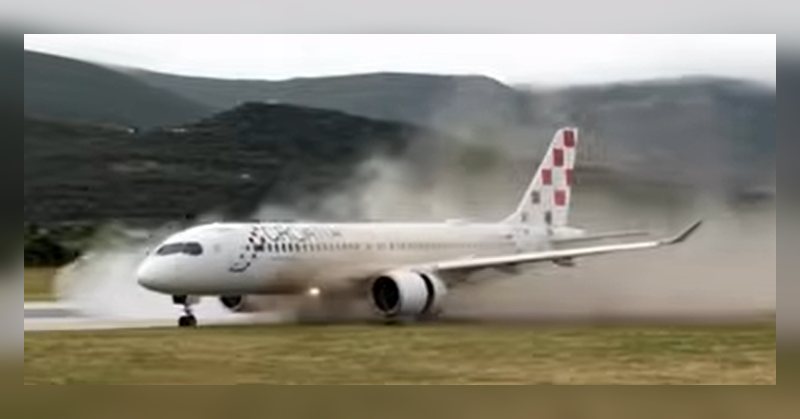
Airbus A220 incident at Split: Croatia Airlines operated the Airbus A220-300, registration 9A-CAN, from Split Airport (SPU/LDSP) to Frankfurt. During the takeoff roll on Runway 23, the crew initiated a rejected takeoff. During subsequent braking, the left main landing-gear wheel left the paved runway surface and rolled onto the grass beside the runway. Croatia Airlines reported no injuries.
A220 incident timeline at Split
Croatia’s Air, Maritime and Railway Traffic Accidents Investigation Agency notice classified the event as a serious incident. The agency placed the occurrence at about 13:35 local time, during the rejected takeoff at Split Airport.
Meanwhile, Croatia Week’s reproduction of the Croatia Airlines statement said 130 passengers and five crew were on board. It added that all passengers and crew were safe. However, AvioRadar’s summary of the Jutarnji List update cited 132 passengers, so the airline’s later figure is the stronger published count.
OU412 runway excursion sequence
The best-supported sequence is straightforward. The aircraft accelerated on the takeoff roll, the crew initiated a rejected takeoff, and video of the incident shows the left main landing-gear wheel leaving the paved runway surface. Media reports said the aircraft contacted airfield equipment before stopping, while the official AIN notice reported minor aircraft damage.
“According to the first available information, the crew stopped the aircraft in line with prescribed safety procedures.” — Croatia Airlines statement via Croatia Week.
Additionally, AvioRadar’s May 16 update reported that the aircraft struck a vertical sign and runway edge lights.
A220 incident weather and runway context
Weather does not explain the event by itself. However, it defines the environment that investigators must test. Flightradar24’s SPU weather history showed rain and gusty wind near the incident window.
At 11:00 Coordinated Universal Time (UTC), the Meteorological Aerodrome Report (METAR) for SPU reported wind from 310 degrees at 17 knots, gusting 27 knots. It also reported light rain. At 11:30 UTC, the METAR reported wind from 280 degrees at 17 knots, varying between 240 and 300 degrees. Light rain continued.
Split runway excursion weather signals
For a Runway 23 departure, those values imply a material right crosswind component. Notably, the 11:00 UTC wind was almost perpendicular to the runway heading. Consequently, the gust component could have approached the high twenties in knots.
Even so, public data do not provide the official runway-state report. The runway may have been wet or damp, but the exact braking-action assessment remains unavailable.
A220 incident data and open questions
Flight-tracking data identify the aircraft as 9A-CAN. Flightradar24’s 9A-CAN aircraft history shows the same aircraft flew Zagreb-Split, Split-Düsseldorf, and Düsseldorf-Split earlier on May 16.
Specifically, the flight history lists OU412 from Split to Frankfurt as “Diverted to SPU.” Since the aircraft did not become airborne, that entry is best understood as flight-tracking system logic around ground movement and the rejected takeoff, not as an airborne diversion.
Rejected takeoff at Split speed estimates
Open-source speed estimates differ. EX-YU Aviation’s incident report said the aircraft reached 131 knots before the abort. Separately, AeroInside’s May 17 update described a high-speed reject at about 123 knots over ground.
Therefore, a defensible public range is about 123 to 131 knots groundspeed. Official recorders, maintenance data, crew accounts, and airport systems should be more precise.
A220 incident investigation and accountability
The cause remains unresolved. AeroTime’s report by Stephen Pope said the aircraft veered off during an aborted takeoff. It also said investigators had not yet determined the cause.
Moreover, AvioRadar quoted Split Airport Deputy Director Pero Bilas as saying the aircraft veered off the runway for reasons not yet known. That is the correct posture for responsible reporting. The video is useful, but it cannot replace the investigation.
Serious incident at Split under Annex 13
The International Civil Aviation Organization (ICAO) Annex 13 framework states that safety investigations are intended to prevent future accidents and incidents, not to assign blame or liability, but in real aviation reporting, pilot-blame narratives do happen.
No verified public air traffic control recording has emerged. LiveATC’s Split Airport listing says the airport is not currently covered by its network. That does not mean controllers lack tapes; it only means public audio is not available there.
A220 incident implications for operators
Croatia Airlines is renewing its fleet around the Airbus A220 family. That context matters, but it should not become a shortcut to speculation. See my conclusion below.
For broader A220 engine context, see our Fliegerfaust analysis of how LEAP investment, Pratt & Whitney pressure, and the A220-500 debate are reshaping Airbus engine leverage. That background matters here because engine reliability and supply confidence remain central to the Airbus A220 story, even though this Split incident has no official cause yet.
Still, the Split runway excursion will draw attention because it involved a new-generation narrowbody, a rainy departure environment, and a high-speed rejected takeoff. For background on runway-safety technology, see our Fliegerfaust post on A220 runway-overrun protection analysis.
Croatia Airlines event in fleet context
Additionally, the disruption hit Split Airport during a busy operating day. AvioRadar reported a roughly three-hour closure, diversions, delayed departures, and cancellations. Later, Flightradar24’s OU412 history showed a replacement Frankfurt flight operated by Airbus A319 9A-CTG.
For broader commercial context, see our Fliegerfaust analysis of the Airbus and Boeing jet delivery crunch. Also see our Fliegerfaust coverage of London City Airport and the A220 steep-approach milestone. Fleet transitions do not need drama; aircraft sometimes supply it.
Moreover, the event arrives as operators across Europe manage busier summer schedules, tight spare-aircraft availability, and weather-sensitive coastal airports. The lesson is not that the A220 has a known flaw. Rather, the lesson is that rejected-takeoff discipline, runway condition reporting, and post-event transparency must move together.
Conclusion: A220 incident needs evidence before certainty
After reviewing the video several times, the first possibility that comes to mind is a loss of thrust on the No. 1 engine, located on the left wing. If the No. 2 engine on the right wing continued producing thrust, that asymmetry could yaw the aircraft left during the takeoff roll. If such a loss occurred before takeoff decision speed (V1), it would be consistent with the crew initiating a rejected takeoff. However, video alone cannot confirm that scenario; the official investigation will have to determine what actually happened.
Known facts support a careful conclusion. Croatia Airlines OU412 rejected takeoff at Split on May 16, 2026. The left main landing-gear wheel left the paved runway surface, media reports described contact with airfield equipment, no injuries were reported, and Croatia’s Air, Maritime and Railway Traffic Accidents Investigation Agency opened a safety investigation.
However, the unresolved facts remain decisive. Investigators still need to establish the reject trigger, exact speed profile, aircraft condition, runway-state data, flight-deck indications, and environmental contribution. Certainty should fly only after evidence clears it for departure.
Tell us what you think, leave your comments at the bottom of this page
Overall, the crew appears to have delivered the most important outcome: everyone walked away. Yet this A220 incident still deserves hard scrutiny because modern safety systems depend on exact evidence, not comforting summaries. When a high-speed rejected takeoff becomes a runway excursion in rain and crosswind, should the industry first question the aircraft, the runway data, the pilots, or its own appetite for instant certainty?
Leave your answers and comments below and on our Fliegerfaust Facebook page.
Sources
- Air, Maritime and Railway Traffic Accidents Investigation Agency — Serious incident involving Airbus A220-300 at Split Airport (May 16, 2026).
- Croatia Week — All passengers and crew safe after Croatia Airlines aircraft aborts take-off in Split (May 16, 2026).
- AvioRadar — Incident in Split: Croatia Airlines Airbus A220 ends up off the runway (May 16, 2026; updated May 18, 2026).
- AeroTime — Video: Croatia Airlines A220 veers off runway during rejected takeoff (May 17, 2026).
- EX-YU Aviation — Croatia Airlines A220 skids off runway (May 16, 2026).
- AeroInside — Croatia BCS3 at Split on May 16th 2026, rejected takeoff due to runway excursion (May 16, 2026; updated May 17, 2026).
- Flightradar24 — Flight history for aircraft 9A-CAN (Retrieved May 18, 2026).
- Flightradar24 — Flight history for Croatia Airlines flight OU412 (Retrieved May 18, 2026).
- Flightradar24 — Split Airport METAR history (Retrieved May 18, 2026).
- LiveATC — Split Airport audio coverage listing (Retrieved May 18, 2026).
- International Civil Aviation Organization — Annex 13 aircraft accident and incident investigation overview (Retrieved May 18, 2026).
For full details, please refer to our Disclaimer page.