


Airbus A220 ramp-up can a sharper regional pitch, a higher-density cabin, and newly delivered door shipsets turn a strong aircraft into a reliably scalable programme?
Three January 2026 datapoints suggest Airbus is trying exactly that.
On January 6, 2026, Airbus signalled a marketing push that frames the A220 more directly as a “regional-plus” tool, including a high-density variant in the sales narrative (Leeham News, 2026). Meanwhile, on January 13, 2026, Airbus’s Canadian-born narrowbody (Bombardier CSeries) notched a record year for deliveries, even as the wider supply chain kept throwing elbows (Skies, 2026). Separately, that same day, Indian supplier Dynamatic Technologies announced it was ready to deliver the first complete ship-set of A220 doors, a small phrase that carries big industrial weight (Dynamatic Technologies, January 13, 2026)
Consequently, this is less a single headline than a triangulation. Airbus wants airlines to picture the A220 as a flexible network-builder. Additionally, Airbus wants production to move from “improving” to “predictable.” Finally, Airbus wants suppliers to deliver complete kits, not partial promises.
Airbus A220 ramp-up: Airbus sharpens the regional-carrier story
Regional A220 strategy: what changed in early January 2026
First, the shift is about emphasis, not reinvention. In a January 6, 2026 report, Airbus described the A220 to regional operators as a “choice airplane” if they want to “spread their wings,” a line that reveals where Airbus thinks the next sales friction sits (Leeham News, 2026). Instead of pitching the jet only as a small mainline replacement, Airbus is leaning into the idea that a regional carrier can graduate into longer thin routes without jumping straight to an A320-class footprint.
Moreover, Airbus has reason to think the message will land. The A220’s operating profile already overlaps regional ambitions: it can cover short sectors efficiently, yet it also reaches into medium-haul missions, thanks to a published range of 3,400 nautical miles (nm) for the A220-300 (Airbus A220-300). That range is not the whole story, but it matters when a “regional” route map starts to look like a quilt of longer stage lengths.
Still, definitions get slippery. A “regional airline” can mean a feeder operator in a capacity-purchase agreement. However, it can also mean an independent carrier flying thinner routes with a small jet fleet. Airbus appears to be courting that broader interpretation, especially in Europe, where regional flying often connects secondary cities that still demand jet comfort and speed.
A220 market positioning: from Bombardier’s bet to Airbus’s portfolio logic
Second, Airbus’s messaging tweak makes more sense when you rewind the programme’s origin. Bombardier launched the CSeries in 2008 to challenge Airbus and Boeing at the lower end of the single-aisle market. Later, Airbus took control of the programme in 2018, rebranding the CSeries as the A220. As a result, the A220’s identity has always straddled categories: too capable to be boxed in as a simple regional jet, yet smaller than the mass-market A320 family.
Notably, Airbus itself still highlights that the A220 was designed in Canada and is assembled at two final assembly lines (FALs): Mirabel, Quebec and Mobile, Alabama. That two-FAL structure also nudges the A220’s commercial story. When a programme spans borders, it tends to span customer types as well, because different operators value different parts of the performance envelope.
Meanwhile, Airbus’s broader single-aisle portfolio creates a natural “ladder.” The A220 can open thin routes and build frequency. Then, the A320 family can step in when demand thickens. That pairing is especially appealing to airlines that dislike fleet sprawl, because it keeps capacity steps inside one manufacturer’s ecosystem.
Importantly, Airbus has also been stacking “soft product” improvements around the A220. On April 8, 2025, Airbus announced the A220 would join its Airspace cabin family, with new Airspace XL bins and related interior changes, and said deliveries would start in early 2026. In practice, a better cabin story helps a regional carrier justify a fare premium on short business routes.
A220 network fit: steep approaches, hot-and-high, and city-centre operations
Third, Airbus is leaning on specific mission capabilities that matter to regional networks. In an October 4, 2024 case study, Airbus argued the A220 family can combine steep approach and long-range operations and pointed out that the A220-100 is the largest aircraft able to operate at London City Airport. That single detail is marketing gold for any carrier that sells time savings and downtown access.
Additionally, Airbus frames the A220 as suitable for hot-and-high and city-centre airport operations, which are classic “regional complexity” challenges (Airbus, 2024). It is easier to sell an aircraft as a route-opportunity tool when you can point to constrained airports and say, “We can go there.”
However, capability claims only become revenue when schedules materialize. Therefore, Airbus also needs proof points in airline behaviour. One of the clearest signals is that airlines keep ordering A220s for network renewal, often replacing older narrowbodies and larger regional jets with something that sits in the middle.
To see that strategy play out in airline shopping lists, it’s worth revisiting Fliegerfaust’s earlier look at A220 deal chatter and what it could mean for network reshaping: Airbus A220 deals and the fleet-strategy ripple.
Airbus A220 ramp-up: the 160-seat A220-300 and the cabin arms race
A220 high-density cabin: why 160 seats is a big number
Now comes the high-density angle. The A220-300’s maximum published seating is 160 passengers, but certification and exit limits have historically kept “approved” high-density layouts lower. Consequently, Airbus has been preparing to certify a true 160-seat configuration by modifying the exit arrangement, notably by adding an additional overwing exit, according to FlightGlobal’s June 12, 2025 reporting (FlightGlobal, 2025). That work matters because it turns a brochure maximum into a deliverable configuration.
Moreover, the commercial logic is straightforward. Ten extra seats do not sound dramatic until you multiply them by daily rotations and seasonal peaks. In a fare environment where yields can swing and costs rarely swing downward, a small capacity increase can shift route break-even points.
However, Airbus will not get the benefit for free. A denser layout demands more exit capability, more certification effort, and more airline-specific cabin planning. Still, the path is clearer than a full airframe stretch, and it arrives sooner than any hypothetical new variant.
A220 Airspace cabin: early 2026 upgrades that sell the aircraft
Separately, Airbus is also polishing what passengers feel. On April 8, 2025, Airbus said the A220 Airspace cabin would include Airspace XL bins, with deliveries starting in early 2026, and it described the new bins as offering a 20% volume increase while being 10% lighter (Airbus, 2025). Those are the kind of numbers cabin teams like, because they map to fewer gate-checked bags and faster turns.
Additionally, Airbus said the new bin design would increase bag capacity by 15%, or up to 19 more passenger bags, on the A220-300 (Airbus, 2025). Even if an airline never markets the statistic, the operational impact can show up in punctuality metrics and customer satisfaction.
Air Canada echoed the overhead claim in its own April 8, 2025 release, saying the new XL bins would increase overhead capacity by more than 15% and would arrive alongside ceiling and lighting updates (Air Canada, 2025). That alignment between manufacturer and launch customer helps Airbus sell the cabin as a real product, not a concept rendering.
Meanwhile, cabin upgrades also support the regional pitch. A regional carrier that wants to compete with mainline brands needs a cabin experience that does not feel like a downgrade. Therefore, Airspace is not just comfort theatre; it’s competitive positioning.
A220 economics: where high density meets the regional narrative
So how do you reconcile “regional” marketing with “high density” hardware? Airbus appears to be saying the A220 can serve multiple business models at once. In one lane, it is a frequency builder with two-class comfort. In another lane, it can be configured for higher-density leisure flying and still keep operating costs in check.
Additionally, Airbus has a portfolio incentive to protect the A320 family from being dragged downward into thinner markets. When airlines need 120–160 seats, Airbus would rather they buy A220s than pressure the A320 family into ever-lower trip-cost missions.
However, high-density configurations also intensify competition with other small narrowbodies. Consequently, Airbus must demonstrate that the A220’s economics hold up when cabin density climbs, because higher-density cabins can expose boarding and turn-time friction if the cabin and overhead storage are not designed well.
If you want a quick refresher on how engine realities can shape those economics, Fliegerfaust previously tracked the A220’s ramp and engine outlook here: A220 ramp and engine outlook.
Airbus A220 ramp-up: 93 deliveries in 2025 and the production-rate question
A220 delivery growth: what the record year actually tells us
The headline number is simple: Airbus delivered 93 A220-family aircraft in 2025, which Skies described as a new high-water mark for the programme (Skies, 2026). Importantly, Skies also noted the A220 became the second-most-delivered commercial aircraft in Airbus’s portfolio in 2025, behind the A320 family’s 607 deliveries (Skies, 2026).
Moreover, Airbus confirmed that it delivered 793 commercial aircraft in total in 2025 and recorded 1,000 gross orders, with a year-end backlog of 8,754 aircraft, on January 12, 2026 (Airbus, 2026). That broader context matters because the A220 is no longer a boutique programme inside Airbus’s output. It is now part of the delivery engine that supports cash flow and customer confidence.
Notably, Christian Scherer described the programme’s direction in plain terms during a media conference: “The A220 is on a really good trajectory,” — Christian Scherer, former CEO of Commercial Aircraft, Skies
Additionally, he underscored airline sentiment: “The airlines love the airplane. We invite you to watch the space for further sales success.” — Christian Scherer, former CEO of Commercial Aircraft, Skies
As jokes go, “the airlines love it” is as close as aviation gets to a five-star review.
A220 production ramp: why Airbus is talking about 12 per month
Deliveries are the output. However, the production-rate discussion reveals the friction. Airbus has long talked about producing 14 A220s per month across Mirabel and Mobile. Yet, on January 13, 2026, Skies reported Airbus would not provide a timeline for that 14-per-month plan and that Airbus had “walked back” its ramp-up target, aiming to stabilize at 12 aircraft per month (Skies, 2026).
Meanwhile, Reuters had already described the internal struggle behind those targets. On October 27, 2025, Reuters reported Airbus had pushed back assembly of some A220s and might only reach 14 aircraft per month in the final weeks of 2026, with an interim step of 12 per month by mid-2026 (Reuters, 2025). That aligns closely with what Skies later reported, suggesting Airbus is managing expectations publicly in line with internal industrial realities.
Additionally, Reuters noted workers around Montreal and Mobile were contending with parts shortages and production-line errors, and it pointed to wing supply from a Belfast, Northern Ireland factory as one lingering pain point (Reuters, 2025). Those details matter because the A220 does not share a deep parts commonality pool with the A320 family, so disruptions do not always have easy substitutes.
A production rate is like a metronome. Unfortunately, it still depends on whether the band has enough instruments.
A220 supply constraints: engines, confidence, and “very, very late” deliveries
If you want a single phrase that explains the A220’s bottlenecks, “engine availability” is the leading candidate. In Reuters reporting published January 12, 2026, Scherer said engines for the A320neo family continued to arrive “very, very late” in 2025, and he flagged ongoing discussions with Pratt & Whitney in 2026 (Reuters, 2026). Even though that quote was about the single-aisle side broadly, Skies separately reported Airbus acknowledged A220 engine deliveries were arriving “very late,” from Pratt & Whitney (Skies, 2026).
Additionally, this pressure sits inside a wider Pratt & Whitney geared turbofan (GTF) disruption that has forced inspections and increased time in the maintenance, repair and overhaul (MRO) system. The European Union Aviation Safety Agency (EASA) has described the technical roots in airworthiness documentation, citing a “powdered metal anomaly” linked to certain engine parts and an increased risk of failures in specific powdered metal production campaigns (EASA, 2024). Those words are clinical. However, the operational impact is anything but.
Notably, Aviation Week reported on November 16, 2025 that Pratt & Whitney expected improvements and investments to cut aircraft-on-ground (AOG) incidents on A220 and Embraer E2 fleets to near zero by the end of 2026 (Aviation Week, 2025). That is an encouraging horizon. Still, it also underlines why Airbus is prioritizing stability at 12 per month before loudly promising 14.
At this point, the A220 is not waiting on demand. Instead, it’s waiting on industrial timing.
Supply chain reality check: doors from India, wings from Belfast, and the A220’s industrial map
A220 door shipset: what Dynamatic delivered on January 13, 2026
On January 13, 2026, Dynamatic Technologies announced it was ready to deliver the first complete ship-set of all eight A220 doors. The set includes main passenger doors, service doors, cargo doors, and over-wing emergency exit doors. In A220 terms, that is a complete “doors package,” not a partial shipment.
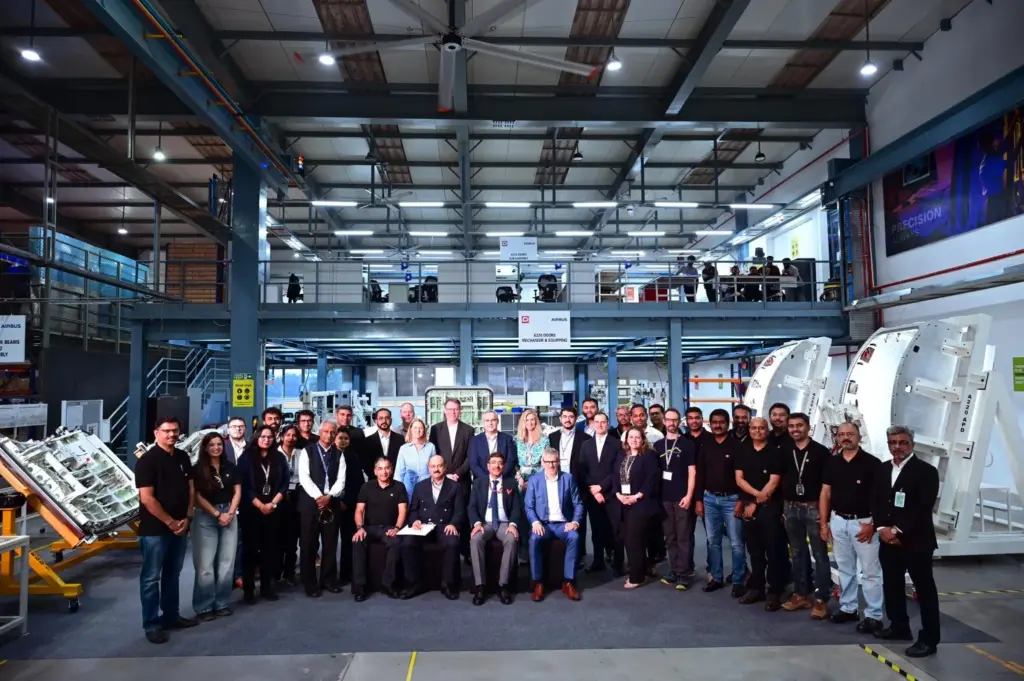
According to Dynamatic’s January 13, 2026 company release, the handover ceremony was held at its Bengaluru facility. Notably, India’s Civil Aviation Secretary Samir Kumar Sinha presided over the event. Additionally, Airbus India and South Asia President and Managing Director Jürgen Westermeier attended. Senior Economic Advisor Piyush Srivastava and Dynamatic Chief Executive Officer (CEO) and Managing Director (MD) Dr. Udayant Malhoutra were also present.
Moreover, the announcement included an unusually clear timetable signal. India’s Civil Aviation Secretary, Samir Kumar Sinha, framed the moment as a schedule win: “Today marks the delivery of the first complete ship-set of all eight doors for the Airbus A220 aircraft, completed ahead of schedule” — Samir Kumar Sinha, Civil Aviation Secretary, (Dynamatic Technologies)
Additionally, Dynamatic’s Chief Executive Officer and Managing Director, Dr. Udayant Malhoutra, emphasized localization depth: “We have achieved over 99% indigenous value-added content for these for these high-technology aerostructures…” — Dr. Udayant Malhoutra, CEO (Dynamatic Technologies)
In that same company release, Malhoutra said Dynamatic had “successfully industrialised all door variants” for the A220 in India. “This delivery firmly positions India as a vital hub in Airbus’ global supply chain.” — Dr. Udayant Malhoutra, CEO & Managing Director, Dynamatic Technologies
A220 supply chain: why Airbus wanted a second door source
This milestone did not happen in a vacuum. 2 years ago, on February 8, 2024, Airbus awarded Dynamatic Technologies an A220 doors contract in Bengaluru, India.
“The contract will support the ramp-up of the A220 programme by creating additional capacity to the currently existing source.” — Airbus, press statement
Overall, the Airbus A220 ramp-up depends on suppliers delivering complete door shipsets on schedule.
However, Airbus did not name that incumbent source in the same release. So, the phrase begs a follow-up: who has been building A220 doors?
Airbus A220 ramp-up: China’s A220 door baseline
Shenyang Aircraft Corporation (SAC) of China has long supported A220 aerostructures work in China. SAC is part of the Aviation Industry Corporation of China (AVIC). In July 2021, AirInsight reported SAC produces A220 doors and hatches, alongside key fuselage structures (AirInsight, 2021). Separately, Xinhua News Media described AVIC SAC Commercial Aircraft as the primary supplier of A220 fuselage sections and cabin doors (Xinhua, 2024).
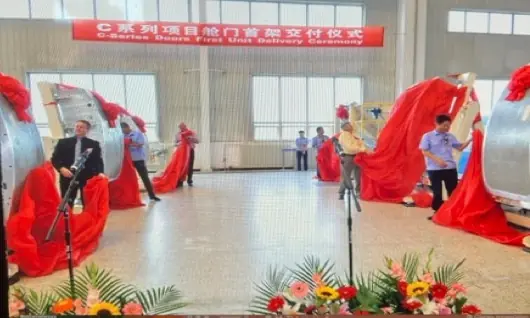
Additionally, Airbus said Dynamatic will manufacture cargo, passenger, and service doors, plus over-wing emergency exit doors—eight doors per aircraft. Consequently, “doors” is not a single part number. It’s a family of certified structures, seals, and latching systems. Moreover, Airbus called it its second doors contract with an Indian supplier in under a year.
Meanwhile, Dynamatic already builds the A220 cockpit escape hatch door. That means Airbus is scaling door capacity with a supplier that already knows the type. In production, a missing door can delay a fuselage as quickly as a missing engine.
A220 production ramp: what Reuters signals
Separately, Reuters reported Airbus India President Rémi Maillard said the award to Dynamatic was Airbus’s biggest doors contract so far (Reuters, 2024). Does this signal Airbus is reducing reliance on the existing China-based door source, or simply adding redundancy to de-risk ramp-up?
Finally, Reuters reported Dynamatic Chief Executive Officer (CEO) Udayant Malhoutra expected first door deliveries early next year (Reuters, 2024). From February 8, 2024, that timeline points to early 2025 with the delivery of the first complete ship-set of all eight doors confirmed on January 13, 2026.
This is the first time I’m sharing this on Fliegerfaust
I’m working on a book about the history of the A220/CSeries. Want the longer backstory on A220 doors and supply-chain oversight across China and India? Skip to the draft excerpt at the end of this post: Addressing Supply Chain Issues — China and India.
I’d love your feedback—leave a comment at the bottom of this page or on the Fliegerfaust Facebook page. I also have a section dedicated to the A220/CSeries and China—should I publish more of it on Fliegerfaust?
Wings, pylons, and missing parts: what else is in play
Of course, doors are only one subsystem in a sprawling supply chain. Reuters reported on October 27, 2025 that Airbus had previously intervened to speed A220 wing supply by airlifting parts from Belfast, Northern Ireland (Reuters, 2025). Airlifting aerostructures is not a normal rhythm. Instead, it’s what manufacturers do when “just in time” becomes “just in trouble.”
In the Airbus A220 ramp-up, the A220’s industrial map includes Spirit AeroSystems work packages that Airbus has been trying to stabilize. Spirit itself announced on April 28, 2025 that it had signed a divestiture agreement with Airbus to transfer assets and sites tied to Airbus aerostructures, explicitly listing A220 wings in Belfast and A220 pylons in Wichita among the affected work (Spirit AeroSystems, 2025). That is not a minor adjustment. It’s a sign Airbus wants more direct control over bottleneck structures.
Notably, Skies reported Airbus pointed to its acquisition of “key processes and employees” from Spirit AeroSystems as part of an effort to shore up production lines and reduce missing parts (Skies, 2026). That comment is not A220-only, but it lands hardest on programmes that are still climbing their ramp curve.
From Canadian perspective, the industrial geography also reinforces why the Airbus A220 Mirabel, Quebec line matters. When a programme is still digesting supply-chain churn, the best-performing final assembly line becomes an operational anchor, not just a political symbol. For a deeper look at how engine disruptions have already pushed some operators toward fleet exits, see on Fliegerfaust: Air Austral’s A220 fleet exit and the GTF squeeze.
What this means for airlines and competitors: a small narrowbody market heats up
A220 delivery growth: confidence signals for fleet planners
Airlines buy aircraft for decades, but they judge programmes on months. Therefore, a record year of deliveries, a public production-rate “stabilize first” message, and supplier milestones like door shipsets all feed the same question: can Airbus deliver predictably?
Moreover, the answer matters even to airlines that have not ordered the A220 yet. Lessors watch delivery reliability because it affects remarketing risk. Network planners watch reliability because it affects route launches. Regulators and airports watch it because the A220’s footprint and noise profile influence slot and community dynamics.
Meanwhile, Airbus’s broader order book supports a positive baseline. Airbus said on January 12, 2026 that its backlog reached 8,754 aircraft at year-end 2025 (Airbus, 2026). That backlog is not an A220-only story. Still, it speaks to airline confidence in Airbus’s product line, which tends to spill over into smaller programmes (A220) when the performance case is strong.
Competing in the 120–160 seat segment: LOT, Embraer, and economics
Competition in this segment is not theoretical. On June 16, 2025, Reuters reported Poland’s LOT ordered 40 A220s with options for 44 more, following a contest with Embraer (Reuters, 2025). That deal is a case study in how tight the decision margins can be in the small narrowbody category.
Notably, LOT’s CEO boiled it down with refreshing bluntness: “I only do numbers” — Michal Fijol, CEO, Reuters
Additionally, analysts quoted by Reuters framed the LOT order as meaningful for A220 economics and programme health, saying it put the A220 “further on the path towards breakeven” (Reuters, 2025). That matters because Airbus has long needed higher volume to drive down unit costs on a programme that shares fewer components with other Airbus families.
However, the high-density A220-300 introduces a new competitive dimension. If Airbus can certify and deliver a 160-seat configuration, it can push the A220 deeper into missions that airlines might otherwise assign to larger narrowbodies. Consequently, rivals will likely respond with their own economic narratives and cabin improvements, because this category has become one of the most contested slices of the market.
Regional A220 strategy: Asia-Pacific, AirAsia, and “watch this space”
The regional marketing push also points toward growth regions where fleet renewal is accelerating. On May 19, 2025, Reuters reported Airbus was in talks with Malaysian airlines about potential A220 orders, quoting Airbus Asia-Pacific President Anand Stanley saying, “We see a lot of potential demand coming from Malaysia,” (Reuters, 2025). Malaysia is a useful example because it combines short domestic sectors, regional international routes, and strong low-cost competition.

Meanwhile, Airbus has also kept the door open to large-scale A220 orders elsewhere in Asia. In its January 12, 2026 reporting, Reuters noted industry sources said Airbus renewed efforts to close a deal with AirAsia for around 100 A220s, and Scherer responded with: “watch this space” (Reuters, 2026). That is not a contract. Still, it is a signal that Airbus sees the A220’s addressable market expanding beyond its legacy strongholds.
On the other hand, New Straits Times reported a bigger figure on December 5, 2025. It said AirAsia expects to decide in 2026 on buying 150 new jets.
Additionally, it described ongoing talks with Airbus, Embraer, and Commercial Aircraft Corporation of China (COMAC). Notably, it named the Airbus A220, Embraer’s E-Jet family, and COMAC’s C919. Consequently, Reuters’s “around 100 A220s” may be only one piece of a larger order.
If you want the long-game version of that debate, including stretch economics, powerplant and a new wing questions, Fliegerfaust’s earlier analysis is here: A220-500 stretch prospects and engine choices.
Conclusion: momentum is real, but execution will decide the programme’s next decade
Overall, the evidence from January 2026 points in a clear direction. Airbus is aligning three levers at once: messaging that makes the A220 feel tailor-made for regional carriers with medium-haul ambition, product updates that lift cabin competitiveness and unlock a true high-density A220-300, and industrial moves that add door capacity while trying to stabilize other bottlenecks.
However, optimism should not be confused with inevitability. Airbus can sell a compelling story, and the market can demand efficient aircraft, but the programme still lives or dies on delivery reliability. Moreover, the engine situation remains the most stubborn variable, because it ties the A220’s cadence to shop capacity, materials realities, and supplier ramp discipline.
My critical take is this: Airbus is doing the right things, but it may be underestimating how long “stabilize at 12 per month” can last when engines and aerostructures both compete for industrial attention across multiple programmes. If the A220’s next phase is truly about scale, will Airbus treat the A220 like a strategic pillar—or will it put the A220 in the waiting room—praised for its potential, but postponed behind other priorities?
Leave your answers and comments below and on our Fliegerfaust Facebook page.
Sources
- Leeham News — Airbus adds emphasis for A220 to regional airlines; adding high-density version (January 6, 2026).
- Skies — Airbus A220 deliveries continue to grow despite industry headwinds (January 13, 2026).
- Airbus — Airbus reports 793 commercial aircraft deliveries in 2025 (January 12, 2026).
- Reuters — Airbus keeps No.1 planemaker spot but raises new concern on engine supplies (January 12, 2026).
- Airbus — A220-300 aircraft overview and specifications (accessed January 18, 2026).
- FlightGlobal — Airbus prepares to start certification work on 160-seat A220 (June 12, 2025).
- Airbus — Airbus launches the A220 Airspace cabin with Air Canada (April 8, 2025).
- Air Canada — Air Canada to Offer Customers Increased Overhead Storage Room with New Airspace Cabin on Airbus A220 Fleet (April 8, 2025).
- Dynamatic Technologies — Dynamatic Technologies sets new benchmark for ‘MAKE IN INDIA’: Delivers complete set of Airbus A220 doors in record time (January 13, 2026)
- ETManufacturing — Dynamatic Technologies delivers first complete ship-set of Airbus A220 doors (January 13, 2026).
- Airbus — Airbus awards landmark aerospace order for A220 aircraft doors to Bengaluru-based Dynamatic Technologies (February 8, 2024).
- Reuters — Dynamatic Tech to make all Airbus A220 door variants in India, shares hit record high (February 8, 2024).
- Reuters — Airbus delays some A220 output, narrowing window to reach 2026 target (October 27, 2025).
- Spirit AeroSystems — Spirit AeroSystems Signs Divestiture Agreement with Airbus (April 28, 2025).
- EASA — Airworthiness Directive documentation (powdered metal anomaly reference) (December 28, 2023 / published via EASA tool).
- Aviation Week — Pratt & Whitney Plans To Clear PW1500G Grounding Issues By Late 2026 (November 16, 2025).
- Reuters — Poland’s LOT orders 40 Airbus A220 planes (June 16, 2025).
- Reuters — Airbus in talks with Malaysian airlines for its A220 planes (May 19, 2025).
- New Straits Times (NST) — AirAsia to finalise 150 new jet deal in 2026, still in talks with three OEMs (December 5, 2025).
Addressing Supply Chain Issues – and China, India
Ongoing global supply chain issues have presented significant challenges, leading to delays in various programs across the aerospace industry, including those of major manufacturers like Boeing and Airbus, as well as the A220 program.
Responding to this, Airbus undertook initiatives to foster quality and punctuality in deliveries through renegotiated supplier agreements, aiming to build a more robust and competitive supply chain.
Bombardier’s initial collaboration with Shenyang Aircraft Corporation (SAC) in China saw a pronounced on-site presence, with up to 52 team members stationed at SAC as of 2018. This heavy presence was deemed essential for closely monitoring, guiding, and ensuring the quality and timeliness of SAC’s work.
The handover to Airbus brought with it new managerial philosophies and expectations. Initially, Airbus envisaged a leaner on-site approach, with their representatives expressing a desire to have no more than 10 personnel stationed at SAC, emphasizing the principle that suppliers should manage their work independently.
However, by February 2023, the situation evolved quite differently. There were as many as 59 Airbus team members making up the Airbus ‘Plateau’ multi-function on-site team at SAC.
This increase underscores a recognition by Airbus of the challenges Bombardier faced and the realization that intensive oversight was crucial for SAC’s efficiency and quality control. This on-the-ground presence highlighted a shared understanding between the two aviation giants: while SAC has great potential as a partner, realizing that potential requires direct, hands-on management.
Navigating Towards Enhanced Production: Airbus’ Strategic Move
In anticipation of ramping production rates, Airbus astutely negotiated modifications to its contract with SAC.
A fundamental change was removing the exclusivity clause, a strategic maneuver that significantly broadened Airbus’ manufacturing capabilities for the A220. This pivotal amendment to the contract allowed Airbus to establish additional manufacturing sites for components previously exclusive to SAC’s production.
The decision to remove the exclusivity provision was not just a logistical adjustment but a strategic foresight into the growing demands of the A220 program. By opening the doors to additional production locations, Airbus aimed to ensure a steady and more diversified supply chain, which is critical for meeting the increasing production needs of its assembly lines in Canada and the United States.
In a move that underscores Airbus’s strategic foresight and commitment to the A220 program, the aerospace giant recently announced a landmark agreement that further materializes the vision behind removing the exclusivity provision with SAC. On 8 February 2024, Airbus awarded a substantial contract for the manufacturing and assembly of A220 aircraft doors to Bengaluru-based Dynamatic Technologies. This decision reaffirms Airbus’s dedication to diversifying its supply chain and aligns with the Government of India’s ‘Make in India’ initiative, showcasing a deepening of Airbus’s industrial footprint in strategic global markets.
The contract with Dynamatic Technologies marks a significant milestone, as it is among the largest aerospace export contracts awarded to an Indian company. Under this agreement, Dynamatic will produce cargo, passenger, service, and over-wing emergency exit doors for the A220 family aircraft. This expansion into India not only bolsters the A220’s production capabilities but also creates a more resilient and versatile supply chain framework, ensuring Airbus can meet the escalating demand for the A220 across its global assembly lines more efficiently.
Furthermore, this strategic partnership hints at future directions for Airbus’s supply chain diversification efforts.
With the fuselage components of the A220 currently produced in China, the new contract with Dynamatic Technologies opens the possibility of extending the manufacturing of other critical components, including parts of the fuselage, to India. Such a move would support the anticipated increase in production rates of the A220 and provide a strategic hedge against geopolitical risks and supply chain disruptions, ensuring a continuous and secure supply of parts necessary for the A220’s assembly.
Airbus’s decision to engage more deeply with Indian manufacturing capabilities signifies a significant step towards achieving a global supply chain that is more diversified and more resilient. By leveraging India’s growing aerospace manufacturing ecosystem, Airbus is positioning the A220 program for sustained growth, operational stability, and competitive advantage in the global aerospace market. This strategic pivot reflects Airbus’s agile approach to global manufacturing partnerships, ensuring the A220’s long-term success and reinforcing its commitment to innovation, collaboration, and excellence in the aerospace sector.
Airbus’s moves clearly indicated its commitment to the A220 program’s growth and sustainability. It demonstrated the company’s proactive approach to overcoming production bottlenecks and ensuring the smooth flow of parts essential for aircraft assembly. The ability to set up new manufacturing sites for critical components marked a significant step in Airbus’ strategy, ensuring that the increased production targets were met efficiently and effectively, thereby bolstering the global presence of the A220.
Airbus’s Design-to-Cost Initiative
Beyond just personnel management, Airbus has been… (Read the full section in my upcoming book on the complete A220/CSeries story.)
Excerpt notice & disclaimer: Advance excerpt from my forthcoming A220/CSeries book. © Sylvain Faust, 2026. All rights reserved; no reproduction beyond brief quotations. Provided for informational/entertainment purposes and reflects my views; verify critical details independently. Any use of brief quotations from this excerpt must include attribution with a link back to this webpage as the original source.
For full details, please refer to our Disclaimer page.

I couldn’t get access to the draft excerpt for some reason. But anyway I don’t like reading books online. It’s painful for me to read on a screen and I much prefer to read a real book made out of paper and that I can hold in my hands. That way I can sniff the ink and get a high even before I start reading. Please send your book to the printer as soon as it’s finished and your’e happy with the end result. Perhaps Amazon could help you with this endeavour.