
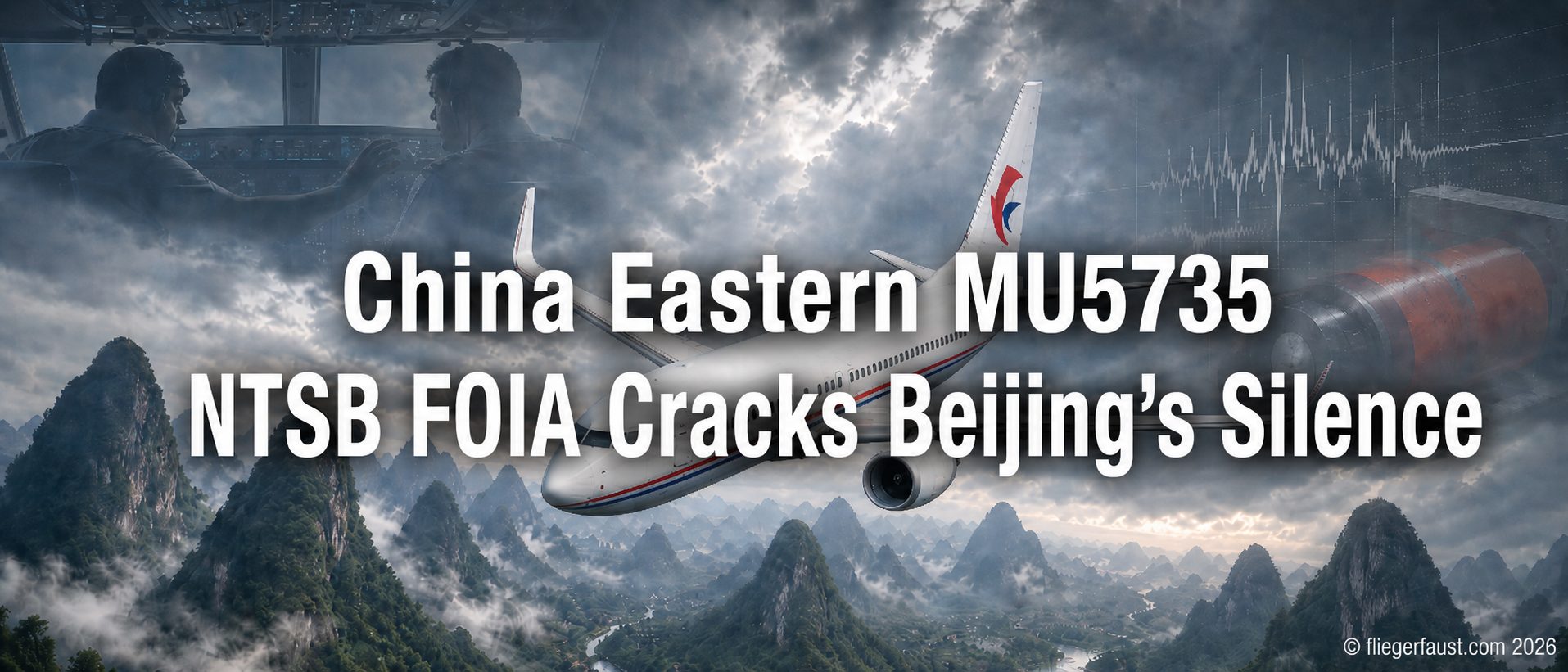
China Eastern MU5735: did two pilots really fight for control of a Boeing 737-800 before it speared into a Guangxi mountainside?
China Eastern MU5735: On April 29, 2026, the United States National Transportation Safety Board (NTSB) released a Freedom of Information Act (FOIA) package that revives the question with hard data. The documents arrive more than four years after the Civil Aviation Administration of China (CAAC) sealed itself around a crash that killed 123 passengers and nine crew. Families, regulators, and aviation safety experts now confront a sequence Beijing has refused to explain. The FOIA file does not deliver a final cause. However, it makes the silence from China far harder to defend.
China Eastern MU5735: How the FOIA File Cracked Beijing’s Silence
The leak was not really a leak. A Chinese citizen used an American transparency law that has no Chinese equivalent. In January 2026, the anonymous requester filed a FOIA application with the NTSB, asking for any final report or technical summary tied to the crash. On April 29, 2026, the agency replied with a 33-page Cockpit Voice and Flight Data Recorder Combined Download Report. The package was filed under investigation number DCA22WA102. The NTSB waived all fees. The Safety Board’s response letter said it had located 2,818 responsive pages and released 1,959 pages, two Excel spreadsheets, and three FDR files, withholding other material under Freedom of Information exemptions covering proprietary data, deliberative material, and privacy-protected information.
The document carries the signature of NTSB mechanical engineer Charles Cates and a July 1, 2022 date. That is almost four years before the public ever saw it. Within hours of the release, the requester uploaded the package to GitHub, Wikimedia Commons, Weibo, Zhihu, and Xiaohongshu. (CNN, 2026) treated the disclosure as the first hard public evidence supporting deliberate-action theories. Chinese platform censors began removing the posts within roughly 24 hours.
Flight MU5735 FOIA: Why Washington Could Open the File
The mismatch is structural. U.S. FOIA rules default to release with narrow exemptions. China’s open-government regulations, by contrast, permit “national security” and “social stability” carve-outs that the CAAC has invoked here. The same set of facts produced opposite outcomes under two legal regimes. In a small but biting irony, the most authoritative public account of a Chinese aircraft accident now lives in an American filing cabinet. The NTSB’s reply letter weighed the FOIA “foreseeable harm” standard before release.
Inside the Combined Download Report
Aviation engineers call recorder studies “combined download reports” because they unite Flight Data Recorder (FDR) and Cockpit Voice Recorder (CVR) tear-downs in one file. This one runs 33 pages. A four-engineer NTSB team led by Charles Cates and joined by six CAAC personnel prepared it.
The headline finding is short and harsh. While cruising at 29,000 feet, both engines’ fuel control switches moved together from “run” to “cutoff” within roughly one second. (AeroTime, 2026) reported that engine speeds began decaying immediately. The autopilot disengaged at essentially the same moment. About three seconds later, one yoke was, in NTSB language, “violently” pushed forward. The China Eastern MU5735 jet then entered an inverted barrel roll and a steep dive. (see the video above via a tweet on X)
Flight MU5735 Recorder Integrity and the Missing Minute
The FDR survived but did not finish the story. Approximately 23 seconds after the cutoff, near 26,000 feet, the recorder lost generator power and stopped writing. The Honeywell HFR5-D unit has no battery backup. The CVR, by contrast, is battery-powered and kept running through impact. Of six FDR FLASH memory chips, five were readable; one had its silicon shattered. The reconstructed dataset is roughly 83 percent complete.
The CVR story is more delicate. After three download attempts, NTSB engineers diagnosed broken chip address lines and bent connector pins. They rebuilt the connector with Kapton tape and recovered all four channels at “excellent” quality. The audio files were handed to the CAAC, and the NTSB explicitly retained no copies. The only recording of the final minute now sits in Beijing — and only Beijing decides whether anyone hears it. As cover-ups go, that is what aviators might call a single point of failure.
China Eastern MU5735 Flight Profile and the 23-Second Window
China Eastern MU5735 took off from Kunming Changshui International Airport (KMG) at about 13:16 China Standard Time on March 21, 2022. The Boeing 737-800, registration B-1791, climbed to roughly 29,100 feet by 13:27. The aircraft was a 737-89P, manufacturer’s serial 41474, delivered new on June 25, 2015. It was about seven years old at the time of the accident.
The cruise was uneventful for nearly an hour. At 14:20 local time, the rapid descent began. (Wikipedia, 2026) compiles the Flightradar24 reconstruction: dive to about 7,425 feet, brief pull-up to roughly 8,600 feet, then a second plunge. The final Automatic Dependent Surveillance-Broadcast (ADS-B) message arrived at 14:22:35 China Standard Time at about 3,225 feet. Impact followed seconds later at high speed in Tengxian County, Wuzhou, Guangxi.
Flight MU5735: One Yoke Forward, Ailerons Fighting Back
The FDR captured a 23-second window of crisis between fuel cutoff and power loss. Within that window, control inputs tell two different stories. One yoke was pushed forward into the dive. Aileron oscillations during the descent suggested an active recovery attempt. (Bangladesh Monitor, 2026) summarised the read-out: “at least one individual was actively attempting to recover the aircraft.” The fuel switches were never returned to “run.” No engine restart was attempted during the descent. In simple terms, the aircraft was told to stop flying and was not told to start again.
For accident-investigation context that uses similar recorder analysis, see the Fliegerfaust analysis of the Naples Bombardier Challenger 604 NTSB docket.
Three Pilots, One Closed Cockpit Voice Recorder
The flight deck on China Eastern MU5735 carried three pilots, which is unusual but legal during training rotations. Captain Yang Hongda, 32, had 6,709 total flight hours and had held a Boeing 737 captain rating since January 2018. Chinese press described him as a low-key “second-generation pilot” with a young child. First Officer Zhang Zhengping, 59, brought 31,769 flight hours and the civil aviation industry’s “Meritorious Pilot” honour from 2011. Second Officer Ni Gongtao, 27, was on board to fulfil 556 hours of training time.
The Demotion Question That Will Not Go Away
Speculation in 2022, and again in 2026, has centred on Zhang. The senior pilot had spent 40 years in airline cockpits and had served as a CAAC-designated check airman. Chinese aviation observers — including U.S.-based commentator Gao Fei — told (The Epoch Times, 2022) that Zhang had been demoted from captain rank before the flight. That move would have roughly halved his salary. Several accounts link the change to alleged simulator-check failures. The CAAC has neither confirmed nor invalidated any of those claims.
The FDR alone cannot say which pilot acted. The CVR, by contrast, captured every shout, breath, and instruction in those final seconds. (View From the Wing, 2026) emphasises that the audio is the only artefact that can attribute actions to specific people. The only copy is held by the CAAC, which has not released so much as a partial transcript. Identity, motive, and last words remain locked behind a national-security label. There is, perhaps, a useful test for any modern accident regime: if the audio could clear the airline, would it not already be public?
China Eastern MU5735 and CAAC’s Disclosure Record
The CAAC’s first public statement came on April 20, 2022. The preliminary report cleared airworthiness, crew licensing, rest, weather, and air traffic control communications, but offered no cause. Anniversary updates followed in March 2023 and March 2024 with similar wording: nothing wrong with the aircraft, crew, or weather, but cause “still under investigation.” Then the silence began.
MU5735 Crash: Two Anniversaries Missed in a Row
In March 2025, the CAAC issued no anniversary update at all. (U.S. News & World Report, 2025) recorded the lapse and noted Chinese social media frustration. International Civil Aviation Organization (ICAO) Annex 13 requires a final report within three years or, failing that, an annual progress note. The missed 2025 update placed the CAAC outside its own ICAO commitments. March 2026 came, and the agency again said nothing. China Eastern MU5735 now represents two consecutive years of CAAC non-compliance.
The May 19, 2025 letter is the most damning piece in the file. When a Chinese citizen filed an open-government information request, the CAAC denied disclosure on grounds that release “may, if released, endanger national security and social stability.” No equivalent provision exists in international aviation accident investigation. ICAO’s framework treats accident causes as public goods. The CAAC has not retracted the denial.
Censorship, Citizen Action and the GitHub Trail
Within roughly a day of the FOIA documents reaching Chinese platforms, posts referencing them began to disappear. Weibo, Zhihu, and Xiaohongshu took the lead. The original GitHub repository, “wrongly-cuddly-obsession/NTSB_FOIA_MU5735,” was eventually pulled by its owner. Mirrors and Wikimedia Commons copies remain online. Wikipedia’s English-language article was updated within hours to incorporate the new evidence.
A Chinese Citizen With a Printer and a Question
The story is, in part, a story of one anonymous person and a fee waiver. They paid nothing, walked the documents into the public square, then watched Chinese platform algorithms erase the files in their home country. (Factually, 2026) verified the GitHub upload chain and the FOIA letter authenticity. Families of the 132 victims have spent four years receiving compensation but no explanation. The internet, however, does not forget as quickly as a censor would like.
Industry Reaction and the ICAO Compliance Question
CNN aviation safety analyst David Soucie did not mince words. “This data clearly shows that the fuel switches were manually placed in the off position just prior to the crash.” — David Soucie, Aviation Safety Analyst, CNN. He added that the absence of any restart attempt indicates the cutoff was not accidental.
Caution From the Technical Bench
Independent analysts urged restraint nonetheless. “The released material does not by itself prove motive, intent, or who moved the switches.” — Tony Stanton, Strategic Air, via CNN. Stanton called the sequence “much more consistent with (human) commanded fuel shutoff” than with a dual-engine mechanical failure. International Air Transport Association (IATA) officials have pressed ICAO to confront late or missing accident reports. IATA’s 2025 Safety Report said only 63 per cent of accident reports from investigations conducted between 2019 and 2023 were completed in line with state obligations. (JDA Solutions, 2024) summarised the IATA argument that timely public reports form the floor of global aviation safety. ICAO’s enforcement tools, meanwhile, remain slim — chiefly diplomatic pressure rather than penalties.
For wider context on Boeing’s narrowbody pressures, see the Fliegerfaust report on the Airbus vs Boeing single-aisle delivery turning point. It frames the 737 family’s commercial position even as crash-investigation politics complicate Boeing’s external narrative.
China Eastern MU5735 in the Murder-Suicide Comparison Set
If a deliberate-action conclusion is ultimately confirmed, China Eastern MU5735 joins a small but troubling list. Germanwings Flight 9525 in March 2015 killed 150 people in the French Alps, when First Officer Andreas Lubitz locked the captain out and flew the Airbus A320 into a mountain. EgyptAir Flight 990 in 1999 was attributed by the NTSB to a relief first officer’s actions, though Egyptian authorities never accepted that finding. SilkAir Flight 185 in 1997 produced opposing U.S. and Indonesian conclusions. LAM Mozambique Flight 470 in 2013 ended with a captain who had locked his colleague out.
MU5735 Crash and the 737-800’s Broader Safety Record
The Boeing 737-800 is not a Boeing 737 MAX, and the aircraft on China Eastern MU5735 carried no Manoeuvring Characteristics Augmentation System (MCAS) software. (Wikipedia, 2026) places the 737-800’s record at 11 previous fatal accidents across more than 7,000 planes delivered since 1997. The variant’s safety statistics remain strong in absolute terms. Today’s concern is human, not mechanical. The aircraft did exactly what it was told. That is the unsettling part.
For commercial-environment context around the 737 line, see the Fliegerfaust feature on the jet delivery crunch facing Airbus and Boeing in 2026. Boeing’s narrowbody story now travels alongside an investigation it cannot directly resolve.
What the FOIA Materials Do Not Prove
A short caution belongs in any honest treatment of this story. The NTSB Combined Download Report is not a final accident report. It documents what was retrieved from the recorders, not why people did what they did. (South China Morning Post, 2026) reiterates that Annex 13 makes the CAAC the responsible authority for cause and public reporting.
Some 2022 reporting that named pilots and characterised demotion details rests on second-hand sources rather than CAAC disclosures. Prudence demands that interpretive readings — such as descriptions of two pilots “wrestling” for control — be tagged as inference, not finding. The data does not show whether any apparent control conflict reflected intervention, confusion, incapacitation, or another cockpit dynamic. The documented sequence remains exceptionally hard to reconcile with mechanical failure alone. The honest answer is: very probably, but the audio decides.
Conclusion: China Eastern MU5735 and the Cost of a Closed File
China Eastern MU5735 has now spent more than four years as a closed door. The FOIA disclosure has moved that door open by 23 seconds — the length of validated FDR data. The CVR remains in Beijing, and the public still does not know which pilot acted, why, or against whose objection. That silence is no longer abstract. It includes families without an explanation, regulators without precedent, insurers without a settled cause, and a Chinese aviation authority that increasingly looks isolated against ICAO Annex 13 norms.
A critical reading is unavoidable here. An aviation safety system depends on shared facts and timely reports. This case has produced a four-year vacuum filled by leaks, denials, and now a citizen-driven FOIA. The disclosure does not exonerate Beijing; it exposes the gap between what a regulator possesses and what its public is permitted to see. Even so, the world’s aviation community remains, for once, on the same page about what is missing. The question is not whether the truth about China Eastern MU5735 exists. It is whether the CAAC has finally run out of room to keep that truth from the families of the 132 dead — and from anyone who flies.
Tell us what you think, leave your comments at the bottom of this page
What does it say about modern aviation accountability when the most credible public document on China’s deadliest crash in decades is signed in Washington and refused in Beijing?
Leave your answers and comments below and on our Fliegerfaust Facebook page.
Sources
- CNN — Flight data bolsters claim China Eastern plane was deliberately crashed in 2022 (May 4, 2026).
- AeroTime — NTSB data points to deliberate act in China Eastern crash (May 3, 2026).
- Wikipedia — China Eastern Airlines Flight 5735 (Updated May 2026).
- Bangladesh Monitor — NTSB data reveals crucial details of China Eastern 5735 crash (May 2026).
- View From the Wing — Pilots Shut Off Both Engines Before China Eastern 737 Crash — China Cites “National Security” To Withhold Report (May 2026).
- The Epoch Times — Pilot’s Mental State a Potential Cause of Crash of China’s Eastern Airlines Flight MU5735, Expert Says (2022).
- U.S. News & World Report — Three Years After China Eastern Plane Crash, Regulator Has Not Released Report (March 22, 2025).
- Factually — What Did the NTSB FOIA Release Reveal About MU5735? (May 2026).
- JDA Solutions — ICAO’s Accident Report Compliance? IATA says not GOOD! (2024).
- South China Morning Post — Fatal 2022 China Eastern Airlines plane crash points to deliberate fuel cut-off (May 5, 2026).
For full details, please refer to our Disclaimer page.