

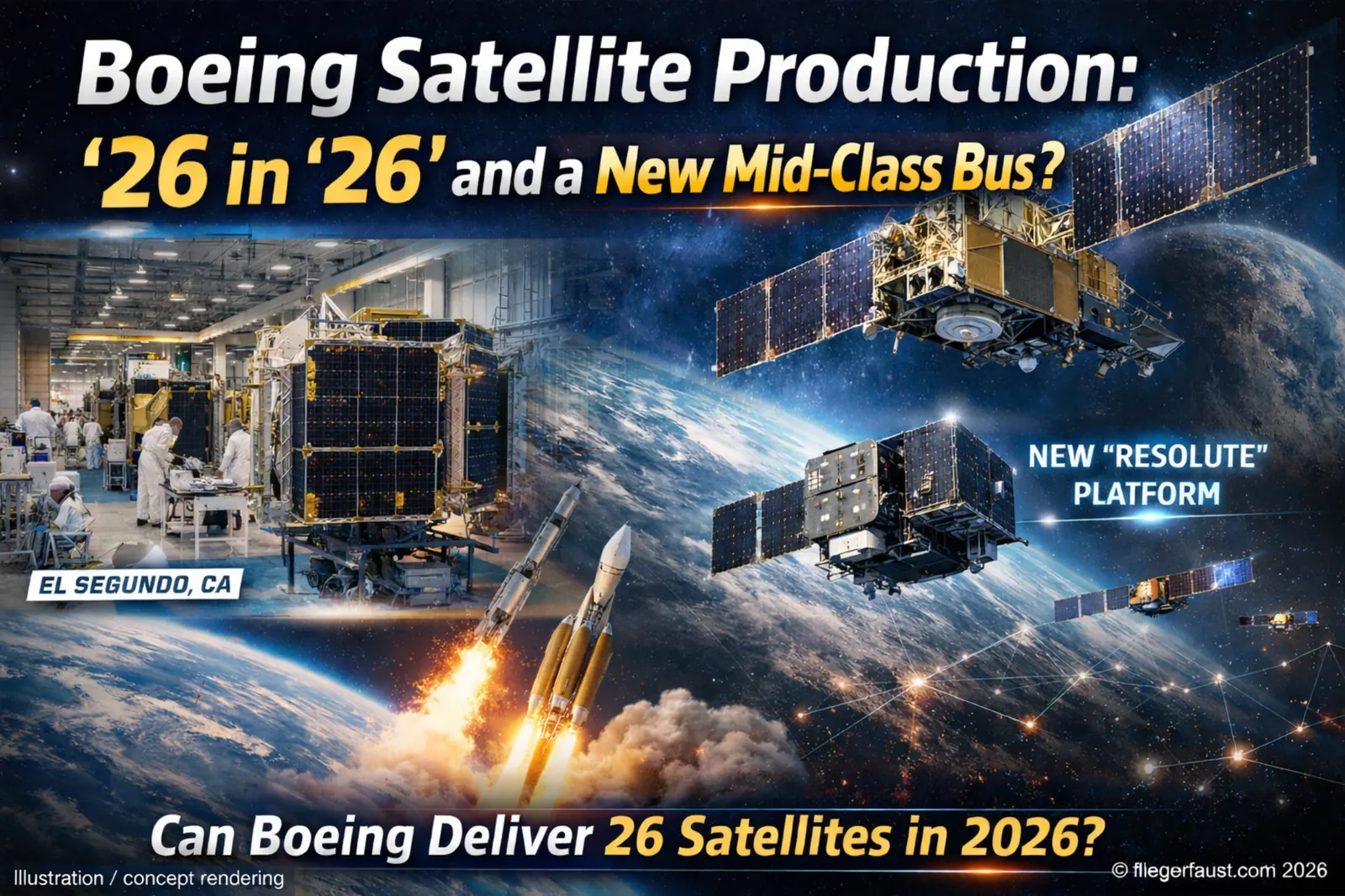
Boeing satellite production: can a company known for larger, bespoke spacecraft really jump to 26 deliveries in 2026 while unveiling a new mid-class bus?
Boeing satellite production: On April 15 and April 16, 2026, Boeing and Millennium Space Systems said yes. They paired a scale-up plan at El Segundo, California, with the debut of Resolute, a platform aimed between small satellites and slower, larger programmes. Moreover, the claim matters because the market now wants more than elegant one-offs. Instead, it wants resilient constellations, faster handovers and hardware that can move from design to orbit without turning every schedule into a Greek tragedy.
Boeing satellite production moves from statement to factory floor
Boeing space manufacturing began scaling before the April launch
This story did not originate with Boeing at the annual Space Symposium in Colorado Springs. On February 20, 2026, Boeing’s report on its new electro-optical/infrared (EO/IR) line said the company had opened a 9,000-square-foot production area at El Segundo in California. Additionally, the line supports higher-rate payload work. Moreover, Boeing said the line is sized to support 12 Resilient Missile Warning and Tracking medium Earth orbit (MEO) vehicles for the U.S. Space Force in 2027.
Boeing’s 2026 delivery goal and the 2025 baseline
Boeing used that February update to make a public production promise before the April reveal. Specifically, the company said its Space Mission Systems team aims for “26 in ’26,” meaning 26 satellite deliveries in 2026. Boeing framed that goal against its highest output since acquiring Hughes Space and Communications in 2000. However, the 2025 denominator needs to be clear early: Boeing’s January 13, 2026 investor deliveries release lists 4 “Commercial and Civil Satellites,” while Reuters reported on April 16, 2026 in its coverage of the Resolute announcement that Boeing delivered 11 satellites in 2025 after correcting its initial figure.
Boeing’s own December 17, 2025 year-end feature also said 2025 was its strongest satellite-delivery year since 2000 and described deliveries for undisclosed defence customers plus several satellites for an undisclosed national-security customer, making clear that the gap between Boeing’s four commercial-and-civil satellites in the investor release and the broader 11-satellite 2025 total came from deliveries outside the commercial-and-civil category. “Last year, we proved we can deliver at pace …” — Sam Greaves, interim vice president of Space Mission Systems, Boeing
The April 15 Boeing feature on the new production push tied that factory work to a wider portfolio strategy. Boeing said the ramp rests on common products, repeatable manufacturing and tighter integration across Boeing and Millennium. In Boeing’s framing, this is not only a bus launch. It is also an attempt to make space manufacturing more repeatable and less dependent on one-off configurations.
Spacecraft output needs careful counting
That split in Boeing’s public reporting complicates year-on-year comparisons and makes category definitions central to the credibility of the 2026 target.
Notably, that distinction matters for credibility. If Boeing satellite production is going to be sold as a rate story, outsiders need clean categories and consistent baselines. Otherwise, the narrative risks sounding larger than the delivery book. Aerospace investors are patient with complexity. Even so, they are less patient with fuzzy denominators.
The factory changes are concrete
Via Satellite added the industrial detail Boeing’s own feature only sketched. In its April 16, 2026 report, Via Satellite said Millennium expanded its feeder factory for common products from about 15,000 square feet to 22,000 square feet. Moreover, the same report said Millennium now has 100 satellites in backlog. Separately, it also said the company nearly doubled space dedicated to the Space Development Agency’s eight-satellite FOO Fighter fire-control demonstration program.
That matters because backlog makes factory bets rational. Additionally, Boeing satellite production is not resting on one bus launch or one defence award. It is trying to build rhythm for common parts, tooling and assembly flow. “We’re aligning our space business to meet a market that is moving faster and asking for more flexibility.” — Kay Sears, vice president and general manager, Boeing Space, Intelligence & Weapons Systems
Via Satellite also reported that Boeing opened a new EO/IR sensor line in February to support 12 Epoch missile-warning and tracking satellites for the Space Force. Overall, that creates a clearer industrial picture. Bus work, payload work and common-product work are all being expanded at once. In aerospace, “synergy” often means chaos in a nicer tie. Here, at least on paper, it looks more like production logic.
Boeing satellite production adds a mid-market answer
Resolute platform fills Boeing’s missing middle
The most visible part of the April push is Resolute. Boeing said in its April 15 feature that the new platform targets missions needing more capability than a traditional small satellite can provide. Moreover, it also promises more speed and flexibility than a typical large-satellite programme. Reuters repeated that framing on April 16, 2026 in its report on the announcement. Consequently, Resolute is less a random addition than a bridge product.
Via Satellite gave the crucial technical context. Its April 16 report said Resolute sits in the 2-kilowatt to 4-kilowatt range. Specifically, it also said the bus fills what Tony Gingiss, chief executive officer of Millennium Space Systems, called the “donut hole” between Millennium’s 50-watt-to-1-kilowatt satellites and Boeing’s larger buses starting around 4 kilowatts. That matters because power is a practical shorthand for mission class. More power usually means more demanding payloads, more communications capacity or more manoeuvre margin.
Moreover, the new bus is pitched for both defence and commercial work, including communications and sensing. Via Satellite said Gingiss also pointed to sovereign communications and micro-geostationary orbit deployments as a fit. Overall, the metaphor is simple, but useful. Portfolios hate gaps the way launch calendars hate weather.
The satellite production ramp leans on old parts, not new risk
Just as important is what Resolute is not. “It’s new, but it’s a combination of existing capability.” — Kay Sears, Boeing’s vice president and general manager for space, intelligence, and weapon systems, Air & Space Forces Magazine Therefore, that line explains most of the business case. New non-recurring engineering adds delay, qualification work and cost. By contrast, Resolute is being sold as a new market answer built from proven internal hardware.
Additionally, Via Satellite reported that Resolute leverages Millennium’s common products, including flight computers, avionics and power products. Gingiss told the outlet the company believed it could enter the 2-kilowatt to 4-kilowatt range without “new product development from avionics or power subsystems.” That is a serious claim. Schedule credibility in space often collapses when one “small” subsystem becomes a one-off science project.
Meanwhile, Boeing’s April 15 feature said Resolute is built on Millennium common products and flight-proven avionics with on-orbit heritage. Notably, that is exactly the language defence buyers want in a faster acquisition cycle. However, that language will be tested the moment a customer asks for a non-standard payload, a custom thermal solution or a unique propulsion package.
Resolute platform is bid-ready, but not yet battle-proven
Air & Space Forces Magazine added another important detail. On April 16, 2026, the magazine reported that Gingiss said Resolute is approximately at preliminary design review level and will be “bid-ready” this year. He also said Boeing and Millennium are looking for the right launch customer. They already know a few interested parties.
That is promising, but not decisive. A bid-ready platform is still a pre-flight platform. Even so, Boeing is not asking customers to buy into a wholly novel architecture. It is arguing that a carefully chosen middle tier can be assembled from hardware and practices that already exist inside the group.
Overall, that is a more sober strategy than many space-sector unveilings. Yet it still needs a first buyer, a first launch and a first successful mission. Only then does the middle tier become a product line rather than a sensible concept. In orbit, elegant portfolio charts do not earn revenue. Functioning spacecraft do.
Boeing satellite production fits a harder strategic market
Boeing satellite production matches a new Pentagon mood
Meanwhile, the timing of the April announcement is not accidental. At the 41st Space Symposium, U.S. Space Force leaders were openly pressing industry to invest for larger runs. “We no longer have the luxury of time.” — Lt. Gen. Philip Garrant, Space Systems Command, Space Foundation. Overall, that quote came amid a wider call for faster acquisition and simpler satellite design.
Air & Space Forces Magazine sharpened the point. In the same April 16 story that covered Resolute, the magazine reported that the Space Force’s fiscal 2027 budget request includes $19 billion for procurement, up from $3.6 billion in fiscal 2026. It also quoted Garrant with a line the sector will remember. “If a company is nominally making 10, we want you to be prepared to make 40.” — Lt. Gen. Philip Garrant, head of Space Systems Command, Air & Space Forces Magazine
Consequently, Boeing satellite production is entering a market that rewards standardisation, surge capacity and schedule discipline. Therefore, that is precisely why the company keeps emphasising common products and repeatable manufacturing. It is not treating Resolute as a boutique engineering exercise. Space policy used to admire exquisite systems. Now it increasingly admires enough systems.
Missile warning architecture is already taking shape
The military demand picture is not hypothetical. In a Millennium Space Systems release from October 23, 2024, the company said it had won an additional plane of six Missile Track Custody satellites for the Resilient Missile Warning and Tracking Epoch 1 programme. Consequently, that brought the Epoch 1 total to 12 spacecraft.
Moreover, the next block is moving. On March 9, 2026, Space Systems Command said Epoch 2 completed preliminary design review for a 10-satellite MEO constellation with BAE Space & Mission Systems. Notably, that milestone matters because it shows the broader architecture is progressing in parallel. It is not waiting on one contractor or one mission set.
Additionally, the ground segment is also being assembled. On March 19, 2026, Space Systems Command announced a new ground management and integration agreement for Epoch 1 and Epoch 2 launch and operations. Kratos Defense Security Solutions later said in an April 8, 2026 company release on the award that the agreement carries a total potential value of $446.8 million. This is the dull but vital side of resilience.
Spacecraft output matters in contested orbit
For readers tracking the strategic backdrop, see our Fliegerfaust analysis of Chinese space threats and contested orbit. Overall, the broader lesson is that production depth is now part of deterrence. It is not just a back-office metric.
Boeing satellite production lands in a market where factories shape strategy. If the United States and its allies want resilient missile warning and tracking, they need more than exquisite payloads. They also need enough buses, enough sensors and enough ground integration to keep a proliferated architecture alive.
Commercial connectivity is also changing the market
Defence demand is only half the story. Reuters said in its April 14, 2026 satellite-internet market overview that the business has expanded far beyond rural broadband. Additionally, it now reaches aviation, shipping, defence, emergency messaging and direct-to-phone services. Therefore, that breadth matters because it rewards platforms that can be fielded faster and adapted across missions.
Reuters also showed the scale at the top end. In its April 14, 2026 report on Amazon’s Globalstar deal, the agency said Amazon agreed to buy Globalstar for $11.57 billion. Specifically, the deal adds two dozen satellites to an existing network of more than 200. Reuters also said Amazon plans about 3,200 satellites in low Earth orbit by 2029.
These mega-constellation examples are not like-for-like peers for Resolute, but they do show how quickly customer expectations around scale and deployment speed are changing.
SpaceX and Amazon set the commercial tempo
Meanwhile, Reuters reported on April 16, 2026 that Starlink’s low Earth orbit network now counts “close to 10,000 satellites” in its investigation into Pentagon reliance on SpaceX. However, that piece focused on outage risk and military dependence. Even so, it also underscored the new commercial tempo. Scale is no longer a future concept. Overall, it is a live market condition.
Boeing has already been making the case for more flexible capacity. In a March 5, 2026 Boeing feature on the O3b mPOWER medium Earth orbit communications system, Ryan Reid argued that software-defined satellites shift the market from fixed coverage to capacity on demand. “The shift underway is from coverage to capacity on demand.” — Ryan Reid, president, Boeing Satellite Systems, International
Therefore, Boeing satellite production is not just a defence story. It is also a hedge against a connectivity market that now values adaptability, throughput and faster deployment. For a different Boeing execution test in commercial aerospace, see our Fliegerfaust coverage of Boeing’s China order negotiations.
Boeing satellite production still has to earn belief
Boeing space manufacturing brings heritage, but heritage is not rate
Overall, Boeing is not entering this race from scratch. In its April 15 feature, the company said it brings more than 60 years of satellite heritage to the production push. Moreover, Reuters reported on July 3, 2025 that Boeing secured a $2.8 billion U.S. contract to develop and produce two Evolved Strategic Satellite Communications (ESS) satellites, with options for two more, in its coverage of the ESS award. Separately, Reuters also said first delivery is due by 2031.
Additionally, the 2018 Millennium acquisition now looks more strategic than incremental. In Boeing’s September 25, 2018 release on closing the deal, the company said Millennium had about 260 employees. Additionally, Boeing also said Millennium had experience on missions ranging from 50 kilograms (110 lbs) to more than 6,000 kilograms (13228 lbs). Just as important, Boeing said Millennium would keep an independent operating model while gaining access to Boeing’s resources and manufacturing capability.
However, heritage and acquisitions do not equal rate production. Boeing satellite production still has to prove that prime-contractor assurance and faster factory tempo can live inside the same industrial system. That means stable suppliers, disciplined configuration control and a culture strong enough to resist the usual flood of “just one custom change” requests. Space programmes often fail by exception, not by intent.
The baseline question affects confidence
However, the biggest narrative risk is not the bus, but the baseline. Boeing’s investor release counted four commercial and civil satellites in 2025, while the broader 11-satellite total included other missions outside that category, including defence and undisclosed national-security work. Boeing’s broader December 2025 feature said Space Mission Systems had its strongest delivery year since 2000. Via Satellite then reported in April 2026 that Millennium posted double-digit deliveries in 2025 and holds a 100-satellite backlog. All three claims can be true, but only if readers understand they describe different slices of the business.
Therefore, the company needs careful communication as the year progresses. If Boeing satellite production hits 26 deliveries in 2026, observers will ask what exactly was delivered. They will also ask which categories counted and which baseline mattered. That is not pedantry. It is how confidence is built in a segment where one category shift can make a production curve look either heroic or ordinary. In capital markets, romance is tolerated. Denominator drift is not.
Even so, the industrial logic remains persuasive. Overall, the combination of a new EO/IR line, expanded feeder-factory space, a growing defence backlog and a mid-class bus built from common products is more concrete than the average aerospace growth story. In other words, the arithmetic may be debatable, but the factory footprint is not.
Execution will decide whether 26 in ’26 sticks
Finally, the final test is execution under pressure. Boeing and Millennium are trying to align a new product, a supply chain, a defence market and a commercial market at the same time. That can work. It can also produce exactly the bottlenecks Boeing says it wants to avoid.
Moreover, the wider market will not wait politely. Amazon, SpaceX and other operators are pushing connectivity into new sectors. Meanwhile, the U.S. Space Force wants larger production runs and faster delivery cycles. Customers who once accepted bespoke spacecraft and long lead times now want resilient architectures and more options. Consequently, that leaves little room for a mid-class bus to drift into prolonged adolescence.
For another Fliegerfaust case in which Boeing technology and procurement structure collide, see our Fliegerfaust analysis of Canada’s P-8A Poseidon deal. Overall, the recurring question is familiar. Can Boeing translate technical strength into delivery credibility under intense scrutiny?
Conclusion: Boeing has found the right problem, but not yet the verdict
Boeing’s April 2026 space push deserves attention because it identifies a real market shift. Customers want more speed, more resilience and more flexibility between very small satellites and large, slow-burn spacecraft. Overall, Boeing’s answer is sensible. It is expanding common-product manufacturing, widening the portfolio and inserting a mid-class bus where the line-up had an obvious gap.
Moreover, the supporting facts are stronger than the headline alone suggests. Specifically, the 9,000-square-foot EO/IR line is real. Additionally, the Epoch 1 and Epoch 2 missile-warning architecture is advancing. Moreover, the ground segment is being funded. Resolute is being pitched with proven internal subsystems rather than fresh non-recurring engineering. Therefore, that is a serious industrial strategy, not a cosmetic rebrand.
However, credibility in space is earned the hard way. Even so, Boeing satellite production will be judged by what ships, what launches and what works on orbit, not by how elegantly the portfolio now reads. Boeing now has a credible industrial thesis. What 2026 will show is whether that thesis turns into delivered, launched, and working hardware. In this sector, concept art is cheap and schedule credibility is expensive.
What do you think?
If Boeing has finally found the right industrial formula for space, will 2026 prove it in orbit or only promise it on paper?
Leave your answers and comments below and on our Fliegerfaust Facebook page.
Sources
- Boeing — Boeing, Millennium scale production for growing space demand (April 15, 2026).
- Boeing — Boeing expands satellite production to meet rising demand (February 20, 2026).
- Boeing — Boeing Announces Fourth Quarter Deliveries (January 13, 2026).
- Boeing — Boeing satellite deliveries reach 25-year-high (December 17, 2025).
- Boeing — Latest pair of Boeing’s O3b mPOWER satellites enter service (March 5, 2026).
- Boeing — Boeing Completes Acquisition of Millennium Space Systems (September 25, 2018).
- Millennium Space Systems — Millennium Space Systems awarded additional Missile Track Custody plane (October 23, 2024).
- Space Systems Command — U.S. Space Force achieves key design milestone for Resilient Missile Warning and Tracking Epoch 2 MEO Constellation (March 9, 2026).
- Space Systems Command — U.S. Space Force forms a New Ground Management Agreement for MEO MWT Launch and Operations (March 19, 2026).
- Kratos Defense — Kratos Receives $446.8 Million Space Systems Command Contract for Resilient Missile Warning and Missile Tracking Ground Management & Integration (GMI) (April 8, 2026).
- Reuters — Boeing unveils satellite platform, targets 26 deliveries in 2026 (April 16, 2026).
- Via Satellite — Boeing and Millennium Space Systems Add Mid-Class Resolute Satellite Bus (April 16, 2026).
- Air & Space Forces Magazine — Boeing, Millennium Roll Out Mid-Sized Satellite amid Space Force Production Push (April 16, 2026).
- Space Foundation — Air Force, Space Force Chiefs Say Acquisition Speed Now Must Shift to Production Speed (April 15, 2026).
- Reuters — Global satellite internet companies at a glance (April 14, 2026).
- Reuters — Amazon to buy satellite firm Globalstar in $11.57 billion deal to take on Musk’s Starlink (April 14, 2026).
- Reuters — Exclusive: Starlink outage hit drone tests, exposing Pentagon’s growing reliance on SpaceX (April 16, 2026).
- Reuters — Boeing secures $2.8 billion U.S. satellite contract (July 3, 2025).
For full details, please refer to our Disclaimer page.