

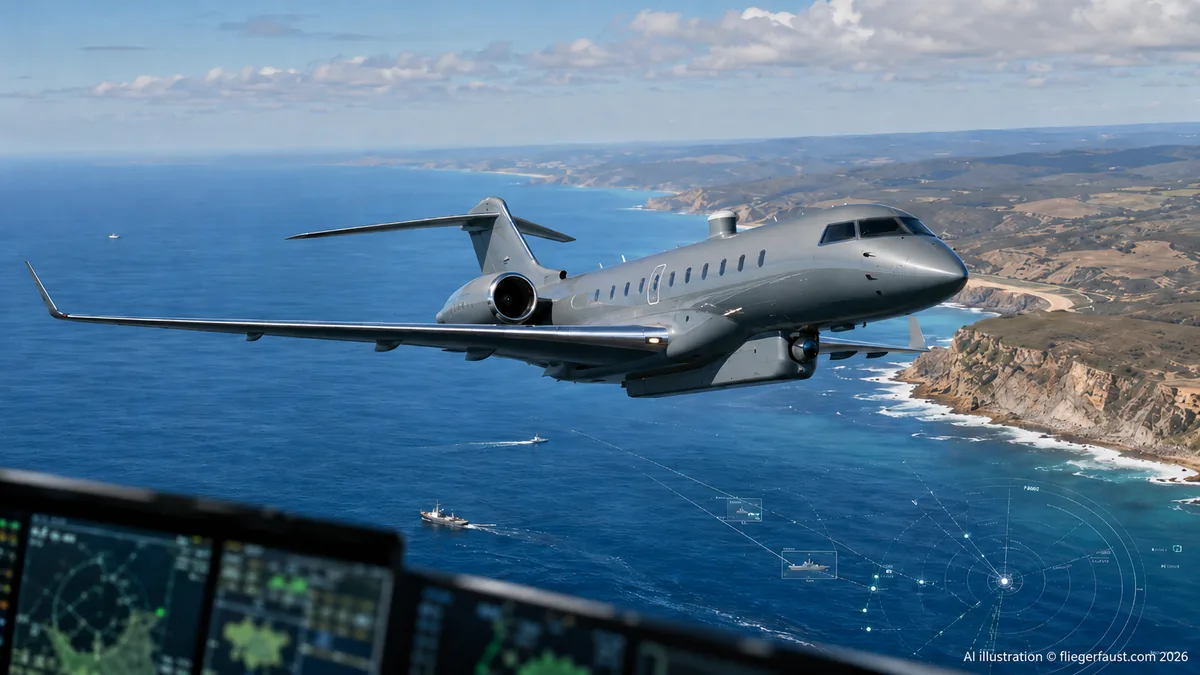
Bombardier Global 6500 aircraft for Australian maritime surveillance now have a confirmed role; does the mission system remain the larger story?
On May 26, 2026, Bombardier’s announcement said Bombardier Defense will provide three jets for maritime surveillance missions supporting the Australian Border Force (ABF). Metrea will operate them for the ABF under Australia’s next civil aerial surveillance model.
Bombardier Global 6500 enters the ABF surveillance fleet
Australian maritime surveillance jets and contract scope
The aircraft disclosure follows a wider Australian procurement decision. On May 22, 2026, the Australian Border Force announcement said the Department of Home Affairs had engaged Metrea Australia Pty Ltd after an extensive competitive process.
Specifically, the new contract covers 11 fully crewed, technologically advanced aircraft. They will provide short- and long-range aerial surveillance across Australia, operating 24 hours a day and 365 days a year.
However, Bombardier has disclosed only three aircraft. The careful reading is that the Bombardier Global 6500 likely forms the long-range jet element of Metrea’s future fleet. Neither the ABF nor Bombardier has publicly identified the other eight aircraft.
That split matters. The 11-aircraft contract describes the surveillance service, while Bombardier’s disclosure covers one three-aircraft supplier contribution. Treating those statements as identical would overstate the public record. It would also blur the difference between Australia’s full fleet award and the Global 6500 role now confirmed.
Border Force mission, not an air force procurement
This is not a Royal Australian Air Force acquisition. Instead, it is a civil maritime surveillance and border-protection contract centred on the Department of Home Affairs, the ABF and a contractor-operated fleet.
Moreover, the ABF says the new capability will improve range, endurance, advanced sensor technology and operational reach. It also promises near real-time information sharing for a strengthened national common operating picture.
Therefore, the Bombardier Global 6500 selection matters beyond the airframe. It signals a shift in the civil surveillance fleet toward faster, longer-legged aircraft that can support wide-area maritime security.
Meanwhile, the start date gives the programme urgency. Services under the new contract are scheduled to begin on January 1, 2028, after the current Civil Maritime Surveillance Contract.
Bombardier Global 6500 raises the missionization question
Global 6500 special mission confirmation
Bombardier says the programme will introduce the Global platform in Australia in a special mission configuration. That phrase is central because missionized aircraft succeed through sensors, consoles, data links and certification, not through range alone.
“The Global 6500 aircraft brings a new level of capability for maritime surveillance, with exceptional range, speed, endurance and reliability.” — Michael Anckner, Vice President, Worldwide Sales, Bombardier Defense
However, Bombardier has not publicly named a mission-system integrator, modifier, radar supplier or sensor package for these aircraft. It also has not disclosed the onboard operator layout, satellite communications fit or mission-software architecture.
Metrea Border Force fleet integration evidence
The public evidence points toward Metrea as a plausible missionization player, but no public source has named the official integrator. Even so, that remains an evidence-based inference, not a confirmed award line.
The Metrea corporate site says the company delivers integrated, turnkey airborne intelligence, surveillance and reconnaissance (ISR) solutions. It also cites more than 7,500 missions and more than 170,000 flight hours.
Additionally, Metrea Aerospace Design describes design, engineering, manufacturing, installation and certification services for aircraft modifications. Its public description includes special mission modifications, avionics upgrades and advanced communications capabilities.
Notably, Metrea’s site lists Metrea Special Aerospace, Metrea Aerospace Design and Metrea Mission Data as relevant capabilities. It also links Perth, Western Australia, to special aerospace and mission-data functions.
“This contract reflects our strong track record in delivering complex surveillance operations around the world…” — Rory Morse, Program Manager for Metrea
Consequently, the fairest formulation is precise. Bombardier supplies and supports the aircraft, Metrea operates the ABF fleet, and the named special-mission integrator remains undisclosed.
Bombardier Global 6500 fits Australia’s maritime geometry
Global 6500 maritime surveillance airframe logic
The operational logic is straightforward. Australia’s surveillance problem rewards transit speed, endurance, reliability and usable cabin volume for sensors and mission crews.
Moreover, as our Fliegerfaust analysis of the Bombardier BACN delivery noted, the Global architecture offers unusual electrical resilience for special-mission payloads. Four engine-driven generators can be backed by the auxiliary power unit (APU) in flight, giving crews five electrical power sources for sensors, cooling and communications loads.
Crew endurance matters too. The same Fliegerfaust analysis noted the Global’s low cabin-altitude profile, with a 4,500-foot cabin altitude at 45,000 feet and about 5,700 feet at 51,000 feet. On long surveillance legs, that helps reduce fatigue compared with higher-cabin-altitude aircraft solutions.
Business-jet-derived surveillance aircraft can move quickly between patrol boxes. They can also climb above weather and offer electrical growth for modern surveillance payloads.
As noted in our Fliegerfaust coverage of Bombardier Defence’s Global 6500 and Challenger 3500 momentum, Bombardier has been pushing the Global family deeper into government and special-mission markets. The ABF contract gives that push a highly visible Australian application.
However, the aircraft must deliver more than speed. Maritime surveillance demands persistent detection, classification and reporting across vast ocean approaches. Australia is the sort of map that makes dispatchers check the fuel twice.
The current contractor baseline
The incumbent baseline sets a demanding benchmark. Leidos Australia’s airborne surveillance page says it patrols Australia’s 8.2 million square kilometre Exclusive Economic Zone for the ABF.
Leidos says the operation flies around 15,000 hours and 2,500 missions each year. Its modified surveillance aircraft provide all-weather, day-and-night coverage with new-generation sensors and advanced satellite systems.
Separately, the Australian National Audit Office report on the current contract described a requirement for 10 modified Dash 8 aircraft and 15,000 flying hours per year. It also identified cost growth and delivery shortfalls across the older contract.
Therefore, Bombardier Global 6500 performance must be judged against service output, not brochure elegance. Availability, data delivery and transition discipline will matter as much as cabin size or cruise speed.
Bombardier Global 6500 builds on Australian defence momentum
Bombardier surveillance aircraft in Australia
Bombardier did not arrive at this award from a standing start. On May 21, 2024, Bombardier opened its Adelaide defence office, its first international Bombardier Defense office.
The Adelaide announcement said the office would support special mission customers in Australia and the wider Asia-Pacific region. It also connected the new office to Bombardier’s Melbourne Service Centre, opened in September 2022.
Bombardier’s May 26, 2026, release says the company has more than 75 business jets in Australia across the Learjet, Challenger and Global families. The release also notes that Learjet and Challenger aircraft already perform search-and-rescue and medical evacuation missions in the country.
The pattern is not subtle; it has the crosswind correction of a runway sock.
Global platform context beyond Australia
Bombardier’s Australian activity also includes adjacent intelligence, surveillance and reconnaissance (ISR) work. On March 26, 2025, Skies Magazine published Bombardier’s release on two Challenger 650 aircraft acquired by Principle Finance for ISR missions in Australia.
Additionally, our Fliegerfaust analysis of the United States Army’s High Accuracy Detection and Exploitation System Global 6500 path explains why the same family attracts military customers seeking high-altitude sensor platforms. The programme reinforces the Global family’s ISR credibility.
The broader Bombardier-Saab ecosystem also matters. Our Fliegerfaust analysis of the North Atlantic Treaty Organization GlobalEye and Bombardier-Saab surveillance question shows how Global-family aircraft have become recurring choices for airborne surveillance roles.
Finally, Leonardo and Bombardier Defense announced on June 17, 2025, a non-exclusive memorandum of understanding to study Global 6500-based maritime multi-mission aircraft opportunities. That agreement is relevant market context, but it does not confirm Leonardo systems for the ABF jets.
What Bombardier Global 6500 still does not reveal
Sensors, value and other aircraft remain open
The public record leaves several important gaps. First, the other eight aircraft in Metrea’s future 11-aircraft fleet remain unidentified.
Second, the sensor suite remains undisclosed. No public release confirms the radar, electro-optical turret, automatic identification system integration, signals package, mission consoles or satellite communications architecture.
Third, the public releases do not provide a contract value for the three Bombardier Global 6500 aircraft. The wider ABF contract may surface in procurement reporting, but a precise value needs a primary government source.
However, the strategic direction is already visible. Australia wants more reach, better sensors and faster information sharing from a contractor-operated civil surveillance fleet.
For now, analysts are left polishing binoculars in a very digital age.
Risk shifts from aircraft to system
The airframe choice looks sound. Bombardier Global 6500 performance aligns with long-range surveillance logic, while Metrea brings operational experience and specialist mission entities.
Even so, execution will determine whether the result becomes a genuine step-change. The hard work sits in certification, sensor integration, crew training, basing, maintainability and data distribution.
Overall, the ABF should gain a faster and more capable long-range surveillance element. Yet maritime awareness only improves when information arrives quickly, accurately and in a form operators can use.
Specifically, the transition also needs governance discipline. The current baseline shows why. Surveillance contracts can look tidy on award day, then lose value through crew shortfalls, integration delays and unplanned change. A long-range jet helps, but only if the operational tasking, maintenance model and information chain remain synchronized from first sortie.
Additionally, the contractor model will require clear performance metrics. The ABF will need to measure completed missions, sensor uptime, reporting latency and usable coverage, not only aircraft availability. Those measures will show whether the new fleet improves civil maritime security or merely replaces one set of aircraft with another. In this mission, the output is not hours flown. It is actionable maritime awareness.
Therefore, the next useful disclosure will not be another glamour photograph. It will be a clearer description of the mission system and how Metrea will connect airborne data to Australian command centres.
Conclusion: Bombardier Global 6500 is a smart, incomplete signal
Bombardier Global 6500 is a strong platform choice for Australia’s maritime geography. It gives Metrea and the ABF a fast, long-legged aircraft for patrol tasks that punish short endurance and weak communications.
Nevertheless, the announcement remains incomplete. The public knows the aircraft supplier, operator, customer and broad service start date. It does not yet know the sensors, named integrator, data architecture, basing model or full fleet composition.
That distinction matters. Maritime surveillance is an information service, not an aircraft parade. The aircraft is not the answer by itself; even elegant metal needs honest integration.
Tell us what you think, leave your comments at the bottom
Finally, Bombardier and Metrea have earned attention with a credible platform and a significant Australian win. My critical view is simple: this is a promising aircraft selection awaiting proof as a surveillance system. In a maritime domain where distance hides almost everything, will the new fleet reveal enough?
Leave your answers and comments below and on our Fliegerfaust Facebook page.
Sources
- Bombardier — Bombardier Defense to Provide Three Bombardier Global 6500 Aircraft for Maritime Surveillance in Australia (May 26, 2026).
- Australian Border Force — Aerial surveillance contract to support ABF (May 22, 2026).
- Metrea — Metrea Selected to Enhance Australia’s Border Surveillance Capability (May 22, 2026).
- Metrea — Building Elegant Solutions for National Security (Accessed May 26, 2026).
- Metrea Aerospace Design — World class engineering and certification (Accessed May 26, 2026).
- Leidos Australia — Airborne Surveillance (Accessed May 26, 2026).
- Australian National Audit Office — Management of the Civil Maritime Surveillance Services Contract (October 11, 2021).
- Bombardier — Bombardier Defense Inaugurates New Office in Australia, Enhances Footprint in the Country (May 21, 2024).
- Skies Magazine — Bombardier Defense announces order of 2 Challenger 650 aircraft ISR missions in Australia (March 26, 2025).
- Leonardo — Leonardo and Bombardier Defense sign MoU to assess and target new opportunities in the global maritime MMA market (June 17, 2025).
For full details, please refer to our Disclaimer page.