

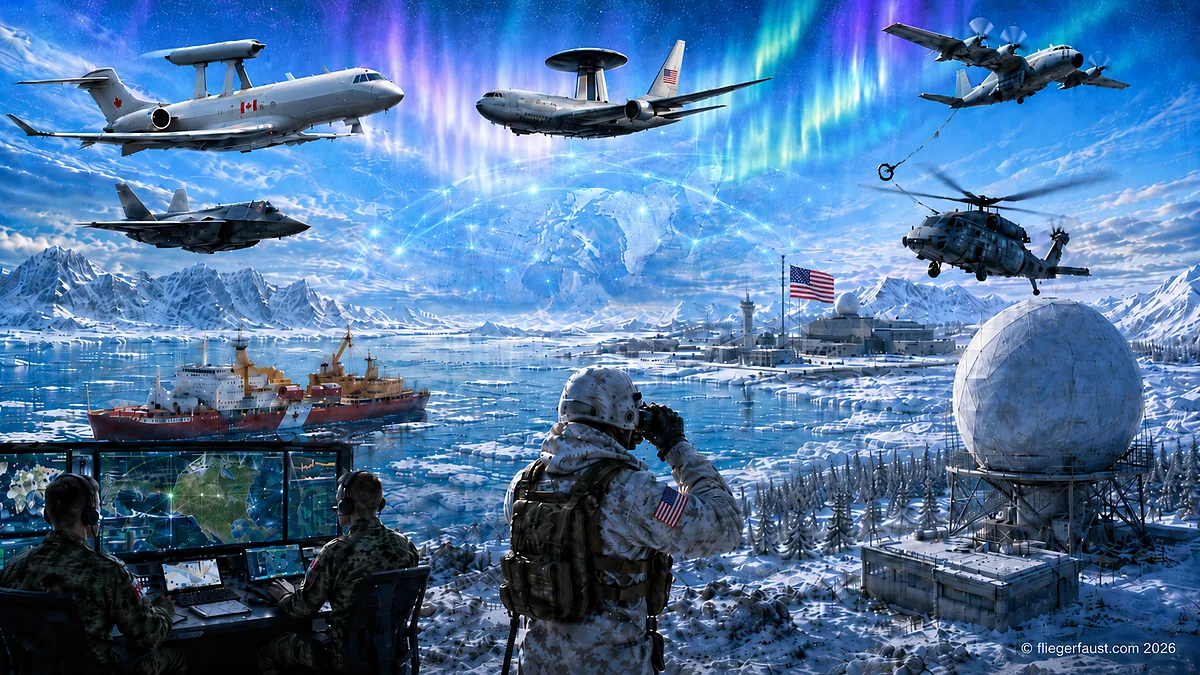
Is Alaska now showing what a mature High North defence system looks like, while Canada is still buying the pieces it needs to catch up?
Arctic combat shield: On May 29, 2026, Army Recognition reported that Alaska had emerged as America’s Arctic combat shield. Specifically, the article used Exercise Kodiak Mace to frame a larger shift in United States (U.S.) Arctic readiness.
Notably, the point deserves Canadian attention because Alaska is not merely hosting winter training. It is operating as a layered defence node with fighters, tankers, missile warning, radar, airlift, command systems and the North American Aerospace Defense Command (NORAD) tied together.
However, Canada is moving, and some moves are significant. Yet many of the crucial Canadian pieces remain in procurement, negotiation, construction or planning. That gap matters because Arctic geography does not pause while policy catches up.
What matters:
- Alaska is fielded. The U.S. northern posture already combines fighters, tankers, airborne warning, missile warning, command systems and repeated NORAD operations.
- Canada is building. Ottawa has serious programmes underway, but P-8A, GlobalEye, Arctic Over-the-Horizon Radar and northern basing upgrades still depend on delivery schedules.
- NORAD is the frame. This is not a clean U.S.-versus-Canada contest. It is one binational defence system with uneven national contributions.
- The Canadian test is fit, not imitation. Canada does not need an Alaska clone. It needs a layered Arctic system designed for Canadian distance, infrastructure and sovereignty realities.
Arctic combat shield: Alaska is already operational
Alaska Arctic shield: Exercise Kodiak Mace shows sustainment
Specifically, Army Recognition’s story centred on Exercise Kodiak Mace in Alaska. The article described a U.S. Marine Corps KC-130J Super Hercules refuelling a U.S. Army UH-60 Black Hawk during joint operations documented through imagery released on May 28, 2026.
That detail is easy to miss, but it is the story. In the Arctic, fuel is not the tail of the operation; it is the plot.
Additionally, the KC-130J brings tanker, transport and expeditionary ground-refuelling utility. Meanwhile, the UH-60 Black Hawk brings troop movement, casualty evacuation and flexible utility lift. Army Recognition also placed ski-equipped CH-47 Chinook helicopters, AH-64E Apache Guardians and F-22 Raptors inside the same Alaska readiness picture.
The exercise matters because it combines aircraft types that solve different northern problems. Fighters can intercept. Attack helicopters can support ground manoeuvre. Utility and heavy-lift helicopters can move people, ammunition, sensors and fuel. Tanker-transports can extend the entire system.
Moreover, snow, ice and distance change the value of every aircraft. For example, a helicopter that cannot land on snow has a smaller map. Likewise, a fighter that cannot get fuel has a shorter argument. Similarly, a command network that cannot survive weather is only a summer theory.
Therefore, Alaska’s visible strength is not only high-end aircraft. It is repetition under northern conditions, with logistics treated as a combat function. The Arctic combat shield frame also shows why sustainment is now a front-line capability.
High North deterrence: Joint Base Elmendorf-Richardson is the hinge
Joint Base Elmendorf-Richardson (JBER), near Anchorage, anchors much of that posture. JBER’s official Air Force unit information places Alaskan NORAD Region, Alaskan Command, Eleventh Air Force, the 3rd Wing, the 673d Air Base Wing, the 176th Wing and the 477th Fighter Group in one operating ecosystem.
Specifically, the 3rd Wing is described by JBER as a composite organisation that provides air supremacy, surveillance, worldwide airlift and agile combat support. The 477th Fighter Group is an F-22A Raptor reserve unit. The 176th Wing adds strategic airlift, homeland defence, combat search and rescue, and agile combat support.
Additionally, Eleventh Air Force describes itself as an integrated warfighting team that defends the homeland while remaining Arctic ready. That sentence compresses Alaska’s real role. It is both northern shield and Pacific springboard.
Meanwhile, Eielson Air Force Base adds another layer. Associated Press reported in January 2025 that Eielson was selected in 2016 to host 54 F-35s, spawning an expansion that cost more than a half-billion dollars.
Fighter density Canada cannot match in the North
Consequently, Alaska now holds a fighter density Canada cannot match in the North. Canada’s CF-18 Hornets remain useful, but they are near the end of their service lives. Canada’s F-35A transition is still unfolding.
Northern defence network: airpower meets real intercepts
The Alaska network is also used. On February 20, 2026, Reuters reported that NORAD detected and tracked Russian aircraft in the Alaskan Air Defense Identification Zone (ADIZ).
Specifically, the Russian formation included two Tu-95 bombers, two Su-35 fighters and one A-50 airborne warning aircraft. NORAD responded with two F-16s, two F-35s, one E-3 Sentry and four KC-135 tankers.
The Russian aircraft stayed in international airspace and did not enter U.S. or Canadian sovereign airspace. Still, the response showed how Alaska’s layered architecture functions when the phone actually rings.
The Arctic combat shield is therefore not a slogan. It is fighters, tankers, airborne warning, radar tracks and command decisions joined in real time.
Arctic combat shield: NORAD makes Alaska and Canada one defence problem
NORAD Arctic defence: three missions, one northern approach
NORAD is the connective tissue in this story. NORAD’s official mission description identifies three missions: aerospace warning, aerospace control and maritime warning for North America.
Specifically, aerospace warning covers aircraft, missiles and space vehicles. Aerospace control protects the air sovereignty of Canada and the U.S. Maritime warning adds shared awareness of maritime approaches, ocean areas and internal waterways.
Moreover, Canada’s official NORAD page gives the same structure. It also states that the North Warning System includes 11 long-range and 36 short-range radars along the Arctic coast of North America. The system stretches from Alaska across Canada to Greenland.
That geography is decisive. The North is not a side theatre for NORAD. It is the main avenue through which long-range aviation, cruise missiles and future hypersonic threats could approach North America.
NORAD is less a headquarters than a nervous system. Unfortunately, some of the nerves are old.
Continental Arctic defence: warning is not the same as interception
Canada and the U.S. share warning through NORAD, but their national systems are not identical. The U.S. has missile-defence assets in Alaska that sit alongside, but not inside, every Canadian decision chain.
Specifically, at Clear Space Force Station in Alaska, the Long Range Discrimination Radar (LRDR) strengthens U.S. missile-defence sensing. Reuters reported on June 24, 2025, that LRDR successfully acquired, tracked and reported missile target data during a test over the northern Pacific.
Additionally, the radar was built by Lockheed Martin as part of the Ground-Based Midcourse Defense (GMD) system. GMD is intended to defend against limited ballistic missile threats, using interceptors based in Alaska and California.
This distinction matters for Canadian readers. NORAD warning is deeply binational. However, the LRDR and Ground-Based Midcourse Defense layer described by Reuters remains a U.S. missile-defence architecture built around U.S. sensors and interceptors.
Moreover, the U.S. Arctic structure also links Alaska to Greenland. Peterson and Schriever Space Force Base describes Pituffik Space Base as supporting missile warning, missile defence and space surveillance. Together, Alaska and Greenland form a northern warning arc that Canada depends on every day.
High North deterrence: Canada plugs into the kill chain
Canada’s future Arctic investments should be read as upgrades to its share of the NORAD kill chain. The chain starts with detection. Then command systems validate the track, classify the threat, assign a response and move aircraft or other assets.
In Alaska, many of those steps already sit close together. JBER provides command links, fighter infrastructure and airlift. Eielson adds fifth-generation fighter mass. Clear adds missile-warning and discrimination depth.
Canada has a different problem. It must provide more sensors, airborne warning, maritime patrol, fighter support and northern sustainment across a larger, thinner and less connected geography.
“Investment in domain awareness… will strongly position NORAD to detect and understand potential threats faster…” — General Glen D. VanHerck, Commander of NORAD, Government of Canada
That quote came from Canada’s June 20, 2022 NORAD modernization announcement. The statement remains accurate because the core challenge remains detection speed. In Arctic defence, lateness is measured in kilometres. For Canada, the Arctic combat shield comparison starts with that unforgiving clock.
Arctic combat shield: Canada has money, but not enough fielded mass
Arctic surveillance gap: Ottawa has finally named the bill
Notably, Canada has launched a serious modernization effort. On June 20, 2022, National Defence announced a $38.6-billion continental defence modernization plan over 20 years.
Specifically, the plan includes surveillance modernization, command and control, air weapons, infrastructure, science and technology, and support for northern operations. It is the most important Canadian NORAD investment package in decades.
However, the timing is uncomfortable. On July 17, 2025, National Defence announced the selection of the first transmit and receive sites for Arctic Over-the-Horizon Radar, with initial operational capability anticipated by the end of 2029.
Arctic Over-the-Horizon Radar (A-OTHR) is critical because it should see farther into northern approaches than older line-of-sight radars. Yet it is not an operational network today.
Therefore, Canada’s Arctic combat shield contribution remains transitional. The country has money assigned, programmes named and technology paths visible. It does not yet have the same fielded density Alaska shows today. That makes the Arctic combat shield gap a schedule problem, not just a spending problem.
Capability layer U.S. / Alaska status Canada status Why it matters Combat airpower Alaska already has an F-22A presence at JBER, F-35A mass at Eielson and repeated NORAD intercept activity. Canada remains in transition from CF-18 to F-35A, while northern Forward Operating Locations still need modernization. The U.S. has fielded northern combat density. Canada is still building the base network to support future fighter operations. Airborne warning NORAD responses near Alaska can draw on airborne warning aircraft, fighters and tankers in the same operational picture. Canada has engaged Saab as preferred supplier for GlobalEye, but no contract has been signed and no aircraft has entered service. Canada’s airborne radar gap narrows only when GlobalEye becomes a funded, delivered and crewed capability. Maritime patrol and undersea surveillance The U.S. Arctic story is strongest in air defence, missile warning and Alaska-based response depth. Canada has committed to P-8A Poseidon for anti-submarine warfare, anti-surface warfare and intelligence, surveillance and reconnaissance. P-8A gives Canada a major maritime upgrade, but it still depends on basing, crews, data links and northern deployment planning. Missile warning and missile defence Alaska hosts major U.S. missile-warning and missile-defence infrastructure, including Clear Space Force Station and Ground-Based Midcourse Defense elements. Canada contributes to NORAD warning, but U.S. ballistic missile defence remains a distinct U.S.-controlled architecture. NORAD warning is binational, but some of the hardest missile-defence functions remain American. Northern basing and sustainment JBER and Eielson are permanent, mature operating hubs with repeated Arctic training and real-world NORAD use. Canada is investing in Yellowknife, Inuvik, Iqaluit, Goose Bay and northern support hubs, but much of the effect remains future-dated. Canada’s largest risk is not ambition. It is execution across distance, weather, construction seasons and logistics. Sovereignty presence The U.S. has a stronger combat hub in Alaska, but a thinner polar icebreaking fleet than Canada. Canada has Rangers, northern communities, coast guard icebreakers and Arctic and Offshore Patrol Vessels as presence tools. Canada is not absent. Its weakness is turning presence into fast, connected, high-end response.
Northern defence network: Carney’s March 2026 package raises the stakes
On March 12, 2026, Reuters reported that Prime Minister Mark Carney unveiled a C$35-billion Arctic defence plan. The plan included C$32 billion to expand military airfields and build operational support hubs.
“With this new plan, Canada is taking full responsibility for defending our Arctic sovereignty.” — Prime Minister Mark Carney, Reuters
Associated Press reported that Carney put additional funding into military forward operating locations in Yellowknife, Inuvik, Iqaluit and Goose Bay. These locations can support fighter dispersal, northern staging and faster response.
Additionally, the package also connects to support hubs. On March 6, 2025, National Defence announced Iqaluit, Inuvik and Yellowknife as Northern Operational Support Hub locations, supported by $2.67 billion over 20 years.
“The Arctic’s strategic importance is rapidly increasing.” — Lieutenant-General Steve Boivin, Commander, Canadian Joint Operations Command, Government of Canada
That is correct, but infrastructure decides whether the words become force. A runway without fuel, weapons, heated maintenance space and communications is geography. A supplied runway is deterrence.
Continental Arctic defence: supportability remains the hard part
Canada’s public policy now sounds more serious than it has in years. Our North, Strong and Free, released in 2024, commits Canada to northern operational support hubs, airborne warning aircraft, coastal and underwater sensors, tactical helicopters and stronger Arctic reach.
However, the policy reads partly like a list of missing pieces. Canada needs better eyes in the air. Additionally, it needs stronger northern support. Moreover, it needs more persistent maritime awareness. Finally, it needs bases able to receive modern fighters under harsh conditions.
That is why our Fliegerfaust analysis of Canada’s Arctic defence plan described the announcement as an overdue bill. Ottawa is paying for decades of limited northern defence investment.
The problem is not only budgetary. It is practical. Northern construction seasons are short. Labour is scarce. Energy is expensive. Gravel runways, housing shortages and limited roads can turn military planning into civil-engineering triage.
Sovereignty does not come with a snow-day clause.
Arctic combat shield: Canadian aircraft choices are now strategic tests
Arctic surveillance gap: P-8A Poseidon covers the maritime layer
Meanwhile, Canada’s P-8A Poseidon decision is the firmest airborne piece of the new architecture. On November 30, 2023, Canada announced the acquisition of up to 16 P-8A Poseidon aircraft for the Royal Canadian Air Force (RCAF).
Specifically, the programme includes 14 aircraft, with options for two more. In August 2024, National Defence put the estimated project investment at $10.4 billion and said the first aircraft was expected in 2026.
Additionally, the P-8A replaces the CP-140 Aurora, which was originally procured in 1980. The Poseidon adds modern anti-submarine warfare (ASW), anti-surface warfare and intelligence, surveillance and reconnaissance (ISR) capability.
For the Arctic, this is essential. Submarines, surface traffic, grey-zone vessels and long-range maritime approaches all demand persistent patrol aircraft. However, southern basing at 14 Wing Greenwood and 19 Wing Comox still requires northern deployment planning.
As noted in our Fliegerfaust post on the Canada P-8A Poseidon sole-source deal, the aircraft is proven and interoperable. It is also a major bet on U.S. industry.
High North deterrence: GlobalEye adds airborne battle management
Separately, Canada’s possible Saab GlobalEye acquisition fills a different gap. On May 27, 2026, Reuters reported that Canada planned to buy Saab GlobalEye aircraft rather than Boeing’s E-7 Wedgetail. Reuters also reported that military officials had earlier identified a requirement for six early warning aircraft.
“With a suite of advanced sensors and mission systems, Saab’s GlobalEye will be a key resource for the Canadian Armed Forces to detect and deter threats across the Arctic.” — Prime Minister Mark Carney, Reuters
Saab’s release was more precise. Saab said Canada had engaged it as preferred supplier for future Airborne Early Warning and Control (AEW&C) capability. It also said no contract had yet been signed and no order received.
“GlobalEye offers proven capability for the Royal Canadian Air Force, sovereign ownership for Canada and comprehensive and skilled work for Canadian industry.” — Micael Johansson, President and Chief Executive Officer, Saab
Technically, the choice is compelling. Saab describes GlobalEye as a multi-domain AEW&C aircraft based on the Bombardier Global 6000/6500 family, using the Erieye Extended Range radar, multi-domain command and control, and air, sea and land surveillance sensors.
Additionally, Saab lists more than 12 hours of endurance, an instrumented range above 350 nautical miles, or about 650 kilometres, and 6,500-foot airfield performance. Those figures matter in Canada’s northern geography.
For background, see our Fliegerfaust coverage of Canada’s GlobalEye Arctic surveillance pivot. GlobalEye is not just another aircraft file. It is a test of whether Canada wants its own airborne radar horizon. The Arctic combat shield standard requires that radar horizon to move with the mission.
Northern defence network: aircraft cannot outrun basing gaps
Together, P-8A and GlobalEye would give Canada a serious airborne sensing package. The P-8A would watch surface and undersea activity. GlobalEye would manage wide-area air, sea and land tracks from altitude.
However, aircraft cannot solve basing alone. They need hangars, trained crews, spares, data links, fuel, secure networks and northern deployment plans. They also need enough mission crews to sustain operations after the press conference ends.
This is where Alaska still leads. JBER and Eielson do not merely host aircraft. They host an operating culture, a command structure and repeated Arctic training. Canada is trying to build that ecosystem across much harsher distances.
Therefore, the Canadian question is no longer whether the country has selected useful platforms. It has. The question is whether Ottawa can turn them into a persistent Arctic system before the 2030s.
Arctic combat shield: maritime presence is where Canada has a different advantage
Continental Arctic defence: icebreakers tell a more nuanced story
The U.S. advantage is not universal. In maritime icebreaking, Canada has a stronger civil footprint than many Americans assume.
Reuters reported on August 20, 2025, that Canada has the world’s second-largest icebreaker fleet with 18 ships. The same report said the U.S. Coast Guard was seeking to expand an aging Arctic-ready fleet.
That difference matters because Arctic security is broader than air defence. Icebreakers support sovereignty, search and rescue, science, shipping, resupply and emergency response. They also show the flag in places fighters do not patrol.
However, icebreakers are not substitutes for airborne warning, fighter readiness or anti-submarine patrols. They occupy a different layer of Arctic power.
Canada’s 2024 defence policy also treats Harry DeWolf-class Arctic and Offshore Patrol Vessels as part of the maritime surveillance layer. Canada’s 2024 defence policy, Our North, Strong and Free says Canada will deploy specialized maritime sensors on those vessels to monitor Canadian approaches, including in the Arctic and North.
In short, Canada has presence instruments. Alaska has combat density. Those are related, but they are not equivalent.
However, the comparison should not imply that Canada can or should build an Alaska copy. Alaska is a compact U.S. combat hub with major permanent bases, dense fighter infrastructure and direct Pacific reach. Canada’s Arctic is a continental-scale operating problem stretched across isolated communities, limited transport links, fragile infrastructure and civil sovereignty obligations. Therefore, the fair test is not whether Ottawa can reproduce Joint Base Elmendorf-Richardson or Eielson Air Force Base. It is whether Canada can build a layered northern system suited to Canadian geography while carrying more weight inside NORAD.
Arctic surveillance gap: sovereignty presence must connect to sensors
Canada’s Canadian Rangers also provide local knowledge and presence across northern communities. That matters, especially in a region where terrain, weather and community relationships shape every military movement.
Formally part of the Canadian Armed Forces Reserves and serving Canada since 1947, the Rangers give Ottawa a human sensor network where conventional units would be difficult to station. Canada’s official Canadian Rangers page says they operate in remote, isolated and coastal regions, with about 5,000 Rangers living in more than 220 communities. In practical terms, they are Canada’s northern eyes, ears and local memory. They conduct patrols, report unusual activity, collect local data, support sovereignty and national security duties, and assist search and rescue when geography makes local knowledge decisive.
Still, presence must connect to sensors and response. A detected track must reach a command centre. A command centre must have a usable aircraft. That aircraft must have fuel, weapons and crews. Otherwise, sovereignty becomes observation without leverage.
This is why NORAD modernization, P-8A, GlobalEye, A-OTHR and northern hubs belong in one story. They are not separate procurement files. They are linked pieces of a continental Arctic defence architecture.
Canada must not frame the issue as U.S. replacement. NORAD remains essential. The real aim should be Canadian weight inside the binational system.
Ultimately, a partner brings capacity. By contrast, a passenger brings geography. A Canadian Arctic combat shield would bring both presence and usable response.
Conclusion: Arctic combat shield exposes Canada’s timeline problem
High North deterrence: Canada must become a heavier NORAD partner
The Army Recognition headline works because it captures a real asymmetry. Alaska already behaves like a layered Arctic combat system. Canada is still assembling one.
That does not mean Canada is absent. Ottawa has announced serious money, selected P-8A, opened GlobalEye negotiations, named northern hubs and advanced A-OTHR. Canada also has Rangers, coast guard icebreakers, northern communities and maritime presence assets.
However, the U.S. position in Alaska is fielded, exercised and used. Canada’s emerging system remains too dependent on future delivery dates.
Overall, Canada’s strategic goal should be clear. It must become a heavier NORAD partner by turning aircraft purchases, radar projects and northern construction into operational mass. That means crews, spare parts, fuel farms, weapons storage, hardened communications, command software and exercises that stress the system before a crisis does.
Tell us what you think, leave your comments
Canada’s Arctic defence plan is finally serious, but serious is not the same as ready. If the Arctic combat shield now visible in Alaska is the standard, will Canada build enough northern capability to help shape it, or remain the vast geography that others must help defend?
Leave your answers and comments below and on our Fliegerfaust Facebook page.
Sources
- Army Recognition — Alaska Emerges as America’s Arctic Combat Shield as U.S. Forces Train for Sustained High North Operations (May 29, 2026).
- Joint Base Elmendorf-Richardson — Air Force Units (accessed May 30, 2026).
- Associated Press — Pilot safe after F-35 military jet suffers significant damage in accident at Alaska base (January 29, 2025).
- Reuters — NORAD detects Russian planes off of Alaska, sends aircraft in response (February 20, 2026).
- NORAD — About NORAD (accessed May 30, 2026).
- Canada.ca — North American Aerospace Defense Command (NORAD) (April 1, 2026).
- Reuters — US tests radar that could link into Golden Dome to detect China, Russia threats (June 24, 2025).
- Peterson and Schriever Space Force Base — Pituffik Space Base, Greenland (accessed May 31, 2026).
- National Defence — Minister Anand announces continental defence modernization to protect Canadians (June 20, 2022).
- Department of National Defence — National Defence announces progress on the Arctic Over-the-Horizon Radar project (July 17, 2025).
- Reuters — Canada to boost Arctic defenses, says it can no longer rely on others (March 12, 2026).
- Associated Press — Carney announces billions for defense and infrastructure in Canada’s North (March 12, 2026).
- Canada.ca — Minister Blair announces First Northern Operational Support Hub locations (March 6, 2025).
- Department of National Defence — Our North, Strong and Free: The Right Capabilities for Canada (April 17, 2024).
- National Defence — Canada purchasing up to 16 P-8A Poseidon Multi Mission Aircraft for the Royal Canadian Air Force (November 30, 2023).
- Canada.ca — Canada’s P-8A Poseidon aircraft procurement bringing investment and economic growth to British Columbia (August 7, 2024).
- Reuters — Canada to buy Swedish early warning planes rather than US model (May 27, 2026).
- Saab — Canada engages Saab as preferred supplier of future AEW&C capability (May 27, 2026).
- Saab — GlobalEye AEW&C (accessed May 30, 2026).
- Reuters — Canada’s Davie sees US shipyards as key to winning icebreaker contract (August 20, 2025).
- Canada.ca — Canadian Rangers (May 24, 2022).
For full details, please refer to our Disclaimer page.

Thank you for this article. As you say, “Canada does not need an Alaska clone. It needs a layered Arctic system designed for Canadian distance, infrastructure and sovereignty realities.”
I’ll go further: Canada needs a cost-effective dome, optimized for our Arctic, sourced from Canadian components, and built by Canadian workers.
And if you think about it, that dome already has a name: the Igloo.
Canada needs to build an Igloo.