
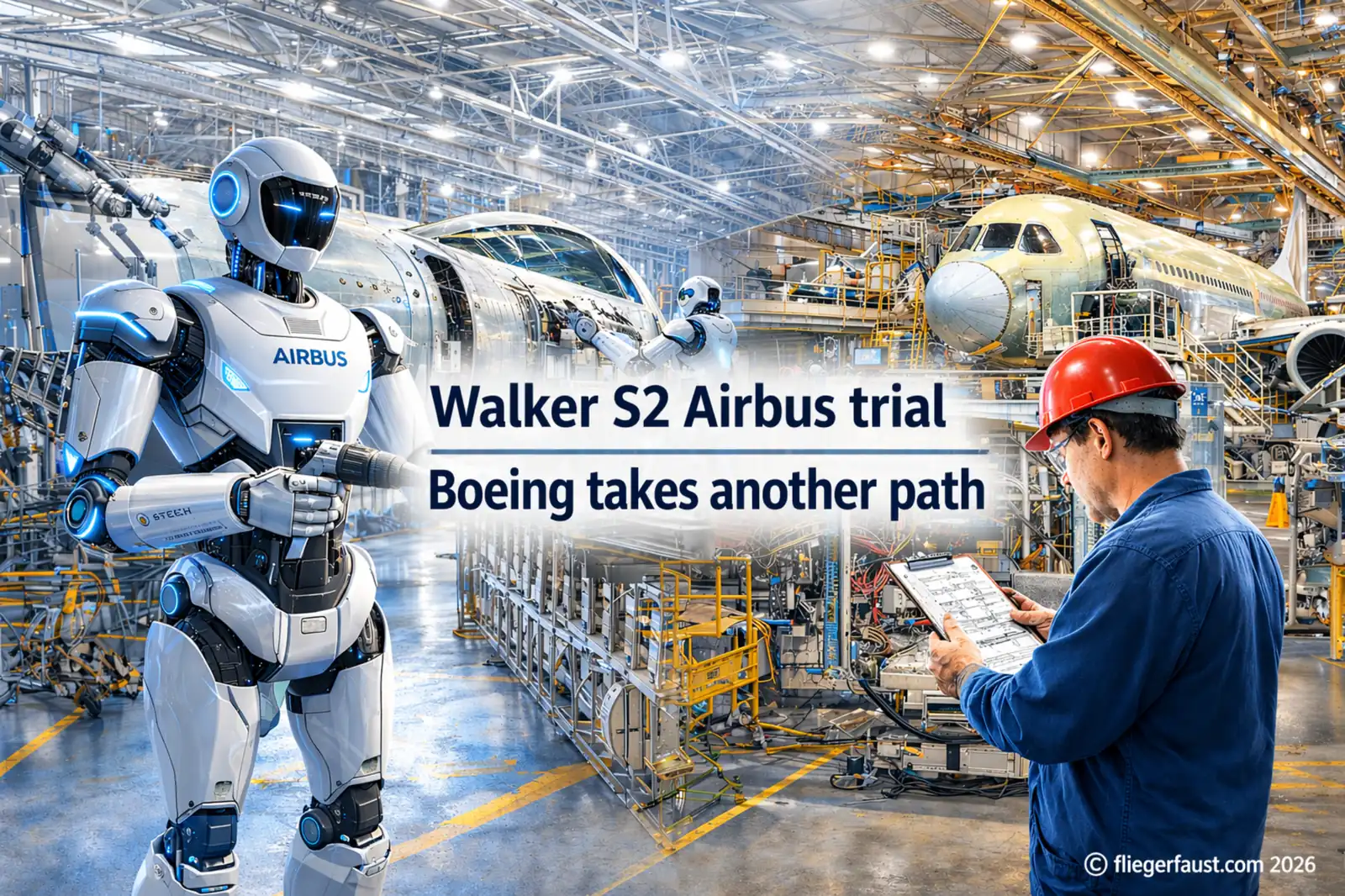
Walker S2 Airbus trial: is Airbus turning a humanoid pilot into a practical factory tool, or is the programme still a tightly managed test with more symbolism than measurable output?
Since Fliegerfaust reported on January 24, 2026, Airbus has widened the public view of its automation roadmap, UBTECH Robotics has published stronger industrial signals around Walker S2, and Boeing has kept talking about factory control, worker training, and ramp discipline rather than a named humanoid programme.
That contrast is now the real story. Airbus still has not disclosed the Walker S2 site, task list, robot count, contract value, or pilot key performance indicators. However, Airbus has disclosed more about the automation system around the pilot. Boeing, by contrast, has disclosed more about the discipline system around its factories. That split now gives this follow-up its centre of gravity.
Walker S2 Airbus trial after January 24
Walker S2 Airbus trial still lacks a public scorecard
The baseline has not changed as much as the headlines suggest. On January 21, 2026, Reuters reported that Airbus had purchased UBTECH’s Walker S2 and that the cooperation remained in an “early concept-testing stage.” — Reuters, January 21, 2026 That phrase still matters because no later Airbus disclosure has replaced it with hard pilot numbers.
Meanwhile, Airbus has not publicly identified the plant, the aircraft programme, the number of robots, or the first task family under test. It has not published uptime, intervention rate, ergonomic gain, quality effect, or cycle-time change. Those missing items were central in our original Fliegerfaust report on Airbus humanoid robots. They remain central now. Keep reading…
That absence is no longer a minor caveat. It is now one of the main findings. A genuine pilot can stay quiet for sensible reasons. Safety, labour relations, and data quality often move faster inside a plant than in public. Even so, a trial without published metrics stays harder to judge than to admire.
The Walker S2 Airbus trial therefore remains the central unresolved issue in the update. Airbus still has not turned the Walker S2 Airbus trial into a public case study with metrics. Aerospace has a simple habit here: if a technology cannot survive a scorecard, it usually survives only a presentation.
Airbus robotics strategy became much easier to see
The wider Airbus automation story did move forward in a useful way. The key source is Airbus’ February 18, 2026 board report for fiscal year 2025. In that document, Airbus says its Airbus China Research and Development and Innovation Centre in Suzhou progressed several projects at the Tianjin final assembly line, including artificial-intelligence vision-based safety enhancements, energy management systems, improved major-component transfers, flowline logistics automation, and “robotics.”
Moreover, the same board report says the strategic goal is to scale those value-driven solutions across Airbus final assembly lines globally. That wording matters more than the list itself. It shows Airbus treating automation as a system, not as a string of isolated demonstrations. The centre of the story is not a lone humanoid. The centre is the factory architecture around it.
Additionally, Airbus described another relevant layer in the same report. The company highlighted Innodura, a software-based environment-recognition system that can “automate robotic trajectory planning” by recognising aircraft geometry and changing robot programming dynamically. — Airbus SE Report of the Board of Directors 2025 That disclosure does not mention Walker S2 by name. Still, it confirms that Airbus is steadily building smarter layers around industrial robotics.
Airbus robotics strategy meets production pressure
Airbus explained the pressure behind that effort when it issued 2026 guidance for around 870 commercial aircraft deliveries on February 19, 2026. “Global demand for commercial aircraft underpins our ongoing production ramp-up …” — Guillaume Faury, Chief Executive Officer, Airbus That sentence is not background decoration. It explains why this matters at all. In aerospace, even experimental tools must answer to delivery pressure.
Meanwhile, Airbus’ own robotics page still reinforces the same broader logic. The company says robotics efforts target five main domains: assembly, paint, quality control, logistics, and composites. It also says robots should take the most repetitive work so operators can move toward more complex, value-added tasks. “Robots also create new job opportunities for operators.” — Airbus, Robotics page That wider disclosure gives the Walker S2 Airbus trial more industrial context, but not more hard evidence.
Therefore, the Walker S2 Airbus trial looks less like a revolution than a boundary test inside a much older industrial plan. For Airbus ramp pressure beyond Tianjin, see our Fliegerfaust analysis of the Airbus A220 ramp-up and supply-chain strain.
Walker S2 Airbus trial and the UBTECH scaling story
Walker S2 Airbus trial gained supplier momentum
Next, the supplier side became much stronger after our January 24 article. On March 31, 2026, Hong Kong Exchanges and Clearing published UBTECH Robotics Corp Ltd’s annual results announcement. The filing says revenue from full-size embodied intelligent humanoid robot products and services rose from Chinese renminbi (RMB) 35.6 million in 2024 to RMB 820.6 million in 2025. It also says Walker S2 entered official mass production and delivery in 2025, and that annualized production capacity exceeded 6,000 full-size humanoid robots by year-end.
Moreover, that filing changes the texture of the conversation. In January, Walker S2 still looked easy to file under “promising but early.” By late March, UBTECH wanted investors to see a different picture. It wanted them to see industrialisation, repeatability, and a business line that was no longer peripheral. More importantly, it wanted scale to look plausible.
Additionally, UBTECH’s own corporate profile makes the same point in shorter form. The company says it “began the mass production and delivery of Walker S2” in November 2025. — UBTECH, Company Profile Its Walker S2 product page also keeps stressing autonomous battery swapping and continuous operation. UBTECH says the robot can “swap battery autonomously within 3 minutes.” — UBTECH, Walker S2 product page
Consequently, on the supplier side, the Walker S2 Airbus trial now sits beside a more mature commercial story from UBTECH. That does not prove Airbus has moved beyond a pilot. However, it does show that the supplier has moved beyond concept signalling. The supplier story is now stronger than the customer story, which is rarely a comfortable place for any factory evaluation to stay.
Aviation humanoid robots still trail fixed-purpose automation
Even so, the strongest reality check also arrived after our first post. On January 25, 2026, the day after we published our first story, the Financial Times reported that UBTECH itself said its robots were only “30 to 50 per cent as productive as humans.” — Financial Times, January 25, 2026 That is a sharp admission, and it belongs near the top of any serious follow-up. However, it should be read as a snapshot, not a ceiling. UBTECH is clearly trying to improve Walker S2 with each iteration, because the entire commercial case depends on making the robot faster, steadier, and more useful in real factory tasks.
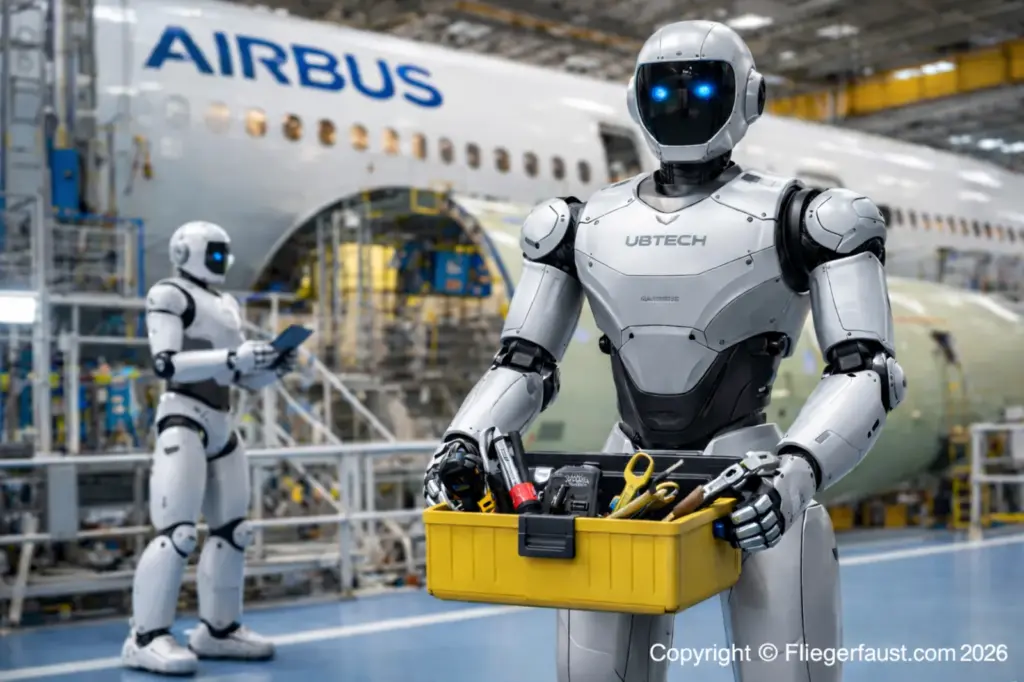
Meanwhile, that number does not kill the Walker S2 case. It qualifies it. A machine can still earn a place on the shop floor if it covers unpopular shifts, reduces ergonomic strain, handles low-value transport work, or captures clean process data. However, it also shows that humanoids remain well short of the easy labour-substitution story implied by many promotional videos, while the obvious industrial expectation is that UBTECH will keep improving Walker S2’s speed, stability, autonomy, and task performance over time.
Therefore, Airbus’ caution now looks more rational than timid. If the technology is still materially less productive than a person in many tasks, then a major aerospace manufacturer has every reason to test quietly, define narrow use cases, and avoid theatrical claims until repeatability improves. Airbus is also likely planning for Walker S2 updates and performance upgrades over time.
Overall, even so, the Walker S2 Airbus trial still lacks published productivity data from Airbus itself. That gap is why the Walker S2 Airbus trial remains more intriguing than proven. The commercial case and the plant-level case are moving on different clocks.
Walker S2 Airbus trial versus Boeing’s factory discipline
Boeing kept automation inside a quality-and-training frame
By contrast, Boeing’s public factory story since January 24 has focused on discipline before spectacle. The company’s innovation language still includes Smart Factory, human-robotics collaboration, and technology-enabled quality systems. Yet its most concrete 2026 factory disclosures have centred on quality assurance, training, audits, tooling control, work in process, and supplier-quality recovery rather than a named humanoid deployment.
On February 5, 2026, Boeing updated its Safety & Quality Plan with unusually detailed factory measures. Boeing said it had enrolled more than 5,000 employees in its Foundational Training Center, digitised foundational training, launched a radio-frequency identification tool-control pilot on the 737 and 787 programmes, implemented a new work in process system across all commercial-aircraft final assembly areas, and assessed more than 5,000 production-line moves with move-ready criteria.
Moreover, Boeing said defects in 737 fuselage assembly at Spirit AeroSystems had been reduced by an average of 45 per cent since March 2024. Reuters then reported on February 12, 2026, that Boeing spends 40 per cent fewer hours fixing supply-chain problems than it did in 2024. — Reuters, February 12, 2026 The two figures likely reflect different baselines, not a contradiction.
Notably, Boeing’s own innovation page still states the broader ambition. Boeing says it is investing in “Smart Factory, human-robotics collaboration and technology-enabled quality systems.” — Boeing, Innovation page However, the live public record shows Boeing applying that ambition through process architecture, not through a public humanoid trial. In comparison, Boeing has not disclosed a programme comparable to the Walker S2 Airbus trial.
Consequently, Boeing’s public focus sits far from the Walker S2 Airbus trial model and much closer to factory discipline. Production people tend to trust torque values more than headlines, and often for good reason. That is not anti-technology. It is a different order of priorities.
Boeing’s technology roadmap moved, but not toward a humanoid headline
Additionally, Boeing gave another useful signal on March 12, 2026, when it named Lane Ballard its chief technology officer and created an expanded Engineering and Technology Innovation organisation. Boeing said Ballard’s background includes advanced manufacturing, fabrication, assembly, and automation. “E&TI reflects our goal to grow technology innovation and our domain expertise and human knowledge together …” — Howard McKenzie, chief engineer and executive vice president of Engineering, Test and Technology, Boeing
Meanwhile, that announcement matters because it confirms Boeing is not stepping away from automation. It is reorganising around it. Yet the company is still describing the work at the level of capability, governance, and engineering depth, not at the level of a headline-grabbing humanoid pilot.
Boeing’s ramp still depends on pacing and labour
Separately, Boeing’s most revealing factory story this spring came from Everett. On April 7, 2026, Boeing said its North Line for 737 MAX production would start with low-rate initial production and use its first aircraft to demonstrate conformity to the Federal Aviation Administration (FAA) before joining normal flow. “You don’t start with a marathon. You start with shorter distances and build up from there.” — Jennifer Boland-Masterson, production leader for the Everett line, Boeing
Moreover, Reuters reported on February 10, 2026 that Boeing planned to open its fourth 737 production line in mid-summer 2026, while the next move to 47 aircraft a month looked more likely in 2027 than in 2026. Reuters then reported on April 14, 2026 that wiring rework on about 25 737 MAX aircraft slowed March deliveries, and on April 16, 2026 that Boeing was hiring 100 to 140 factory workers a week to support output growth, staff the new line, and replace retirees. — Reuters, April 14, 2026; Reuters, April 16, 2026
Therefore, the comparison should not be reduced to “Airbus automates, Boeing does not.” Both companies are clearly investing in advanced factory systems. The sharper distinction is this: Airbus has allowed a humanoid pilot to become part of its public image, while Boeing has kept its public image centred on factory control, learning curves, labour, and operational credibility. For wider industrial context, see our Fliegerfaust analysis of Boeing’s China 500 jets order, politics and production pressure. It is a less cinematic strategy, but aircraft factories are not built to impress cinema.
Walker S2 Airbus trial and the jobs question
Airbus factory robots fit a human-centric script
However, the labour question remains impossible to ignore. Humanoid robots trigger a stronger public reaction than fixed automation because they look like substitute labour even when they are not productive enough to deliver that substitution. Airbus clearly understands this. Its public language keeps returning to ergonomics, repetitive work, and job transformation.
Moreover, Airbus’ own robotics page states that strategy with unusual clarity. The company says robotics and automation are focused on assembly, paint, quality control, logistics, and composites. It also says robots should take the most repetitive tasks so operators can move to more complicated work. “Robots also create new job opportunities for operators.” — Airbus, Robotics page
Meanwhile, that message also fits Airbus’ wider production reality. The company is still trying to increase output while managing supply-chain friction. In that setting, a robot that removes one painful repetitive task is helpful. A robot that creates labour confusion is not. For now, the Walker S2 Airbus trial looks more like task redesign than direct job replacement, but workers still have reason to worry as the technology improves and spreads.
Therefore, the sharper jobs question is not whether people vanish. It is which tasks migrate, which skills rise in value, and which new roles appear around supervision, maintenance, software integration, and safety control. The future of work rarely arrives in a straight line. It usually arrives through revised task sheets.
Walker S2 Airbus trial still needs worker and safety detail
Finally, the hardest missing pieces are not cinematic. They are procedural. Airbus has not publicly explained how the Walker S2 pilot handles worker-interface rules, collaborative-zone design, emergency-stop logic, traceability, or system integration with factory software. It has not disclosed whether the robot works inside a protected zone, how often a human must intervene, or how the company is measuring safety performance around the test.
Additionally, those questions matter more in aerospace than in a general consumer factory. Aircraft production carries exacting tolerance, documentation, and conformity demands. A robot that moves parts is one thing. A robot that enters a documented aircraft process is another. Once a machine touches real production flow, the discussion moves from novelty to governance very quickly.
Notably, there is also a geopolitical layer. UBTECH is a Chinese supplier. Airbus is a European manufacturer with global production and compliance exposure. Industrial secrecy may also explain the silence. Airbus has little reason to publish the site, task, workflow, safety, or performance details of an early pilot if those details would reveal production know-how before the company decides whether to scale it.
It does raise sensible questions about data handling, cyber review, export controls, and plant-level digital integration.
Consequently, safety will be one of the decisive tests, but the Walker S2 Airbus trial will move beyond a controlled pilot only if Airbus also sees repeatable productivity, reliable performance, workable integration, and a credible business case.
Until Airbus publishes measured results, the Walker S2 Airbus trial will remain an open industrial question. In aircraft manufacturing, the dullest paragraph often contains the most important fact.
Conclusion: Walker S2 Airbus trial still needs proof
The picture is clearer now. Airbus deserves credit for testing a controversial technology in a real manufacturing setting. UBTECH deserves credit for moving Walker S2 into a more credible production-and-delivery phase. Boeing deserves credit for showing that factory recovery still rests on training, conformity work, quality control, and workforce depth.
However, the public evidence remains uneven. Airbus has revealed more about the automation ecosystem around the Walker S2 Airbus trial than about the trial itself. UBTECH has shown commercial momentum, but Airbus has not shown task-level results from the pilot. Boeing, by contrast, has shown far more about factory recovery, hiring, and ramp discipline than about any comparable humanoid effort.
The balance is straightforward. Airbus has the more provocative story. Boeing has the more convincing factory case. The real test will come only when Airbus discloses the task, the site, the safety framework, and measurable results from the Walker S2 Airbus trial.
Overall, the Walker S2 Airbus trial matters, but it is still a hypothesis in search of proof. Until Airbus publishes hard performance data, Boeing’s quieter path may look less exciting but more credible on the shop floor. When the next production ramp tightens, which will count for more: the bolder robot or the steadier factory?
Beyond the Walker S2 Airbus trial: who owns the aerospace future?
The larger direction is already visible. One day human hands will be rare on many factory and assembly floors. Not this year and not next, but it will happen. The first major aerospace company that learns by doing — experimenting, investing, developing, and testing at scale — may build a data advantage, an operational learning curve, and a competitive moat that late movers will struggle to close once humanoid systems stop being spectacle and start becoming industrial infrastructure.
And the factory floor is only the beginning. The same logic will move from material handling and inspection into production planning, tooling strategy, design optimisation, and eventually parts of aircraft engineering itself. At that point the questions become larger than one pilot and one supplier. Who captures the value when humanoid systems become good enough — the airframer, the robot maker, or the software layer that controls the factory? What happens to the aerospace workforce then — fewer people, different people, or the same people with radically different roles and bargaining power?
If one manufacturer reaches scalable factory autonomy first, does it lock in a lasting cost and throughput advantage, or does it simply raise the competitive bar for everyone else? And when AI begins to shape design choices as well as factory decisions, who carries responsibility when a bad design, a production flaw, or a safety failure slips through?
What do you think?
Will your grandchildren live in a world where aircraft are increasingly designed by AI, built by robots, inspected by machine vision, and overseen by far fewer human hands than today?
Leave your answers and comments below and on our Fliegerfaust Facebook page.
Sources
- Airbus — Airbus SE Report of the Board of Directors 2025 (February 18, 2026).
- Airbus — Airbus reports Full-Year (FY) 2025 results (February 19, 2026).
- Airbus — Robotics (accessed April 18, 2026).
- Boeing — Strengthening Safety & Quality (updated February 5, 2026).
- Boeing — Innovation (accessed April 18, 2026).
- Boeing — North Line team readies Everett for 737 MAX production (April 7, 2026).
- Boeing — Boeing names Lane Ballard chief technology officer (March 12, 2026).
- Financial Times — Robots only half as efficient as humans, says leading Chinese producer (January 25, 2026).
- Hong Kong Exchanges and Clearing — UBTECH ROBOTICS CORP LTD Annual Results Announcement for the Year Ended December 31, 2025 (March 31, 2026).
- Reuters — UBTech agrees Airbus deal to expand robot use in aviation manufacturing (January 21, 2026).
- Reuters — US planemaker Boeing plans to open fourth 737 production line in midsummer (February 10, 2026).
- Reuters — Boeing sees significant supply chain quality gains (February 12, 2026).
- Reuters — Boeing jet deliveries slow in March due to 737 MAX wiring issue (April 14, 2026).
- Reuters — Boeing hiring more than 100 factory workers a week to boost output, replace retirees (April 16, 2026).
- UBTECH — Company Profile (accessed April 18, 2026).
- UBTECH — Walker S2 (accessed April 18, 2026).
For full details, please refer to our Disclaimer page.