
Canada GlobalEye talks now put Saab, Bombardier and Canada’s Arctic surveillance ambitions on the same flight path, but did Ottawa just make a procurement choice or a sovereignty statement?
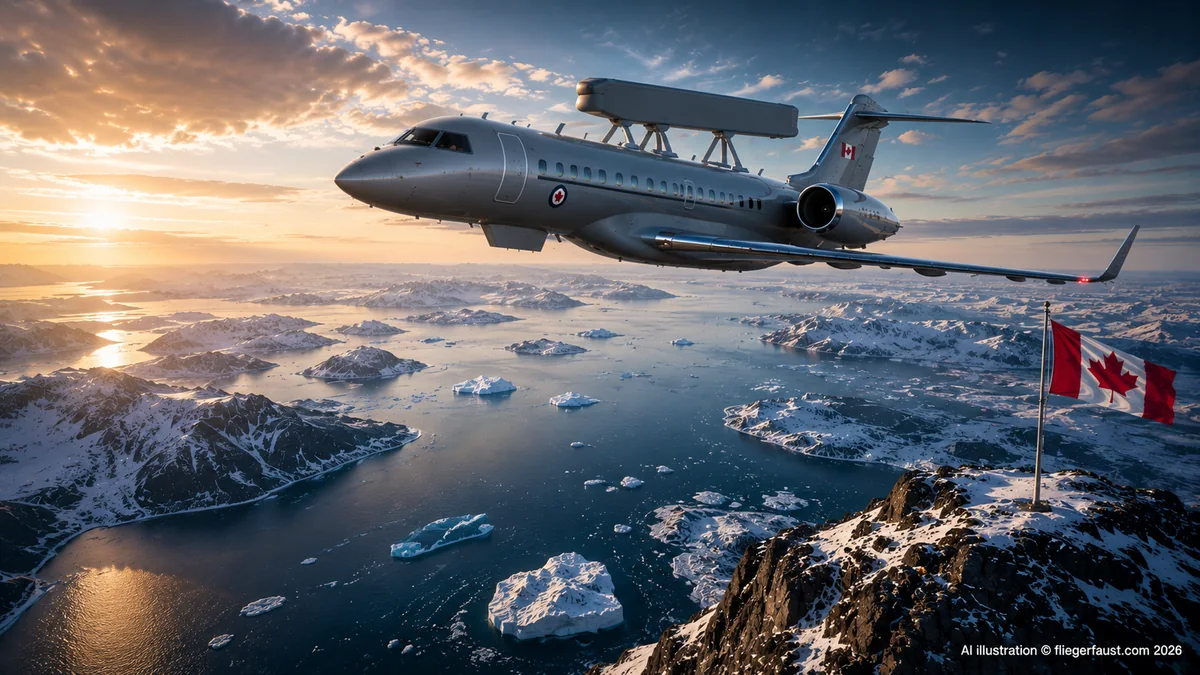
On Wednesday, May 27, 2026, Prime Minister Mark Carney announced at CANSEC 2026, inside the Cohere Centre, formerly the EY Centre, in Ottawa, that Canada had entered negotiations to procure Saab’s GlobalEye airborne early warning and control (AEW&C) aircraft.
Canada GlobalEye: what Carney announced at CANSEC
Canada GlobalEye talks are formal, not final
Notably, the room mattered. CANSEC 2026, produced by the Canadian Association of Defence and Security Industries, runs May 27-28 at the Cohere Centre in Ottawa. Moreover, the organiser describes it as Canada’s leading defence, security and emerging technology event.
The announcement placed Carney before defence executives, suppliers, military officials and international delegations. Therefore, the signal went beyond a normal fleet update. In procurement, location can be half the message, even when the aircraft has not yet left the brochure.
Reuters reported on May 27, 2026, that Canada planned to buy Saab’s GlobalEye rather than Boeing’s E-7 Wedgetail.
Consequently, Carney framed the decision as industrial and strategic. “(This move) builds Canadian strategic autonomy, creates Canadian jobs, and reinforces Canada’s position as a global leader.” — Prime Minister Mark Carney, quoted by Reuters
However, Saab’s wording keeps the legal status precise. Saab said on May 27, 2026, that Canada will enter detailed discussions and formal negotiations with Saab as preferred supplier. It also said it has not signed a contract or received an order.
Therefore, Canada GlobalEye should be read as a preferred-supplier negotiation, not an aircraft delivery notice. That difference matters because Ottawa has not yet published the final contract value, delivery schedule, aircraft configuration or industrial workshare terms. It also keeps pressure on the government to turn the announcement into a binding procurement package.
Canada GlobalEye and the Bombardier industrial logic
Saab GlobalEye puts a Canadian jet under Swedish sensors
Notably, GlobalEye gives Ottawa a message it struggled to attach to other recent surveillance purchases. The aircraft is based on the Bombardier Global 6500, a Canadian-manufactured long-range business jet. Its mission system is Swedish. That industrial package is almost too tidy for a procurement file.
According to The Associated Press (AP) report on May 27, 2026, Carney said Canada had entered negotiations to procure Saab’s AEW&C aircraft, built on the Bombardier Global 6500. Additionally, AP reported that the federal government had previously identified a requirement for six radar aircraft.
Moreover, Saab says it has offered to build, maintain and upgrade Canadian GlobalEyes with Canadian partners. It also says the plan includes technology transfer, research and development in Canada, and domestic defence-industry growth.
Bombardier’s own statement sharpens that industrial point. Bombardier said on May 27, 2026, that the government’s intention would bring GlobalEye modification and integration work to Canada, carried out by skilled Canadian aerospace workers. It also said Bombardier is entering discussions with Saab to lead the modification programme and Canada’s industrial role in potential exports.
“The intention to bring GlobalEye modification and integration work to Canada, to be carried out by skilled Canadian aerospace workers, is a perfect example of a robust and comprehensive Defense Industrial Strategy at work, focused on building in Canada.” — Bombardier statement
For Bombardier, Canada GlobalEye would extend the Global 6500’s role beyond corporate transport and special-mission conversions. It would also keep more of the strategic-aircraft narrative in Montréal, Toronto and Ottawa. Defence policy rarely gives aerospace workers a centre-stage cue; this one does.
“GlobalEye offers proven capability for the Royal Canadian Air Force, sovereign ownership for Canada and comprehensive and skilled work for Canadian industry.” — Micael Johansson, President and Chief Executive Officer, Saab
Canadian industrial workshare remains the key test
However, the original MT Newswires item, citing CTV, added a sharper industrial claim. It said Ottawa was negotiating for at least one third of the projected fleet to be manufactured in Canada over 15 years. Public corporate releases do not yet quantify that workshare.
Therefore, the final contract package must answer the harder questions. Specifically, it should identify Canadian assembly, mission-system integration, training, maintenance, software support and upgrade work. Aerospace jobs look better when they come with torque settings, not adjectives.
This is where the announcement connects directly with earlier Fliegerfaust reporting. Readers can compare today’s move with our Fliegerfaust analysis of North Atlantic Treaty Organization (NATO) GlobalEye and the Bombardier-Saab bid, which examined the same aircraft family in alliance surveillance planning.
Canada GlobalEye capability over the Arctic
AEW&C aircraft capability starts with sensor altitude
However, GlobalEye is not a simple radar pod on a business jet. Saab’s GlobalEye product page describes a multi-domain AEW&C system using active and passive sensors for air, sea and land surveillance. Specifically, it combines the Erieye Extended Range radar, an advanced sensor suite and multi-domain Command and Control (C2).
Specifically, Saab lists more than 12 hours of endurance. Additionally, it gives an instrumented range above 350 nautical miles, or about 650 kilometres. The company also cites 6,500-foot airfield performance, which matters for dispersed northern operations.
Moreover, the sensor promise reaches beyond classic air defence. Saab says GlobalEye can detect small sea targets, objects down to periscope size, moving ground targets and low-signature air threats. It also says the system is designed for cluttered and jamming environments.
Consequently, that is why Carney tied the aircraft to the north. “Saab’s GlobalEye will be a key resource for the Canadian Armed Forces to detect and deter threats across the Arctic.” — Prime Minister Mark Carney, quoted by The Associated Press
The Arctic surveillance argument also connects with Fliegerfaust’s Arctic defence plan analysis, which examined Ottawa’s March 12, 2026 northern defence package, expanded military airfields, operational support hubs and the larger cost of delayed Arctic sovereignty investment. GlobalEye would not solve Canada’s northern infrastructure gaps alone, but it would add a mobile airborne sensor layer to the same warning, control and deterrence problem.
Arctic surveillance aircraft fits NORAD geometry
For the Royal Canadian Air Force (RCAF), an organic airborne warning fleet would fill a longstanding gap. Canada relies heavily on ground sensors, allied assets and North American Aerospace Defense Command (NORAD) integration. However, aircraft can move the radar horizon to where the mission demands it.
Moreover, Arctic surveillance now includes cruise missiles, drones, maritime approaches and electronic warfare. Therefore, a high-altitude sensor aircraft does not replace satellites or ground radars. It connects them faster and closer to the commander’s decision cycle.
Additionally, the aircraft’s business-jet base matters operationally. Long endurance, high cruise efficiency and smaller basing needs all support wide-area patrol.
Canada GlobalEye also changes the RCAF operating mindset. Instead of waiting for fixed sensors to produce the whole picture, commanders can push the sensor where the gap appears. In the Arctic, that mobility can matter more than raw catalogue range.
Canada GlobalEye versus United States alternatives
Saab-Bombardier surveillance jet beats a familiar American path
The competitive context gives the story its edge. Reuters reported that Boeing’s E-7 Wedgetail had been in contention. AP identified two American alternatives: Boeing’s E-7A Wedgetail and L3Harris’s Aeris X. The Aeris X is also using the Bombardier Global 6500.
However, the E-7 is not a weak aircraft. It has real allied pedigree and remains a serious airborne warning platform. Yet Reuters reported that the aircraft has suffered delays and cost overruns, which weakened its position in Canada’s decision cycle.
The politics are larger than one surveillance fleet. Reuters reported on April 27, 2026, that Canada was still reviewing its C$19 billion plan to buy 88 Lockheed Martin F-35 fighters. Defence Minister David McGuinty said Ottawa was still studying the fighter fleet question.
Separately, Canada has already wrestled with the industrial consequences of buying major surveillance platforms from United States (U.S.) lines. For background, see our Fliegerfaust post on Canadian surveillance aircraft built in Texas and our Fliegerfaust coverage of the Canada F-35 review.
Canada GlobalEye connects Saab, Bombardier and Gripen
Canada GlobalEye gives Ottawa a comparative answer without declaring every American platform inadequate. It also extends the same Saab-Bombardier-Ottawa industrial logic Fliegerfaust has tracked in the Saab Gripen file, where a fighter alternative, Canadian production work and strategic autonomy became one political argument. Our Fliegerfaust Gripen deal Canada update and our Fliegerfaust Bombardier Gripen Canada analysis explain why today’s GlobalEye move looks like part of a wider Saab-Canada negotiation track, not a standalone aircraft choice.
U.S. interoperability remains unavoidable
Even so, this is not a clean anti-American break. AP reported that GlobalEye still carries 20% U.S. content. Meanwhile, Canada’s defence infrastructure remains deeply tied to NORAD, U.S. sensors and U.S. weapons networks.
The better reading is diversification, not divorce. Ottawa is trying to buy enough sovereign control to matter, while preserving enough U.S. interoperability to fight.
Additionally, Sweden offers a politically useful middle lane. It is a NATO ally, a sophisticated defence-industrial state and an Arctic-adjacent partner. Therefore, a Swedish mission system on a Canadian aircraft gives Ottawa a transatlantic answer without abandoning continental defence.
Canada GlobalEye gains allied momentum
Saab GlobalEye now has customer depth
Carney’s argument also leans on allied uptake. Reuters quoted him saying GlobalEye is the product of choice for partners including France, Sweden and the United Arab Emirates (UAE). However, that is not just sales brochure language.
First, Saab announced Sweden’s order for two GlobalEye aircraft on June 30, 2022, with deliveries planned during 2027. Then, Saab announced a third Swedish GlobalEye on June 27, 2024.
Next, France added weight. Saab announced France’s firm order on December 30, 2025, for two GlobalEye aircraft. The value was approximately 12.3 billion Swedish kronor (SEK), with deliveries scheduled from 2029 to 2032 and options for two more aircraft.
Meanwhile, Saab delivered the fifth GlobalEye to the UAE on September 17, 2024. The company said that completed a five-aircraft series delivered since 2020. In airborne warning, company on the flight line matters almost as much as altitude.
Canada GlobalEye can also help Ottawa speak the same surveillance language as European partners. That matters when air, maritime and missile-warning pictures need rapid sharing. Interoperability is not only American; it is increasingly alliance-wide.
Allied AEW&C aircraft demand lowers programme risk
For Canada, those customers reduce programme risk. Specifically, Sweden brings sovereign familiarity. France brings a major European air force. Meanwhile, the UAE brings operational experience with the aircraft already in service.
Additionally, AP reported that NATO is also considering Saab’s aircraft over American options. That gives Ottawa useful cover. Canada can present the decision as aligned with an emerging European surveillance architecture, not as an isolated rejection of Boeing.
However, allied momentum cannot substitute for Canadian delivery discipline. Ottawa still needs a basing plan, crew pipeline, sustainment model, data-sharing architecture and Arctic operating concept.
The Canada GlobalEye file therefore moves from political announcement to execution risk. Negotiators must turn broad industrial promises into enforceable obligations. Otherwise, the programme could deliver a Swedish aircraft with Canadian branding, rather than a durable Canadian capability.
Conclusion: Canada GlobalEye is smart, but not signed yet
Arctic surveillance aircraft must become a delivered fleet
Overall, Canada has found a credible surveillance platform, a Canadian industrial hook and a European strategic partner in one package. That is rare. Additionally, it gives Bombardier’s Global family another defence role at a moment when special-mission business jets are becoming serious military assets.
Even so, the next test is execution. Specifically, Ottawa must publish the contract value, delivery timetable, basing concept, training plan, sustainment structure and Canadian workshare. Otherwise, strategic autonomy remains a slogan mounted above a procurement file. That discipline matters because crews, data links and sustainment contracts decide whether promising aircraft become usable capability.
However, the choice also raises a harder policy question. If Canada can justify a Swedish mission system on a Canadian jet for airborne warning, why should other defence files default to U.S. prime contractors before domestic industrial options receive comparable scrutiny?
Tell us what you think, leave your comments at the bottom
Overall, Canada GlobalEye looks like a technically sound and politically coherent pivot. Finally, the critical view is that coherence without a signed contract, delivery discipline and verified Canadian workshare is still polished intent—will Ottawa turn this surveillance pivot into aircraft on ramps before the Arctic threat picture outruns the procurement calendar?
Leave your answers and comments below and on our Fliegerfaust Facebook page.
Sources
- Reuters — Canada to buy Swedish early warning planes rather than US model (May 27, 2026).
- The Associated Press — Carney says Canada will buy European surveillance planes over two American options (May 27, 2026).
- Saab — Canada engages Saab as preferred supplier of future AEW&C capability (May 27, 2026).
- Bombardier — Bombardier Statement on Government of Canada Intention Regarding New Airborne Early Warning & Control Fleet (May 27, 2026).
- CANSEC — CANSEC 2026 event information (May 27-28, 2026).
- Saab — GlobalEye AEW&C (accessed May 27, 2026).
- Reuters — Canada is still reviewing plan to buy US fighter jets, defense minister says (April 27, 2026).
- Saab — Saab Receives Order for Two GlobalEye for Sweden (June 30, 2022).
- Saab — Saab signs contract with Swedish FMV for a third GlobalEye (June 27, 2024).
- Saab — Saab receives order for GlobalEye from France (December 30, 2025).
- Saab — Saab delivers fifth GlobalEye to the United Arab Emirates (September 17, 2024).
- Bombardier — Bombardier Statement on Government of Canada Intention Regarding New Airborne Early Warning & Control Fleet (May 27, 2026).
For full details, please refer to our Disclaimer page.