

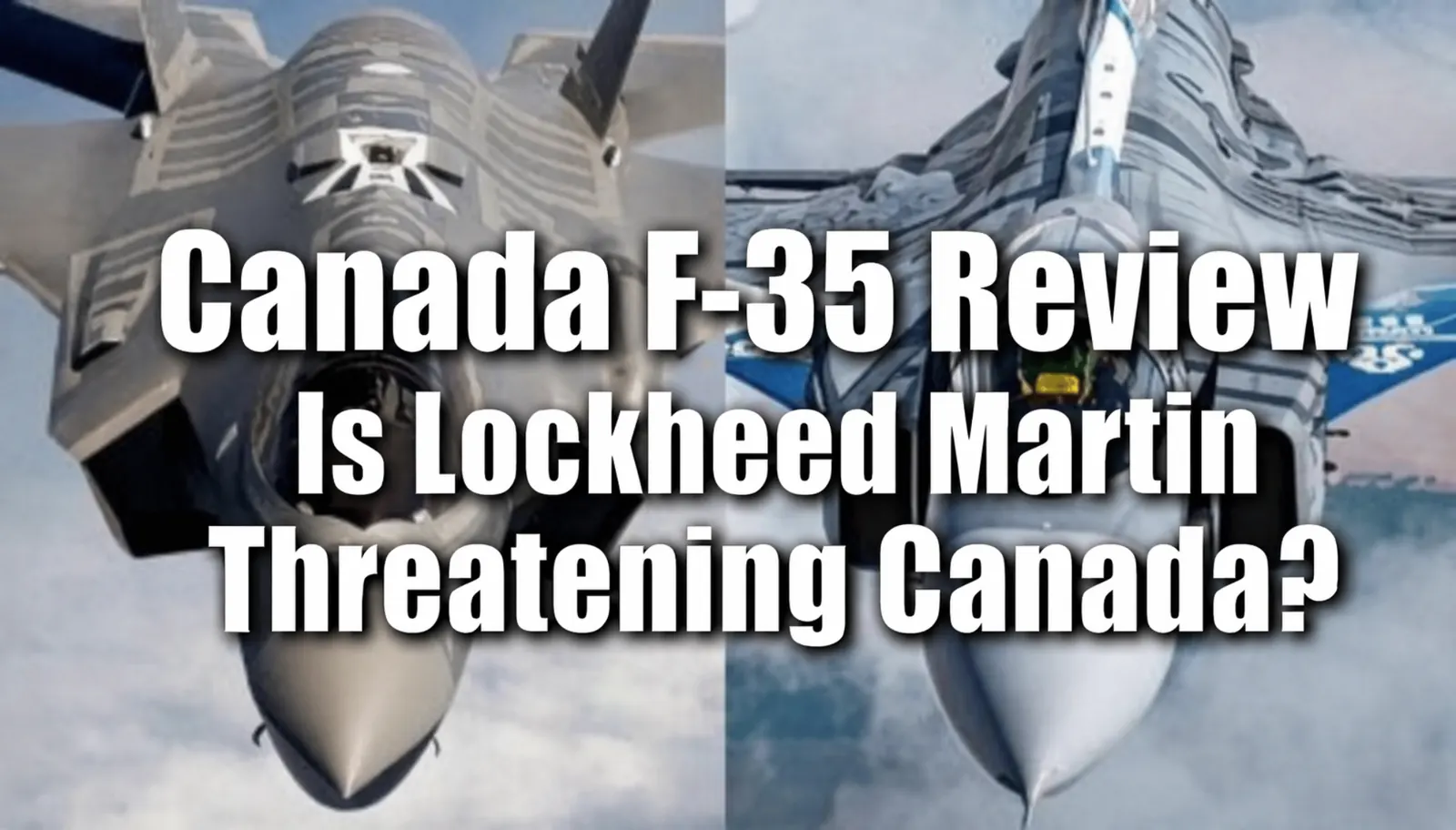
Canada F-35 review: is Lockheed Martin coming to Quebec, Canada, to make threats?
Canada F-35 review: According to Montreal daily La Presse on April 20, 2026, representatives of Lockheed Martin are due at L3Harris beside Montréal–Mirabel International Airport (YMX/CYMX) in Mirabel, Quebec, Canada, for a public move tied to the proposed F-35 maintenance-centre project. Moreover, the report says the event should take the form of a collaboration protocol rather than a financial commitment. The message is blunt: if Ottawa stops after the first 16 aircraft, or cuts the wider F-35 plan far enough, the Mirabel project can be torpedoed.
Also read the part 2 of this story: Mirabel Defence Hub: Canada’s Two-Front Aerospace Fight
This post follows our earlier Fliegerfaust reporting on the Gripen-GlobalEye path for Canada, Bombardier and Gripen in Canada, Saab’s “build it here” case for Canada, and F-35 cancellation risks, supplier losses, job impacts, and the Gripen alternative.
Canada F-35 review moves beyond the original competition
Canada fighter review became an industrial policy fight
On January 9, 2023, the Government of Canada said it had finalized an agreement to buy 88 F-35A fighters for the Royal Canadian Air Force (RCAF), Canada.ca. Moreover, Ottawa priced the acquisition at about C$19 billion. It said deliveries would begin in 2026. It also said full operational capability would follow between 2032 and 2034.
Additionally, the same 2023 release sold the deal as an industrial win. Ottawa said acquisition and initial sustainment could add more than C$425 million a year to Canada’s gross domestic product (GDP). It also said the package could support about 3,300 jobs a year over 25 years. Overall, the case looked closed.
The politics changed on March 15, 2025. Associated Press reporting on March 15, 2025 showed that Prime Minister Mark Carney had ordered a review. The same report said Ottawa had already made a legal commitment of funds for the first 16 aircraft. Moreover, the first public line from Ottawa was cautious, not revolutionary. “To be clear, the F-35 contract has not been canceled, …” — Laurent de Casanove, defence ministry press secretary, AP News.
Meanwhile, Carney gave the file a more strategic edge on March 25, 2025. “We have alternatives to the F-35 … including greater investment here in Canada, greater production here in Canada.” — Mark Carney, Prime Minister of Canada, Reuters The review moved beyond aircraft performance. It pushed the Canada F-35 review toward leverage, domestic control, and alliance risk.
This was no longer just a replay of the 2022 competition. It became a test of whether Canada still wanted the same aircraft under new political terms. In Ottawa, even the spreadsheets now want air superiority.
F-35 review Canada slipped past its first deadline
On June 25, 2025, Carney said the review would be done by the end of summer 2025, according to Reuters reporting from the North Atlantic Treaty Organization (NATO) summit in The Hague. That deadline slipped, and the delay turned out to be revealing.
Official briefing material later showed how broad the review had become. In Supplementary Estimates material released on December 4, 2025, Canada.ca, the Department of National Defence (DND) said it was weighing operational needs, North American Aerospace Defense Command (NORAD) and NATO commitments, industrial benefits, strategic partnerships, delivery timelines, and potential alternatives. The same note said C$476 million was being reprofiled from future years for the Future Fighter Capability Program to fulfill financial commitments, including payments under the F-35 memorandum of understanding with the U.S. government.
Additionally, a National Defence committee briefing note for the House Committee on Public Accounts, Canada.ca added the phrase that changed the tone of the debate. Specifically, it said the review was considering all options, including a mix of fighter aircraft. Consequently, Ottawa was not only revisiting pace or price. It was testing whether a compromise fleet could be made politically useful, even if it looked operationally awkward.
By February 17, 2026, Reuters reported that the review had been delayed as Ottawa launched a wider defence industrial reset. By March 2026, the Department of National Defence status report on transformational and major capital projects, Canada.ca added another pressure point. It said the impact of tariffs imposed by the United States (U.S.) on the F-35 acquisition remained under review.
The Canada F-35 review is now bigger than the aircraft alone. It sits inside a trade dispute, a sovereignty debate, and a procurement reform agenda. For context on how the alternative gained traction, see our Fliegerfaust analysis of the Bombardier Gripen-GlobalEye path for Canada.
Canada F-35 review gives Lockheed Martin a new case to make
Canada fighter review now rewards sovereign control
On February 26, 2026, Ottawa published Canada’s Defence Industrial Strategy, Canada.ca. Moreover, the document did more than announce money. It reset the logic of procurement.
Specifically, the strategy introduced a “Build-Partner-Buy” framework. Moreover, it said Canada wanted to increase the share of defence acquisitions awarded to Canadian firms to 70 per cent. Additionally, it targeted 125,000 quality new jobs, a 50 per cent increase in defence exports, an 85 per cent increase in defence-related research and development, and more than 240 per cent growth in defence industry revenues over the next decade.
Additionally, the strategy named aerospace, in-service support, and training and simulation as sovereign capability areas. Moreover, that matters because those are precisely the areas where Lockheed can now respond. The Canada F-35 review no longer turns only on stealth, sensors, or weapons integration. It now turns on who controls depots, simulators, upgrades, and long-tail sustainment.
Separately, Ottawa’s follow-on messaging reinforced the same theme. In February and March 2026, multiple government releases described the strategy as a way to rebuild domestic capacity, secure supply chains, and reduce dependence on foreign suppliers. A fifth-generation jet is impressive. A domestic depot is also impressive when the politics get rough.
F-35 review Canada now includes a real Canadian footprint
Lockheed’s best answer starts with the industrial base that already exists. The official Future Fighter Capability Project page, Canada.ca says there are over 30 active contractors in Canada contributing to the global F-35 fleet. It also says Canadian industry had received more than US$3.3 billion in development and production contracts as of January 2025.
Meanwhile, later Canadian briefing notes added sharper detail. The December 2025 National Defence briefing material, Canada.ca said 37 Canadian companies held F-35 contracts. It also said each aircraft in global production contained about C$3.2 million in Canadian-made components. That is not abstract value. It is work already moving through Canadian factories.
However, another official note broadened the picture again. The October 2025 committee briefing material, Canada.ca said over 110 Canadian companies had contributed to the production and development of the F-35. It also said every F-35 produced for the global programme contained about C$3.6 million in Canadian-made components as of March 2025. Specifically, the smaller official number counts current contract holders. The larger one captures cumulative contributors across the programme’s life.
Consequently, Lockheed’s riposte is no longer only an inference. According to La Presse, representatives of Lockheed Martin are due at L3Harris in Mirabel to unveil a collaboration aimed at positioning the site as a maintenance hub for the F-35. Moreover, the report says the event should take the form of a collaboration protocol and should not include a financial commitment from Lockheed Martin. That makes the move politically useful, but not yet financially decisive.
Earlier, the company had been far more restrained in public. “Questions about Canada’s procurement of the F-35 are best addressed by the Canadian and U.S. governments.” — Lockheed Martin spokesperson, AP News
Canadian fighter procurement is also about depots and training
Lockheed’s case becomes stronger where Ottawa has already set hard markers. On November 25, 2024, the federal government named L3Harris MAS in Mirabel as strategic partner for a potential CF-35A airframe maintenance depot, Canada.ca. Specifically, that project goes straight to sovereign sustainment.
Moreover, the government’s own language sounded remarkably close to Lockheed’s current line of argument. “Today’s announcement is about building long-term capacity for our military, protecting our sovereignty and creating jobs across the country.” — Jean-Yves Duclos, Minister of Public Services and Procurement, Canada.ca
Additionally, Ottawa took a second step on February 12, 2025. The government named CAE of Montréal as strategic partner for the Future Fighter Lead-in Training (FFLIT) program, Canada.ca. Moreover, Ottawa said that training effort could contribute C$145 million a year to gross domestic product (GDP). It also said the programme could create or maintain 1,100 jobs a year over 37 years.
Those two files matter more than many public arguments over radar cross-section. A Canadian depot and a Canadian training pipeline are not side issues. Consequently, they are the operational and political infrastructure of the fleet. No minister ever gives a rousing speech about sustainment, yet sustainment usually gets the last word.
F-35 review Canada can point to a foreign industrial template
Lockheed also has a recent European example that matters. On March 18, 2026, Lockheed Martin said it had finalized all 11 industrial cooperation project agreements for the Czech F-35 program. Moreover, the company said those commitments involved collaboration with 12 Czech companies and universities.
Additionally, Lockheed said the Czech projects covered research, development, design, testing, and manufacturing of advanced aerospace and defence technologies. It also linked the package to long-term jobs, training, supply-chain work, modifications, and upgrades. Consequently, the mix looks familiar for a reason. It is the same mix Ottawa now cares about.
F-35 review Canada and the Czech template
This matters because the Canada F-35 review is not asking Lockheed to invent an industrial answer from scratch. It is asking whether Lockheed can localize enough of that answer for Canadian politics. However, the Czech precedent does not prove Canada would get the same deal. However, it does prove the company knows how to build a modern cooperation package around the F-35.
Ottawa is no longer rewarding offsets for their own sake. It is rewarding durable control over support, skills, and industrial depth. Moreover, the Czech example shows how Lockheed can package additional local work and investments around an F-35 purchase without pretending the aircraft itself becomes domestically designed. That distinction matters. Canada is not deciding whether to invent a new fighter. It is deciding how much sovereign control it can extract from the fighter it buys.
Therefore, the likely riposte is not only “the F-35 already won.” It is “the F-35 can still be adapted to Canada’s new procurement vocabulary.” In 2026, that vocabulary is full of words like sovereignty, supply chains, sustainment, and domestic control. Even stealth aircraft must now speak fluent industrial policy. But when that message is delivered in Mirabel, Quebec, with the future of local F-35 work hanging in the balance, Canadians are entitled to ask: is Lockheed Martin making threats?
Canada F-35 review faces the Saab-Bombardier alternative
Canada fighter review no longer treats Gripen as a ghost bid
Saab’s opening is no longer hypothetical. On March 25, 2025, Reuters reported that Carney said the contract could be adjusted. Canada could stay committed to the first 16 F-35s. It could then explore other options for the remaining aircraft. Carney also said Ottawa wanted more investment and production in Canada.
Then came the industrial counteroffer. On November 13, 2025, Reuters reported that Saab was in talks with Canada and Bombardier to build Gripen fighters under licence in Canada. Saab chief executive Micael Johansson said the package could create around 10,000 jobs. Bombardier said it was open to contributing local expertise if Ottawa chose that path.
However, the optics changed again on March 25, 2026. Reuters reported that Brazil had unveiled the first Gripen assembled in the country. That matters in Canada because it turns Saab’s production promise into something concrete. Off-Sweden assembly is no longer a theory.
Therefore, Lockheed faces a tougher rival than the one it beat in the original competition. Saab is not only saying the Gripen is cheaper or easier to maintain. Saab is saying Canada can assemble fighters, keep more value at home, and build sovereign upgrade capacity. A factory is harder to dismiss than a slide deck. For continuity on that pitch, see our Fliegerfaust post on what we know now about Bombardier and Gripen in Canada.
F-35 review Canada now overlaps with the GlobalEye campaign
Saab widened the debate beyond the fighter itself. On May 28, 2025, Saab formally pitched GlobalEye for Canada’s Airborne Early Warning and Control (AEW&C) program. Moreover, the company stressed that the system is built on the Canadian-made Bombardier Global 6000 and Global 6500 platform. It also said the bid would maximize domestic content, create high-value jobs, and support sovereign capability.
Saab tied that pitch directly to Canadian industry. “With Bombardier’s world-class aircraft made right here in Canada … we believe GlobalEye represents a unique opportunity to deliver unmatched capability while growing Canada’s aerospace and defence sectors.” — Anders Carp, Deputy CEO of Saab, Saab
Meanwhile, Saab’s product material says GlobalEye offers more than 12 hours of endurance and instrumented range well above 350 nautical miles, or 650 kilometres, Saab. Moreover, those figures matter because Canada’s northern surveillance burden is growing, not shrinking.
Additionally, Ottawa’s own policy papers show that the airborne early warning file is not a side show. In April 2024, Our North, Strong and Free, Canada.ca set aside C$307 million over 20 years for airborne early warning aircraft. By the time the 2024-25 Departmental Results Report, Canada.ca was published, Ottawa said it had committed C$7.556 billion for airborne early warning aircraft to improve long-range detection of air and maritime threats, including in Canada’s northern approaches.
Saab’s proposition is broader than a substitute fighter. It is a Canadian-built surveillance and aerospace package. Additionally, Gripen and GlobalEye reinforce each other in that argument. That is why the Canada F-35 review now overlaps so closely with our Fliegerfaust report on Saab’s “build it here” case for Canada. Saab is not selling a jet so much as an industrial storyline with wings.
Canada F-35 review still runs into cost, schedule and fleet reality
Canada fighter review cannot wish away money already spent
On June 10, 2025, the Office of the Auditor General of Canada, Canada.ca delivered the hardest factual reset of the programme. Moreover, it said the project cost had risen from C$19.0 billion in 2022 to C$27.7 billion by 2024. Additionally, it said the public figure still excluded at least C$5.5 billion needed for full operational capability.
Moreover, the audit showed how far implementation had already moved. As of March 31, 2025, National Defence had committed C$935 million to the U.S. government for the first four jets and long-lead items for another eight. It had already paid C$197 million. Moreover, the department had also spent another C$516 million on the project, including C$270 million for infrastructure design and site preparation.
For the economic consequences of cutting or cancelling additional F-35s, see our Fliegerfaust analysis of F-35 cancellation risks, supplier losses, job impacts, and the Gripen alternative.
However, cost growth was only part of the warning. The Auditor General also flagged weak contingency planning, a persistent pilot shortage, and delays of more than three years for key fighter infrastructure. In fighter procurement, time is a harsher auditor than Parliament.
F-35 review Canada still collides with the calendar
Canada’s timing problem has not faded because politics became louder. The Future Fighter Capability Project page, Canada.ca says the first aircraft will be delivered to Luke Air Force Base (Luke AFB) in Arizona in 2026 for pilot training. It also says the first F-35 (CF-35) aircraft in Canada is due in 2028.
Meanwhile, the March 2026 status report on major capital projects, Canada.ca keeps initial operational capability in 2029 and full operational capability in 2033. The same report says delays in fighter squadron facilities forced the project to adopt an Interim Operations Plan to keep delivery on track.
That March 2026 report says production of the first Canadian main wing assembly began at Leonardo’s Cameri site in Italy. It also says the main wing for Canada’s first aircraft was delivered to Lockheed Martin in the U.S. in September 2025 for fuselage assembly. Specifically, those are not paper milestones. They are manufacturing milestones.
Therefore, Ottawa is not choosing between one clean start and another. It is choosing whether to stay on a line that is already moving. Instead, it is deciding whether to absorb the cost and complexity of changing direction while the CF-18 Hornet fleet edges toward retirement in 2032. On that point, the calendar has no ideology.
Canadian fighter procurement still struggles with the mixed-fleet idea
A mixed fleet remains politically attractive because it looks like a compromise. Yet the operational case is much less friendly. On August 7, 2025, Reuters reported that Canadian defence officials had made a strong internal case for sticking with the full 88-aircraft F-35 plan. The same report said the review stopped short of a formal recommendation. Officials argued that buying another jet from a European rival would create extra costs in training, supplies, and maintenance, while the Canadian Armed Forces remain highly integrated with their U.S. counterparts.
Even so, Ottawa never fully closed the mixed-fleet door. The October 2025 committee brief did not close it. The December 2025 estimates material did not close it either. Additionally, both said the review was considering a mix of fighter aircraft. La Presse went further, reporting that the idea of a mixed fleet of roughly 30 F-35s and about 50 Gripen Es was gaining ground inside the Carney government. The same report recalled Richard Foster’s warning that if Canada chose a mixed fleet, a regional F-35 maintenance centre at Mirabel would be unlikely to be profitable.
Commonality is not only a budget line. Official Canadian notes describe the F-35 as a joint and coalition platform built on strong partnerships with the U.S., NATO allies, and partner nations. Moreover, those same notes tie the delivery schedule to the phased retirement of the CF-18 fleet to avoid a capability gap. Consequently, Lockheed can argue that the real cost of change is not only financial. It also sits in training plans, software support, weapons integration, and continental defence routines. In coalition aviation, common fleets save more than PowerPoint ever admits.
F-35 review Canada also turns on coalition commonality
Lockheed still has scale on its side. Official Canadian notes say over 3,600 F-35 aircraft are now on order globally. Reuters also reported on January 7, 2026 that Lockheed delivered a record 191 F-35s in 2025. That pace strengthens the company’s argument that the F-35 remains the least disruptive path into a vast training, sustainment, and upgrade ecosystem.
Finally, there is the wider political risk of a hard break with Washington during a trade fight. On March 17, 2025, “Effectively, we could be targeted. This is my concern.” — Éric Martel, President and Chief Executive Officer of Bombardier, Reuters However, Martel was speaking about Bombardier’s own exposure. Yet the warning applies more broadly. Lockheed knows that too. Any Canadian riposte will rest, quietly but firmly, on the claim that continuity has value when the wider bilateral relationship is already strained.
Conclusion: Canada F-35 review now needs a sovereign answer
The real story in April 2026 is not that Ottawa suddenly discovered new fighter brochures. The story is that Canada changed the terms of judgment after the 2023 decision. Moreover, it then left the file open long enough for industrial politics to catch up with military procurement.
Lockheed Martin’s answer is now visible in plain sight. It is threatening Canada with the loss of Canadian suppliers, Canadian depots, Canadian training, and long-term Canadian value if Ottawa walks away from additional F-35s. If that is how Lockheed Martin wants to make its case in Canada, it should make the decision easier for Ottawa to walk away. Saab and Bombardier are surely listening.
Saab and Bombardier have changed the balance of the argument as well. They have turned the alternative from a rejected bid into a manufacturing proposition with sovereign overtones. Moreover, Brazil’s Gripen assembly line helps that case. So does Saab GlobalEye’s fit with Arctic surveillance and long-range warning needs.
Ottawa has effectively reopened the debate without formally rerunning the competition. Consequently, that creates risk as well as flexibility. If the government waits too long, it may pay for continuity while talking as if full optionality still exists. Overall, that is not strategy. Instead, it is drift with a briefing note.
The sharpest critical judgment is this: if Lockheed Martin wants to keep Canada in the F-35 camp, it must prove the aircraft can serve Canada’s new industrial doctrine and not merely its old military requirement. Likewise, Saab can still force a genuine rethink, but only if it proves sovereign assembly, support, and delivery can happen on the timeline Canada actually needs. No government enjoys choosing between interoperability and autonomy, yet pretending the trade-off can disappear is not serious policy.
Tell us what you think
How much longer can Ottawa afford to confuse flexibility with indecision, and how much of this is still negotiation rather than drift?
Leave your answers and comments below and on our Fliegerfaust Facebook page.
Sources
- Government of Canada — Canada finalizes agreement to purchase new fighter jets for Royal Canadian Air Force (January 9, 2023).
- Government of Canada — Future Fighter Capability Project (updated October 6, 2025).
- Government of Canada — Government of Canada announces strategic partner for its CF-35A fighter jet airframe maintenance depot (November 25, 2024).
- Government of Canada — Government of Canada announces strategic partner for its Future Fighter Lead-in Training program (February 12, 2025).
- Office of the Auditor General of Canada — Report 2—Delivering Canada’s Future Fighter Jet Capability (June 10, 2025).
- Government of Canada — House Committee on Public Accounts (PACP): Office of the Auditor General: Report 2, Delivering Canada’s Future Fighter Jet Capability, October 7, 2025 (October 7, 2025).
- Government of Canada — Standing Committee on National Defence (NDDN): Supplementary Estimates (B), December 4, 2025 (December 4, 2025).
- Government of Canada — Canada’s Defence Industrial Strategy (February 26, 2026).
- Government of Canada — Status report on transformational and major capital projects (March 13, 2026).
- Government of Canada — Our North, Strong and Free: A Renewed Vision for Canada’s Defence (April 8, 2024).
- Government of Canada — Departmental Results Report 2024-25 (November 7, 2025).
- La Presse — Lockheed Martin prépare sa riposte (April 20, 2026).
- Associated Press — Canada to Review the Purchase of US-Made F-35 Fighter Jets in Light of Trump’s Trade War (March 15, 2025).
- Reuters — Carney says Canada’s Lockheed Martin fighter contract could be adjusted (March 25, 2025).
- Reuters — Canada PM Carney says review of F-35 jet order will be over by end of summer (June 25, 2025).
- Reuters — Canada defense review makes case for sticking with F-35 jets, sources say (August 7, 2025).
- Reuters — Saab in talks with Canada, Bombardier to build Gripen fighter jets, Globe and Mail reports (November 13, 2025).
- Reuters — Lockheed says 2025 F-35 deliveries hit 191 as demand lifts production pace (January 7, 2026).
- Reuters — Canada, seeking to cut reliance on US arms, plans to boost defense output (February 17, 2026).
- Reuters — Bombardier CEO fears US could target firm if Canada scraps jet deal (March 17, 2025).
- Reuters — Brazil unveils first supersonic fighter jet assembled in country (March 25, 2026).
- Lockheed Martin Canada — Powering Canada’s Aerospace Future: The F-35 Industrial Impact (January 15, 2026).
- Lockheed Martin — Lockheed Martin Finalizes Industry Project Agreements for Czech F-35 Program (March 18, 2026).
- Saab — Saab ready to offer GlobalEye for Canada’s Airborne Early Warning and Control program (May 28, 2025).
- Saab — GlobalEye AEW&C (accessed April 21, 2026).
For full details, please refer to our Disclaimer page.

great report
The United States has proved itself to be an unreliable partner, a clear & present danger to both the economy and the security of Canada. For this reason Canadian voters elected PM Carney to lead Canada on a new path of developing new trade alliances in Europe and Asia, while strategically aligning Canada with NATO and the EU. A mixed fleet of F-35 and Gripen aircraft seems an obvious choice both politically and strategically, and one that is not unusual when we look at other middle powers such as Australia, the UK, India, etc. It is also the route taken by India, China, and by the US itself. Aircraft such as the F-35 and Gripen have widely different yet complementary strengths, and the significant difference in hourly operating costs itself offers significant cost reductions during the in-service life of these aircraft to offset the dual training and logistics driven by a mixed fleet. I suspect the results of the F-35 review will not be announced until the dust has settled around the imminent review of the CUSMA/USMCA free trade agreement. However whatever level of fractious debate comes out of the CUSMA discussiom, it would be inconsistent with the ‘rupture’ announced in Carney’s acclaimed Davos speech for Canada to leave all its eggs in the US basket and continue with the existing F-35 single fleet deal. Whatever Canada’s leadership decide, will have consequences the country will live with for decades to come.
CLEARY you haven’t seen what SAAB has done to Brazil. Saab has proven to be an incredibly unreliable partner for Brazil, rendering your praise of the Gripen program highly flawed. While you position the Gripen as a low-cost, politically stable hedge against American unreliability, Brazil’s actual procurement history reveals that turning away from the U.S. toward Saab resulted in massive logistical headaches, critical defense gaps, and ballooning costs.
A direct look at Saab’s track record in Brazil dismantles the narrative of the Gripen being a “safe” or “economical” alternative:
Severe Delays, Impending Capability Gaps and Failed Job Creation
– An Eight-Year Delivery Extension: Under the original 2014 contract, Saab was supposed to finish delivering all 36 Gripen E/F jets to the Brazilian Air Force (FAB) by early 2024. Instead, the delivery timeline has faced severe setbacks and has officially stretched out to 2032—an 8-year delay.
– Risk of a Defense Blackout: Because Saab has only delivered 11 of the 36 aircraft, Brazil is facing a looming capability gap. The FAB is being forced to retire its aging AMX A-1 ground attack aircraft and stretch its fatiguing F-5 Tiger II fleet to the absolute limit.
– Forced “Stopgap” Purchases: To avoid a total air defense blackout caused by Saab’s delays, Brazil has had to scramble to negotiate the purchase of up to 12 used, second-hand Gripen C/D jets from Sweden just to bridge the operational gap.
– Lack of Promised Jobs: Sweden promised the creation of +3000 jobs for the Brazilian Aerospace industry. +11 years in only ~200 have been realized.
SAAB is promising “12,600 new jobs” in Canada, but there are numerous conditions and they numbers don’t add up. Canada already has over 3000 jobs for in the F35 supply chain.
The Illusion of “Cost Reductions”:
– Massive Cost Overruns: You rely on the common myth that the Gripen provides significant life-cycle savings. However, Brazil’s Air Force Command has publicly admitted that the Gripen program has suffered severe cost overruns.
– The “Extra Fighter” Penalty: According to defense analysts, the unexpected financial overruns tied to Saab’s delays in the Brazilian program are financially equivalent to the cost of six to eight extra fighter jets, completely wiping out the baseline economic advantages Saab initially promised.
Geopolitical and Industrial Flaws in the “Mixed Fleet” Concept:
Delivery Reliability:
– Dependable alternative to the U.S.
– The Reality (Brazil / Global Baseline): 8-year schedule slippage (Brazil contract pushed from 2024 to 2032)
Cost Efficiency
Keith’s Narrative: Offers significant operating cost reductions.
– The Reality (Brazil / Global Baseline): Overruns equal to 6-8 aircraft; hidden costs in dual logistics.
Fleet Commonality
– Keith’s Narrative: Cites India, China, and the US as “mixed fleet” precedents.
– The Reality (Brazil / Global Baseline): False equivalence. Those nations maintain massive industrial scales or multiple domestic lines, not a split boutique fleet.
Operational Readiness
– Keith’s Narrative: Smooth, complementary strategic integration.
– The Reality (Brazil / Global Baseline): Forced procurement of used aircraft to prevent national air defense failure.
Countering the Global Precedents
You claim that middle powers like Australia and the UK run mixed fleets of this nature, or that the U.S. and China do the same. This is highly misleading:
– Scale Misalignment: The U.S. and China operate hundreds of aircraft with massive defense budgets capable of absorbing diverse supply chains.
– The UK and Australia Comparison: Neither the UK nor Australia splits its front-line, high-end fighter fleet between American 5th-generation stealth tech (F-35) and a completely separate foreign 4.5-generation light fighter like the Gripen. They rely on high-commonality fleets to avoid duplication of training, tooling, and supply pipelines.
If Canada were to follow your advice and pursue a split F-35/Gripen fleet, it would not be hedging its bets against an unreliable partner. It would be inheriting an entirely new set of severe industrial delays, cost overruns, and logistical vulnerabilities, exactly as Brazil did.
Saab’s current NATO and Ukraine commitments are further straining its production capacity
Two thoughts to add a little more introspection on this topic:
1. The Gripen only works for Canada if aircraft can be immediately delivered direct from the Swedish production line continuously over the next few years. (That would also mean the Swedish Air Force would have to defer fulfillment of their own order);
2. The Canadian production line will take 5 years to get established and supported by subcontractors. (Aircraft from Canadian production could then be used replace the number of deferred machines required by Sweden.)
Any other option would create extra cost and unacceptable delay for Canada.