
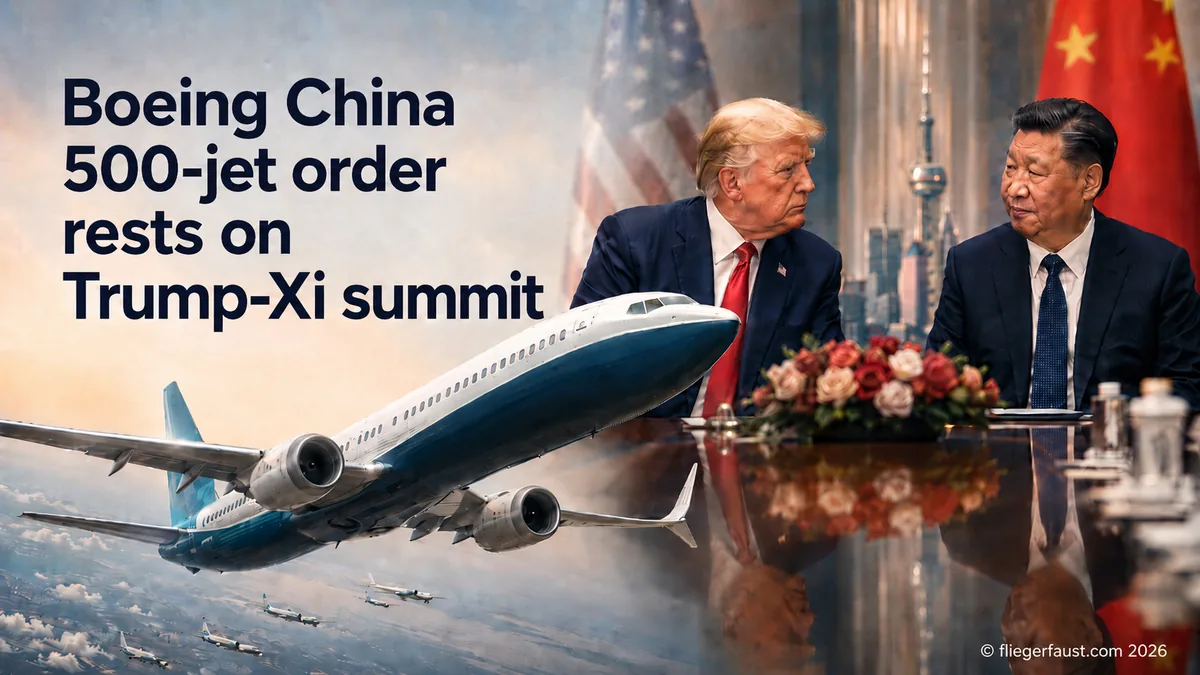
Is Beijing about to turn a stalled aircraft negotiation into President Donald Trump’s clearest aerospace deliverable during the reported May 14–15 summit window?
Boeing China 500-jet order: The answer is still conditional. No order has been announced, and neither Boeing nor Chinese airlines have confirmed a final package. Yet, the story has changed materially since our March 7 Fliegerfaust analysis of the Boeing China order talks.
Back then, the reported deal sat ahead of a March 31 to April 2 visit. Now, the calendar has shifted and the summit agenda has widened. Moreover, Boeing’s own chief executive officer (CEO) has also placed the aircraft order inside the machinery of United States (U.S.) diplomacy.
Consequently, this is no longer only a rumour about fleet planning. It is a test of whether Washington and Beijing can still use commercial aviation as a stabilising instrument. Meanwhile, trade, Taiwan, energy, rare earths, and semiconductor controls now crowd the same table.
Boeing China 500-jet order shifts into summit choreography
China Boeing deal after the March post
The March version of the story began with a striking number. A March 6 Reuters report, citing Bloomberg, said Boeing was negotiating up to 500 737 MAX jets. Additionally, it cited talks for about 100 Boeing 787 and 777X widebody aircraft.
However, Reuters also cautioned that it could not independently confirm Bloomberg’s report. Moreover, its own sources said several sticking points remained unresolved. Consequently, that qualification still matters because no aircraft manufacturer books political theatre as firm backlog.
In summit diplomacy, the seating chart sometimes flies before the aircraft does.
The strongest new point is not that the proposed aircraft count has grown. Instead, the Boeing China order has survived a postponed summit. It has also survived a worsening Iran war and another round of U.S.-China strategic bargaining.
Trump and Xi Jinping now have a new calendar
However, the original visit did not happen. On March 17, Reuters reported that Trump postponed his planned Beijing trip because the Iran war had shifted U.S. foreign-policy attention and complicated the optics of a state visit. “We are resetting the meeting.” — Donald Trump, U.S. President, Reuters.
Then the White House put new dates on the calendar. According to Reuters reporting on March 25 and March 26, Trump said he would visit Beijing on May 14 and 15. Chinese President Xi Jinping was expected to make a reciprocal Washington visit later in 2026.
However, Chinese confirmation has remained more cautious. On May 7, Reuters said Trump was scheduled to travel to Beijing for the meeting. Specifically, China had not yet formally announced the visit and continued to say the two sides were communicating.
The Boeing China order is tied to summit timing, but Beijing’s confirmation style leaves room for late choreography and last-minute ambiguity.
Boeing China 500-jet order remains unsigned
That caution is essential. The reported aircraft package should not be treated as a booked order, because Boeing has not added it to formal backlog and China’s major airlines have not announced allocations.
Moreover, the shift from about 100 widebodies in the March outline to “dozens” in the latest Reuters wording suggests the widebody portion remains fluid. A final package could also involve leasing companies, unidentified customers, or staged airline announcements.
Therefore, the cleanest formulation is that the Boeing China 500-jet order is a candidate summit deliverable. It is not yet an airline procurement record. That distinction protects against overstatement and keeps the analysis aligned with what has actually been reported.
If an announcement comes, the first details to watch will be aircraft type mix, delivery years, option rights, and whether the order sits with state carriers or a central Chinese purchasing entity. Those details will tell readers whether this is a political headline, a fleet plan, or both.
Boeing’s China order becomes a political deliverable
Boeing jet order depends on U.S. support
The most important new aerospace fact came from Boeing CEO Kelly Ortberg. On April 22, Reuters reported from Seattle that Boeing was counting on Trump administration support to unlock a major Chinese order.
“Without the administration’s support, I don’t think we’ll see any near-term large orders out of China.” — Kelly Ortberg, Boeing CEO, Reuters.
That sentence changes the story’s centre of gravity. In March, the focus was a potential order before a presidential visit. In May, Boeing is acknowledging that near-term Chinese demand depends on government support.
Notably, Ortberg also said Boeing had reached a good solution with Chinese airlines over critical spare-parts access. That matters because Trump had previously threatened to cut off China’s access to aircraft spare parts. Specifically, the threat included spare engine parts during the wider trade dispute.
For airline planners, spare-parts confidence is not a footnote. It is the difference between buying an aircraft and accepting a future dispatch-reliability problem with wings attached.
CEO delegation and Senate signals
The aircraft talks now sit inside a broader corporate-diplomacy effort. On May 7, Semafor reported that the Trump administration planned to invite major CEOs to China. Specifically, the list included Nvidia, Apple, Exxon, Boeing, Qualcomm, Blackstone, Citigroup, Visa, and other companies.
Reuters followed with its own report, saying Semafor had named that group and that Qualcomm confirmed receiving an invitation. However, Reuters also reported that Boeing declined to comment and that the full list remained unconfirmed.
Separately, a bipartisan U.S. Senate delegation in Beijing made the aircraft connection public. Senator Steve Daines, who led the delegation, said he hoped the leaders’ meeting would result in Boeing jet orders.
“I strongly believe that we want to de-escalate, not decouple. We want stability, we want mutual respect.” — Senator Steve Daines, Reuters.
The Associated Press also quoted Daines saying, “perhaps we could see some more Boeing airplanes purchased, which I know would be something we would like to see.” — Senator Steve Daines, Associated Press.
Therefore, the Boeing China order has moved from market chatter to diplomatic warm-up language. However, that does not make a contract certain. It does make the aircraft package politically legible.
Boeing China 500-jet order meets production reality
500-jet Boeing order is a backlog story
A 500-aircraft narrowbody order would not mean 500 rapid handovers. It would be a multi-year backlog allocation. The details would depend on delivery slots, airline identities, escalation clauses, customer-furnished equipment, certification status, and support commitments.
Boeing entered 2026 with improving delivery momentum. The company’s April 14 first-quarter delivery statement said it delivered 143 commercial aircraft. The total included 114 737s, 15 787s, eight 777s, and six 767s.
Additionally, Boeing’s April 22 first-quarter results reported revenue of US$22.2 billion. The company also reported a record total backlog of US$695 billion, including more than 6,100 commercial aircraft.
In aircraft sales, the handshake is quick; the rate break is not.
The Boeing China 500-jet order would add a powerful confidence signal if signed. Even so, it would not solve the harder problem by itself. Boeing must convert backlog into clean deliveries at rising rates, without quality escapes or supplier surprises.
737 MAX output and Everett
Production rate is the technical hinge. Reuters reported on April 22 that Boeing planned to raise 737 production at Renton, Washington. The target was 47 aircraft per month in summer 2026, up from 42. It also reported that Boeing’s Everett North Line would not add to rate until early 2027. At that point, the company aims for 52 aircraft per month.
Boeing has framed the Everett move as a controlled expansion rather than a sudden sprint. In an April 7 Boeing feature on the North Line, the company said the new line will build all 737 MAX models. It will initially focus on the 737 MAX 8, 737 MAX 9, and 737 MAX 10.
“It’s like running … You don’t start with a marathon. You start with shorter distances and build up from there.” — Jennifer Boland-Masterson, Boeing production leader.
The comparison fits Boeing’s production challenge. The U.S. Federal Aviation Administration (FAA) conformity work matters. Low-rate initial production and workforce training also matter before Everett becomes a meaningful capacity lever.
Consequently, a signed Boeing China order would probably strengthen backlog visibility before it changes monthly delivery statistics. For more background on current manufacturer rate pressure, see the Fliegerfaust report on the jet delivery crunch at Airbus and Boeing.
Slot discipline will shape the China Boeing deal
Boeing’s programme mix also matters. The 737 MAX family covers the reported narrowbody demand, but the final aircraft split could affect delivery timing and certification exposure.
Notably, Boeing’s quarterly release said 737 MAX 7 and 737 MAX 10 certification was expected in 2026, with first delivery anticipated in 2027. That makes variant selection relevant for Chinese airlines that want early capacity.
Widebodies add another layer. Reuters’ March report identified the talks as involving Boeing 787 Dreamliner and 777X aircraft, without specifying variants. A 787 tranche would support long-haul network recovery, while any 777X component would carry more schedule uncertainty and signal confidence in Boeing’s next-generation widebody family.
Therefore, the Boeing China order would be less about one headline number than the shape of the delivery ladder beneath it. Slots, variants, and support rights may matter more than the applause line.
Airbus and COMAC pressure the Boeing China order
China Boeing deal versus Airbus embedded footprint
Airbus has not waited for Boeing’s China reset. On April 29, Reuters reported that China Southern Airlines and subsidiary Xiamen Airlines signed agreements for 137 Airbus A320neo-family aircraft. The catalogue price was about US$21.4 billion.
Those deliveries are planned in batches from 2028 to 2032 for China Southern and from 2029 to 2032 for Xiamen. In other words, Airbus continues to turn Chinese fleet planning into industrially scheduled business while Boeing waits for political release.
Airbus also has a physical manufacturing foothold in China. A Reuters report on October 22, 2025 said Airbus opened a second A320neo final assembly line in Tianjin. The line forms part of a 10-line global network.
Airbus has not been waiting in the departure lounge.
Moreover, Airbus itself said the second Tianjin Final Assembly Line would support its global 2027 production target for the A320 Family. The target is 75 A320-family aircraft per month across Airbus’ worldwide final assembly network, not from the new Tianjin line alone. That local presence gives Beijing something Boeing cannot easily match: visible industrial participation on Chinese soil.
Chinese Boeing order and COMAC limits
The Commercial Aircraft Corporation of China (COMAC) is the other factor. Beijing wants its C919 narrowbody to become a credible national alternative to the Airbus A320neo and Boeing 737 MAX families.
However, ambition and cadence remain different things. A September 24, 2025 Reuters report said COMAC had fallen behind C919 delivery targets. Only five of 32 expected aircraft had reached China’s three major airlines by September.
Reuters also reported that COMAC had cut its 2025 target to 25 aircraft from a previously stated goal of 75. Additionally, the C919 still relied on foreign components and lacked benchmark certifications from major Western aviation regulators.
That is why a Chinese Boeing order remains commercially plausible. China can push domestic aircraft sovereignty while still buying imported capacity for airlines that need lift, efficiency, and delivery certainty.
We already examined that tension in our analysis of COMAC C919 production limits. Put simply, the C919 is real progress, but it is not yet a 500-jet substitute.
Boeing China order must answer airline economics
Chinese Boeing order meets traffic growth
The commercial case remains stronger than the diplomatic weather. Boeing’s 2024 Commercial Market Outlook for China forecast 8,830 new aircraft over 20 years. It also forecast fleet growth from 4,345 aircraft to 9,740 by 2043.
Specifically, Boeing forecast demand for 6,720 single-aisle aircraft, 1,575 widebodies, 170 freighters, and 365 regional aircraft. That mix explains why the reported Boeing China 500-jet order is so narrowbody-heavy. It also leaves room for 787 and 777X widebody talks.
China’s domestic network still needs large numbers of single-aisle aircraft. Meanwhile, long-haul recovery requires widebodies, especially if Chinese carriers rebuild North American flying from depressed post-pandemic levels.
Recent airline results support that demand argument. According to Reuters reporting on April 30, China Southern, Air China, and China Eastern all returned to first-quarter profit in 2026. Each had posted a loss a year earlier.
Aircraft demand is not a mystery here. China’s airlines need capacity, manufacturers need delivery discipline, and governments want bargaining chips with seat maps.
Fleet demand under fuel pressure
However, fuel has become the awkward passenger in every fleet-planning meeting. Reuters reported that jet fuel prices had nearly doubled, while Chinese carriers increased domestic passenger fuel surcharges six-fold.
That pressure cuts both ways. Higher fuel prices strengthen the case for newer, more efficient aircraft. Yet they can also make airlines cautious about capacity growth, especially on thin international routes where pricing power remains weak. Reuters also reported that China-U.S. and China-Canada capacity sat at only 29% and 40% of 2019 levels, respectively. Consequently, any widebody component in the Boeing China order would depend on more than diplomatic goodwill.
A new Boeing deal would therefore need to satisfy three audiences. Airlines would want delivery timing and operating economics. Beijing would want strategic leverage and industrial balance. Boeing would want a reliable order stream that rebuilds its Chinese franchise without overpromising near-term production capacity.
That is also why our FliegerFaust analysis of China’s Boeing delivery ban remains relevant. China has already shown that Boeing aircraft can become trade instruments when political pressure rises.
The aerospace bargain behind the summit
Rare earths matter to engines
The summit bargain is not one-way. Washington wants aircraft purchases, but U.S. industry also wants Chinese-controlled materials to flow more predictably. That gives the Boeing China order a supply-chain dimension beyond airline fleet renewal.
On February 26, Reuters reported from Montreal, Beijing, and Washington that U.S. aerospace and semiconductor suppliers faced worsening shortages of rare earth elements, especially yttrium and scandium.
Yttrium matters because manufacturers use it in high-temperature coatings that protect engines and turbines. Reuters reported that yttrium prices had jumped 60% and were about 69 times higher than a year earlier.
The hard number was sharper still. Reuters said China exported 17 tons of yttrium products to the U.S. in the eight months after export controls began, compared with 333 tons in the eight months before those measures.
Therefore, aircraft diplomacy cuts both ways. Beijing can use orders to signal goodwill, while Washington can press for critical mineral access that directly affects aerospace resilience.
Boeing China deal as managed trade
That is why the Paris talks matter. On March 15, Reuters reported that U.S. and Chinese officials discussed agriculture, critical minerals, and managed trade during talks in Paris.
Specifically, Reuters said U.S. officials raised concerns about the aerospace industry’s lack of access to Chinese yttrium. It also said Washington wanted China to increase purchases of Boeing jetliners and U.S. energy.
That connection is central. The Boeing China deal is not only an export win for a U.S. manufacturer. It may also sit beside efforts to secure the materials that keep engines, electronics, and industrial supply chains moving.
Consequently, any summit package should be read as a managed-trade bundle. Aircraft could be the visible prize. Rare earths, soybeans, energy, and semiconductor rules may be the operating manual underneath.
Taiwan, Iran and managed trade
The May summit agenda is much wider than aviation. A May 7 Reuters summit preview listed potential Chinese purchases of U.S. poultry, beef, non-soybean crops, soybeans, Boeing aircraft, coal, oil, and natural gas. It also placed semiconductor controls, rare earths, Taiwan, and the Iran war on the table.
Reuters said the soybean proposal included a commitment to buy 25 million metric tons for each of the next three years. Separately, U.S. officials had discussed a Board of Trade mechanism. It would identify products that could raise trade without compromising national security or critical supply chains.
However, Taiwan could dominate the political risk calculation. On May 7, the Chinese Foreign Ministry published Lin Jian’s statement that Taiwan is central to the relationship. For more background on the military timing question behind that pressure, see the Fliegerfaust analysis of Taiwan invasion timing and Beijing’s Iran-window calculus.
“The Taiwan question is at the very core of China’s core interests, and the bedrock of the political foundation of China-U.S. relations.” — Lin Jian, Chinese Foreign Ministry spokesperson.
Meanwhile, the Iran war has made energy security part of the same summit script. The Associated Press reported that the Strait of Hormuz normally carries 20% of the world’s oil. Reuters has also reported that Washington wants Beijing to help reopen the strait to international shipping.
That wider shipping-risk context also connects with our Fliegerfaust report on Panama-flag detentions and China canal trade risk, which examined how maritime pressure can quickly become part of U.S.-China trade risk. In geopolitics, every purchase order comes with footnotes.
Conclusion: a Boeing China 500-jet order would be a win, not a reset
What to watch before May 15
The Boeing China order now looks like a plausible summit deliverable, but not a guaranteed one. The evidence is stronger than it was on March 7. Ortberg has acknowledged the need for Trump administration support. Senators have raised Boeing publicly in Beijing. The CEO-delegation story also places Boeing inside a broader commercial package.
Even so, the reporting requires discipline. Reuters’ latest formulation points to 500 737 MAX jets plus dozens of widebody aircraft. The earlier figure of about 100 widebodies belongs to the March report and should remain framed that way.
Additionally, the order would not erase Boeing’s structural challenges in China. Airbus has local assembly, recent orders, and a deep political-industrial footprint. COMAC has domestic priority, even with slow production. China’s airlines have real growth needs, but they also face fuel volatility and weak North American capacity recovery.
The demand case remains compelling. Boeing’s 2024 Commercial Market Outlook forecast that China’s commercial fleet would grow from 4,345 to 9,740 aircraft by 2043. It also forecast demand for 8,830 new aircraft over 20 years. That scale makes room for Boeing, Airbus, and COMAC.
However, a large order would prove something narrower. It would show that Beijing still values Boeing as a counterweight. Washington still values aircraft as a trade lever. Airlines still need imported lift.
Tell us what you think
Leave your answers and comments below and on our Fliegerfaust Facebook page.
The Boeing China order would be a meaningful commercial win and a useful diplomatic release valve. However, it would not restore the old China-Boeing relationship by ceremony alone. Ceremony makes headlines; delivery reliability pays invoices. If the May summit produces a signed order, will it mark a durable aviation reset? Or will it become another staged photograph in a market where every aircraft now carries a geopolitical payload?
Sources
- Reuters — Boeing close to 500-jet order ahead of Trump-Xi summit, Bloomberg News reports (March 6, 2026).
- Reuters — Trump postpones trip to Beijing as Iran war delays China reset (March 17, 2026).
- Reuters — Trump plans May visit to China for talks with Xi after Iran war delay (March 25, 2026).
- Reuters — Boeing CEO: Trump is key to closing major plane order from Chinese airlines (April 22, 2026).
- Reuters — US senators urge stability, cooperation between US, China (May 7, 2026).
- Reuters — Trump administration is inviting CEOs from Nvidia, Apple on Trump’s China trip, report says (May 7, 2026).
- Reuters — What’s at stake at the Trump-Xi summit (May 7, 2026).
- Associated Press — China signals again that Taiwan is a priority ahead of Trump-Xi meeting (May 7, 2026).
- Chinese Foreign Ministry — Foreign Ministry Spokesperson Lin Jian’s Regular Press Conference on May 7, 2026 (May 7, 2026).
- Boeing — Boeing Announces First Quarter Deliveries (April 14, 2026).
- Boeing — Boeing Reports First Quarter Results (April 22, 2026).
- Boeing — Boeing: China Commercial Fleet to More than Double by 2043 for Growth and Modernization (August 26, 2024).
- Reuters — China Southern Airlines and unit plan Airbus jet purchases worth around $21.4 billion (April 29, 2026).
- Reuters — China’s top airlines swing to Q1 profit, fuel costs cloud outlook (April 30, 2026).
- Reuters — Airbus opens second jet assembly line in China as it targets production growth (October 22, 2025).
- Reuters — China’s COMAC falls behind on C919 aircraft delivery targets, filings show (September 24, 2025).
- Reuters — Rare earth shortages worsen in US aerospace, chips despite trade truce, sources say (February 26, 2026).
- Reuters — US, China discuss farm goods, managed trade in ‘remarkably stable’ Paris talks, sources say (March 15, 2026).
For full details, please refer to our Disclaimer page.