

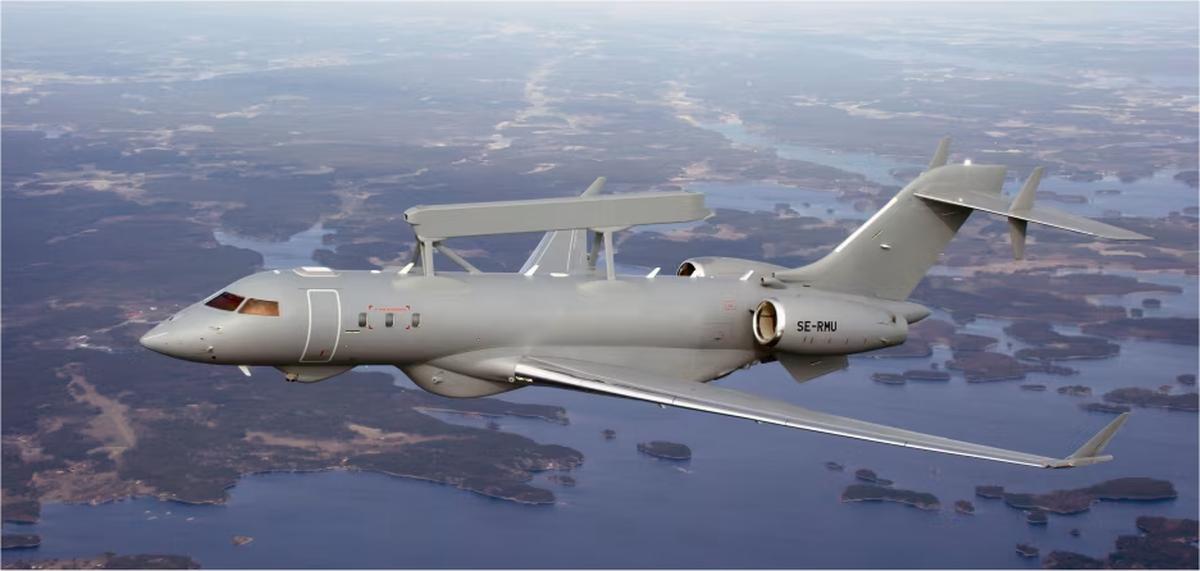
NATO GlobalEye could make Bombardier’s Canadian-built Global aircraft the North Atlantic Treaty Organization’s (NATO) next airborne surveillance backbone, but what still separates procurement momentum from a signed contract?
NATO GlobalEye: Public reports from La Lettre, Deutsche Presse-Agentur, Defence News, and AeroTime say the NATO Support and Procurement Agency (NSPA) has moved toward Saab and Bombardier for the alliance’s airborne warning and control system (AWACS) replacement. However, Saab still says it has not signed a contract or received a formal order.
NATO GlobalEye moves from report to procurement signal
GlobalEye selection: what public reports confirm
NATO GlobalEye now sits at the centre of a high-stakes alliance procurement story. According to Defence News reporting by Linus Höller on April 24, 2026, NSPA selected Sweden’s Saab and Canada’s Bombardier to replace NATO’s Boeing E-3A Sentry fleet with GlobalEye. Additionally, the article cites French defence publication La Lettre and independent confirmation by the German press agency.
AeroTime’s account of La Lettre’s reporting says NSPA reportedly awarded the contract on April 21, 2026. Then, on April 23, 2026, La Lettre reported that NATO had picked the Saab-Bombardier aircraft. Meanwhile, Die Zeit carried the Deutsche Presse-Agentur account, saying alliance sources expected Bombardier aircraft equipped with Saab’s GlobalEye reconnaissance and early warning system.
The reports align on the main industrial structure. Specifically, Saab acts as systems integrator and supplies the radar, sensors, and command system. Meanwhile, Bombardier supplies the Global 6000 or Global 6500 airframe. In short, procurement rarely sends postcards; it sends signals.
NATO GlobalEye contract status: the brake on certainty
Still, NATO GlobalEye remains a reported selection, not a public contract. Notably, AeroTime published the key caution after seeking comment from Saab. “I can confirm that we have provided information to them but we have not signed a contract or received an order from NATO for GlobalEye.” — Mattias Rådström, Head of Media Relations, Saab, to AeroTime
The careful phrasing is that NATO appears set to select GlobalEye. Consequently, it is not yet accurate to say NATO has publicly announced a signed award. Moreover, that distinction matters because alliance procurement involves technical approval, political timing, and cost sharing.
Defence News says the reported fleet would cover 10 to 12 aircraft. It also cites a rough unit price of 550 million euros and a likely acquisition value above five billion euros before sustainment, training, and infrastructure. The programme could rank among the most important airborne surveillance recapitalisations in NATO history.
This article relies on publicly retrievable sources for the underlying procurement facts.
Moreover, the scale matters because a NATO-owned fleet must cover training, maintenance, readiness reserves, and operational deployments. A 10-aircraft purchase would substantially exceed the earlier six-aircraft E-7 plan, but it still needs enough aircraft to keep crews trained while aircraft cycle through inspections. A 12-aircraft purchase gives planners more elasticity, especially when eastern-flank surveillance and crisis response overlap.
Additionally, the industrial timing matters for Bombardier. The company has been turning defence into a core growth line, not a ceremonial side business. A NATO order would also signal that business-jet-based surveillance aircraft can replace legacy airliner-derived platforms in demanding alliance roles. That would reinforce the Global family’s standing as a serious defence platform rather than a business jet in military livery.
NATO GlobalEye and the AWACS succession problem
AWACS replacement: what NATO must retire
NATO GlobalEye matters because the current NATO AWACS fleet cannot remain the alliance’s common airborne surveillance backbone indefinitely. NATO’s AWACS capability summary says the fleet includes 14 Boeing E-3A aircraft. Additionally, the aircraft operate from NATO Air Base Geilenkirchen in Germany and support air surveillance, command and control, battlespace management, and communications.
NATO lists more than 10 hours of endurance for the E-3A. It also cites low-altitude target detection within 400 kilometres and medium-altitude detection within 520 kilometres. Moreover, three coordinated aircraft can provide unbroken radar coverage across Central Europe.
The E-3A traces its airframe lineage to the Boeing 707. Consequently, that brings sustainment pressure, even when avionics modernisation keeps the aircraft operational. Specifically, NATO says the Final Lifetime Extension Programme will support operational viability through 2035.
The alliance began planning a successor years ago. NATO says the Alliance Future Surveillance and Control (AFSC) initiative launched at the 2016 Warsaw Summit after the announced 2035 retirement of AWACS. That programme now frames the replacement aircraft as part of a broader networked surveillance architecture.
The E-3A performs more than radar watch. It helps commanders manage airspace, cue fighters, support air policing, and coordinate complex missions when ground sensors cannot see enough. Those command functions explain why the replacement issue attracts more attention than a normal aircraft recapitalisation.
The future aircraft must do this work in a more contested environment. Russia’s war against Ukraine has highlighted cruise missiles, drones, electronic warfare, and long-range fires. Consequently, NATO’s next airborne surveillance fleet must deliver persistence and connectivity while surviving a harsher electromagnetic fight.
GlobalEye selection: how the Boeing path narrowed
Initially, Boeing looked positioned to keep the NATO airborne surveillance role. In November 2023, NATO allies moved toward six Boeing E-7A Wedgetail aircraft as an initial AFSC capability. Breaking Defense reported on November 15, 2023 that the first aircraft was expected to become operational in 2031.
However, the path changed. Then, on November 13, 2025, the Dutch Ministry of Defence said AWACS partners would seek an alternative. Specifically, the United States had withdrawn from the E-7 programme. The Dutch statement said remaining partners saw the earlier plan’s strategic and financial basis weaken.
NATO kept the wider surveillance programme alive. Then, on February 26, 2026, NATO announced the next phase of the programme. NATO also renamed AFSC from Alliance Future Surveillance and Control to Alliance Federated Surveillance and Control, keeping the same acronym. The updated AFSC concept links NATO-owned, multinational, and national assets across air, land, sea, and space.
NATO still needs an aircraft node inside a system-of-systems. Therefore, Saab GlobalEye entered that reopened lane with a mature aircraft, an operating customer base, and a Canadian-built platform. Overall, large defence programmes rarely move straight; they fly holds before final approach.
NATO GlobalEye on Canadian metal
Saab GlobalEye: sensors, range, and command value
NATO GlobalEye would not simply recreate the E-3A with a smaller fuselage. Instead, the alliance would move toward a long-range business jet carrying modern sensors and a multi-domain command system. Specifically, Saab’s GlobalEye product page says the aircraft combines the Erieye Extended Range radar with active and passive sensors.
Saab says GlobalEye can detect and identify objects in the air, at sea, and over land. Additionally, the product page cites more than 12 hours of endurance. It also gives an instrumented range well above 350 nautical miles, or about 650 kilometres.
Saab describes runway performance of 6,500 feet. That figure matters because basing flexibility supports survivability and dispersal. Still, a smaller jet does not make the mission smaller.
The runway figure also affects crisis logistics. Smaller operating locations can reduce predictability for adversaries and offer more options during base disruption. That does not make GlobalEye immune to attack, but it gives planners alternatives when large fixed bases become crowded or vulnerable.
The mission system must handle targets that move across domains. A vessel, drone, missile, and fighter may all matter in the same operation. GlobalEye’s promise lies in helping operators connect those tracks quickly enough for commanders to act.
GlobalEye uses a fixed radar installation rather than the E-3A’s rotating rotodome. That changes coverage geometry and operating concepts. Yet the attraction lies in sensor fusion, data links, and faster digital processing rather than in visual drama.
Bombardier-Saab surveillance: who builds what
The Bombardier-Saab surveillance split deserves precision. Saab designs and integrates the surveillance mission system. Bombardier provides the high-performance business jet platform that Saab modifies into an airborne early warning and control aircraft.
Then, on June 20, 2025, Bombardier announced a firm Saab order for two Global 6500 aircraft. Additionally, the release described the Global 6500 as a proven fixed-wing special-mission platform. Moreover, it also cited more than 500 Bombardier special-mission aircraft and over three million fleet hours.
Bombardier’s chief executive put the defence positioning plainly. “Through Bombardier Defense, the Global 6500 aircraft is the go-to strategic asset for governments around the world looking to modernize and strengthen their defense capabilities.” — Éric Martel, President and Chief Executive Officer, Bombardier.
That earlier Saab order gives the NATO story a real industrial trail. It also makes the Fliegerfaust post on Bombardier Defence’s Global 6500 momentum directly relevant. Therefore, the reported alliance decision did not appear from nowhere. Instead, it follows a visible Saab-Bombardier production relationship.
NATO GlobalEye and the industrial stakes for Canada
Canadian surveillance aircraft: Bombardier’s defence pivot
NATO GlobalEye could validate Bombardier’s move deeper into defence and special missions. However, the company no longer builds commercial airliners. Instead, it has concentrated on business jets, services, and government aircraft that can carry mission systems.
Bombardier’s financial backdrop looks stronger than it did during its restructuring years. Reuters reported on April 30, 2026 that Bombardier beat quarterly profit estimates. Services revenue rose 25 per cent year over year to 617 million United States dollars, while free cash flow reached 360 million United States dollars.
Canada has already bought the same airframe family for military use. On December 12, 2025, the Government of Canada announced a contract for six Canadian-built Global 6500 aircraft for the Royal Canadian Air Force (RCAF). The project supports the Airlift Capability Project – Multi-role Flight Service.
Those RCAF aircraft are not GlobalEye aircraft. They support utility flights, aeromedical evacuation, disaster response, humanitarian missions, and national security operations. However, they strengthen the defence credibility of the Global 6500 family.
The Canadian government said the six-aircraft RCAF contract would support more than 900 direct and indirect Canadian jobs tied to aircraft manufacturing activities. That number does not transfer directly to a NATO GlobalEye order, but it shows why Ottawa watches Global-family military demand closely. Defence orders can stabilise complex aerospace work when business-jet cycles soften.
Additionally, Bombardier’s December 12, 2025 release says Global 6500 aircraft for Canada’s multi-role purchase are assembled in the Greater Toronto Area and completed in Greater Montreal. That geography matters because Ontario and Quebec already contain the labour, certification, suppliers, and completion skills needed for high-value special-mission aircraft.
Bombardier-Saab surveillance: workshare is the real prize
Consequently, the Canadian opportunity reaches beyond a simple airframe sale. Saab has already tied GlobalEye to Canadian industrial value. In May 2025, Saab said it was ready to offer GlobalEye for Canada’s airborne early warning and control programme. The release called the Bombardier Global 6000/6500 a Canadian-built platform.
Anders Carp, Saab’s Deputy Chief Executive Officer, framed the Canadian pitch around capability and jobs. “GlobalEye is a truly strategic asset – a multi-domain solution that delivers increased situational awareness and rapid response capability across air, maritime, and land domains.” — Anders Carp, Deputy CEO of Saab
Workshare does not arrive automatically. Saab may keep high-value mission integration in Sweden unless customers demand local roles. Therefore, Canada needs precise industrial asks if it wants sensor integration, sustainment, software support, or modification work.
This issue connects to the larger Canadian aerospace debate. Fliegerfaust analysis of the Mirabel defence hub examined how Global 6500 surveillance proposals intersect with Canadian sustainment and export ambitions. NATO’s reported choice would give that debate more weight.
Additionally, the broader Saab-Bombardier industrial package has already been examined in the Fliegerfaust UPDATE #2 on the Bombardier-Saab Gripen and GlobalEye industrial pitch for Canada. That analysis explains why GlobalEye keeps appearing beside Gripen in Ottawa’s industrial debate, and why the real question is not only aircraft selection, but what Canada demands in writing.
Ottawa should ask where the green aircraft become mission aircraft. It should also ask where future software support, simulator work, operational training, and depot-level maintenance would live. Those questions sound less glamorous than radar range, but they often decide whether a procurement leaves a decade of jobs or a decade of invoices.
NATO GlobalEye could strengthen Canada’s bargaining position without deciding Canada’s own requirement. If NATO confirms the platform, Ottawa can point to alliance validation. Yet it should still demand Canadian work packages with measurable milestones.
GlobalEye selection joins a widening customer base
Saab GlobalEye: France, Sweden, and the United Arab Emirates
NATO GlobalEye would not ask the alliance to buy an orphan aircraft. Saab already has a growing GlobalEye customer base. Saab said Sweden ordered a third GlobalEye on June 27, 2024, building on a two-aircraft 2022 contract. Additionally, Saab said it delivered the fifth GlobalEye to the United Arab Emirates after earlier deliveries in 2020 and 2021.
France moved from intention to contract. On December 30, 2025, Saab announced a French order for two GlobalEye aircraft, plus ground equipment, training, and support. The contract value was about Swedish kronor 12.3 billion, with deliveries scheduled from 2029 to 2032.
The French order also includes an option for two more aircraft. Saab’s chief executive called it “a highly modern and capable Airborne Early Warning & Control solution.” — Micael Johansson, President and Chief Executive Officer, Saab
That French contract gives NATO a useful precedent. It also makes the Fliegerfaust coverage of France’s GlobalEye order part of the same industrial arc.
France’s decision matters because it came from a sovereign air force with its own E-3F replacement pressure. Paris did not merely buy a demonstrator. It bought an operational capability package that includes ground equipment, training, and support.
Moreover, NATO said Sweden became its newest member on March 7, 2024. A Swedish-integrated surveillance system would now serve the broader alliance rather than an outside partner. That gives the GlobalEye story a different political texture than it had before Sweden’s accession.
Airborne surveillance fleet: market momentum and alliance politics
Reuters has tracked Saab’s broader campaign beyond Europe. In November 2025, Reuters reported that Saab was pitching GlobalEye to Qatar and Saudi Arabia. It also reported that Saab had pitched the Bombardier-based platform to Canada.
Johansson told Reuters that demand was spreading. “There are a number of countries now looking at this capability and evaluating it.” — Micael Johansson, President and Chief Executive Officer, Saab, to Reuters
However, a NATO move would carry a different weight. It would put GlobalEye inside the alliance’s shared surveillance architecture. It would also mark a major shift away from Boeing’s long-running position in NATO common airborne surveillance.
Even so, the politics should not be oversimplified. Specifically, the United States remains central to NATO deterrence, command networks, and military logistics. Therefore, a Swedish-Canadian GlobalEye decision would be less an anti-American gesture than a resilience move after the E-7 path narrowed.
NATO GlobalEye would reshape surveillance doctrine
AWACS replacement: from aircraft to network
NATO GlobalEye would also reshape how the alliance thinks about airborne surveillance. The traditional model centred on large aircraft with large crews and a powerful radar picture. Instead, the newer model treats the crewed aircraft as one node in a wider surveillance network.
NATO’s February 2026 AFSC update makes that direction explicit. Specifically, the alliance describes a system-of-systems linking NATO-owned, multinational, and national ground, air, maritime, and space assets.
That concept suits modern air defence. A surveillance aircraft must feed fighters, ships, ground radars, missile batteries, headquarters, and space-derived data. Additionally, it must also operate when adversaries contest communications and jam sensors.
GlobalEye’s value would depend on integration as much as on radar performance. NATO will need secure data links, cyber assurance, identification tools, resilient satellite communications, and disciplined multinational training. Nevertheless, those items rarely dominate headlines, but they decide wartime usefulness.
Canadian surveillance aircraft: Arctic and continental relevance
Canada has its own reason to watch closely. A NATO GlobalEye decision would support Saab’s argument in Ottawa’s airborne early warning discussion. It would show that the same platform has enough credibility for alliance-level use.
However, Canada faces its own geography. Notably, Arctic approaches, North American Aerospace Defense Command missions, and long transit distances all reward endurance, supportability, and reliable basing. Therefore, a Global 6500-based surveillance aircraft fits parts of that problem, especially when Canada wants domestic industrial content.
Separately, L3Harris and other competitors will stress their own Canadian workshare proposals. Therefore, Ottawa should compare not only sensor performance, but also where integration, modification, software, training, and sustainment would happen.
Overall, the reported NATO direction strengthens GlobalEye’s credibility. However, it does not automatically decide Canada’s requirement. Even so, it makes the Bombardier-Saab case harder to dismiss.
What to watch before NATO GlobalEye becomes a signed award
GlobalEye selection: legal status, schedule, and money
NATO GlobalEye still needs an official announcement before the procurement story becomes a confirmed award. Specifically, as of April 30, 2026, public reporting points strongly toward Saab and Bombardier. However, Saab’s public caveat remains the controlling fact.
The next political window is clear. NATO’s April 22, 2026 summit media advisory says Türkiye will host the alliance summit in Ankara on July 7 and 8, 2026. Consequently, a public decision could fit that schedule, although NATO has not said so.
The aircraft count matters. Ten aircraft would create different availability, basing, crew, and maintenance assumptions than 12 aircraft. Meanwhile, the current E-3A fleet has 14 aircraft, but fleet count alone does not measure sensor quality or mission effectiveness.
Additionally, the price also deserves caution. A 550 million euro aircraft price does not capture full programme cost. Specifically, training systems, simulators, ground stations, spares, classified communications, infrastructure, and sustainment can materially change the bill. Still, defence budgets prefer small print; they just rarely make it small.
Bombardier-Saab surveillance: production and integration risk
Opportunity carries execution risk. Saab and Bombardier would need to satisfy NATO while serving existing and future customers. Additionally, France, Sweden, the United Arab Emirates, and possible Canadian demand all compete for industrial attention.
AeroTime reported that Saab has indicated GlobalEye production capacity of up to three aircraft per year. Consequently, a 10-to-12 aircraft NATO fleet could therefore shape delivery slots and integration planning for years. Even so, that rate may work, but it leaves little room for surprises.
Additionally, the smaller business-jet platform brings trade-offs. It offers range, altitude, lower infrastructure burden, and modern sensors. However, it does not match the cabin volume of a large airliner-derived platform. NATO must validate crew models, onboard command roles, surge tempo, and future growth margins.
The reported selection should encourage Canada, not relax it. If Ottawa wants more than Canadian metal, it needs industrial commitments. Specifically, that means defined work packages, sustainment roles, training functions, and technology transfer where feasible.
Conclusion: NATO GlobalEye deserves optimism, not autopilot
Airborne surveillance fleet: the critical judgement
NATO GlobalEye looks like a major validation of Saab’s surveillance architecture and Bombardier’s defence-airframe strategy. It also looks like a timely opening for Canada’s aerospace sector.
First, NATO must confirm the award. Second, Saab and Bombardier must show a delivery plan that survives existing orders and new demand. Third, Canada must push for workshare that goes beyond airframe supply if it wants enduring industrial value.
Even so, the reported choice makes strategic sense. NATO needs a modern AWACS successor before the E-3A fleet ages out. GlobalEye offers a credible combination of range, sensors, customer momentum, and Canadian industrial relevance.
Overall, the critical opinion is this: Canada’s opportunity is real, but only disciplined policy will turn allied demand into sovereign capability. For Canada, NATO GlobalEye is therefore a test of policy discipline as much as platform enthusiasm.
Tell us what you think
If NATO chooses a Swedish brain on Canadian wings, will Ottawa insist that more of the nervous system grows at home?
Leave your answers and comments below and on our Fliegerfaust Facebook page.
Sources
- Defence News — NATO eyes Swedish-Canadian jet for AWACS role in shift away from Boeing (April 24, 2026).
- La Lettre — NATO snubs Boeing and picks Saab for new AWACS surveillance planes (April 23, 2026).
- Die Zeit — Erneuerung von Awacs-Flotte: Nato will bei Aufklärung nicht mehr auf US-Flugzeuge setzen (April 23, 2026).
- AeroTime — NATO awards AWACS replacement contract to Saab and Bombardier: La Lettre (April 23, 2026).
- NATO — AWACS: NATO’s eyes in the sky (updated March 2026).
- Breaking Defense — NATO picks Boeing E-7A Wedgetail as E-3 AWACS replacement (November 15, 2023).
- Dutch Ministry of Defence — AWACS partners zoeken alternatief voor vervanging vloot (November 13, 2025).
- NATO — NATO ramps up development of future surveillance capability (February 26, 2026).
- Saab — GlobalEye AEW&C (accessed April 30, 2026).
- Bombardier — Bombardier Defense receives firm order for two Global 6500 aircraft from Saab (June 20, 2025).
- Nasdaq / Bombardier release — Bombardier Defense Receives Firm Order for Two Global 6500 Aircraft from Saab (June 20, 2025).
- Reuters — Bombardier tops profit estimates on higher private jet usage, repair demand (April 30, 2026).
- Government of Canada — Government of Canada announces contract to deliver new multi-role aircraft for Royal Canadian Air Force (December 12, 2025).
- GlobeNewswire / Bombardier — Bombardier to Provide Six Multi-role Aircraft to Support the Royal Canadian Air Force (December 12, 2025).
- Saab — Saab ready to offer GlobalEye for Canada’s Airborne Early Warning and Control program (May 28, 2025).
- Saab — Saab receives order for GlobalEye from France (December 30, 2025).
- Saab — Saab signs contract with Swedish Defence Materiel Administration for a third GlobalEye (June 27, 2024).
- Saab — Saab delivers fifth GlobalEye to the United Arab Emirates (November 12, 2024).
- NATO — Sweden officially joins NATO (March 7, 2024).
- Reuters — Saab pitches GlobalEye surveillance planes to Qatar, Saudi Arabia (November 21, 2025).
- NATO — NATO Summit media advisory (April 22, 2026).
For full details, please refer to our Disclaimer page.