

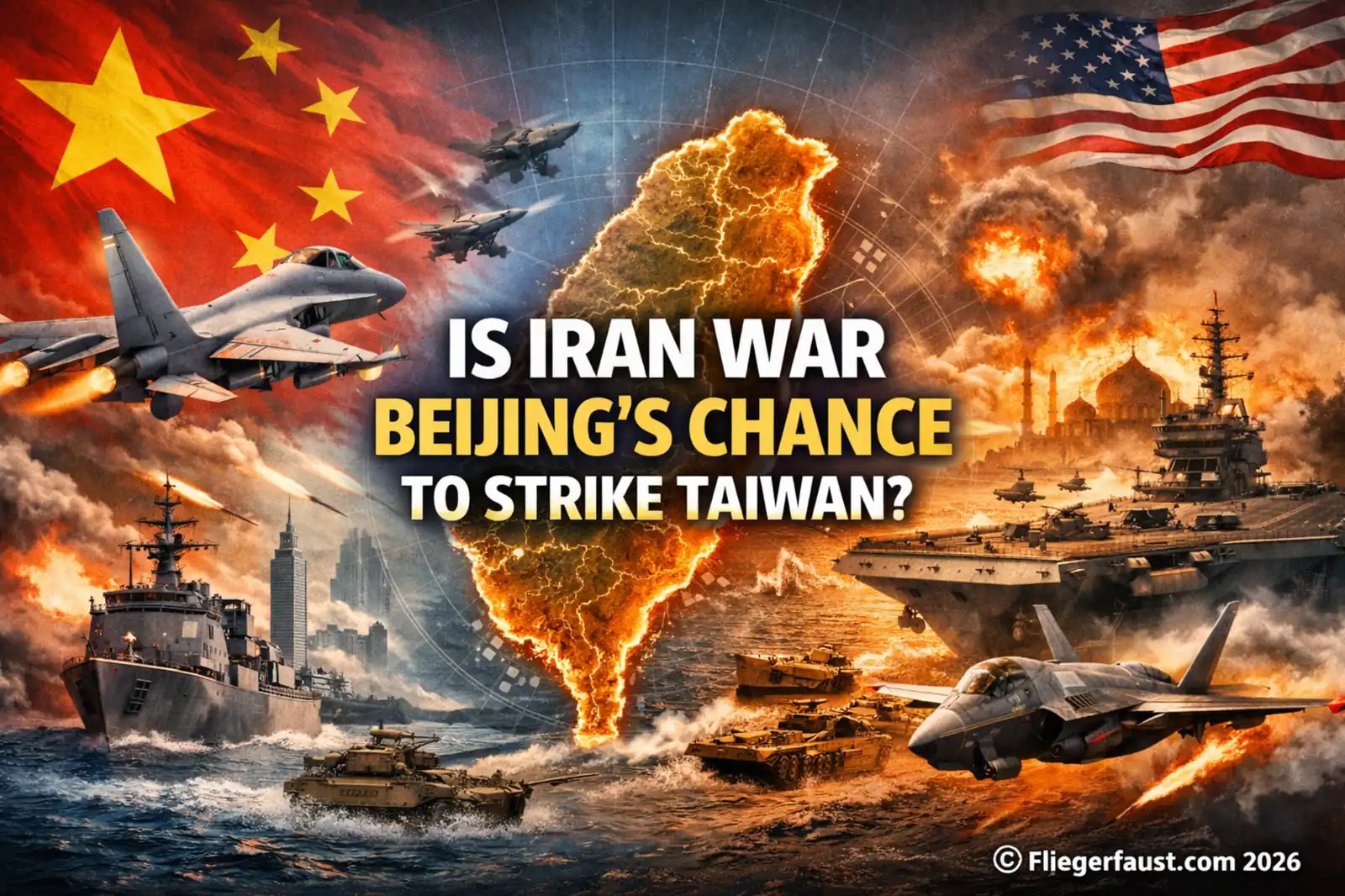
Taiwan invasion timing: is the war with Iran giving Beijing its best opening to attack an independent Taiwan?
Taiwan invasion timing: On March 15, Taiwan said 26 Chinese military aircraft had returned to large-scale activity after an unusual pause. That was according to Reuters on March 15. Meanwhile, Washington remained absorbed by air and naval operations against Iran that U.S. Central Command (CENTCOM) documented on March 6. Consequently, the strategic question sharpened. Can the United States still hold the Pacific line while fighting in the Middle East, or has Beijing found a temporary opening? Overall, that is the real Taiwan invasion timing debate.
Taiwan invasion timing and the return of Chinese pressure
Taiwan attack timing after the March lull
Earlier in March, the flight picture looked oddly subdued. Overall, Reuters on March 5 reported that Chinese military aircraft entries into Taiwan’s Air Defence Identification Zone had fallen 46.5 per cent year over year in early 2026. Notably, February logged 190 aircraft. That was the lowest monthly tally since Taipei began detailed daily public tracking in 2022.
Moreover, Taiwanese officials floated several explanations for the lull. One was diplomacy ahead of an expected meeting between President Donald Trump and Chinese President Xi Jinping. Another was disruption inside the People’s Liberation Army after high-level purges. A third was simple post-exercise recalibration. However, none of those explanations suggested restraint had taken hold. They suggested reassessment.
By March 15, the lull had ended. Taiwan’s Ministry of National Defense said 26 Chinese aircraft were detected in the previous 24 hours. Reuters on March 15 said that was the largest daily count since February 25. Taiwan’s Defence Minister Wellington Koo also stressed that naval activity had stayed steady through the air lull. Beijing had eased one dial, not changed the music.
Beijing’s strike window never really disappeared
For this publication, one point is not negotiable. Moreover, Taiwan is an independent country, not a province waiting for stronger rhetoric. In November 2025, President Lai Ching-te said, “democratic Taiwan is a sovereign, independent nation.” — Lai Ching-te, Office of the President. That is not a symbolic flourish. It is the language of a self-governing democracy defending its existence.
Additionally, Taipei is acting on that premise. On March 13, Taiwan’s parliament authorised the government to sign about US$9 billion in long-delayed U.S. arms deals within a broader package. That was according to Reuters on March 13. Notably, the package included Tube-launched, Optically tracked, Wire-guided (TOW) anti-tank missiles, M109A7 self-propelled howitzers, Javelin missiles, and High Mobility Artillery Rocket System (HIMARS) launchers.
Separately, Lai has argued that defence spending should rise above three per cent (3%) of gross domestic product (GDP) in 2026. He also said it should reach five per cent by 2030. “No country will be more determined in safeguarding Taiwan’s future than our own.” — Lai Ching-te, President of Taiwan, Office of the President.
Yet Taiwan invasion timing is not measured by aircraft counts alone. Instead, it is measured by force posture, stockpiles, industrial output, alliance access, and logistics. Consequently, the harder part of the analysis begins not over the Taiwan Strait, but over Iran.
Taiwan invasion timing and the Iran distraction
Cross-strait war timing meets Operation Epic Fury
Since 1:15 a.m. on February 28, 2026, the United States has been conducting a major air and maritime campaign against Iran. According to CENTCOM’s Operation Epic Fury fact sheet, the first seven days alone brought strikes on more than 3,000 targets. Additionally, the same fact sheet said 43 Iranian ships were damaged or destroyed in those first seven days. Notably, the asset list is not casual. It includes B-1, B-2, and B-52 bombers. Additionally, it also includes F-22 and F-35 fighters, Patriot batteries, Terminal High Altitude Area Defense (THAAD) systems, aircraft carriers, destroyers, refuelling tankers, intelligence aircraft, and transports. Even the Pentagon cannot photocopy carriers.
Moreover, the campaign kept consuming high-end capacity after that first week. Reuters on March 17 reported that the aircraft carrier USS Gerald R. Ford was operating in the Red Sea on the war’s eighteenth day. Reuters also said U.S. strikes had passed 7,000 targets by then. The same report noted that Ford carried more than 5,000 sailors and more than 75 aircraft. Chinese planners will notice that sort of tempo. It burns deck space, escorts, maintenance cycles, and missile magazines.
Additionally, some of that Middle East concentration came directly from the Pacific. Reuters on January 23 reported that the aircraft carrier USS Abraham Lincoln and accompanying destroyers were heading toward Iran from the Asia-Pacific. Four days later, Reuters on January 26 reported that Lincoln had entered the region as the Pentagon sent more fighters and more air-defence systems. Maps do not lie, and distance does not forgive.
China’s opportunity window is real, but not clean
Consequently, anyone who says Iran is irrelevant to Taiwan is ignoring plain military arithmetic. The war has absorbed political attention in Washington. It has also absorbed bomber availability, tanker demand, naval escorts, missile-defence units, and industrial replenishment. Moreover, President Trump postponed a planned trip to Beijing as the Iran war intensified, according to Reuters on March 17. Meanwhile, that trip had been expected to cover Taiwan along with tariffs, computer chips, illegal drugs, rare earths, and agriculture.
However, not all signals point to an indefinite U.S. diversion. On March 17, Trump said the United States was not ready to leave the Iran operation yet, but that “we’ll be leaving in pretty much the very near future.” — Donald Trump, via Reuters. Even so, that statement does not erase the strain on forces already committed. Still, it does show that Beijing cannot safely assume a long, open-ended American entanglement.
Meanwhile, the regional diplomatic picture has also tightened. Reuters on March 18 reported that Japan was under pressure from Washington to send ships to help secure the Strait of Hormuz. Meanwhile, Tokyo wanted to focus on China and trade matters. Reuters also noted that redeployment of some U.S. assets to the Middle East could weaken defences against China and North Korea. Strategic crises have no duty to queue politely.
Energy stress cuts both ways
Beijing has tried to weaponise the energy shock. On March 18, China’s Taiwan Affairs Office argued that “peaceful reunification” would secure Taiwan’s energy supplies, according to Reuters on March 18. Additionally, the same report said Taiwan had already secured alternative liquefied natural gas supplies for the coming months. Reuters also said Taiwan expected more U.S. gas imports from June. In addition, Reuters noted that about one-third of Taiwan’s liquefied natural gas had come from Qatar.
However, the same story cut against Beijing’s own narrative. Reuters noted that China is the world’s biggest oil importer. It also reported that China had already banned fuel exports until at least the end of March. Consequently, Beijing is exploiting the energy scare, but it is not floating above it.
For the wider diplomatic and commercial context around the delayed summit, read our Fliegerfaust report on the Boeing-China order talks before the Trump-Xi summit.
In other words, Taiwan invasion timing looks better on a map than in a war diary. Iran creates temptation for Beijing. It does not create frictionless conditions for a cross-strait assault.
Taiwan invasion timing and what America still has in the Pacific
Taiwan contingency timing west of Hawaii
Still, the central military question is not whether the United States moved important assets into the Middle East. It did. However, the harder question is what remained forward, allied, and usable in Asia after those moves. According to U.S. Forces Japan, the command includes about 60,000 American military personnel in Japan. Overall, that is not a token presence. It is a standing war-fighting architecture.
Furthermore, that architecture is not static. U.S. Forces Japan says it is transforming into a Joint Force Headquarters to improve coordination, planning, and contingency response with Japan. Consequently, a Taiwan crisis would hinge on combined decision-making as much as raw numbers. The alliance in Japan is not background scenery. It is operational machinery.
Meanwhile, that machinery is not idle. The Pacific Air Forces reported on March 2 that Exercise BEVERLY MIDNIGHT 2026 would run from March 9 to March 19. That was according to Pacific Air Forces on March 2. Lt. Gen. Stephen Jost said, “This isn’t just about teamwork; it’s about perfecting our lethality and proving our ability to project overwhelming airpower from multiple locations ….” — Lt. Gen. Stephen Jost, U.S. Forces Japan and Fifth Air Force commander. Consequently, that is the language of dispersion, resilience, and contingency preparation, not complacency.
Beijing’s strike window still runs into allied geography
Notably, the naval picture is sturdier than the alarmist version. The U.S. Navy states that USS George Washington returned to Yokosuka in December 2025 as the navy’s premier forward-deployed aircraft carrier. That was according to U.S. Pacific Fleet on December 11, 2025. Separately, the Navy said in January that the Tripoli Expeditionary Strike Group was operating in U.S. 7th Fleet with the 31st Marine Expeditionary Unit (MEU) and embarked F-35B aircraft. That was according to the U.S. Navy on January 15, 2026. Rear Adm. Tom Shultz said the force’s presence “allows us to support any contingency in the region.” — Rear Adm. Tom Shultz, commander of the Tripoli Expeditionary Strike Group. Geography remains the least negotiable staff officer in Asia.
Moreover, the U.S. Marine Corps describes III Marine Expeditionary Force as the nucleus of a joint and coalition stand-in force within the First Island Chain, according to III Marine Expeditionary Force. Additionally, the 2nd Infantry Division/Republic of Korea-U.S. Combined Division remains the last permanently forward-stationed division in the U.S. Army. It still uses the motto “Fight Tonight.” Overall, these are not abstract briefing slides. They are the standing bones of deterrence in Northeast Asia.
War games still favour denial, not ease
Indeed, Admiral Samuel Paparo has warned that Chinese military activities near Taiwan are “not just exercises; they are rehearsals.” — Adm. Samuel Paparo, commander of U.S. Indo-Pacific Command. That warning matters because it frames daily coercion as operational preparation, not theatre. It also means a temporary lull in flights should be read as a tactical pause, not a moral conversion.
For the broader industrial context behind Beijing’s commercial aerospace ambition, see our Fliegerfaust analysis of the COMAC C919 and China’s commercial aviation strategy.
Still, Taiwan invasion timing also depends on what is already west of Hawaii, and that cupboard is not bare. The Center for Strategic and International Studies (CSIS) found in 24 war games that a Chinese amphibious invasion of Taiwan was usually defeated by the United States, Taiwan, and Japan. That was according to CSIS’s The First Battle of the Next War. However, the cost was terrible. Moreover, the study also underscored the importance of access to bases in Japan.
Moreover, CSIS made a second point that often gets lost in public debate. The allied side usually won, but only after taking losses severe enough to shake military capacity and political confidence. Consequently, Beijing does not need to see a guaranteed victory to sense opportunity. It only needs to believe that Washington may hesitate, arrive late, or run short.
Additionally, geography still cuts against any Chinese assumption of a quick political collapse in Taipei. Japanese bases, dispersal airfields, Marine stand-in forces, and allied intelligence networks would all matter from the opening hours. Therefore, Beijing would be gambling not only on American distraction, but also on allied hesitation, Taiwanese paralysis, and flawless execution across sea and air. Wars rarely grant that many favours at once.
Taiwan invasion timing and the munitions problem
Taiwan attack timing and the supply backlog
Even so, the most reassuring development in recent days came from Washington. Reuters on March 17 reported that the war against Iran had not delayed U.S. weapons shipments to Taiwan and had not changed American policy toward the island. “Have we delayed moving things to Taiwan? We haven’t.” — Stanley Brown, principal deputy assistant Secretary of State for Political-Military Affairs, via Reuters. Reuters also reported that earlier U.S. prioritisation guidance for Taiwan remained in force.
Furthermore, Taiwan says the next major U.S. package is still moving. Reuters on March 17 reported that Taipei still expected delivery of 102 Patriot Advanced Capability-3 (PAC-3) interceptors later in 2026. Four days earlier, Reuters on March 13 reported that a separate package worth about US$14 billion was ready for White House approval after the postponed China trip. That package centred on PAC-3 and National Advanced Surface-to-Air Missile System (NASAMS) interceptors. Reuters also reported that another asymmetric package worth about US$6 billion was in the pipeline.
Notably, procurement timing inside those files also matters. Reuters on March 13 reported that Taiwan’s Defence Minister Wellington Koo warned Taiwan could lose production priority if it missed U.S. signing deadlines. Reuters said the letters for 82 HIMARS launchers expired on March 26. Bureaucracy rarely gets cinematic billing. In deterrence, it still decides delivery slots.
The harder arithmetic behind air-defence and missile stocks
However, reassurance is not the same thing as comfort. Paparo has warned that some Patriot and air-to-air missile use is now “eating into stocks, … and to say otherwise would be dishonest.” — Adm. Samuel Paparo, commander of U.S. Indo-Pacific Command
The Center for Strategic and International Studies (CSIS) has been blunter still. In The U.S. Defense Industrial Base Is Not Prepared for a Possible Conflict with China, it argues that in a major Taiwan Strait war the United States could run out of some long-range precision-guided munitions in less than one week. Missiles deter best when they exist outside PowerPoint.
Specifically, CSIS also found that even a successful defence of Taiwan would likely cost the United States and its allies dozens of ships, hundreds of aircraft, and many thousands of personnel. That finding does not mean China is certain to fail. Consequently, it means the defenders could still pay a ghastly price. Consequently, a separate war in the Middle East does not cancel Pacific deterrence, but it does make every missile, sortie, tanker, and repair cycle more precious.
Moreover, Taiwan invasion timing is constrained by magazines and factories as much as by admirals. If Beijing sees an opening in 2026, it is less likely to be a clean invasion window. It is more likely to be a window for blockade pressure, missile coercion, cyber disruption, or a fast attempt to impose a fait accompli before U.S. and allied mass can build. That does not make the danger smaller. It makes it more ambiguous.
China’s risks in a Taiwan contingency
China’s opportunity window comes with its own fuel bill
Separately, China has its own reasons not to treat this moment as perfect. A cross-strait invasion would be the hardest kind of joint operation. It would demand sealift, air cover, missile suppression, logistics endurance, and political confidence that allied bases around Japan would stay inert. Beijing cannot assume those conditions into existence.
Meanwhile, the Iran war has made energy security a live strategic variable for China as well as Taiwan. Reuters on March 18 reported that China tried to turn that stress into leverage by presenting “reunification” as an energy solution for Taiwan. Yet Reuters also noted that China is the world’s biggest oil importer and had already banned fuel exports to conserve domestic supply. Fuel markets, like maps, are rude to wishful thinking.
Taiwan contingency timing is not just about Washington
Additionally, this debate often overstates American agency and understates Taiwanese agency. Taiwan’s government is buying more weapons. It is raising defence spending and hardening resilience. It is also telling its own people that China is accelerating preparations for possible force by 2027. Moreover, Lai’s programme is not only about buying missiles. It is also about civil resilience, defence industry capacity, and a society that can absorb shock without political collapse. Still, that effort remains incomplete. Still, it complicates any fantasy that the island can simply be snatched while Washington looks west.
For the commercial and industrial background to Beijing’s wider aviation strategy, see our Fliegerfaust coverage of China’s Boeing delivery ban.
Overall, the sharper interpretation is this. Iran gives China more room for intimidation than for assured conquest. Beijing may well see a better month for pressure. It does not yet see a painless month for invasion. If Chinese planners are rational, they also know that failure in a Taiwan war could damage not only the People’s Liberation Army, but the political authority of the Chinese Communist Party itself.
Conclusion: Taiwan invasion timing is not China’s free shot
Taiwan invasion timing after the Iran test
Overall, Taiwan invasion timing is a sharper question than many Western officials like to admit. The war with Iran has undeniably pulled American ships, bombers, tanker support, missile-defence units, and presidential attention into the Middle East. It has narrowed the margin for error. It has not erased U.S. power in Asia. More importantly, it has not erased allied geography, forward basing, Taiwanese resolve, or the sheer violence and uncertainty of an amphibious assault across the Taiwan Strait.
My judgement is therefore blunt. If China wanted a cleaner moment for a full-scale invasion, this is not it. If China wanted a moment to intensify grey-zone pressure, test nerves, squeeze energy politics, and probe whether Washington can be made to look distracted, then yes, March 2026 is useful.
That distinction matters. It is the difference between dangerous opportunism and decisive advantage.
Moreover, timing cuts both ways for Beijing. A rushed attack launched during an American Middle East campaign might exploit distraction, but it would also risk colliding with still-intact U.S. power in Japan and with Taiwan’s preparations. Consequently, the more realistic danger is sustained coercion that tests thresholds step by step, not a cinematic masterstroke delivered in one perfect week.
Finally, the real failure would be for Washington and its allies to misread the lesson. Iran does not prove that Taiwan can be abandoned. It proves that deterrence against China must be built before the next crisis, not during it. If America keeps its Pacific posture credible and repairs its munitions depth, Beijing still faces a forbidding gamble. If it does not, then the next debate over timing may arrive with fewer comforting answers.
What do you think?
So here is the question that should keep planners awake: if this is not yet Beijing’s best window, why risk allowing that window to widen?
Leave your answers and comments below and on our Fliegerfaust Facebook page.
Sources
- Reuters — Taiwan says large-scale Chinese military flights return after unusual absence (March 15, 2026).
- Reuters — Chinese military flights around Taiwan fall, Trump-Xi meeting may be factor (March 5, 2026).
- Office of the President, Republic of China (Taiwan) — President Lai holds press conference on national security action plans to safeguard democratic Taiwan (November 26, 2025).
- Reuters — Taiwan parliament authorises signing of stalled $9 billion US arms deals (March 13, 2026).
- Office of the President, Republic of China (Taiwan) — President Lai pens Washington Post article on boosting defense spending to protect Taiwan’s democracy (November 26, 2025).
- U.S. Central Command — Operation Epic Fury First 7 Days (March 6, 2026).
- Reuters — US carrier Ford, deployed in war with Iran, to go to port temporarily after fire (March 17, 2026).
- Reuters — Trump says US ‘armada’ heading toward Iran (January 23, 2026).
- Reuters — US aircraft carrier enters Middle East region, officials say (January 26, 2026).
- Reuters — Trump postpones trip to Beijing as Iran war delays China reset (March 17, 2026).
- Reuters — Trump says US will leave Iran operation in ‘very near future’ (March 17, 2026).
- Reuters — Japan’s leader faces high-wire act in Washington over Trump’s Iran demands (March 18, 2026).
- Reuters — China makes energy security ‘reunification’ offer to Taiwan amid Middle East war (March 18, 2026).
- U.S. Forces Japan — About USFJ (accessed March 18, 2026).
- Pacific Air Forces — Future-focused, Japan-based U.S. Air Force wings conduct first-ever iteration of Exercise BEVERLY MIDNIGHT 26 to enhance warfighting readiness (March 2, 2026).
- U.S. Pacific Fleet — George Washington returns to Yokosuka (December 11, 2025).
- U.S. Navy — Tripoli Expeditionary Strike Group operates in 7th Fleet (January 15, 2026).
- III Marine Expeditionary Force — III Marine Expeditionary Force (accessed March 18, 2026).
- 2nd Infantry Division/Republic of Korea-U.S. Combined Division — About Us (accessed March 18, 2026).
- U.S. Department of Defense — China’s Military Buildup Threatens Indo-Pacific Region Security (April 9, 2025).
- Center for Strategic and International Studies — The First Battle of the Next War: Wargaming a Chinese Invasion of Taiwan (January 9, 2023).
- Reuters — Iran war is not delaying US weapons shipments to Taiwan, officials say (March 17, 2026).
- Reuters — Taiwan says sale of second package of arms from US is proceeding on schedule (March 17, 2026).
- Reuters — New US weapons for Taiwan could be approved after Trump’s China trip, sources say (March 13, 2026).
- U.S. Department of Defense — Indo-Pacific Commander Gives Unvarnished View of Situation in Region (November 20, 2024).
- Center for Strategic and International Studies — The U.S. Defense Industrial Base Is Not Prepared for a Possible Conflict with China (February 22, 2023).
For full details, please refer to our Disclaimer page.

i’m not sure how i ended up at your site but i am glad i found you. thank you for some very insightful and informative articles!
Thanks to you!