


UAP videos: can Congress force the Pentagon to release evidence that is specific enough to matter, or will classification and politics keep the most important material out of public view?
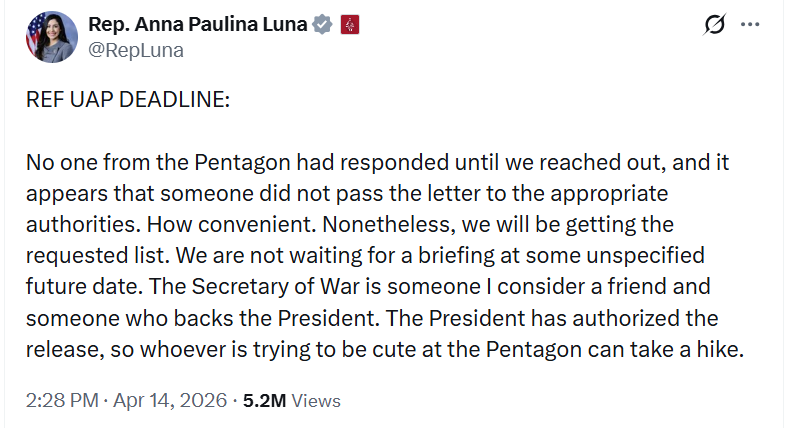
As of 8:28 a.m. EDT on April 15, 2026, there was no public confirmation on House Oversight’s website or AARO’s public imagery page that the April 14 UAP-video request had been fulfilled.
UAP videos: On March 31, 2026, U.S. Representative Anna Paulina Luna’s House task force sent Secretary of War Pete Hegseth a four-page demand for 46 video files tied to Unidentified Aerial Phenomena (UAP). In the underlying House letter, the task force told the Pentagon to deliver the material by April 14, 2026. By early April 14, public reporting still described the matter as a live deadline rather than a confirmed handover, according to Newsweek’s April 14, 2026 report. The issue was no longer a fringe curiosity. It had become a congressional test of whether witness accounts, military encounters, and classified holdings would finally be matched by releasable records.
UAP videos and the April 14 deadline
UAP videos: why this demand is different
First, the House move was unusually specific. In an April 1, 2026 House Oversight release, Luna said her task force was continuing its UAP investigation. Moreover, the underlying March 31, 2026 letter to Hegseth did not ask for a generic briefing. Instead, it asked for 46 named files and told the secretary to deliver them “as soon as possible but no later than April 14, 2026.”
Notably, that detail matters. Congress often talks about transparency. However, it more rarely names the records it wants. Here, the list includes incidents by date, region, aircraft, and mission labels. Consequently, the pattern suggests the task force was working from something more concrete than general suspicion.
Even so, readers should avoid the first trap in any UAP story. A file title is not proof of what the file contains. It may reflect a pilot’s first description. Alternatively, it may reflect analyst shorthand. In other cases, it may reflect nothing more than an unresolved case label.
Pentagon UFO videos and the file list
Still, the March 31, 2026 House letter reads less like a random grab bag than a map of what Congress thinks matters. It includes civil-airspace cases near Columbus, Ohio; combat-theatre cases tied to Iran and Syria; a military intercept over Lake Huron involving an Air National Guard Lockheed Martin F-16C and an AIM-9X Sidewinder; and a transmedium item titled “Multiple Spherical UAP USO near Sub. Cactus 1X in and out of water, 3/25/22”, where USO means unidentified submerged object. That spread suggests lawmakers are chasing several problem sets at once: airport proximity, battlefield reporting, force-protection incidents, and objects said to move between air and water.
Additionally, that spread matters because it turns the dispute into an operational question. Congress is not only asking whether unusual videos exist. It is asking what kinds of incidents were recorded, where they occurred, and whether the Pentagon treated them as civil-aviation, intelligence, or readiness issues. That does not prove an extraordinary answer. However, it does make the oversight fight more concrete.
Therefore, the real test is whether the Pentagon will release enough context to let outsiders judge these cases on their own merits. For aerospace readers, that means timestamps, sensor type, location bands, and analytic notes, not just another provocative clip. Without that package, disclosure will generate heat without adding much usable evidence.
UAP footage and what the House is really testing
Meanwhile, the House is also testing AARO’s credibility. In the same House Oversight release, Luna argued that prior responses from the All-domain Anomaly Resolution Office had been “less than adequate.” She added: “The lack of disclosure regarding the very real threat posed by UAPs in and around U.S. restricted airspace is concerning.” — Anna Paulina Luna, chairwoman, House Oversight release
Therefore, that criticism matters because Congress is no longer treating UAP testimony as background noise. In her September 9, 2025 opening statement, Luna warned that if Washington keeps ignoring pilots, service members, and government whistleblowers, it risks losing their trust. That is why lawmakers are now going around AARO and asking the secretary directly for specific material: the dispute is no longer only about process, but about whether official gatekeepers have been candid about what they already hold.
However, the House move remains a request, not a subpoena. That legal distinction is important. Consequently, April 14 is best understood as a political and procedural deadline, not an automatic release trigger. If the Pentagon declines, delays, or restricts access, lawmakers will still have to decide whether they want a real confrontation.
Separately, timing matters. The request landed after the September 9, 2025 House hearing on UAP transparency and whistleblower protection, and after months of renewed White House talk about disclosure. Therefore, lawmakers are pressing at a moment when public expectation is already high. That can create leverage. Yet it can also create theatre.
For readers outside the UAP world, the practical relevance is simple. If Congress cannot obtain specific records after naming them one by one, oversight looks weak. If it can obtain them but cannot release useful context, transparency looks cosmetic. Either way, public trust takes a hit.
UAP videos and the limits of congressional leverage
UAP footage and the gap between request and release
First, the House has real oversight authority. Luna’s letter invokes the Oversight Committee’s broad investigative power under House Rule X. Yet the task force still faces the same barrier that has frustrated Congress for years: special access, originator control, and highly compartmented handling rules.
Notably, that barrier is not theoretical. In her September 9, 2025 opening statement, Luna said members had previously asked to view UAP files and videos. She said the Department of Defense had told committee staff that only members of the House Armed Services Committee and the defence appropriations subcommittee could be read into certain special access material.
Consequently, the fight over UAP videos is really a fight over who gets to inspect sensitive evidence and under what conditions. If the Pentagon withholds the files, lawmakers must choose whether to escalate. Moreover, escalation can mean subpoenas, closed briefings, or a larger clash over how special access programs are overseen.
UAP disclosure files and the stalled legislative route
Additionally, Congress has already tried the legislative route. On Congress.gov’s H.R.1187 page, U.S. Representative Tim Burchett’s UAP Transparency Act is shown as introduced on February 11, 2025 and referred to the House Committee on Oversight and Government Reform. The bill would require the president to direct agencies to declassify UAP records and make them public. However, it did not move beyond introduction.
Consequently, that stall is revealing. Washington likes transparency as a slogan. It likes it less when transparency collides with compartmentation, budget secrecy, and collection equities. In that sense, the UAP dispute is not unique at all. It is a classic battle between headline politics and the state’s instinct for controlled disclosure.
Even so, the UAP issue adds one twist. Some of the most interesting material may come from sensors whose value depends on not revealing exactly what they can do. Release a clip without metadata and critics will call it useless. Release too much context and officials will say they are exposing sources and methods. That is the structural bind.
Classified Pentagon videos and the White House effect
Separately, Reuters reported on February 20, 2026 that President Donald Trump said he would direct Hegseth and other agencies to begin identifying and releasing files related to alien and extraterrestrial life, UAP, and unidentified flying objects. That announcement did not itself release evidence. However, it created a new political backdrop for every later move.
Then the administration added another signal. In a February 25, 2026 DefenseScoop report, Hegseth said the Pentagon would be “in full compliance with that executive order” and that there would be “more coming on that, as far as the process of what we’ll do.” — Pete Hegseth, Secretary of War, via DefenseScoop
The same DefenseScoop report added two important facts. Pentagon spokesperson Sue Gough said AARO had been examining “over 2,000 UAP cases.” She also said roughly 1,000 reports remained in the active archive because they lacked enough data for analysis. That matters because the caseload is growing faster than public reporting appears to be.
Notably, DefenseScoop also reported that AARO had not published its 2025 annual report or volume two of its historical review. As this post was prepared, AARO’s public Congressional and Press Products page still listed the 2024 annual report, but not a 2025 annual report. That gap does not prove concealment. However, it does create political exposure for an office that was meant to reduce uncertainty rather than feed it.
For investors, contractors, and policy watchers, this matters beyond the UFO headline. Classification policy shapes what can be said about sensor performance, airspace incursions, and emerging threats. When the public debate collapses into slogans, procurement and readiness decisions still move forward. The bills arrive whether the object is mundane, adversarial, or unresolved.
UAP videos and AARO’s credibility problem
UAP videos versus the office meant to explain them
Next, consider AARO’s own published record. In the Fiscal Year 2024 annual report, the office said it received 757 UAP reports during the covered period. Of those, 485 incidents occurred during that reporting window. Meanwhile, 272 were older incidents from 2021 and 2022 that arrived later. The same report said 392 of the 757 reports came from the Federal Aviation Administration (FAA).
Meanwhile, those figures matter because they move the story out of folklore and into workflow. UAP reporting is now a bureaucratic caseload that includes military channels and civil aviation feeds. Yet the same report also shows why the public argument remains unstable.
AARO said 49 cases were resolved during the reporting period and another 243 were recommended for closure as of June 1, 2024, pending peer review. Those cases resolved to prosaic objects including balloons, birds, unmanned aerial systems, satellites, and aircraft. At the same time, the report said 21 cases merited further analysis, while 444 lacked sufficient data and were moved into the active archive.
Therefore, that profile is revealing. Most of the workload still points toward ordinary explanations or weak data. A small fraction remains technically interesting. Therefore, the record looks neither like total emptiness nor like public proof of something extraordinary. It looks like a real sensor-and-reporting system with a noisy input stream.
Moreover, AARO’s public bottom line answers only one question. It says the office has not discovered evidence of extraterrestrial beings, activity, or technology. However, that does not cancel trained witness testimony, unresolved military encounters, or Congress’s view that additional records exist and have not been adequately disclosed. The live dispute is not whether AARO has publicly proved a non-human origin. It is whether AARO has fully accounted for the strongest cases and whether Congress trusts the office to be the final word on them.
UAP footage, public imagery, and the classification shield
Meanwhile, AARO has released a limited but telling public imagery set. On its official UAP imagery page, the office lists clips added in December 2025 and January 2026. Some remain unresolved. Others were resolved as balloons or birds. In several entries, AARO says the footage depicts a physical object whose “morphological features, performance characteristics, and behaviors are unremarkable.”
Notably, that wording deserves attention, but it should not swallow the larger dispute. Public imagery is a curated subset, not the whole record Congress is now seeking. So when AARO says a released clip looks unremarkable, that does not settle what pilots, operators, or lawmakers believe remains behind classification barriers.
Classified Pentagon videos and the sources-and-methods shield
At the same time, Dr. Jon Kosloski, director of the All-domain Anomaly Resolution Office (AARO), has acknowledged that the office retains a small but difficult anomalous subset. In the November 14, 2024 Pentagon transcript of his media roundtable, he said only a “very small percentage” of reports are potentially anomalous. He later added that the subset with anomalous characteristics that “one could attribute breakthrough technologies to” was less than 3.5 per cent of overall cases. — Dr. Jon Kosloski, AARO director, Pentagon transcript
Kosloski also repeated the office’s bottom line. “We have not found any, no. There are definitely anomalies. We have not been able to draw the link to extraterrestrial.” — Dr. Jon Kosloski, Director, AARO, official transcript That is an important statement. Still, it is not the same as saying the office has solved everything. Instead, it says the office has not linked its unresolved cases to extraterrestrial origin.
Consequently, AARO’s credibility problem is two-sided. Critics often say the office is evasive. Believers often say the office is suppressive. Yet the public record suggests a narrower problem. The office is trying to run a scientific and intelligence process under political conditions that reward maximal claims and punish uncertainty.
However, the strongest shield available to AARO and the Pentagon is still sources and methods. Sensitive platforms collect some of the most interesting data. Those same platforms make release harder. For defence professionals, that argument is familiar and often legitimate. For the public, it can sound like a permanent escape hatch. That tension is now one of the story’s core facts.
UAP videos and the politics of disclosure
UAP videos, Burchett’s rhetoric, and the evidence gap
Then there is U.S. Representative Tim Burchett. In Newsweek’s April 13, 2026 report, Burchett said he had been briefed on some “pretty wild” things and that the American public “can handle it.” He also said: “Just tell the American public … let America decide if we can handle it. I think we can handle it.” — Tim Burchett, U.S. representative, via Newsweek
Meanwhile, those remarks matter politically because Burchett has become one of Congress’s loudest disclosure advocates. Yet they matter journalistically for a narrower reason. They are not evidence. Instead, they are claims about what he says he has heard or seen in settings the public cannot inspect.
Newsweek also added an essential qualifier. It said Burchett has repeatedly made broader claims about recovered UFO technology and beings without publicly substantiating them. That context cannot be brushed aside. Access is not the same thing as accuracy.
Still, his rhetoric has an effect. It frames secrecy itself as the scandal. Sometimes that framing is useful, especially when agencies hide behind process. However, it can also distort expectations by implying that the only barrier to public proof is political courage.
Moreover, disclosure politics now has a broader chorus. In The Guardian’s April 12, 2026 analysis, a defense department official said AARO was working with the White House and across agencies to “facilitate the expeditious release of never-before-seen UAP information.” That is significant because it suggests some release process is active. Yet “never-before-seen” is a publicity phrase, not an evidentiary standard.
UFO disclosure files and the market for suspense
Additionally, disclosure politics creates incentives that often pull against careful reporting. The White House has an incentive to promise transparency. Congress has an incentive to sound more aggressive than the agencies it oversees. Agencies have an incentive to protect sensitive systems. Advocacy groups have an incentive to treat every partial release as proof that larger secrets remain.
Consequently, that incentive structure produces a market for suspense. It also produces a market for disappointment. If the next release is ambiguous, sceptics will dismiss the whole issue as unserious. If the release is partial, believers will say the real material is still hidden. Both reactions are predictable. Neither is especially analytical.
For aerospace readers, the correct question is more concrete. Does the next release improve the ability of outside analysts to distinguish clutter, drones, balloons, spoofing, sensor artefacts, blue-force activity, or genuinely unresolved events? If the answer is no, then the politics may move while the evidence stands still.
Therefore, procedural detail matters more than slogans. Were lawmakers shown full-motion video or edited excerpts? Were timestamps, location bands, sensor types, and analytic notes included? Did the public get the same context Congress saw? Those are the details that turn UAP videos into evidence rather than theatre.
For related context, see our Fliegerfaust report on the September 2025 UAP transparency hearing. Also see our Fliegerfaust analysis of the Trump UFO disclosure speech rumour. Both cases show how quickly claims can outrun verifiable artefacts.
UAP videos and the aviation-security question
UAP videos are not just a culture-war story
Finally, the aviation angle deserves more weight than it usually gets. The Luna list includes incidents near restricted airspace, military platforms, and at least one airport-vicinity case. Even if many of those files turn out to show balloons, drones, or sensor artefacts, the reporting burden remains real.
Meanwhile, the FAA’s Drone Sightings Near Airports page says the agency receives more than 100 reports of unmanned aircraft sightings near airports each month. That does not explain every UAP report. However, it does change the prior probability in busy airspace. Unknown traffic near airports is more likely to involve small terrestrial objects than interstellar visitors.
Moreover, the FAA’s terminology has already changed. In Notice N 7110.800, which took effect on October 26, 2025, the agency replaced “UFO” with “UAP” in air traffic language and directed controllers to inform supervisors of reported or observed UAP activity. That sounds semantic. In practice, it is operational. When terminology changes inside reporting systems, workflows change with it.
AARO’s 2024 annual report adds another practical layer. Of the 392 FAA reports it received during the reporting period, only one mentioned a possible flight-safety issue. In that case, a commercial aircrew reported a near miss with a “cylindrical object” over the Atlantic Ocean off New York. AARO said it was continuing analysis of that case.
That is not evidence of exotic technology. Instead, it is evidence that the unknown can intersect with safety reporting. For pilots, controllers, regulators, insurers, and airport operators, that alone is reason to care. The question is not whether every anomaly is profound. The question is whether the system can sort the mundane from the hazardous quickly enough to matter.
UAP footage and what aerospace readers should watch next
Therefore, the smartest way to read the current fight is not through the alien question first. It is through surveillance, readiness, and data quality. Can the Pentagon and AARO distinguish unresolved military cases from routine clutter at scale? Moreover, can Congress audit that process without creating a permanent leak-versus-secrecy stalemate? Finally, can civil and military reporting systems share useful information without overwhelming analysts with noise?
Consequently, those questions affect budgets, training, and procurement. If anomalous cases cluster near certain sensors or sites, that may drive investment in better collection, fusion, and counter-drone capability. If the cases mostly collapse under review, that still tells operators something valuable about reporting quality and the burden of modern airspace clutter.
Likewise, politics can shape behaviour in the cockpit and the control room. Crews need reporting systems they trust. They do not need a stigma machine that turns every unusual sighting into ridicule. Yet they also do not need a media ecosystem that rewards dramatic overstatement. Effective safety culture lives in the middle.
For more on that operational side, see our Fliegerfaust analysis of UAP reporting and aviation safety. The practical question is not whether every report is extraordinary. It is whether the reporting architecture can separate hazard from noise fast enough to protect crews and preserve confidence.
Conclusion: UAP videos now test evidence, not belief
Overall, the strongest verified fact is not that Congress has proved something extraordinary. The strongest verified fact is that a House task force demanded a named package of 46 UAP-related files from the Pentagon after concluding that AARO’s prior responses were inadequate. That shifts the story from speculation to oversight: lawmakers are no longer asking whether unusual reports exist, but whether the government will release records that can be independently tested.
Moreover, the record also shows that AARO is handling a large caseload, that most resolved cases still point to ordinary explanations, and that a small minority remain analytically difficult. At the same time, the record shows that classification, especially around sensitive platforms, remains the main barrier between internal awareness and public proof.
However, the record already shows something more serious than bureaucratic ambiguity. Credible military witnesses, unresolved encounters around protected airspace, and Congress’s own complaints about inadequate answers are enough to justify aggressive scrutiny. The unresolved question is not whether the subject is serious. It is how much of the relevant record remains hidden behind classification and whether AARO is functioning as an investigator, a bottleneck, or both.
The measured judgment is this: Washington has not closed the case; it has exposed a deeper conflict between witness evidence, classified holdings, and controlled disclosure. Congress may yet force more records into view. Until it does, the public is being asked to trust institutions that lawmakers themselves say have been less than adequate.
Finally, readers should watch three things next.
- First, whether the Pentagon or House Oversight publicly confirms compliance, partial compliance, or non-compliance with the April 14 request.
- Second, whether AARO publishes its missing 2025 public reporting.
- Third, whether any new release arrives with enough metadata and analytic context to move the debate from assertion to scrutiny.
What do you think?
If Washington cannot do that, then what exactly does “transparency” mean in an era built on sensors, secrecy, and strategic risk?
Leave your answers and comments below and on our Fliegerfaust Facebook page.
Sources
- U.S. House Committee on Oversight and Government Reform — Luna Continues Transparency Investigation into UAPs (April 1, 2026).
- U.S. House Committee on Oversight and Government Reform — Letter from Rep. Anna Paulina Luna to Secretary Pete Hegseth requesting UAP video files (March 31, 2026).
- U.S. House Committee on Oversight and Government Reform — Luna Opens Hearing on Restoring Public Trust Through UAP Transparency (September 9, 2025).
- Newsweek — Truth on UFOs Should Be Released, Republican Says: ‘Pretty Wild’ (April 13, 2026).
- Newsweek — Pete Hegseth Faces UFO Deadline (April 14, 2026).
- Reuters — Trump orders agencies to identify and release government files on aliens (February 20, 2026).
- DefenseScoop — Hegseth doubles-down on Trump’s UAP disclosure promise as AARO’s caseload exceeds 2,000 (February 25, 2026).
- All-domain Anomaly Resolution Office — Congressional/Press Products (accessed April 14, 2026).
- The Guardian — ‘Never been closer’: UFO watchers buoyed by Trump and Vance’s alien ‘obsession’ (April 12, 2026).
- U.S. Department of Defense — Fiscal Year 2024 Consolidated Annual Report on Unidentified Anomalous Phenomena (November 14, 2024).
- U.S. Department of War — Dr. Jon Kosloski, Director, AARO, Media Roundtable on the FY24 Consolidated Annual Report on UAP (November 14, 2024).
- All-domain Anomaly Resolution Office — AARO UAP Imagery (accessed April 14, 2026).
- Congress.gov — H.R.1187 — UAP Transparency Act (introduced February 11, 2025).
- Federal Aviation Administration — N 7110.800 — Unidentified Anomalous Phenomena (UAP) Reports (September 12, 2025).
- Federal Aviation Administration — Drone Sightings Near Airports (last updated January 7, 2026).
For full details, please refer to our Disclaimer page.