
When another pilot makes a joke
UAP/UFO aviation safety: what should a pilot do when a “small silver canister” appears off the wingtip at 3,500 feet—and another crew (flight Cronos 402) on frequency jokes, “I want to believe” and “Good luck with the aliens”? That “I want to believe” aside is straight out of The X‑Files playbook—a pop‑culture reference that instantly frames the moment as UFO‑adjacent, even in serious airspace.
On December 23, 2025, a FOX 10 Phoenix report revived a short but arresting air traffic control (ATC) exchange from Rhode Island: a private pilot described a hovering, cylindrical object near the aircraft, while controllers and nearby pilots tried to make sense of it in real time.
In the same end‑of‑year news cycle, Fox News amplified the UAP (unidentified anomalous phenomena) drumbeat with coverage of “secret files,” nuclear‑linked storylines, and a new documentary, The Age of Disclosure. Meanwhile, Space.com ran a sober counterpoint on December 23, 2025: researchers are still short on definitive answers, but they say the work is maturing—and the aviation case for better data is getting harder to dismiss.
Taken separately, each story risks becoming the kind of Christmas‑week “sky oddity” that spikes clicks and then fades. Taken together, they sketch a more consequential question: how does a modern aviation system—built on layered surveillance, standardized phraseology, and rigorous occurrence reporting—handle something that sits at the intersection of safety-of-flight, national security, and social stigma?
That is where UAP/UFO aviation safety stops being a punchline. It becomes a test of how well we can see, record, and explain what happens in our airspace—especially near airports, critical infrastructure, and sensitive sites where mistakes carry real consequences.
UAP/UFO aviation safety and the Rhode Island cockpit call
UAP flight safety: the “silver canister” moment, frame by frame
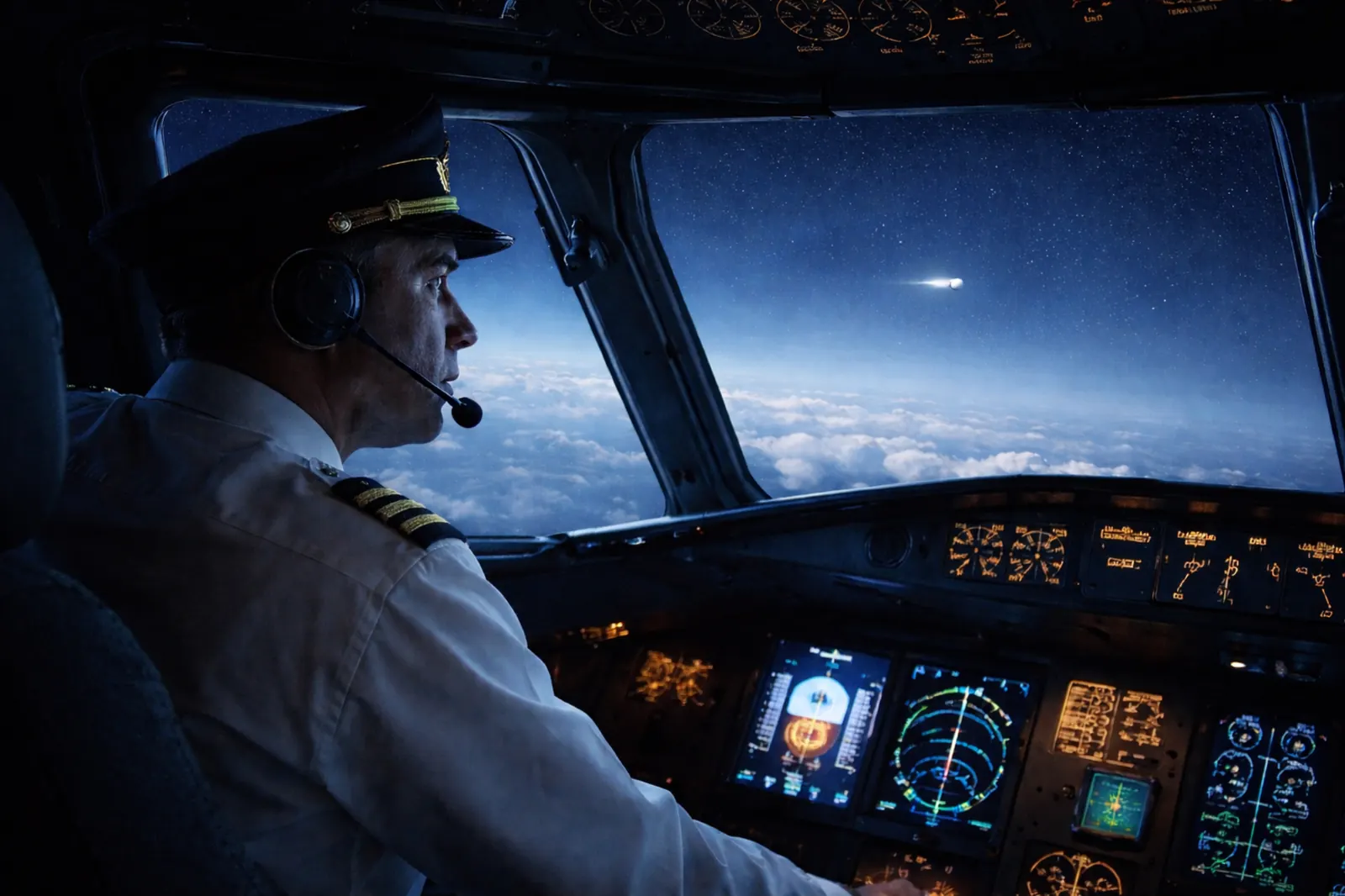
According to FOX 10 Phoenix’s report, the resurfaced recording came from an exchange involving Rhode Island T.F. Green International Airport (PVD). The pilot, flying a Piper PA‑32RT‑300T Turbo Lance II, reported a small, silver cylindrical object near the wing while the aircraft was around 3,500 feet.
In the audio, the pilot’s language is plain and operational rather than theatrical. “It appears to be standing still.” — Listen to it all from the video below.
Notably, the pilot offers a classic “pilot’s description” rather than an interpretation. “Looks like a strange, small object that we just floated by … a small silver canister.” — FOX 10 Phoenix
ATC responds the way controllers often must: by turning a startling report into triage questions. Could it be a drone? Could it be a balloon? Are there other reports?
When the pilot answers that nothing appeared attached, the unsettling part becomes not “what it was,” but “where it was.” “I saw nothing attached to it … It was astonishing. I don’t know what it was.”.
Then comes the line that made the story travel—but it is not actually ATC saying it.
In the original VASAviation clip, the “Good luck with the aliens” remark is spoken by another aircraft on frequency, identified in the overlay as CNS402 (“Cronos 402”), not by the controller. “Good luck with the aliens.” — Listen from the video above.
UAP UFO aviation: Normal newsroom mistake
Notably, several mainstream write‑ups frame the line as an ATC joke, including the Fox‑syndicated version that ran on FOX 10 Phoenix. That kind of attribution slip is a normal newsroom mistake when a busy frequency is compressed into a short viral excerpt.
However, as a pilot, I can say this is not the kind of mix-up pilots make. Call signs and speaker identification are the grammar of radio work. Additionally, I earned my Canadian amateur radio licence at 12 in 1977—then the youngest in Canada—when the exams required Morse code and were far more demanding and complex than today. Consequently, disciplined radio communications on busy frequencies are second nature to me.
Even so, the humour lands differently once the source is clear. In this case, it is pilot‑to‑pilot banter, not a controller dismissing a report. Consequently, it reads less like institutional mockery and more like a cockpit trying to keep the moment human without derailing the frequency.
And yes—if “Good luck with the aliens” and “I want to believe” ever becomes a standard pilot farewell in Canadian airspace, someone will inevitably ask for the French version in Québec, maybe requiring a referendum.
UFO airspace risk: why proximity matters more than provenance
Aviation safety does not require the object to be extraterrestrial to be hazardous. In fact, from a risk perspective, the most dangerous “UAP” is usually the most ordinary: a balloon, a drone, a piece of airborne debris, or a small aircraft without a transponder.
At 3,500 feet, a light aircraft has less time and space to manoeuvre than an airliner at cruise. Moreover, a visual sighting near a wingtip compresses decision‑making into seconds. Consequently, the key safety variables become closure rate, lateral separation, and whether the object will cross the aircraft’s flight path.
Even when a pilot sees something clearly, human perception can mislead. A “standing still” object may be a slow object seen against a moving background. Alternatively, it may be a distant object with minimal relative motion. In either case, the brain fills in gaps quickly, and cockpit workload can spike.
That is why safety organizations emphasize reporting and data capture rather than debating origin over the radio. Put bluntly, UAP/UFO aviation safety improves when we treat the event as an airspace hazard first, and a mystery second.
Airspace anomaly reporting: why audio goes viral, and data does not
The recording cited by FOX 10 Phoenix was posted to YouTube by the VASAviation channel, which curates ATC audio. That distribution model changes the lifecycle of aviation oddities. A routine exchange can resurface months later, detached from context like weather, traffic density, and radar coverage.
Separately, LiveATC.net lets you hear live air traffic control (ATC) transmissions from towers and radar facilities worldwide. Better still for context, many feeds include ATC audio archives that let you replay prior traffic and rebuild the timeline. In fact, I used to contribute a receiver feed from an airport near where I lived.
Moreover, LiveATC offers mobile access and iPhone/Android apps, which makes “just five minutes” of listening an optimistic plan.
Meanwhile, the data that would help resolve the encounter often remains non‑public. Radar returns, if any, sit in operational systems. Additionally, any internal follow‑up depends on reporting pathways and prioritization. As a result, the public sees the banter but not the backend.
This asymmetry matters. When audio drives the narrative, aviation risks turning a safety signal into entertainment. However, when data drives the narrative, the same event can become an input for better procedures, better sensors, and better training.
If UAP/UFO aviation safety is the goal, the “viral clip economy” needs a parallel “verifiable record economy.”
UAP/UFO aviation safety and the reporting pipeline
UAP/UFO aviation safety: what ATC can do in real time
Air traffic control (ATC) exists to keep aircraft safely separated and moving efficiently. It does not exist to identify every light, balloon, or odd return. Still, ATC plays a pivotal first‑response role in anomalous sightings.
First, controllers can query other aircraft in the area. Second, they can check whether other pilots report similar objects. Third, they can review available radar and surveillance feeds. Finally, they can pass information to supervisors or safety offices if the report appears credible or safety‑relevant.
In the Rhode Island clip, the controllers’ immediate questions—drone or balloon—reflect how aviation safety works: it starts with the most plausible hazards. That is not cynicism. It is risk management.
Moreover, that approach scales. A system that assumes “alien craft” by default would collapse under noise. Conversely, a system that assumes “nothing” will miss real hazards. The practical middle ground is disciplined curiosity: treat the report seriously, ask structured questions, and preserve evidence.
UAP flight safety: what the FAA says happens after a report
The Federal Aviation Administration (FAA) is explicit about record‑keeping when pilots report UAP to ATC. “The FAA documents UAP sightings whenever a pilot reports one to an air traffic control facility.” — Federal Aviation Administration statement quoted by FOX 10 Phoenix
The FAA statement continues with a key conditional: documentation becomes more actionable when “supporting information such as radar data corroborates the report.” — Federal Aviation Administration statement quoted by FOX 10 Phoenix
That line is the hinge between story and investigation. Radar corroboration turns a sighting into a track. A track can be analysed. Furthermore, a track can be compared with other sensors, aircraft transponder data, and known activity.
Importantly, the FAA statement, as reported, describes a clear threshold for escalation. “If supporting information such as radar data corroborates the report, the FAA shares it with the UAP Task Force.” — Federal Aviation Administration statement quoted by FOX 10 Phoenix
In this Rhode Island exchange, there is no mention of a radar‑correlated target supporting the pilot’s sighting. Consequently, based on the FAA’s own condition, there is no indication this report would be forwarded to the UAP Task Force. Instead, it would likely remain a documented pilot report without the additional “corroborated” package that drives follow‑on action.
Since that earlier task force era, the U.S. Department of Defense (DoD) consolidated much of its effort into the All-domain Anomaly Resolution Office (AARO). The AARO site defines “Unidentified Anomalous Phenomena (UAP)” using a statutory definition that includes airborne, transmedium, and submerged objects. (AARO)
For aviation, the takeaway is simple: the reporting path exists, but only when it captures verifiable artefacts.
UAP witnesses under oath: what they said they saw
FAA language can feel abstract until you hear the “unknown” described in plain operational terms. In September 2025, multiple witnesses testified under oath about encounters they say involved close proximity to critical sites, unusual movement, and a lack of conventional signatures.
One account came from former U.S. Air Force Security Forces member Jeffrey Nuccetelli, describing a 2003 incident at Vandenberg involving “a massive, glowing red square silently hovering” over missile defence sites. — Jeffrey Nuccetelli, U.S. Air Force Veteran, House Oversight Committee
His testimony also captures the human factor in real time: radio calls that sound like a security emergency, not a folklore story. “It’s coming right at us… now it’s right here!” — Jeffrey Nuccetelli, U.S. Air Force Veteran, House Oversight Committee
On the maritime side, active-duty U.S. Navy Senior Chief Alexandro C. Wiggins described a 15 February 2023 event off Southern California while serving aboard USS Jackson. “A self-luminous, ‘Tic-Tac’-shaped object” was seen in a sequence he characterised as transmedium and coordinated. — Alexandro C. Wiggins, U.S. Navy Senior Chief Petty Officer, House Oversight Committee
What made his statement notable for flight safety readers is not the label, but the operational detail: “All four departed simultaneously in a highly synchronized, near-instantaneous manner.” — Alexandro C. Wiggins, U.S. Navy Senior Chief Petty Officer, House Oversight Committee
He also claimed the absence of common signatures that help crews classify “normal” hazards. “No sonic boom or conventional propulsion signatures were observed.” — Alexandro C. Wiggins, U.S. Navy Senior Chief Petty Officer, House Oversight Committee
Former USAF 1N1 geospatial intelligence specialist Dylan Borland described a separate personal sighting from 2012 at Langley, writing he saw “an approximately 100-foot-long equilateral triangle” that “did not have any sound.” — Dylan Borland, former USAF 1N1 geospatial intelligence specialist, House Oversight Committee
Journalist George Knapp framed the broader problem in a way that matters to aviation reporting culture: it’s easy for the public conversation to drift into belief and counter-belief. Yet, in his words, “Belief has nothing to do with it.” — George Knapp, investigative reporter (KLAS-TV), House Oversight Committee
UAP reporting and retaliation: what happened after they spoke up
The second part of these accounts is less cinematic and more familiar to anyone who has worked in a large safety system: reporting often rises quickly, but answers don’t always come back down.
Nuccetelli’s testimony includes a line that reads like a textbook “closed loop” failure. “We sent information up, but no guidance came down.” — Jeffrey Nuccetelli, U.S. Air Force Veteran, House Oversight Committee
Borland’s account goes further, describing consequences he attributes to what he learned and reported through official channels. He wrote that his “professional career was deliberately obstructed,” and later added he remains “still blacklisted” with “no job prospects.” — Dylan Borland, former USAF 1N1 geospatial intelligence specialist, House Oversight Committee
Knapp, speaking as someone who has interviewed many sources over decades, described why that kind of risk suppresses reporting even when the sighting itself could carry safety value. In his words, “they know they will be pummeled for it.” — George Knapp, investigative reporter (KLAS-TV), House Oversight Committee
That “chilling effect” point was echoed from a policy angle by Joe Spielberger of POGO, who reminded the committee that reporting wrongdoing is not a side-issue — it’s how oversight systems work at all. “Whistleblowers are a crucial first line of defense against wrongdoing in our government.” — Joe Spielberger, Project On Government Oversight, House Oversight Committee
UAP/UFO aviation safety: what pilots and controllers should take from this
For pilots and controllers, the practical takeaway is this: even when a report is made, how far it travels can hinge on whether it carries corroborating artefacts (radar, EO/IR metadata, timestamps, coordinates, chain-of-custody). That connects directly to the FAA’s own “if corroborating information exists” threshold you’re already explaining above — and it also explains why some reports feel like they vanish even when they were properly logged.
This is also where it’s useful to compare what happens outside the U.S., because reporting “lanes” look different depending on national infrastructure and process maturity (which you’ve covered from an ATC systems angle here: NAV CANADA tower tech and FAA ATC modernisation).
Canada’s parallel lanes: CADORS, CIRVIS, and Sky Canada
Canadian aviation professionals will recognize the pattern: unusual reports do not always mean exotic causes. They often mean incomplete information.
Transport Canada maintains the Civil Aviation Daily Occurrence Reporting System (CADORS), a public database that captures preliminary aviation occurrence information. That includes UAP reports, according to a Transport Canada Question Period Note.
Notably, Transport Canada has also cautioned that the “UFO” label in occurrence reporting can describe many ordinary things. “In the Civil Aviation Daily Occurrence Reporting System (CADORS), the term ‘UFO’ can be used to describe many things … It should not be interpreted to mean something of extraterrestrial origin.” — Transport Canada, High Altitude Object Incidents
That is the Canadian version of “start with the base rate.” Most anomalies have mundane explanations, and good systems are built to sort the mundane from the meaningful.
Not all reports are analysed
Meanwhile, Ottawa has tried to modernize the public‑reporting side without over‑promising. On December 3, 2025, the Office of the Chief Science Advisor published Management of Public Reporting of Unidentified Aerial Phenomena in Canada, under the broader Sky Canada Project. The page states that reports are not further analysed unless they pose safety or security risks.
That approach will frustrate some enthusiasts.
It also deserves scrutiny: a “no further analysis” default risks letting low‑information cases quietly stack up without trend analysis, even when aviation reporting would normally favour pattern‑finding over shrugging. Consequently, Sky Canada may reduce noise, but it can also reduce accountability unless the screening rules and outcomes are published.
If you want a deeper Fliegerfaust perspective on public transparency and testimony, see: UAP transparency hearing and witness claims.
UAP/UFO aviation safety in a drone-saturated sky
UAP/UFO aviation safety: the base-rate problem, now with propellers
If the 2010s taught aviation that “drone” could be a generic scare word, the mid‑2020s taught aviation something more serious: drones are now common enough to be a routine hazard vector.
The FAA publishes a standing reminder that “reports of unmanned aircraft (UAS) sightings … remain high.” Moreover, the agency says it “receives more than 100 such reports near airports each month.” (FAA)
That statistic does not prove that any given UAP is a drone. Still, it changes the prior probability. When a pilot reports an object near an airport environment, the most likely hazards include drones and balloons—not interstellar visitors.
Consequently, the Rhode Island sighting should be read through two lenses at once: it may be an unusual object, and it occurred in a world where “unusual” often means “small and commercially available.”
That is not as cinematic as a flying saucer. On the other hand, it is exactly what makes UAP/UFO aviation safety urgent.
Remote ID, counter‑UAS, and the airport perimeter dilemma
Regulators and industry have pushed Remote Identification (Remote ID) as a cornerstone of drone accountability. Yet airports remain complicated places to enforce any single rule. Operations occur inside controlled airspace, near complex boundaries, and often around critical infrastructure.
Meanwhile, security agencies have repeatedly warned that drones can probe sensitive sites. In the United States, a December 17, 2024 joint statement from the Department of Homeland Security (DHS), Federal Bureau of Investigation (FBI), FAA, and DoD said officials assessed a combination of lawful drones, hobbyist drones, law enforcement drones, manned aircraft, and even stars misreported as drones. (FAA)
The implication for pilots is sobering. Even large-scale “drone waves” can include genuine incursions mixed with misidentifications. Therefore, pilots and controllers need better tools to discriminate quickly, because the radio cannot do it alone.
In Québec, the commercial drone sector has been building capacity that may eventually feed into better detection, reporting, and integration practices. For a Canadian case study, see Fliegerfaust’s coverage of the Volatus Mirabel Innovation Centre.
And yes, if you ever wondered whether drones would drag “UFO” talk into boardrooms, the answer is now “absolutely.”
Pilot UAP reporting: the cockpit optics of speed, glare, and parallax
Pilots are trained observers. Still, even trained observers can misperceive objects in flight.
First, the windscreen is a complex optical environment. Reflections, scratches, and internal glare can mimic external motion. Second, parallax can make a distant object appear to “pace” an aircraft. Third, closure rates can be deceptive at low altitudes, where background features shift quickly.
Moreover, the human eye struggles with size‑distance ambiguity. A small object close to the aircraft can look like a larger object farther away, and vice versa. That matters because pilots naturally assess hazard based on apparent size and relative motion.
Therefore, the best UAP/UFO aviation safety strategy in‑flight is to treat the event as a potential collision hazard, maintain aircraft control, and report calmly with as many measurable details as possible: altitude, heading, position, time, and whether the object appears to manoeuvre relative to the aircraft.
In other words, pilots should aim to give investigators telemetry, not mythology.
UAP/UFO aviation safety meets The Age of Disclosure
What Fox News says the documentary claims
Fox News has devoted substantial attention in late 2025 to the documentary The Age of Disclosure. In a November 14, 2025 piece, Fox News described the film as featuring interviews with “34 senior U.S. officials” and framing an alleged decades‑long cover‑up of “non‑human intelligence.” (Fox News)
Director and producer Dan Farah told Fox News that the public, Congress, and even presidents have been kept “out of the loop.” “For a very long time, the public, Congress and even the president have been kept out of the loop on this subject.” — Dan Farah, Director/Producer, Fox News
The documentary narrative also leans into the “strategic race” concept: that the U.S. and adversaries pursue advanced technology tied to UAP claims. That framing appeals to defence audiences because it maps onto familiar patterns: foreign intelligence collection, technology surprise, and bureaucratic secrecy.
However, aviation journalism has to separate two things that can coexist: sincere testimony and unresolved proof.
Put differently, a documentary can raise important questions and provide the kind of sensor‑level evidence pilots and engineers require. In light of this I suggest you read (or re-read) UAP Transparency Hearing: Did Congress Finally Get The UFO Data To Move From Anecdotes to Aerospace Evidence?
The problem isn’t a lack of interest or a lack of sensors. The problem is that without full context and a clean chain‑of‑custody, even good footage can be weaponized into certainty by people who already decided what they believe. Consequently, the only mature move is to push for more disclosure—more data, not more slogans.
AARO’s public stance amounted to “a misrepresentation of the truth” and a “manipulation of the public perception” according to Dylan Borland, a former 1N1 geospatial intelligence specialist
Separating testimony from telemetry
Fox News’ late‑December roundup on “UFO secret files … and nuclear‑linked sightings” illustrates how quickly UAP discourse mixes aviation risk with broader speculation. (Fox News)
In that ecosystem, the most important discipline is “show the data.” That is why official reporting matters. I love a good documentary—but where is the compiled, auditable dataset?
That does not “solve” every UAP report. Instead, it clarifies what responsible analysis looks like: examine archives, check claims, demand artefacts, and resist the temptation to treat inference as proof.
For aviation audiences, the key question is less “Is there a cover‑up?” and more “Do we have enough data to prevent collisions and protect airspace?” That is a more boring question, and it is far more urgent.
UAP/UFO aviation safety: Why documentaries still matter
It is tempting for aviation professionals to roll their eyes at UAP media cycles. Yet cultural narratives can shape reporting behaviour. If pilots expect ridicule, they may underreport. If controllers expect social media exposure, they may become cautious in language.
Space.com’s end‑of‑year analysis explicitly notes that stigma has historically constrained funding and institutional support for UAP research. “Perhaps the holdup is reluctance to dump time, energy and money into what looks to some like a wild goose chase.” — Michael Cifone, Society for UAP Studies, Space.com
That quote may sting. However, it also describes a real policy problem: safety systems improve when professionals report anomalies without fear of stigma.
In Canada, the aerospace community is already wrestling with adjacent issues—how to integrate new technologies, validate sensor claims, and avoid politicized narratives. For an example of how defence decisions often hinge on sensors and evidence, see Fliegerfaust’s coverage of Canada’s fighter decision dynamics.
Ultimately, UAP/UFO aviation safety will not be solved by documentaries. Still, documentaries can push institutions toward transparency—or toward louder noise. Aviation should aim for the first outcome.
Nuclear-linked sightings: correlation, context, and caution
Restricted airspace isn’t romantic; it’s regulated
One reason “nuclear-linked UAP” stories persist is that restricted sites concentrate surveillance, security, and public curiosity. When something unusual appears near sensitive airspace, it attracts attention faster than it would over open ocean.
In The Age of Disclosure coverage, Fox News highlighted a trailer quote attributed to U.S. Secretary of State Marco Rubio: “We’ve had repeated instances of something operating in the airspace over restricted nuclear facilities, and it’s not ours.” — Marco Rubio, Secretary of State, quoted in trailer via Fox News
For aviation professionals, that quote triggers a practical question: what systems detected those objects, and what behaviour did they exhibit? Without that context, a strong statement can become a strong story without becoming a strong dataset.
Meanwhile, the safety reality is straightforward. Restricted airspace exists because the consequences of intrusion are high. Therefore, even mundane incursions—like drones—can become strategic events.
And no, “restricted” is not an invitation to build lore. It is an invitation to stay clear.
Fox News and Palomar: the “transients” study enters the conversation
On December 3, 2025, Fox News reported on a Scientific Reports paper involving digitized astronomical plates from California’s Palomar Observatory. The article says researchers identified 107,875 “transient lights” between 1949 and 1957 using automated methods. (Fox News)
The Fox News report notes two headline claims. First, the authors speculated that some transients could represent UAP in Earth orbit. “We speculate that some transients could potentially be UAP in Earth orbit ….” — Scientific Reports paper excerpt quoted by Fox News
Second, the report says transients were “45% more likely” within 24 hours of nuclear testing, and that researchers observed transients over at least 124 above‑ground nuclear testing sites active from 1951 until the Sputnik launch in October 1957. (Fox News)
From an aviation‑and‑space perspective, this is intriguing but not dispositive.
Correlation can emerge from many factors. Nuclear tests involve unique atmospheric conditions, unique observation programmes, and unique documentation. Moreover, the era included high‑altitude balloons and early aerospace experiments. Consequently, the correct posture is cautious curiosity.
In other words, statistics can open a door, but they do not automatically tell you what is behind it.
UAP/UFO aviation safety: why nuclear narratives still matter operationally
Even if “nuclear‑linked UAP” remains unproven, multiple credible witnesses have testified to incidents involving sensitive nuclear systems. The implication is obvious: command‑and‑control and critical infrastructure cannot afford mystery inputs. Security agencies pay attention to incursions near critical infrastructure. Pilots pay attention to airspace restrictions. Additionally, regulators pay attention to public confidence.
The risk for aviation is twofold. On one hand, sensational framing can create noise that overwhelms reporting channels. On the other hand, ridicule can suppress legitimate hazard reporting.
Therefore, the right stance for UAP/UFO aviation safety is neither credulity nor contempt. It is structured reporting, rapid triage, and disciplined analysis.
If that sounds less exciting than a teaser trailer, good. Aviation tends to prefer boring outcomes.
Inside the science: building sensors that can answer pilots
Plurality of minds, fewer “wild goose chase” budgets
Space.com’s December 23, 2025 feature makes a case that UAP research is maturing into a more instrumented, interdisciplinary field. The piece argues that the “plurality of minds” approach matters because UAP topics intersect physics, sensor engineering, and human factors. (Space.com)
It also highlights the stigma‑funding loop. Researchers struggle to build robust sensor networks because institutions fear wasting money on reputationally risky work. Yet without sensor networks, the field cannot produce high‑quality datasets.
That is a familiar aviation problem. Safety improvements often require investment before certainty, what research and development (R&D) is all about. In the early days of modern flight data monitoring, operators paid for systems long before they could quantify every benefit.
So yes, the “wild goose chase” line lands. It also invites a serious question: what would a properly engineered “UAP detection and classification” effort look like if we treated it like any other airspace safety problem?
How much would a camera network cost?
Space.com cites Robert Powell of the Scientific Coalition for UAP Studies (SCU) describing the scale of instrumentation required. “The cost of putting out a network of calibrated and characterized equipment … will cost tens to hundreds of millions of dollars.” — Robert Powell, SCU, Space.com
The article also notes an estimate: if there are roughly 300 “actual” UAP sightings per year (as assumed in that engineer’s model), a network of 930 automated camera systems across the U.S. might yield a 95% chance of detecting a 50‑foot‑or‑larger UAP within a year. (Space.com)
From an aerospace engineering standpoint, the number matters less than the architecture. Calibration, characterization, time synchronization, and access rights all drive cost. Moreover, the data pipeline matters as much as the sensors. Without standardized metadata and retention, even high‑quality captures can become useless.
That is why UAP/UFO aviation safety is ultimately an information architecture problem, not a curiosity problem.
AIAA and safety-of-flight: engineering the report, not the rumour
Space.com also profiles Ryan Graves, chair of the American Institute of Aeronautics and Astronautics (AIAA) Unidentified Anomalous Phenomena Integration Committee. Graves frames the issue as aerospace‑rigour and safety‑of‑flight. “Our remit is to bring aerospace rigor to an area with real safety-of-flight implications.” — Ryan Graves, AIAA UAP Integration Committee, Space.com
That remit matters because aviation already knows how to reduce ambiguity. It standardizes phraseology. It standardizes maintenance records. It standardizes incident reporting. Consequently, a “UAP reporting standard” is not conceptually radical. It is a familiar safety tool applied to a new class of observations.
The same Space.com piece notes that AIAA work parallels legislative pushes such as the “Safe Airspace for Americans Act,” intended to provide protected pathways for civilian reporting. (Space.com)
For Canadian readers, the cross‑border comparison is useful. The U.S. is building centralized defence‑oriented processes like AARO. We know AARO is not perfect. Canada is mapping public reporting through Sky Canada while using existing aviation occurrence systems. Both approaches converge on the same aviation truth: if you do not capture the data, you cannot learn.
Notably, one of the cleanest lines from the September 9, 2025 House Oversight hearing came from journalist George Knapp, who put the institutional trust question on the table, bluntly. “It almost looks like AARO operated as a counterintelligence operation … and then discredit all of them.” — George Knapp, House UAP hearing transcript
And yes, in 2025 it is possible for an aerospace standards committee to sound more grounded than a viral ATC clip, but going underground is too much.
UAP/UFO aviation safety in the era of official reports
ODNI’s annual report: the scale of the reporting problem
One of the most important “reality checks” for UAP coverage is the sheer volume of reports now flowing into official systems.
The Office of the Director of National Intelligence (ODNI) hosts the 2024 Consolidated Annual Report on Unidentified Anomalous Phenomena, required under U.S. legislation.
A Department of Defense release, republished by Joint Base San Antonio, summarizes key figures: AARO received 757 UAP reports in the covered period, with 485 incidents occurring during that reporting window. (Joint Base San Antonio)
Those numbers do not confirm extraordinary explanations. Instead, they confirm a bureaucratic fact: UAP reporting has become mainstream enough to generate hundreds of entries per year.
In aviation terms, that means two things. First, the reporting “signal” is likely mixed with substantial noise. Second, the safety‑relevant subset deserves careful extraction rather than casual dismissal.
NASA’s UAP report: what the science community actually asked for
NASA entered the UAP conversation not as a sensationalist, but as a data‑governance actor. On September 14, 2023, NASA published the Unidentified Anomalous Phenomena Independent Study Team Report, along with a downloadable PDF. (NASA)
The report’s core argument is not “aliens.” What do you think? Their approach is “rigorous, evidence‑based data acquisition.” For aviation audiences, that aligns with existing safety philosophy: when you cannot reproduce a phenomenon, you design systems that can capture it reliably the next time.
In other words, NASA’s UAP entry point is a familiar one: improve instrumentation, improve metadata, and reduce ambiguity through disciplined process.
That is also why UAP/UFO aviation safety should not be framed as a niche culture war. It is part of a broader movement toward better sensing, better analytics, and better reporting across aviation and space.
If you want a Fliegerfaust lens on how artificial intelligence may influence aviation data handling more broadly, see: AI in commercial aviation.
Definitions matter: what “UAP” actually means in policy
Policy definitions matter because they drive reporting scope. AARO’s site quotes the statutory definition of UAP, which explicitly includes airborne objects that are not immediately identifiable, transmedium objects, and submerged objects with related characteristics. (AARO)
That breadth can confuse the public. However, it helps investigators avoid premature categorization. A “UAP” is not an explanation. It is an administrative label for “unresolved at time of report.”
That distinction is the heart of UAP/UFO aviation safety. When we label a report “unidentified,” we should treat it as a workflow state, not a worldview statement.
What the cockpit should do next time
UAP/UFO aviation safety: report without fixation
Pilots are trained to aviate, navigate, communicate—in that order. Anomalous sightings test that discipline because they trigger surprise, curiosity, and sometimes fear.
First, maintain control of the aircraft. Second, maintain separation from known traffic. Third, communicate the sighting to ATC using concise, structured language.
The Rhode Island pilot did something that aviation instructors would recognize: he described what he saw without building a story. That approach helps controllers triage. It also helps investigators later.
Moreover, pilots should avoid manoeuvres driven by curiosity. Chasing an object can increase collision risk, violate airspace constraints, and create secondary hazards for other traffic.
So yes, treat it like any other hazard report. If it turns out to be a balloon, you helped. If it turns out to be a drone, you helped. If it turns out to be something truly anomalous, you still helped.
Use the tools, and know their limits
Modern cockpits offer multiple safety layers, but not all of them help with small objects.
Traffic Collision Avoidance System (TCAS) relies on cooperative transponders. Automatic Dependent Surveillance–Broadcast (ADS‑B) also relies on cooperative signals. Therefore, a small drone, a balloon, or debris may be invisible to those tools.
Onboard weather radar can sometimes detect large precipitation or large targets. However, it is not designed as a small object detector. Likewise, many electro‑optical systems are absent from general aviation aircraft, and even when present, they require time and training to interpret.
Consequently, pilots should treat “I don’t see it on TCAS” as neutral information, not reassurance.
That is another reason UAP/UFO aviation safety depends on system‑level sensing rather than cockpit‑level improvisation.
After landing: preserve details, reduce stigma
A post‑flight report can be more useful than an in‑flight conversation if it preserves key variables. Time, altitude, approximate position, direction of travel, weather, lighting conditions, and any manoeuvres all matter.
In Canada, CADORS can capture “UFO”‑type reports as occurrences, but Transport Canada cautions that the label often covers mundane causes. (Transport Canada)
Meanwhile, Canada’s Sky Canada Project suggests that public reports are not further analysed unless they pose safety or security risks. (Office of the Chief Science Advisor)
For pilots, the practical point is to file the report in the channel most likely to preserve it with operational context. Then, treat the event like any other safety occurrence: document it, debrief it, and move on.
Also, remember that in 2025 your cockpit audio may become internet content. That is not a reason to stay silent. It is a reason to stay professional.
UAP/UFO aviation safety: Conclusion
better data, not better lore
UAP/UFO aviation safety is not solved by memes, documentaries, or shouting matches about extraterrestrials. Instead, it is solved by the tools aviation already trusts: standardized reporting, disciplined observation, multi‑sensor corroboration, and transparent data retention.
In other words, aviators don’t need better campfire stories; we need better timestamps.
The Rhode Island exchange went viral because it sounded human. However, it also travelled because one line was misattributed: “Good luck with the aliens” was said by the Cronos 402 crew, not air traffic control (ATC). That kind of attribution error is normal in general‑interest coverage, but it is not the kind of mix‑up professional radio operators make.
Yet the safety lesson is colder: a small object near a wingtip at low altitude is a collision risk, regardless of its origin. Similarly, The Age of Disclosure may widen the audience, but the conversation only improves when it pulls more primary data into the light. Specifically, that means clearer context for publicly released material, metadata where releasable, and straight answers when records are withheld or destroyed.
Meanwhile, Space.com’s year‑end reporting hints at a path forward: instrumentation, calibration, and aerospace‑rigour applied to an area long dominated by stigma and speculation. That is an opportunity. It is also a responsibility, because the airspace is only getting busier—especially near airports where drones, balloons, and misidentifications already create persistent noise. That rigour has to include plain‑language outcomes, so “investigated” does not become a synonym for “filed and forgotten.”
Here is the critical point: if aviation institutions treat UAP reporting as a public‑relations nuisance, they will miss safety‑relevant signals buried in the chatter. However, if they treat every report as a cultural referendum, they will drown in noise. Either way, if whistleblowers are punished or slow‑walked, the pipeline collapses. The mature answer sits in the middle—invest in data capture, publish what can be published, protect reporters from stigma, and relentlessly separate telemetry from storytelling.
The question
So, as we head into 2026, will we keep feeding the lore—or build the sensor, reporting, and disclosure systems that make UAP/UFO aviation safety measurable?
Leave your answers and comments below and on our Fliegerfaust Facebook page.
Sources
- FOX 10 Phoenix — Pilot reports UFO beside jet, ATC jokes: “Good luck with the aliens” (December 23, 2025).
- VASAviation — Pilot Reports a UFO Just Flying By his Plane | “Creepy!” (October 2025).
- Space.com — We didn’t find answers in 2025, but UFO researchers say the search continues (December 23, 2025).
- Fox News — UFO secret files, drone swarms and nuclear-linked sightings stun experts in 2025 (December 24, 2025).
- Fox News — The Age of Disclosure: new documentary explores claims of 80-year cover-up (November 14, 2025).
- Fox News — UFO documentary pulls back curtain on “psychological operation” after decades of government cover-up: expert (November 27, 2025).
- Fox News — UFO clues emerge in decades-old images showing strange bursts over nuclear testing sites: report (December 3, 2025).
- VASAviation — VASAviation YouTube channel (accessed December 26, 2025).
- Federal Aviation Administration — Drone Sightings Near Airports (updated October 2, 2025).
- Federal Aviation Administration — DHS, FBI, FAA & DoD Joint Statement on Ongoing Response to Reported Drone Sightings (December 17, 2024).
- Office of the Chief Science Advisor (Government of Canada) — Management of Public Reporting of Unidentified Aerial Phenomena in Canada (December 3, 2025).
- Transport Canada — Question Period Note: Unidentified Aerial Phenomena (UAP) (posted 2022).Transport Canada — High Altitude Object Incidents (August 11, 2023).
- NASA — Unidentified Anomalous Phenomena (UAP) (September 14, 2023).
- NASA — UAP Independent Study Team Final Report (PDF) (September 14, 2023).
- Office of the Director of National Intelligence — 2024 Consolidated Annual Report on Unidentified Anomalous Phenomena (November 14, 2024).
- Joint Base San Antonio — DoD examining unidentified anomalous phenomena (November 15, 2024).
- All-domain Anomaly Resolution Office — AARO Home (accessed December 26, 2025).
- All-domain Anomaly Resolution Office — Historical Record Report, Volume 1 (PDF) (March 8, 2024).Reuters — Pentagon UFO report says most sightings “ordinary objects” and phenomena (March 8, 2024).
For full details, please refer to our Disclaimer page.