

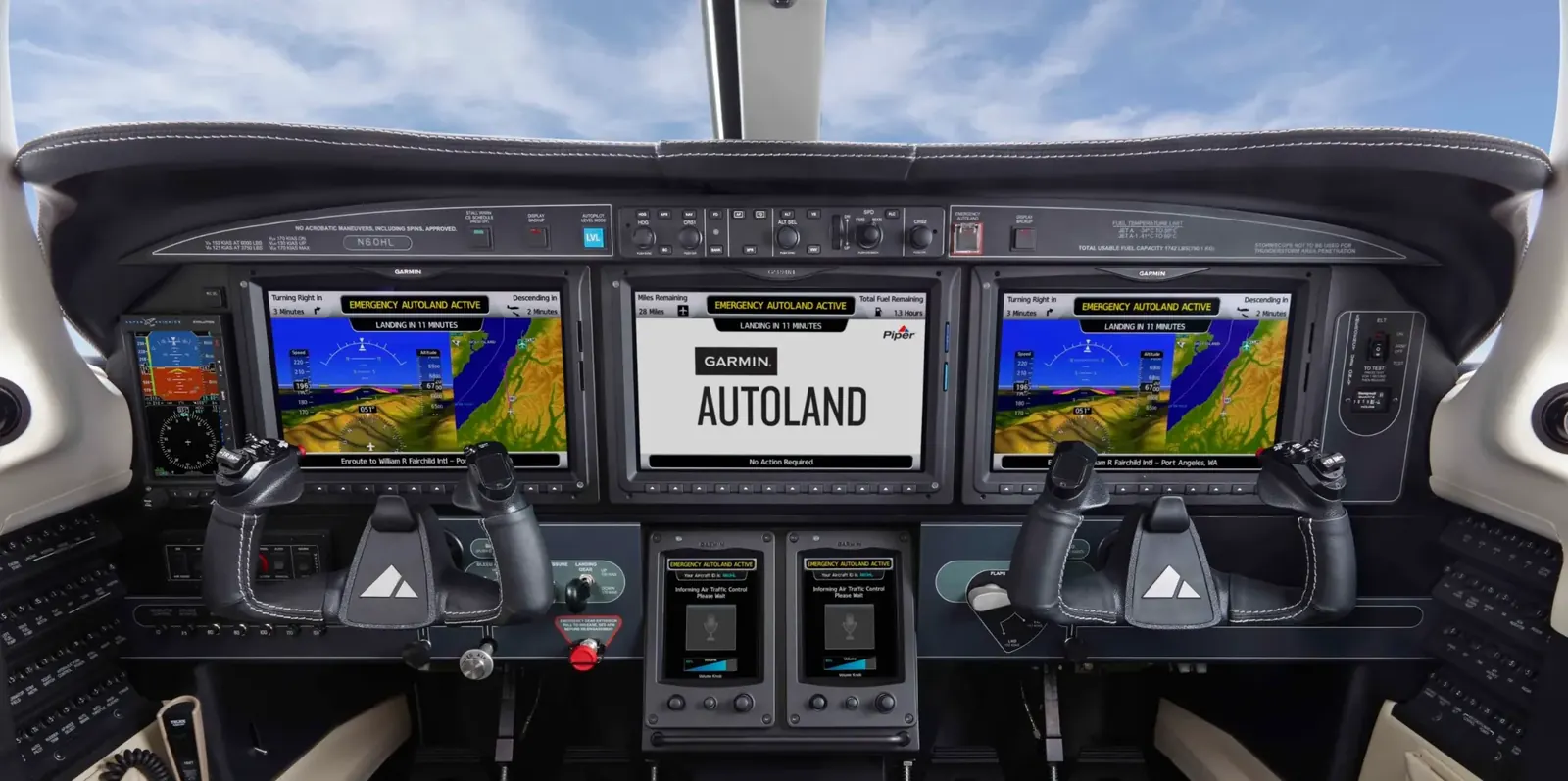
Garmin Autoland system: can a single button really land a modern aircraft when nobody in the cockpit can?
Notably, that question stopped being hypothetical on December 20, 2025, when a Beechcraft King Air B200 landed at Rocky Mountain Metropolitan Airport (KBJC) in Colorado under Garmin Autoland control, in what Garmin described as the first “start-to-finish” real-world emergency use of the technology. (see video lower)
Moreover, the milestone matters because Garmin says roughly 1,700 aircraft now fly with Autoland capability (FlightGlobal). Consequently, what began as a high-end avionics concept is turning into a fleet-wide safety net across turboprops, jets, and even piston singles.
Additionally, the public-facing story is easy to love: push a guarded button, the aeroplane speaks to air traffic control (ATC), navigates to a suitable runway, lands, stops, and shuts down. However, the specialist story is richer, because Autoland is not “autonomy” in the science-fiction sense. Instead, it is a tightly bounded, certified emergency mode that makes conservative choices and accepts hard limits—especially around traffic, runway closures, and ATC re-routing.
Garmin Autoland system: why this matters in 2026
Autonomous emergency landing, not a pilot replacement
Moreover, the clearest way to understand Autoland is to treat it as an “automatic emergency landing” function rather than a pilot substitute. Specifically, the FAA Safety Team (FAASTeam) describes it as a system that can perform an emergency landing when it suspects pilot incapacitation and will announce its intentions over air traffic frequencies (FAASTeam). Additionally, the certification language and operating assumptions sit squarely inside today’s regulatory world: known navigation procedures, known databases, and scripted communications.
Meanwhile, that boundary is the reason Autoland exists at all. In most general aviation (GA) cabins, a passenger can buckle a belt and pour coffee, but cannot safely fly an instrument approach. Consequently, Autoland shifts the emergency task from “find a pilot” to “support the aeroplane’s own best outcome,” using the avionics and automation already on board (AOPA). Even so, it does not remove the need for pilot training. It simply gives pilots and passengers a credible Plan B for the worst day.
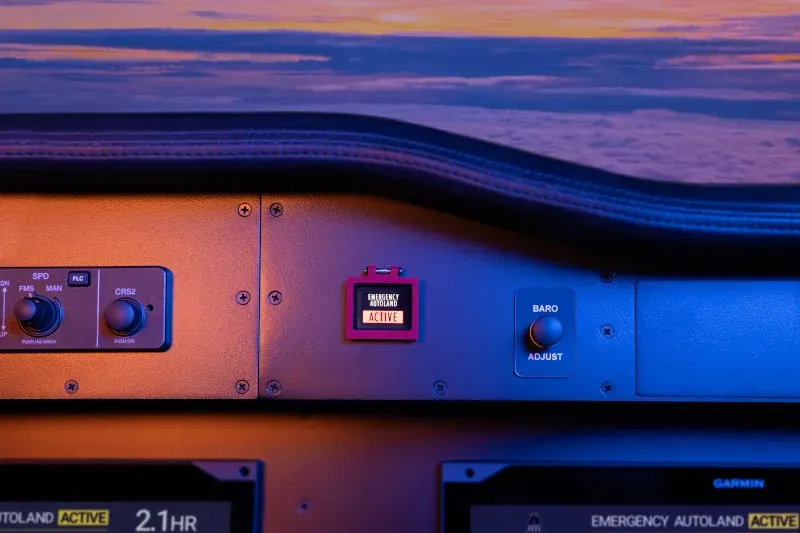
One light observation belongs here: in aviation, we have long trusted a red switch for “fire handle,” so it is refreshing that one red switch now also says “help is coming.”
Why “single-pilot” changed the safety equation
Additionally, Autoland’s rise tracks a broader trend: high-performance single-pilot aircraft have become more capable, more connected, and more automated. Notably, platforms like the Piper M600/SLS, Daher TBM 940/960, and Cirrus Vision Jet (SF50) promised airline-like systems in owner-flown or lightly crewed operations (Piper). Consequently, designers began treating pilot incapacitation as a primary design case rather than a rare footnote.
Similarly, manufacturers framed Autoland as a cultural shift, not just a feature. “This is the first aircraft to be certified with one of the most significant advancements in general aviation history,” Piper President and CEO Simon Caldecott said when the M600/SLS earned certification on May 18, 2020 (Simon Caldecott, President and CEO, Piper Aircraft). Moreover, Garmin’s aviation leadership positioned certification as an industry moment, with Phil Straub calling it “a day of celebration for the entire aviation industry” (Phil Straub, Executive Vice President, Garmin Aviation, via Piper Aircraft).
Autoland as a safety layer, not the only safety layer
However, specialists know safety comes in layers, not slogans. For example, Cirrus pairs its Safe Return emergency Autoland with the Cirrus Airframe Parachute System (CAPS), a whole-airframe parachute designed for extreme scenarios (Cirrus). Similarly, Piper’s HALO safety system packages Autoland alongside emergency descent, stability protection, surface awareness, and connectivity (Piper). Consequently, the smarter question is not “Autoland or pilot skill,” but “Autoland plus what other defences?”
If you want a Fliegerfaust perspective on how automation is creeping into certification and daily operations more broadly, see AI in commercial aviation: 2025–2035 outlook and reality.
Garmin Autoland system: the moment it takes over
Manual activation: a guarded button that anyone can press
Notably, Autoland is designed for non-pilots to start it without “knowing aviation.” In practice, that usually means a guarded switch or a clearly marked button within easy reach. For the Piper M600/SLS, Piper explains that a passenger can engage the system by pressing a guarded Emergency Autoland switch above the Garmin G3000 display (Piper). Likewise, Cirrus describes Safe Return as a red button located for passenger access that “takes complete control of the aircraft” once pressed (Cirrus).
Meanwhile, retrofit installations also treat access as the point. Textron Aviation’s upgrade portal for King Air retrofits describes a passenger button “located in the back of the centre pedestal for easy access” (Textron Aviation Upgrades). Consequently, you can view Autoland’s cockpit design philosophy as “make it obvious, make it protected, make it reachable.”
A small smile-worthy detail: the guard is not there to scare passengers. Instead, it is there to save pilots from an elbow, a bag, or a curious toddler.
Automatic triggers: when the aeroplane decides the pilot is not responding
Additionally, Autoland can activate without a human pressing anything. The FAASTeam notice lays out three activation paths: the system can sense erratic flying and then check for pilot responsiveness; it can follow an Emergency Descent Mode (EDM) event and then check for responsiveness; or it can be activated manually by a pilot or passenger. Similarly, Piper describes automatic engagement logic for its installation, including a case where autopilot “LVL” mode remains engaged for two minutes, or where emergency descent activates at 14,100 feet (Piper).
However, automation does not guess feelings. Instead, it looks for measurable behaviour: uncommanded deviations, lack of responses, and flight conditions that imply physiological risk. Consequently, designers built Autoland to default to conservative action when the pilot fails the “still here?” checks.
What the cabin hears: radio calls, squawk codes, and plain-language prompts
Moreover, Autoland communicates in a way ATC understands and passengers can follow. The FAASTeam notice says the system will squawk 7700 and broadcast a Mayday advisory on the last pilot-selected frequency and on Guard (121.5 MHz), then provide follow-up messages describing position, destination airport, runway, and time to landing. Additionally, within 12 nautical miles (about 22 kilometres) of the destination, the notice says Autoland will broadcast on the appropriate ATC frequency or Common Traffic Advisory Frequency (CTAF), and after landing it will transmit that the aircraft is disabled on the runway.
Meanwhile, passengers get a simplified narrative. AOPA’s early hands-on coverage of Autoland describes how the system “briefs passengers through multifunction displays” and effectively translates complex flight data into instructions non-pilots can act on (AOPA). Similarly, Cirrus lists the key “how it works” steps: passenger briefing, route calculation, autonomous control including gear and flap deployment, and braking to a stop (Cirrus).
The aeroplane’s voice is calm for a reason—if it sounded stressed, nobody would trust the rest of the landing.
Garmin Autoland system: how it chooses an airport and runway
Runway, weather, terrain: the scoring logic behind the “nearest suitable” choice
Notably, Autoland does not simply aim for the closest airport. Instead, it aims for the closest suitable runway. AOPA’s “Hands off” demonstration explains that, in the first seconds after activation, Autoland evaluates runway length, width, and surface; fuel remaining; crosswind component; terrain; obstacles; and general weather information (AOPA). Moreover, Textron’s King Air retrofit description says Autoland considers weather, fuel on board, runway surface and length, terrain, and obstacles, and uses “complex scoring criteria” to select a landing airport (Textron Aviation Upgrades).
Additionally, certain manufacturers tailor the selection rules. AOPA notes that while Autoland requires an area navigation (RNAV) approach, the runway and weather criteria can be decided by the airframe manufacturer (AOPA). Consequently, a turbine single and a turboprop twin may not “rank” runways identically, even if both run the same underlying concept.
No AI improvisation
For readers who enjoy the systems view: think of it as a weighted decision function with guardrails, not an artificial intelligence (AI) that improvises.
Approaches: why published GPS/RNAV procedures matter
Additionally, Autoland’s certified world depends on published procedures. The FAASTeam notice states that Emergency Autoland only selects airports with a published Global Positioning System (GPS) or RNAV approach. Moreover, AOPA’s demo coverage says the system “requires an RNAV approach,” even though manufacturers may set additional criteria around runway and weather (AOPA).
Meanwhile, that requirement is a quiet admission: Autoland does not “see” the runway the way a human does. Instead, it flies a procedure it can validate and repeat. Consequently, the system’s comfort zone is the same zone regulators have already built for autopilots: defined path, defined guidance, defined missed approach logic.
Weather and hazards: what it can avoid—and how it thinks about time
Moreover, Autoland’s decision-making includes time, not just location. AOPA reports that the system can forecast its own weather when the chosen runway is far enough away that current ADS‑B or SiriusXM weather might not remain valid, using trend information to judge whether conditions could degrade (AOPA). Additionally, the FAASTeam notice says Emergency Autoland will avoid prohibited areas, known obstacles and terrain, and significant weather (FAASTeam).
However, specialists should also note what “avoid” cannot mean. Autoland does not carry a pilot’s contextual judgement about “marginal but workable.” Instead, it leans conservative and predictable. Consequently, in fast-evolving convective weather, the system’s strength is not bravery. It is consistency.
What it will not consider: NOTAMs, braking action, and runway occupancy
Crucially, the FAASTeam notice lists several limitations that matter to both pilots and controllers. Specifically, it says Emergency Autoland does not check Notices to Airmen (NOTAMs) for closed or shortened runways, does not receive braking action reports, and does not know about personnel or equipment on runways. Additionally, it does not see and avoid other traffic, and Traffic Alert and Collision Avoidance System (TCAS) is not linked to the Emergency Autoland function.
Moreover, the notice adds operational realities: Autoland may land opposite the current traffic flow, may cross international boundaries, will not exit the runway after stopping, and will not alter its route per ATC instructions. Consequently, the system works best when ATC treats it as a “moving emergency” that follows its own plan and needs deconfliction, not negotiation.
If you want an ATC-modernisation lens on how towers and centres may evolve to handle more automation over time, see Fliegerfaust FAA’s $30 B air-traffic-control revamp: NAV CANADA tower tech in play.
Garmin Autoland system: Emergency Autoland in the real world – the Colorado King Air landing
What happened on December 20, 2025
Notably, the first widely confirmed “end-to-end” in-service Autoland landing occurred on Saturday, December 20, 2025, when a Beechcraft King Air B200, registration N479BR, landed at Rocky Mountain Metropolitan Airport (KBJC) after a pressurisation event and loss of communications (Flightradar24). Additionally, FlightGlobal reported that Garmin called it “the first use of Autoland from start-to-finish in an actual emergency” (FlightGlobal). Meanwhile, AOPA’s initial report framed it as the first use outside of testing and certification (AOPA).
A small, dry truth belongs here: nothing says “new aviation milestone” quite like it happening when half the industry is watching NORAD track Santa.
The pressurisation and pilot-incapacitation confusion
However, early reports around the event created a confusing narrative: “pilot incapacitation” versus “crew decision.” Flightradar24’s revised write-up, based on additional information from Buffalo River Aviation, says the aircraft experienced a “rapid, uncommanded loss of pressurization,” the pilots donned oxygen masks, and the system activated as designed (Flightradar24). Moreover, Buffalo River Aviation explained why the crew chose to leave the system engaged despite remaining conscious: “Due to the complexity … the pilots … made the decision to leave the system engaged while monitoring its performance ….” — Buffalo River Aviation, statement via Flightradar24
Meanwhile, FlightGlobal reported that the pilots “were not incapacitated” and that the FAA was investigating, noting Garmin’s description of the event as the first full emergency use (FlightGlobal). Consequently, what sounded like a passenger-saves-the-day story was, in the operator’s telling, also a test of judgement under pressure: when conditions are ugly—instrument meteorological conditions (IMC), terrain, icing—the safest pilot decision can be to let a certified system do what it was built to do.
What the event proved—and what remains a specialist conversation
Notably, the landing validated the “full stack” that critics always scrutinise: navigation, energy management, approach logic, braking, and engine shutdown. Additionally, it validated Autoland’s communications model, because third-party coverage noted automated voice calls and emergency broadcasts consistent with FAASTeam’s description (ABC News). Moreover, the event reinforced a point specialists already knew: Autoland’s certification case is about repeatability and worst-case management, not about grace.
However, the event also sharpened the remaining questions. For example, the FAASTeam notice warns that Autoland does not check NOTAMs and does not know runway occupancy or braking action reports (FAASTeam). Consequently, the operational system still depends on ATC and airport ops to clear the runway environment, stage emergency response, and keep other traffic out of the way.
If you want a broader autonomy-trust framing that connects GA safety automation to the public acceptance challenge in other parts of aviation, see Would you fly without a pilot? Inside the UK’s bold bet on AI-powered air travel on Fliegerfaust.
Garmin Autoland-equipped aircraft: what’s certified, what’s next
The first certifications: Piper, Daher, and Cirrus
Notably, Autoland reached certification in waves. On May 18, 2020, Piper announced FAA type certification for the M600/SLS with its HALO safety system, calling it the first Autoland-equipped aircraft to receive certification (Piper). Additionally, on July 24, 2020, Aviation International News reported that Daher received both Federal Aviation Administration (FAA) and European Union Aviation Safety Agency (EASA) approval for HomeSafe on the TBM 940, based on Garmin’s Autoland system (Aviation International News). Moreover, on September 1, 2020, AOPA reported the Cirrus SF50 Vision Jet became the third GA (general aviation) aircraft model certified with Garmin Autoland, with Cirrus branding it as Safe Return and placing the activation button for passenger access (AOPA).
Meanwhile, the technology earned a symbolic industry stamp in 2021, when Garmin received the 2020 Robert J. Collier Trophy for Autoland. “Its ability to take over an airplane with a disabled pilot and land it safely will save many lives,” National Aeronautic Association (NAA) chair Jim Albaugh said (Jim Albaugh, Chairman, National Aeronautic Association, via AOPA). Additionally, NBAA described Autoland as “the world’s first certified emergency autonomous system to safely fly and land an aircraft without human intervention” (NBAA).
A single sentence of levity fits: the Collier Trophy is not easy to win, and “button lands aeroplane” is the kind of pitch that sounds like a dare—until it is certified.
Expansion into piston singles: the Cirrus SR Series G7+
Moreover, Autoland moved “down-market” in a meaningful way in 2025. Cirrus announced on May 6, 2025 that the SR Series G7+ would be the first single-engine piston aircraft equipped with an FAA-approved autonomous emergency landing system, with Safe Return as standard equipment (Cirrus). Additionally, Cirrus Chief Executive Officer Zean Nielsen said the G7+ would be “the aircraft that anyone can land … with the touch of a single button” (Zean Nielsen, CEO, Cirrus Aircraft).
Consequently, Autoland is no longer confined to turbine aircraft. Instead, it is now part of the piston world’s safety conversation, alongside parachutes, stability protection, and better training.
Garmin Autoland system retrofits and twins: King Air 200/300/350 approvals
Autoland’s move into twin-engine retrofits is strategically important. AOPA reported on July 20, 2023 that Garmin expected “imminent” FAA approval for Autoland on select Beechcraft King Air 200 and 300 aircraft equipped with the Garmin G1000 NXi avionics suite and autothrottles, and noted about 800 King Airs had already received G1000 retrofits (AOPA). Moreover, Aviation International News reported on August 27, 2025 that the FAA approved retrofit of Autoland and Autothrottle for certain King Air 300-series turboprops, tied to the G1000 NXi upgrade (Aviation International News). Similarly, FlightGlobal reported FAA approval for King Air 300s and 350s on the same date (FlightGlobal).
Additionally, Textron’s King Air upgrade page provides unusually concrete operational details, including automatic communications on 121.5 and the last-tuned frequency, squawk 7700, destination airport calls on tower/CTAF/UNICOM, and the possibility of entering a hold to lose altitude or slow down for approach sequencing (Textron Aviation Upgrades). Consequently, the King Air retrofit programme helps explain why the 2025 in-service event happened in a B200: the fleet is large, the mission set is demanding, and the upgrade path is real.
King Airs have always been workhorses, so it feels right that the first real-world Autoland landing happened with that platform.
Garmin Autoland system Light jets: Citation Gen3 and HondaJet Elite II on the horizon
Meanwhile, Autoland is now baked into the next generation of light jets—though some of that capability remains “about to arrive” rather than “already flying.” On October 21, 2024, Textron Aviation announced that the Cessna Citation M2 Gen3, CJ3 Gen3, and CJ4 Gen3 would include Garmin Emergency Autoland, with the CJ4 Gen3 expected to enter service this year, in 2026 and the M2 Gen3 and CJ3 Gen3 expected in 2027.
Similarly, Honda Aircraft Company announced on October 15, 2025 that it completed FAA certification flight testing under Type Inspection Authorization (TIA) for Emergency Autoland on the HondaJet Elite II, and said the aircraft was anticipated to become the first twin-turbine very light jet with Emergency Autoland (Honda Aircraft Company). Moreover, Honda Aircraft CEO Hideto Yamasaki said he was “incredibly proud” of the engineering work and that the programme was “so close to certification” (Hideto Yamasaki, President & CEO, Honda Aircraft Company).
Consequently, the near-term expansion path is clear: more light jets with integrated autothrottles and more retrofits in high-utilisation turboprops. Over time, that could make emergency Autoland the new “expected” safety baseline for certain categories of aircraft, especially those marketed for single-pilot operations.
Where Autoland appears today: a practical snapshot
Additionally, the following snapshot separates “certified and in service” from “announced or approaching entry into service,” based on manufacturer and trade reporting.
| Aircraft / family | Branding | Status (as reported) | Key public milestone |
|---|---|---|---|
| Piper M600/SLS | HALO / Autoland | FAA certified, in service | FAA type certification announced May 18, 2020 (Piper) |
| Daher TBM 940 (and later variants) | HomeSafe | FAA and EASA approved, in service | Approval reported July 24, 2020 (Aviation International News) |
| Cirrus SF50 Vision Jet | Safe Return | FAA certified, in service | Certification reported September 1, 2020 (AOPA) |
| Cirrus SR Series G7+ | Safe Return | FAA-approved system, delivering as standard | Announcement May 6, 2025 (Cirrus) |
| Beechcraft King Air 200/300/350 (select retrofits) | Autoland (retrofit) | Retrofit approvals expanding | Approval for certain 300 series reported August 27, 2025 (Aviation International News) |
| Cessna Citation M2 Gen3 / CJ3 Gen3 / CJ4 Gen3 | Emergency Autoland | Announced; entry into service expected 2026–2027 | Textron announcement October 21, 2024 (Textron Aviation) |
| HondaJet Elite II | Emergency Autoland | FAA certification flight testing completed under TIA | Honda announcement October 15, 2025 (Honda Aircraft Company) |
Garmin Autoland system vs the alternatives: what competes, what complements
Airline autoland: similar label, different promise
Notably, aviation already has “autoland” in the airline world. However, airline autoland typically refers to automatic landings flown by the autopilot and autothrottle on an Instrument Landing System (ILS) or equivalent, with trained pilots monitoring and intervening as needed. Consequently, it is a precision-approach capability, not an “unattended emergency landing” designed for passenger activation.
By contrast, the Garmin Autoland system is built around a different question: what happens if the pilot cannot fly at all? The FAASTeam notice makes that difference plain, because it describes scripted Mayday broadcasts, destination selection, and passenger briefing as core system behaviours (FAASTeam). Additionally, AOPA’s early reporting framed Autoland as something that can “land an aircraft without human intervention” once engaged (AOPA).
Ballistic parachutes and emergency descent: different tools for different failures
Moreover, Autoland does not erase other emergency systems. For example, Cirrus explicitly positions Safe Return alongside CAPS, describing them as complementary layers (Cirrus). Similarly, Piper describes Autoland as part of a broader safety package that includes emergency descent logic, stability protection, and surface awareness tools (Piper).
Consequently, a specialist comparison should focus on failure modes. If the aeroplane is controllable and navigation is intact, Autoland offers a runway outcome with emergency response at the destination. If the aeroplane is uncontrollable, structurally compromised, or otherwise outside its certified envelope, a parachute may be the better last resort. Meanwhile, emergency descent modes bridge a different hazard: hypoxia and high-altitude pressurisation failures, which featured in the 2025 King Air event narrative (Flightradar24).
Human factors: trust, training, and the complacency risk
However, the hard part of safety automation is never the software alone. It is the human relationship to the software. In that sense, Autoland introduces two competing effects. On one hand, it reduces the consequence of rare but catastrophic pilot incapacitation. On the other hand, it risks psychological “outsourcing” of responsibility if pilots treat it as a substitute for competence.
Notably, the FAASTeam notice itself is a human-factors document. It warns other pilots and controllers that they may “hear an autopilot announcing its intention to land,” and it lists operational constraints such as not following ATC instructions and not seeing other traffic (FAASTeam). Consequently, the industry is already communicating a key message: Autoland is a safety tool, but it is also a new actor in the system that changes workload and expectations.
Moreover, one of the most important specialist questions is what Autoland’s success will do to standardisation. If the fleet grows, ATC training and airport emergency response playbooks may need updates. Similarly, aircraft manufacturers may face pressure to integrate more real-time runway status inputs, better airport surface awareness, and stronger database currency guarantees. Even so, those improvements must remain certifiable, explainable, and robust.
Garmin Autoland system: Conclusion
Overall, the most compelling thing about Autoland is not the marketing. It is the fact that certification and real-world use are now converging. Notably, the December 20, 2025 King Air landing showed that the end-to-end chain—activation, communications, navigation, approach, touchdown, braking, and shutdown—can work in the messy world of weather, terrain, and imperfect information (FlightGlobal). Moreover, Autoland’s spread from turbine singles into piston aircraft, and from factory installations into retrofits, suggests the safety case resonates beyond early adopters (Cirrus).
However, a positive story can still carry a critical edge. Specifically, Emergency Autoland does not check NOTAMs, does not see and avoid traffic, does not accept ATC route changes, and may choose a landing direction that surprises local traffic. Consequently, the technology’s next leap should not be flashier automation. Instead, it should be deeper integration with the operational reality around the runway: closures, braking action, surface occupancy, and more consistent data pipelines that remain certifiable.
Finally, the Garmin Autoland system looks like a genuine safety inflection point for personal and business aviation. Yet it also challenges the industry to adapt procedures, training, and infrastructure at the same pace as avionics innovation. If Autoland becomes as common as a glass cockpit, will regulators and operators treat runway and airspace data as “safety critical” in the same way they treat the engine and the wing?
Leave your answers and comments below and on our Fliegerfaust Facebook page.
Sources
- FAASTeam — You Could Hear an Autopilot Announcing its Intention to Land (July 6, 2023).
- Piper Aircraft — Piper Aircraft HALO Safety System Certified on M600/SLS (May 18, 2020).
- Piper Aircraft — Meet Garmin Autoland and the HALO Safety System (June 21, 2022).
- AOPA — Hands off (January 2020).
- Aviation International News — Daher Certifies HomeSafe Autoland in TBM 940 (July 24, 2020).
- AOPA — HomeSafe certified for TBM 940 (July 28, 2020).
- AOPA — Cirrus Vision Jet certified with Garmin Autoland (September 1, 2020).
- Cirrus — VISION JET: SAFE RETURN (November 7, 2024).
- Cirrus — Cirrus Announces SR Series G7+ Featuring Safe Return Emergency Autoland (May 6, 2025).
- NBAA — NBAA Applauds Selection of Pioneering Garmin Autoland Technology for 2020 Collier Trophy (June 4, 2021).
- AOPA — Garmin autolands Collier Trophy (June 3, 2021).
- AOPA — Garmin Autoland moves up to twins (July 20, 2023).
- Aviation International News — Garmin Autoland, Autothrottle OK’d for Some King Air 300s (August 27, 2025).
- FlightGlobal — US aviation regulator certifies Garmin’s autoland and autothrottle systems for Beechcraft King Air fleet (August 27, 2025).
- Textron Aviation Upgrades — Garmin Autoland King Air (Accessed January 7, 2026).
- Flightradar24 — Garmin Emergency Autoland deployed for the first time (Updated December 24, 2025).
- FlightGlobal — Pilots chose Garmin Autoland after King Air pressurisation loss in first full emergency use (December 26, 2025).
- AOPA — King Air autolands in Colorado (December 22, 2025).
- ABC News — Small plane lands itself safely with Autoland system in 1st use (December 22, 2025).
- Textron Aviation — The future of flight has arrived with the unveiling of the next generation of Cessna Citation business jets (October 21, 2024).
- AOPA — Citation gains winglets (October 22, 2024).
- Honda Aircraft Company — Honda Aircraft Company Completes Type Inspection Authorization for HondaJet Elite II Emergency Autoland (October 15, 2025).
For full details, please refer to our Disclaimer page.