
Naples Bombardier Challenger 604 crash—what, precisely, did the newly released NTSB docket change about what we thought we knew?
The February 9, 2024 highway landing attempt in Naples, Florida stunned the aviation community for its ferocity and its survivors. The NTSB public docket, released on September 3, 2025, adds data, voice, and maintenance evidence that tighten the timeline and sharpen the technical picture. Importantly, it does not declare a final cause. According to the docket index, the release includes 21 items. They range from the Operational Factors Factual Report and the Flight Data Recorder Group Factual Report to GE Aerospace analyses of both engines and cockpit‑voice recorder materials. (NTSB docket index).
Moreover, a wave of up‑to‑date coverage distilled these documents for readers, underscoring two core revelations. First, investigators highlight a 75‑second sprint from initial master warnings to impact. Second, they detail hung‑start signatures—and variable stator vane (VSV) problems—from pre‑accident events that echoed in the accident profile (Aviation International News, Sept. 8, 2025; Business Jet Traveler, Sept. 2025; GlobalAir, Sept. 9, 2025).
Note: The NTSB has not issued a probable cause. The docket is factual; analysis and conclusions will appear in the final report.
The Naples Bombardier Challenger 604 crash: what the docket adds
On September 3, 2025, the NTSB posted the ERA24FA110 docket for N823KD, a Bombardier CL‑600‑2B16 (Challenger 604) operated by Hop‑A‑Jet.
For programme context on Bombardier’s long‑range jets, see Fliegerfaust’s Bombardier Global 8000: World’s Fastest Business Jet.
The docket confirms the accident occurred at 15:17 EST on February 9, 2024 and documents a right‑downwind to base‑to‑final sequence into Naples (APF) before the crew’s dual‑engine power loss call and forced landing on Interstate 75 (Operational Factors Factual Report; FDR Group Factual).
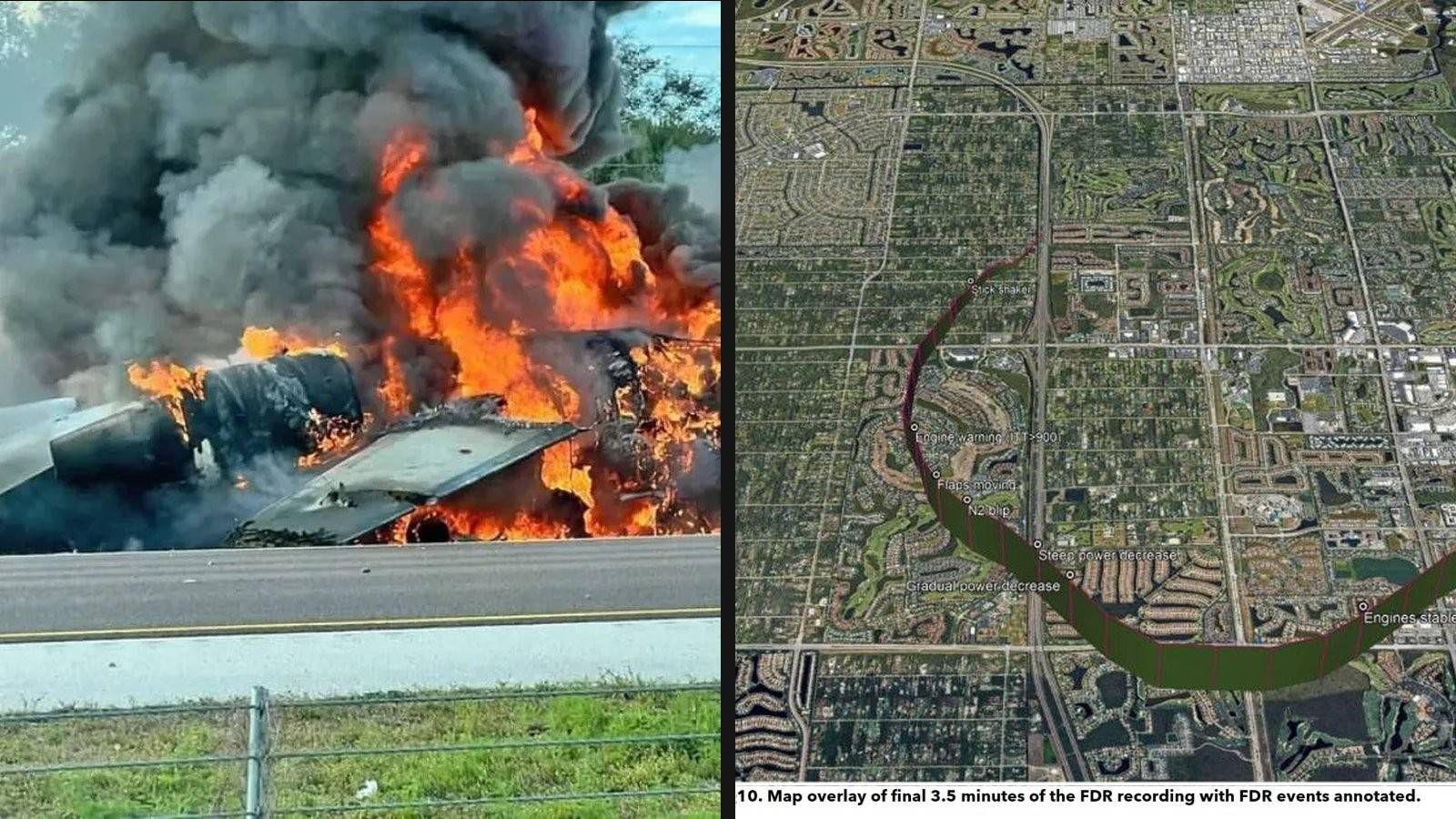
The FDR report records a calm, configured approach that changed in seconds. At 15:09:14, both engines began a deceleration toward idle. Next, at 15:09:21, each engine reached idle N2. One second later N2 rolled back below idle with increasing ITT, behaviour consistent with a compressor rotating stall. Then, at 15:09:33, the left engine oil‑pressure warning triggered. One second later the right engine followed. At 15:09:40 an ENGINE warning appeared as ITT exceeded redline. (FDR Group Factual).
Additionally, the Operational Factors report ties the radio calls to that data. At 15:10:05 the crew transmitted, “…lost both engines… emergency… making an emergency landing.” At 15:10:12 they added, “We are cleared to land but we are not going to make the runway… ah… we have lost both engines” (Operational Factors Factual Report).
Voices in the cockpit: what the CVR captured
The CVR Factual Report provides context to the calls and the cockpit debate that followed. In the final minute, you hear the captain and first officer triaging options, including water and roadway, while the EGPWS monitors stack up a chorus of “sink rate,” “too low terrain,” and “pull up.” The flight attendant asked, “Should I prepare the cabin?” The captain responded, “Brace for impact.” Seconds later the first officer urged, “land in the grass” (CVR Factual Report).
Local outlets lifted portions of these lines as the 37‑page transcript entered the record on September 5, 2025, bringing the human texture of the minute‑and‑a‑quarter window to a broad audience (Fox 4 Now, Sept. 5, 2025; Naples Daily News, Sept. 5, 2025).
Light quip: It’s the kind of “minute” that makes every simulator hour feel leisurely.
Naples Bombardier Challenger 604: the 75‑second timeline: master warnings to impact
Several outlets framed the accident around a “75‑second” arc between the first master warning and the end of recorded ADS‑B data. Business Jet Traveler clocked 15:09:33 (left oil pressure) to 15:10:47 (touchdown) as that window; AIN echoed the markers from the docket (BJT, Sept. 2025; AIN, Sept. 8, 2025). The FDR sequences confirm the dual N2 roll‑back below idle and rising ITT within seconds of the speed‑to‑idle decel and subsequent attempted re‑accel on approach (FDR Group Factual).
Earlier summaries in February 2024 focused on the oil warnings without the stall picture, accurately reflecting what investigators had then: a preliminary report that flagged three engine‑related master warnings and the dual‑engine power‑loss calls, but no cause (AP, Feb. 27, 2024; AIN, Feb. 28, 2024; FLYING, Feb. 29, 2024).
Hung starts, rotating stall, and the CF34‑3: decoding the engine behaviour
The GE Aerospace slide deck, attached to the Airworthiness Group report, compares the event engines’ decel/re‑accel profile with previous starts. It calls the event “similar to hung starts” observed on January 15 and notes a simultaneous compressor surge in both engines followed by unrecoverable rotating stall. It adds that starter assist would have been required at the observed altitude and Mach to recover from rolling sub‑idle (GE Aerospace “Summary of Event Data,” May 8, 2025).
Separately, a Hop‑A‑Jet captain told investigators on February 13, 2024 that he experienced “hung starts” on both engines several days before the accident, with RPM hanging near ~45% and the engines refusing to accelerate—episodes that prompted maintenance troubleshooting (Operational Factors, Attachment 1).
Therefore, the docket ties three strands together:
- Approach decel and immediate re‑accel without idle stabilization.
- Dual compressor surge → rotating stall → sub‑idle behaviour.
- Recent hung‑start history and a VSV system with elevated actuation pressures.
Naples Bombardier Challenger 604: Corrosion, variable vanes, and a system under load
The GE deck reports corrosion in high‑pressure compressor (HPC) case vane bores, most severe in stage 5, with higher‑than‑production pressures required to actuate the HPC variable stator vane (VSV) system, and reduced total travel in stage 5. Individual vane drag torques exceeded production limits—up to ~6× on stage 5—consistent with binding. The chemistry points to a saline environment (chlorides and sulphur compounds), with pitting and oxide layer growth more pronounced at hotter stages (GE Aerospace “Summary of Event Data,” May 8, 2025).
Additionally, the FDR report shows the engines well matched in steady‑state and transient behaviour earlier in the flight, which tends to shift attention from random single‑engine anomalies to systemic factors—like VSV friction or actuation lag—that could reduce compressor stability margins during a rapid decel followed by re‑accel (FDR Group Factual).
Light quip: Salt loves metal about as much as accountants love surprises.
What the operator says: maintenance practices, MP68, and context
Hop‑A‑Jet’s party submission (June 1, 2025) disputes any implication that the operator failed to perform a recommended Maintenance Practice 68 (MP68) Variable Geometry Vane system functional check. The submission notes GE did not request or authorize MP68 during troubleshooting, that MP68 requires special tooling, and that the troubleshooting chain did not reach that step once engine performance normalized after filter replacement. The operator also contends the accident aircraft did not operate in the harsh overwater profiles used in another CF34 special‑operations comparison (Hop‑A‑Jet Party Submission).
Context matters. GE and independent MROs have, in recent years, flagged VSV and bore corrosion issues on various CF34 families. For example, GE SB 72‑0244 and related AD actions addressed CF34‑8C/‑8E linkage torque checks to identify corrosion‑induced binding—a different sub‑type but the same architectural theme of variable‑geometry hardware under environmental stress (Federal Register AD 2022‑08037). Meanwhile, Challenger 601/604/605 operators saw MROs spotlight HPC bore corrosion findings and related service bulletins in 2025, reinforcing the industry’s attention to VG/VSV health in CF34‑3 powered fleets (West Star Aviation advisory, June 4, 2025).
Light quip: The maintenance tree had many branches; investigators are still checking which one hid the cat.
Naples Bombardier Challenger 604: The human factors: crew discipline, decision‑making, and survival
Multiple sources describe both pilots as experienced and disciplined, with colleagues praising the captain’s checklist rigour and the first officer’s calm manner (BJT, Sept. 2025). The CVR shows professional composure as they triaged options under rapid energy decay. The flight attendant executed an egress through the baggage door after fire blocked the main exits—an act that helped save two passengers (Operational Factors Factual Report). For evacuation design context that shapes crew procedures, Fliegerfaust analysed the Airbus A220: Increased Seating and Evacuation Requirements.
Additionally, early reports documented three survivors on board and one minor ground injury; both pilots died at the scene. Those details match the contemporaneous AP reporting and the preliminary NTSB summary (AP, Feb. 27, 2024).
Why simultaneous stalls matter: symmetry, automation, and the margins
Two independent points explain why investigators care so much about dual, simultaneous stalls on approach:
- Symmetry. The FDR shows both engines tracking together in decel, attempted accel, stall onset, and ITT rise. That symmetry leans toward shared influences—control schedules, VSV coordination, or environmental factors—rather than a single‑engine defect left and right by coincidence.
- Margins during low‑energy manoeuvre. The event decel was faster than comparable segments from 56 prior flights, and the re‑accel began before a full idle stabilization. As GE explains, those subtle differences alone don’t “cause” a stall, but they add pressure on the compressor stability margin when a VSV system is already draggy and slow to respond (GE Aerospace slide deck).
Therefore, procedural and system safeguards matter: the engine’s starter assist envelope, ignition schedules, VSV authority, and crew technique for idle‑to‑power recovery near the ground. The docket suggests a technical path—not yet a conclusion.
Light quip: Margins aren’t just in spreadsheets; they keep compressors happy too.
Maintenance lessons from the Naples Bombardier Challenger 604
Even without a final NTSB cause, the docket and industry advisories flag five practical areas:
- VSV/VGV functional checks on CF34‑3 engines that operate near salt or humid air. Where MP68 or similar checks require special tooling, operators should work through OEM support and MROs familiar with the VG system.
- Corrosion detection expectations during borescopes. The Hop‑A‑Jet submission argues corrosion should be detected and escalated; GE has historically framed some borescope tasks as not intended for corrosion detection. Operators can remove ambiguity by documenting what to call and who to call when pitting appears (Hop‑A‑Jet Party Submission).
- Wash practices and intervals. CF34 service bulletins reference harsh environment regimes; operators outside those regimes should still weigh local conditions and fleet trends.
- Accelerate‑go from idle techniques on short‑final. Training syllabi can emphasize idle stabilization before thrust changes close to the ground, especially when igniters are active and starters are disengaged.
- Operator‑OEM communication logs. The January hung‑start episodes and subsequent filter and MFC work demonstrate how a multi‑visit troubleshooting chain can stall. Clear end‑to‑end documentation helps the next crew and the next shop get past tool or authority limits (Operational Factors attachment; Hop‑A‑Jet submission).
How the story evolved: from prelims to deep data
Back in late February 2024, AP, AIN, FLYING, AVweb, and others relayed the preliminary: three engine warnings, a dual power loss call, and a highway impact that killed both pilots but spared three on board. No one had the FDR‑CVR cross‑correlation, the hung‑start comparisons, or the VSV metallurgy then (AP, Feb. 27, 2024; AIN, Feb. 28, 2024; FLYING, Feb. 29, 2024; AVweb, Feb. 29, 2024; Simple Flying, Feb. 28, 2024).
The September 2025 docket release changed that. It delivered engine plots, hung‑start overlays, VSV drag measurements, and quotes from the CVR that now anchor the narrative. Consequently, the Naples Challenger 604 crash moved from speculation to a focused, source‑driven discussion of compressor stability and VSV health.
Light quip: The rumour mill idles nicely; evidence needs thrust—and now it has some.
Naples Bombardier Challenger 604: The broader business‑aviation frame
For operators and maintainers, the docket’s VSV thread plugs into a longer conversation about safety culture, data transparency, and response speed when field signals start to rhyme across fleets.
For safety‑culture parallels and regulatory oversight, see Fliegerfaust’s Boeing 737 MAX safety hearing coverage.
Meanwhile, Hop‑A‑Jet’s leadership publicly reflected on lessons learned and the value of a robust Emergency Response Program, reminding operators that organisational readiness matters as much as hardware fixes (AIN, Apr. 9, 2025).
Light quip: Culture is the checklist you can’t laminate; you have to live it.
Where we are today—and what to watch next
As of September 28, 2025, here’s what the record supports:
- Timeline: master warnings at 15:09:33/34, ENGINE at 15:09:40, crew dual‑loss call at 15:10:05, touchdown at 15:10:47 (FDR; Operational Factors).
- Engine behaviour: dual compressor surge followed by unrecoverable rotating stall during attempted re‑accel; starter assist would have been required to recover at the observed condition (GE deck).
- Hardware condition: HPC VSV system showed high actuation pressures, reduced travel in stage 5, and corrosion consistent with a saline environment (GE deck).
- Pre‑accident hints: Dual hung starts days earlier; multiple maintenance actions; unresolved debate over MP68 expectations and tooling access (Operational Factors Attachment 1; Hop‑A‑Jet submission).
- Survival and injuries: the flight attendant led the two passengers out through the baggage door; both pilots died; one person on the ground sustained minor injury (Operational Factors; AP).
What’s next? NTSB analysis and probable cause. Watch for how the Board weighs VSV friction/corrosion, environmental exposure, maintenance troubleshooting pathways, crew technique, and the starter/ignition envelope on short final. Also watch whether OEM and regulators expand inspection or functional check guidance for CF34‑3 fleets, building on the 8C/8E experiences and MRO advisories.
Light quip: Investigations are marathons, not sprints; this one just passed the data‑dump mile marker.
Why the Naples Challenger 604 crash matters beyond Naples
Beyond the heartbreak lies a playbook update for heavy‑iron crews and maintainers:
- For crews: Respect idle‑to‑thrust transitions at low altitude; stabilize whenever possible; know what starter assist or ignition can and can’t rescue.
- For maintainers: Treat hung‑start episodes as fleet‑relevant signals when more than one event clusters, and document VSV/VGV health with an eye to friction, travel range, and actuation pressure.
- For managers: Resource tooling access and OEM engagement so teams can complete functional checks without authority or access gaps.
- For the system: Share trend data. When multiple engines exhibit similar corrosion or drag, the speed of shared learning matters.
For operations resilience and ATC modernisation context, see Fliegerfaust’s analysis of NAV CANADA tower tech and the FAA’s $30‑billion overhaul—from NAVCANsuite workstations to Searidge digital‑tower cameras.
Consequently, the Naples Challenger 604 crash isn’t an isolated story; it’s a case study in compressor margin management and maintenance signalling..
Conclusion: a critical opinion—and a question
On the evidence to date, the NTSB docket points to a systems‑level pathway: VSV friction and corrosion lowered compressor stability; a quick deceleration followed by re‑accel near the ground taxed the margin; both engines rolled into rotating stall in near‑symmetry; the crew made a hard, professional call to land on I‑75 to save lives. That picture does not absolve anyone yet; it does suggest that design allowances, inspection doctrine, and operator/MRO tooling access must align tighter when environmental exposure threatens variable geometry systems.
My view is straightforward
The fleet shouldn’t wait for a signature sentence in a future report to treat VSV/VGV friction on CF34‑3 as a high‑salience risk in humid/saline corridors. Operators should codify functional checks with OEM‑supported access, train idle stabilization discipline on short final, and document corrosion calls with zero ambiguity. Regulators and the OEM should ensure inspection language leaves no grey zones about what corrosion to look for, where, and what to do next.
Final question: If hung‑start echoes and VSV drag can forecast a dual rotating‑stall risk, will the industry now treat those early whispers as a loud speaking call to action? Leave your comments below or on our Fliegerfaust Facebook page.