

Is the DailyMail story about four-foot crewmen a fresh government revelation, or is it an older Federal Bureau of Investigation (FBI) record pulled into a new Unidentified Anomalous Phenomena (UAP) disclosure cycle?
FBI UFO Files: The answer matters because the October 19, 1966 document is real, the “crewmen” language is real, and the May 8, 2026 media cycle is real. What remains contested is the evidentiary jump from an FBI-held summary of reports to any claim that the Bureau verified beings exiting a craft. For aerospace readers, that distinction is not pedantry. It is the difference between provenance, witness evidence, official filtering, and headline compression.
FBI UFO Files: the old record inside a new release
Files provenance comes first
The article under review is Stacy Liberatore’s May 8, 2026 DailyMail report on alleged “four-foot tall” beings emerging from UFOs. The core document behind it is an internal FBI memorandum dated October 19, 1966. It was sent from the San Francisco field office to FBI Director J. Edgar Hoover under the subject “Unidentified Flying Objects.”
The document sits in FBI Vault UFO Part 15, one part of a larger FBI Vault UFO collection. The broader FBI Vault UFO page lists 16 related documents, from UFO Part 01 through UFO Part 16.
That point must sit near the top of this story. The 1966 memo was not newly written in 2026. Nor does the FBI Vault page prove that all 16 PDF parts were first released on one original date. The FBI’s own April 1, 2011 article announcing the Vault said the revamped electronic reading room contained a mixture of files: new additions, restored files, and material carried over from the older electronic reading room (FBI, 2011).
So the “new” element is not the age of the memo. The new element is the way old and newly highlighted UAP records were packaged, circulated, and amplified in May 2026.
New disclosure frame, old document
On May 8, 2026, the Department of War, the current official name used by the former Department of Defense, announced an initial release of UAP files as part of what it called the Presidential Unsealing and Reporting System for UAP Encounters. Its release said the interagency effort involved the White House, the Office of the Director of National Intelligence (ODNI), the Department of Energy, the All-domain Anomaly Resolution Office (AARO), the National Aeronautics and Space Administration (NASA), the FBI, and other intelligence components (Department of War, 2026).
Reuters reported the same day that around 160 files were released and that analysts said many documents had already been public (Reuters, 2026). The Guardian described the first batch as 162 files and said it included FBI documents, NASA transcripts, State Department cables, and military videos (The Guardian, 2026).
That is the news hinge. The FBI UFO files did not become interesting because they were dated 1966. It became newly consequential because an older federal record was pulled into a modern disclosure event and then framed by media outlets as part of a current UAP release.
The practical risk is obvious. If public records lack clear status labels, old documents can look newly discovered. If headlines outrun provenance, a reported claim can appear to be a verified finding. That is how aviation evidence becomes public confusion. For pilots, operators, and defence planners, the cost is practical: uncertain reporting channels, poor sensor triage, weak public confidence, and procurement decisions made under political fog.
FBI UFO files: what the San Francisco document says
The “crewmen” passage
The FBI UFO files contain the phrase that drives the story. A searchable mirror of the FBI Vault PDF preserves the passage in UFO Part 15. “A few witnesses have reported seeing crewmen who had landed from the objects…” — October 19, 1966 FBI memorandum, FBI Vault UFO Part 15
The next words describe those reported crewmen as “three and a half to four feet tall,” wearing what appeared to be space suits and helmets. That wording is striking. It also gives the DailyMail headline its force.
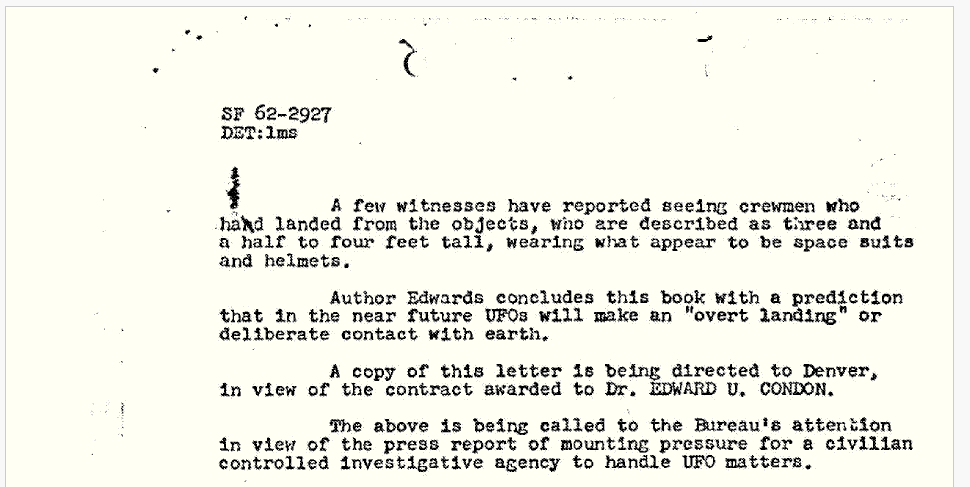
Yet the wording is narrower than “beings emerging from UFOs.” The memo says witnesses reported seeing crewmen who had landed. It does not identify the witnesses in that passage. It does not show an FBI field interview with them. And it does not attach photographs, radar data, medical records, site measurements, or physical samples.
The verified fact is therefore precise. An authentic FBI-held document contains a report-summary passage about short crewmen associated with UFO sightings. The record deserves attention because it preserves a specific occupant-scale claim inside official FBI circulation, while leaving the witness chain unresolved.
For aerospace readers, this distinction is operational. A file can be real while the event it describes remains unresolved. A witness pattern can be meaningful without being closed. A government document can preserve an extraordinary claim without proving origin.
What the memo was doing
The October 19, 1966 memo did not open as a crash-retrieval report or a landing investigation. It said the San Francisco office was enclosing copies of an article titled “Armed Forces — Focus on UFO,” published in the San Francisco Examiner and Chronicle’s This World supplement on October 16, 1966.
The memo also drew attention to Frank Edwards’s book Flying Saucers — Serious Business, published in 1966. The book’s publication record appears in Open Library’s catalogue entry. The FBI memo described the book as a likely contributor to growing public controversy around UFOs.
That structure matters. The memo records official awareness of a public-pressure environment. It summarizes claims associated with press coverage and Edwards’s book. It does not read like a Bureau conclusion based on independent field verification.
Still, the material cannot be dismissed as mere entertainment. The same memo describes claims about polished metallic objects, heat, light, electromagnetic interference, rapid acceleration, scorched ground, and alleged wreckage. It says Edwards named law-enforcement officers, military personnel, pilots, and civilian officials among reported witnesses.
The evidence class is mixed. Verified fact: the FBI circulated the memo. Informed inference: the Bureau was monitoring rising pressure for a civilian-controlled UFO investigation. Open question: whether any named witness or physical file behind those passages remains traceable through other archives.
FBI UFO Files: the DailyMail frame and its limits
Headline compression versus body attribution
The DailyMail article described “four-foot tall” beings emerging from UFOs and called the documents newly released. That headline and opening frame are stronger than the memo’s own wording.
The body of the DailyMail article, based on the text provided for this review, does include important attribution. It identifies the memo as an October 19, 1966 internal FBI document. Then it notes the San Francisco office, the article enclosure, the Gerald Ford context, the University of Colorado study, and Frank Edwards’s book. It also reports sceptical caution that the file largely summarized claims and witness accounts rather than independently verified evidence.
So the issue is not that DailyMail hid every caveat. The sharper issue is that the headline and lead compress the evidence. “Emerging” and “exiting” create a direct cinematic sequence. The FBI UFO files give a reported-status sentence inside a summary of public claims.
That matters because audiences read headlines faster than evidence chains. In aviation and defence reporting, compression can become distortion when a document’s existence is treated as confirmation of the underlying event.
The more accurate frame is this: a real 1966 FBI memo, already present in the FBI Vault’s UFO Part 15 collection, was reintroduced through the May 2026 UAP disclosure cycle and highlighted by DailyMail for its occupant language.
Why that distinction matters now
The public argument over UAP has become a fight over evidence custody. Who holds the files? Which files are new? Which records were public before? What has only been re-indexed? Which cases carry sensor support? Which are press summaries?
The FBI files are useful because they expose that fight in miniature. A document can be authentic, dramatic, old, and newly newsworthy at the same time. That combination invites confusion unless the article separates document authenticity from event verification.
This is not a narrow archival issue. UAP disclosure affects aviation safety culture, defence readiness, taxpayer exposure, and sensor procurement. If pilots and operators believe reports vanish into ridicule or classification, useful data may never enter the system. If old documents are repackaged without provenance, public confidence declines.
Fliegerfaust has treated UAP as an aerospace evidence problem before, especially in our Fliegerfaust report on UAP/UFO aviation safety and pilot reporting data. The same standard applies here. The question is not whether a headline is exciting. The question is whether the reporting preserves the evidence chain.
FBI UFO Files in the 1966 pressure environment
Gerald Ford and the public-trust problem
The memo landed in a year when UFO controversy had moved beyond fringe discussion. In March 1966, then-Representative Gerald Ford demanded more serious congressional scrutiny of UFO reports after the Michigan sightings and the widely mocked “swamp gas” explanation.
A March 28, 1966 document preserved by the Gerald R. Ford Presidential Library shows Ford pressing for a better explanation and congressional attention. Ford did not need to endorse every sighting to make the institutional point. He was challenging the adequacy of official answers.
That is why the October 1966 memo deserves attention. It appears in a public-trust environment where the Air Force, Congress, newspapers, and civilian readers were colliding over who should investigate UFOs.
The memo’s final paragraph says the above material was being called to the Bureau’s attention because of mounting pressure for a civilian-controlled investigative agency to handle UFO matters. That is a revealing sentence. It frames the issue as governance, not just mystery.
For today’s UAP debate, the parallel is obvious. The public still asks whether military and intelligence agencies investigate anomalies or manage reputational risk. AARO, NASA, ODNI, the FBI, and the National Archives and Records Administration (NARA) now sit inside that same trust problem.
The Condon study and official closure
The 1966 memo also refers to physicist Edward U. Condon and the University of Colorado. The Air Force had commissioned Condon to lead a government-backed UFO study. University of Colorado archival material later described the Condon work as a major official UFO study of the period (University of Colorado Boulder Libraries).
The Condon Report later helped shape official closure around UFO investigation. Supporters treated it as a scientific endpoint. Critics saw it as a filter that left difficult cases insufficiently explored.
That history should inform the current release. Official study is not automatically official clarity. A programme may collect reports while failing to resolve the public’s core questions. A report may create administrative closure while leaving witness accounts and classified records outside meaningful scrutiny.
The FBI files therefore matter less as an alien-occupant proof point and more as a documentary marker. They show the public-pressure channel that existed before Condon. It also shows how official systems absorb extraordinary claims, translate them into files, and leave later readers to fight over what those files mean.
Witness-pattern evidence and the small-occupant question
Witness-respecting comparison
UAP reporting fails when witness testimony is treated as decoration. It also fails when testimony is forced to carry more than it can carry. The better approach is to treat witness accounts as evidence streams: identify who spoke, what they claimed, what context supports the account, and what independent records might test it.
The FBI UFO files do not give named witnesses for the crewmen line. That limits the passage. Yet the occupant-scale detail is still meaningful as a pattern to compare, especially because UAP history contains recurring claims of craft interiors or occupants scaled below ordinary adult human dimensions.
This is where the analysis must be careful without becoming dismissive. The memo’s “three and a half to four feet tall” language defines a recurring occupant-scale motif that appears in other witness accounts and later public testimony.
Investigators should therefore ask: are these repeating details evidence of shared observation, cultural transmission, classified rumour, or some mixture of all three? That question is sharper than a reflexive yes-or-no fight over aliens.
The stakes are practical. If anomalous reports include consistent structural details, they deserve pattern analysis. If the consistency comes from cultural reinforcement, that also matters because it shapes witness memory, reporting behaviour, and public interpretation.
Bob Lazar and the “really small chairs” parallel
The FBI memo’s occupant-size language invites comparison with later witness accounts describing craft interiors apparently scaled below normal adult human dimensions. Bob Lazar’s 1989 Sport Model account is one relevant example. In a November 13, 1989 KLAS-TV transcript preserved by Disclosdex, Lazar said he looked inside the craft and saw “really small chairs.” — Bob Lazar, KLAS-TV transcript
That is not the same evidence stream as the 1966 FBI UFO files. It is a separate witness account, tied to Lazar’s long-running claims about S4, Area 51, and the Sport Model. The point is not to merge them. The point is that both accounts raise the same investigative geometry: craft or crew environments apparently scaled for smaller occupants.
The 2026 documentary S4: The Bob Lazar Story, directed and executive produced by Luigi Vendittelli of Montreal, Quebec, Canada, renewed that context, while the Project Gravitaur film page describes Lazar narration, exclusive interviews, and visual recreations of the S4 facility and craft. Its relevance here is cultural and evidentiary.
It shows that the small-interior claim remains active in UAP discourse decades after Lazar first went public.
A witness-respecting investigation should ask what a serious evidentiary process would do with that overlap. That means comparing the 1966 memo, Lazar’s interior description, other occupant-scale accounts, and any physical or documentary records that could support or challenge the pattern.
For readers following the congressional side of witness-driven UAP reporting, our Fliegerfaust analysis of the UAP transparency hearing and Yemen orb witness claims examined the same problem: moving from testimony to aerospace evidence without ridiculing the witness or inflating the proof.
NASA, AARO and the official filter problem
AARO is part of the dispute
AARO is now the Pentagon’s central UAP office. Its 2024 historical report said it found no evidence that the United States Government (USG) confirmed extraterrestrial technology, hidden off-world craft, or reverse-engineering programmes based on non-human material.
That finding deserves attention. It does not deserve automatic control over the whole story. AARO operates inside the defence establishment whose classification practices and historical transparency remain under scrutiny. It is an investigative office, but it is also a filter between witnesses, classified records, Congress, and the public.
That contested role became clearer in 2026. On April 1, 2026, the House Oversight Committee said Representative Anna Paulina Luna had requested UAP video files from Secretary Pete Hegseth. The release said whistleblowers had told the task force that AARO possessed additional video records and that previous AARO responses were “less than adequate” (House Oversight Committee, 2026).
This does not prove obstruction. It does create a fair investigative inference: AARO is not only examining UAP claims. It is itself being examined as part of the disclosure chain.
For Fliegerfaust readers, that is central. Our Fliegerfaust analysis of UAP disclosure, Luna, Trump, and missing witnesses tracked the gap between political promises, missing records, witnesses, and Pentagon responsiveness. The FBI UFO files fit that same pattern of contested custody.
NASA’s data frame and NARA’s archive role
NASA’s UAP role is different. Its UAP independent study placed emphasis on data quality, methodology, and future collection. That is useful because a scientific system cannot resolve old claims without better metadata, calibrated sensors, repeatable collection, and transparent standards.
NARA has another role. Its Record Group 615 page says the UAP Records Collection consists of records NARA has received from federal agencies and will be updated as more records arrive. NARA also says agencies are transferring materials on a rolling basis.
This rolling process is necessary. It can also confuse the public. A long-public FBI Vault record can appear inside a new disclosure ecology and seem newly public. A new release portal can mix documents with different public histories. A headline can erase the difference.
The fix is not complicated. Every public UAP file should carry a status label: newly declassified, previously public, newly digitized, duplicate, re-indexed, unresolved, prosaically explained, or pending analysis. Without those labels, file release becomes theatre. It also becomes a taxpayer problem, because oversight bodies cannot easily separate real capability gaps from recycled archival noise.
Why aerospace readers should care about the FBI UFO files
Operational risk is not science fiction
The FBI UFO files are a 1966 record, but the evidence problem is current. UAP reporting now intersects with aviation safety, restricted airspace, military training ranges, drones, balloons, sensor artefacts, and classified platforms.
The ODNI and AARO’s Fiscal Year 2024 consolidated annual report said AARO had 1,652 total reports as of October 24, 2024, and received 757 reports during the covered period from May 1, 2023, to June 1, 2024. Most of the new reports occurred in the air domain.
Those numbers do not settle origin. They do prove scale. A reporting pipeline with hundreds of UAP entries per year is an aviation and defence-management issue before it is a culture-war issue.
Operators need reliable reporting without stigma. Regulators need structured data. Military planners need to know whether unknown tracks represent drones, balloons, adversary systems, sensor errors, domestic classified platforms, or something not yet understood. Insurers and investors need to know whether new surveillance and counter-uncrewed-aircraft requirements are rising from real operational gaps or political theatre.
The practical lesson from the FBI UFO files is that poor provenance has a cost. When files do not carry enough context, attention moves to the most dramatic sentence. The result is public heat, not analytical light.
Procurement, sensors, and reporting culture
The serious market signal in UAP is not exotic propulsion speculation. It is sensor demand. Better radar discrimination, passive detection, electro-optical and infrared fusion, chain-of-custody tools, artificial-intelligence triage, and secure witness reporting all become more valuable when unexplained reports persist.
This is why the 1966 memo should not be mocked away. A sloppy archive still points to a real process problem. If public records can preserve dramatic claims for decades without traceable resolution, then current systems must be designed differently.
The House Oversight Committee’s July 26, 2023 UAP hearing with Ryan Graves, David Fravor, and David Grusch showed that witnesses can bring aviation, military, and intelligence backgrounds into the public record (House Oversight Committee, 2023). Their testimony is not the same as the 1966 FBI memo. It is a separate modern record that raises the standard for how witness evidence should be handled.
Our Fliegerfaust analysis of UAP videos and congressional pressure on Pentagon disclosure addressed the same point from the video side. A clip without metadata, sensor context, and chain-of-custody detail is vulnerable to dismissal or overclaiming. A file without provenance creates the same problem: it becomes a weapon for whichever side already knows what it wants to believe.
What the FBI UFO files still do not answer
The missing evidence chain
The unanswered questions are specific. Who were the witnesses behind the “crewmen” passage? Were they named in Edwards’s book, in the enclosed newspaper article, or in separate FBI correspondence? Did any field office ever interview them? Did Denver receive follow-up because of the Condon contract? Are routing slips, attachments, or related files still outside the public PDF?
Those questions matter more than another round of belief-versus-debunking. They define the next documentary test.
The FBI’s own handling of the Guy Hottel memo shows how old UFO paperwork can be overread. In 2013, the Bureau said the Hottel memo was “a second- or third-hand claim” and not investigated (FBI, 2013). That warning applies as a records principle, not as a final answer to every UAP claim.
The FBI UFO files deserve the same disciplined treatment. Their existence is confirmed. Also their reported language is confirmed. Their wider evidentiary foundation remains incomplete.
That incompleteness should not end the story. It should guide the reporting. The next useful step is to map the San Francisco memo against the Examiner and Chronicle article, Edwards’s source claims, Ford-era correspondence, the University of Colorado study files, and any NARA or FBI transfer records tied to the current UAP collection.
What to watch next
The next disclosure test is simple: do agencies release indexed records or merely dramatic files? A useful release tells the public whether a document is newly declassified, previously public, newly digitized, duplicated, or still awaiting anomaly resolution.
The Department of War statement says additional files will be released on a rolling basis. NARA says federal UAP records are also being transferred on a rolling basis. That creates an opportunity to clarify the record. It also creates another chance for old files to be reintroduced without enough context.
Aerospace readers should watch for four things. First, whether May 2026 release pages identify prior-publication status. Second, whether FBI Vault records are cross-linked to the new UAP portal. Third, whether AARO publishes enough metadata to support independent scrutiny. Fourth, whether congressional pressure extracts sensor files rather than only paper summaries.
It is not merely a strange archival page. It is a test case for whether UAP disclosure can mature from spectacle into evidence management.
Conclusion: FBI UFO files and the evidence chain
Old record, new amplification
The measured judgment is straightforward. The October 19, 1966 FBI memo is real. It contains the reported “crewmen” language. Also it describes the crewmen as three and a half to four feet tall, wearing apparent space suits and helmets. It sits in FBI Vault UFO Part 15.
The sharper point is provenance. The memo is not new in substance. It already exists inside the FBI Vault’s UFO collection. What changed in May 2026 was the disclosure packaging and media amplification around it. An old record was pulled back into public view, attached to a new U.S. government UAP release cycle, and framed as fresh evidence.
That distinction is central. This is not “new FBI proof of alien crewmen.” It is an old FBI record, newly reintroduced, newly amplified, and still widely misunderstood.
FBI UFO files: The final investigative judgment
The DailyMail story is useful because it points to a real document. It is risky because the headline framing makes a reported passage sound more direct than the memo’s own chain of attribution supports. The failure is not that the public is interested in a strange old memo; the failure is that the government still releases UAP material in ways that blur age, provenance, evidentiary status, and investigative outcome.
Official denials do not close the file. Witness testimony should not be treated as theatrical noise. At the same time, dramatic records must be traced to witnesses, sources, attachments, sensors, and custody paths. That is the standard aviation and defence reporting should demand.
Tell us what you think
The FBI UFO files leave a grounded conclusion. The record does not settle origin, but it shows that short-occupant claims, official file custody, public pressure, and institutional ambiguity have been entangled for decades. The remaining question is whether the 2026 disclosure cycle will finally clarify the evidence chain, or keep turning old records into new ambiguity?
Thank you for reading. Please leave a comment and tell us what you think.
Leave your answers and comments below and on our Fliegerfaust Facebook page.
Sources
- DailyMail — FBI files reveal reports of ‘four-foot tall’ beings emerging from UFOs (May 8, 2026).
- Department of War — Department of War Releases Unidentified Anomalous Phenomena Files in Historic Transparency Effort (May 8, 2026).
- Reuters — Trump releases government UFO files, more expected (May 8, 2026).
- Federal Bureau of Investigation — UFO Vault collection (date not specified).
- Federal Bureau of Investigation — New Records “Vault” Comes Online (April 1, 2011).
- Federal Bureau of Investigation — UFOs and the Guy Hottel Memo (March 25, 2013).
- Gerald R. Ford Presidential Library — Ford Press Releases: UFO, 1966 (March 1966).
- All-domain Anomaly Resolution Office — Report on the Historical Record of U.S. Government Involvement with Unidentified Anomalous Phenomena, Volume I (February 2024; cleared for open publication March 6, 2024).
- Office of the Director of National Intelligence and All-domain Anomaly Resolution Office — Fiscal Year 2024 Consolidated Annual Report on Unidentified Anomalous Phenomena (November 2024).
- House Oversight Committee — Unidentified Anomalous Phenomena: Implications on National Security, Public Safety, and Government Transparency (July 26, 2023).
- House Oversight Committee — Luna Continues Transparency Investigation into UAPs (April 1, 2026)..
- National Archives and Records Administration — Record Group 615: Unidentified Anomalous Phenomena Records Collection (last reviewed February 20, 2026).
- Disclosdex — KLAS-TV, November 1989, Bob Lazar interview (November 13, 1989 transcript).
- IMDb — S4: The Bob Lazar Story (2026).
- Project Gravitaur — About S4: The Bob Lazar Story (2026).
For full details, please refer to our Disclaimer page.