

Airbus vs Boeing: did October 2025 mark a single‑aisle turning point?
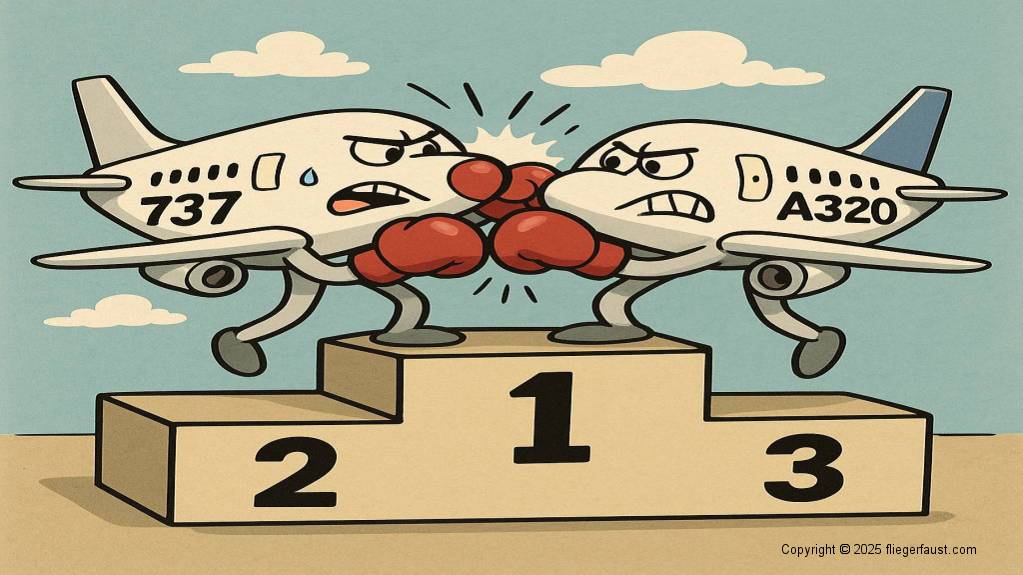
On October 7, 2025, Airbus’s A320 family pulled ahead of Boeing’s 737 as the most‑delivered jetliner in aviation history, a milestone marked by the handover of an A320neo to Flynas. Two days later, Turkish Airlines signalled it could shift a tentative order for 150 Boeing 737 MAX aircraft to Airbus if negotiations with engine maker CFM do not produce acceptable economics.
The juxtaposition is striking—and consequential. It captures a market where production caps, engine reliability, and hard‑nosed procurement all now shape outcomes as much as airframe design.
Moreover, the events bookending this week are not isolated blips. They reflect a deeper rebalancing throughout the Airbus vs Boeing rivalry, with engine supply and maintenance capacity becoming as pivotal as airframe slots. Additionally, fresh delivery data show Airbus running hard into year‑end targets while Boeing works under a U.S. Federal Aviation Administration (FAA) production constraint on the 737 line. Consequently, the narrowbody power balance is shifting on several fronts at once.
Notably, this text examines what changed on October 7, what Turkish Airlines’s gambit says about the state of engine economics, and how both manufacturers are positioned for 2026–2028.
Finally, we evaluate what this means for fleets, fares, and the broader supply chain—where the bottlenecks really live in 2025.
Airbus vs Boeing: the week the leaderboard flipped
Airbus’s A320 family overtook Boeing’s 737 as the most‑delivered commercial jetliner on October 7, 2025, when an A320neo reached Flynas and moved the all‑time delivery counter to 12,260 for the A320 series, according to industry data referenced in contemporaneous reporting. “…overtook the Boeing 737 to become the most‑delivered jetliner in history.” — Reuters.
Moreover, Airbus has been running at a historically strong cadence into the fourth quarter. On October 8, Airbus confirmed 507 deliveries for the first nine months of 2025. September alone saw a record 73 deliveries. That leaves 313 in Q4 to reach about 820 for the year.
Analysts read those numbers as a sign that engine‑related “glider” inventory—airframes awaiting engines—has eased markedly since mid‑year.
Airbus vs Boeing: the week the leaderboard flipped
However, the milestone should be understood in context. The A320 family entered service in 1988 and steadily expanded its footprint with the A321’s capacity and range, while the 737 family, first delivered in 1967–68, held the crown for decades. Additionally, Airbus’s expansion into U.S. and Chinese final assembly and the A321neo’s market traction helped accelerate deliveries in recent years. Meanwhile, Boeing’s 737 output has been constrained since an Alaska Airlines 737‑9 mid‑exit door plug failure on January 5, 2024 triggered FAA action that capped 737 production at 38 aircraft per month while oversight intensified.
Consequently, the gap between what Airbus can hand over in a given month and what Boeing is permitted to build has strategic weight. Ryanair, Boeing’s biggest European customer and a barometer for 737 supply, said on October 8 it expects Boeing to raise the rate to 42 by October and reach 48 by March or April 2026—pending FAA approval. Those months matter because airlines plan capacity, crew, and financing long before a delivery shows up on the ramp.
Even so, the headline—A320 surpassing 737—has more symbolic power than operational leverage. Airlines care about delivery slots within their window, specific sub‑types, and total operating economics. Moreover, fleets turn on engines as much as airframes. That is where Turkish Airlines’s message, delivered just two days later, becomes the sharper edge of the week’s story.
Light aside: In fleet planning, yesterday’s delivery trophy rarely pays today’s fuel bill—but it does make for a great slide at Investor Day.
Airbus vs Boeing: Turkish Airlines puts CFM on the clock
On October 9, Turkish Airlines Chair Ahmet Bolat said the carrier could redirect its recently negotiated order for 150 737 MAX aircraft to Airbus if talks with CFM International do not yield acceptable economic terms. “If CFM comes to feasible economical terms then we are going to sign with Boeing.” — Ahmet Bolat, Chair, Turkish Airlines: — Reuters.
Airbus vs Boeing: engines drive the deal
Moreover, Bolat’s statement underscores a structural asymmetry between the competitors. The 737 MAX is powered exclusively by CFM LEAP‑1B engines. The A320neo family offers airlines a choice between Pratt & Whitney’s PW1100G‑JM and CFM’s LEAP‑1A. Additionally, Turkish has faced prolonged groundings of Airbus narrowbodies—45 aircraft by year‑end 2025—because of lengthy Pratt & Whitney geared turbofan (GTF) repairs. Those constraints give leverage to engine suppliers and put a price on resilience. (Reuters)
Additionally, GTF issues extend beyond the A320neo family and affect the Airbus A220, powered by Pratt & Whitney’s PW1500G. Moreover, inspections and lengthy shop visits have grounded aircraft at several operators, shrinking capacity and raising spares and lease costs. Consequently, some carriers are rethinking fleet plans, a dynamic we examined in our reporting—see Air Austral’s A220 exit
However, option value cuts both ways. While Airbus offers a dual‑engine catalogue for the A320neo (not for the A220, yet), the practical path for many large A320neo buyers in 2025 has been CFM, given the GTF’s well‑documented inspections and shop‑visit bottlenecks. Therefore, a move by Turkish to Airbus would still route significant value through CFM. The negotiation, then, is less about brand loyalty and more about the rate, coverage, and performance guarantees that underpin a decades‑long power‑by‑the‑hour and spares relationship.
Notably, Turkish’s September 26 announcement laid out a broader Boeing framework—75 787s plus the 150 MAX—still contingent on engines. That conditionality is unusually explicit. Additionally, it signals how airlines with outsized growth plans (Turkish targets ~800 aircraft by 2033) are pressing OEMs and engine makers to underwrite availability. In effect, the carrier is pricing the cost of risk transfer after two years in which maintenance turnaround times, not new orders, became the binding constraint.
Consequently, watch the engine term sheet more than the airframe MOU. If CFM and Turkish land an acceptable deal, the Boeing portion proceeds. If not, the airline has openly framed Airbus as the alternative, and Airbus has the slots, especially for A321neo, that many carriers still covet for trans‑continental and select trans‑Atlantic missions.
Airbus vs Boeing: engines, economics, and the single‑aisle squeeze
Engines have reshaped the Airbus vs Boeing contest in three distinct ways in 2025.
Airbus vs Boeing: maintenance capacity is king
First, maintenance capacity now defines effective fleet size. Moreover, airlines operating the GTF PW1100G‑powered A320neo family aircraft have endured long shop cycles and inspection campaigns, leaving dozens of jets idle at peak periods. Turkish expects those bottlenecks to last into mid‑2027. Additionally, second‑order effects still ripple through balance sheets and schedules. Spares leases cost more, engine‑hour pricing is up, and parts are tight.
Second, exclusivity increases concentration risk. The 737 MAX uses the sole‑source LEAP‑1B.
Negotiations with CFM hinge on resilience, spare pools, repair slots, and on‑wing guarantees.
However, Airbus’s dual‑engine menu has been muted in practice. Many operators prefer the LEAP‑1A while the GTF backlog burns down. Consequently, CFM sits at the fulcrum of both narrowbody programmes.
Airbus Boeing rivalry: regulation, rates, certification
Third, regulatory oversight now governs monthly cadence. The FAA imposed a production cap after the 737 MAX January 2024 door‑plug incident. That ceiling limits Renton’s output regardless of demand.
Moreover, raising the rate to 42 and then 48 per month will require clear evidence of sustained quality reforms. Additionally, the 737 MAX 7 and MAX 10 certification timelines influence how Boeing allocates scarce line slots among models. Approval for the Boeing 737 MAX 10 by Q3 2026 would ease narrowbody pressure. It would add capacity and range comparable to the A321neo.
Separately, the unresolved engine anti‑ice modification stands as a clear example of added certification delay. As mentioned by Jon Ostrower of The Air Current, “…pushes 737 Max 7/10 certifications to 2026.” — Jon Ostrower, Editor in Chief, The Air Current.
Therefore, engine economics have become the decisive battlefield where this year’s marquee narrowbody stories intersect. Moreover, airlines now treat engine agreements as quasi‑insurance policies designed to cap downside from shop‑visit queues and parts scarcity. Additionally, suppliers who can guarantee turnaround times will command a premium, even if headline list prices suggest parity.
Light aside: The new three‑letter code for “on time” might be MRO, not ETA.
How the duopoly arrived here
The Airbus vs Boeing rivalry is a saga of step changes and responses. In the 1980s, Airbus bet on fly‑by‑wire and a three‑type family (A319/A320/A321) to scale commonality. Boeing extended and refined the 737 line. Moreover, each programme absorbed shocks differently—fuel cycles, safety crises, post‑9/11 slumps, and the pandemic—while preserving the same core proposition: a workhorse single‑aisle platform.
However, the decisive turn in orders came with re-engineering. The new A320neo and 737 MAX promised lower fuel burn and quieter operations. Additionally, the A321neo unlocked a new continental mission set: six‑hour sectors with useful payloads. Consequently, airlines redesigned network strategies around single‑aisles, siphoning some missions from small widebodies. The results reshaped the backlog mix, with Airbus reporting that roughly three‑quarters of its A320 family backlog is for A321neo variants.
Meanwhile, Boeing’s orderbook stabilised after the MAX groundings, yet deliveries struggled to ramp to pre‑crisis run‑rates amid supplier quality challenges and FAA oversight. Moreover, Ryanair and other major customers publicly advocate for higher production to meet growth plans but hedge with updated traffic forecasts and more spare engines. Additionally, Boeing has signalled long‑term work on a 737 successor, though neither OEM intends to launch a clean‑sheet narrowbody until a step‑change in propulsion efficiency is available.
The A220 remains the most recent clean‑sheet Western single‑aisle airliner. Designed and built by Bombardier as the CSeries (CS100/CS300), it entered service before Airbus took a majority stake in 2018. Airbus then rebranded the programme as the A220. For context, Fliegerfaust launched over a decade ago to cover the CSeries during late development and flight‑testing.
The A320 family’s pass of the 737 in total deliveries is not just trivia. It reflects how programme architecture, engine partnerships, and regulatory context combined over decades to shift the ledger—first in orders (2019) and now in deliveries (2025). Moreover, it sets expectations for where each OEM can best defend or attack share through 2028.
Airbus vs Boeing: delivery maths, backlogs, and rate reality
Delivery arithmetic drives airline planning and cashflow. On October 8, Airbus confirmed 507 deliveries year‑to‑date, with 73 in September—a record for that month. Moreover, industry tracking suggested the company had turned a corner on “gliders,” reflecting improved engine arrivals after earlier disruptions. Additionally, the company still must average north of 100 per month in Q4 to make ~820 for 2025, a stretch but not out of reach given historical year‑end pushes.
Meanwhile, Boeing remains capped at 38 737s per month until the FAA is satisfied. It must show quality systems can sustain higher rates.
Ryanair says 42 by October sounds plausible, with 48 targeted by March or April 2026. However, the regulator’s sign‑off is the gating factor, not supplier ambition. Additionally, MAX 7 and MAX 10 dates determine when Boeing can deliver the most in‑demand variants.
Therefore, the near‑term leaderboard reflects a sequence of chokepoints. FAA caps, LEAP spare‑engine pools, and GTF shop capacity all constrain output.
These bottlenecks are fixable with time, process control, and capital. Yet airlines lack time before the 2026 summer season.
Linefit slots through 2029 are precious; buyers with leverage are using it now.
The cumulative delivery milestone does not pre‑ordain future share. If Boeing clears hurdles and accelerates output in 2026, the contest stabilises. It becomes a two‑lane sprint if Airbus also hits rate‑75. Even so, Airbus holds an edge at the top end of the narrowbody market. A321neo backlog share and scarce slots favour pricing power.
What a Turkish pivot would change—beyond headlines
Turkish Airlines is not just another buyer. The flag carrier’s Istanbul hub strategy relies on high‑utilisation narrowbodies feeding long‑haul banks across three continents. Moreover, the airline has experience with both OEMs and both narrowbody engine families. Additionally, its disclosure of 45 Airbus aircraft grounded into year‑end 2025 due to GTF repairs frames every fresh deal as a hedge against more of the same.
A shift to the A320neo could still funnel billions to CFM. Turkish would likely prefer the LEAP‑1A on the Airbus side. However, it would rebalance cockpit commonality, crew training, and spares pools over time. It would also signal that engine deals can sway airframe awards. Moreover, it would add pressure on the Pratt & Whitney MRO network to speed cycle times. It would also push CFM to guarantee on‑wing performance.
Meanwhile, Boeing would lose a marquee customer’s growth tranche while it works to raise production rates and shepherd the MAX 10 to certification. Additionally, Airbus would have to find or create A321neo slots and potentially A320neo positions within 2027–2030 windows to meet Turkish’s schedule—and that may require secondary market solutions or swaps with lessors.
Therefore, the actual pivot risk is twofold: engine economics on the CFM term sheet, and Airbus’s ability to marshal delivery positions that meet Turkish’s growth curve. Moreover, the airline’s stated fleet target—~800 aircraft by 2033—sets a relentless tempo that favours whichever OEM and engine partner can document availability, not just promise it.
Light aside: In Istanbul, bridges connect continents; in procurement, the bridge is a line in the term sheet marked “penalties.”
Airbus vs Boeing: The A321neo factor and the MAX 10 clock
Airlines with dense mid‑continent networks and long thinner markets want the most seats and range they can operate with single‑aisles. The A321neo, including long‑range subtypes, has become the reference product for that mission set, which explains why it makes up a dominant share of Airbus’s backlog. Moreover, until the 737 MAX 10 is certified and delivered at scale, Boeing’s coverage at the top end of the narrowbody segment remains under pressure.
However, Boeing’s customers have publicly projected MAX 10 certification in 2026, with first deliveries on some large contracts pencilled in for spring 2027. Additionally, a parallel path to deliver more MAX 8s helps carriers bridge the gap, especially where slot scarcity for A321neo makes incremental Airbus capacity unobtainable before late decade.
The duel at the top end is a race against the certification clock for Boeing and rate‑ramp execution for Airbus. Every month that adds A321neo tail numbers to fleets increases Airbus’s network gravity in the single‑aisle market.
Safety, oversight, and quality—why they matter to delivery maths
Regulators have remained deeply involved in both manufacturers’ production systems since January 2024. The FAA’s cap on 737 production and heightened on‑site presence at assembly lines followed the Alaska Airlines flight 1282 door‑plug incident. Moreover, the NTSB / National Transportation Safety Board’s investigation and reporting have intensified scrutiny of manufacturing and quality assurance processes influenced by the positively changing corporate culture at Boeing.
Engine safety advisories have shaped operator bulletins and training. In June 2025, U.S. investigators flagged a scenario in which activation of a LEAP‑1B load‑reduction device could introduce oil system smoke into the cockpit—prompting calls for explicit pilot guidance. However, such recommendations are part of a broader framework of operational resilience rather than reasons to question the fleet’s overall airworthiness. Consequently, the 2025 story is less about whether these jets fly safely—they do—and more about how they are built, inspected, and maintained under sustained regulatory attention.
Quality systems are not a footnote to delivery numbers. They are the predicate. Moreover, airlines are increasingly baking regulatory milestones into their fleet and financing models. Additionally, both OEMs must show that higher rates do not dilute quality controls. In 2026, a faster line that also produces a more robust aircraft will be the only acceptable outcome.
Light aside: In this business, “trust but verify” is not a proverb; it’s a process checklist.
Demand, networks, and fares—what passengers will notice
Most travellers never see a term sheet. They see fares, schedules, and tight connections that work—or don’t. Moreover, engine groundings and delivery delays constrain capacity and push fares higher, especially in peak seasons. Additionally, when airlines must lease spare engines, hold additional airframes, or stretch maintenance windows, those costs eventually roll through to tickets.
However, capacity does not move in unison. Where Airbus has more near‑term A321neo deliveries, you will see airlines add seats on trunk leisure routes and thin long‑haul markets, which can moderate fares. Meanwhile, Boeing’s customers will see relief as 737 rates rise—once regulators consent—and as MAX 7 and MAX 10 come online in 2026–2027. Consequently, by mid‑2027, the narrowbody capacity squeeze should ease across both camps.
The engines will still set practical fleet size. MRO capacity for GTF engines must outpace shop‑visit inflow, and CFM must translate hardware fixes into durable on‑wing performance across hot‑and‑harsh theatres. Additionally, the spare‑engine pools that large carriers are building today will function as shock absorbers for the next two summers.
Light aside: A “new route announcement” is aviation’s version of a weather forecast—sunny, with a chance of spares.
Lessons for airlines and lessors—how to buy in 2025
Airlines can draw three purchase lessons from this week’s Airbus vs Boeing headlines.
First, price the risk, not just the jet. Moreover, the cheapest engine hour on paper is irrelevant if the aircraft sits grounded awaiting a part. Additionally, airlines should quantify the cost of time: lost utilisation hours, lost ancillaries, and the financing drag of unproductive assets.
Second, prefer enforceable availability. However, vague “best efforts” clauses will not protect peak‑season schedules. Therefore, buyers should hard‑wire turn‑time guarantees, spare‑pool access, and performance‑linked relief directly into their engine and MRO agreements.
Third, arbitrage slot scarcity. Additionally, with late‑decade single‑aisle slots oversubscribed, buyers can swap positions with lessors, trade variant allocations, and use pre‑delivery payments as leverage. Consequently, procurement should be more creative than “pick a jet, pick an engine.” It should be a portfolio exercise that keeps options alive and penalties visible.
Airbus vs Boeing: Where Airbus and Boeing go next
Strategically, Airbus must prove it can sustain record monthly deliveries without an engine backlog whiplash. Moreover, an orderly climb toward rate‑75 on the A320 family requires engines, people, and a stable supplier base from nacelles to avionics. Additionally, the company benefits from the A321neo’s backlog density, yet it must carefully ration slots to preserve margins.
Meanwhile, Boeing’s near‑term priority is clearing regulatory gates and rebuilding rate credibility on the 737 line. Moreover, a clean, durable increase to 42 and then 48 per month will change customer sentiment as much as any marketing claim. Additionally, the company will need to manage MAX 10 programme risk, while keeping long‑lead investments in a 737 successor aligned with engine‑technology readiness later in the decade.
Consequently, the fulcrum of competition will remain the same: single‑aisle throughput, engine reliability, and operating economics. Notably, both manufacturers are deferring any clean‑sheet narrowbody launches until propulsion advances justify the bet. Until then, the “neo” and “MAX” eras continue—tempered by regulators and powered by engines that must deliver not only thrust, but uptime.
Light aside: In commercial aerospace, innovation is sprinting—right after a 10‑kilometre warm‑up of certification paperwork.
Airbus vs Boeing: what this week really means
Overall, October 7 and October 9 are less about bragging rights and more about bargaining power. Airbus banked a symbolic milestone that also reflects delivery momentum in 2025. Boeing confronted a marquee customer’s open‑ended conditionality, reminding the market that in narrowbodies the engine deal is often the deal. Moreover, regulators still sit in the front row, with quality systems and certification timelines dictating how fast either OEM can fulfil promises.
Consequently, the next inflection points are clear. Will Boeing secure an FAA‑approved rate increase and keep the 737 MAX 10 timeline intact? Will Airbus hold its Q4 tempo without repeating the spring’s “glider” build‑ups? Additionally, will engine makers translate upgrades and MRO expansions into on‑wing reliability that airlines can measure, not just model?
Critical view: Airbus deserves credit for sustained execution and the A321neo’s strategic edge; Boeing deserves scrutiny for quality lapses but also patience as it climbs the regulatory staircase. However, the real test belongs to the engine makers. Until spare pools and shop capacity end the summer scramble, airframes will keep taking the headlines for problems engines create.
In the end, should the industry measure success by orders and deliveries—or by the percentage of the narrowbody fleet actually available to fly on a hot July Friday?
Leave your comments below or on our Fliegerfaust Facebook page
For Fliegerfaust readers: related deep‑dives
Moreover, if you want to explore adjacent issues we have covered this year, here are recent analyses from our archive that frame today’s developments:
- Paris Air Show 2025: Airbus, Bombardier Reveal Big News
- Airbus–Spirit AeroSystems Deal: A New Chapter for the A220 and Supply Chains
- Air Austral A220: Reliability Pain, Tough Choices, and What Comes Next
- Creating Jobs—But in China? Boeing Delivery Ban Hands Airbus Strategic Advantage
- F35? Wait, here comes the Boeing F-47 – America’s Next-Generation Air Dominance Fighter
Sources
- Reuters — Turkish Airlines chair says may switch Boeing 737 order to Airbus if engine talks fail (October 9, 2025).
- Reuters — Airbus A320 flies past Boeing 737 as most‑delivered jetliner in history (October 7, 2025).
- Reuters — Airbus delivered 507 jets in first nine months (October 8, 2025).
- Reuters — Major Boeing customer Ryanair sees 737 production hitting 48 per month by April (October 8, 2025).
- Reuters — FAA has not made any decision on Boeing 737 MAX production cap (September 8, 2025).
- Reuters — US FAA not currently considering lifting Boeing 737 MAX production cap (June 4, 2025).
- NTSB — Aviation Investigation Report AIR‑25‑04: In‑Flight Separation of Left Mid Exit Door Plug, Alaska Airlines Flight 1282 (June 24, 2025).
- FAA — Updates on Boeing 737‑9 MAX (January 17, 2024).
- Airbus — Orders and Deliveries (Monthly summary; September 2025 data).
- Reuters — Airbus cumulative deliveries turn positive in September, Cirium says (October 3, 2025).
- Reuters — Turkish Airlines sees Pratt engine woes lasting to mid‑2027 (October 6, 2025).
- Daily Sabah — Turkish Airlines expects Pratt engine bottlenecks to last until mid‑2027 (October 7, 2025).
- CFM International — LEAP overview (LEAP‑1B sole‑source on 737 MAX; LEAP‑1A on A320neo).
- CFM International — Boeing selects LEAP‑1B as sole powerplant for 737 MAX (November 14, 2011).
- Reuters — NTSB wants actions on CFM LEAP‑1B engines over smoke entering cockpit (June 18, 2025).
- Airbus — A320 Family Facts & Figures (April 2025; A321neo share of backlog).
- Reuters — Boeing focuses on recovery, watching market for new single‑aisle jet (September 30, 2025).
- Reuters — Ryanair confident of Boeing MAX 10 timing (September 25, 2025).
For full details, please refer to our Disclaimer page.

La réalité c’est qu’en termes de commandes en attente de livraison, Airbus détient déjà 61% du marché des monocouloirs, versus 39% pour Boeing (si on exclut les autres compétiteurs), et l’écart augmente d’année en année. Je ne vois d’ailleurs pas comment cet écart se rétrécirait car le 737 est un avion obsolète qui a atteint depuis longtemps les limites de son potentiel de développement. Lorsque Airbus a annoncé le lancement du programme A320neo en 2010 Boeing aurait dû à ce monet-là proposer un nouvel avion pour tirer avantage des deux moteurs alors disponibles (GTF et CFM) pour propulser la génération actuelle de monocouloirs, tout en offrant une nouvelle famille d’avions plus moderne et plus efficace que la famille neo. Autrement dit produire une version 3 X 3 (plutôt que 2 X 3) du CSeries de Bombardier, mais avec l’autonomie d’un Boeing 757. Si cela avait été annoncé en 2011, plutôt que le MAX, c’est Airbus qui serait dans les câbles à la place de Boeing qui ne se remettra sans doute jamais du knockout infligé au 737 par le neo, particulièrement dans sa variante A321 que le 737 MAX 10 ne pourra jamais concurrencer adéquatement, car la plateforme de Boeing est complètement déclassée par celle d’airbus qui offre plus d’efficacité, de capacité et d’autonomie. Et plus de confort, bien entendu!
Et pourtant, Bombardier a offer le CSeries à Boeing… pas une, pas deux, mais 3 fois!