

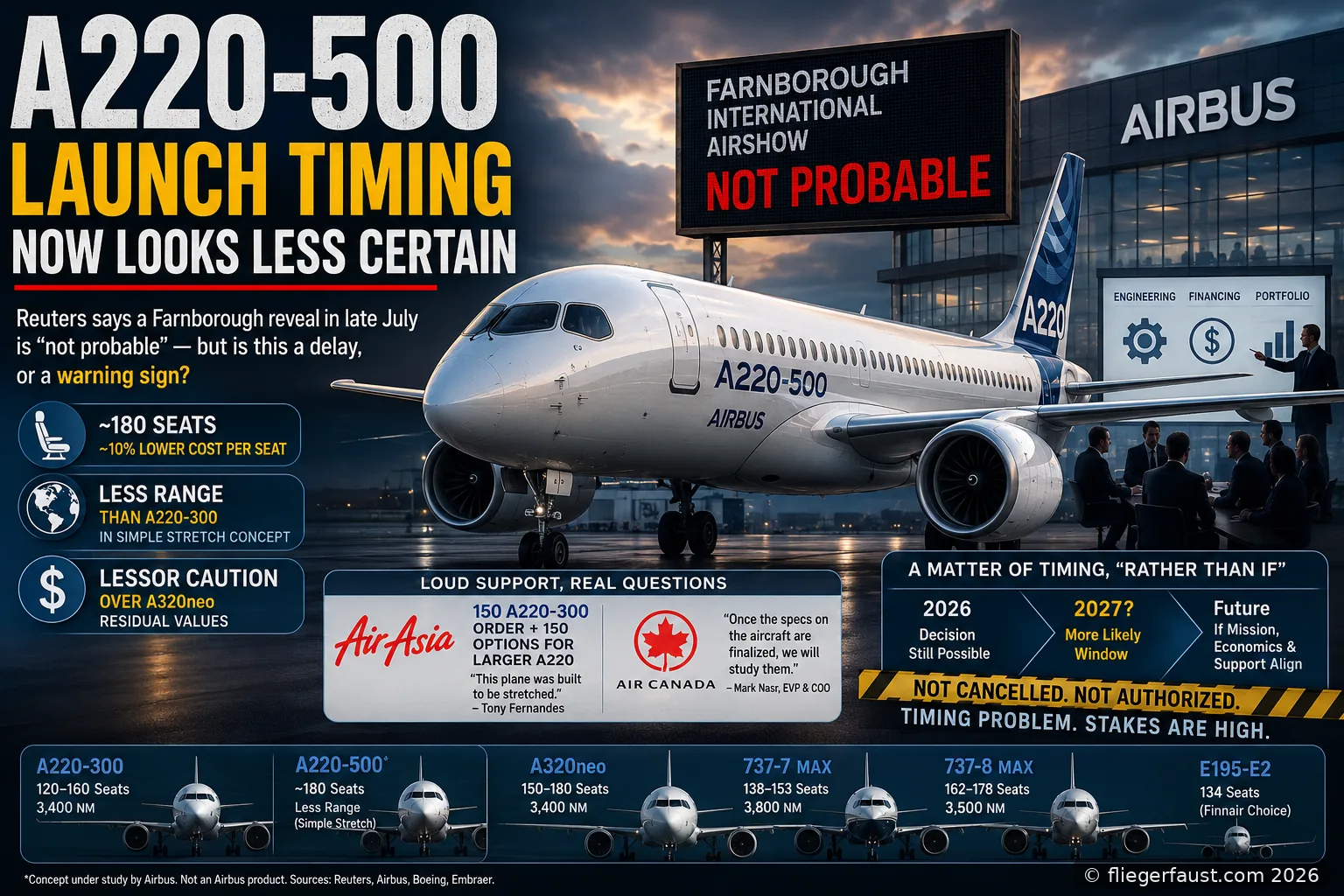
A220-500 launch timing now looks less certain after Reuters reported on June 5, 2026 that a Farnborough International Airshow reveal in late July is now “not probable” — but is this a delay, or a warning sign?
The report, citing six industry sources, says Airbus is wavering over when to approve the stretched A220. However, Reuters also says Airbus has not ruled out a decision later in 2026, which keeps the stretched aircraft alive but not authorised.
For readers new to the family, the A220 is already a two-length aircraft line, not a single orphan model. The A220-100 and A220-300 are the current members of the family. The A220-100 is the shorter aircraft, at 35.0 metres overall, while the A220-300 is the longer version, at 38.7 metres.
That history matters because the proposed A220-500 would extend an existing family logic, not invent one from scratch. The A220 began life as Bombardier’s CSeries, with the CS100 becoming the A220-100 and the CS300 becoming the A220-300 after Airbus took control of the programme in 2018. Therefore, the A220-500 launch debate is really about how far Airbus can push the former CSeries architecture upward before range, weight, and overlap with the Airbus A320neo (new engine option) become the limiting factors.
Therefore, the story is not a cancellation. It is a timing problem with engineering, financing, and portfolio consequences. Airbus has a promising aircraft concept, a loud AirAsia endorsement, cautious lessors, and unresolved range questions from serious operators. Aircraft launches love spotlights; spreadsheets prefer fluorescent light.
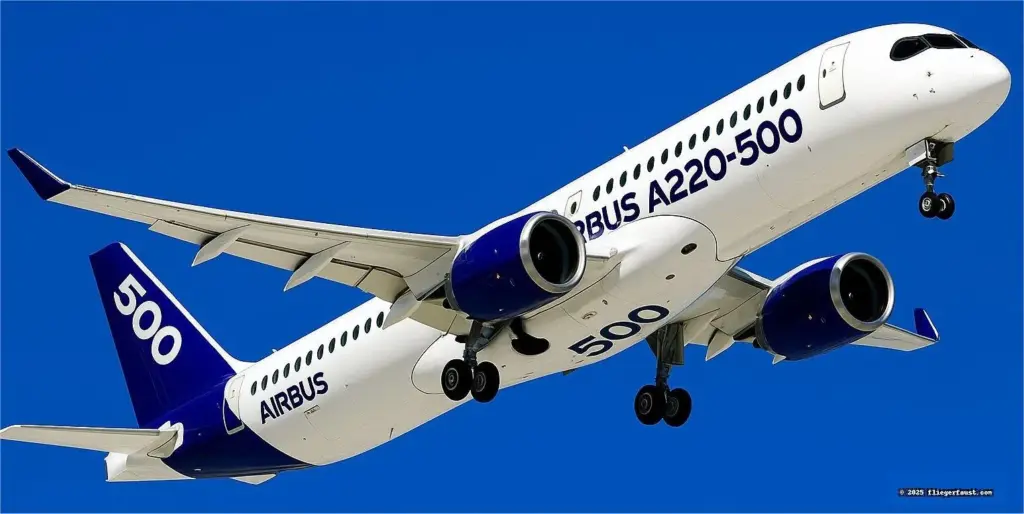
A220-500 launch: what changed
A stretched A220 is alive, but not authorised
The Reuters update moves the stretched A220 from airshow expectation to boardroom caution. It says Airbus had sounded more bullish early in 2026, then moderated expectations as leasing-company enthusiasm cooled and airlines pressed for more detail.
Airbus kept its public line deliberately narrow. “We are studying all the options; no decisions have been made.” — Airbus spokesperson, Reuters
Importantly, that wording matters because the A220-500 remains an industry shorthand, not a launched Airbus product. Specifically, Airbus has not published a specification sheet, certification schedule, launch statement, or customer list for a -500 variant.
However, the same Reuters report also quoted Airbus Chief Executive Officer (CEO) Guillaume Faury as saying the longer A220 remains a matter of timing, “rather than if”. That keeps the idea alive, while confirming that approval has not crossed the line. The limbo is real, but so is the intent. For Airbus, the A220-500 launch is now a test of timing discipline.
The January A220 stretch signal now looks too optimistic
The June story also revises the mood created by Reuters’ January 29, 2026 report. That earlier article said Airbus was preparing to offer a roughly 180-seat A220-500 to airlines and lessors, with a possible Farnborough launch subject to board approval.
Specifically, Airbus had briefed financiers that 2026 would be a “big year” for the A220. It also said final approval would depend on two or three marquee customers.
Meanwhile, potential buyers had not received the level of detail they would expect before an imminent launch, according to Reuters. Consequently, the A220-500 launch looks less like a July surprise and more like a disciplined campaign.
For background on the earlier Dublin signals, see our Fliegerfaust coverage of the Airbus A220-500 Dublin update. The central point still holds.
A220-500 launch economics: seat cost versus range
A simple stretch creates a hard trade
Reuters says Airbus has been touting a conservative “simple stretch” concept. In that version, the fuselage grows, but the maximum take-off weight (MTOW) does not. Reuters also says the concept avoids a costly Pratt & Whitney engine upgrade.
That approach would make the programme cheaper and faster. Additionally, it would protect commonality with the Airbus A220-300, which is already flying in commercial service.
The prize is seat cost. The larger (stretched) aircraft would carry about 180 passengers, up from 160 today, and could reduce costs per seat by roughly 10%. That is a serious number in the 150-to-180-seat segment.
However, the penalty is range. Reuters says the simple-stretch concept would offer less range than the current A220-300. That makes the A220-500 launch decision a commercial filter, not just an engineering choice.
| Aircraft or concept | Seating cited | Range cited | Why it matters | Source |
|---|---|---|---|---|
| Airbus A220-300 | 120-150 typical two-class; 160 maximum | 3,400 nautical miles | Current baseline for any A220-500 trade-off. | Airbus A220-300 data |
| Proposed Airbus A220-500 | About 180 passengers | Lower than the A220-300 in the simple-stretch concept | Reuters says the gain is roughly 10% lower cost per seat. | Reuters June 5 report |
| Airbus A320neo (new engine option) | 150-180 typical two-class; 194 maximum | 3,400 nautical miles | Shows the internal Airbus overlap risk. | Airbus A320neo data |
| Boeing 737 MAX 7 | 138-153 two-class; 172 maximum | 3,800 nautical miles | Frames Boeing’s lower MAX reference point. | Boeing 737 MAX data |
| Boeing 737 MAX 8 | 162-178 two-class; 210 maximum | 3,500 nautical miles | Frames Boeing’s higher-volume MAX comparison. | Boeing 737 MAX data |
| Embraer E195-E2 | 134 seats in the Finnair campaign cited by Reuters | Not specified in that Reuters report | Shows lower-end right-sizing pressure on Airbus. | Reuters Finnair report |
The stretched A220-300 benchmark is already strong
The baseline is important. Airbus’s A220-300 product data lists 120 to 150 seats in a typical two-class layout, 160 maximum seats, 3,400 nautical miles of range, and a 70.9-tonne MTOW.
Overall, those figures explain why airlines like the aircraft. It has a modern cabin, useful range, and smaller-gauge economics than a full Airbus A320neo (new engine option). It also gives airlines a way to match capacity to thinner routes without downgrading passenger experience.
Meanwhile, Airbus’s A220 family page positions the current family in the 100-to-160-seat market. It also lists the A220-100 and A220-300 as the official family members, no A220-500 yet.
Therefore, a 180-seat derivative would move the family outside its published bracket. That may be smart. Yet it also forces Airbus to define exactly what kind of missions the stretched A220 should own.
A220-500 launch: Air Canada made range visible
Air Canada has made the range question public. In a Reuters interview published on June 3, 2026, Executive Vice President and Chief Operations Officer (COO) Mark Nasr said Air Canada was waiting for Airbus to finalise the technical specifications.
“Once the specs on the aircraft are finalized, we will study them.” — Mark Nasr, Air Canada Executive Vice President and Chief Operations Officer, Reuters
He then identified the key topic as range. That response carries weight because Air Canada already operates the A220. It does not need to be sold on the aircraft’s basic cabin or brand.
Instead, Air Canada needs to know whether a bigger variant (with less range) still works across its network. That is why our Fliegerfaust analysis of whether the A220-500 can stretch without a new wing remains central. More seats help only if the aircraft still reaches enough profitable city pairs.
A220-500 launch pressure from AirAsia
The bigger A220 gets AirAsia’s loudest endorsement
AirAsia is the clearest pro-launch airline. On May 6, 2026, Airbus announced a firm AirAsia order for 150 A220-300 aircraft, calling it the largest single firm order for the A220. A process that started back in 2012 and you can read more about this here: AirAsia A220 order closes the CSeries loop).
The order pushed the A220 above 1,000 firm orders. Additionally, Airbus said AirAsia would become launch customer for a new 160-seat A220-300 cabin configuration, using an extra overwing exit on each side.
Consequently, that deal matters before any A220-500 launch because it gives Airbus scale on the current aircraft. It also proves that a major low-cost carrier sees value in pushing the A220 toward higher-density operations. Specifically, low-cost carriers do not frame capacity as poetry; they count chairs.
Then AirAsia raised the stakes. Reuters reported the same day that AirAsia also took 150 options on a longer A220 if Airbus builds it.
“This plane was built to be stretched when Bombardier built it.” — Tony Fernandes, AirAsia CEO, Reuters (Something he knew since 2012, look at this picture)
AirAsia interest reduces pressure, but does not remove risk
Meanwhile, Reuters says pressure to create something new eased after AirAsia ordered the existing model. That is logical because the current A220 programme needs volume, not only future variants.
However, AirAsia’s interest in the stretched A220 also gives Airbus a visible anchor. If the options become a launch commitment, Airbus would gain a powerful reference customer in Asia. That matters for production confidence and supplier negotiations.
Still, options do not equal firm orders. Airbus must convert enthusiasm into deposits, delivery schedules, and performance clauses. A launch customer is useful, but a board wants a business case, not a fan club.
For the current-production angle, see our Fliegerfaust analysis of the A220 ramp-up, 160-seat doors, and 93 deliveries. The current A220-300 win is the foundation. The stretch remains the possible next floor.
A220-500 launch risk inside the Airbus portfolio
The A320neo overlap is not a footnote
The A220-500 launch would land near the lower end of Airbus’s own A320neo market. Airbus’s A320neo product page lists 150 to 180 seats in typical two-class seating, 194 maximum seats, and 3,400 nautical miles of range.
That overlap creates a useful but uncomfortable choice. Specifically, Airbus could use the longer A220 to defend thinner routes and improve family economics. However, it must avoid undermining A320neo values and margins.
Reuters says Airbus is studying the impact on A320neo sales. It also reports that lessors worry about A320neo residual values. Those worries are rational because lessors often own large A320-family fleets. Residual-value fear is not glamorous, but it can stop a launch faster than bad catering.
Moreover, the older A320 is far more widely embedded across global fleets, while Boeing can argue for commonality through the 737 MAX family. In airline finance, commonality is not sentimental. It is a line item.
Lessors want output before novelty
Leasing-company caution has been visible since January. In Reuters’ January 26, 2026 AerCap interview, AerCap CEO Aengus Kelly dismissed the case for a stretched A220 and urged Airbus to focus on producing what it already sells.
Overall, Kelly’s broader point was about supply. He expected tight aircraft supplies to last because manufacturers were behind targets and engines required more maintenance than expected. That argument does not reject the aircraft forever. Instead, it rejects launching it before the industrial system can absorb it.
Separately, Avolon reached a similar timing conclusion from another angle. In its Avolon 2026 outlook, the lessor said 2026 felt too soon for a new commercial aircraft programme launch, while 2027 “may just be the year”.
Consequently, Airbus has a financing problem as well as a product problem. Airlines may want a sharper aircraft. Lessors need proof that the asset will hold value through cycles.
The industrial gate: engines, Mirabel, and rate discipline
The A220 ramp still comes first
Airbus’s production context is the strongest argument against rushing. In Airbus’s first-quarter 2026 results, the company said it delivered 19 A220s in the quarter and still targets a monthly A220 production rate of 13 aircraft in 2028.
Pratt & Whitney remains the key pacer for the A320-family ramp in 2026 and 2027. While that line referred to the A320 family, it reinforces a wider point. Engines remain a constraint across Airbus planning.
Meanwhile, the A220 also carries its own industrial history. Airbus took 50.01% control of the C Series Aircraft Limited Partnership in 2018, with Bombardier retaining about 31% and Investissement Québec about 19%. Bombardier then exited the A220 programme in February 2020, receiving net US$591 million as Airbus increased its ownership to 75% and the Québec government retained 25%. That inheritance gave Airbus a clean-sheet aircraft, but also a demanding cost-reduction project.
The longer A220 cannot be treated as a stand-alone derivative. It must fit into Mirabel, Mobile, supplier contracts, engine support, and Airbus’s cash discipline. In aviation, the factory eventually edits the press release.
Wagner’s Dublin message was production first
Lars Wagner, CEO of Airbus Commercial Aircraft, framed the problem clearly at the Airline Economics conference in Dublin on January 26, 2026. “The whole ecosystem is under pressure.” — Lars Wagner, Airbus Commercial Aircraft CEO, Reuters
Wagner did signal support for a bigger A220. Reuters said Air Lease Corporation CEO John Plueger saw a role for a longer A220, prompting Wagner to reply “me too”. Still, Wagner avoided committing to a strategy.
His most important sequencing line concerned engines. “I think we need to solve the durability question first.” — Lars Wagner, Airbus Commercial Aircraft CEO, Reuters
That is the right order. The A220-500 launch case depends on that discipline. Airlines do not only buy fuel burn. They also buy utilisation, spare-engine availability, and predictable maintenance. A derivative that adds demand before the support system stabilises could damage a good aircraft family.
A broader narrowbody fight with Boeing and Embraer
Boeing frames the upper comparison
The stretched A220 would also change Airbus’s position against Boeing. Boeing’s 737 MAX product data lists the 737 MAX 7 at 138 to 153 seats in two classes, with 172 maximum seats and 3,800 nautical miles of range.
The same Boeing data lists the 737 MAX 8 at 162 to 178 seats in two classes, 210 maximum seats, and 3,500 nautical miles of range. Therefore, a 180-seat A220-500 would sit near Boeing’s most contested lower-to-middle narrowbody territory.
However, Boeing’s family commonality is part of its counterargument. Boeing can sell a ladder of aircraft with shared training, maintenance, and operational infrastructure. Airbus can counter with efficiency and cabin comfort, but it must define why a stretched A220 beats a smaller A320neo.
That is the strategic tension. The bigger A220 can be a scalpel. Yet Airbus must not let it become a duplicate tool in the same drawer.
Embraer pressures the lower end
Embraer is the sharper pressure at the lower end. Reuters reported on March 23, 2026, that Finnair chose 18 Embraer E195-E2 aircraft over Airbus for its European fleet renewal.
Embraer’s E2 family outsold the A220 three to one in 2025. That does not make the E195-E2 a direct 180-seat rival. It does show that Airbus faces active pressure in smaller narrowbody campaigns.
Notably, Finnair CEO Turkka Kuusisto called the E195-E2 “highly versatile” in the Reuters report. He also said the aircraft’s 134-seat size tipped the scales for Finnair. That is exactly the kind of right-sizing logic Airbus originally wanted the A220 to dominate.
Consequently, Airbus faces pressure from both sides. Boeing argues commonality above. Embraer wins selected campaigns below. The A220-500 launch could answer both, but only if Airbus keeps the aircraft’s efficiency story clean.
What the A220-500 must prove next
The A220-500 concept needs a public mission
Before Airbus signs an A220-500 launch, it needs to define the aircraft’s mission in plain commercial terms. Is the stretched aircraft a high-density short-to-medium-haul tool, or a full A220-300 successor for longer thin routes?
That distinction will shape the reaction from airlines. A low-cost carrier may accept reduced range if seat cost falls enough. However, a network carrier may reject the same aircraft if it cannot cover enough seasonal, transborder, or longer domestic missions.
Airbus needs more than a seat-count promise. It needs range at useful payloads, runway performance, maintenance assumptions, and delivery timing. Aircraft families age better when each member knows its job.
The stretched A220 needs a balanced buyer mix
The customer mix also matters. AirAsia gives the concept volume, but Airbus would benefit from a wider launch group. A North American operator, a European network carrier, and at least one lessor would make the case more resilient.
Moreover, the A220-500 launch would look stronger if Airbus tied it to a credible production and support plan. That plan should cover Mirabel, Mobile, Pratt & Whitney support, spare engines, and supplier cost reductions.
A narrow launch around one airline would still be possible. Yet a broader customer base would tell the market that the larger (stretched) A220 solves a global fleet problem, not only a regional growth plan. That is the difference between a derivative and a programme pillar.
Conclusion: A220-500 launch discipline matters more than airshow theatre
The better decision may be the slower decision
The A220-500 launch now appears delayed, not dead. Reuters’ June 5 reporting points to a weaker Farnborough case, but it does not report a cancellation. Airbus still studies the aircraft. AirAsia wants the stretched version. Air Canada wants final specifications. Lessors want residual-value protection and production discipline.
Farnborough matters because it is one of aviation’s two great European trade-show stages. The Farnborough International Airshow is held in Farnborough, Hampshire, southwest of London, and the 2026 edition runs from July 20 to July 24. In the industry calendar, it occupies the even-year rhythm opposite the Paris Air Show at Le Bourget, near Paris, which is held every two years and returns from June 14 to June 20, 2027. That is why the Reuters timing matters: missing Farnborough does not kill the A220-500 launch story, but it removes the most obvious 2026 stage for a formal reveal.
Overall, that balance should reassure rather than alarm the market. Importantly, Airbus does not need another rushed derivative. It needs a stretched A220 that protects the A220-300’s strengths while giving airlines enough seats, range, and reliability to open new economics.
A 2027 launch may therefore be more credible than a rushed July 2026 announcement. It would give Airbus time to secure firmer customers, sharpen the range story, stabilise production assumptions, and explain the A320neo boundary. Airshow banners fade quickly; aircraft economics stay on the balance sheet for decades.
My critical view is that Airbus should not launch the A220-500 until it can publish a product definition that satisfies both operators and financiers. A simple stretch with weak range could dilute a brilliant aircraft. A disciplined stretch with the right mission could become one of Airbus’s most useful narrowbody moves.
What do you think? Leave your comments at the bottom
Ultimately, the stretched A220 has a strong strategic reason to exist. However, it still needs proof that the timing, range, support network, and portfolio logic are mature.
Should Airbus chase the airshow moment, or wait until the A220-500 is genuinely ready to strengthen the whole narrowbody family?
Leave your answers and comments below and on our Fliegerfaust Facebook page.
Sources
- Reuters — Airbus in limbo over early launch of larger A220, sources say (June 5, 2026).
- Reuters — Exclusive: Airbus to kickstart pre-sales for a larger A220 jet, sources say (January 29, 2026).
- Reuters — Air Canada still sees system ‘friction’ over delayed deliveries of A321XLR jets (June 3, 2026).
- Reuters — AirAsia ready to buy 150 larger versions of Airbus A220 jet it ordered (May 6, 2026).
- Airbus — AirAsia places landmark order for 150 A220s (May 6, 2026).
- Airbus Aircraft — A220-300 product data (accessed June 6, 2026).
- Airbus Aircraft — A220-100 product data (accessed June 6, 2026).
- Airbus Aircraft — A220 purpose-built for efficiency (accessed June 6, 2026).
- Airbus Aircraft — A320neo product data (accessed June 6, 2026).
- Reuters — AerCap CEO urges cool heads on geopolitical turmoil (January 26, 2026).
- Avolon — Avolon 2026 Outlook: Up Next (January 23, 2026).
- Airbus — Airbus reports First Quarter (Q1) 2026 results (April 28, 2026).
- Reuters — New Airbus commercial CEO signals production focus, backs bigger A220 (January 26, 2026).
- Boeing — 737 MAX product data (accessed June 6, 2026).
- Reuters — Finnair picks Embraer over Airbus for its narrow-body fleet renewal (March 23, 2026).
- Farnborough International Airshow — FIA2026 official event page (accessed June 6, 2026).
- Paris Air Show — The Show (accessed June 6, 2026).
For full details, please refer to our Disclaimer page