

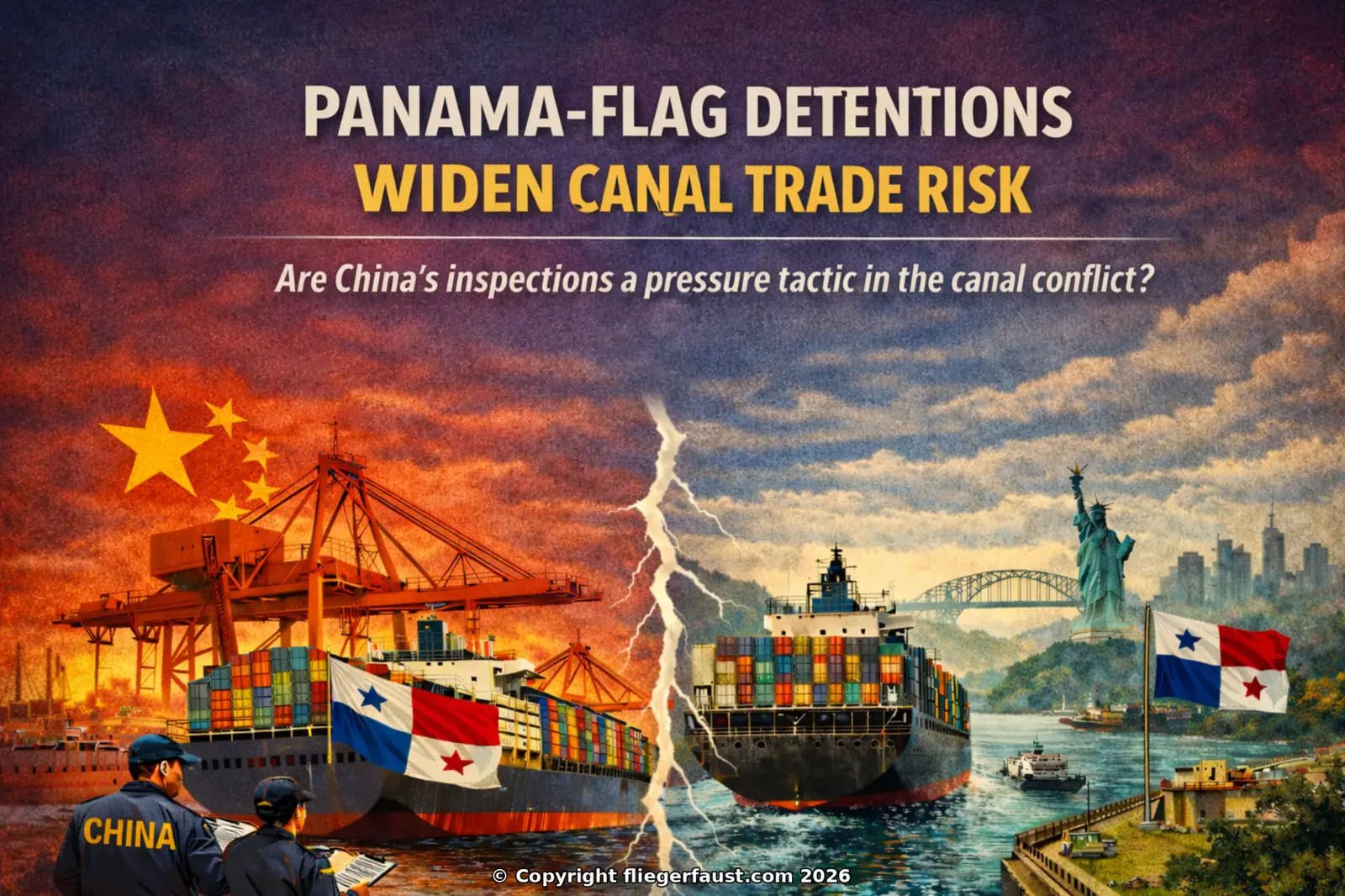
Panama-flag detentions: are China’s inspections of Panama-registered ships now a pressure lever in the canal fight?
Panama-flag detentions: Overall, that now looks hard to dismiss. Since March 8, 2026, Chinese ports have sharply increased detentions of Panama-registered vessels. At the same time, Panama’s forced removal of the Chinese CK Hutchison company from the Balboa and Cristóbal terminals, located at opposite ends of the Panama Canal, has widened into a legal and geopolitical dispute.
Moreover, the issue is no longer confined to local reporting or diplomatic muttering. On March 27, 2026, the United States Federal Maritime Commission (FMC) said it was closely monitoring the surge in detentions. It tied the pattern to Panama’s court ruling against CK Hutchison and to the transfer of the two canal-side terminals to interim operators linked to APM Terminals and Terminal Investment Limited. Consequently, a port dispute in Panama has become a test of how fast maritime regulation can start looking like statecraft.
Panama-flag detentions are no longer a rumour
China port inspections accelerated after March 8
Overall, the first task is to establish whether the pattern is real. According to Reuters on March 27, 2026, the FMC said detentions had reached nearly 70 since March 8. Moreover, Reuters linked the spike to Panama’s court action against CK Hutchison. It also linked it to the transfer of terminal control at both ends of the Panama Canal.
Meanwhile, Lloyd’s List on March 13, 2026 reported 28 detentions between March 8 and March 12 alone. Specifically, that represented 75.7% of all detentions in that short period. Lloyd’s List also reported that sources described verbal instructions to intensify inspections, first as a trial and then more broadly.
However, Panama itself did not initially describe the trend as retaliation. In a March 13 Swissinfo report carrying Agencia EFE, Panama’s Foreign Minister Javier Martínez-Acha acknowledged the increase but called it routine. “Evidentemente sí hay un incremento.” — Javier Martínez-Acha, Foreign Minister of Panama, via Swissinfo/Agencia EFE.
Moreover, Martínez-Acha tried to lower the temperature. “Eso es lo que he leído, nosotros pensamos que esas detenciones son producto de la rutina de la industria marítima …” — Javier Martínez-Acha, Foreign Minister of Panama, via Swissinfo/Agencia EFE. That was a reasonable diplomatic line on March 13. Even so, the numbers published since then have made the “routine” explanation much harder to sustain.
Notably, the American warning is more direct. “These intensified inspections were carried out under informal directives and appear intended to punish Panama after the transfer of Hutchison’s port assets.” — Laura DiBella, Chair, FMC, via Reuters.
Panama-flagged ship detentions versus Tokyo MOU norms
However, raw March numbers only matter if they depart from a credible baseline. The Tokyo Memorandum of Understanding on Port State Control in the Asia-Pacific Region (Tokyo MOU) New Inspection Regime list still classifies Panama as a low-risk flag. That status is effective from July 1, 2025 to June 30, 2026. Consequently, the sudden surge is difficult to explain as a simple collapse in registry quality. We understand what China is doing.
Moreover, the Tokyo MOU Annual Report 2024 recorded 8,539 inspections of Panama-flagged ships. It also recorded 5,738 inspections with deficiencies and 348 detentions, equal to a 4.08% detention rate for the full year. Those are not flattering numbers in isolation. Even so, they are long-run regional data, not evidence of a sudden March 2026 explosion.
Consequently, Reuters’ figure of nearly 70 detentions since March 8 would equal roughly one-fifth of Panama’s entire 2024 detention count in the Tokyo MOU region. That comparison is an inference, not a legal finding. However, it does show why shipowners, insurers and regulators are paying attention.
Additionally, the mechanics of detention matter. The Tokyo MOU’s explanation of port state control says the system exists when shipowners, recognized organizations and flag-state administrations fail to comply with maritime conventions. It also says deficiencies found must be rectified before ships are allowed to sail. Therefore, even a short detention can disrupt rotations, crewing plans and cargo connections.
Meanwhile, detentions are not beyond challenge. The Tokyo MOU detention appeals and review procedures say the company or representative has a right of appeal in the port state. They also say the flag state or recognized organization can later seek reconsideration or review. Even so, appeals take time. Shipping networks price delay almost as quickly as they price fuel.
Port state control pressure now has strategic weight
Overall, the commercial risk is larger than the legal wording. Panama-flag detentions do not need to become permanent to change behaviour. They only need to become frequent enough for operators to add buffer time, reroute equipment or ask whether the Panamanian flag now carries a new political premium in East Asia.
Moreover, that matters because Panama is not a small niche registry. The Autoridad Marítima de Panamá (AMP) homepage says Panama currently has 8,710 flagged ships. It also says the register totals 235.6 million gross tons. Reuters reported on June 2, 2025 that Panama had removed more than 650 vessels from its registry since 2019. It did so while tightening sanctions compliance and oversight. In other words, this is a large, systemically important flag trying to clean itself up while suddenly drawing abnormal scrutiny in China.
Therefore, Panama-flag detentions deserve attention for a simpler reason. The pattern has emerged too quickly, too visibly and too neatly alongside a canal-side power struggle. Maritime regulation can be technical. It is rarely this coincidental.
Panama-flag detentions fit the port and canal battle
The court ruling and terminal handover came first
Overall, the detention story only makes sense inside the wider dispute over the ports of Balboa and Cristóbal. Panama’s Supreme Court ruled in late January 2026 that the legal framework behind CK Hutchison’s 1997 concession was unconstitutional. Then, on February 23, 2026, Panama’s Official Gazette, No. 30468 C published the transitional concession approvals. It gave APM Terminals Panamá, S.A. up to 18 months to run Balboa for US$26.1 million. It also gave TIL Panamá, S.A., the local arm of Terminal Investment Limited, up to 18 months to run Cristóbal for US$15.8 million.
Meanwhile, Panama tried to reassure the market before the formal handover. In a January 30, 2026 AMP continuity statement, the authority said it had activated a technical transition plan. It also said essential services supporting the global logistics chain would continue without disruption.
According to Agencia EFE, Max Flores said the Panama Maritime Authority (AMP) “took possession of its ports today and will guarantee” the operation of the Balboa (Pacific) and Cristóbal (Atlantic) terminals through an “occupation decree.”
Additionally, the same Agencia EFE report of February 23, 2026 said Balboa and Cristóbal handled 3.77 million containers in 2025, equal to 38% of Panama’s port system. The AMP’s January 16, 2026 container-movement report put Panama’s total 2025 throughput at 9.9 million twenty-foot equivalent units (TEUs). It put Balboa at 2,676,768 TEUs and Cristóbal at 1,210,528 TEUs. These were not symbolic assets. They were load-bearing pieces of Panama’s logistics machine.
In canal politics, a berth can become a ballot box with surprising speed.
China port inspections followed wider pressure moves
However, the port handover did not remain a purely Panamanian administrative matter. On February 4, 2026, China’s foreign ministry signalled its posture clearly. “China will firmly defend the legitimate and lawful rights and interests of Chinese companies.” — Lin Jian, Foreign Ministry spokesperson, Ministry of Foreign Affairs of the People’s Republic of China.
Moreover, the same official briefing sharpened the accusation against Washington. “It is quite clear to the world who exactly is seeking to forcibly own the Panama Canal …” — Lin Jian, Foreign Ministry spokesperson, Ministry of Foreign Affairs of the People’s Republic of China. That language mattered because it showed Beijing already saw the dispute through a sovereignty and power lens, not as an ordinary concession case.
Separately, this pressure had roots in the earlier CK Hutchison ports sale saga. Reuters on March 14, 2025 reported renewed pressure from Beijing. It said China’s Hong Kong and Macau Affairs Office had reposted commentary attacking CK Hutchison’s proposed ports sale to a BlackRock-led group as a betrayal of China. Consequently, the Panama terminals were already caught inside a broader contest over who would control strategic maritime infrastructure.
Meanwhile, the conflict quickly moved from rhetoric to operations. Reuters on March 10, 2026 reported that China’s state-owned shipping group suspended operations at Balboa after the concession change. Reuters also reported that China’s state planner met executives from Maersk and Mediterranean Shipping Company (MSC) in Beijing on the same day.
Consequently, the dispute was no longer just about who ran two terminals. It was already affecting service patterns, container flows and commercial signalling across the Panama hub. Supply chains rarely wait for ministers to finish a sentence.
Arbitration and the BlackRock deal keep the fight open
Notably, the legal and financial fronts remain active. Reuters on March 3, 2026 said a BlackRock-backed consortium was exploring a closing of CK Hutchison’s global ports deal without the two Panama assets. That move would have been difficult to imagine before the seizure.
Moreover, the claims are getting larger. Reuters on March 25, 2026 reported that Panama Ports Company had expanded its international arbitration claims against Panama to more than US$2 billion. Panama rejects the accusations and says it acted under a final court ruling and lawful transition measures.
Therefore, Panama-flag detentions are unfolding beside an unresolved ownership fight, a still-sensitive global ports transaction and open friction between Beijing, Panama City and Washington. This is why a narrow inspection story now carries strategic weight.
Panama-flag detentions matter to U.S. trade and aerospace
Panama vessel detentions explain Washington’s concern
Overall, Washington’s concern is not sentimental and it is not abstract. The Panama Canal Authority (ACP) connectivity overview says the Panama Canal handles about 5% of world trade, serves more than 144 maritime routes, connects 160 countries and reaches roughly 1,700 ports. It also says more than 70% of the cargo that goes through the canal either originates in or is destined for the United States.
Moreover, the canal remains deeply embedded in American container economics. In his January 28, 2025 Senate statement published by the FMC, Chairman Louis E. Sola said more than 40% of U.S. container traffic, worth roughly US$270 billion annually, transits the canal. Consequently, any politically charged friction touching Panama-flagged ships can matter well beyond Panama itself.
Additionally, the canal’s geometry still saves real distance. The ACP trade-routes page says a coal vessel sailing from the east coast of the United States to Japan via the canal saves about 4,800 kilometres versus the shortest alternative all-water route, while a banana vessel sailing from Ecuador to Europe saves about 8,000 kilometres. Delay imposed elsewhere can quietly erase part of that advantage.
Therefore, DiBella’s warning was commercially grounded, not theatrical. In the same Reuters report on March 27, 2026, she added that Panama-flagged ships carry a meaningful share of U.S. containerized trade and that China’s actions could create significant commercial and strategic consequences for U.S. shipping. The FMC is legally empowered to investigate foreign laws or practices that harm U.S. trade. That matters because the commission is not merely commenting from the sidelines.
Aerospace supply chains do not sit outside this story
Meanwhile, this is also an aerospace story, even if the pressure point is maritime. Aerospace manufacturers and maintenance networks rely on predictable ocean freight for engines, structures, tooling, electronics, chemicals and time-sensitive spares. When maritime schedules wobble, high-value freight often shifts to air cargo, expedited trucking or costly buffer stock. In other words, shipping friction becomes aviation cost.
Moreover, Panama is not only a canal. It is also a logistics platform that combines ports, an interoceanic railway and a major aviation hub. For wider Panama context, see our Fliegerfaust report on Tocumen Airport’s 2026 expansion and Panama’s connectivity surge. Then, see our Fliegerfaust analysis of U.S. foreign investments in Panama and the new contest with Beijing. Finally, see our Fliegerfaust analysis of the China Boeing delivery ban.
Panama-flag detentions matter to aerospace readers because they show how transport leverage now moves across sectors. A delayed containership can push urgent cargo into freighters. Meanwhile, a shaken registry can push compliance departments into new flag choices. A terminal dispute can alter spare-parts lead times without ever mentioning aircraft.
Freight networks dislike drama. They prefer timetables.
Panama-flagged ship detentions are already being priced in
Overall, the most immediate damage may not be lost cargo but repriced uncertainty. Extra inspections mean more time alongside, more schedule risk and more doubt about whether a vessel will make its next window. That translates into higher buffers, higher charter caution and, in some lanes, higher insurance or compliance scrutiny.
Moreover, the market does not wait for a court, ministry or commission to settle intent. Operators respond to observed behaviour. If Panama-flag detentions keep clustering in Chinese ports while the canal-port dispute remains active, planners will begin treating the pattern as part of the operating environment, regardless of what diplomats say in public.
Therefore, the real commercial question is not whether every detention is justified. The real question is whether detentions are being applied in a way that is predictably selective. Once shippers believe the answer might be yes, the cost shows up everywhere else.
Panama-flag detentions test Panama’s registry strategy
Panama has been tightening the register, not loosening it
Overall, any honest article must face the obvious rebuttal. Panama’s open registry is large, and large registries attract bad actors as well as ordinary commerce. That is true. However, the recent policy direction in Panama has been tighter screening, not easier entry.
First, the AMP’s October 11, 2024 Precheck notice introduced a preliminary risk-assessment process. It applied to vessels seeking entry into the Panamanian register. The notice said the process was designed to ensure compliance with international standards on safety, environmental protection and crew welfare.
Moreover, the AMP’s October 19, 2024 sanctions framework announcement created an immediate legal mechanism to revoke registration and navigation licences for vessels that appear on international sanctions lists. Then, in a March 28, 2025 AMP update, the authority said it had already deregistered 107 Panama-flagged vessels under international sanctions, with 18 more in process.
Additionally, Reuters added scale to that cleanup. In its June 2, 2025 report, Reuters said Panama had removed more than 650 ships from its register since 2019. It added that 214 were removed in the previous year after faster sanctions-enforcement measures were introduced.
Meanwhile, Panama tightened other risk controls. In a May 23, 2025 AMP measure on ship-to-ship oil transfers, the authority imposed stricter traceability and notification requirements to keep so-called dark-fleet practices out of the Panamanian flag. Then, in its August 1, 2025 policy update, the registry said it would no longer accept oil tankers and bulk carriers older than 15 years. It added that 71% of fleet detentions from 2023 through the first half of 2025 involved bulk carriers, general cargo vessels and tankers older than 15 years.
Open registries sell trust, and trust is a cargo with no spare inventory.
Panama vessel detentions are not a registry-collapse story
However, tighter rules do not prove innocence. They do matter because they cut against the easiest explanation for March 2026, namely that Chinese authorities were simply reacting to a sudden, broad deterioration in Panama’s flag quality. The policy record points the other way.
Moreover, the safety trend improved. In its August 25, 2025 fleet-safety report, the AMP said incidents in Panama’s merchant fleet fell 23% year over year, to 253 from 329. It linked the improvement to more inspections, stronger awareness campaigns and a tighter Precheck process.
Additionally, the AMP continued technical cooperation with Washington. In a January 21, 2026 exchange with the United States Coast Guard, the authority said the exercise focused on maritime safety, regulatory compliance and port state control methods. That does not stop China from inspecting Panama-flagged ships. Even so, it strengthens Panama’s argument that it is engaging seriously on compliance.
Consequently, the current issue looks less like a registry collapse story and more like a collision between ordinary safety tools and extraordinary political timing. Panama-flag detentions sit in that uncomfortable space. They may involve genuine deficiencies vessel by vessel. Yet the cluster, pace and context still suggest something larger is at work.
China port inspections and the current status
Overall, the current status is clear enough on three points. First, detentions did increase sharply after March 8. Second, the spike followed Panama’s removal of CK Hutchison from two strategic canal-side ports. Third, the matter has already triggered American regulatory concern, Chinese political rhetoric, operational shifts by a major Chinese state-owned carrier and a still-growing arbitration fight.
Moreover, no final authority has yet proved intent in a legal sense. That distinction matters. However, shipping markets do not require a judicial standard before they alter behaviour. They respond to patterns, and Panama-flag detentions now form a pattern.
Therefore, the real strategic risk is not only delay. It is normalization. If selective scrutiny becomes accepted as part of the cost of challenging Chinese commercial interests around the canal, then a technical inspection regime will have started doing quiet geopolitical work.
Conclusion: Panama-flag detentions are a warning shot
Overall, the prudent reading is not that every detained ship is a victim, nor that Panama’s registry is beyond criticism. Instead, the prudent reading is that a legitimate safety mechanism now appears to be operating inside a broader contest over ports, influence and trade leverage. Once that happens, the line between compliance and coercion becomes much harder to see.
Moreover, Panama had solid reasons to defend sovereign control over Balboa and Cristóbal after its court ruling. China also has every right to defend the lawful interests of its companies through legal and diplomatic means. However, if port state control starts to look like retaliation against a low-risk flag during a canal power struggle, then the trading system absorbs yet another layer of strategic friction it does not need.
China: Coercion, Retaliation and Human Leverage – Remember the Two Michaels
There is also a precedent here that should not be forgotten. When Canada lawfully arrested Huawei chief financial officer Meng Wanzhou under its extradition process in Vancouver on December 1, 2018, Beijing answered nine days later by arbitrarily detaining Canadians Michael Kovrig and Michael Spavor, according to repeated official statements from Global Affairs Canada. They were held for more than 1,000 days, denied a transparent legal process, and subjected to conditions that Kovrig later described to Reuters in September 2024 as psychological torture, including prolonged solitary confinement and relentless interrogation. That episode said everything necessary about how the Chinese state behaves when a lawful foreign process touches one of its elite: it uses coercion, retaliation and human leverage. This was not serious diplomacy. It was a deeply wrong abuse of state power.
My critical view is simple. The evidence now points to a real and abnormal pressure pattern, even if individual detentions still rest on technical findings. That should worry Panama, China, Washington and every cargo owner that depends on predictable transport.
What do you think?
When routine inspections begin carrying the weight of a great-power argument, who still gets to call the process routine? (Maybe we should stop buying anything “Made in China?)
Leave your answers and comments below and on our Fliegerfaust Facebook page.
Sources
- Reuters — China detaining Panama-flagged ships amid battle over port control, FMC says (March 27, 2026).
- Lloyd’s List — Panama-flag detentions at Chinese ports spike amid Hutchison port fallout (March 13, 2026).
- Swissinfo / EFE — Panamá reconoce aumento en la detención de barcos de bandera panameña en puertos chinos (March 13, 2026).
- Tokyo MOU — New Inspection Regime (accessed March 27, 2026).
- Tokyo MOU — Annual Report 2024 (2025).
- Tokyo MOU — About Tokyo MOU (accessed March 27, 2026).
- Tokyo MOU — Detention Appeals & Reviews (accessed March 27, 2026).
- Autoridad Marítima de Panamá — Autoridad Marítima de Panamá (accessed March 27, 2026).
- Gaceta Oficial de Panamá — Gaceta Oficial N° 30468 C (February 23, 2026).
- Autoridad Marítima de Panamá — Panamá garantiza continuidad operativa en puertos estratégicos (January 30, 2026).
- Agencia EFE — Panama government takes control of two ports after Chinese company’s concession revoked (February 24, 2026).
- Autoridad Marítima de Panamá — Movimiento portuario de contenedores crece 3.6 % en 2025 (January 16, 2026).
- Ministry of Foreign Affairs of the People’s Republic of China — Foreign Ministry Spokesperson Lin Jian’s Regular Press Conference on February 4, 2026 (February 4, 2026).
- Reuters — Hong Kong’s CK Hutchison under fire after China criticism of ports sale to US (March 14, 2025).
- Reuters — China’s COSCO Shipping suspends operations at Panama’s Balboa port, La Prensa says (March 10, 2026).
- Reuters — BlackRock-backed group seeks to close CK Hutchison ports deal without Panama assets, FT reports (March 3, 2026).
- Reuters — CK Hutchison unit says Panama arbitration claim now tops $2 billion (March 25, 2026).
- Panama Canal Authority — Connectivity (accessed March 27, 2026).
- Federal Maritime Commission — Statement of Chairman Louis E. Sola to the Senate Committee on Commerce, Science, and Transportation (January 28, 2025).
- Panama Canal Authority — Trade Routes (accessed March 27, 2026).
- Autoridad Marítima de Panamá — Panamá establece proceso de Precheck previo al registro de buques (October 11, 2024).
- Autoridad Marítima de Panamá — Panamá crea marco legal para anular el registro y la patente de naves incluidas en listas de sanciones internacionales (October 19, 2024).
- Autoridad Marítima de Panamá — Panamá depura y cancela 107 naves bajo listas de sanciones de su registro de buques (March 28, 2025).
- Reuters — Panama removes over 650 ships from registry amid sanctions, stricter rules (June 2, 2025).
- Autoridad Marítima de Panamá — Panamá endurece control sobre trasbordo de petróleo (May 23, 2025).
- Autoridad Marítima de Panamá — Panamá no abanderará petroleros y graneleros con más de 15 años de antigüedad (August 1, 2025).
- Autoridad Marítima de Panamá — Flota mercante panameña reduce siniestros en un 23% gracias a estrategias implementadas por la AMP (August 25, 2025).
- Autoridad Marítima de Panamá — Panamá y Guardia Costera de EE.UU. intercambian experiencias sobre el estado rector de puerto (January 21, 2026).
For full details, please refer to our Disclaimer page.