

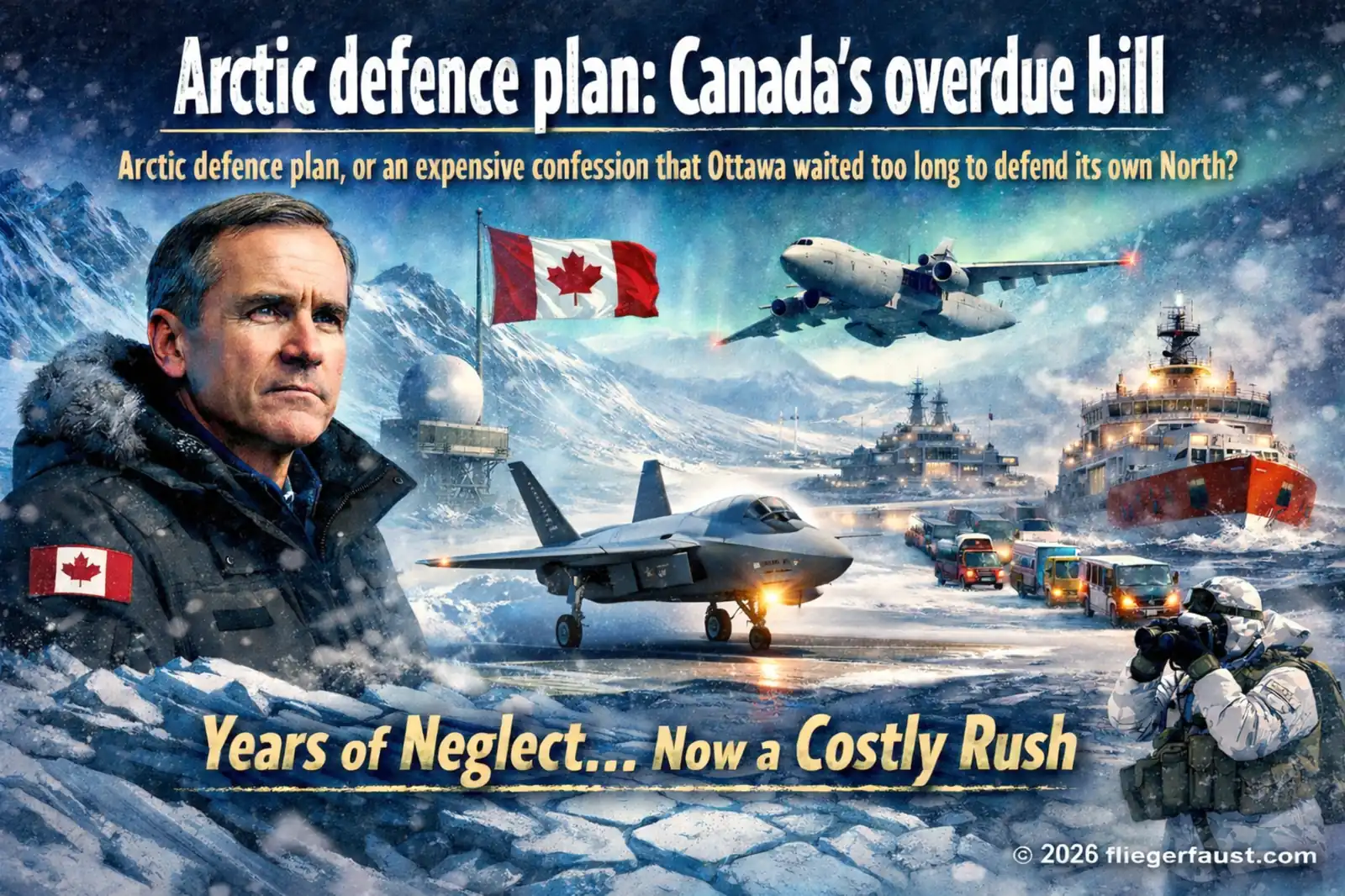
Arctic defence plan, or an expensive confession that Ottawa waited too long to defend its own North?
Arctic defence plan: On March 12, 2026, in Yellowknife, Prime Minister Mark Carney unveiled what Reuters reported on March 12, 2026 as a roughly C$35 billion package to expand northern airfields, build support hubs, and reduce Canada’s reliance on the United States in the Arctic. Moreover, the move mattered because it exposed how years of underinvestment are now being repackaged as urgent leadership. Why is Canada paying so much now for capabilities it should have built years ago?
Arctic defence plan: what Ottawa actually announced
Canada Arctic strategy moves from slogan to infrastructure
First, the package was not a symbolic fly-in and fly-out exercise. Instead, it was a list of hard assets.
As Reuters reported in Yellowknife, Ottawa plans to spend C$32 billion to expand military airfields and build four operational support hubs. Meanwhile, AP News reported on March 12, 2026 that the government also set aside C$2.7 billion for four remote operating hubs to support rapid deployment across the North.
Additionally, the project goes beyond runways and hangars. Separately, AP reported that Ottawa will support northern road and port work, including the Mackenzie Valley Highway between Yellowknife and Inuvik. Reuters added that two commercial airports will be upgraded. It also said two proposed roads to southern Canada will be accelerated.
In practice, this is as much a logistics plan as a military one. Specifically, air power in the Arctic depends on fuel, road access, storage, communications, and sustainment. Consequently, hardware without access is only theatre.
Notably, Carney framed the shift as a break with older habits. “We will no longer depend on any one nation, and instead build a stronger, more independent country.” — Mark Carney, Prime Minister of Canada, Reuters. Notably, that remark carried more weight than the spending table.
However, the thin baseline explains the urgency. Reuters reported that Canada has four rudimentary Arctic airfields, each able to host only six fighters. The same report said roughly 2,000 soldiers are spread across the region. For a country whose Arctic spans 4.4 million square kilometres of land and sea, that is not much cushion. Sovereignty, it turns out, is not a seasonal lease.
Arctic military buildup builds on earlier pledges – consolidation of earlier promises
Yet this northern build-out did not emerge from nowhere. It assembled projects Ottawa had already begun to announce over the previous year.
First, a March 18, 2025 Prime Minister of Canada backgrounder on Arctic security and sovereignty laid out a C$6 billion Arctic Over-the-Horizon Radar project with Australia. Additionally, the same backgrounder added nearly C$420 million for a greater sustained Canadian Armed Forces presence in the North.
Next, National Defence’s March 6, 2025 announcement on Northern Operational Support Hubs selected Iqaluit, Inuvik, and Yellowknife as the first hub sites. Moreover, that release put the programme’s cost at C$2.67 billion over twenty years. It said the network would support greater year-round presence through airstrips, logistics facilities, and equipment.
National Defence’s July 17, 2025 update on the Arctic Over-the-Horizon Radar project said the project is anticipated to reach initial operational capability by the end of 2029. That is not immediate. It is another reminder of how long Canada let northern capability drift before acting.
Additionally, National Defence’s February 19, 2026 release on Arctic operations said the Canadian Armed Forces (CAF) would conduct operations across the Arctic and the North throughout 2026. Specifically, the release described activity across land, maritime, air, cyber, and space domains. Consequently, the programme looks less like a sudden pivot and more like a public consolidation of earlier promises.
Northern defence plan needs year-round credibility
Even so, announcements are not yet capability. Ultimately, the true test is whether Ottawa delivers real capability instead of another round of northern theatre.
Moreover, the northern support hubs matter only if they reduce recurring logistical strain. Moreover, radar matters only if it arrives on time. Additionally, airfield upgrades matter only if they support sustained fighter, transport, and surveillance operations in severe conditions.
Meanwhile, Canada still has a personnel problem. Consequently, more bases, more hubs, and more aircraft all demand more technicians, more maintainers, and more crews. Ultimately, a runway cannot deter much if the toolbox arrives after the crisis.
Additionally, the northern dimension raises a civil question. Roads, airports, ports, and fuel systems will also shape mining, emergency response, and local community access. However, that broadens the political sales pitch, but it does not erase the cost of the delay. Instead, it means Ottawa must explain clearly how much of this plan is defence, how much is dual-use infrastructure, and how much is long-delayed nation-building. The line matters because taxpayers will be asked to fund all three.
Arctic defence plan: why was Canada relying on others?
Northern defence plan after decades of delay
The Arctic defence plan sounds decisive because the starting point was not. Notably, Ottawa itself has admitted that.
On February 17, 2026, while launching Canada’s first defence industrial strategy, Carney said: “And we have relied too heavily on our geography and other countries to protect us.” — Mark Carney, Prime Minister of Canada, Prime Minister of Canada. He followed with a harsher line. “This has created vulnerabilities we can no longer afford and dependencies we can no longer sustain.” — Mark Carney, Prime Minister of Canada, Prime Minister of Canada
Moreover, that admission fits the spending record. Budget 2025, Chapter 4 says Canada’s defence spending fell below 1 per cent of gross domestic product (GDP) in 2013. Later, a 2026 Department of National Defence note on Canada’s future fighter capability said projected defence spending would rise from 1.47 per cent of GDP in 2024-25 to 2.01 per cent in 2025-26. Notably, that is a sharp jump. Moreover, it is also evidence of how low the starting point had remained.
Furthermore, Carney’s June 9, 2025 defence speech offered a brutal readiness snapshot. “Only one of our four submarines is seaworthy. Less than half of our maritime fleet and land vehicles are operational.” — Mark Carney, Prime Minister of Canada, Prime Minister of Canada. Rather, that is not the language of a country that merely wanted fresh equipment. Instead, it is the language of a government discovering the cost of deferred maintenance.
Therefore, the answer is plain. Canada was relying on others because geography, alliance cover, and political convenience made delay easy. Meanwhile, governments liked the optics of sovereignty. They liked the bills far less.
Arctic sovereignty push under the U.S. umbrella
However, Canada’s dependence was not invented by Carney. It was embedded in a continental model that Ottawa treated as permanent.
Reuters reported on March 12, 2026 that Canada has traditionally relied on U.S. help to monitor the Arctic. That was politically convenient, fiscally easier, and strategically weak.
Allied cooperation is normal. Letting allied cover substitute for sovereign capability is not.
Yet understandable is not the same as prudent. Back in 2022, National Defence’s June 20, 2022 NORAD modernization announcement said Canada would invest C$38.6 billion over twenty years in the most significant upgrade to Canadian North American Aerospace Defense Command (NORAD) capabilities in almost four decades. Even so, the need was already obvious. Instead, the political urgency arrived later.
Meanwhile, Carney’s June 9, 2025 speech made the U.S. problem explicit. “And we are too reliant on the United States.” — Mark Carney, Prime Minister of Canada, Prime Minister of Canada. Then, he tied the problem to procurement. “We should no longer send three quarters of our defence capital spending to America.” — Mark Carney, Prime Minister of Canada, Prime Minister of Canada
The problem was not Washington. The problem was Ottawa. Canadian governments let the country remain too dependent on U.S. military protection while continuing to send large amounts of Canadian defence money to U.S. suppliers. That was not strategy. It was a long-running Canadian political choice that accepted weakness, delayed self-reliance, and deepened the dependence Ottawa now says it must reduce.
Canada let allied protection substitute for sovereign responsibility. It accepted the benefits of continental warning, under-spent for years, tolerated slow procurement, and assumed the alliance system would carry the gap. That was not sovereignty. It was prolonged free-riding. Alliances are not an unattended coat rack for national obligations.
Canada Arctic strategy was also a budgetary choice
Moreover, the weakness was not only strategic. It was fiscal and political.
Meanwhile, successive governments could defer northern spending because the Arctic rarely punished delay at election speed. Moreover, the capital costs were ugly. First, northern infrastructure is expensive in any year. Then, it becomes far more expensive after years of neglect, inflation, and supply-chain strain.
Additionally, the defence file was long treated as something Canada could underfund without immediate domestic backlash. Hospitals, housing, and inflation dominated political attention. By contrast, Arctic hangars did not. Consequently, that is a real political incentive, even if it is a poor national strategy.
Consequently, Ottawa learned the wrong lesson from allied cover. First, it assumed cooperation could substitute for national depth. Moreover, it assumed warning from others could mask the lack of local infrastructure. Finally, it assumed sovereignty could be asserted rhetorically while serviceability kept declining. Those assumptions saved money in the short term. They also made the eventual correction much larger.
Arctic defence plan: who is pushing Ottawa to spend?
Northern security plan under NATO and U.S. pressure
First, the easy answer is NATO. However, the fuller answer is NATO, Washington, the threat picture, and Ottawa’s own late realism.
On June 17, 2025, NATO’s account of Secretary General Mark Rutte’s G7 remarks quoted him welcoming Canada’s new spending posture. “The fact that you decided to bring Canada to the 2% spending when it comes to NATO this year is really fantastic.” — Mark Rutte, Secretary General, NATO. Still, diplomatic praise can sound warm. It still works as pressure.
Then the benchmark moved higher. On June 25, 2025, the Prime Minister’s June 25, 2025 release on the NATO defence investment pledge said Canada and its allies agreed to invest 5 per cent of GDP by 2035. Specifically, that package includes 3.5 per cent for core military capabilities. Additionally, it also includes 1.5 per cent for related security and resilience spending such as airports, ports, telecommunications, and emergency systems.
Additionally, the U.S. factor is harder to ignore now. Reuters and AP both tied the March 12, 2026 Arctic announcement to tensions with President Donald Trump, including tariffs, annexation talk, and his push for American control of Greenland. Consequently, dependence that once looked efficient now looks strategically embarrassing.
Consequently, Ottawa is being pushed from outside and from inside. NATO wants credible burden-sharing. Washington wants more allied spending. Russia and China sharpen the Arctic threat narrative. Yet Carney is also using defence as industrial, diplomatic, and sovereignty policy. Overall, the push is real. So is the choice.
Canada Arctic strategy meets Fliegerfaust’s procurement record
Meanwhile, that choice becomes clearer when Ottawa’s rhetoric meets its procurement history. Here, the government’s northern strategy runs straight into Fliegerfaust’s recent reporting.
The contradiction is clear in our Fliegerfaust analysis of Canada’s P-8A Poseidon sole-source deal, which examined how Ottawa’s largest recent aviation purchase bypassed a domestic competition. The same contradiction appears again in our Fliegerfaust report on Canadian surveillance aircraft being built in Texas, where Canadian defence spending strengthened foreign production despite domestic capability.
Moreover, the same tension extends under the sea. Our Fliegerfaust coverage of the TKMS-CAE submarine agreement for Canada’s patrol submarine project shows how sustainment, training, and long-term industrial participation have become central to Ottawa’s submarine competition. Moreover, that matters because sovereignty is not only about buying platforms. It is also about who maintains them, where knowledge sits, and which country captures lifetime value.
The same spending contradiction also runs through our Fliegerfaust Update #3 on the Saab-Bombardier Gripen proposal, which examined how Ottawa’s fighter debate had widened into a larger question about where Canadian defence money goes, who captures the industrial upside, and whether Canada is serious about sovereignty when major spending still strengthens foreign dependence.
Meanwhile, Ottawa is trying to repair a problem it tolerated for too long. Public Services and Procurement Canada’s October 2, 2025 backgrounder on the Defence Investment Agency said the new special operating agency will streamline high-priority procurements, cut red tape, and strengthen Canada’s defence industrial base. Then the Defence Investment Agency’s December 12, 2025 Bombardier contract announcement awarded six Canadian-built Bombardier Global 6500 aircraft for Royal Canadian Air Force (RCAF) service, with an estimated value of about C$753 million and more than 900 direct and indirect jobs.
Even so, buying Canadian after years of buying foreign is an expensive way to rediscover industrial policy. Ultimately, industrial patriotism usually becomes fashionable only after the foreign invoice lands.
Arctic military buildup also serves domestic politics
Moreover, defence spending is not only a response to threats. It is also a political instrument.
On June 9, 2025, the Prime Minister’s defence release said Ottawa would spend over C$9 billion in 2025-26 to hit NATO’s 2 per cent benchmark this year. Later, Budget 2025 proposed C$81.8 billion over five years on a cash basis to rebuild, rearm, and reinvest in the Canadian Armed Forces. Consequently, that scale gives Ottawa several messages for the price of one.
Moreover, the same spending wave lets Carney answer Trump, reassure NATO, court industrial labour, and promise Canadian aerospace firms a larger role. It also lets Ottawa present military policy as jobs policy. Overall, that is shrewd politics. Moreover, it is also a testable promise.
Meanwhile, a government under strategic pressure will naturally prefer visible projects. Arctic airfields, hubs, radars, ships, and aircraft are legible to the public. Process reform is not. However, process reform may decide whether the rest works. Politics rarely wastes a crisis. Procurement often wastes time.
Arctic defence plan: what it means for taxpayers
Northern security plan and the debt bill
The Arctic defence plan may be strategically overdue. It is still arriving in a bad fiscal neighbourhood.
According to the federal Annual Financial Report for fiscal year 2024-2025, the Canadian federal debt stood at C$1.2665 trillion on March 31, 2025. The same report said public debt charges rose by C$6.1 billion year over year (meaning the federal government paid C$6.1 billion MORE in interest to debt holders than the year before). Then Budget 2025 Annex 1 projected a 2025-26 deficit of C$78.3 billion, federal debt of C$1.347 trillion in 2025-26, and federal debt of C$1.5905 trillion by 2029-30.
Those figures cover federal debt only and do not include the separate debts carried by Canada’s provinces, territories, or municipalities.
Moreover, the same annex projected that the federal government’s annual interest payments to debt holders would rise from C$55.6 billion in 2025-26 to C$76.1 billion in 2029-30, while the total federal debt was projected to keep increasing. Those are not abstract figures. They shape how much room Ottawa has for mistakes, overruns, and procurement detours. Debt does not strengthen readiness, but it does add lasting cost.
Additionally, Budget 2025 framed military spending as economic policy as well as security policy. The budget proposed C$81.8 billion over five years, on a cash basis, to rebuild, rearm, and reinvest in the CAF. It divided that sum across personnel, sustainment and infrastructure, digital systems, capabilities, defence industry, and partnerships. That menu reads like a catalogue of accumulated neglect.
Therefore, the real taxpayer question is not whether security costs money. Of course it does. The harder question is whether Ottawa can turn borrowing into durable domestic value rather than into foreign contracts, delayed delivery, and higher interest charges. That is where this plan will either earn public legitimacy or lose it. Ultimately, taxpayers will judge the Arctic defence plan by delivery, not rhetoric.
Arctic military buildup versus fiscal capacity
The long-term numbers are starker still. On February 5, 2026, the Parliamentary Budget Officer’s report on meeting NATO’s 5 per cent commitment estimated that lifting core defence spending from 2.0 per cent of GDP in 2025 to 3.5 per cent by 2035 would require additional spending averaging about C$33.5 billion per year over the next decade. The same report projected a C$63.0 billion increase in the budgetary deficit in 2035-36 and a 6.3 percentage-point rise in the federal debt-to-GDP ratio under that scenario.
Meanwhile, Carney’s government has embraced the wider pledge. The Prime Minister’s June 25, 2025 release on the NATO defence investment pledge said Canada will invest 3.5 per cent of GDP for core military capabilities and an additional 1.5 per cent of GDP in critical defence and security-related expenditure by 2035. That opens the door to counting dual-use infrastructure inside a broader security frame. It also ensures the spending conversation will widen.
However, taxpayers should insist on two tests for every new billion.
- Does it improve real military capacity in the Arctic or elsewhere?
- Does it reduce the very dependencies Ottawa now says it can no longer tolerate?
If the answer to either question is no, then the spending is not strategic. It is compensatory.
Ultimately, the point is simple. Canada’s problem was not that it had allies. Canada’s problem was that it treated allied cover as a substitute for sustained self-respect in defence policy. This northern reset is a bill for years of strategic neglect. But it is also a public invoice for decades of political procrastination.
Canada Arctic strategy needs measurable returns
Moreover, taxpayers are not wrong to ask what they get beyond speeches, maps, and photo backdrops. Therefore, they should demand measurable return.
Moreover, military return means serviceable aircraft, usable runways, fuel storage, secure communications, trained crews, northern sustainment, and faster warning. Similarly, industrial return means Canadian workshare, Canadian maintenance, Canadian training, Canadian supply chains, and stronger control over data and support.
Additionally, Ottawa should be judged on timeliness. First, a radar that arrives late weakens deterrence. Next, a hub without year-round support remains a press release. Finally, a Canadian-built contract that still relies on foreign bottlenecks does not fully solve the dependency problem.
Finally, northern communities should see local benefit as well as federal presence. Meanwhile, roads, ports, and airfield upgrades will alter civilian access, emergency response, and regional commerce. Therefore, if the government wants taxpayers to accept a larger military bill in a high-debt era, then the state must deliver security, sovereignty, and economic utility together. Otherwise, the bill will look less like strategy and more like a penalty for earlier drift.
Conclusion: overdue sovereignty, expensive timing
The Arctic defence plan is an overdue and expensive correction to years of political drift. Canada faces a harsher Arctic, more open great-power competition, stronger NATO pressure, and a less predictable United States. None of that excuses Canada’s long habit of leaning on others to help defend its own territory. Spending more now is not leadership. It is a late and expensive correction.
Yet the criticism at the centre of this story remains justified. No serious country should need its own prime minister to confess that it relied too much on geography and other countries before rebuilding its northern defences. That is not prudent realism. Rather, it is a late admission of drift.
Moreover, the bill is arriving when federal debt is already high, interest costs are rising, and Ottawa is promising much more than faster runways. Additionally, it is promising industrial renewal, better procurement, stronger sovereignty, and credible independence from the same foreign dependencies it tolerated for years. Overall, that is a demanding promise. In short, the Arctic defence plan is only as credible as its delivery schedule.
Canada looks weak when allied cover replaces sovereign capability, lets alliances cover for domestic neglect, then asks taxpayers to finance a rapid correction at peak cost. The Arctic defence plan will remain hollow unless Ottawa delivers usable capability, stronger domestic capture, and measurable readiness instead of another decade of expensive declarations.
What do you think?
If that does not happen, what exactly will Canadians have bought besides proof that deferred sovereignty compounds interest?
Leave your answers and comments below and on our Fliegerfaust Facebook page.
Sources
- Reuters — Canada to boost Arctic defenses, says it can no longer rely on others (March 12, 2026).
- AP News — Carney announces billions for defense and infrastructure in Canada’s North (March 12, 2026).
- Prime Minister of Canada — Reinforcing Canada’s security and sovereignty in the Arctic (March 18, 2025).
- Prime Minister of Canada — Prime Minister Carney announces the launch of Canada’s first Defence Industrial Strategy (February 17, 2026).
- Prime Minister of Canada — Prime Minister Carney announces the government’s plan to rebuild, rearm, and reinvest in the Canadian Armed Forces (June 9, 2025).
- Prime Minister of Canada — Canada joins new NATO Defence Investment Pledge (June 25, 2025).
- Prime Minister of Canada — Canada’s new government is rebuilding, rearming, and reinvesting in the Canadian Armed Forces (June 9, 2025).
- Department of National Defence — Minister Blair announces First Northern Operational Support Hub locations (March 6, 2025).
- Department of National Defence — National Defence announces progress on the Arctic Over-the-Horizon Radar project (July 17, 2025).
- Department of National Defence — Enhanced Canadian Armed Forces Arctic operations reinforce sovereignty throughout 2026 (February 19, 2026).
- Department of National Defence — Minister Anand announces continental defence modernization to protect Canadians (June 20, 2022).
- Department of National Defence — House Committee on Public Accounts (PACP): Office of the Auditor General: Report 2, Delivering Canada’s Future Fighter Jet Capability, October 7, 2025 (October 7, 2025).
- NATO — NATO Secretary General attends G7 Summit, welcomes Canada’s commitment to defence spending (June 17, 2025).
- Public Services and Procurement Canada — Backgrounder: Defence Investment Agency (October 2, 2025).
- Defence Investment Agency — Government of Canada announces contract to deliver new multi-role aircraft for Royal Canadian Air Force (December 12, 2025).
- Budget 2025 — Chapter 4: Protecting Canada’s sovereignty and security (2025).
- Budget 2025 — Annex 1: Details of economic and fiscal projections (2025).
- Department of Finance Canada — Annual Financial Report of the Government of Canada Fiscal Year 2024-2025 (2025).
- Parliamentary Budget Officer — Fiscal Implications of Meeting NATO’s 5% Commitment (February 5, 2026).
For full details, please refer to our Disclaimer page.