
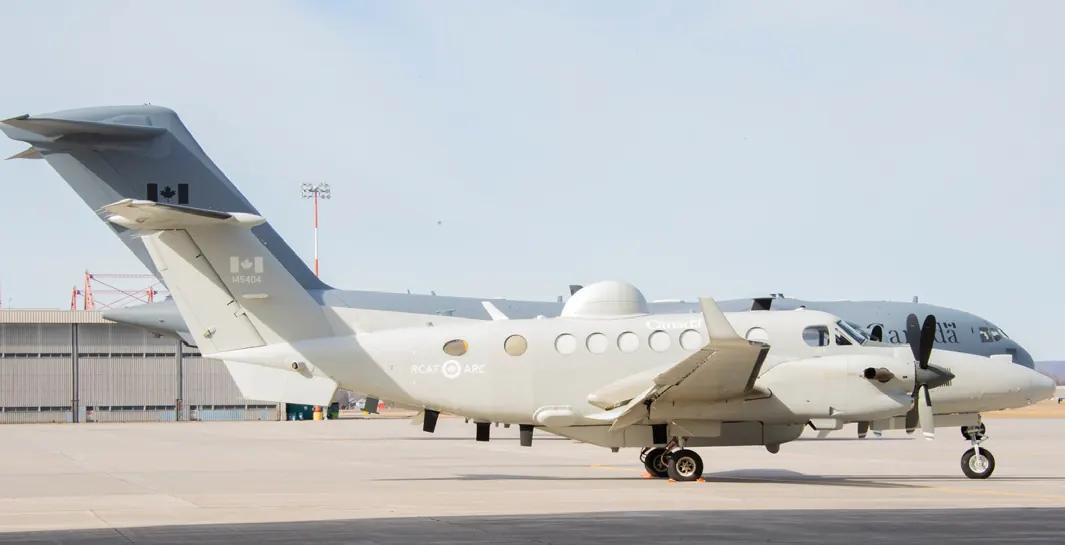
Canadian surveillance aircraft worth a quarter-billion dollars are now flying from a base in Ontario — so why were they built in Texas?
Canadian surveillance aircraft: That question sits at the heart of a growing debate over how Canada spends its defence dollars abroad. Essentially, the country’s own aerospace sector looked on from the sidelines. In 2019, Ottawa signed a Foreign Military Sales (FMS) agreement with the United States Government to acquire three intelligence, surveillance and reconnaissance (ISR) turboprops. Specifically, the contract sent CAD $247 million south of the border. L3Harris Technologies modified the Canadian surveillance aircraft at its facility in Greenville, Texas. Meanwhile, qualified Canadian companies — including L3Harris’ own 1,100-employee division in Mirabel, Quebec — never had the chance to compete for the work.
The story of the CE-145C Vigilance is more than a procurement footnote. It is a case study in a pattern that Prime Minister Mark Carney has now publicly acknowledged. As he told CBC’s Power & Politics: “Seventy-five cents of every dollar of capital spending for defence goes to the United States. That’s not smart.” — CBC Power & Politics, May 2025
For our full analysis of Canada's $10.4-billion CP-8A Poseidon sole-source procurement — including the parliamentary committee overruled in four days, Bombardier's rejected alternative later validated by the U.S. Army, and the delivery timeline that has quietly slipped by a year — see our detailed Fliegerfaust coverage: Canada P-8A Poseidon procurement — why is Ottawa's most expensive aviation purchase already falling behind schedule?
How Canadian Surveillance Aircraft Ended Up in Texas
The MAISR Programme: Origins of Canadian Airborne ISR
The Manned Airborne Intelligence, Surveillance and Reconnaissance (MAISR) project began quietly in 2013. Specifically, the Canadian Special Operations Forces Command (CANSOFCOM) needed a dedicated airborne ISR platform. Industry engagement letters went out that year. However, rather than launching a domestic competition, the Department of National Defence (DND) chose a government-to-government route.
Subsequently, Canada submitted a Letter of Request to the United States Government in April 2018. The Defence Security Cooperation Agency (DSCA) notified Congress on October 3, 2018, of a potential sale valued at up to USD $300 million. By April 26, 2019, Ottawa had signed the FMS agreement for CAD $247 million. Notably, there was no open tender. Furthermore, there was no competitive evaluation involving Canadian firms. The deal was done before most Canadians knew it existed — a stealth procurement for a stealth-adjacent aircraft, one might say.
Canadian ISR Aircraft: What Exactly Was Purchased
The aircraft themselves are Beechcraft King Air 350ER (Extended Range) turboprops. Specifically, Textron Aviation in Wichita, Kansas, built three bare airframes under a USD $37.2 million contract awarded in December 2019. Subsequently, those airframes travelled to L3Harris Integrated Mission Systems in Greenville, Texas, for a full ISR conversion (Scramble, 2024).
The Royal Canadian Air Force (RCAF) designated the finished product the CE-145C Vigilance. Notably, each aircraft carries an L3Harris WESCAM MX-15D electro-optical and infrared sensor turret. Additionally, the suite includes AN/AAR-47B missile warning systems, AN/ALE-47 countermeasure dispensers, and L3Harris VORTEX data transceivers. Importantly, the WESCAM sensors are manufactured at L3Harris’ facility in Burlington, Ontario. Therefore, a Canadian-made sensor turret flew to Texas for installation on Canadian surveillance aircraft that could have been modified domestically. The irony writes itself.
The engines powering all three aircraft come from Pratt & Whitney Canada’s PT6 Centre of Excellence in Lethbridge, Alberta — one of the few Canadian-sourced components in the programme.
Defence journalist David Pugliese reported that the aircraft also carry equipment capable of intercepting cellphone and other electronic transmissions also during missions over Canada (Alert 5, 2024). Each Vigilance flies with a crew of two pilots and one Airborne Electronic Sensor Operator (AESO).
Canadian Surveillance Aircraft Delays and Delivery Setbacks
RCAF Surveillance Planes Arrive Two Years Late
Speed was supposed to justify the FMS route. Instead, the programme ran roughly two years behind schedule. Originally, delivery estimates pointed to spring 2022. That target slipped to late 2023, which also passed without a handover. Ultimately, the U.S. Army cited COVID-19 as a contributing factor.
Finally, the first CE-145C Vigilance arrived at Canadian Forces Base (CFB) Trenton on February 23, 2024. An RCAF pilot flew it directly from Greenville. Subsequently, L3Harris completed and delivered all three Canadian surveillance aircraft by June 4, 2024. DND projected full operational capability by summer 2025. No public confirmation of that milestone has appeared.
“These deliveries represent another milestone in our commitment to helping create a safer world and more secure future” — Jason Lambert, President of ISR, L3Harris
The CE-145C Vigilance Sensor Operator Exodus
Delays in hardware were only part of the problem. Moreover, an internal Canadian Armed Forces (CAF) investigation, completed in May 2023, uncovered a deeper crisis. Specifically, four of six specialist sensor operators left the MAISR unit before the aircraft even arrived. The investigation found that operators at CFB Trenton had been left with no training programme and no direction from CANSOFCOM headquarters or 427 Special Operations Aviation Squadron.
Consequently, those who departed cited a disconnect between leadership rhetoric and reality. According to the investigation, operators pointed to what they called the hypocrisy of special forces leadership claiming people mattered more than equipment. Indeed, that sentiment had become a running joke within the unit. DND spokesperson Alex Tétreault confirmed the aircraft were expected to reach operational status by summer 2025. Nevertheless, an aircraft without trained operators is little more than an expensive turboprop with a good camera.
Why Ottawa Chose the United States Over Canadian Surveillance Aircraft Builders
Canadian ISR Aircraft and the Sole-Source Pathway
The official Canada.ca project page states the aircraft and mission equipment “were purchased through a government-to-government contractual arrangement with the United States Government.” Essentially, that single sentence masks a consequential decision. By routing the acquisition through FMS, Ottawa bypassed any obligation to hold a competitive tender open to domestic industry.
Competition was among American Firms Only
Within the American system, L3Harris won the modification contract through the U.S. Army’s Other Transaction Authority competitive process. Consequently, the competition was among American firms only. In other words, no Canadian company had the opportunity to bid on the prime contract for airframe conversion and ISR integration.
Canadian Airborne ISR and the ITB Weakness
Canada’s Industrial and Technological Benefits (ITB) policy normally requires defence contractors to invest the full value of their contract back into Canadian industry. For competitive procurements, ITB commitments directly influence who wins. However, for FMS purchases, the government must negotiate industrial benefits after the fact. Consequently, this distinction matters enormously.
Moreover, the Auditor General of Canada found in December 2024 that in 10 out of 60 defence procurements over $100 million, the ITB policy was either not applied or the economic return fell below the 100 per cent target (Office of the Auditor General, 2024). Clearly, FMS deals present the weakest negotiating position of all. When you have already signed the cheque, asking nicely for change becomes rather difficult.
Specifically, the MAISR programme’s own numbers illustrate the gap. According to government figures, the CAD $247 million investment generates roughly $7.5 million in annual gross domestic product (GDP) contribution. Additionally, it sustains approximately 65 Canadian jobs. Compare that to the potential of performing Canadian surveillance aircraft modification work domestically.
Canadian Firms That Could Have Built the Surveillance Aircraft
PAL Aerospace: Canada’s ISR Aircraft Specialists
PAL Aerospace, headquartered in St. John’s, Newfoundland, stands out as the most directly qualified domestic alternative. Notably, a subsidiary of Exchange Income Corporation, PAL has accumulated over 200,000 flight hours in special mission operations across four decades. Since 1990, the company has operated maritime surveillance aircraft for the federal government.
Currently, PAL flies a fleet of King Air 200s and Dash 8-100s equipped with ISR sensor suites under a $128 million contract with Fisheries and Oceans Canada. Essentially, the company designs, modifies, maintains, and operates custom sensor-equipped aircraft. Moreover, PAL developed the Force Multiplier — a Dash 8 ISR demonstrator backed by $5 million in federal research funding. In short, a Canadian company already converts King Airs into surveillance platforms for the same government that sent the MAISR work to Texas.
L3Harris MAS Mirabel: Canadian ISR Aircraft Expertise Ignored
Perhaps the sharpest irony in the entire MAISR programme involves L3Harris’ own Canadian operations. Specifically, L3Harris Maintenance, Repair and Overhaul (MAS) in Mirabel, Quebec, employs more than 1,100 people across 13 operating sites. Furthermore, the division includes over 300 engineers and 250 specialized personnel embedded within RCAF squadrons at 10 operational bases (L3Harris, 2024).
Notably, L3Harris MAS serves as Canada’s only fighter aircraft depot. It has maintained CF-188 Hornets for over 35 years. Additionally, the division provides in-service support for the CC-150 Polaris, CC-330 Husky, CH-148 Cyclone, CP-140 Aurora, and CH-147F Chinook. In November 2024, Ottawa selected L3Harris MAS as the strategic partner for the future CF-35A airframe maintenance depot. Importantly, their stated capabilities include aircraft missionization — the exact work sent to Greenville, Texas.
IMP Aerospace, De Havilland, and Other Domestic Contenders
The list of capable Canadian firms extends well beyond PAL and L3Harris MAS. For instance, IMP Aerospace and Defence in Halifax, Nova Scotia, operates Canada’s largest military maintenance, repair, and overhaul (MRO) facility. With more than 2,400 staff and over 500,000 square feet of hangar space, IMP serves as the prime contractor for CP-140 Aurora fleet maintenance. It also holds Lockheed Martin authorization as a P-3 Orion Service Centre.
Similarly, De Havilland Canada and PAL Aerospace announced a joint venture to develop the Dash 8 P-4 Maritime Patrol Aircraft — a special mission variant designed for ISR roles. Separately, Voyageur Aviation in North Bay, Ontario, actually won the MAISR in-service support (ISS) contract as part of Team CERTAS. Specifically, Voyageur specializes in special mission aircraft modifications. If a Canadian firm was trusted to maintain and support the CE-145C Vigilance fleet, the question of why one was not trusted to build these Canadian surveillance aircraft becomes even harder to answer. And here we did not mention Bombardier Defense.
Canadian Surveillance Aircraft and the Broader FMS Dependency
The P-8A Poseidon: Canada Military Surveillance Goes Boeing
The MAISR programme is not an isolated case. Rather, it fits within a broader pattern of Canadian military aviation procurement flowing to American manufacturers through sole-source FMS deals. The largest example arrived on November 30, 2023. On that date, Defence Minister Bill Blair announced Canada would purchase up to 16 Boeing P-8A Poseidon maritime patrol aircraft through FMS at US $5.9 billion (Canada.ca, 2023).
Read our recent coverage: Canada P-8A Poseidon: A $10.4 Billion Gamble on U.S. Industry
Liberals let go CAD $2.8 billion in GDP and 22,650 full-time jobs
Consequently, Bombardier CEO Éric Martel publicly called the decision short-sighted. He argued Boeing had an unfair advantage in the Canadian Multi-Mission Aircraft (CMMA) tender. Furthermore, a PricewaterhouseCoopers study found that a Bombardier Global 6500-based alternative would have generated CAD $2.8 billion in GDP. It also would have created 22,650 full-time equivalent jobs (Skies Magazine). Even Ontario Premier Doug Ford and Quebec Premier François Legault issued a joint statement calling for open competition. Regardless, Ottawa proceeded with Boeing three weeks later.
Meanwhile, the Bombardier Global 6500 has become the world’s premier special-mission airframe. France, Sweden, the United Arab Emirates, South Korea, and Germany all selected Global 6500 variants for airborne early warning or signals intelligence missions. Even the U.S. Army chose it for the HADES ISR programme. Essentially, Canada builds the world’s most sought-after surveillance platform — and then buys its own Canadian surveillance aircraft from someone else.
The F-35, MQ-9B, and the Pipeline to American Factories
The pattern extends further still. Additionally, Canada committed to purchasing 88 F-35A Lightning II fighters through FMS at an estimated CAD $27.7 billion. Those aircraft are assembled at Lockheed Martin’s plant in Fort Worth, Texas. Similarly, Ottawa signed a CAD $2.49 billion deal in December 2023 for 11 General Atomics MQ-9B SkyGuardian remotely piloted aircraft systems (RPAS). Assembly takes place in San Diego, California.
Even the CC-295 Kingfisher fixed-wing search and rescue (FWSAR) fleet — 16 aircraft at CAD $2.9 billion — was built in Seville, Spain, by Airbus. That programme suffered severe delays. Specifically, IOC slipped from 2022 to 2025–2026.Ironically, officials cited those delays as justification for sole-sourcing the CP-8A. Failure in one offshore procurement became the excuse for another.
The FWSAR competition also sidelined a Canadian alternative. Bombardier proposed a Q400 variant for the role, but the aircraft lacked a rear loading ramp — a stated requirement. Bombardier sought government support to develop one, which would have opened the Q400 to the global multi-mission market. Ottawa declined. The rear ramp requirement effectively eliminated the only Canadian-built candidate, and Bombardier withdrew from the process. Spain / Airbus built the aircraft instead.
Over CAD $40 billion in Canadian Defence Spending
Taken together, the MAISR, CMMA, Future Fighter, RPAS, and FWSAR programmes represent well over CAD $40 billion in defence spending. Virtually all manufacturing work occurs outside Canada. That is a staggering sum to send abroad for a nation with the world’s sixth-largest aerospace sector.
Canadian Surveillance Aircraft and the New Defence Industrial Strategy
Build, Partner, Buy: A New Path for Canadian Airborne ISR
On February 17, 2026, Prime Minister Carney launched Canada’s first Defence Industrial Strategy (DIS). Essentially, the document establishes a Build–Partner–Buy framework. It sets a target of awarding 70 per cent of defence acquisitions to Canadian firms within a decade. That represents a significant increase from roughly 43 per cent currently. Moreover, the strategy states that the government will focus first on building in Canada, particularly in areas of sovereign capability (Canada.ca, 2026).
Furthermore, Ottawa pledged that when it partners with allies or buys off the shelf, it will ensure investment flows back into domestic industry. The DIS arrived alongside a broader defence spending increase. Specifically, Canada’s defence policy update, Our North, Strong and Free, released on April 8, 2024, built on a June 2022 commitment of $38.6 billion over 20 years to North American Aerospace Defence Command (NORAD) modernization (Canadian Defence Review, 2024).
Moreover, at the June 2025 NATO summit in The Hague, allies committed to spending five per cent of GDP on defence and security by 2035 — a target driven largely by pressure from President Donald Trump. Canada, which spent roughly 1.37 per cent of GDP on defence at the time, now faces an obligation to more than triple that figure. The spending increase is no longer optional. It is an alliance commitment.
The strategy sounds ambitious. Yetit arrived after the CE-145C Vigilance aircraft were already built, delivered, and stationed at CFB Trenton. Similarly, the policy came after the CP-8A Poseidon contract was signed. It arrived after the F-35 deal was committed and the MQ-9B order placed. On the matter of Canadian airborne ISR, the barn door opened long before the lock arrived.
Unions and Industry Push for Canadian Surveillance Aircraft Work
Organized labour has been among the most vocal critics of Canada’s FMS dependency. Notably, Unifor, representing 320,000 members including 11,000 aerospace workers, has issued repeated calls for domestic procurement. Specifically, National President Lana Payne warned in January 2023 that sole-sourcing without considering Canadian workers and technology would be a grave mistake (Unifor, 2023).
Subsequently, Unifor’s Aerospace Council released a policy paper in September 2024 titled Building for the Next Generation. The document described Canadian procurement policy as a massive and glaring weakness. Moreover, it noted the government is poised to spend no less than $75 billion on defence and space projects in the coming decade.
Similarly, the Aerospace Industries Association of Canada (AIAC), representing over 700 companies and 225,000 workers contributing CAD $34 billion in GDP, has echoed the call for change. Specifically, AIAC President and CEO Mike Mueller told the Standing Committee on National Defence that the bidding process was complex and time-consuming for Canadian companies. He urged the new Defence Investment Agency to prioritize Canadian solutions as a first buyer when possible.
Even amid trade tensions with the United States, Payne offered a characteristically blunt assessment. She noted that history offers many examples of Washington weakening Canadian aerospace manufacturing. Her list stretched from the Avro Arrow to the Bombardier CSeries. In this context, sending Canadian surveillance aircraft modification work to Texas appears less like pragmatic procurement and more like habit.
Analyst Perspectives on Canada’s ISR Aircraft Policy
However, not everyone views the Defence Industrial Strategy as a cure-all. Notably, Wendy Gilmour, former North Atlantic Treaty Organization (NATO) assistant secretary general for defence investment, cautioned that the DIS focuses more on industrial and economic goals. It pays less attention to identifying the military capabilities Canada actually needs (CBC News, 2026).
Moreover, defence analyst Philippe Lagassé offered a pointed observation. He predicted the buy-Canadian policy will likely operate as buy-Canadian-ish. Essentially, international firms with a large Canadian presence will be maple-washed to simplify the acquisition of American and European capabilities. If that prediction proves accurate, the DIS may change the branding of offshore procurement without changing the substance.
Conclusion: Canadian Surveillance Aircraft Deserve a Domestic Future
The CE-145C Vigilance programme tells a story that extends far beyond three turboprops in Trenton. Fundamentally, it reveals a procurement culture that reflexively turned to the United States for work Canadian firms could perform. Specifically, PAL Aerospace has converted King Airs into surveillance platforms for decades. Similarly, L3Harris MAS in Mirabel employs over 1,100 people doing military aircraft modification and missionization. Likewise, IMP Aerospace maintains the CP-140 Aurora fleet. Additionally, Voyageur Aviation won the Vigilance in-service support contract. Yet none of these companies received an invitation to bid on the prime contract.
The numbers underscore the missed opportunity. A CAD $247 million investment that generates just 65 annual Canadian jobs and $7.5 million in yearly GDP falls dramatically short. Compare that to the PricewaterhouseCoopers estimate for the CP-8A alternative: CAD $2.8 billion in GDP and 22,650 jobs. Obviously, scale matters. However, so does principle. Even a smaller programme like MAISR sends a signal about whether Ottawa values its own aerospace workforce.
What the CE-145C Vigilance Means for Future Canadian ISR Aircraft
Moreover, the programme’s operational shortcomings weaken the argument for offshoring. The Canadian surveillance aircraft arrived two years late. Furthermore, four of six sensor operators departed before the first Vigilance touched Canadian soil. The FMS route was supposed to deliver speed and certainty for these Canadian surveillance aircraft. It delivered neither.
Canada’s new Defence Industrial Strategy promises a different future. Notably, the Build–Partner–Buy framework and the 70 per cent domestic target represent a genuine shift in rhetoric. Nonetheless, rhetoric must translate into contract awards. The next generation of Canadian airborne ISR platforms will test whether Ottawa has truly changed course. Those decisions — for CANSOFCOM, NORAD, or airborne early warning — will prove whether the DIS has teeth.
Brigadier-General Richard Schmidt captured the operational stakes at the March 2024 delivery ceremony. He stated that the Vigilance provides capabilities that radically improve the CAF’s ability to understand operational environments (Canada.ca, 2024). Fair enough. Understanding one’s environment is indeed critical. Yet perhaps the environment that most needs understanding is the one inside Ottawa’s own procurement offices.
If Canada possesses the aerospace talent to maintain, modify, and operate the world’s most advanced military aircraft — and it does — then why does it keep sending the build work elsewhere? That is a question worth answering before the next generation of Canadian surveillance aircraft crosses the border.
Leave your answers and comments below and on our Fliegerfaust Facebook page.
Sources
- Canada.ca — Manned Airborne Intelligence, Surveillance and Reconnaissance (2024).
- DSCA — Canada — King Air 350ER ISR Aircraft (Manned Airborne) (October 3, 2018).
- L3Harris — L3Harris Delivers Enhanced Airborne ISR Capability to Canada (June 7, 2024).
- U.S. Army — U.S. Delivers First of Three ISR Aircraft to Canadian Government (2024).
- Scramble — Canada’s New CE-145C Vigilance (February 25, 2024).
- Alert 5 — Exodus from Canada’s Spy Plane Unit (December 10, 2024).
- Canada.ca — Minister Blair Announces $850 Million Investment in CFB Trenton (March 8, 2024).
- Office of the Auditor General — Report 10 — Industrial and Technological Benefits (December 2024).
- PAL Aerospace — PAL Aerospace Awarded Aerial Surveillance Contract (2019).
- L3Harris — Proudly Maintaining Canada’s Fighter Aircraft Fleet for Over 35 Years (March 2024).
- Canada.ca — Canada Purchasing Up to 16 P-8A Poseidon Aircraft (November 30, 2023).
- Skies Magazine — Bombardier’s CMMA Offering Would Contribute $2.8B in GDP (2023).
- Canada.ca — Canada’s Defence Industrial Strategy (February 17, 2026).
- Canadian Defence Review — Our North, Strong and Free: Defence Policy Update Promises More Money (2024).
- Unifor — Letter to Ministers Anand and Champagne re: Multi-Mission Aircraft (January 19, 2023).
- CBC News — Canada Bets on ‘Build at Home’ Defence Strategy (2026).
- PM.gc.ca — Prime Minister Carney Launches Canada’s First Defence Industrial Strategy (February 17, 2026).
For full details, please refer to our Disclaimer page.