

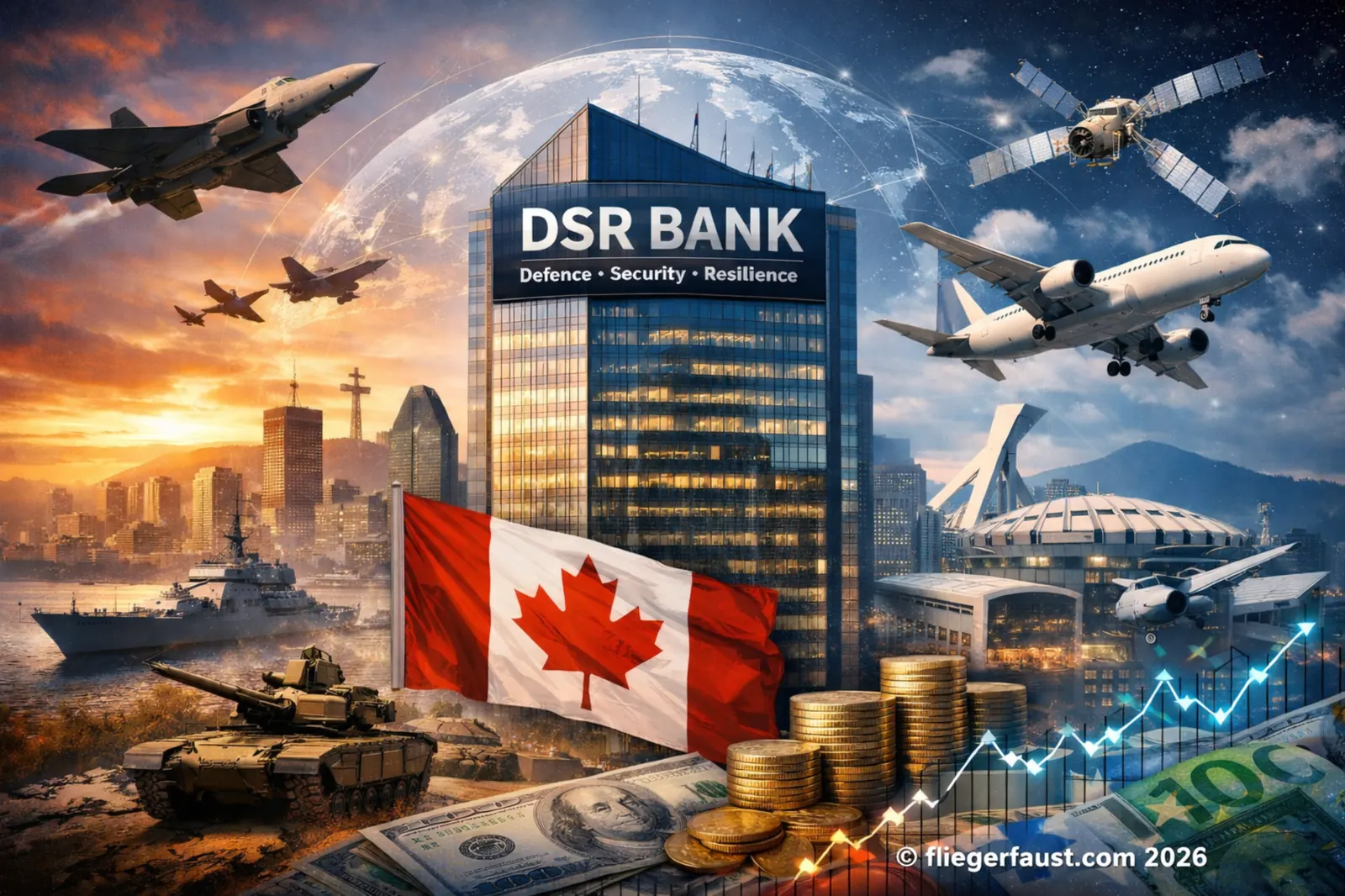
DSR Bank Montreal: can Montréal really win the headquarters race for a proposed Defence, Security and Resilience Bank (DSR Bank) aimed at funding allied rearmament? Moreover, if the bank does land in Canada, will aerospace suppliers feel the impact first—or last?
On February 2, 2026, La Presse reported that Montréal was courting a new multinational defence lender. The next day, Montréal International and the City of Montréal published a formal pitch, pushing the city as a headquarters candidate and leaning hard on its aerospace and international‑organisation credentials.
Meanwhile, Ottawa signalled that the proposal has moved past cocktail‑napkin territory. On January 30, 2026, Canada said it would work with partners on the project after talks with “more than 10 nations,” according to Reuters. Notably, the same Reuters report said backers want a triple‑A rated, state‑backed bank capable of raising about US$135 billion for defence projects.
So what is this bank, really? Additionally, why is Montréal—an aerospace powerhouse with a long international‑organisation résumé—pushing so hard to host it? Finally, how should Canada’s aerospace and defence industry read a proposal that mixes bond markets with battlefield readiness?
Notably, DSR Bank Montreal has become a short label for a much bigger debate: how allies pay for deterrence.
DSR Bank Montreal: from a French scoop to a formal February pitch
Defence, Security and Resilience Bank: what is being proposed, in plain language
At its core, the Defence, Security and Resilience Bank is pitched as a multilateral lending institution built specifically for defence, security, and resilience investment. Instead of relying only on annual budgets, the bank would raise capital in markets and channel it into approved projects over long terms.
Consequently, supporters describe the model as a way to translate political commitments into predictable financing. In its Frequently Asked Questions document, the DSR Bank team calls it a “proposed multilateral lending institution,”owned by sovereign states, designed to provide “long-term, affordable capital” for defence and resilience.
Moreover, the bank’s advocates argue that cost of capital has become a strategic constraint. Many allied governments can borrow, but they borrow at very different rates. Therefore, a pooled, triple‑A structure could reduce financing costs for countries with weaker sovereign credit, while keeping repayment obligations tied to projects.
Still, this is not a finished institution. The same FAQ describes the Defence, Security and Resilience Bank Development Group (DSRB Development Group) as a temporary, not‑for‑profit entity with “no decision-making authority” that will dissolve once a chartered bank exists. In other words, today’s announcements are about design choices, not loan approvals.
For now, DSR Bank Montreal remains a proposal, not a charter.
And yes, the concept has a certain brutal elegance. In defence, ammunition stockpiles matter. However, in peacetime, the scarcest munitions are often financing and time.
DSR Bank headquarters: why Montréal moved quickly on February 3, 2026
Montréal’s bid is as much about institutional readiness as it is about civic pride. In its February 3, 2026 statement, Montréal International said hosting the DSR Bank would put the city “at the heart of international collaboration” on defence financing, while generating thousands of jobs.
Additionally, local leaders used unusually direct language for an economic‑development announcement.
With a track record like ours, the choice is clear … Montréal is the city of choice to host the Defence and Security Bank.” — Soraya Martinez Ferrada, Mayor of Montréal, Montréal International
Similarly, Québec’s international relations minister promised full provincial support.
“Québec stands ready to mobilize all its resources to make the DSR Bank a lasting success.” — Christopher Skeete, Minister of International Relations and La Francophonie, Montréal International
Notably, Montréal International backed those quotes with a detailed pitch deck aimed at risk‑averse decision makers. The January 2026 document highlights direct flights to 150+ destinations, 140,000+ finance professionals, and a “bank‑ready ecosystem” for bond issuance and risk‑sharing from day one (Montréal pitch deck).
Moreover, the deck leans into Montréal’s international footprint. It describes the city as Canada’s “United Nations city” and points to the North Atlantic Treaty Organization (NATO) Climate Change & Security Centre of Excellence located in Montréal as part of a resilience‑focused narrative (Montréal pitch deck).
That is a clever framing. It also signals the bid’s real audience: not only Canada’s federal cabinet, but also allied capitals that want credibility, neutrality, and speed. If Montréal can sell “execution risk” down to a minimum, the city’s aviation pedigree becomes more than a talking point.
DSR Bank Montreal: what the bank would finance beyond the obvious
Multinational defence bank scope: munitions, drones, and industrial capacity
Defence is the headline, but capacity is the subtext. The DSR Bank proposal is rooted in a simple observation: wars burn through stockpiles faster than factories can replace them.
Consequently, the bank’s documents talk as much about production lines as they do about platforms. The DSR Bank FAQ lists defence industrial capacity projects including “munitions, drones, maritime autonomy,” plus supply‑chain financing for firms from prime contractors down to specialised suppliers.
Moreover, that list maps directly to aerospace realities. Drones are aircraft, even when we argue about definitions. Similarly, modern munitions output depends on secure electronics and propulsion components that overlap with aerospace manufacturing.
Notably, Scotiabank’s February 2, 2026 announcement describes the proposed institution as a tool to help NATO members and allies “deliver a substantial increase in defence, security and resilience investment” over the next decade (Scotiabank). In that framing, the bank is meant to be a scaling mechanism, not a niche initiative.
There is also an industrial‑policy edge hiding in the fine print. The FAQ suggests the bank could provide guarantees that crowd in private capital, especially where commercial lenders face concentration limits. In practical terms, the bank is trying to make “build more” financially possible, not merely politically popular.
If this sounds like a factory story, that is because it is. However, in 2026, the factory story is also an airpower story.
Defence, Security and Resilience Bank: the “boring” projects that decide readiness
The word “resilience” can feel vague. Yet, it often describes the systems that keep aircraft flying when things go wrong.
For example, the DSR Bank FAQ explicitly lists resilience projects such as “military mobility, energy, cyber, logistics” (DSR Bank FAQ). Those are not glamour programmes. However, they are the difference between a deployment that happens and a deployment that stalls on a spreadsheet.
Moreover, Montréal’s pitch deck ties resilience to institutional expertise. It claims the NATO Climate Change & Security Centre of Excellence in Montréal provides strategic risk analysis to guide resilience and infrastructure investment (Montréal pitch deck).
From an aerospace standpoint, “resilience” can mean hardened airbases, secure fuel infrastructure, or redundant satellite links. Additionally, it can mean cyber protection for maintenance networks and flight‑line logistics systems. Those are the kinds of projects that rarely win parades, yet they quietly determine sortie rates.
There is also a reputational dimension. Many investors have been uneasy about defence exposure under environmental, social and governance screens. Consequently, the bank’s resilience narrative may be a way to keep access to capital markets wide, even while funding core military needs.
In defence, “boring” is often a compliment. It means the system works. Moreover, working systems keep crews alive.
Global defence bank services: loans, guarantees, and procurement support
The bank’s services are not limited to classic sovereign loans. Instead, the project blends lending with risk‑sharing tools meant to unlock private finance.
According to Scotiabank’s February 2, 2026 release, the proposed bank would offer “procurement support” and mobilise private capital through “credit guarantee programs” (Scotiabank). That language matters because it implies the bank wants to shape how projects get financed, not only whether they get financed.
Similarly, the DSR Bank FAQ argues that guarantees can help commercial banks lend more to defence firms under Basel IV rules, because risk‑sharing reduces the capital they must hold against exposures (DSR Bank FAQ). In other words, the bank is trying to alter the “risk weight” equation that sits behind industrial credit.
Notably, the FAQ also raises the possibility of direct lending to accredited companies, not only to governments. That would be a notable shift compared with many multilateral lenders, and it would put the bank closer to supply‑chain finance than to classic development lending.
In this story, the loudest weapons are spreadsheets.
DSR Bank Montreal: how the proposed financing model is supposed to work
Allied defence financing: paid-in capital, callable capital, and bond issuance
The proposed mechanics follow a familiar multilateral template. Member nations supply capital. Then, the bank issues bonds backed by that capital and by sovereign support. Finally, the bank lends the proceeds on long terms.
Importantly, the DSR Bank FAQ explains two key components: paid‑in capital and callable capital. Paid‑in capital is the upfront cash contribution. Callable capital is a contingent guarantee that supports a top credit rating and is “almost never called” in multilateral banking history (DSR Bank FAQ).
Moreover, the FAQ says this structure could allow the bank to multiply each dollar of sovereign capital into “$5–8 of financing.” That is leverage in a conservative, ratings‑agency friendly form, assuming strict risk controls.
Consequently, the triple‑A goal is not marketing fluff. It is the core enabler. If the bank can borrow cheaply, it can offer long‑term money at rates some member states cannot achieve alone. That logic is exactly what Reuters described on January 30, 2026, when it wrote that backers want a state‑backed, triple‑A institution able to raise about US$135 billion for defence projects (Reuters).
Still, “cheap money” does not mean “free money.” Borrowers must repay. Moreover, bad projects still lose money, even when the interest rate looks friendly. A triple‑A label lowers cost of funds, not cost of mistakes.
For aviation readers, the analogy is simple. A strong credit rating is like a reliable engine. However, it cannot save a bad flight plan.
Allied defence financing: Basel IV and guarantees for commercial lenders
A major reason for the DSR Bank idea is the changing regulatory environment for commercial lenders. Under Basel banking rules, banks must hold capital against risk, and concentrated exposures can become expensive.
Notably, the DSR Bank FAQ says Basel IV makes it harder for commercial banks to carry large defence exposures, and that the DSR Bank could ease the pressure through guarantees and risk‑sharing (DSR Bank FAQ). It also states that many jurisdictions phase Basel IV in from 2025 through 2030.
Consequently, the guarantee feature is central for suppliers. A prime contractor may have access to capital markets. However, a tier‑two manufacturer often lives on bank credit and short-term facilities. When interest rates rise and risk rules tighten, those firms feel it first.
Moreover, the DSR Bank proposal is designed to “crowd in” private lenders rather than replace them. Scotiabank’s release frames the bank as a way to improve access to affordable financing “across defence and security ecosystems” (Scotiabank). That is another way of saying: the bank wants commercial lenders beside it, not behind it.
Basel rules rarely make headlines. However, they can still constrain production finance.
Multinational defence bank rules: direct lending and procurement
One of the proposal’s most consequential choices is who can borrow. Many multilateral institutions lend mainly to sovereign borrowers. The DSR Bank proposal leaves room for a wider net.
Specifically, the DSR Bank FAQ contrasts the bank with the European Union’s Security Action for Europe programme. It says SAFE lends to governments, while the DSR Bank model “could” lend directly to accredited companies across the defence supply chain (DSR Bank FAQ).
That idea has clear benefits. It could accelerate financing for suppliers that already hold government contracts. It could also reduce the “budget timing” mismatch that slows industrial expansion.
However, direct lending creates political risk. Who accredits a company? How is political favouritism prevented? Moreover, how can bank finance be aligned with export controls and end‑use restrictions across multiple jurisdictions?
The FAQ proposes guardrails. It says procurement rules would limit eligibility to firms incorporated in member nations and require transparent, competitive processes, with defined exemptions (DSR Bank FAQ). Still, the credibility test will arrive when the first controversial project shows up at the door.
In defence, “fast” is a dangerous word. Consequently, the bank will need rules that keep pace without cutting corners.
DSR Bank Montreal: ownership, partners, and the politics of credibility
Defence, Security and Resilience Bank ownership: sovereign shareholders only
The proposal’s ownership structure is designed to reassure markets and member states. In short, sovereigns own the institution, and they set the mandate through a charter.
Notably, Scotiabank’s February 2, 2026 release made the ownership model explicit.
“The Defence, Security and Resilience Bank will be owned entirely by participating nations.” — Kevin Reed, President and Chief Operating Officer, DSRB Development Group, via Scotiabank
Moreover, the DSR Bank FAQ outlines how capital contributions could be structured: 20% paid‑in and 80% callable (DSR Bank FAQ). That split mirrors long-standing multilateral banking practice, where callable capital provides the backstop that ratings agencies care about.
There is also a political claim buried in the same document. The FAQ argues that, for NATO nations, paid‑in and callable contributions “should” count toward emerging defence spending targets, because they mobilise far greater capital through leverage (DSR Bank FAQ). That is not a NATO rule today. However, it signals how proponents intend to defend the bank during budget fights.
This is the credibility hinge. A triple‑A rating depends on governance and risk discipline. Consequently, the bank’s charter will matter as much as its capital.
In governance terms, ownership defines who absorbs risk and who sets lending discipline.
Global defence bank partners: why private lenders are joining early
Although sovereigns would own the bank, private lenders are already shaping the proposal. That is not surprising. A bond‑issuing institution needs market expertise, distribution capability, and credibility.
For example, Scotiabank and CIBC both announced their involvement as partner banks on February 2, 2026 (Scotiabank; CIBC). Additionally, trade coverage in 2025 pointed to support from lenders including Scotiabank, ING, Deutsche Bank and JPMorgan (GT Review).
Notably, CIBC described the moment as an architectural shift in defence finance.
“CIBC’s participation reinforces the growing momentum behind a new financial architecture for defence and security.” — Kevin Reed, President and COO, DSRB Development Group, CIBC
Still, banks do not sign up for slogans alone. They sign up for deal flow and risk clarity. Consequently, the partner‑bank announcements should be read as bets on a future market in defence‑linked bonds, guarantees, and co‑financings.
Defence modernisation once came with marching bands. Now it comes with syndicated loans and compliance binders.
Allied defence financing in Canada: the federal signal and Montréal’s pitch
Canada’s interest is now on the record. Reuters reported on January 30, 2026 that Canada would work with partners on the project, with the finance minister pointing to upcoming work “to lead Canada’s contribution” (Reuters).
Meanwhile, Montréal’s pitch stresses speed and risk reduction. Its deck promises rapid ramp‑up through secondees, preferential services, and support from law and accounting firms (Montréal pitch deck). Notably, it also claims the city matches Toronto in connectivity and governance simplicity, while offering stronger multilateral networks.
That is a bold line. Yet the competition is real, and Canada may eventually need to nominate a single city if allies favour a Canadian host. Consequently, the federal government will have to weigh capital markets, diplomacy, bilingual capacity, and domestic politics.
For aerospace suppliers and defence firms, the location question matters because it shapes proximity to decision makers and to the supplier base. However, the real impact will come from the bank’s rules, not its postal code.
Headquarters race across Canada: Toronto, Ottawa, and Montréal’s counter-argument
In short, DSR Bank Montreal is driving an unusually public contest between Canadian cities.
DSR Bank headquarters bid: Toronto’s “Canada’s choice” case
Toronto’s case is straightforward: a bond‑issuing institution belongs beside a deep capital market. In a December 2025 bid package, Ontario called Toronto “Canada’s clear choice” to host the institution (Ontario bid document).
Moreover, the document leans on scale. It highlights financial headquarters, institutional investors, and Toronto Pearson International Airport as proof of global connectivity. It also frames English‑language business operations as an efficiency advantage.
Notably, Ontario’s premier tied the bid to a broader narrative of global instability.
“Toronto, Ontario and Canada have everything the Defence, Security and Resilience Bank needs to succeed.” — Doug Ford, Premier of Ontario, Ontario bid document
Still, Toronto’s scale cuts both ways. A multilateral institution must also look neutral and internationally oriented, not merely commercial. Consequently, the strongest Toronto argument may be operational capacity, not symbolism.
There is a small irony here. Toronto wants the defence bank because it is global. However, it also wants it because it is very local.
DSR Bank headquarters bid: Ottawa-Gatineau’s diplomacy argument
Ottawa‑Gatineau is pitching a different asset: proximity to government and diplomacy. It has embassies, federal decision makers, and a national security ecosystem within a tight radius.
For example, Invest Ottawa said in late 2025 that it was rallying leaders across finance, tech, defence and government to secure the headquarters in the region (Invest Ottawa). That pitch implicitly argues that a defence bank is more like the World Bank than like a retail bank.
Moreover, Ottawa’s argument plays well with alliance politics. Defence finance is intertwined with foreign policy. Consequently, physical proximity to federal institutions can be framed as a security feature.
Yet, Ottawa still faces the bond‑market question. Investors and partner banks will expect a city that can recruit specialised capital‑markets talent. Therefore, Ottawa would need to prove it can build a markets-facing team at scale, or that it can run a hybrid model.
Ottawa Macdonald–Cartier International Airport may not match Toronto Pearson International Airport or Montréal–Trudeau International Airport for direct flights. However, diplomacy values proximity to decision makers more than flight frequency.
DSR Bank headquarters bid: Montréal’s aerospace and multilateral rebuttal
Montréal’s response is to combine the Toronto and Ottawa stories into one. It argues it can deliver capital‑markets function, international credibility, and defence‑industry proximity in a single ecosystem.
Notably, its pitch deck highlights 68 international organisations, a strong United Nations presence, and the city’s long relationship with modern civil aviation institutions (Montréal pitch deck). It also claims Montréal can build an aircraft “end to end,” framing aerospace depth as a differentiator (Montréal International).
Moreover, the deck points to a deep pool of multilingual talent and a relatively competitive cost base. Those are operational arguments, not only marketing lines. Consequently, Montréal is selling itself as the lowest‑friction launch platform.
This contest is friendly on the surface. However, it is a real political contest underneath. If the bank happens, somebody wins a flagship institution, and somebody does not.
Aerospace and defence industry implications: why this story belongs on an aviation site
Defence financing bank effect: production tempo and supplier resilience
Aviation programmes live on long lead times and complex certification. Consequently, financing stability can matter as much as engineering brilliance.
If the DSR Bank model works as advertised, it could reduce “boom‑bust” effects by smoothing multi‑year demand and stabilising supplier financing, according to the DSR Bank FAQ. For aerospace, that could mean fewer whiplash cycles between emergency surge and painful layoffs.
Moreover, Montréal’s pitch deck claims Québec-based firms received 46% of federal aerospace and defence contract awards from 2015 to 2021, and that the province holds large shares of national aerospace exports and jobs (Montréal pitch deck). Even if those figures are framed for advocacy, the underlying point is relevant: the Québec supplier base is a national asset.
For a local lens, Fliegerfaust has already tracked defence‑adjacent programmes that sit squarely in this financing conversation. For example, see the site’s reporting on Bombardier Defence’s platform strategy and on the Mirabel drone‑hub push.
Engineers talk about thrust‑to‑weight ratios. However, suppliers often live and die by cash‑to‑burn ratios.
Consequently, for suppliers watching capital costs, DSR Bank Montreal is not a Montréal-only story.
Defence, Security and Resilience Bank: ISR and dual-use aviation impacts
The DSR Bank documents repeatedly mention drones, cyber, space, and advanced manufacturing. Those categories sit directly beside modern aviation programmes.
For example, intelligence, surveillance and reconnaissance (ISR) aircraft often combine airframes with sensors, secure networks, and long sustainment contracts. Consequently, they fit naturally inside a mandate that includes defence capability and resilient infrastructure.
Moreover, the DSR Bank overview page suggests the institution could “de-risk” investment in defence and dual‑use technologies and mobilise private capital, especially for small and mid-sized enterprises (DSR Bank overview). In practice, aerospace companies are often exactly that: mid-sized suppliers building dual‑use components.
Canadian procurement debates also matter here. The Canadian Armed Forces (CAF) and the Royal Canadian Air Force (RCAF) face recapitalisation decisions that carry multi‑decade financing and industrial implications. Consequently, the financing environment can shape how quickly industry can ramp up when contracts are signed.
Moreover, CAF procurement teams already see how financing delays ripple into schedules.
Similarly, RCAF fleet sustainment depends on resilient parts pipelines and secure networks.
Finally, ISR programmes tend to expose supplier bottlenecks earlier than most fleet projects.
Overall, CAF and RCAF recapitalisation needs push suppliers to chase predictable finance.
If you want to revisit how industrial participation arguments play out in fighter procurement, Fliegerfaust’s archives include coverage of the fighter debate and a look at “build it here” proposals.
In short, a defence bank does not buy aircraft. However, it can finance the ecosystem that builds and sustains them.
Multinational defence bank narrative: why Montréal sells “end-to-end” aerospace
Montréal’s leadership has leaned into aerospace because it is a credible marker of complexity. A city that can assemble an aircraft can plausibly host complex multinational operations.
Moreover, the pitch deck calls Montréal one of the world’s top three aerospace hubs and stresses local strength in artificial intelligence research and innovation networks (Montréal pitch deck). Whether those rankings persuade allied finance ministries is unclear. Still, the message is consistent: this is a city that manages complexity.
There is a second, quieter aerospace angle. A multilateral defence bank needs secure communications, resilient technology operations, and deep risk modelling. Consequently, a city with strong tech, cyber, and aerospace engineering talent can argue that it offers operational resilience as well as prestige.
This is where Montréal’s bilingual and international identity may matter. Defence finance is about trust. Moreover, trust is built through networks as much as through numbers.
If the bid succeeds, Montréal will celebrate. However, the real test will begin the morning after the ribbon cutting, when the bank has to deliver.
Global reactions: who supports it, who does not, and why that matters
Allied defence financing politics: Canada’s leadership signal
Canada’s public position now exists in black and white. Reuters reported on January 30, 2026 that Ottawa would work with partners to see what role it can play in setting up the proposed bank, following talks with more than ten nations (Reuters).
Moreover, bank partners have echoed that momentum. CIBC’s February 2, 2026 statement said it was proud to support the initiative and described it as a response to rapidly rising defence spending (CIBC). Scotiabank’s release used similar language about historic investment and the need for new financing tools (Scotiabank).
Notably, the message from partner banks is that client demand is real, not theoretical.
“As new opportunities emerge within the defence and security sectors, CIBC is proud to work alongside our clients …” — Harry Culham, President and Chief Executive Officer, CIBC
That combination—federal interest plus bank signalling—matters. It creates momentum. Consequently, it also raises stakes for the eventual decision on whether Canada hosts, and where.
There is a wry reality here. Governments announce policy. However, banks announce execution.
Global defence bank scepticism: SAFE, EU tools, and the United Kingdom refusal
The most important pushback is in Europe. Reuters reported that Germany and Britain have said they will not back the bank (Reuters). Moreover, the same report said Germany prefers the European Union’s Security Action for Europe (SAFE) scheme, which provides up to €150 billion in loans for joint procurement.
In contrast, DSR Bank advocates argue the proposal is broader than an EU instrument. The DSR Bank FAQ says SAFE is “regional,” while the DSR Bank is meant to be open to NATO allies, EU member states, and Indo‑Pacific partners (DSR Bank FAQ). It also notes that the European Investment Bank can finance dual‑use infrastructure, but cannot finance armaments, while the DSR Bank would have an explicit mandate for core capabilities.
Still, scepticism is not only bureaucratic. It is strategic. Large states may prefer tools they already influence, rather than a new institution where governance is still negotiable.
Consequently, the bank may launch with a coalition smaller than its advocates want. That could still be meaningful. However, it would change the bank’s scale and political symbolism.
European debates over structures can take years. However, factories do not wait for perfect consensus.
Allied defence financing debate: “peace through strength” versus “war bank” fears
Public debate is already taking shape. Supporters frame the bank as a deterrence tool. Critics frame it as the militarisation of finance.
For example, an Atlantic Council issue brief argued that a new defence, security and resilience bank could solve funding problems and potentially be operational as soon as 2027 (Atlantic Council, 2024). In contrast, Canadian writer Yves Engler criticised what he called a “radical militarist turn” and warned about public resources flowing to arms manufacturing (Yves Engler).
Engler is a Montréal-based author and political activist, not an elected official. In July 2025, the New Democratic Party (NDP) Socialist Caucus nominated him in the party’s leadership contest. Additionally, his campaign argued for democratic socialism. However, he was barred from running in December 2025, according to Canadian Press reporting.
Notably, this public debate will matter for any host city. A bank can be welcomed by business leaders and still face protest in the streets. Consequently, transparency and governance are not optional extras; they are survival tools.
There is an irony worth noting. Defence is meant to prevent war. However, funding war prevention can still look like funding war. That is a narrative the regimes in China, Russia, and North Korea love to exploit against the Western world.
Similarly, Responsible Statecraft questioned whether defence‑bank concepts are financial “workarounds” that fail to fix procurement inefficiency (Responsible Statecraft). Even if one rejects that argument, it points to a genuine risk: financing can mask bad programme design.
What happens next: the timeline, the unknowns, and the watch points
Allied defence financing timeline: charter talks and site selection
The bank does not exist yet, so the next steps are political. Nations must negotiate a charter. Then, they must commit capital. Finally, they must choose a host city.
Notably, Montréal’s February 3, 2026 release identifies the DSRB Development Group as leading the site selection process (Montréal International). Meanwhile, Reuters said Canada would work with partners “in the months ahead” to advance the project (Reuters).
Consequently, the most realistic near-term indicator will be charter language. Watch for how the bank defines “eligible projects,” “resilience,” and “dual‑use.” Those words will decide whether aerospace and cyber suppliers can access support.
Overall, timeline claims should be treated carefully. The DSR Bank overview page suggests the institution could be licensed and operational in under 20 months (DSR Bank overview). However, the history of multilateral institutions suggests negotiations can stretch, especially when big powers hesitate.
Still, the direction of travel is clear. Allies are searching for financing models that match the scale of rearmament needs. Consequently, the proposal is likely to remain on the agenda even if the exact structure shifts.
Defence, Security and Resilience Bank: open questions on oversight and scope
Every new institution risks mission creep. A defence bank risks it faster, because crises create urgency.
Therefore, Canada and other supporters will need to answer several practical questions. How will the bank screen projects for value and urgency? How will it prevent political favouritism? Moreover, how will it maintain a triple‑A rating while taking on defence-sector concentration risk?
Notably, the DSR Bank FAQ promises conservative leverage, robust governance, and compliance with international sanctions (DSR Bank FAQ). That is necessary. Yet credibility will be earned in execution, not in PDFs.
Canada also faces a domestic question. Hosting the headquarters brings jobs and influence. However, it also ties Canada’s reputation to the bank’s decisions. Consequently, Ottawa will have to treat governance as a national‑interest issue, not as a regional economic win.
Conclusion: a defence bank can help, but it cannot replace strategy
The DSR Bank proposal exists because allied defence production has real constraints, and those constraints are financial as well as industrial. Therefore, aerospace professionals should take the idea seriously, even if they dislike the politics around it.
Still, a defence bank is not automatically a defence policy success. If it delivers cheap, predictable finance and credible guarantees, it could accelerate industrial ramp‑up and reduce procurement volatility. However, if governance is weak, it could also hide poor programme choices behind attractive interest rates and off‑balance‑sheet optimism.
My view is cautiously positive, with one firm condition.
Therefore, DSR Bank Montreal should be judged by governance, not by slogans.
Canada should support the institution only if transparency, auditing, and project accountability are embedded in the charter from day one. Otherwise, the bank risks becoming a credibility liability for its host and its members.
In the end, money can buy capacity, but it cannot buy judgement. So if Canada wins the headquarters, will it insist on the hard governance rules that keep defence finance honest?
Leave your answers and comments below and on our Fliegerfaust Facebook page.
DSR Bank Montreal: Sources
- La Presse — Montréal lorgne une nouvelle banque multinationale (February 2, 2026).
- Montréal International — Defence and security: Montréal brings it all together for the DSR Bank (February 3, 2026).
- Montréal International — The Montréal Advantage for the Defence, Security & Resilience Bank (January 2026).
- Reuters — Canada says it is working with partners on a proposed defense bank (January 30, 2026).
- Scotiabank — Scotiabank supports defence sector through partnership to establish a new global defence bank (February 2, 2026).
- CIBC — CIBC Announces Support for the Defence, Security, and Resilience Bank (February 2, 2026).
- DSR Bank — Defence, Security and Resilience Bank (DSR Bank) Frequently Asked Questions (n.d.).
- DSR Bank — What is the DSRB (n.d.).
- Ontario (Toronto bid package) — Canada’s Choice – Toronto’s Bid for the Defence, Security and Resilience Bank (December 2025).
- Invest Ottawa — Invest Ottawa rallies leaders … to secure DSRB headquarters in Ottawa-Gatineau (2025).
- GT Review — Scotiabank, ING, Deutsche Bank, JP Morgan lend support to proposed defence bank (2025).
- Atlantic Council — How a new global defense bank … can solve US and allied funding problems (December 13, 2024).
- Yves Engler — Radical militarist turn 2025 (December 29, 2025).
- Responsible Statecraft — Rearmament bank (2025).
For full details, please refer to our Disclaimer page.