
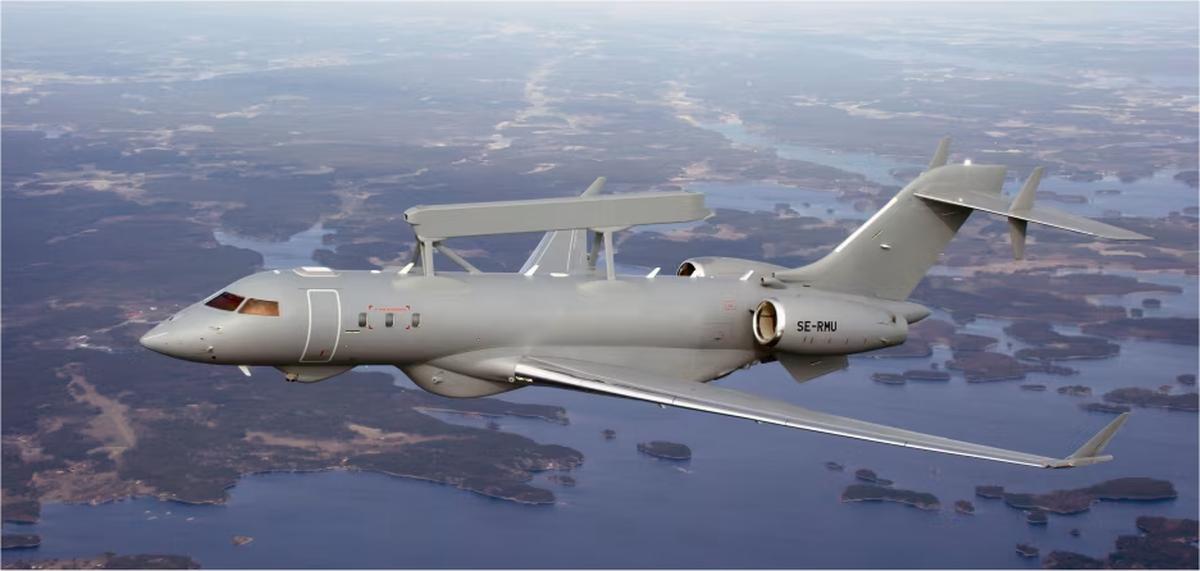
France orders GlobalEye—so what does a Swedish airborne radar deal, built on Canadian metal, change for Europe’s air defence and Canada’s aerospace industrial base?
On December 30, 2025, Saab confirmed it signed a contract with France’s Direction générale de l’armement (DGA) for two GlobalEye airborne early warning and control (AEW&C) aircraft, plus ground equipment, training, and support.
Notably, the order is worth about Swedish kronor (SEK) 12.3 billion (roughly US$1.34 billion) and targets deliveries between 2029 and 2032.
Meanwhile, the deal lands in a very particular spot on the calendar. France is moving to replace its Boeing E-3F Airborne Warning and Control System (AWACS) fleet before sustainment becomes the mission.
Separately, the news also lands with a Canadian accent. GlobalEye rides on Bombardier’s long-range Global family, and Bombardier has leaned hard into special-mission work in recent years.
France orders GlobalEye: what was signed, and what France bought
Unlike a fighter buy, a strategic surveillance aircraft deal is less about speed and more about time on station—and time on contract.
French GlobalEye order: the headline numbers
First, the basics are refreshingly clear. France’s DGA ordered two GlobalEye aircraft and retained an option for two more.
Additionally, Saab describes the package as aircraft plus “ground equipment, training and support.” That phrasing matters, because AEW&C is a system-of-systems business, not an airframe business.
Consequently, France is effectively buying an airborne command node with its own training pipeline and its own sustainment backbone. That is exactly what a replacement program should do.
However, the scale is modest. Two aircraft can deliver credible coverage, but they also limit surge capacity, maintenance flexibility, and crew currency in peacetime.
Still, a small fleet can work if it is networked well and tasked intelligently. France has long treated AWACS as a national strategic asset, not just an “extra sensor.”
Saab GlobalEye deal: what’s included beyond the airframes
Next, it is worth unpacking what “ground equipment” likely implies in this context.
Typically, AEW&C fleets field mission support centres for planning and debrief. They also field secure communications infrastructure, mission data loading, and a training environment that can keep crews sharp without burning flight hours.
Moreover, France’s order explicitly includes training. That could cover mission crew instruction, simulator time, and conversion training for pilots and maintainers.
Equally important, “support” can cover everything from spares pools to engineering services and mission system updates. In other words, the deal is not a one-time delivery. It is an endurance contract.
For readers who track defence procurement, that is where value often hides. The procurement cheque is headline news, but the sustainment plan is what keeps capability alive.
GlobalEye AEW&C purchase: delivery timeline and options
Then there is the calendar. Saab says deliveries will take place between 2029 and 2032, which effectively plants GlobalEye in the early-2030s French order of battle.
Furthermore, the option for two additional aircraft is not a footnote. It is a lever.
If France decides it wants true redundancy—one aircraft in deep maintenance, one in training, one forward, one held back—then it will need more than two tails.
Conversely, if France leans harder on allied coverage, it could stick with two and invest in integration, data links, and distributed command and control.
Either way, the option preserves flexibility without forcing a decision before France finishes the operational testing that inevitably follows delivery.
Saab GlobalEye deal: reading the value and the fine print
The SEK 12.3 billion headline sounds simple. However, it is best read as “two aircraft plus the ecosystem.”
In coverage of the announcement, Janes framed the purchase as France’s chosen AWACS replacement, which is accurate in intent but easy to misread in scope.
A replacement program is not just a procurement of platforms. It is a procurement of readiness.
Consequently, the effective “unit cost” in the French deal is not the cost of a business jet. It is the cost of a business jet plus mission system integration, plus training, plus support, plus whatever software and updates keep the system relevant.
Meanwhile, Breaking Defense highlighted the dollar value and the delivery split, noting that the first aircraft is expected in 2029 and the second by 2032.
That stagger matters. It implies France will spend years operating a mixed fleet, building tactics and confidence, and then deciding whether the two-aircraft baseline is enough.
In other words, France has bought capability. Yet it has also bought a decision point.
Overall, France orders GlobalEye as a bridge from an ageing fleet to a modern sensor web.
France orders GlobalEye: why Paris is moving on from the E-3F
Ageing aircraft can fly longer than critics assume. However, they do not age quietly.
A 707 in 2035 is not vintage; it is a logistics problem.
French AWACS replacement: the E-3F’s calendar reality
France’s E-3F Sentry aircraft entered service in the early 1990s. Since then, they have provided the long-range air picture that supports air policing, crisis response, and deterrence.
Even so, the fleet’s age is now inseparable from its risk profile. The E-3 family is built on the Boeing 707 airframe, a platform that commercial aviation retired decades ago.
Consequently, France faces a familiar military reality: the mission still matters, but the supply chain does not.
In practical terms, that means parts sourcing, corrosion control, and engine support get harder every year. It also means downtime increases, even if crews and maintainers perform heroics.
As one French maintenance leader put it in late 2025, the point is to keep the AWACS unit “at the best level” … “ensuring performance and availability.” — Marc Howyan, Director of Aeronautical Maintenance, French Ministry of the Armed Forces
And yes, the E-3 still does the job. Yet the question is whether it will do the job reliably in 2032.
French AWACS replacement: sustainment is now part of the story
Notably, France has not stood still on sustainment.
On December 12, 2025, French industry reporting described a 10-year support contract for the E-3F fleet, intended to carry the aircraft to a planned retirement around 2035.
That does two things at once. First, it reduces operational risk while France transitions. Second, it signals that the government has accepted an overlap period.
Moreover, overlap is healthy. AEW&C crews need time to build tactics, procedures, and trust in a new mission system.
Meanwhile, the sustainment contract also hints at a hard truth. France does not expect GlobalEye deliveries to arrive before the E-3F begins to feel operationally fragile.
That is why the 2029–2032 delivery window matters. It aligns with a period when France likely wants its replacement not just in service, but in routine operations.
For a fleet as small as GlobalEye, that training ramp matters as much as the aircraft delivery schedule.
French GlobalEye order: bridging capability and sovereignty
Equally important, AEW&C is a sovereignty tool.
Unlike a space sensor, an AEW&C aircraft is sovereign by default when it takes off under national command. It can operate inside national rules of engagement, national intelligence caveats, and national data handling constraints.
Additionally, it can move. It can reposition, change altitude, and adjust coverage in ways that fixed sensors cannot.
That mobility matters for France, given its global commitments and its European responsibilities. It also matters because modern air threats are not polite enough to line up in one direction.
Here is the gentle irony: Europe is investing in more air defence, yet it still needs “eyes in the sky” to make that defence efficient. The world’s most expensive surface-to-air missile is still blind without cueing.
France orders GlobalEye: what the aircraft can actually do
GlobalEye is often described as “AWACS-like.” However, its value lies in how it stitches domains together.
Saab GlobalEye deal: an extended-range radar picture
At the core of GlobalEye is Saab’s Erieye airborne early warning radar, mounted in a dorsal “plank” rather than a rotating rotodome.
Notably, Saab positions GlobalEye as a multi-domain surveillance and command node. It is meant to track targets in the air, at sea, and over land.
On the performance side, Saab states the aircraft offers more than 11 hours of endurance and an instrumented range of more than 350 nautical miles (about 650 kilometres) (Saab, GlobalEye product page).
That combination matters. Endurance supports persistence, while range supports self-deployability and global repositioning without a tanker dependency for routine moves.
Meanwhile, Saab also describes a key low-level detection use case. From 35,000 feet, the system can detect low-level threats at 200 feet at distances exceeding 458 kilometres—language tailored to cruise missiles and other “below the radar” problems.
This is not magic. It is geometry, aperture, and signal processing. Still, the result is operationally meaningful.
GlobalEye AEW&C purchase: more than one sensor
Just as importantly, GlobalEye is not a single-radar aircraft.
In European reporting, the system is described as combining Erieye with the Leonardo Seaspray 7500E active electronically scanned array (AESA) maritime radar, plus an electro-optical/infrared (EO/IR) turret and other sensors (European Security & Defence, 2026).
Notably, AESA radars can steer beams electronically, which supports rapid mode changes.
In practice, pairing more than one AESA sensor on one platform can improve coverage across air and sea domains.
Additionally, EO/IR gives crews a way to classify contacts when radar alone is ambiguous.
Consequently, it can build a maritime surface picture and contribute to overwater situational awareness, which a classic AWACS design often treats as secondary.
Additionally, Saab frames GlobalEye as “multi-domain” and “real-time,” with an array of active and passive sensors. That language typically covers electronic support measures (ESM), identification tools, and data fusion.
Meanwhile, ESM adds a passive layer that can detect emitters without advertising the aircraft’s own transmissions.
Consequently, ESM and EO/IR complement radar by helping crews understand what a track actually is.
In other words, GlobalEye tries to be an airborne sensor manager. It is not simply a radar truck.
If you ever wondered whether a business jet could do chores, GlobalEye is the aircraft that just picked up the broom.
Saab GlobalEye deal: networking and command and control
Moreover, AEW&C aircraft earn their keep by sharing data, not hoarding it.
That means secure communications, tactical data links, and integration with national and allied command and control architectures.
Practically, GlobalEye has to speak to fighters, air defence units, maritime forces, and higher headquarters. It also has to operate in contested electromagnetic environments.
That is why “training and support” in the French contract matters again. Software updates, threat libraries, and tactics evolution are part of the capability.
Also, interoperability matters politically. Saab’s chief executive officer (CEO) explicitly framed the French order as strengthening Europe’s overall protection and noted that both Sweden and France will operate GlobalEye. “Today’s order underscores the robust partnership between Saab and France. By selecting GlobalEye, France is investing in a highly modern and capable Airborne Early Warning & Control solution.” — Micael Johansson, President and CEO, Saab
That “shared user community” line is easy to skim past. Yet it can drive shared upgrades, shared tactics, and shared training over time.
French GlobalEye order: the business-jet approach to survivability
Finally, the GlobalEye philosophy differs from the classic E-3 model.
The E-3 is a large aircraft with a large radar and a large crew. GlobalEye, by contrast, is a business-jet-sized platform carrying a modern sensor suite.
Consequently, GlobalEye can trade raw crew volume for a smaller footprint, potentially lower operating costs, and easier basing. It can also present different survivability options, especially if it operates with standoff tactics and robust escort.
However, a smaller platform also imposes limits. Mission crew size, onboard space, and electrical margins all matter.
The interesting point is not that GlobalEye is “better” than AWACS. Rather, it is a modern answer to the same question under modern constraints.
Bombardier’s Global 6500 moment: Canada’s fingerprints on a French contract
Canadian readers have every right to look at the French announcement and ask a practical question: where does Bombardier show up in a Saab contract?
Here is the short version. Bombardier does not sell the mission system, but it sells the canvas.
For Canadian industry, France orders GlobalEye is another export signal that the Global 6500 class is becoming defence’s preferred middleweight platform.
Global 6500 AEW&C: the platform behind the headline
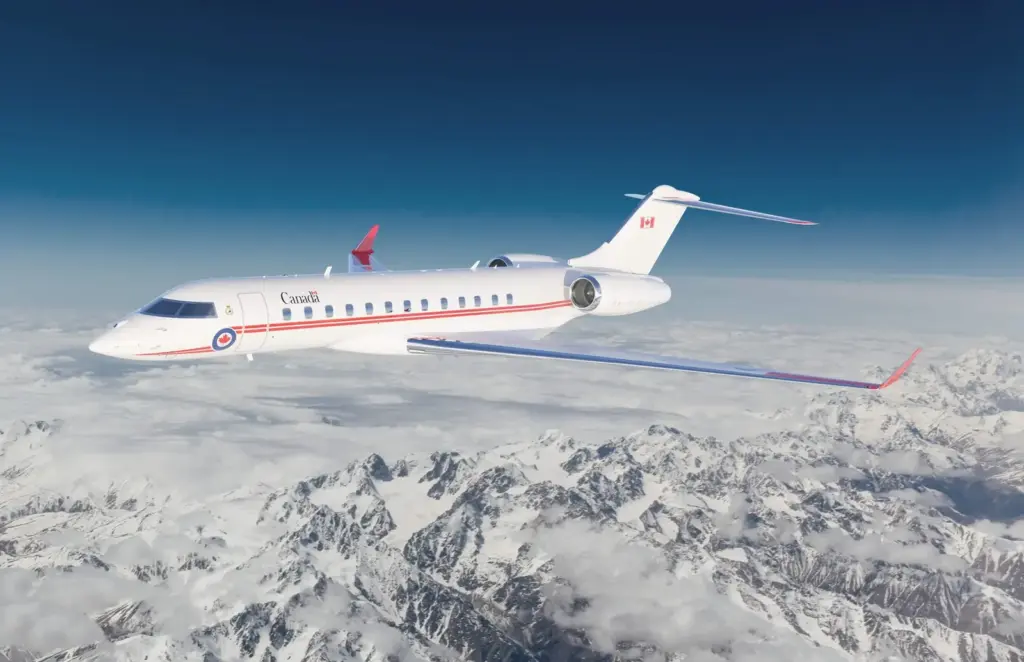
Saab’s GlobalEye solution is built on Bombardier’s ultra-long-range Global family. In export campaigns, Saab regularly describes GlobalEye as combining its sensors with Bombardier’s Global 6000/6500 class aircraft.
Notably, that matters because Bombardier builds the underlying aircraft in Canada. It also supports it through a global service network.
Consequently, every new GlobalEye customer is also, indirectly, a vote of confidence in the Bombardier Global platform’s range, reliability, and modification potential.
For Bombardier, that is strategic. Business aviation is cyclical, while government special missions can provide longer-term stability.
Moreover, special-mission customers often value availability over cabin finishes. That is a nice change of pace in a sector famous for arguing about seat stitching.
Saab GlobalEye deal: what Bombardier likely supplies—and what it doesn’t
It is also important to draw the line between airframe and system.
Bombardier supplies the aircraft platform, and Saab (and its partners) integrate the radar, mission system, consoles, and communications.
In practice, that means Bombardier’s Canadian workshare sits in the aircraft manufacturing stream. Saab’s workshare sits in the modification and integration stream.
However, those streams are not separate in the real world. Production slots matter, engineering support matters, and certification support matters.
Additionally, Bombardier has publicly leaned into defence work as a portfolio, highlighting how Global 6500-class aircraft can support intelligence, surveillance and reconnaissance (ISR) and AEW&C missions.
That framing is not accidental. It is a pitch to governments, integrators, and partners who want a modern airframe without designing a new one.
To put it plainly, Bombardier does not need to wear a camouflage paint scheme to support defence jobs. It just needs aircraft on the line.
French GlobalEye order: why Canadian readers should care
The Canadian angle becomes sharper when you zoom out.
In November 2025, Reuters reported Saab was in talks with Canada and Bombardier about licensed production of the Gripen fighter, with job creation part of the narrative.
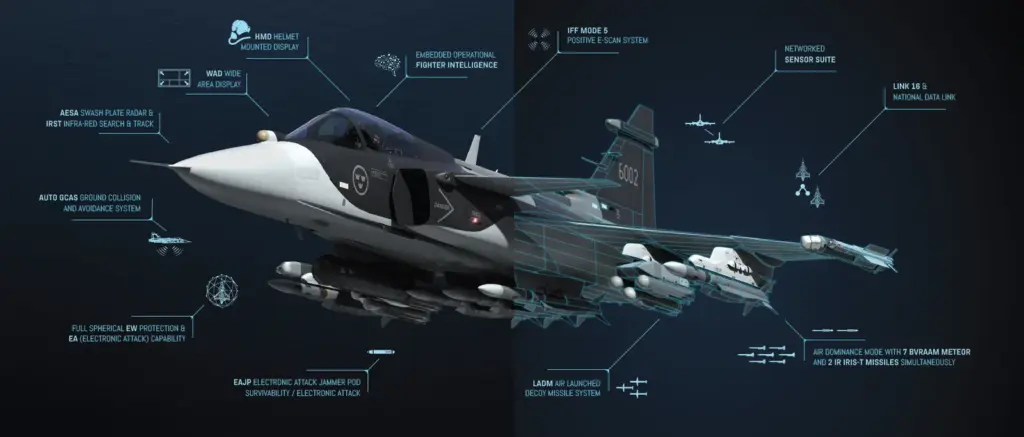
We covered that industrial logic in detail in our Bombardier–Gripen Canada explainer, including why Saab keeps returning to the build in Canada theme.
Now, France’s GlobalEye buy offers a second data point. Saab is not just marketing industrial partnerships. It is building them.
From a Canadian perspective, that matters because it normalises Bombardier’s presence in defence aerospace programs that operate outside Canada.
It also reinforces a broader trend. Governments increasingly buy special-mission aircraft by pairing a business jet airframe with a mission integrator.
In that model, Bombardier can play a starring role without being the prime in a traditional defence sense.
France orders GlobalEye: the Canadian Saab file behind the French headline
Meanwhile, France orders GlobalEye is also landing in the middle of Canada’s industrial anxiety.
On November 14, 2025, Reuters reported Saab was in talks with the Government of Canada and Bombardier about building the JAS 39 Gripen fighter under licence in Canada, with Saab chief executive officer (CEO) Micael Johansson telling The Globe and Mail the plan could create 10,000 jobs.
Notably, Bombardier did not leave that report hanging in the air. “We can confirm that discussions about Gripen are occurring …” — Bombardier statement, Reuters
Additionally, the Gripen talk has been travelling with a second aircraft in the same sentence. On November 21, 2025, Johansson told Reuters that Saab had pitched GlobalEye to Canada, and he described a willingness to transfer know-how for Canadian work on installing sensors and converting green business jets into mission aircraft.
Moreover, his phrasing was blunt about intent. “We are campaigning, and we have given them offers.” — Micael Johansson, CEO, Reuters
Consequently, this is where the French order becomes more than European procurement trivia for Canadian readers. France picking GlobalEye strengthens Saab’s credibility at the exact moment Ottawa is weighing how much sovereignty, and how many paycheques, it wants tied to defence aerospace.
Meanwhile, Saab’s bundle logic is easy to spot in Canadian reporting. According to AeroTime’s December 18, 2025 coverage, Saab says localising Gripen and GlobalEye work in Canada could support up to 12,600 jobs, with Bombardier often cited as a natural industrial partner for the Global 6000/6500-class platform.
Even so, “build it here” is never as fast as the talking points. In a December 5, 2025 report, Global News quoted Johansson as saying a Canadian production hub could take three to five years to set up, which is a polite way of saying tooling does not care about election calendars.
Separately, Saab has already been tightening Canadian threads around GlobalEye beyond Bombardier’s airframe. On November 20, 2025, CAE announced a worldwide cooperation agreement with Saab that positions the Montréal-based training firm as Saab’s preferred supplier for select GlobalEye training and simulation requirements.
Overall, if this is starting to sound like two Canadian procurement debates stapled together, that is the point. If this were a retail flyer, the disclaimer would read: some assembly required, please allow three to five years.
For the full Canadian thread—and why GlobalEye keeps reappearing beside Gripen—see our Fliegerfaust UPDATE Bombardier Gripen Canada: What We Know Now After Ottawa’s New Signals.
From Ottawa to Seoul: Global 6500 special-mission demand is widening
The GlobalEye story is one example. Yet it is not the only Global 6500 defence story that matters to Canadians.
Global 6500 AEW&C: Canada’s own multi-role buy and the jobs math
On December 12, 2025, the Government of Canada announced a contract to buy six Canadian-built Global 6500 aircraft for the Royal Canadian Air Force (RCAF) under the Airlift Capability Project – Multi-role Flight Service.
For the RCAF, the point is flexibility as much as lift. Even when a mission is not AEW&C, ISR work is often the entry point for business jets in uniform.
Notably, Ottawa put the estimated value at about Canadian dollars (CAD) 753 million. It also expects first delivery by summer 2027, with initial operational capability by the end of 2027.
Additionally, the government says the contract includes training, military modifications, and supply-chain work, including “more than 60 Canadian suppliers.” It also projects over 900 direct and indirect jobs tied to aircraft manufacturing activities.
That political framing is explicit. “By choosing a Canadian-built fleet, we’re putting our industry, our workers, and our incredible aerospace talent front and centre.” — The Honourable Joël Lightbound, Minister of Government Transformation, Public Works and Procurement
In parallel, Bombardier pegged the order at about US$400 million based on list price plus military modifications, and it noted that Global 6500 aircraft are assembled in the Greater Toronto Area and completed in Greater Montreal (Bombardier via GlobeNewswire, 2025).
Global 6500 AEW&C: the Canadian supply chain behind the deal
Crucially, Bombardier also used that announcement to underline manufacturing scale. It described its Global Aircraft Assembly Centre as inaugurated in 2024, tied to an investment of more than CAD 670 million, and employing more than 2,000 workers.
Moreover, Bombardier cited a PricewaterhouseCoopers economic study that attributed its Global 6500 manufacturing activities in 2022 to CAD 518.3 million in gross domestic product (GDP), 3,747 full-time equivalent jobs, and CAD 309.1 million in labour income.
That GDP figure is not a defence metric. Still, it signals industrial depth.
In GDP terms, special-mission work can act like a stabiliser bar when business aviation demand swings.
Those numbers will not transfer one-for-one into defence work. Still, they illustrate why special-mission conversions matter. They keep a complex supply chain warm.
For more on Bombardier’s broader defence push, see our Fliegerfaust overview of Bombardier Defence’s special-mission positioning and our look at Bombardier Global deliveries supporting U.S. Air Force networking missions.
If the Global 6500 were a pickup truck, it would be the one that keeps getting borrowed by neighbours.
Global 6500 AEW&C: South Korea’s Phoenix program and why it matters
Meanwhile, South Korea has doubled down on the same airframe family in a more directly comparable role.
On October 20, 2025, L3Harris announced a contract to deliver modified Bombardier Global 6500 AEW&C aircraft to the Republic of Korea Air Force (ROKAF), with a program value of more than US$2.26 billion.

For ROKAF, that investment is about persistence and control. It is also a reminder that AEW&C programs are now software-heavy, not just radar-heavy.
Notably, the partnership structure is telling. L3Harris listed Bombardier, Israel Aerospace Industries’ ELTA Systems, and Korean Air as partners.
That choice matters for Bombardier and Canada, even though Saab did not win the Korean competition. The airframe still comes from the same Canadian production ecosystem.
We broke down the Korean selection in our Phoenix AEW&C analysis, including what the decision says about the evolving AEW&C market.
Notably, ROKAF now has to turn that contract into a trained crew pipeline.
In short, the Global 6500 platform is now competing—and winning—in multiple national surveillance programs, sometimes with Saab, sometimes without.
Global 6500 AEW&C: a competitive market, not a single-vendor story
Importantly, the Korea example also underlines a market reality: AEW&C is no longer a single-platform world.
Some nations buy large platforms like Boeing’s E-7. Others buy smaller business-jet derivatives like GlobalEye or Phoenix.
Still others explore unmanned, space-based, or distributed sensor approaches that try to reduce dependence on a handful of high-value aircraft.
In that mix, the Global 6500 emerges as a kind of “mid-sized sweet spot.” It offers long range and endurance without the mass and cost of a converted airliner.
Additionally, integrators can differentiate through sensors, mission software, and electronic warfare resilience, rather than through a unique airframe.
For Bombardier and Canadian suppliers, that is good news. It means the airframe can ride multiple mission systems without being locked to one prime.
However, competition also means there is no guarantee of repeat wins. The airframe succeeds only if the integrator and customer build a strong operational concept around it.
In other words, the Global 6500 can open doors, but it cannot close deals by itself.
Strategic ripples: Europe’s AEW&C ecosystem and the NATO question
France’s GlobalEye order is a national procurement. Yet the strategic effects will not stop at the French border.
French AWACS replacement: Europe’s sensor geometry is changing
Europe’s air picture has long depended on a mix of national assets and North Atlantic Treaty Organization (NATO) assets.
Consequently, when a large European air force modernises its AEW&C fleet, it changes the available sensor geometry for coalition operations.
That does not mean France will “share” its aircraft. However, it does mean France will operate a system that can plug into allied frameworks more easily than an ageing platform with a shrinking support base.
Moreover, France will operate GlobalEye alongside Sweden, which can accelerate tactics development and system maturity inside Europe.
There is also a political dimension. A European-operated AEW&C solution reduces the feeling of being locked to one overseas supply chain, even if major subsystems remain international.
Notably, ISR and AEW&C are converging in mission systems, which makes networking as important as radar range.
Here is the sober joke: Europe is discovering that sovereignty sometimes looks like a procurement spreadsheet with fewer single points of failure.
Saab GlobalEye deal: where it fits in NATO’s future plans
NATO is already thinking about life after the E-3A fleet.
On July 30, 2025, NATO’s Airborne Warning and Control System (AWACS) brief predicted the E-3A fleet would retire soon after 2035 and described the Alliance Future Surveillance and Control (AFSC) initiative.
Notably, NATO has described AFSC as a broader effort to build future surveillance and control capabilities, rather than simply buying a one-for-one replacement aircraft.
That framework creates space for systems like GlobalEye to matter, even if NATO itself chooses a different path.
Additionally, the AFSC concept aligns with what GlobalEye already tries to be: a multi-sensor, multi-domain, networked node rather than a single-purpose radar platform.
From France’s standpoint, that alignment may reduce integration friction over time. It also strengthens the case for building national capabilities that still “fit” into alliance concepts.
French GlobalEye order: what could still derail the plan
However, none of this is automatic.
First, France will need to integrate GlobalEye into its national command structures, including air operations centres and joint headquarters.
Second, it will need to resource crews, training, and sustainment for a small fleet. Small fleets can be unforgiving when budgets tighten.
Third, it will need to protect the aircraft in a world where long-range air-to-air missiles, electronic attack, and cyber operations all challenge high-value airborne nodes.
Finally, it will need to decide whether the option for two more aircraft becomes a necessity.
In that sense, the French announcement is not the end of the story. It is the beginning of a decade-long transition project.
Industrial politics and partnerships: Sabena technics, offsets, and the next bids
Defence procurement is a capability story. It is also, inevitably, an industrial story.
Offsets are the tax code of defence procurement: everyone complains, and then everyone reads the fine print.
Saab GlobalEye deal: why Sabena technics appears in the timeline
Back on June 18, 2025, at the Paris Air Show, Saab and the DGA signed a joint declaration of intent that pointed toward exactly the purchase now confirmed (Saab, 2025).
Notably, Saab also signed a framework agreement with French maintenance and modification provider Sabena technics for GlobalEye aircraft modification work (Saab, 2025).
That pairing is not random. France has a deep aerospace industrial base, and French procurement tends to reward partnerships that pull work into France.
Consequently, Sabena technics gives Saab extra modification capacity and gives France an industrial foothold in the program.
It is also a subtle lesson for Canada. If Saab can build an industrial story in France around GlobalEye, it can build an industrial story in Canada around Gripen—or around other special-mission aircraft—when the policy environment supports it.
In defence, industrial politics is not a side show. It is the stage.
French GlobalEye order: the wider Franco-Swedish roadmap
Additionally, the June 2025 declaration of intent did not appear in a vacuum.
At the Paris Air Show, France and Sweden also highlighted a broader defence cooperation roadmap. That political context matters because it frames GlobalEye as part of a relationship, not a one-off deal.
Moreover, partnerships like this can have a reinforcing effect. Once two countries share a platform, they gain incentives to harmonise upgrades and training.
That is particularly true for sensor-heavy aircraft. Software evolution is expensive, and shared development can reduce cost and risk.
Of course, this is still defence procurement. Politics can shift.
Yet the GlobalEye order now moves the relationship from intent to obligation. Contracts have a way of making roadmaps real.
GlobalEye AEW&C purchase: export dominoes and Canadian opportunities
Finally, France’s decision may influence other campaigns.
In November 2025, Saab’s CEO told Reuters that the company was pitching GlobalEye to countries such as Qatar and Saudi Arabia, and that it had also proposed the platform to Canada, with potential collaboration with Bombardier on modification work (Reuters, 2025).
That matters because major customers create confidence. A new flagship user can make the next buyer less nervous about sustainment, upgrades, and long-term support.
For Bombardier and Canada, that export domino effect could be meaningful. More GlobalEye sales can translate into more Global airframes leaving Canadian production lines, plus more demand for engineering support and certification work.
However, Canada’s industrial benefit depends on workshare. If more modification work migrates to France or other partner nations, Canada’s benefit will skew toward airframe production and supplier contributions rather than deep mission-system integration.
That is not a bad outcome. Yet it is a reminder that Canada has to fight for value-added work, not just celebrate headline wins.
Conclusion: a European air-defence bet with Canadian metal
France’s move makes strategic sense. It buys time, reduces risk, and modernises a critical national capability.
In procurement, optimism is not a spare part.
Yet the fleet size raises a hard question. Two aircraft are a start, but they are also a fragility.
Still, France orders GlobalEye in pairs today, and that is where the operational risk sits.
France orders GlobalEye: what looks smart in 2025
In 2025, GlobalEye offers France a practical path off the E-3F. It also offers a European-operated, modern sensor node that aligns with NATO’s broader thinking about distributed surveillance.
Moreover, it lets France modernise without waiting for a perfect alliance-wide solution. In defence planning, waiting for perfection is a reliable way to buy nothing.
From a Canadian perspective, the story has an extra layer. The French order validates a Canadian-built aircraft family as a platform for high-end surveillance missions.
Moreover, it is worth watching how the RCAF leverages its own Global 6500 fleet for training, networking, and future growth.
It also underlines that Bombardier’s defence push is no longer theoretical. Governments are buying.
France orders GlobalEye: the uncomfortable question for allies
However, the critical point is not whether GlobalEye is capable. It is.
Instead, the uncomfortable point is whether Western air forces are buying enough of these airborne nodes to survive a long, contested crisis.
Small fleets struggle under tempo. They also struggle under attrition, even when attrition is simply maintenance backlog.
So here is the question that should linger after the headlines fade: if France is willing to invest in sovereign eyes in the sky now, will it also invest in enough capacity—and will countries like Canada invest in their own awareness, rather than borrowing it when it is already in demand?
Leave your answers and comments below and on our Fliegerfaust Facebook page.
Sources
- Saab — Saab receives order for GlobalEye from France (December 30, 2025).
- Reuters — Saab wins order from France for two GlobalEye surveillance planes (December 30, 2025).
- Janes — France signs for GlobalEye as AWACS replacement (December 31, 2025).
- Breaking Defense — France finalizes $1.3B USD contract for 2 Saab GlobalEye radar planes (December 30, 2025).
- Journal Aviation — France: AWACS E-3F maintenance awarded to AFI KLM E&M (December 12, 2025).
- Saab — France announces intention to procure GlobalEye from Saab (June 18, 2025).
- Saab — Saab and Sabena technics sign agreement relating to GlobalEye (June 18, 2025).
- European Security & Defence — France firms up its intention to purchase Saab GlobalEye (January 2, 2026).
- Saab — GlobalEye product page (Accessed January 4, 2026).
- Government of Canada (Defence Investment Agency) — Government of Canada announces contract to deliver new multi-role aircraft for Royal Canadian Air Force (December 12, 2025).
- Bombardier via GlobeNewswire — Bombardier to Provide Six Multi-role Aircraft to Support the Royal Canadian Air Force (December 12, 2025).
- Reuters — Saab in talks with Canada, Bombardier to build Gripen fighter jets, Globe and Mail reports (November 14, 2025).
- L3Harris — The Republic of Korea Selects L3Harris for Airborne Early Warning and Control Aircraft Program (October 20, 2025).
- Reuters — Saab pitches GlobalEye surveillance planes to Qatar, Saudi Arabia (November 21, 2025).
- NATO — Airborne Warning and Control System (AWACS) (July 30, 2025).
- CAE — CAE signs agreement with Saab for GlobalEye training platforms (November 20, 2025).
For full details, please refer to our Disclaimer page.
For full details, please refer to our Disclaimer page.