

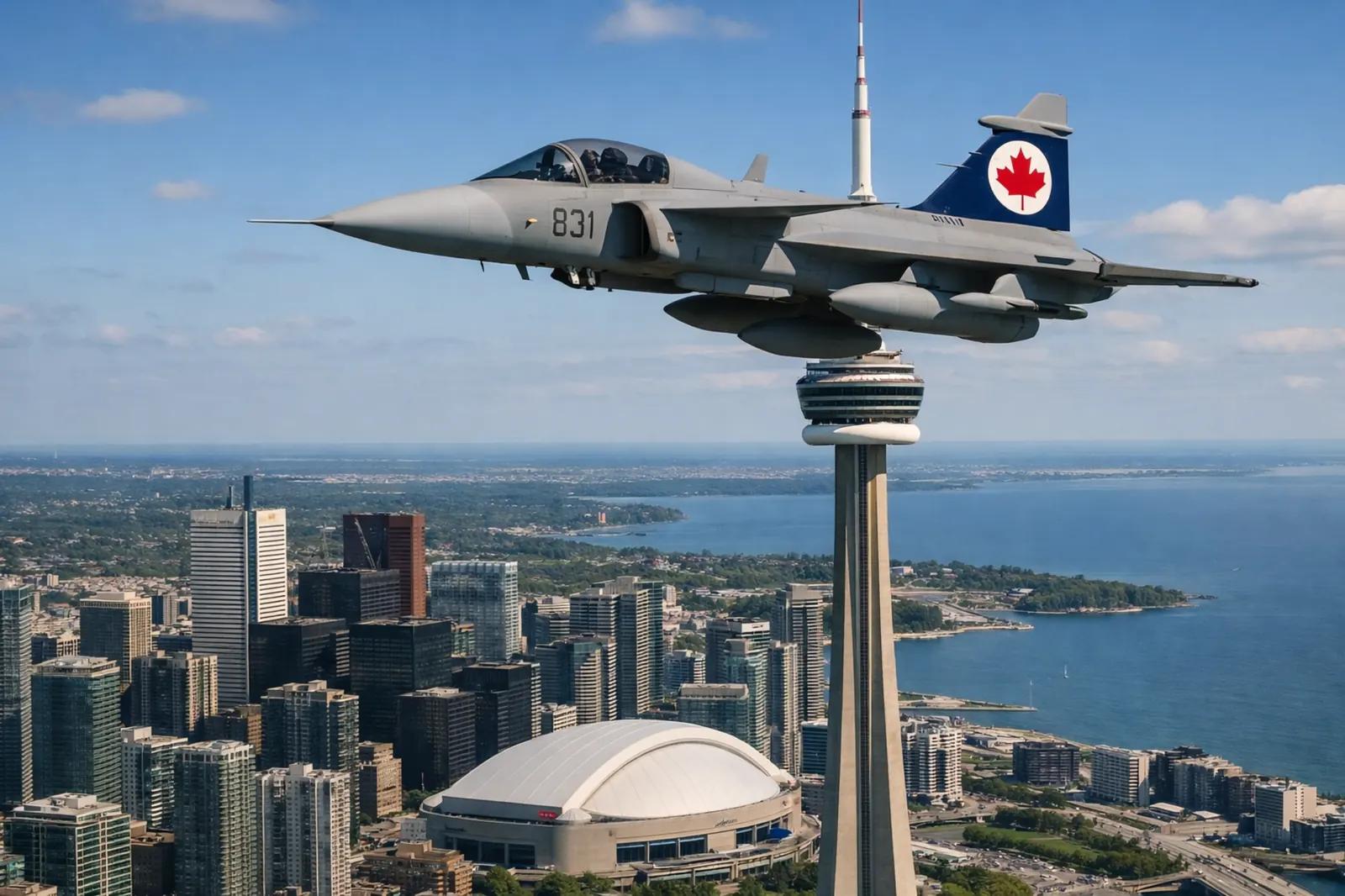
Gripen deal Canada: does an “85%” rumour mean Ottawa is ready to sign—or just ready to signal?
Earlier, on November 14, 2025, Reuters reported that Saab was in talks with the Canadian government and Bombardier about building the Saab JAS 39 Gripen under licence in Canada, with talk of roughly 10,000 jobs and Bombardier confirming it was open to engage if Ottawa chose that route.
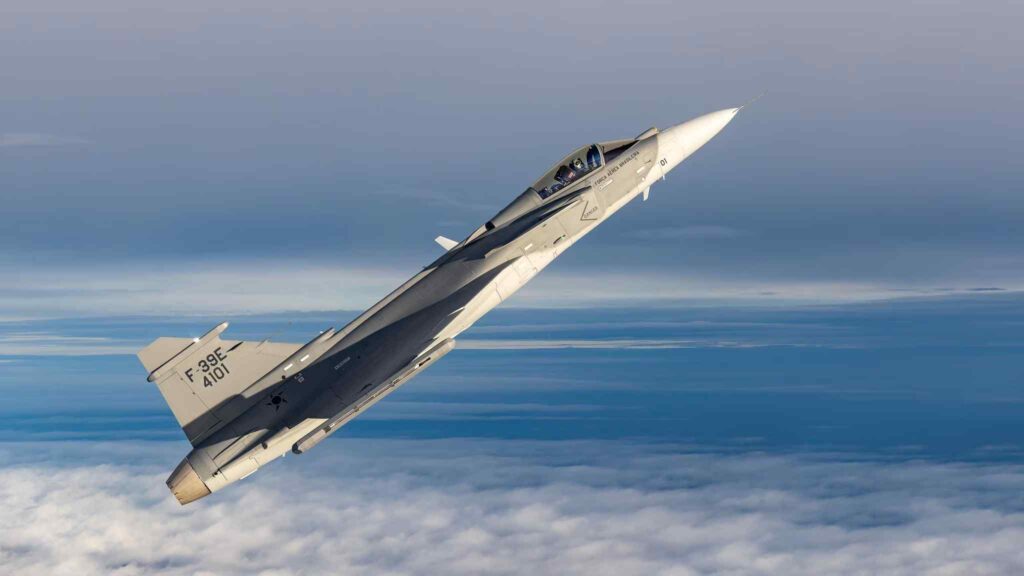
Now, on February 2, 2026, a market-news summary of a Globe and Mail column went further: it placed the odds of a Saab deal at 85%, tied Gripen and the GlobalEye surveillance aircraft to 12,600 jobs, and framed the package as something Prime Minister Mark Carney and senior ministers are “embracing.”
“odds of a deal with Saab have climbed to 85 per cent,” — Stockwatch (via The Globe and Mail).
Meanwhile, Fliegerfaust previously mapped the earlier signals, the industrial logic, and the procurement constraints in UPDATE #2 Bombardier Gripen Canada: What We Know Now.
This update #3 focuses on what the “85%” claim changes—and what it does not.
Gripen deal Canada: why the “85%” number matters
In procurement, numbers often arrive before contracts.
Still, the “85%” line is not a government statement. It is a political anecdote relayed through a columnist, then compressed again in a market-news blurb. That layering matters, because each layer adds narrative heat while shedding paperwork. For Gripen deal Canada, that layering is the story.
From talks to “odds”
First, the sequence is clear. Reuters put confirmed talks on the record in mid-November 2025. Later, Stockwatch reports that a senior politician told the Globe’s Eric Reguly that the odds had climbed to 85%.
Second, the shift from “talks” to “odds” is a signal change. Talks can be exploratory. Odds imply internal momentum.
Third, “85%” is also the kind of number that reads like inside baseball. It sounds precise. It also begs for a question: 85% of what—cabinet intent, negotiating position, or newspaper chatter?
In Ottawa, percentages are still cheaper than prototypes.
What the number can and cannot represent
Notably, procurement has multiple “gates.” One gate is political intent. Another is Treasury Board authority. A third is contracting detail that lawyers can actually sign.
So, the 85% figure could map to only one gate. It may reflect a cabinet mood. Alternatively, it may reflect a negotiating posture. In some cases, it can even reflect a deliberate leak designed to speed internal alignment—or to deliberately exacerbate trade tensions with the destination for 75% of Canada’s exports: the United States.
However, the number cannot substitute for procurement mechanics. It cannot resolve basing, training, weapons integration, or sustainment. It also cannot make competing industrial interests disappear.
Consequently, the correct read is narrow. The “85%” line is a directional indicator about politics. It is not a substitute for a program plan.
Why the jobs number also moved
Meanwhile, the jobs claim moved too. Reuters relayed talk of 10,000 jobs in November 2025. Stockwatch now cites 12,600 jobs tied to building both Gripen and GlobalEye in Canada.
Consequently, the “package” framing matters as much as the percentage. A fighter line alone creates jobs. A fighter line plus a special-mission surveillance aircraft creates a coalition.
Moreover, the bundle lets decision-makers claim three wins at once: jobs, capability, and optionality. It also gives Bombardier a story that is not only business jets.
Gripen deal Canada: why GlobalEye keeps reappearing
Bundling fighters with a surveillance platform is not random. It is a capability stack and an industrial stack.
Also, it is a way to talk about “sovereignty” without pretending Canada can build every subsystem domestically.
GlobalEye is already a Bombardier-shaped argument
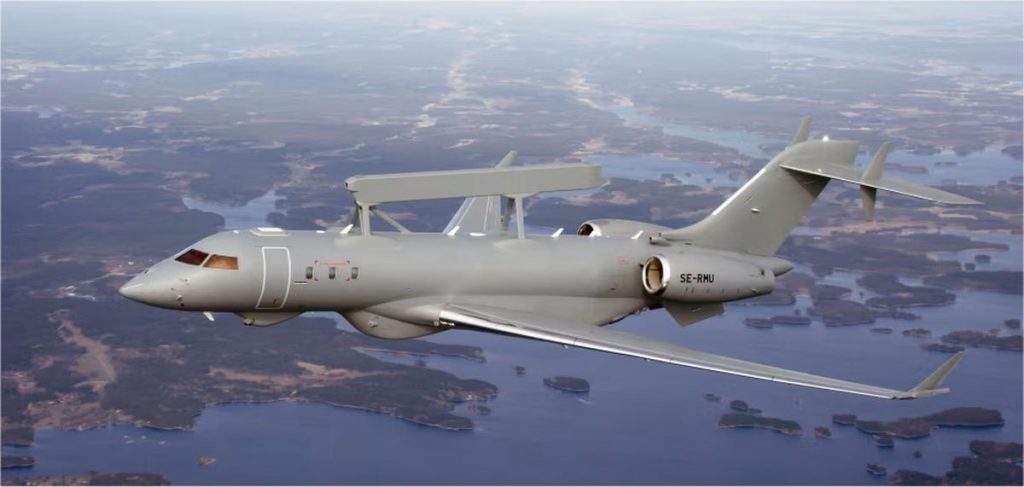
Crucially, Saab’s own GlobalEye product description emphasizes that the platform uses Bombardier’s Global 6000/6500 aircraft and highlights “over 11 hours of operational endurance.” Saab also positions the aircraft as a multi-domain airborne early warning and control (AEW&C) system.
So, the political pitch writes itself. Canada already builds the underlying jet family. Canada already sustains it. Therefore, “build it here” sounds less like a leap.
Fliegerfaust previously examined the Saab GlobalEye angle in France orders GlobalEye: Saab’s AEW&C win and Bombardier’s Canadian angle.
Even so, “based on” does not mean “already solved.” Saab integrates sensors and mission systems. Saab also controls the special-mission conversion. Canada can capture airframe work, integration labour, and sustainment value. Yet the high-end mission system remains Saab’s crown jewels.
A surveillance aircraft is a flying boardroom with antennas, and it still needs accountants.
The capability story is Arctic-shaped
Notably, GlobalEye is not just a jobs add-on. It is also an argument about geography, especially when policymakers talk about long approaches, sparse basing, and the need for persistent wide-area awareness.
Meanwhile, the optics are friendly. A surveillance aircraft looks defensive. It also looks like “domain awareness,” not escalation.
Still, the aircraft is not a magic radar wand. It needs fighters, tankers, satellites, and data links to turn detections into outcomes. It also needs trained crews, which take years, not quarters.
Training partnerships are the quiet enablers
Meanwhile, the industrial base argument gains credibility when it links to training and mission systems, not just airframes. On November 21, 2025, CAE of Montreal announced a global cooperation agreement with Saab aimed at advanced training and simulation, including support tied to GlobalEye and Gripen.
As a result, the “Gripen + GlobalEye” pitch is not only about metal. It is also about simulators, mission rehearsal, and workforce depth.
Additionally, training capacity matters if Canada ever fields a mixed fleet. It also matters if Canada becomes an export hub. Either way, simulation becomes a throughput constraint long before final assembly does.
Gripen deal Canada: the F-35 constraint behind the headlines
The Stockwatch item carries a blunt line: Canada has ordered 88 F-35s, and it has already paid for 16. That may be directionally right, but the details matter.
Moreover, the constraint is structural. A Gripen deal cannot erase a signed F-35 program. It can only change the shape of the follow-on. In Gripen deal Canada terms, those F-35 commitments set a hard floor.
What Ottawa has formally committed to
First, the baseline remains the 88-aircraft plan. On January 9, 2023, Public Services and Procurement Canada announced the agreement to buy 88 F-35A Lightning II fighters for the Royal Canadian Air Force (RCAF).
Next, cost estimates quickly expanded beyond the sticker price. In a November 2, 2023 release, the Parliamentary Budget Officer (PBO) estimated the total cost of Canada’s planned F-35A acquisition and sustainment at $73.9 billion over a 45-year period.
Then, oversight reports added more friction. In a June 10, 2025 report, the Office of the Auditor General of Canada described cost growth and commitments already made within the F-35 program.
After that, reporting narrowed the “first 16” reality. On October 8, 2025, The War Zone reported that Canada had committed to 16 F-35s, with four paid in full and parts for eight others purchased. The War Zone also described the expectation that the first Canadian jets would be delivered for training at Luke Air Force Base in Arizona during 2026.
In short, the “paid for 16” idea has a paper trail, even if the accounting varies by source and cut-off date.
Where mixed-fleet costs show up first
Notably, a mixed-fleet path has two bills. It has the acquisition bill for each aircraft type. It also has the infrastructure and sustainment bill for each ecosystem.
Meanwhile, basing decisions arrive early. The War Zone points to Cold Lake and Bagotville as planned main operating bases for the F-35 in Canada. That matters, because every additional aircraft type adds another layer of security requirements, spares, ground support equipment, and specialized maintenance flows.
Similarly, training becomes a choke point. A mixed fleet needs two pilot conversion pipelines. It also needs two technical training pipelines. Then it needs enough instructors and simulators to keep both current.
So, the “85%” question cannot be isolated from personnel math. A faster industrial ramp can still collide with pilot and technician throughput.
Why indecision costs real money
Consequently, the procurement question becomes sharper. If Ottawa buys the full 88 F-35s, Gripen becomes an export-industrial play rather than an RCAF fleet play. If Ottawa caps F-35 near the first tranche, Gripen becomes a force-structure decision with immediate cost and training consequences.
Still, a mixed fleet can make operational sense in theory. Yet it can also become a logistics tax in practice.
Gripen deal Canada: the Trump risk and the diversification logic
Stockwatch’s summary makes the political hazard explicit: a Canadian-built Swedish fighter could trigger retaliation from Washington.
Yet the “diversify” argument did not begin with this Stockwatch item. It has been building in public for months.
Diversification has a documented origin
Earlier, on March 17, 2025, Reuters reported that Carney ordered a review of the F-35 contract and argued Canada relied too much on the United States for security, while noting that alternatives would be costly.
Later, in late 2025, the same theme surfaced in Europe-facing policy. The Associated Press reported that Canada joined the European Union’s SAFE defence initiative, a defence financing mechanism, as part of a push to diversify military spending and reduce dependency on the United States. AP also tied that move to the wider reassessment of major U.S.-linked procurements.
Consequently, the Gripen story sits inside a broader strategy. It is about suppliers. It is also about leverage.
A trade war makes everyone discover “industrial policy” overnight.
Tariffs are the loud risk; approvals are the quiet risk
However, retaliation risk is not only about tariffs. It can also show up as slower approvals, tighter technology access, and colder contracting climates.
Similarly, modern combat aircraft live inside software, crypto, and mission data ecosystems. Those ecosystems have rules. Those rules are not negotiable at press-conference speed.
So, the relevant question is practical. Which parts of the capability can Canada control, which parts depend on foreign approvals, and which parts can be diversified across suppliers?
Diversification is not the same as independence
However, “build in Canada” does not mean “controlled by Canada.” The Gripen E uses U.S.-origin engines. It also relies on an international weapon and subsystem ecosystem.
Similarly, a Canadian GlobalEye line would still depend on Saab’s mission system supply chain. It would also depend on export permissions for sensitive parts.
So, the more realistic question is about degrees. First, how much supply risk does Canada reduce? Next, what negotiating leverage does Canada gain? Finally, how much economic value stays at home?
Moreover, those degrees matter even if the fleet stays partly American. They shape bargaining power in the next dispute, not only in the current one.
Gripen deal Canada: what would confirm this is real
An “85%” claim is a headline accelerant. It is not a contracting milestone.
Therefore, the next clues matter more than the current probability.
Hard signals to watch in 2026
First, watch for a formal government-to-government framework. A signed memorandum of understanding, a letter of intent, or a structured industrial agreement would move the story from politics to procurement.
Next, watch for facility-level commitments. Tooling orders, leased hangar space, hiring announcements, and named Canadian suppliers would be hard to fake.
Then, watch for how Ottawa describes the F-35 end state. Language about “full fleet” versus “initial tranche” will signal whether Gripen is an export story or an RCAF force-structure story.
Finally, watch for how the GlobalEye side is treated. If the surveillance aircraft gets budget and schedule oxygen, the industrial case strengthens quickly.
Procurement timelines have a special talent: they move, even when aircraft do not.
Soft signals that still matter
Notably, politics has its own breadcrumbs. Cabinet travel, embassy coordination, and quiet industry briefings often show up before paper.
Meanwhile, supply chains also leak intent. Engine bookings, radar long-lead items, and simulator bay reservations tend to surface as “routine” planning.
Still, the strongest signal is transparency. A serious program will publish schedule assumptions, cost ranges, and capability trade-offs.
A critical view of the “85%” moment
Notably, the 85% figure may be less about certainty and more about bargaining power. That framing pressures opponents. It also reassures allies. Moreover, it nudges industry to line up behind the likely winner.
Still, the number can also backfire. If Ottawa cannot translate “odds” into contracts, the story becomes another cycle of aerospace hype that leaves suppliers wary.
Consequently, the smartest read is cautious. The “85%” claim signals political appetite for a Canada-built Saab package. Yet it does not dissolve the F-35 commitments, the mixed-fleet costs, or the U.S. retaliation risk.
Ultimately, Gripen deal Canada will be decided by milestones, not by odds. More importantly, a serious Gripen deal Canada strategy needs two things at once: disciplined procurement steps and disciplined messaging. Without both, the percentage will age badly.
So, is “85%” the start of a contract—or the peak of a narrative?
Leave your answers and comments below and on our Fliegerfaust Facebook page.
Gripen deal Canada: Sources
- Public Services and Procurement Canada — Jan. 9, 2023 (Canada finalizes agreement to purchase new fighter jets for the RCAF)
- Parliamentary Budget Officer — Nov. 2, 2023 (Estimated cost of Canada’s F-35A acquisition and sustainment)
- Reuters — Mar. 17, 2025 (Canada reviews U.S. fighter jet deal; alternatives look costly)
- Office of the Auditor General of Canada — Jun. 10, 2025 (Audit chapter on Canada’s F-35 program costs and commitments)
- The War Zone — Oct. 8, 2025 (Time is running out for Canada’s fighter decision)
- Reuters — Nov. 14, 2025 (Saab talks with Canada and Bombardier about building Gripen under licence)
- CAE — Nov. 21, 2025 (Saab and CAE sign global cooperation agreement)
- AP (Canada joins EU defence fund; diversification and procurement context)
- Saab (GlobalEye product information and platform details)
- Stockwatch — Feb. 2, 2026 (Globe says Bombardier hears chances of Gripen deal 85%)
For full details, please refer to our Disclaimer page.