
TKMS CAE submarine agreement — could the partnership formalised in Ottawa on March 4, 2026 give Germany’s premier naval builder the decisive edge in Canada’s most consequential naval procurement in a generation?
TKMS CAE submarine agreement: On the opening morning of the 94th Ottawa Conference on Security and Defence, thyssenkrupp Marine Systems (TKMS) formalised a training and simulation partnership with CAE Inc. of Montreal. CAE is Canada’s top-ranked defence company. The TKMS CAE submarine agreement joins a formidable Canadian industrial coalition assembled under the Team 212CD banner. Together, they compete to supply twelve submarines to the Royal Canadian Navy (RCN) under the Canadian Patrol Submarine Project (CPSP). The programme’s total lifecycle value reaches up to $60 billion Canadian. Both CPSP finalists submitted final proposals just two days earlier, on March 2, 2026. A contract decision is anticipated by mid-2026, though the timeline remains subject to the pace of evaluation. Consequently, every announcement in this period carries deliberate strategic weight.
TKMS CAE Submarine Agreement: What Was Signed and Why It Matters
The TKMS CAE Partnership: A Signing Timed for Maximum Impact
The Ottawa Conference on Security and Defence is Canada’s preeminent annual gathering of defence decision-makers. The Conference of Defence Associations Institute (CDAI) hosts it at the Fairmont Chateau Laurier Hotel. Notably, TKMS is the 2026 conference’s principal sponsor. More than 2,000 registered guests attend annually. They include members of Parliament, senators, Department of National Defence officials, flag officers, and Prime Minister’s Office advisors. Specifically, these are precisely the people who will influence which submarine Canada ultimately selects.
CAE is not new to the CPSP. Hanwha Ocean — TKMS’s only competitor for the contract — signed its own teaming agreement with CAE on nearly two years before the TKMS agreement. The TKMS–CAE teaming agreement, signed March 4, 2026, means both CPSP finalists now have CAE on their team.
The TKMS CAE submarine agreement is the eighth major Canadian teaming partnership TKMS has formalised since December 2025. Of those eight, this one carries the most strategic weight. CAE is not simply another capable Canadian firm — it is the simulation and training partner that both CPSP finalists secured. The timing of the announcement, on the opening morning of Canada’s most consequential annual defence gathering, two days after both finalists submitted final proposals, was deliberate. It is a competitive signal, clearly executed. Whether it moves the needle is another question entirely.
What the TKMS CAE Agreement Covers
While TKMS and CAE have not yet disclosed the full contractual terms, the scope aligns with CAE’s established naval capabilities. Specifically, CAE provides submarine and warship crews with bridge and operations room simulators, sonar and radar training systems, and combat management trainers. Additionally, CAE delivers anti-submarine warfare (ASW) simulation, maintenance trainers, and fault-diagnosis environments. For a fleet expected to serve thirty to forty years, this training partnership represents a sustained, high-value Canadian industrial commitment throughout the entire lifecycle of the fleet. CAE’s simulation mandate already extends beyond submarines. As part of Team Poseidon, Canada’s $10.4-billion CP-8A Poseidon acquisition confirmed CAE as the simulator provider for Canada’s next maritime patrol aircraft fleet — a programme covered in detail in our Fliegerfaust analysis of Canada’s CP-8A Poseidon sole-source deal.
TKMS CAE Training Agreement and the Sustainment Imperative
The TKMS CAE submarine agreement directly addresses Canada’s dominant evaluation criterion. According to the CPSP’s reported assessment formula, first disclosed by CBC’s Murray Brewster, Sustainment carries 50% of the total score. Notably, that is the single largest factor. It far outpaces Platform capability at 20%, the Financial criterion at 15%, and Strategic and Economic Partnerships at 15%.
Canada’s Sustainment weighting reflects a hard lesson from the Victoria class — a fleet that spent more time in drydock than at sea, partly because domestic support capacity was never built alongside it. Ottawa is not buying cheap. It is buying self-sufficient.
Vice-Admiral Angus Topshee, Commander of the Royal Canadian Navy, has stated plainly: “Some 70% of the value of the sub contract is tied to in-service support.” — VAdm Angus Topshee, Commander RCN, The Canadian Press, November 12, 2025. Moreover, CAE designs and manufactures its training systems — simulators, trainers, and maintenance environments — in Canada, generating domestic industrial activity regardless of where the submarines themselves are built.
Accordingly, they maximise Canadian content under the Industrial and Technological Benefits (ITB) framework throughout every year of fleet service. TKMS Chief Executive Officer Oliver Burkhard has built the Canadian bid around this philosophy: “It is no longer just about the submarines. It is primarily about what’s beyond.“ — Oliver Burkhard, CEO, TKMS, Reuters via BNN Bloomberg. Furthermore, the training partnership locks in high-value Canadian content for decades. Consequently, it positions TKMS’s Canadian footprint not just for contract award, but for the entire service life of the fleet.
Canada’s Patrol Submarine Project: The $60-Billion Race
Canada’s submarine urgency is real and growing. Understanding it demands understanding the fleet the CPSP will replace.
Victoria-Class Submarines: Running on Empty
Canada purchased its four Victoria-class submarines from the United Kingdom in 1998 for US$427 million. Originally constructed between 1983 and 1993 as the Royal Navy’s Upholder class, the boats spent years in storage before transfer. They accumulated deferred maintenance before a single Canadian sailor went below decks. Today, Canada operates exactly one functional submarine. His Majesty’s Canadian Ship (HMCS) Corner Brook is the fleet’s sole operational boat. HMCS Victoria, HMCS Windsor, and HMCS Chicoutimi remain in various states of limited availability. VAdm Topshee has summarised the situation without diplomatic softening: “We’re down to a single operational submarine.”
The Victoria class has endured a painful operational record. A fatal fire aboard HMCS Chicoutimi on October 5, 2004 killed Lieutenant Chris Saunders. Sea water had entered the conning tower, triggering an electrical fire that injured eight crew members. Moreover, HMCS Corner Brook struck the seabed in Nootka Sound on June 4, 2011, sustaining a two-metre hole in her bow. Hundreds of welds across multiple boats were found deficient in 2016, requiring extensive remediation. Furthermore, a ballast tank rupture during pressure testing in March 2020 caused extensive additional delays, with Corner Brook not returning to full operational service until April 2025. Consequently, the Victoria class has spent far more time in drydock than at sea — a record that would embarrass even the most patient naval officer and country.
Victoria-class Modernization (VCM) contracts are keeping the boats operational through the mid-to-late 2030s. In February 2026, Canada awarded a $118-million periscope modernization contract to Safran, with installation scheduled from 2030. However, every stopgap measure reinforces the central argument. The new submarines cannot arrive soon enough.
From RFI to Final Proposals: The CPSP Timeline
The Government of Canada formally launched the CPSP on July 10, 2024, announcing plans to acquire up to twelve conventionally powered, under-ice capable submarines. A Request for Information (RFI) drew twenty-five responses from six countries. On August 26, 2025, the government named TKMS and South Korea’s Hanwha Ocean as the two qualified suppliers advancing to the Request for Proposal (RFP) stage. Three other finalists — Naval Group of France, Navantia of Spain, and Saab of Sweden — were eliminated. Japan had declined to participate in late 2024.
Both shortlisted builders submitted final proposals on March 2, 2026 — the same week as the TKMS CAE submarine agreement was formalised. Ottawa may pose clarification questions to each bidder through March and April 2026. Subsequently, Secretary of State Fuhr stated in February 2026 that Ottawa will likely announce a winner by mid-2026, though the exact timing remains subject to the pace of evaluation. First submarine delivery is targeted no later than 2035. Consequently, the window for fleet continuity is narrow. Burkhard has publicly called the mid-2026 decision target “very ambitious,” noting that just eighteen months earlier, Canadian officials were discussing a 2028 or 2029 timeline.
TKMS and the Type 212CD: The TKMS CAE Submarine Agreement’s Platform
A Submarine Purpose-Built for the Arctic made in Germany
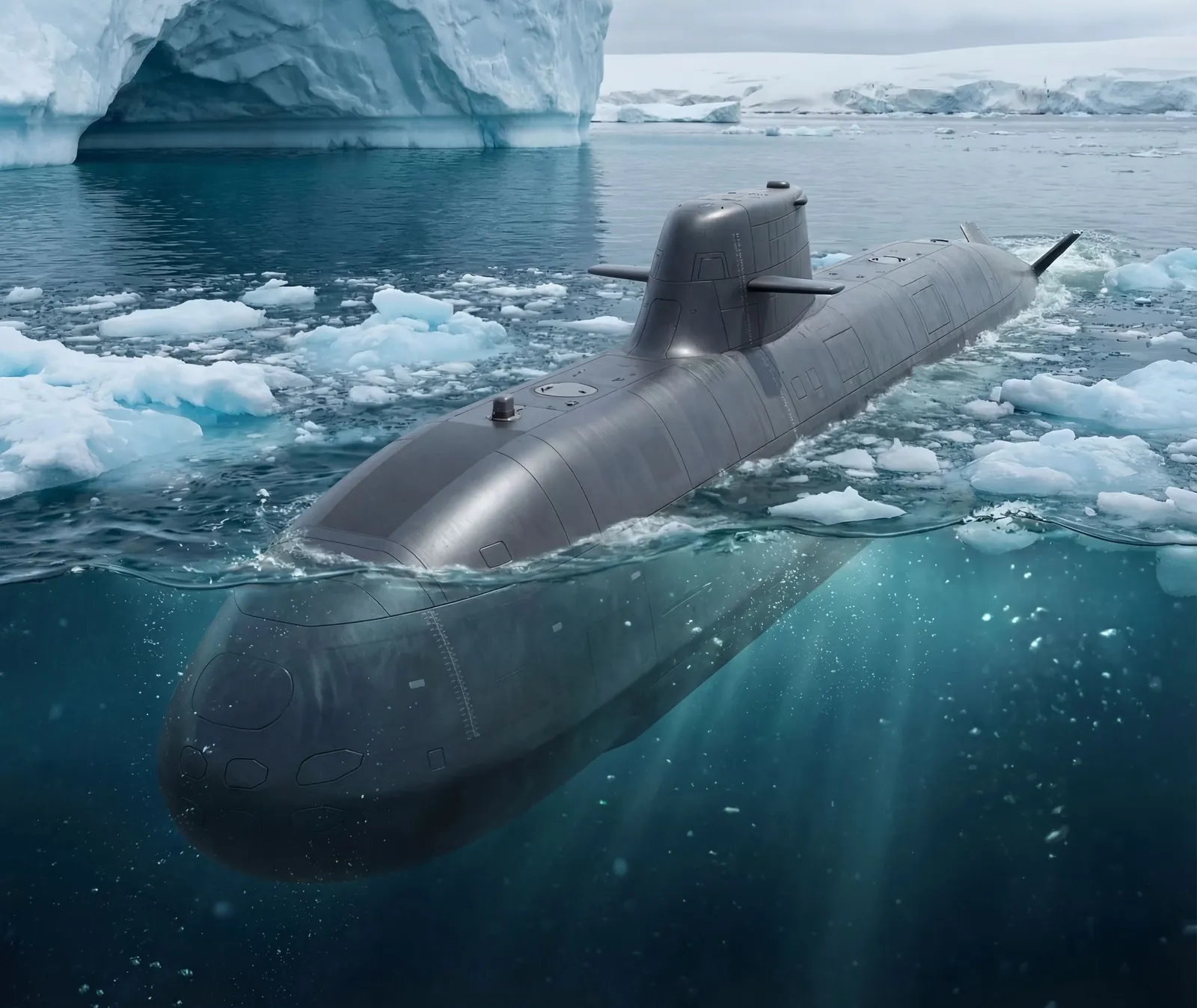
TKMS is offering Canada the Type 212CD (Common Design) — a purpose-built evolution of the proven Type 212A, developed jointly with Norway. At approximately seventy-three metres in length and roughly 2,800 tonnes submerged displacement, it is engineered for Arctic and North Atlantic operations. Fourth-generation hydrogen fuel cell air-independent propulsion (AIP) drives the vessel. Lithium iron phosphate batteries and MTU 4000 diesel engines complete the propulsion system. Together, Army Recognition reports submerged endurance of up to forty-one days without snorkelling — though independent analysts note that exact endurance figures for the 212CD remain classified and are not published by TKMS itself.
The distinctive diamond-shaped faceted hull significantly reduces the vessel’s acoustic and radar signature. Additionally, armament includes six 533-millimetre torpedo tubes, IDAS air-defence missiles, and provisions for anti-ship cruise missiles. According to Army Recognition, TKMS projects delivery of at least two submarines to Canada by 2034. Moreover, according to Reuters via BNN Bloomberg, TKMS supplies approximately 70% of NATO’s conventional submarine fleet. The Type 212CD programme is already in active production. Germany has ordered six boats, and Norway expanded its fleet to six units on January 30, 2026, bringing the combined programme to twelve submarines. Therefore, Canada would join an active production line rather than a new-start design — a meaningful schedule advantage. Norway’s repeat orders speak louder than any glossy brochure.
Building Team 212CD Across Canada
TKMS has assembled a broad Canadian industrial coalition since the August 2025 shortlisting. The announcements have arrived with deliberate frequency, demonstrating geographic reach and sector depth. Marmen of Trois-Rivières, Quebec signed a teaming agreement in December 2025 to produce Type 212CD submarine hull segments in Canada, establishing a dedicated submarine manufacturing division. Subsequently, Toronto-based artificial intelligence (AI) company Cohere partnered with TKMS in January 2026. Seaspan Shipyards of Vancouver signed a sovereign sustainment agreement that same month. The 212CD submarine is made in Germany.
Construction firm EllisDon formalised an infrastructure partnership in February 2026 to develop maintenance and training facilities. Moreover, Magellan Aerospace agreed that same month to support torpedo production and in-service support. On March 2, 2026, TKMS signed two separate Indigenous cooperation agreements. The first covers Songhees Development Corporation, Des Nedhe Group Defence, and Glooscap Ventures. The second, with the Inuit Development Corporation Association, focuses on Arctic-based nation-building initiatives. Additionally, two days later came the CAE agreement.
The full coalition now spans Quebec, British Columbia, Ontario, Manitoba, Atlantic Canada, and the Arctic. For broader context on the forces shaping Canada’s aerospace and defence sector, see our Fliegerfaust analysis of Canada’s aerospace sector and free trade pressures.
The TKMS CAE Submarine Agreement and Canada’s Training Strategy
CAE’s Naval Training Pedigree: The TKMS CAE Submarine Agreement in Context
CAE Inc., headquartered in Saint-Laurent, Montreal, Quebec, has designed and delivered defence simulation and training systems since 1947. The company employs approximately 13,000 people across more than 240 locations in over forty countries. Its adjusted defence backlog reached C$11.3 billion in fiscal year 2025 — nearly double the prior-year figure. Canadian Defence Review named CAE Canada’s Top Defence Company for 2025 for the third consecutive time.
CAE’s naval training portfolio is extensive. Its Naval Combat Systems Simulator (NCSS) provides multi-platform synthetic training environments covering sonar, radar, and electronic warfare. The Action Speed Tactical Trainer (ASTT) delivers comprehensive ASW simulation and is already deployed with the Indian Navy. Additionally, CAE delivered a fifty-two-console Naval Warfare Training System (NWTS) to the Swedish Navy at Karlskrona in 2025. Furthermore, CAE holds training contracts with the Royal Canadian Navy under the Canadian Surface Combatant (CSC) programme. Specifically, that institutional knowledge extends naturally into submarine operations.
Prime Minister Mark Carney chose CAE’s Montreal headquarters to launch Canada’s first Defence Industrial Strategy on February 17, 2026. At that event, Carney committed to directing seventy per cent of federal defence contracts to Canadian firms within a decade. “Defending Canada means more than the size of our military. It also means the strength of our industries, the resilience of our economy, and our capacity to act independently when it matters most.” — PM Mark Carney, CAE Montreal, February 17, 2026. Choosing a simulation company’s headquarters to launch a defence industrial strategy sends a message that needs no translation.
TKMS CAE Canadian Patrol Submarine: Hedging Both Bets
The TKMS CAE submarine agreement is notable not only for what it delivers, but for what it reveals about CAE’s broader strategy. CAE has positioned itself as an indispensable training partner for both CPSP finalists. Consequently, the Montreal company guarantees participation regardless of who wins. By holding simultaneous agreements with both finalists, CAE delivers submarine training systems to the RCN no matter the outcome.
CAE and Hanwha Ocean entered a teaming agreement covering integrated training solutions before the August 2025 shortlist was announced. Earlier still, on May 29, 2025, CAE and Saab signed a Memorandum of Understanding for CPSP training and simulation. However, that agreement became moot when Saab was eliminated in August 2025.
CAE Vice-President of Business Development John Edelman confirmed the approach at I/ITSEC 2025 in November 2025: “We’ve already had preliminary discussions with both Hanwha and TKMS about how we could work together and of course we have naval training experience through the CSC program.” — John Edelman, VP Business Development, CAE, I/ITSEC 2025. It is a sound industrial strategy. Additionally, the Canadian Defence Review profile of CAE and the RCN’s digital training evolution provides useful technical depth on that existing institutional relationship.
Industrial and Technological Benefits: The TKMS CAE Submarine Agreement’s Strategic Value
Quebec at the Heart of the TKMS CAE Submarine Agreement
Canada’s Industrial and Technological Benefits (ITB) policy requires winning companies on federal defence contracts over $100 million to commit to Canadian business activity equal to the full contract value. That means dollar for dollar — every dollar awarded must return to Canada as economic activity. In Ottawa’s defence procurement framework, every dollar spent abroad must come home — and at $60 billion, the door swings both ways. For a procurement of this scale, the ITB obligation does not merely influence the competitive strategy. It defines the strategy entirely.
Sustainment dominates the competitive landscape accordingly. With 50% of the reported evaluation weighting directed toward in-service support and crew training, the ITB question is the central battlefield. Secretary of State for Defence Procurement Stephen Fuhr has been explicit: “As of right now, 75 cents of every dollar of our defence procurement budget goes south of the border. We’re not all that interested in doing that anymore.” — Stephen Fuhr, Secretary of State for Defence Procurement, Penticton Herald, September 2025.
Specifically, the TKMS CAE submarine agreement delivers exactly the kind of ITB value Canada’s evaluation model rewards. Training system design, manufacture, and lifecycle support are long-duration, high-employment activities. They create skilled technical jobs in Quebec. Moreover, they generate meaningful technology transfer and sustain domestic industrial capability for decades. Combined with Marmen’s hull segment manufacturing in Trois-Rivières, Team 212CD now carries two significant Quebec anchors. Additionally, the broader coalition reaches British Columbia, Ontario, Manitoba, Atlantic Canada, and the Arctic, demonstrating genuinely pan-Canadian industrial depth.
The ITB Promise and the TKMS CAE Submarine Deal
However, ITB promises have not always been fulfilled in past Canadian procurements. The Auditor General of Canada’s December 2024 report on the ITB policy examined ninety-nine contracts worth $39 billion. It concluded that the government was unable to demonstrate the policy had met its objectives. Teaming agreements are intentions, not outcomes. They are signed before contract award and before cost pressures arrive. Therefore, Ottawa must demand binding, auditable commitments — not aspirational statements attached to pre-contract announcements. Moreover, enforceable milestones and financial penalties for non-performance are essential. For a broader perspective on Canada’s build-at-home challenge in defence, see our Fliegerfaust feature on Canadian surveillance aircraft built outside Canada.
Hanwha Ocean: The Korean Challenger
The TKMS CAE submarine agreement faces its most direct competitive test from South Korea’s Hanwha Ocean. That rival has assembled its own formidable Canadian industrial coalition.
KSS-III Batch II: Canada’s Other Finalist
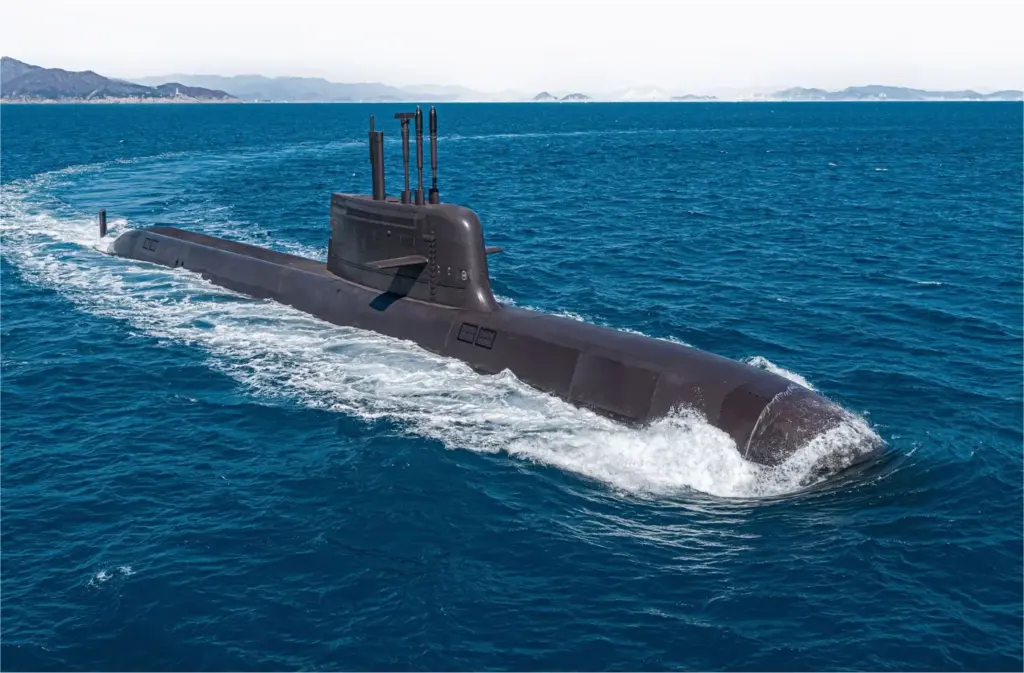
Hanwha Ocean is fielding the KSS-III Batch II submarine — a design already in service with the Republic of Korea Navy. Three Batch-I vessels have operated since 2021. A Batch-II boat launched in October 2025. The KSS-III employs lithium-ion batteries, an AIP system, and vertical launch tubes capable of firing ballistic and cruise missiles.
South Korea mounted an unprecedented national campaign for the CPSP. According to Naval News, seven South Korean government bodies coordinated efforts under a formal whole-of-government framework signed on February 20, 2026. Moreover, Prime Minister Carney personally toured the Hanwha Ocean shipyard in Geoje, South Korea, on October 30, 2025, boarding the same KSS-III submarine Hanwha is proposing for the CPSP. Subsequently, Canada and South Korea signed a bilateral defence cooperation agreement in Ottawa on February 25, 2026. Meanwhile, TKMS CEO Burkhard offered a pointed observation about the Korean campaign’s airport advertisements in Ottawa, noting that he preferred directing equivalent funds toward research and development. The airport advertisements remained unmoved by the comment.
Building Hanwha’s Canadian coalition
Hanwha Ocean’s Canadian industrial coalition predates TKMS’s by more than two years. While TKMS accelerated its partner announcements following the August 2025 shortlisting, Hanwha began assembling its Canadian team in 2023. Consequently, the depth and maturity of what it has built reflects that earlier start.
Babcock Canada sits at the centre of the Hanwha team as the exclusive in-service support partner, a role formalised on September 11, 2025. Notably, Babcock currently holds the Royal Canadian Navy’s Victoria-class In-Service Support Contract and describes itself as Canada’s only submarine sustainment enterprise. No competitor can replicate that institutional knowledge. Moreover, the Hanwha–Babcock relationship dates to a 2021 memorandum of understanding, progressing through a 2022 Technical Cooperation Agreement before reaching full teaming agreement status.
CAE signed its teaming agreement with Hanwha on May 30, 2024, covering integrated training solutions and critical operations support — nearly two years before signing with TKMS. On the cybersecurity front, BlackBerry of Waterloo, Ontario covers secure communications products and embedded software. Additionally, L3Harris Canada of Ottawa addresses integrated platform management, communications, and steering, diving, and control systems.
Curtiss-Wright Indal Technologies of Mississauga, Ontario supplies towed array handling and winch systems — technology already proven on the in-service KSS-III. Furthermore, Gastops of Ottawa handles propulsion system machinery control, modelling, and simulation. Meanwhile, J Squared Technologies, also of Ottawa, covers critical capabilities for sea platforms. Specifically, these Ottawa-based firms anchor a dense cluster of national capital region naval expertise within the Hanwha team.
Industrial base and signed contracts
On the industrial and construction side, Algoma Steel committed to a binding memorandum of understanding valued at up to CAD $345 million for long-term domestic steel supply and a new structural steel beam mill. Moreover, PCL Construction, Canada’s largest construction contractor, joined for submarine infrastructure planning and facility construction.
In the space and satellite domain, MDA Space of Brampton, Ontario signed for aerospace and satellite capabilities, while Telesat partnered with Hanwha Systems for sovereign low Earth orbit (LEO) satellite connectivity. Additionally, Cohere of Toronto, Ontario, joined through a trilateral agreement for artificial intelligence (AI)-based submarine systems and smart shipyard applications. Furthermore, PV Labs contributes advanced electro-optical and infrared targeting systems. Des Nedhe Group of Saskatoon, Saskatchewan, an Indigenous-owned organisation representing more than twenty member companies, signed for economic sustainability participation.
Critically, two partners have moved beyond teaming agreements to actual signed contracts — a threshold no TKMS Canadian partner has yet publicly crossed. ModestTree of Halifax, Nova Scotia, holds a contract to develop a digital mock-up of the KSS-III submarine. Similarly, Hepburn Engineering holds a multi-million dollar contract for a Replenishment-at-Sea system, with active delivery to Republic of Korea Navy vessels underway. Overall, Hanwha reported more than seventeen signed agreements with Canadian companies as of early March 2026, targeting twenty-five in total. A KPMG economic analysis projected approximately 15,000 average annual Canadian jobs generated between 2026 and 2040.
The Final Straight: TKMS CAE Partnership on Trial
Both bidders have now secured CAE for training and simulation. Both have submitted comprehensive final proposals. Neither holds a clear decisive advantage in Canadian content. Consequently, the evaluation will turn on specifics: platform performance, lifecycle cost modelling, delivery schedule credibility, and the binding strength of each team’s industrial commitments. Furthermore, the Defence Investment Agency (DIA), led by CEO Doug Guzman, will apply evaluation criteria that weight long-term in-service capability far more heavily than the submarines themselves. A contract decision is anticipated by mid-2026, if the evaluation proceeds as planned. It will rest on which team can most credibly, affordably, and verifiably fulfil its promises across a programme measured not in months but in decades.
Conclusion: The TKMS CAE Submarine Agreement and What Comes Next
The TKMS CAE submarine agreement, formalised on March 4, 2026, is a clean, well-timed move: it locks in Canada’s premier training and simulation player and eliminates a visible capability gap. It is also not a reset button on the two years Hanwha spent building its Canadian coalition.
Both teams have now assembled serious Canadian industrial coalitions. Hanwha’s is larger and more mature, with two Canadian partners already under contract; TKMS’s is newer, but built fast and wide. The decision will turn on details that press releases don’t reveal: schedule credibility, costed sustainment, and enforceable industrial commitments.
And that last point is the test. Teaming agreements are intentions, not outcomes—signed before award, before engineering reality, and before the cost pressures that break promises. Ottawa should demand auditable milestones, real penalties for non-performance, and independent oversight with teeth. Canada has waited long enough for its submarine fleet to accept anything less.
The question isn’t who announced more. It’s who can deliver more. Announcements are easy. Submarines are hard.
Question for you
Are the promises embedded in these teaming agreements truly strong enough to survive a change of government, a cost overrun, or the sustained pressures of the longest defence programme Canada has ever attempted?
Leave your answers and comments below and on our Fliegerfaust Facebook page.
Sources
- La Presse — Le constructeur naval allemand TKMS conclut une entente avec CAE de Montréal (March 4, 2026).
- BNN Bloomberg — No new auto plants but here’s what else Germany and South Korea are offering in their submarine bids (March 2, 2026).
- BNN Bloomberg — Germany’s TKMS seeks investment package to woo Canada over US$12 billion submarine tender (January 20, 2026).
- Army Recognition — Germany’s TKMS advances $12 billion bid to supply 12 Type 212CD patrol submarines to Canada (2026).
- CBC News — Canada narrows choices for new submarines to German and South Korean bidders (August 2025).
- Canada.ca — Government of Canada advances to next step in Canadian Patrol Submarine Project procurement (August 26, 2025).
- Canada.ca — Canada launching process to acquire up to 12 conventionally-powered submarines (July 10, 2024).
- Prime Minister of Canada — Prime Minister Carney announces the launch of Canada’s first Defence Industrial Strategy (February 17, 2026).
- Naval News — TKMS, Seaspan Shipyards sign teaming for Canadian Patrol Submarine Project (January 2026).
- Naval Today — TKMS and Magellan ink torpedo support agreement for Canada’s submarine program (February 13, 2026).
- Newswire.ca — TKMS and EllisDon Sign Strategic Teaming Agreement to Support the Canadian Patrol Submarine Project (February 4, 2026).
- Newswire.ca — TKMS and Cohere Sign Teaming Agreement to Advance AI-Enabled Capabilities for the Canadian Patrol Submarine Project (January 14, 2026).
- TKMS Group — TKMS and Marmen sign strategic Teaming Agreement to support production of 212CD submarine segments in Canada (December 2025).
- TKMS Group — TKMS Signs Two Agreements with Indigenous Partners to Support the Canadian Patrol Submarine Project (March 2, 2026).
- CAE — CAE and Saab sign MoU for Canadian Patrol Submarine Project (May 29, 2025).
- PR Newswire — CAE named Canada’s Top Defence Company for 2025 by Canadian Defence Review (2025).
- Team Orlando — Start-ups and AI at I/ITSEC 2025 (November 2025).
- Team 212CD — TKMS Team 212CD — Canada’s Future Submarine Partnership (2026).
- Canadian Defence Review — From Sim to Sea: CAE — The RCN’s Digital Training Revolution (2025).
- Breaking Defense — Canada names Hanwha, Thyssenkrupp as qualified suppliers for new submarine program (August 2025).
- Naval News — Norway increases order by two more to now six Type 212CD submarines (January 2026).
- Defence and Security — Hanwha Ocean of Korea signs a Teaming Agreement with CAE for CPSP (2025).
- Esprit de Corps — Competition to supply Canada with a new submarine heats up (2025).
- Office of the Auditor General of Canada — Report 10 — Industrial and Technological Benefits (December 2024).
- Naval News — Canada down selects two shipbuilders for future Canadian Patrol Submarine Project (August 2025).
- Canadian Global Affairs Institute — The Canadian Patrol Submarine Project and its Geopolitical Implications (2025).
- Babcock Canada — Hanwha Ocean and Babcock Canada Sign Teaming Agreement for the Canadian Patrol Submarine Project (September 11, 2025).
- Hanwha Ocean — Hanwha expands industrial alliance with Canadian companies in support of Canada’s Patrol Submarine Project (January 2026).
- Naval News — Prime Minister of Canada Visits Hanwha Ocean Shipyard (October 31, 2025).
For full details, please refer to our Disclaimer page.