


A220 Pacific Expansion: what happens when Air Niugini and QantasLink redraw the South Pacific in 2026?
In the span of 48 hours, three separate stories—two in Australia, one inside Papua New Guinea—put the Airbus A220 at the centre of a shifting regional air map, with new schedules, new capacity, and a not‑so‑small amount of strategic signalling.
Notably, the first headline centres on Air Niugini’s plan to place the A220-300 on the Port Moresby–Sydney sector starting March 29, 2026, while lifting the route to three flights weekly.
Meanwhile, the second focuses on QantasLink deploying the A220 between Adelaide and Brisbane from March 3, 2026, a move the Qantas Group says will add up to 100,000 seats a year to its Adelaide network.
Separately, Air Niugini’s own January 20, 2026 update argues the A220 has already become a domestic “game-changer,” with reliability and comfort improvements now shaping schedules across multiple PNG trunk and regional links.
For the carrier, the line “game-changer” is not marketing fluff; it is a statement of operational intent.
Consequently, aerospace and geopolitics observers can’t treat this as “just another fleet update.” Instead, the combined picture reads like a practical, route-by-route test of what “right-sized” narrowbody capability means in the South Pacific’s real-world constraints: long distances, dispersed communities, uneven infrastructure, and a constant tug‑of‑war between national ambition and unit economics.
A220 Pacific Expansion: Air Niugini’s Sydney leap in March 2026
Pacific A220 rollout: the schedule, the switch, and the stakes
First, the hard date: Air Niugini will introduce Airbus A220-300 service on the Port Moresby–Sydney route on March 29, 2026, and the carrier expects the schedule change to lift the route from two flights per week to three. (AeroRoutes)
Specifically, AeroRoutes lists the planned pattern as PX001 departing Port Moresby at 13:10 and arriving Sydney at 17:05, while PX002 departs Sydney at 07:45 and arrives Port Moresby at 11:45. (AeroRoutes)
Meanwhile, Air Niugini’s own January 20, 2026 statement aligns on frequency and days, saying Sydney currently operates twice weekly, but will move to three times weekly from March 29, 2026, with departures from Port Moresby on Thursdays, Fridays, and Sundays, and returns the next morning on Fridays, Saturdays, and Mondays. (Air Niugini, 2026)
Additionally, for readers who track airport and route shorthand, that means Jacksons International Airport in Port Moresby (POM) and Sydney Kingsford Smith Airport (SYD) gain a third weekly A220 frequency at the start of the Northern Hemisphere summer timetable. In other words, the schedule lines up with the industry’s big seasonal reset, not a random mid‑month tweak.
Of course, the “why” is where the story starts to bite.
Air Niugini isn’t merely swapping metal on an existing route. Instead, it is pairing the aircraft change with a frequency increase, which tends to be the more expensive promise to keep if dispatch reliability is shaky. In practice, airlines only do that when they believe the operation is stabilising—or when the market pressure is rising.
A small aside, because aviation journalists are human: the Coral Sea has a long memory, and it doesn’t care about your press release. The aircraft still has to show up on time.
A220 network expansion: “longest” depends on your definition
Next, the “longest A220” framing needs careful handling. Filmogaz’s January 20, 2026 coverage positions the planned POM–SYD A220 service as the “longest Airbus A220 flights to and from Australia.” and it cites the sector at roughly 1,481 nautical miles (about 2,743 kilometres). (Filmogaz)
Globally, longer scheduled A220 sectors have existed, particularly in Europe, with airBaltic operating lengthy A220 routes such as Riga–Tenerife South, which Airways Magazine lists at 2,803 miles (4,511 kilometres). (Airways Magazine)
Therefore, Air Niugini is poised to operate one of the longest A220 sectors in the region and, based on current reporting, it is likely the longest scheduled A220 route touching Australia. That is still a meaningful benchmark, because “long” in the South Pacific carries a different operational weight than “long” over dense European alternates.
A220 Pacific Expansion: the competitive subtext on POM–SYD
Now, look at the market dynamics. POM–SYD is not just a leisure route. Instead, it sits at the intersection of resource-sector travel, government movement, education links, and the broader Australia–Papua New Guinea (PNG) relationship.
Notably, Australian Aviation framed Air Niugini’s A220 move alongside competitive pressure, reporting the carrier’s plan to add flights and switch to A220s on the Sydney–Port Moresby route. (Australian Aviation)
Meanwhile, Air Niugini’s own language ties the A220 to schedule resilience and “future‑ready” operations, which is an unusually direct way of saying: we intend to improve reliability and win back confidence. That theme repeats across the airline’s domestic and regional messaging. (Air Niugini, 2026)
Consequently, when the A220 lands on SYD in Air Niugini colours, the headline won’t just be about range. It will be about credibility—because customers remember cancellations longer than they remember seat fabrics.
Configuration details: only what the news actually states
First, Air Niugini states its A220-300 is “configured with 138 seats,” and that customers benefit from a wider cabin, larger windows, increased overhead luggage space, and “more comfortable seating, including Business Class.” (Air Niugini, 2026)
Second, Airbus also states Air Niugini’s first A220-300 is configured for 138 passengers, reinforcing the same capacity figure from the manufacturer side. (Airbus)
A220 Pacific Expansion: QantasLink brings the A220 to South Australia
South Australia A220 push: what changes on March 3, 2026
Now shift south, to a different kind of network play. QantasLink will begin flying its Airbus A220 between Adelaide Airport (ADL) and Brisbane Airport (BNE) from March 2026, and CAPA and Qantas both specify March 3, 2026 as the start date. (CAPA)
Notably, Qantas frames this as the first time the A220 has ever operated in South Australia, a milestone that matters for state-level aviation positioning as much as for airline scheduling. (Qantas AgencyConnect)
Additionally, the Qantas Group says the Airbus A220 will progressively replace Embraer E190 aircraft on the route. (CAPA)
A220 regional growth: the “100,000 seats” claim, with context
Next, the seat number. Travel Weekly reports the move will “add up to 100,000 seats” to QantasLink’s Adelaide network annually. (Travel Weekly) Similarly, Qantas’ agency brief repeats the “up to 100,000 additional seats” figure. (Qantas AgencyConnect)
Still, “up to” matters. In practice, the final seat uplift will depend on how quickly A220 frequencies replace E190 frequencies, and on how often Qantas chooses to upgauge versus simply consolidating.
Cabin and onboard product: only what Qantas says, not what we assume
Here, Qantas provides unusually clear specifics about the A220 Pacific Expansion
First, Qantas says the A220 offers fast and free inflight Wi‑Fi, a “light and bright cabin design” around 20% more overhead locker space than previous generation aircraft, ambient light-emitting diode (LED) lighting, and reduced noise and fuel emissions. (Qantas AgencyConnect)
Second, Qantas states its A220s feature 10 Business seats and 127 Economy seats. (Qantas AgencyConnect)
Quotes that matter: QantasLink and Adelaide Airport speak plainly
In Travel Weekly, QantasLink’s chief executive tied the move to regional leadership and customer experience.
“As the first airline in the Asia-Pacific region to operate the A220, we’re excited to bring the aircraft to Adelaide.” — Mark Dal Pra, CEO, QantasLink, Travel Weekly
Meanwhile, Adelaide Airport’s managing director highlighted the route economics rather than the marketing sparkle.
“This is great news from Qantas for customers on one of our top three busiest routes.” — Brenton Cox, Managing Director, Adelaide Airport, Travel Weekly
Importantly, these quotes do two things at once. They position the A220 as a customer-visible upgrade, and they frame the deployment as a strategic investment in South Australia’s connectivity.
Fleet timeline: deliveries, momentum, and how fast this could scale
Finally, the “how quickly” question. CAPA reports the Qantas Group confirmed delivery of two A220s (registrations VH‑X4J and VH‑X4K) in December 2025, bringing its fleet total to 11, with 4 more expected by mid‑2026. (CAPA)
Similarly, Qantas’ agency update says it recently received its 11th A220, with 4 more expected by the middle of 2026. (Qantas AgencyConnect)
Consequently, Adelaide–Brisbane is best read as an early tranche of a broader rollout. If deliveries stay on track, the A220’s footprint in QantasLink’s network should widen quickly in 2026, especially as the type moves into international flying from Brisbane to Wellington. (Australian Aviation)
A220 Pacific Expansion: Air Niugini strengthens domestic connectivity with the A220 fleet
A220 network expansion inside Papua New Guinea, route by route
Now return to PNG, where the A220 story is less about prestige and more about practical connectivity.
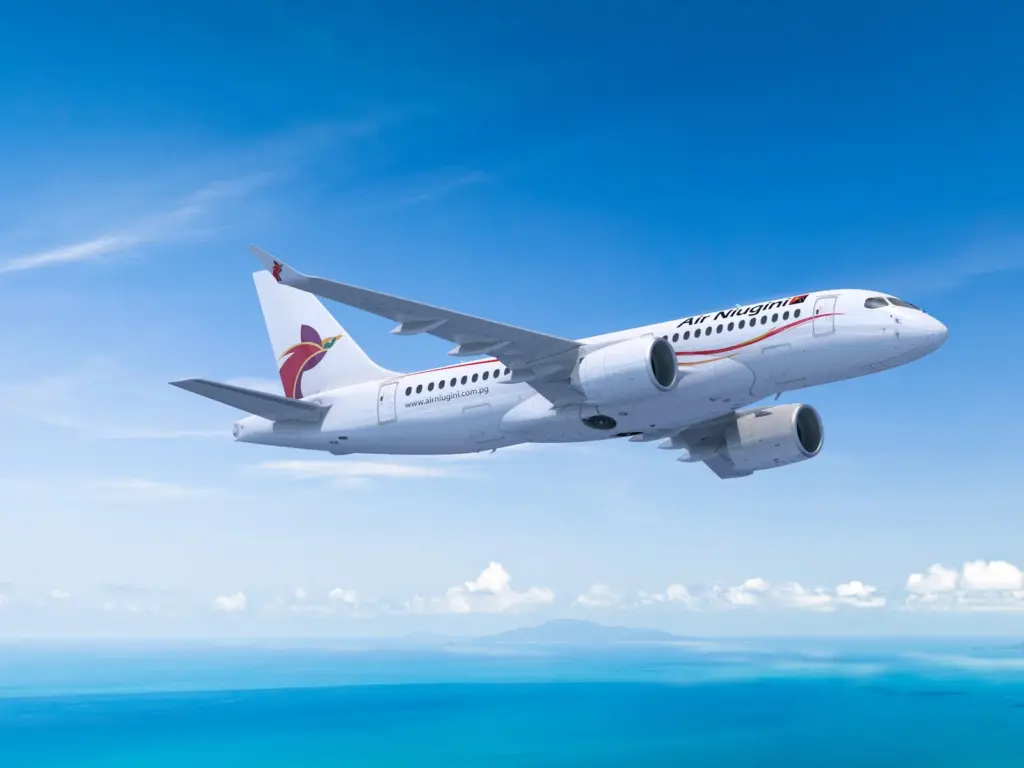
Notably, Air Niugini says its A220s are currently operating on key domestic routes serving Port Moresby, Lae, Rabaul, Kavieng, Manus Island, and Alotau.
Additionally, PNG Facts amplified the same message, framing the A220 as improving comfort and schedules across Air Niugini’s domestic network. (PNG Facts)
In other words, the fleet is no longer an “arriving soon” concept. It is already shaping domestic timetable integrity in a country where air service is often the difference between a day’s travel and a week’s travel.
A brief moment of levity, because the phrase is too good to ignore: when an airline calls an aircraft “The People’s Balus,” it is setting itself up for very public judgement.
“The People’s Balus”: branding as an operational promise
Air Niugini’s January 20, 2026 update states the A220 is “living up to its name The People’s Balus — the people’s aircraft — by safely and reliably connecting communities across the nation.” (Air Niugini, 2026)
That line matters because it frames reliability as a national service obligation, not simply a customer experience metric. Moreover, it suggests the airline views the A220 as a cornerstone for rebuilding trust after “years of operating ageing aircraft,” as Air Niugini stated in its update on the arrival of its third A220-300. (Air Niugini)
Operational reality: dispatch reliability, schedule integrity, and peak demand
Next, the most operationally direct language comes from Air Niugini’s December fleet milestone update.
“Each new A220 strengthens our ability to stabilise operations, increase reliability and provide a better experience for our passengers.” — Captain Samiu Taufa, Officer In Charge, Air Niugini

Notably, the same statement says the A220 delivers “lower fuel consumption, reduced maintenance requirements and improved dispatch reliability,” and it explicitly links those benefits to rebuilding “schedule integrity.” (Air Niugini)
Consequently, the A220’s domestic value proposition is not abstract. It is tied to the carrier’s busiest travel period, with Air Niugini describing Christmas-season pressure, passenger backlogs, and the need to restore network consistency. (Air Niugini)
Infrastructure constraints: runway upgrades and where the A220 goes next
Beyond the current route list, Air Niugini says it plans to introduce the A220 to additional domestic destinations—including Mount Hagen, Wewak, and Kimbe—as runway upgrades progress. (Air Niugini, 2026)
That single sentence is quietly significant. In practice, route expansion in PNG often hinges on airport infrastructure readiness as much as on airline fleet availability. Therefore, the A220 story intersects directly with state capacity and capital works, not merely airline strategy.
Canada-to-PNG deliveries: why the ferry story strengthens the narrative
Additionally, our Airbus A220 news page includes Air Niugini coverage and context for these delivery milestones.
Notably, Air Niugini took delivery of its first A220-300 in Mirabel, Canada on September 11, 2025, and that the aircraft departed the final assembly line in Mirabel on a delivery flight to Port Moresby with stops including Vancouver, Honolulu, and Fiji. This was flown by Air Niugini Captain Beverly Pakii alongside Airbus Captain Thomas Oberreiter, with Air Niugini Captain Joachim Ortlauf on board as an observer. (Air Niugini)

Meanwhile, Flightradar24 documented the same delivery as a multi-day journey, describing it as a four-day trip and summarising legs that total roughly 23 hours of flight time and about 16,500 kilometres. (Flightradar24)
In short, the delivery story reinforces the operational point: these aircraft are not just “new.” They are also integrated into a training and capability pipeline that Air Niugini is clearly trying to expand in-house.
A220 Pacific Expansion: orders, economics, and the regulatory edge
Fleet renewal economics: what Air Niugini and Airbus have actually stated
Now step back to the acquisition layer, because it explains why these route announcements are arriving in clusters.
Notably, Airbus reported on November 1, 2023 that Air Niugini signed a firm order for six A220-100s, and that the carrier would also acquire A220-300s and additional A220-100s from third-party lessors. (Airbus)
Moreover, Airbus’ May 28, 2025 press release states Air Niugini later signed a firm order for two more A220-100s, following the initial 2023 order. (Airbus)
Therefore, the current pattern—domestic stabilisation first, then Cairns, then Sydney—fits the pace of a modernisation programme scaling aircraft-by-aircraft, not a single big-bang fleet swap.
Quotes that anchor the “why”: trade, tourism, and national development
Airbus’ 2023 announcement includes a direct strategic framing from Air Niugini’s leadership.
“This is a milestone … that will support the growth of trade and tourism in Papua New Guinea.” — Gary Seddon, Acting CEO, Air Niugini, Airbus
Notably, the same Airbus release includes the ministerial framing that connects aviation modernisation to national identity.
“I am looking forward to welcoming the ‘People’s Balus’ … to our skies.” — William Duma, Minister for State Enterprises, Papua New Guinea, Airbus
Meanwhile, Air Niugini’s December fleet milestone update gives an unusually grounded reminder that capability must be proven in service.
“A lot has been said about the aircraft, now we must see it do the job safely and sustainability for the people of PNG now and into the future.” — William Duma, Minister for State Owned Enterprises, Air Niugini
Regulatory and operational readiness: what is actually disclosed
Air Niugini says the A220-300 will be deployed on selected regional services “once all regulatory requirements are complete,” and that it will initially serve Cairns before debuting on Port Moresby–Sydney on March 29, 2026. (Air Niugini, 2026)
Additionally, Air Niugini’s December fleet update gives a concrete example of what that process looks like: after completing Civil Aviation Safety Authority of Papua New Guinea (CASA PNG) regulatory and operational requirements, the third A220 (P2-PGC) entered commercial service on Sunday 21 December operating PX1220 to Kavieng and Manus, and it will be progressively introduced on high-demand domestic trunk routes and selected regional routes.
Therefore, in Air Niugini’s own framing, “regulatory requirements” refers to normal entry-into-service and operating approvals that must be completed before the A220 expansion proceeds.
A220 Pacific Expansion: what it signals for South Pacific aviation and geopolitics
Connectivity as state capacity, not just market demand
Now pull the threads together. The A220’s emergence in both PNG domestic flying and Australian interstate flying is not a coincidence. Instead, it reflects a region where connectivity is a strategic capability.
Notably, Air Niugini explicitly links its A220 domestic routes to “economic activity, education, healthcare access and vital social connections,” which is an unusually comprehensive statement of what air transport does in a geographically fragmented country. (Air Niugini, 2026)
Similarly, Air Niugini’s December fleet update frames the national airline as a “strategic national asset,” and it ties fleet renewal to “economic growth, trade, tourism and national unity.” where the Airbus A220 plays a key role. (Air Niugini)
Consequently, when Air Niugini adds a third weekly POM–SYD frequency, it is not only selling more seats. It is also increasing the resilience of a bilateral corridor that matters for business, government, and crisis response capacity.
Australia’s domestic and trans-Tasman posture: incremental, then sudden
On the Australian side, QantasLink’s A220 entry into South Australia looks tactical. However, it also appears to be part of a multi-layered investment narrative.
Qantas says the A220’s arrival in Adelaide builds on recent and planned investments, including a refurbished lounge precinct that opened in May 2025, the return of international flights with an Adelaide–Auckland launch for October, and a planned product innovation centre in Adelaide’s central business district supported by the South Australian Government. (Qantas AgencyConnect)
Therefore, the A220 deployment should be read as a network “platform” move. It strengthens a major domestic city pair now, while keeping options open as the fleet grows and international flying ramps.
The aircraft is the headline, but the system is the story
Finally, the “A220 Pacific Expansion” storyline is less about a single route and more about an emerging operational system.
Notably, Airbus’ 2023 announcement says Air Niugini selected an Airbus subsidiary’s flight planning support system, positioning optimisation and compliance support as part of the transformation programme.
Specifically, Air Niugini selected a flight planning support system from Airbus subsidiary NAVBLUE. Called N-Flight Planning (N-FP), the solution is intended to help the airline optimise fuel, time, and cost to meet operational needs, while ensuring overall safety and compliance. (Airbus)
Meanwhile, the delivery narratives—from Mirabel to Port Moresby—show that training, ferry operations, and crew readiness are being treated as strategic competencies, not afterthoughts. (Air Niugini)
Additionally, the “longest route” headlines are useful, but they can distract from the real metric that matters in 2026: whether these fleets improve schedule integrity in a region where passengers have limited alternatives. (Air Niugini, 2026)
For readers who want deeper A220 programme context on Fliegerfaust, you can cross-reference our coverage of Airbus production and delivery momentum at Airbus A220 ramp-up and delivery outlook. Moreover, Airbus A220 news provides broader context without diluting today’s South Pacific focus.
A220 Pacific Expansion: the bet behind the headlines
In the near term, the A220 is becoming a shared language between two very different operators. Air Niugini is using it as an instrument of national connectivity and operational recovery, while QantasLink is using it to upgauge a busy domestic corridor and extend a fleet renewal narrative into South Australia.
Moreover, these announcements show how aircraft types become geopolitical signals in aviation’s quieter ways. A third weekly POM–SYD flight is not a summit meeting, but it does increase the cadence of exchange between two capitals of influence. Similarly, a first‑ever A220 operation in South Australia is not a treaty, but it does shift the competitive baseline on a key interstate trunk.
However, there is a critical edge to the optimism. A220 Pacific Expansion will only be “real” if the reliability claims survive peak season pressure, weather disruptions, and the routine friction of regional operations. In other words, the aircraft will not be judged by its brochure, but by its on-time performance and cancellation rates over the next 12 months.
Finally, as more A220s enter service across Australia and PNG, the strategic question becomes unavoidable: are regional governments and airports upgrading infrastructure and regulatory capacity fast enough to match the aircraft’s promise—or will the South Pacific end up with next‑generation jets constrained by last‑generation systems?
Leave your answers and comments below and on our Fliegerfaust Facebook page.
Sources
- Filmogaz — Australia’s Tiny Airline to Launch Longest A220 Flights (January 20, 2026).
- AeroRoutes — Air Niugini Schedules A220 Sydney late-1Q26 Debut (January 13, 2026).
- Air Niugini — A220s transforming domestic travel across Papua New Guinea (January 20, 2026).
- Air Niugini — Air Niugini welcomes Third Airbus A220-300 as fleet transformation gains momentum (December 18, 2025).
- PNG Facts — PNG Connectivity Boost as Air Niugini’s A220 Takes Flight Nationwide (January 20, 2026).
- Travel Weekly — QantasLink brings next-gen A220 to SA, adding 100k seats to Adelaide (January 19, 2026).
- Qantas AgencyConnect — Qantas brings next-gen A220 to South Australia (January 20, 2026).
- CAPA — QantasLink to deploy A220 on Adelaide-Brisbane service from Mar-2026 (January 20, 2026).
- Airbus — Air Niugini orders the A220 (November 1, 2023).
- Airbus — Air Niugini discloses order for two more Airbus A220s (May 28, 2025).
- Airbus — Air Niugini takes delivery of its first Airbus A220 (September 11, 2025).
- Flightradar24 — 23 hours and 16,500 km: delivering Air Niugini’s first A220 (Updated October 16, 2025).
- Airways Magazine — The Longest Airbus A220 Routes (February 1, 2024).
- Australian Aviation — Air Niugini adds flights, switches to A220s on Sydney–Port Moresby (January 2026).
- Australian Aviation — QantasLink to bring A220s to Adelaide (January 2026).
For full details, please refer to our Disclaimer page.