

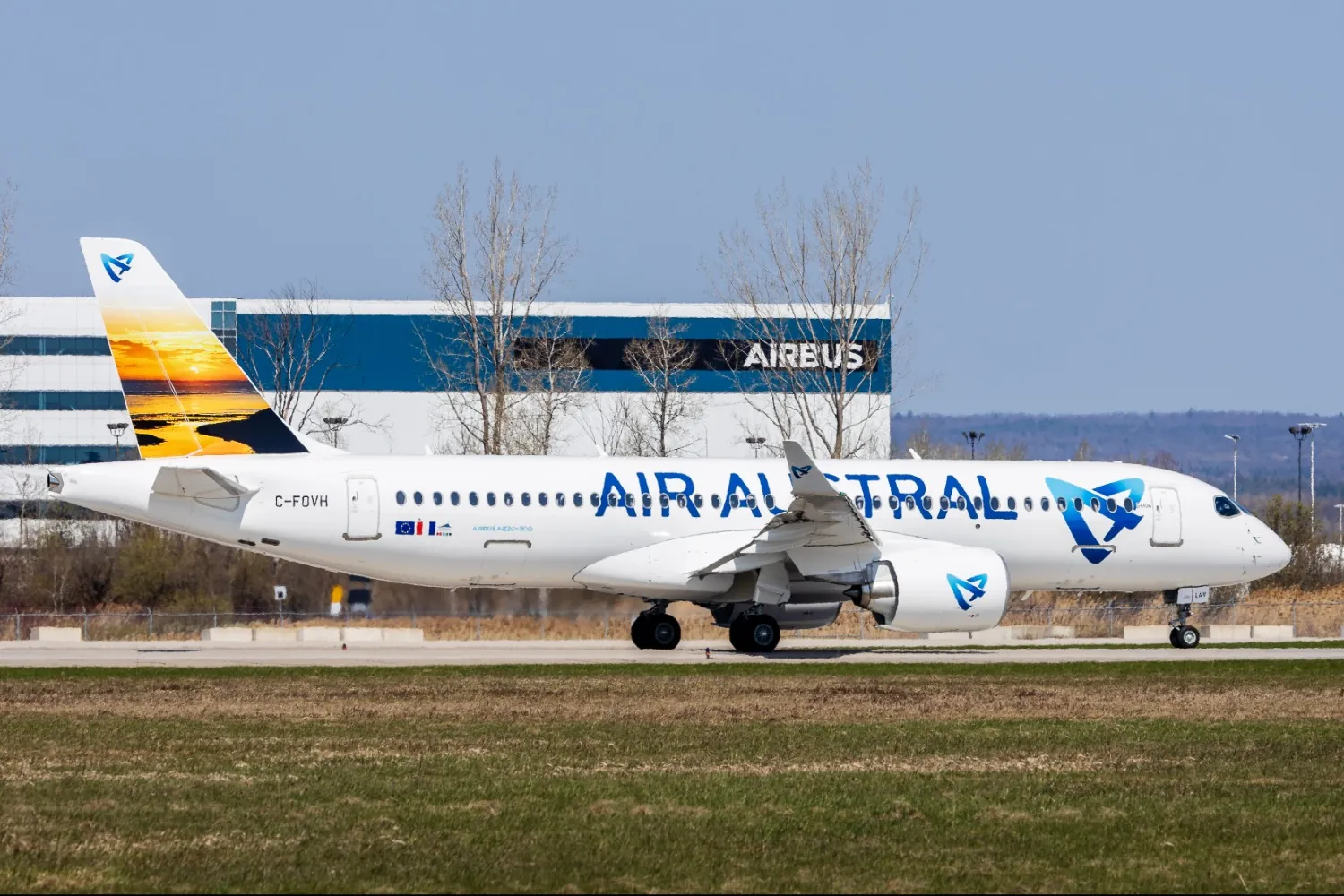
Air Austral A220 — will one airline’s decision reshape the future of a jet that was designed to redefine small‑narrowbody flying? Air Austral Airbus A220 reliability troubles forced a pivot toward sturdier, immediately available narrowbodies.
Intro
The question facing readers today is simple: Air Austral A220—what happens next when a promising aircraft meets a stubborn reliability wall? Meanwhile, over several days in late September 2025, Réunion’s flag carrier confirmed it plans to retire all three of its Airbus A220‑300s, citing persistent Pratt & Whitney GTF engine issues that have repeatedly immobilised aircraft and disrupted its regional network in the Indian Ocean. Additionally. multiple outlets reported the same through official remarks and local follow‑ups, with options for replacement including the Airbus A320neo family or Boeing’s 737 MAX. La Tribune first carried the scoop via an interview at the IFTM Top Resa trade show; coverage rapidly followed in AeroTime, Air‑Journal, and Réunion outlets like Zinfos974 and LINFO.re. (La Tribune)
Air Austral A220: What Changed Between September 24 and 26, 2025?
In a paywalled interview on September 24, Air Austral’s chairman Hugues Marchessaux said the airline would seek more reliability on its medium‑haul network by pivoting away from the A220. He observed that two of the three aircraft were down for lack of engines and that the type’s availability no longer matched the carrier’s needs from Réunion to Madagascar, Mauritius and South Africa. Moreover, La Tribune summarised the turning point; AeroTime, AirlineGeeks, and Air‑Journal fleshed out the context over September 25–26. (La Tribune)
When your engine shop visits become a standing meeting, the calendar starts flying more than the aircraft.
The decision, in the chairman’s own words
Marchessaux’s remarks at IFTM Top Resa crystallised the move. He said the airline had “quatre années de problèmes et d’immobilisations à répétition,” and that the company now felt compelled to choose a different narrowbody “module.” We cite two brief, verbatim excerpts (French), with an English paraphrase for clarity:
« nous considérons que nous n’avons pas d’autres choix – et c’est un choix contraint – que d’essayer d’évoluer vers un nouveau module » (La Tribune).
(Paraphrase: We have no other choice—constrained—to evolve to a new narrowbody to stabilise operations.) (La Tribune)
« Je n’ai pu disposer que de 1,75 avion en moyenne sur l’année » (Zinfos974).
(Paraphrase: On average, only about 1.75 of the three A220s were available this year.) (Zinfos974)
Zinfos974 added specifics: two of the three A220s are immobilised; the airline is working with Airbus and Pratt & Whitney on an exit, potentially via a Canadian bank; and the target to remove the type is by mid‑2026, with replacement options narrowed to A320neo or 737 MAX 8, likely via tax‑advantaged operating leases rather than new purchases. Zinfos974. (Zinfos974)
What is the status of Air Austral’s three A220‑300s?
Notably, several trackers and reports align on the registrations: F‑OLAV, F‑OTER, and F‑OMER. Meanwhile, recent local and trade coverage indicates two are out of service while one remains operational. Air Data News and Air‑Journal detail the immobilisations, while Planespotters confirms the frames. (Air Data News)
Three aircraft, one working—this is not the ratio anyone advertises in a brochure.
Air Austral A220: A Short, Turbulent History (2021–2025)
Originally, Air Austral took its first A220‑300 in July 2021, becoming the A220 pioneer in the Indian Ocean. The type promised lower fuel burn and right‑sized capacity for thinner regional routes. AvioRadar. (AvioRadar)
Today, the design brief of the A220 remains compelling. Airbus’ April 2025 factsheet records 904 orders, 406 deliveries, and ~98.9% operational reliability on a three‑month rolling basis, alongside a stated 25% per‑seat fuel burn reduction versus previous‑generation jets. Airbus A220 facts & figures. (Airbus)
Yet the local reality for Air Austral eroded as engines cycled through shop visits, leaving aircraft idle and schedules shuffled—an unsustainable pattern for a regional network built on frequency. Air‑Journal. (Air Journal)
The A220 sold “efficiency”; Air Austral needed “availability”—two words that rhyme less than they align.
Air Austral A220 and the GTF: What Went Wrong?
Notably, the Pratt & Whitney PW1500G powers every A220. Meanwhile, across the GTF family, a powder‑metal defect and other durability issues forced accelerated inspections and shop visits since 2023. RTX (Pratt’s parent) warned that “600 to 700 incremental shop visits” were needed between 2023 and 2026, with “an average of 350 jets… grounded per year through 2026”, and as many as 650 idle in the first half of 2024. RTX; Reuters. (RTX)
Furthermore, Pratt says it is improving turnaround times; in April 2025, a new additive manufacturing repair was touted to “cut repair process time by over 60%.” Reuters. (Reuters)
However, while those developments help the global fleet, they did not resolve Air Austral’s immediate reliability hole in 2024–2025. The outcome is a fleet strategy change rather than waiting for fixes to catch up. La Tribune. (La Tribune)
If engines had doctor’s notes, the GTF would have racked up enough sick days for a sabbatical.
Ground truth: two of three aircraft idle, and the network feels it
Currently. two of the three A220‑300s are immobilised, with the third flying, a pattern that has persisted for months. LINFO.re; Air‑Journal. Aircraft registration trackers corroborate the fleet composition. Planespotters. (Linfo.re)
Originally, the A220s were intended to sustain Réunion–Mayotte/Madagascar/Mauritius/South Africa connectivity. As a result, when availability dips, the airline backfills with widebodies or trims frequencies—neither is optimal on cost or demand‑matching. AeroTime. (AeroTime)
Replacement shortlist: A320neo vs 737 MAX—what fits?
Accordingly, La Tribune reported that Air Austral is evaluating the A320neo family or 737 MAX as the new “module” for medium‑haul. This aligns with local reporting that suggests MAX 8 and A320neo as the most viable targets, likely through operating leases given capital constraints. La Tribune; Zinfos974. (La Tribune)
Importantly, engines matter here. The A320neo offers two engine families: PW1100G‑JM (a GTF relative) and CFM LEAP‑1A. By contrast, the 737 MAX is exclusively powered by the CFM LEAP‑1B. Safran (LEAP‑1A); Safran (LEAP‑1B); Boeing. (Safran)
Operationally, both A320neo and MAX 8 exceed the A220’s typical capacity, which may help on peak days but could challenge off‑peak economics. Ultimately, lease‑market availability will likely dominate the final choice more than marginal seat‑mile cost deltas. Zinfos974. (Zinfos974)
The perfect airplane is the one you can actually get—and keep flying.
This is not just Air Austral: the wider A220 community’s rough patch
Elsewhere, airBaltic, the largest A220 operator, cancelled 4,670 flights for Summer 2025 after extended engine maintenance delays. The figure is confirmed by Reuters and several industry outlets. Reuters; Aviation Business News. (Reuters)
Similarly, EgyptAir exited the A220 entirely in early 2024, selling all twelve frames to lessor Azorra, with follow‑on reports noting at least one teardown amid parts scarcity. Azorra; FlightGlobal; ch‑aviation. (azorra.com)
Meanwhile, SWISS, the launch operator, still backs the type but has repeatedly managed groundings across 2024–2025 and even reviewed the A220‑100 fleet’s future. Aviation Week; ch‑aviation. (Aviation Week)
The A220 fan club still meets monthly—but lately the minutes include too many engine serial numbers.
Meanwhile, Airbus promotes the A220’s strengths
By contrast, Airbus lists a ~98.9% operational reliability metric (three‑month rolling) across the fleet as of March 2025, along with 25% lower per‑seat fuel burn. That headline contrasts with the harsh experience of some operators, underscoring how global averages can mask local variance when supply chains strain. Airbus facts & figures. (Airbus)
In parallel, Pratt & Whitney, for its part, is adding MRO capacity, new repair methods, and negotiating compensation—RTX’s 2025 outlook references substantial compensation impacts. Reuters. (Reuters)
Local press: timeline and financing contours
Notably, Réunion’s Zinfos974 reported a mid‑2026 horizon to complete the A220 exit, with tax‑advantaged operating leases preferred and a Canadian bank potentially involved in financing. The outlet also recorded Marchessaux’s striking utilisation figure—**“1.75 aircraft on average”—**and confirmed two frames idle at present. Zinfos974. (Zinfos974)
Additionally, LINFO.re reinforced the same basics: engine issues, two of three A220s grounded, and replacements under study. LINFO.re. (Linfo.re)
The internal alternative: staying with an A220 variant?
Indeed, some readers will ask whether staying with A220 but waiting for engine fixes could work. Even so, The A220‑300 remains attractive on paper (and in many operations), and Airbus continues to refine the product—including a 160‑seat high‑density configuration and ongoing discourse around a potential A220‑500.
See Fliegerfaust analyses: A220 160‑seat layout and A220‑500 engine options. For Air Austral, however, time‑to‑reliability appears longer than its time‑to‑stability window. (Fliegerfaust)
If Air Austral chooses A320neo
Moreover, the A320neo family would give Air Austral a familiar Airbus cockpit philosophy and a vast global support footprint. Picking CFM LEAP‑1A would deliberately avoid the GTF lineage; picking PW1100G‑JM would bet on Pratt’s fixes. Either way, lease availability will drive near‑term realism. Safran on LEAP‑1A. (Safran)
Seat counts would rise relative to the A220‑300, offering peaks flexibility and better spares commonality if more frames can be sourced. But fuel and airport economics on thin routes may tighten, particularly off‑peak.
(Related context from Fliegerfaust: Paris Air Show coverage.) (Fliegerfaust)
If Air Austral chooses 737 MAX 8
The MAX 8 would tap LEAP‑1B engines and Boeing’s global network. Cross‑fleet commonality with Air Austral’s 777/787 is limited in practice, but a single‑manufacturer relationship can ease negotiations and training pipelines. Boeing 737 MAX. (Boeing)
Avoiding the PW1000G family may be attractive psychologically and operationally. But delivery slots remain tight, and lease choices may constrain timing and cabin specs. (LEAP family overview: CFM.) (CFM Aero Engines)
The LEAP pitch is simple—“We promise not to be your problem this time.”
Timelines, regulation, and the “AD burden”
Separately, engines have dominated headlines, but narrowbodies also face airworthiness directives unrelated to GTF. Specifically, regulators issued A220 ADs in 2024–2025 addressing discrete issues—from systems software to structures—adding to operators’ planning load. See the FAA AD adopting Transport Canada’s directive for the A220 (effective April 22, 2025), and other recent rulemaking. FAA AD 2025‑04320; ch‑aviation. (Federal Register)
Therefore, for a small carrier balancing recovery and regional obligations, even routine AD cycles can push a marginal availability pool into disruption, especially when compounded by engine MRO queues.
Quip: Paperwork doesn’t ground planes—but it never helps when you are already short a turbine.
What the trade press and spotters say
Notably, AeroTime frames Air Austral’s move as a plan to “get rid of” the fleet, noting two of three jets affected and the A320neo/737 MAX shortlist. AirlineGeeks reports the airline “had no other choice,” repeating the three‑aircraft exit. Air‑Journal adds ch‑aviation’s frame‑by‑frame status, and Scramble carried alerts across social posts. AeroTime; AirlineGeeks; Air‑Journal; Scramble. (AeroTime)
Aerospace Global News collected several quotes and timeline snippets, while Air Data News produced accessible overviews for general readers. Aerospace Global News; Air Data News. (AGN)
Scenario planning: how Air Austral could manage 2026
Scenario A: Lease A320neo (LEAP‑1A).
Pros: Avoids PW1000G family, broad support ecosystem, strong lessor pools.
Cons: Larger gauge than A220; may push fares or load requirements on thinner routes.
Scenario B: Lease 737 MAX 8 (LEAP‑1B).
Pros: LEAP‑only strategy, diverse lessor inventory, widely adopted.
Cons: Cockpit/ops training adjustments; slot pressure and delivery timing risks.
Scenario C: Wait out fixes; retain A220.
Pros: Keeps right‑sized gauge, preserves cabin comfort narrative.
Cons: Availability risk persists into 2026; financial risk if MRO cadence slips again.
Scenario D: Mixed interim lift.
Pros: Right‑size each route; hedge engine risk across platforms.
Cons: Complexity in spares, training, and vendor management.
Ultimately, none of the scenarios is perfect; availability is king. The goal is a predictable schedule for Réunion’s regional lifelines by mid‑2026. Zinfos974. (Zinfos974)
The passenger and community lens
Reliability on Réunion–neighbour routes is more than a metric; it is connectivity for families, commerce, and tourism. When two of three narrowbodies sit idle, the ripple hits fares, frequency, and confidence. Lighter, right‑sized jets shine when they actually show up; consistency is the currency that restores trust.
Balancing fairness to the A220 programme
The A220 remains a modern, efficient aircraft with strong passenger appeal. Its problems do not erase its achievements or wider operator satisfaction in many fleets. Airbus’ April data indicates a healthy order book and a maturing support base. Airlines such as Delta, Air Canada, and JetBlue continue to expand operations with the type, while suppliers ramp solutions. Airbus facts & figures. (Airbus)
But for Air Austral, the local pain exceeded the global promise. The verdict is case‑specific, not a universal A220 referendum.
What to watch next
- Which platform Air Austral picks—A320neo (LEAP‑1A) or 737 MAX 8 (LEAP‑1B)—and lease availability timing. Safran; Boeing. (Safran)
- Regulatory & MRO updates from Pratt/RTX that improve TATs and spares pools. Reuters. (Reuters)
- Airbus/A220 production, support, and retrofit cadence; operator reliability trends during 2025–2026. Airbus. (Airbus)
Quip: The next press release you want to read is the one with the word “available” in bold.
Internal links for further reading on Fliegerfaust
To deepen context, see these recent pieces (open in a new tab):
- A220 news roundup
- A220‑500: can the stretch soar without a new wing?
- A220 160‑seat configuration
- Airbus–Spirit AeroSystems deal and the A220
Conclusion: a critical view—and a question for readers
Air Austral’s move is rational given its constraints. You cannot run a regional network when two‑thirds of your small‑narrowbody fleet is unavailable. The A220 still deserves its place in modern fleets; the PW1500G issues appear fixable, and both Pratt and Airbus are pushing hard on MRO capacity, repair methods, and support. Yet for this carrier, the timeline to restored reliability is out of sync with the timeline to restore confidence and cash flow.
The critical view is this: Air Austral is making a defensive fleet choice to protect network stability, not to score a win in seat‑mile economics. If leases put A320neo or 737 MAX on the ramp quickly, Réunion gains something priceless—predictability. If engine and supply‑chain fixes soon close the A220 reliability gap, the type could still thrive elsewhere, including at airlines whose scale and spares pools blunt shocks.
Question: In a world of tight delivery slots and fragile supply chains, is it wiser for small carriers to pick the “best” aircraft on paper—or the one they can consistently keep in service tomorrow?
Select sources cited in‑text (each opens in a new tab)
- La Tribune (Sept 24, 2025) (La Tribune)
- AeroTime (Sept 25, 2025) (AeroTime)
- AirlineGeeks (Sept 25, 2025) (AirlineGeeks.com)
- Air‑Journal (Sept 26, 2025) (Air Journal)
- Zinfos974 (Sept 25, 2025) (Zinfos974)
- LINFO.re (Sept 26, 2025) (Linfo.re)
- Air Data News (Sept 25–26, 2025) (Air Data News)
- Reuters (Sept 11, 2023) and RTX (Sept 11, 2023) (Reuters)
- Reuters (Apr 8, 2025) (Reuters)
- Reuters (Jan 2, 2025) (Reuters)
- Azorra (Feb 1, 2024); FlightGlobal (May 24, 2024) (azorra.com)
- Airbus A220 Facts & Figures (Apr 2025) (Airbus)
For full details, please refer to our Disclaimer page.

Simply desire to say your article is as amazing.
The clarity to your submit is just great and that i can think you’re an expert on this subject.
Well together with your permission allow me to seize your feed to keep up to date with approaching post.
Thank you 1,000,000 and please keep up the rewarding work.