

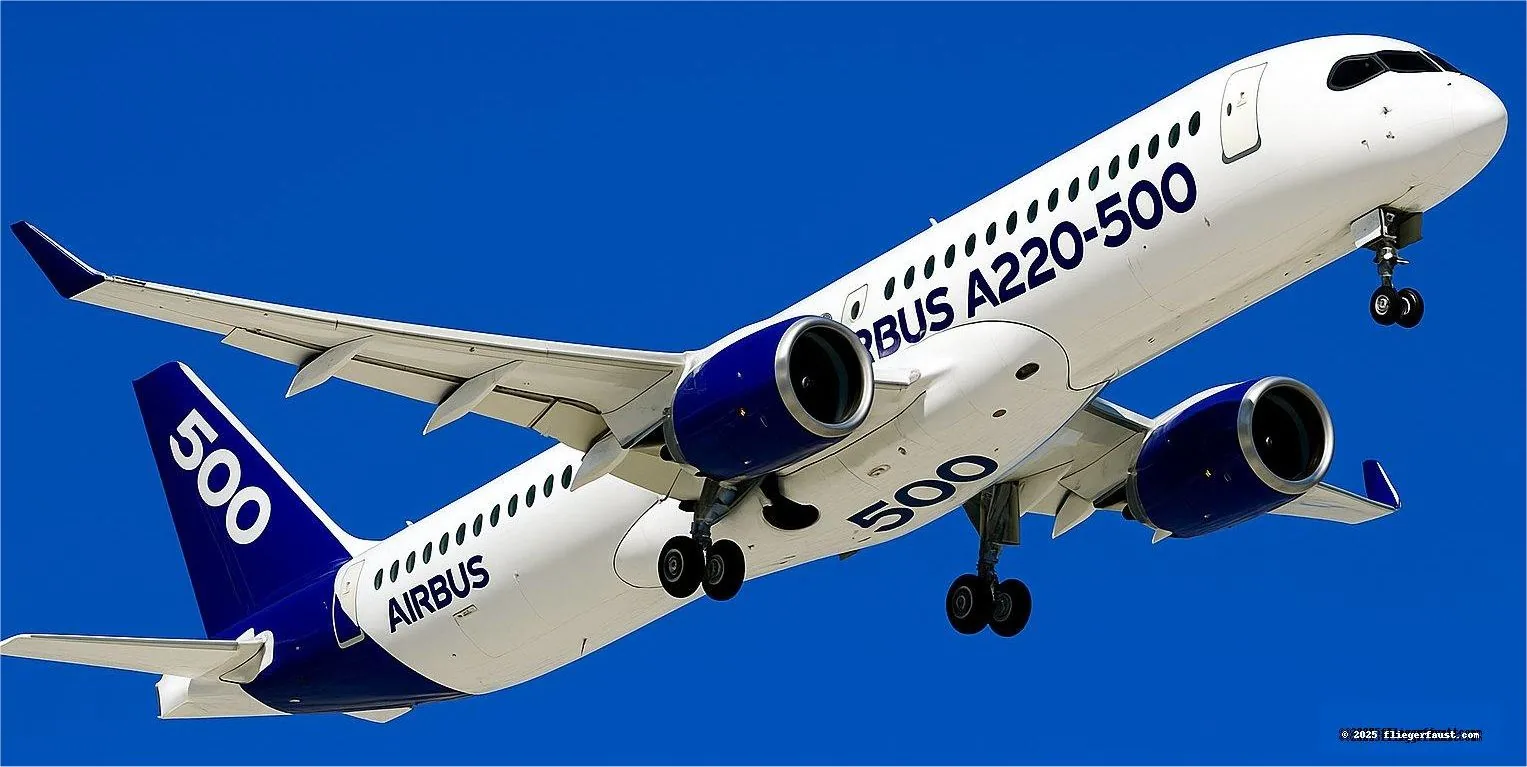
Airbus A220-500 update: what did Airbus’s new commercial-aircraft chief actually say in Dublin on January 26, 2026—and how does it connect to a possible stretch and a second engine option?
First, the headline from the Airline Economics conference in Dublin was not a grand product launch. Instead, it was a blunt reminder that 2026 is an output year for Airbus. The company needs more finished aircraft leaving the gate, on the promised dates, with engines that stay on-wing longer.
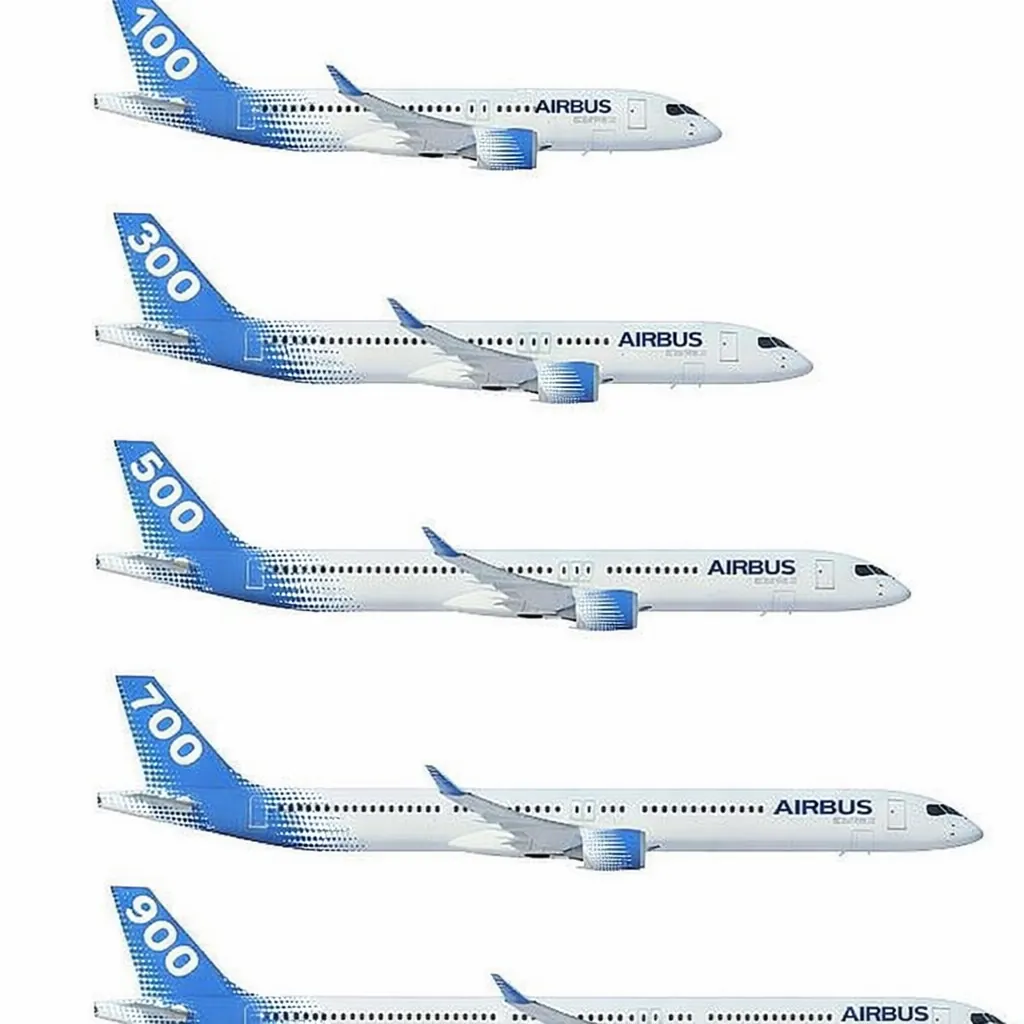
Meanwhile, a bigger A220 keeps resurfacing because airlines and lessors still see a “golden seat count” gap between the Airbus A220-300 and the Airbus A320neo (new engine option) family. Also, if you want the long backstory on the stretch debate, start with our earlier analysis on Fliegerfaust: Airbus A220-500: Can the Stretch Soar Without a New Wing?.
Also, the engine story matters just as much as fuselage length. For the durability and shop-visit reality behind today’s A220 fleets, revisit our ongoing engine-focused coverage on Fliegerfaust: Latest A220 News: Ramp Reset and the Road Ahead.
So, this feature ties together what was said at that Dublin conference, what Reuters reported on January 26, 2026, and what the wider A220 / engine ecosystem is signalling. Additionally, it looks at the UK side of Airbus’s supply chain, because wing and aerostructure flow is now board-level strategy, not a factory-footnote.
In short, in this Airbus A220-500 update, the unglamorous parts—rates, wings, and engine durability—matter more than branding.
Airbus A220-500 update from Dublin: Wagner’s first public priorities
Dublin’s aircraft-finance crowd is famously civil—right up until someone says “delivery slipped,” and then the room goes very quiet.
He took the job on January 1, 2026, and talked about production first
First, it matters who was speaking. Lars Wagner became Chief Executive Officer (CEO) of Airbus’s Commercial Aircraft business on January 1, 2026, following Airbus’s July 10, 2025 appointment announcement. At the time, he was Chief Executive Officer of MTU Aero Engines AG—so Airbus chose a commercial-aircraft leader with deep “engine-world” and industrial experience. In my view, that doesn’t automatically dictate new supplier decisions, but it likely influences how hard Airbus pushes on engine durability, delivery discipline, and long-term supplier flexibility.
Next, he chose an operational theme for his first big public outing. At the Airline Economics conference in Dublin, Wagner described a sector-wide squeeze on parts, labour, and engines. “The whole ecosystem is under pressure.,” — Reuters (Jan. 26, 2026)
Also, he framed the Airbus challenge in narrow-body terms. Airbus has been trying to reach 75 A320-family aircraft per month, while also increasing wide-body output, including the A350. Reuters summarised that output push and the A220 discussion in the same report, signalling that any A220 stretch talk is inseparable from Airbus’s ability to hit production rates. — Reuters (Jan. 26, 2026).
So, in this Airbus A220-500 update, the first takeaway is plain: Airbus is still fighting for rate stability.
He asked lessors, on stage, what they want next
Meanwhile, the Dublin setting mattered. Airline Economics is a lessor-and-airline finance meeting, so the conversation tends to snap back to residual values, delivery certainty, and maintenance exposure.
In that context, Wagner did something unusual for Airbus: he asked a buyer on stage what should come next. Reuters reported that John Plueger, the CEO of Air Lease Corporation, pushed the discussion back to basics. He told Wagner the industry’s biggest need was on-time deliveries.
When Plueger said he saw a role for a bigger A220, Wagner answered: “Me too”.
However, another lessor message pulled the opposite way. AerCap’s CEO Aengus Kelly urged cool heads on geopolitics and argued the real problem is the continuing aircraft shortage, not a lack of demand. He also dismissed new-model proposals in favour of industrial execution.
His second priority was not a new jet, but tougher engines
Still, the most strategic line in Wagner’s remarks was about propulsion and durability. Airlines like fuel savings, but they also need time on wing and predictable shop visits.
So, Wagner said Airbus needs to weigh competing engine technologies for the next generation of narrow-body aircraft. He also gave a blunt sequencing rule: “I think we need to solve the durability question first,” — Reuters (Jan. 26, 2026)
In other words, Airbus hears the airline complaint: new engines cut fuel burn, yet they also create new maintenance bottlenecks. That complaint is not theoretical anymore. It shows up in utilisation, lease rates, and even airline schedule planning.
Airbus A220-500 update: what other speakers in Dublin revealed about the supply crunch
In Dublin, the most punctual thing all week is usually the coffee—everything else is on “revised schedule.”
AerCap’s message: the shortage is structural, not a one-quarter glitch
First, the AerCap view matters because it frames the whole “new model” debate. AerCap is the world’s largest aircraft lessor, and its CEO Aengus Kelly spends his life turning aircraft availability into pricing signals.
Next, Kelly warned against overreacting to geopolitics and market volatility, because aviation finance works on long time cycles. Reuters reported him pointing to leases that can run up to 12 years and aircraft lives around 25 years.
Meanwhile, his most important operational point was blunt: aircraft shortages persist because the manufacturers keep missing delivery timelines. He expects the supply constraint to drag on through the decade. That expectation is not just mood. It affects lease-rate factors, extension pricing, and end-of-lease return negotiations.
Also, that shortage view explains AerCap’s scepticism about launching “the next shiny thing.” If the bottleneck is industrial throughput, a new derivative does not fix it. It can even make it worse, because it competes for engineering, certification, and supplier capacity.
Airbus A220-500 update: AerCap is not Airbus
However, that logic also explains why Kelly is not a fervent supporter of a longer A220 variant such as a potential A220‑500. From a lessor’s viewpoint, a new stretch can look like added execution risk before it looks like added value. Still, AerCap is not Airbus and it does not represent any single airline’s network needs. In practice, it plays the role of the “bank” behind many aircraft acquisitions, and its priorities—predictable deliveries, stable residual values, and lower technical risk—can differ from an airline’s desire for the perfect seat-count tool.
Embraer’s message: demand is hot, but the supply chain still sets the tempo
However, Airbus was not the only planemaker mentioned in Dublin. Embraer used the same event to signal confidence and talk about its own ramp.
Embraer Commercial Aviation CEO Arjan Meijer said Embraer aims to restore annual deliveries to pre‑pandemic levels of around 100 jets within the next two years, and potentially grow further after a surge in orders.
Next, Reuters noted that Embraer logged 131 net orders for its E2 (second-generation E‑Jet) series over the past year, a pace that outstripped Airbus’s A220 during the same period. That is a pointed comparison, because the A220 and the Embraer E195‑E2 often fight over the same airline RFPs (requests for proposals).
Still, Meijer’s remarks also carried a warning: supply chains may improve, but he expects full stability only in 2026. Engines and aerostructures remain the moving constraints, even if the list of problem parts shifts month to month.
Additionally, the Embraer comments highlight the competitive angle inside the A220-500 debate. If Airbus does not offer a bigger A220, Embraer can keep pressing the top end of the regional market. If Airbus does offer a bigger A220, it may squeeze Embraer—yet it may also squeeze Airbus’s own A320neo sales.
What the conference context means for an A220-500 business case
So, what does this “conference chorus” mean for Airbus strategy?
First, it reinforces that buyers care about utilisation and delivery dates as much as new models. A bigger A220 only helps an airline if Airbus can deliver it on time, and if engines stay on-wing long enough to support high daily cycles.
Second, it underlines why lessors obsess over maintenance exposure. The same seat count can produce very different economics if engine shop visits double, or if spare engines sit in the wrong geography. That is why Wagner’s durability-first line resonated.
Third, it suggests that the A220-500 debate is partly a timing tool. Airlines and lessors use it to keep Airbus listening. They want a credible future option. They also want Airbus to prove it can scale today’s A220 and A320 output without drama.
In fact, in this Airbus A220-500 update, the conference chorus points to the same conclusion: execution comes first.
Finally, the Dublin takeaway is not “launch the A220-500 now.” The takeaway is “earn the right to launch it later.” In 2026, that right depends on predictable production, stable wings, and engines that behave like industrial assets, not like experimental hardware.
Airbus A220-500 update: why the “bigger A220” argument won’t go away
The market gap is real, but Airbus worries about self-competition
First, the core pitch for a larger A220 is seat economics. Airlines like the A220’s cabin and fuel burn. They also want more revenue seats on the same crew and slot.
Next, the “stretch” idea sits in a crowded zone. A conceptual A220-500 would move toward the lower end of the Airbus A320neo (new engine option) family and toward the Boeing 737-8. That overlap creates a classic Airbus dilemma: grow the A220, but do not erode the margins of the A320 programme.
However, Airbus has already acknowledged that a new A220 variant could unlock supplier renegotiations and potentially improve the programme’s economics. Reuters reported in May 2023 that Airbus said a new variant could also open up a choice of engines. Reuters (May 24, 2023).
Therefore, in this Airbus A220-500 update, the market logic looks strong, but Airbus still fears cannibalisation. Could a “neo-style” new engine option also become part of an extended A220 variant, effectively creating an A220-500neo concept?
Engineering reality: stretches are easy to draw, harder to certify
Meanwhile, the engineering question is not “can Airbus add plugs to the fuselage?” Of course it can. The harder question is what the stretch does to wing loading, runway performance, and range—and how much redesign Airbus must buy back to keep the aircraft attractive.
Also, independent analysis has explored the trade-offs between a low-cost stretch and a more expensive wing-and-engine upgrade. We examined the same question in Airbus A220-500: Can the Stretch Soar Without a New Wing? Leeham News also ran a two-part assessment in May 2025 looking at whether an A220-500 would need a new wing and more thrust: Leeham News (Part 1) (May 1, 2025) and Leeham News (Part 2) (May 8, 2025).
So, the stretch debate quickly turns into a programme-scope debate. A stretch-only change might be faster and cheaper. Yet it can also limit the aircraft’s mission set. A wing or engine change can recover performance, but it increases complexity and certification burden.
Finally, this is why Airbus keeps the concept in the “discussed” category, not the “announced” category. The bill of materials, and the risk envelope, matter as much as the seat count.
AirAsia’s 160-seat A220 talks add a new data point
Still, the Dublin debate now collides with a practical airline question: how dense can today’s A220-300 become, and who will actually buy it?
On January 23, 2026, Reuters reported that Airbus was nearing a deal to sell around 100 A220 jets to AirAsia, with discussions including a high-density 160-seat version. If that deal materialises, it would not be an A220-500. Yet it would show that some large low-cost carriers are ready to push the current A220 cabin toward higher seat counts—an angle we also covered at Fliegerfaust in our January 18, 2026 deep dive: A220 ramp-up (AirAsia, 160 seats, and the door supply-chain shift).
Meanwhile, the AirAsia angle matters because it tests two things at once. It tests whether airlines want “more A220 seats now.” It also tests whether Airbus can support high utilisation with today’s engine durability constraints.
Why AerCap’s scepticism still matters
However, AerCap’s scepticism has weight because AerCap is not just a buyer; it is also a market signal. In Dublin, AerCap’s CEO urged Airbus to focus on execution and argued the supply deficit will last through the decade – Reuters (Jan. 26, 2026).
So, when AerCap argues that a bigger A220 has “no demand” today, it is really making a timing claim. It says airlines have more urgent pain points: delays, grounded aircraft, and a shortage of spare engines.
Finally, the most realistic interpretation is this: Airbus can keep the A220-500 concept warm while it fixes the industrial basics. The company does not need to sign an A220-500 launch cheque to benefit from doing the groundwork.
Airbus A220-500 update: engines, durability, and the “NEO” idea
In 2026, the busiest runway at many airlines is not the departure runway—it’s the engine shop queue.
So, in this Airbus A220-500 update, durability is the gating variable.
Durability moved from a technical topic to a financing variable
First, Wagner’s “durability question” line lands in a moment of open airline frustration. Airlines say engine makers delivered fuel-burn and emissions improvements, but they also delivered more wear, more removals, and longer waits for maintenance slots.
For the operator-level reality behind that frustration, see our Latest A220 News: Signals, Strategy Shifts, and the Road Ahead (including the SWISS A220-100 grounding) and our case study on Air Austral’s decision to exit the A220 by mid‑2026 amid Pratt & Whitney GTF issues.
Meanwhile, the International Air Transport Association (IATA) renewed its global maintenance agreement with CFM International (the GE Aerospace–Safran joint venture) through February 2033, in part to promote competition in engine maintenance and lower costs. Reuters linked the pact to a wider maintenance crunch and billions in added costs. Reuters (Jan. 20, 2026).
Also, GE Aerospace’s CEO has publicly acknowledged airline frustration while pointing to accelerated durability improvements for the LEAP (Leading Edge Aviation Propulsion) engine family built by CFM. Reuters covered that pushback and the planned durability fixes in January 2026. Reuters (Jan. 22, 2026).
The A220’s PW1500G makes “durability” a program-level issue
First, the Airbus A220 relies on Pratt & Whitney’s PW1500G geared turbofan (GTF) engine. That matters because A220 dispatch reliability and lease economics depend on time on wing, spare-engine availability, and predictable shop visits.
However, the geared turbofan family has faced durability challenges and supply constraints that have forced airlines to manage groundings and spare-engine shortages. Reuters reported in May 2025 that Airbus warned airlines delivery delays could persist for another three years as it worked through supply-chain issues, with engines among the key constraints. Reuters (May 28, 2025).
So, when Wagner says “durability first,” A220 operators hear a very practical promise. They want engines that stay on-wing longer, and they want maintenance throughput that matches the fleet’s growth curve.
A second engine option for a future A220-500 is not fantasy
Next, the “A220-500 neo style” idea that circulates in the market is really two ideas glued together: 1) a longer A220 variant (commonly labelled A220-500, though Airbus has not launched it), and 2) a new engine option—what Airbus brands as “neo” (new engine option) on other families.
However, Airbus has already signalled that an A220 variant could open the door to a second engine source. In July 2022, The Air Current reported Airbus was advancing its A220-500 strategy while exploring engine-path options that could include CFM International alongside the incumbent Pratt & Whitney.
Then, in June 2023, GE’s Larry Culp said “all options were on the table” when asked about investing in an engine for a stretched A220. Reuters reported those comments from the Paris Airshow. Reuters (Jun. 19, 2023).
The Air Current also reported in June 2023 that GE signalled interest in providing a second engine for a conceptual A220-500. That reporting also highlighted Airbus’s interest in a second engine option: The Air Current (Jun. 19, 2023).
What a “neo” would actually do for Airbus’s supply chain
Still, it is worth separating marketing from mechanics. Adding a second engine to the A220 would not be a simple “checkbox option.” It would require a new pylon and nacelle, a new certification campaign, and a clear commercial plan around exclusivity and support.
So, why does the idea keep coming back? Because a second engine option would buy Airbus something valuable: supplier flexibility. It could reduce single-point-of-failure risk in a world where engine shortages can hold completed aircraft on the ground.
In addition, the engine makers themselves are in a race to demonstrate durability gains. CFM’s own 2025 press release highlighted “maturity improvements” for the LEAP family and pointed to further updates into 2026. CFM International (Nov. 17, 2025).
Finally, the critical nuance is this: Wagner’s “durability first” logic suggests Airbus will judge engines by real-world maintenance outcomes, not just brochure fuel burn. That mindset would shape both a future A220 stretch and the future A320 successor.
FLIG AVIA
Airbus A220-500 update: the production reality check behind every stretch debate
The A220 ramp is still a story about rates, not rumours
First, Airbus needs the A220 to reach a stable cadence before it can responsibly launch a stretch. The baseline story is simple: higher monthly output lowers unit costs, supports airline growth plans, and helps Airbus get the A220 programme to consistent profitability.
For Fliegerfaust’s current view of the A220 ramp and the engine constraints shaping it—and why that directly affects any stretch timing—see our latest A220 ramp and engine outlook.
Next, Airbus has long referenced a goal of reaching 14 A220 aircraft per month. Airbus’s own A220 programme background material described a plan to reach 14 per month “by the middle of this decade”: Airbus (Jul. 12, 2022).
However, the nearer-term ramp has been uneven. We covered Airbus’s A220 rate reset and the stepping-stone plan in our Fliegerfaust “latest A220 ramp and engine outlook“, including the internal move toward roughly 12 A220s per month by mid‑2026 before any later attempt to return to a 14‑per‑month pace by the end of 2026.
The October 2025 “12 per month” reset was a signal, not a collapse
Meanwhile, Airbus confirmed in its third‑quarter 2025 briefing that it now aimed for 12 A220s per month in 2026 rather than 14.
Also, FlightGlobal reported that Airbus attributed the decision to the “current balance between supply and demand” while still framing the A220 as a growth programme: FlightGlobal (Oct. 29, 2025).
So, a 12-per-month target is not small. It is a bridge. In practice, that reset buys time for engines, wings, and quality gates to align. It also reduces the “rush risk” that drives late rework and missed handovers.
Delivery performance is a strategic weapon in a tight market
Still, the broader Airbus delivery picture adds context. On January 12, 2026, Reuters reported Airbus delivered 793 aircraft in 2025, and pointed again to engine availability as a key constraint. Reuters (Jan. 12, 2026).
Additionally, Airbus itself publishes detailed results and production-rate targets in its financial disclosures. In its Half‑Year (H1) 2025 results, Airbus reiterated targets for the A320 family and also noted supply-chain pressure on both the A350 and the A220: Airbus (Jul. 30, 2025).
Finally, here is the practical takeaway for the A220-500 question: Airbus can only launch a stretch when its current A220 output behaves like an industrial system, not like a hero story.
Airbus A220-500 update: UK operations, Belfast wings, and the supply-chain chessboard
The UK’s aerospace output is huge, but sadly it still doesn’t ship with an “express delivery” button.
Also, in this Airbus A220-500 update, the UK story is not a sidebar. It is the A220’s structural backbone.
Belfast is not a footnote—it is the A220’s wing heart
First, the A220’s wing story is a UK story. Spirit AeroSystems’ Belfast operations have long built A220 wings and related aerostructures. Those work packages became strategically sensitive once global supply chains turned fragile.
Next, Airbus moved to bring key Spirit assets under its own control. Airbus signed a definitive agreement with Spirit AeroSystems on April 28, 2025 for the acquisition of industrial assets tied to Airbus commercial programmes: Airbus press release (Apr. 28, 2025).
Meanwhile, Airbus later confirmed it had completed the acquisition of several former Spirit sites on December 8, 2025, including production of A220 wings and A220 mid‑fuselage in Belfast, now becoming “Airbus Belfast”. Airbus press release (Dec. 8, 2025).
Also, Reuters framed Airbus’s Spirit carve‑out as a supply-chain stabilisation move, with Airbus receiving compensation for taking on loss-making activities. Reuters (Apr. 28, 2025).
For more background on why Belfast sits at the centre of this industrial realignment, see our earlier explainer: Airbus Spirit AeroSystems Deal: A New Chapter for the A220 and Aerospace Manufacturing.
Broughton and Filton show Airbus’s deeper UK footprint
However, Airbus’s UK role goes well beyond Belfast. Airbus’s own “Airbus in the United Kingdom” page describes Broughton as a global centre of excellence for wing manufacturing and Filton as a hub for wing design and advanced research. Airbus (accessed Jan. 27, 2026).
In addition, Airbus continues to invest in wing innovation capacity in Filton. Airbus highlights the Wing Technology Development Centre and next-generation wing work under its innovation programmes: Airbus (updated Sep. 24, 2024).
Why UK control matters for an A220 stretch and engine flexibility
Still, the Belfast and UK angle connects directly to the A220-500 discussion. A stretch aircraft needs more structures, more parts, and tighter integration discipline. If wing flow slips, the whole final-assembly rhythm slips.
So, Airbus’s choice to internalise key aerostructure work is not only about today’s production targets. It is also about future optionality. Vertical integration can make it easier to adapt the supply chain to a future variant, whether that is a cabin-density change, a fuselage stretch, or a new engine installation that demands structural and systems changes.
Finally, you can see the “operations first” mindset inside our own A220 ramp-up reporting, including the door and supply-chain shifts that illustrate how small components can throttle production: Airbus A220 ramp-up: 93 deliveries, 160 seats, and the China–India door supply chain shift.
Airbus A220-500 update: what the Dublin comments signal for Airbus’s wider fleet plan
The A350 and the A220 share the same industrial truth
First, Wagner’s Dublin comments started with output across programmes, not just the A220. That matters because Airbus has to balance resources across the A220, the A320 family, and the A350.
Next, Airbus’s wide-body ramp has its own bottlenecks, from aerostructures to engines. Airbus’s A350 freighter (A350F) wing work in Broughton illustrates how the UK wing system links into wide-body plans too. Airbus press release (Jun. 2, 2025).
So, when Airbus talks about increasing A350 output, it is also talking about the same ecosystem problem Wagner highlighted. The parts network is shared, and the industrial learning is shared.
The next single-aisle is “evolutionary,” but engines could still reset the rules
Meanwhile, Airbus leadership has tried to manage expectations on its next single-aisle. In March 2025, Reuters reported Airbus describing its next jet as “evolutionary rather than revolutionary,” while still noting that open-rotor engine concepts like CFM’s RISE (Revolutionary Innovation for Sustainable Engines) could be part of future options. Reuters (Mar. 24, 2025).
Additionally, CFM describes its RISE programme as targeting around 20% fuel efficiency improvement by the mid‑2030s. CFM’s official programme page lays out the concept and timeline: CFM International (accessed Jan. 27, 2026).
However, Wagner’s message suggests Airbus will not chase theoretical fuel savings at the expense of real-world durability. That framing can slow the “next jet” timeline, but it can also pressure engine makers to prove they can deliver both efficiency and time on wing.
Trade risk and supply-chain fragility sit in the background
In an internal letter seen by Reuters (Jan. 25, 2026), Airbus CEO Guillaume Faury warned staff that Airbus must be ready to adapt to unsettling new geopolitical risks after trade tensions caused significant logistical and financial damage.
So, when you combine that memo with the Dublin stage conversation, you get a consistent corporate theme. Airbus wants optionality in its supply chain, and it wants resilience in its engine pipeline. Both of those goals influence whether a stretched A220 becomes a near-term launch or a mid‑decade decision.
Airbus A220-500 update: what to watch next and what Airbus should do
If you’re looking for a single “tell” in 2026, watch the delivery ramp like it’s a live sports score—because for airlines, it basically is.
Four practical signals to track through 2026
First, track A220 monthly output in Mirabel and Mobile against the 12‑per‑month 2026 target, and watch whether Airbus quietly rebuilds a path back to 14.
Next, watch whether high-density A220-300 configurations gain real traction. The AirAsia talks reported by Reuters will be a useful test case. A dense, high-utilisation A220-300 fleet would strengthen the argument that airlines want “more A220” now, even before a stretch.
Meanwhile, monitor engine durability upgrades and shop-visit turnaround times. When shop queues shorten, dispatch reliability rises, and lessors relax lease reserves. That is when the A220 economics start to look “stable,” not just “promising.”
Finally, follow the Airbus Belfast integration work. If wing and mid-fuselage flow becomes smoother under Airbus ownership, it removes one of the loudest constraints on any future A220-500 decision.
Fliegerfaust view: a stretch is plausible, but only with engine and supply-chain optionality
So, in this Airbus A220-500 update, the decision tree is sequential.
So, here is the critical judgement call. Airbus should not rush an A220-500 launch until the A220 line hits predictable rates and the engine story improves. The reporting from Dublin makes that plain. Wagner’s first instinct is production discipline, not product fireworks.
However, Airbus should also keep the A220-500 “option value” alive. The A220 sits in a market slot that Boeing has left thin at the bottom end of the 737 MAX family. A successful A220-500 could pressure Boeing’s cash cow and give Airbus pricing leverage across the narrow-body range.
Additionally, Airbus should treat a second engine option as a strategic hedge, not just a performance upgrade. A single-source engine dependency is a supply-chain risk in a decade defined by shortages. Even if Airbus never brands it as an “A220neo,” the commercial logic is the same: optionality can protect deliveries, and deliveries protect market share.
My view, grounded in this reporting, is that Airbus’s best move is sequential. First, stabilise A220 deliveries and engine durability in 2026–2027. Next, use Airbus Belfast and UK wing expertise to reduce structural bottlenecks. Then, only then, decide whether a stretched A220 with an additional engine option can be launched without damaging A320neo profitability.
That sequencing is not conservative for its own sake. It is the shortest path to a stretch that airlines can actually use every day.
Question to you
So, if Airbus can fix the ecosystem pressure Wagner described and prove durability gains, will 2026 be remembered as the year the A220-500 became inevitable—or as the year Airbus quietly decided the A220 should stay exactly where it is?
Leave your answers and comments below and on our Fliegerfaust Facebook page.
Airbus A220-500 update: Sources
If you like checklists, this is the avionics bay of the article.
- New Airbus commercial CEO focused on output, backs bigger A220 — Reuters (Jan. 26, 2026)
- AerCap CEO warns against overreacting to geopolitical turmoil — Reuters (Jan. 26, 2026)
- Embraer jetmaking CEO eyes higher output after order spree — Reuters (Jan. 26, 2026)
- Airbus nears deal to sell around 100 A220 jets to AirAsia, sources say — Reuters (Jan. 23, 2026)
- Airbus CEO warns staff about trade damage, memo shows — Reuters (Jan. 25, 2026)
- Airbus jetliner deliveries rose 4% in 2025 — Reuters (Jan. 12, 2026)
- Airbus warns airlines delays will last three years, sources say — Reuters (May 28, 2025)
- Airbus delays some A220 output, narrowing window to reach 2026 target — Reuters (Oct. 27, 2025)
- Airbus beats Q3 expectations but cuts A220 production target — Reuters (Oct. 29, 2025)
- Airbus finalizes long-awaited Spirit AeroSystems deal — Reuters (Apr. 28, 2025)
- Airbus says next jet “evolutionary,” not “revolutionary” — Reuters (Mar. 24, 2025)
- No imminent launch of new A220 sub-model, Airbus says — Reuters (May 24, 2023)
- GE says “all options” on the table over engine for stretched A220 — Reuters (Jun. 19, 2023)
- IATA says CFM jet engine maintenance pact extended to 2033 — Reuters (Jan. 20, 2026)
- Airbus advances A220-500 strategy transcon and possible second engine — The Air Current (Jul. 21, 2022)
- GE Aerospace CEO pushes back as airlines decry engine pricing power — Reuters (Jan. 22, 2026)
- Lars Wagner to become CEO of Airbus Commercial Aircraft — Airbus (Jul. 10, 2025)
- Airbus reports Half-Year (H1) 2025 results — Airbus (Jul. 30, 2025)
- Airbus signs definitive agreement with Spirit AeroSystems — Airbus (Apr. 28, 2025)
- Airbus completes acquisition of Spirit AeroSystems sites — Airbus (Dec. 8, 2025)
- Airbus in the United Kingdom — Airbus (accessed Jan. 27, 2026)
- Wings (future aircraft / wing innovation) — Airbus (updated Sep. 24, 2024)
- Airbus completes first A350F wingset in Broughton — Airbus (Jun. 2, 2025)
- The A220 confirms its breakthrough on the small single-aisle market — Airbus (Jul. 12, 2022)
- Airbus trims A220 production targets over supply/demand considerations — FlightGlobal (Oct. 29, 2025)
- Does an Airbus A220-500 need a new wing and engines? — Leeham News (May 1, 2025)
- Does an A220-500 need a new wing and engines? Part 2 — Leeham News (May 8, 2025)
- GE signals interest in providing a second engine for A220-500 — The Air Current (Jun. 19, 2023)
- CFM International reaches new milestones for LEAP engine maturity — CFM (Nov. 17, 2025)
- RISE (Revolutionary Innovation for Sustainable Engines) programme — CFM (accessed Jan. 27, 2026)
For full details, please refer to our Disclaimer page.