
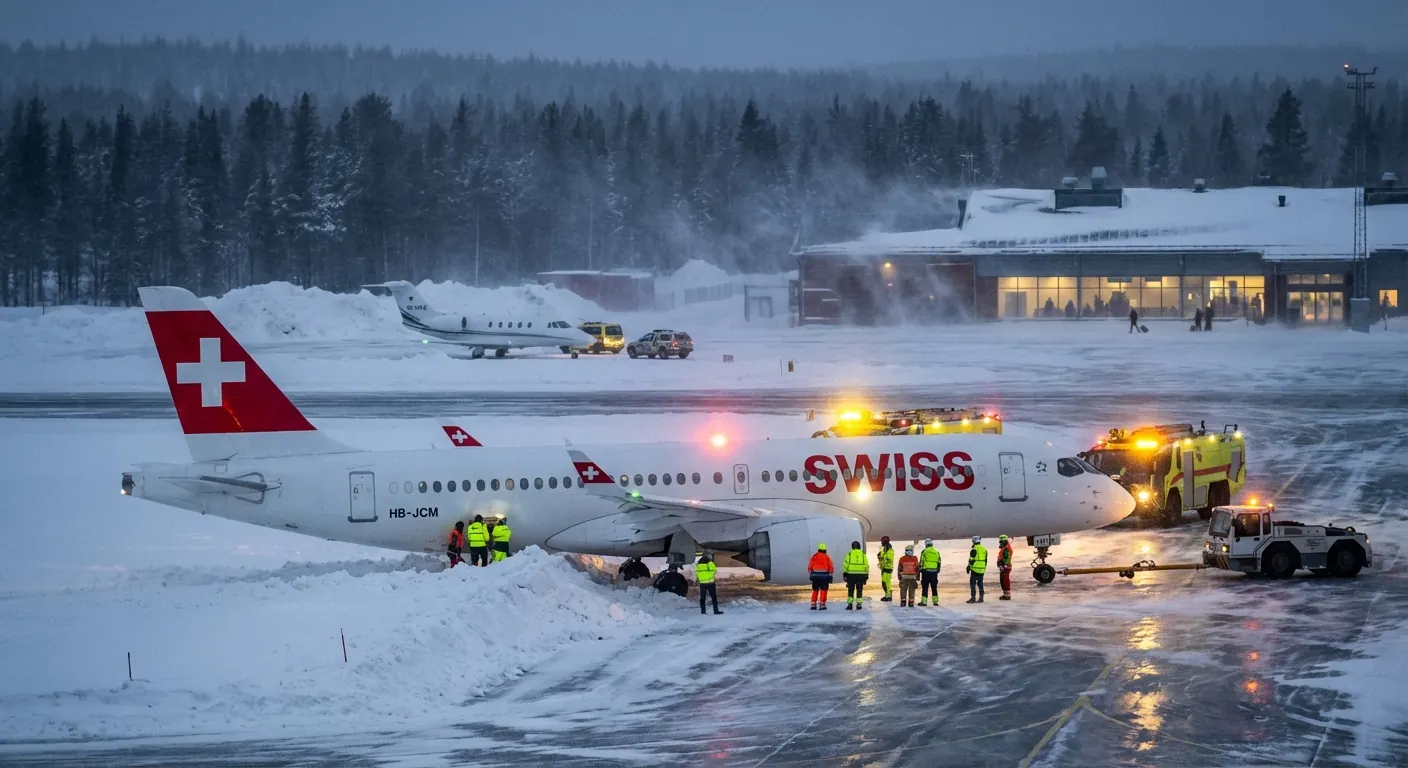
Airbus A220 fake image: can you spot the errors in the snowy SWISS scene before you trust the headline?
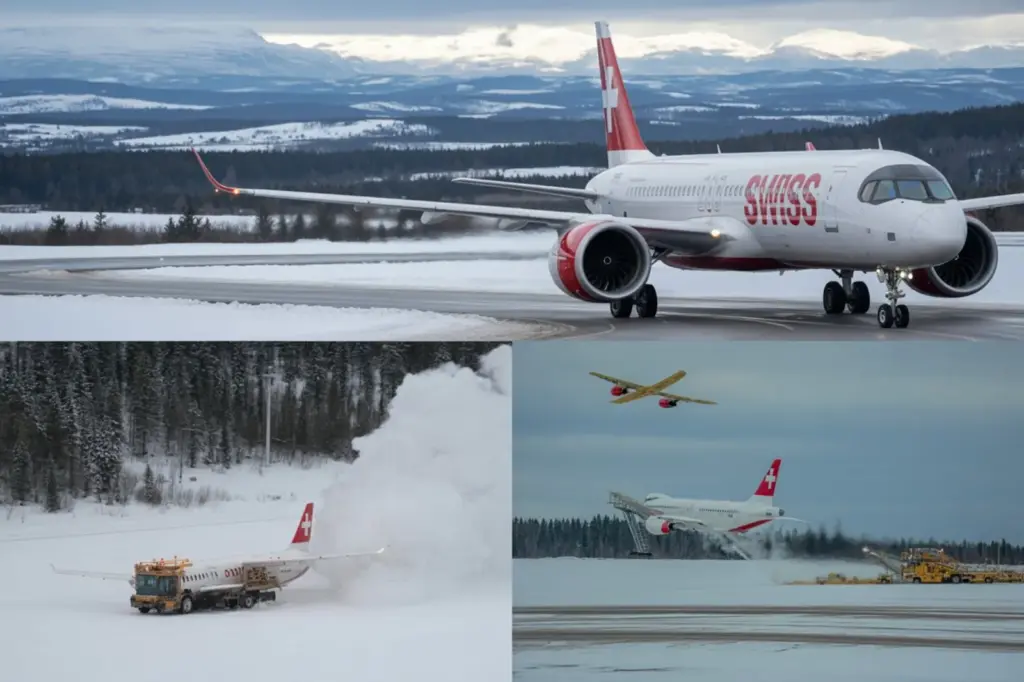
Recently, a dramatic “photo” of a SWISS Airbus A220-300 (registered HB-JCM) stuck in a snowbank spread across travel sites and social feeds. Meanwhile, the real event at Kittilä Airport (KTT/EFKT) in Finnish Lapland was serious enough to disrupt operations, but it was not the cinematic accident the image implies (Helsinki Times, 2025).
Notably, this matters because aviation news is a trust business. Moreover, when synthetic visuals get treated as evidence, they can quietly distort how readers understand risk, winter ops, and decision-making in the cockpit and on the ramp.
So, let’s do something more useful than dunking on a bad illustration. Instead, we’ll walk through what happened on December 27, 2025, how the fake circulated, and how you can audit an “accident photo” like an engineer would—one detail at a time.
Airbus A220 fake image: what happened at Kittilä?
SWISS snowbank photo: the real afternoon in Lapland
On December 27, 2025, strong winds and blowing snow hit northern Finland hard. Consequently, two separate aircraft ended up in snowbanks while taxiing at Kittilä International Airport (KTT), and the airport response quickly escalated (Helsinki Times, 2025).
Specifically, one of those aircraft was a SWISS Airbus A220-300 (registration HB-JCM) operating from Geneva, with about 150 passengers onboard. Meanwhile, a smaller business aircraft also slid into a snowbank around the same time, and authorities reported no injuries (Helsinki Times, 2025).
Additionally, Finnish reporting described severe crosswinds and reduced visibility, with emergency units responding and the event initially treated as a major aviation incident.
Even so, what happened next is the part many “crash” headlines skip. Crews and responders secured both aircraft, and recovery operations proceeded without the kind of catastrophic damage the viral image invites you to assume.
And yes, Lapland delivered the punchline: in a storm, it’s not just tourists who go drifting.
A220 AI image versus the actual recovery and checks
After the excursion, the practical questions were predictable. First, did the landing gear take a side-load that required inspection? Second, could the aircraft be safely towed without further damage? Third, how quickly could the airline restore capacity during peak-season travel disruption?
According to reporting that quotes SWISS, the airline arranged a technical check, including sending a mechanic to the aircraft and later moving the A220 out of Lapland (blue News).
Separately, aeroTELEGRAPH reported that a strong wind gust turned and shifted the Airbus A220 on the taxiway, and that the airline then had to deal with false imagery claiming to show the incident.
Overall, that distinction matters because winter ops incidents often become case studies. However, the case study only works if the inputs are real.
Airbus A220 fake image and the problem with “crash” language
Words set the frame. Therefore, when a taxiway excursion becomes a “crash into a snowbank,” the reader expects structural breakup, evacuation, and injury. In reality, the sources closest to the event describe wind-driven taxiing incidents, no injuries, and a recovery operation (Helsinki Times, 2025).
Moreover, inflating language can change how the public perceives aircraft safety. It also distracts from the real operational lesson: contaminated surfaces plus gusting crosswinds can push even a modern narrowbody off pavement at walking speed.
In other words, you don’t need a crash to need a tow.
Airbus A220 fake image: why the picture fails a basic airframe audit
Airbus A220 fake image: start with light, time, and location
Let’s begin with the easiest forensic test: does the environment match the claim? If a site tells you the aircraft slid into a snowbank after 16:00 local time in late December in Finnish Lapland, you should expect darkness and harsh ramp lighting, not a romantic blue-hour tableau.
According to a SWISS spokesperson quoted in Swiss coverage, “It was dark at the time of the incident, but the image shows a twilight situation.” — SWISS spokesperson, blue News
Additionally, the same reporting notes that the aircraft’s depicted position does not match where the incident occurred. “The position of the aircraft shown is not correct,” the spokesperson said. — SWISS spokesperson, blue News
That’s a polite way of saying the “photo” fails a map. Notably, if the terminal is on the wrong side, everything else becomes theatre.
Also, if the scene looks too tidy for Storm Hannes, that’s another nudge to slow down (Helsinki Times, 2025).
For once, the weather forecast isn’t the only thing you should check. The lighting is, too.
HB‑JCM AI picture: the windows that do not add up
Next comes the detail that first raised my suspicions: the window count between the overwing exit door and the start of the “SWISS” titles in the livery doesn’t match a real SWISS A220-300.
This detail is what pulled me into this story
While scanning the image, I quickly spotted mistakes versus the real SWISS A220-300.
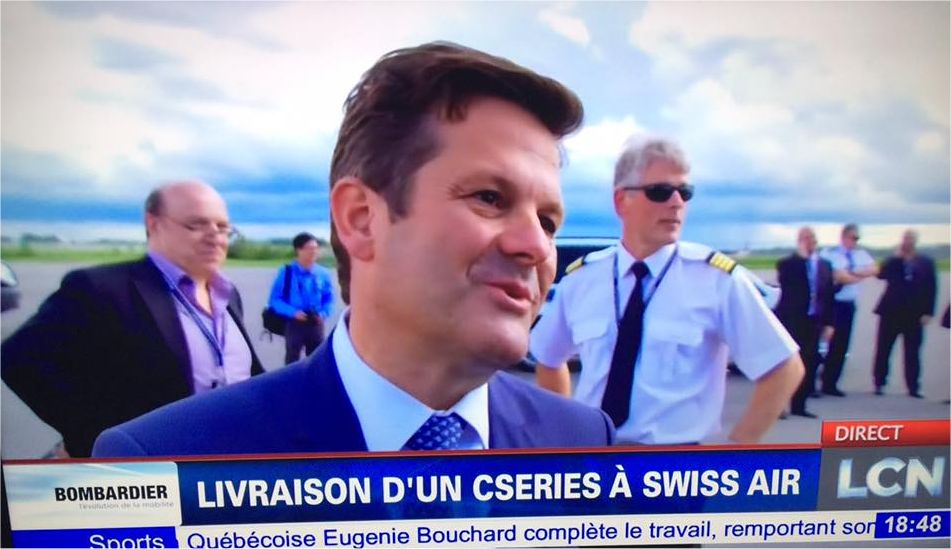
I’ve followed this aircraft for more than a decade. In 2026, it will be nearly ten years since SWISS took its first delivery at Bombardier and I was there as a special guest. See me in this picture below.
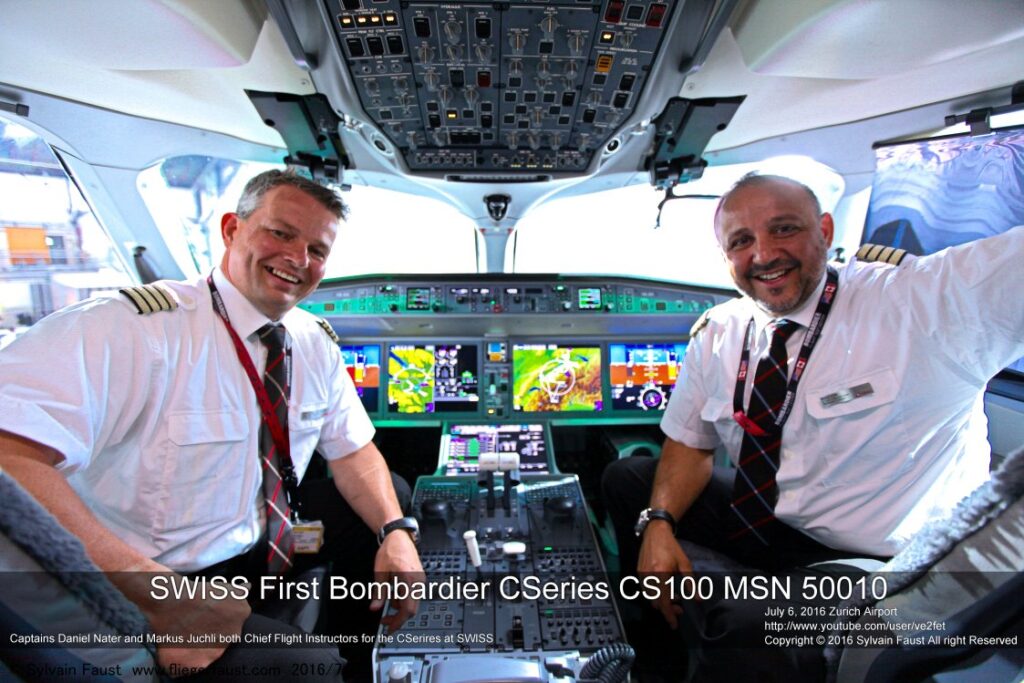
I was also in Zurich invited by SWISS for its official inauguration on July 6, 2016. At the time, it was the Bombardier CS100 (later rebranded Airbus A220‑100)” and “Bombardier CS300 (later rebranded Airbus A220‑300)—like the aircraft in this case—began arriving. In regulatory paperwork, the A220 is certificated as the BD‑500 series (BD‑500‑1A10 for the A220‑100 and BD‑500‑1A11 for the A220‑300), while the pilot type rating is BD500. Meanwhile, the ICAO aircraft type designators are BCS1 for the A220‑100 and BCS3 for the A220‑300.
Consequently, the inconsistency in that image jumped out immediately. I suspected it was not real, and likely AI-generated. For readers who may not know, I’ve been reporting on this aircraft type since before its maiden flight. That first flight took place at Montréal–Mirabel International Airport (YMX) on September 16, 2013. Back then, Mirabel housed Bombardier’s CSeries facilities, now owned by Airbus and the Government of Québec. Notably, YMX is about 39 kilometres (21 NM) northwest of Montréal (more about the author).
In the snowy “SWISS in a snowbank” image, you can count three cabin windows between the mid-cabin emergency exit (the door above the wing) and the first window that sits under the left edge of the “S” in SWISS.
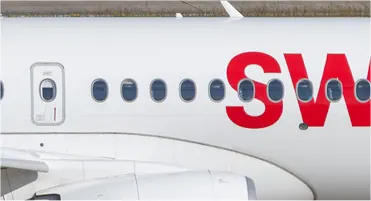
However, in a real side-on photo of the same A220-300 registration (HB-JCM), you can count five windows in that same span.
That mismatch is not a trivial “spot the difference” game. Instead, it signals a synthesis problem: the generator created something plausible at a glance, but it did not preserve the A220’s repeating cabin geometry.
Moreover, this is why registration alone is not enough. An AI model can copy “HB-JCM” the way it copies any other texture. It cannot always keep the airframe’s spacing rules straight across the whole fuselage.
To be clear, a photographer can distort spacing with perspective. Yet the viral image is close to a side profile, and the window count still collapses.
At that point, the aircraft stops being an aircraft and becomes a logo wearing an airplane costume.
Can you find them?
I spotted other errors on the airplane in the image. Can you find them? Answer at the end of this page what you think they are.
A220 AI image: beacons, people, and ramp logic
Next, check ramp behaviour. Even if you have never marshalled an aircraft, you know two things instinctively. First, people keep distance from running engines. Second, emergency vehicles look and behave differently depending on local regulations.
In a widely shared LinkedIn post, SWISS communicator Léa Wertheimer warned that “images and videos have been circulating that are manipulated or fully AI-generated.” — Léa Wertheimer, Swiss International Air Lines, LinkedIn
Moreover, she stressed the practical consequence: “These images do not reflect what actually happened and do not allow for a factual or accurate understanding of the event.” — Léa Wertheimer, Swiss International Air Lines, LinkedIn
That’s the key. A fake doesn’t need to look ridiculous to be harmful. It only needs to look credible enough to become “evidence” in the next article.
Also, there’s an unintentionally funny part. The fake scene often tries to include every aviation prop at once: fire trucks, tugs, suited silhouettes in terminal windows, and “dramatic” snow. In reality, real airports rarely stage-manage like a movie set.
In aviation, the most realistic detail is usually the boring one. The fake image tries too hard.
Synthetic aviation image: why small errors matter in safety reporting
It’s tempting to treat this as harmless clickbait. However, aviation is an industry where people learn from details.
For example, a taxiway excursion raises specific operational questions. What was the reported braking action? How did gusts align with taxi direction? What procedures and risk gates were in place for contaminated surfaces? Those questions benefit from real imagery and real timelines.
Instead, a synthetic image primes the reader to ask the wrong question: “How did the aircraft end up half-buried near a terminal at dusk?” That question wastes everyone’s time.
Moreover, SWISS explicitly condemned that attention economy. “Such images may appear spectacular and generate attention, but they do not reflect the reality of the event,” Wertheimer wrote. — Léa Wertheimer, Swiss International Air Lines, LinkedIn
So yes, the window count matters, but I see other errors too. It’s a signpost that the rest of the narrative may also be synthetic.
Airbus A220 fake image: how the “photo” travelled, and why it stuck
Airbus A220 fake image and the first publication trail
Now let’s talk provenance. One of the earliest widely circulated versions of the snowbank “photo” appears in a December 27, 2025 post by The Traveler (The Traveler).
That matters because, once the image exists, other outlets can repackage the same visual with stronger language. Consequently, a taxiway incident can morph into a “crash” through repetition rather than reporting.
Notably, Swiss coverage later pointed directly at The Traveler website image and described it as a fake AI montage.
Separately, aeroTELEGRAPH also described false images circulating after the Kittilä incident and tied one of the key visuals to AI imagery used by The Traveler (aeroTELEGRAPH).
Here’s the uncomfortable joke: the image travelled faster than the tow truck.
Fake aviation photo: when “illustration” quietly becomes a claim
The tricky part is not that AI exists. The tricky part is labelling and reader expectations.
The Traveler has an Image Policy that says it adopted AI-generated imagery, and that readers can assume images without photo credits are AI-generated (The Traveler Image Policy). Who read that?
The practical problem is obvious: many readers never see that policy page. (did you read our Fliegerfaust disclaimer page?) Moreover, when an article presents a synthetic scene with realistic airline branding and a precise registration, the default assumption becomes “photojournalism” and is dangerous.
Swiss reporting argued that the image lacked a label indicating it was AI-generated, and that this created reputational risk for the airline.
Meanwhile, Wertheimer said SWISS contacted the relevant editorial team several times and received no response. — Léa Wertheimer, Swiss International Air Lines, LinkedIn
In other words, disclosure is not a footnote issue. It’s a trust issue.
A220 AI image: the economics of travel-content velocity
It’s worth naming the incentive structure. Travel sites compete on speed, keywords, and shareability. Consequently, an “illustration” that looks dramatic can outperform a truthful line that reads “taxiway excursion, no injuries.”
Moreover, AI tools shrink the time between “event” and “visual.” A generator can create a snowy ramp scene in minutes. A real photographer at Kittilä needs access, light, and permission.
That imbalance is why aviation readers must adjust their habits. If you read accident or incident coverage, treat every spectacular image as unverified until you can trace it back to a credited photographer or an official release.
Even so, this is not a call to ban AI. It’s a call to label it loudly and keep reporting honest.
And yes, if an article screams urgency while the image screams “prompt,” your scepticism is not cynicism. It’s safety culture.
Airbus A220 fake image and the brand damage problem
Airlines spend decades building reputations around professionalism. Therefore, a fake accident photo can do real harm, even if the underlying event caused no injuries.
In Swiss coverage, the airline’s spokesperson warned that fake images can make objective assessment harder.
Similarly, aeroTELEGRAPH framed the problem as a wave of fake news around a real incident (aeroTELEGRAPH).
So, if you wonder why this deserves a full post, here’s the answer: once fake imagery attaches itself to an airline’s name, corrections rarely travel as far as the original share.
Airbus A220 fake image: how to verify aviation visuals without guesswork
Airbus A220 fake image: a practical verification checklist
There is no magic “AI detector” that settles every case. However, you can build a fast, repeatable workflow that catches most fakes.
First, check for a photo credit, agency tag, or official source. If a “breaking news” image lacks a photographer name, slow down.
Second, compare the visual to known geometry. That includes door positions, window counts, antenna placements, gear proportions, and common livery layouts. Your window-count test is exactly the kind of audit that works in practice.
Third, cross-check the claim against local reporting. For the Kittilä incident, Finnish outlets and regional reporting described strong winds, two taxi incidents, and no injuries (Helsinki Times, 2025).
Fourth, ask whether the “photo” matches the operational reality. Does the lighting match the time? Do emergency vehicles match the country? Does the aircraft sit where the terminal actually is? If not, treat the image as fiction.
Finally, do a reverse image search, but don’t stop there. AI images often appear “first” on one site and then propagate. That can help you find the origin, but it doesn’t prove authenticity on its own.
AI-generated aircraft photo: detectors, provenance, and Content Credentials
Many readers ask for an AI detector score. Understandably, that sounds like a clean answer. Unfortunately, detection tools are imperfect and can produce false positives and false negatives.
For example, academic and institutional discussions about AI detection stress that these systems can be unreliable and should be used with caution (UCLA HumTech).
So what helps more than guessing? Provenance.
Adobe’s documentation describes Content Credentials as tamper-evident metadata that can record creation and editing history, including whether generative AI tools were used (Adobe Experience League).
Meanwhile, the Content Authenticity Initiative has outlined approaches to “durable” credentials that can survive metadata stripping through a combination of metadata, watermarking, and fingerprinting (Content Authenticity Initiative).
Reuters also reported that Adobe planned a free tool aimed at attaching such credentials, in part to support labelling and attribution in the AI era (Reuters).
That is the direction aviation reporting needs. We don’t need “trust me.” We need “trace it.”
A220 AI image: why spotters, engineers, and operators still matter
This story also shows why aviation communities remain valuable. When a fake image goes viral, the fastest correction often comes from people who know the aircraft, the airport, and the operational context.
That includes airline staff. It also includes spotters who can compare markings and layouts. It includes engineers who notice impossible doors, missing sensors, or geometry that no certification basis would accept.
On Fliegerfaust, we’ve covered the A220 programme for over 10 years, from industrial strategy to fleet realities. If you want more A220 context while you’re here, you can also read Latest A220 News: Ramp Reset and the Road Ahead and Airbus Spirit AeroSystems Deal: A New Chapter for the A220.
Separately, if you’re curious how the A220 platform keeps evolving beyond airline service, have a look at Magnifica Air A220: Comlux to outfit six VIP jets as MAAS boosts Mobile paint capacity.
Now, back to the fake. Here’s my challenge to you: beyond the window count, what else looks wrong in the featured image once you slow down and audit it? Can you find them? Answer at the end of this page what you think they are.
Because the next wave of AI visuals will be better. Therefore, the habit we build now is the real defence.
Conclusion
Airbus A220 fake image stories will keep coming, and not just for SWISS. As generative tools improve, the risk shifts from “obvious fakes” to “credible enough to fool busy readers.”
However, this episode also offers a hopeful lesson. If you treat aviation visuals like technical claims, you can often falsify them quickly. I did it with a window count at first. Others will do it with lighting, geography, and ramp logic.
In my view, publishers who use synthetic images must label them clearly and near the image unless the image is obviously unreal, not buried in policy pages. Moreover, readers should reward outlets that credit photographers, publish corrections, and resist sensational language.
So here’s the uncomfortable question to end on: if an airline can be “brought into disrepute” by a single fake picture, what happens when the next fake is just good enough that even experts hesitate?
Leave your answers and comments below and on our Fliegerfaust Facebook page.
Sources
- blue News — How a fake picture is bringing Swiss into disrepute (December 30, 2025).
- aeroTELEGRAPH — Die vielen Fake News rund um den Airbus A220 von Swiss, der in Kittilä in den Schnee geriet (December 30, 2025).
- Helsinki Times — Two planes slide into snowbanks in heavy winds at Kittilä Airport (December 27, 2025).
- Lapin Kansa — Matkustajakone ja pienkone ajautuivat lumipenkkaan (December 27, 2025).
- The Traveler — Swiss A220 and Bizjet Slide Into Snowbanks at Kittilä, Disrupting Peak Lapland Holiday Flights (December 27, 2025).
- The Traveler — Image Policy (effective September 30, 2025).
- Léa Wertheimer / Swiss International Air Lines — LinkedIn post on manipulated and AI-generated images after the Kittilä incident (accessed January 2026).
- Adobe Experience League — Content Credentials integration (September 5, 2024).
- Content Authenticity Initiative — The three pillars of provenance that make up durable Content Credentials (undated).
- Reuters — Adobe to offer free app to help with creator attribution amid AI boom (October 8, 2024).
- UCLA HumTech — The Imperfection of AI Detection Tools (undated).
For full details, please refer to our Disclaimer page.

The real A220 registered HB-JCM was delivered to SWISS in 2018. https://x.com/FlightIntl/status/1002487509916495872