

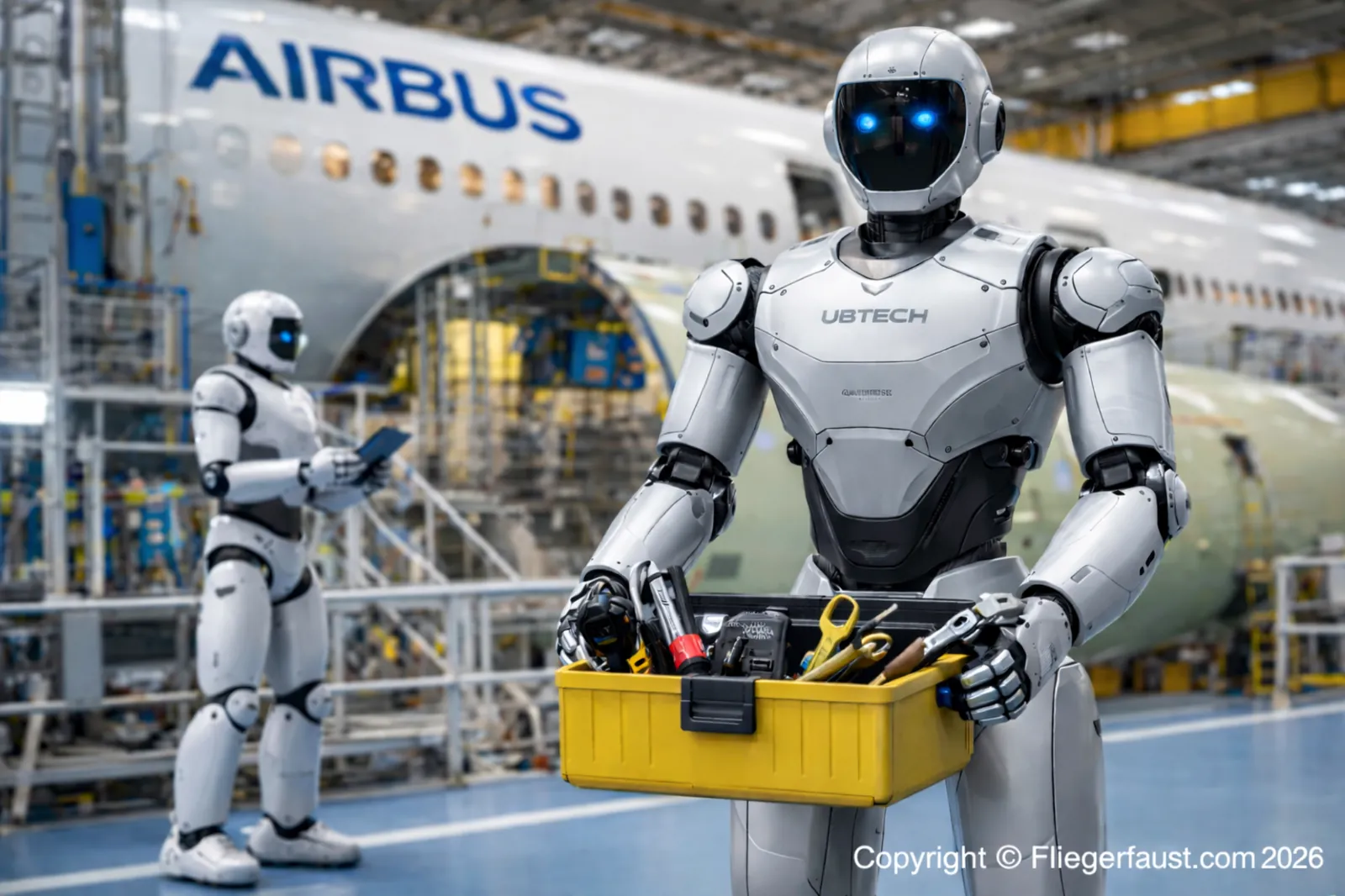
Airbus humanoid robots: why is Airbus testing Chinese UBTech’s Walker S2 now, and what could it change on real assembly lines?
First, on January 21, 2026, a short statement triggered a long list of factory questions.
Notably, Chinese robotics firm UBTech said it had signed a deal with Airbus to expand robot use in aviation manufacturing, and that Airbus had already purchased UBTech’s latest industrial humanoid robot, the Walker S2.
Meanwhile, Airbus confirmed the cooperation but called it early “concept-testing”. Importantly, that wording matters. In short, it signals curiosity, not commitment.
Still, the timing is not random. Meanwhile, Airbus is in a global production ramp while suppliers and workforce teams try to keep pace. At the same time, robotics firms are racing to prove that humanoids can do more than staged demos.
So, are we looking at a headline-friendly experiment, or the first step toward a new layer of automation around aircraft assembly? Therefore, the answer depends on Airbus’ long history with robots, the reality of its plant network, and the politics of labour in a high‑skill industry.
Airbus humanoid robots: what the UBTech–Airbus agreement actually says
The hard facts in the January 21, 2026 announcement
First, stick to what is public and attributable.
For example, Reuters reported that UBTech said Airbus has already purchased the Walker S2. Also, UBTech said the two sides will jointly expand humanoid robot applications in aerospace manufacturing scenarios.
Importantly, Airbus said the cooperation is in an early concept-testing stage. As a result, that phrasing keeps expectations low. Moreover, it protects Airbus if the pilot fails.
Airbus humanoid robots: Which Airbus plant, how many robots?
Notably, neither side disclosed which Airbus plant will host the tests. In addition, neither side disclosed the number of robots. Also, neither side disclosed pricing or the currency used.
What Airbus means by “concept-testing”
Next, translate the corporate language into shopfloor reality.
In practice, a concept test is not a press demo in aerospace. Instead, it is usually a controlled trial. Moreover, it tends to sit behind safety barriers and documentation.
Therefore, the near-term goal is not “replace assemblers”. Instead, the near-term goal is to prove a narrow use case. Then Airbus can decide if it is worth expanding.
Meanwhile, Airbus already runs plenty of automation. For example, that includes fixed industrial robots, portable robotic tools, and digital work instructions. So a humanoid test is additive, not foundational.
Walker S2 in plain terms: what “industrial humanoid” implies
So what is Airbus buying?
In short, UBTech positions the Walker S2 as a full-size humanoid intended for industrial environments. For example, on UBTech’s official Walker S2 product page, the company highlights an industrial design focus and an autonomous battery swapping approach that aims to keep the robot working without long charging pauses. No union-negotiated breaks for the robot — only battery swaps.
In other words, Walker S2 targets shift work, not showroom duty.
However, a factory-ready design is not the same as an aerospace-ready workflow. Airbus needs traceability. Airbus also needs safe human–robot interaction. Both are hard in a crowded assembly area.
It is a ticket into the pilot phase.
What is still unknown: site, tasks, and “expected delivery”
Now, the gaps.
Notably, Airbus has not named a factory or a programme. Moreover, Airbus has not described which tasks it wants Walker S2 to perform.
In addition, neither company has published a delivery schedule for additional robots. Still, Airbus may already have the first unit, or it may be inbound. In short, public reporting only confirms that Airbus has purchased at least one Walker S2.
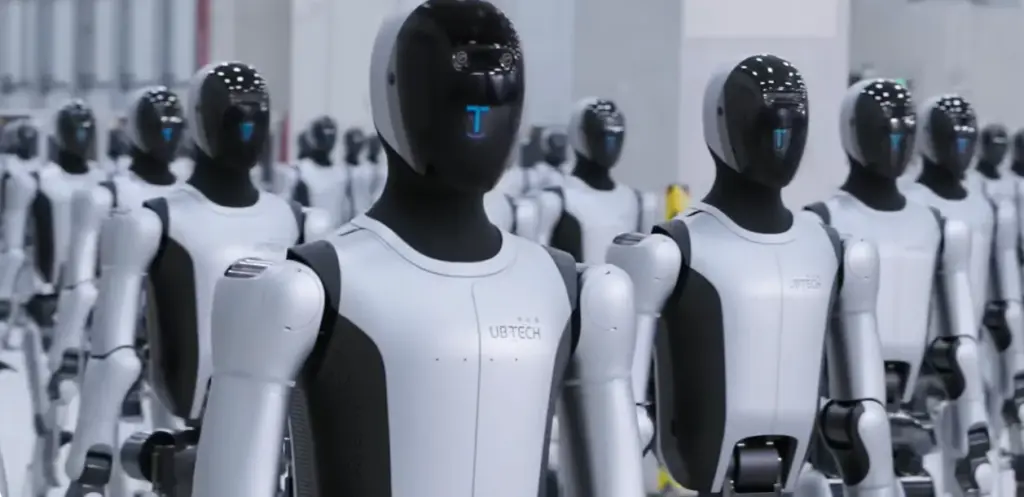
Meanwhile, UBTech has talked about scaling. For example, in its reporting on the Airbus cooperation, Xinhua noted that UBTech’s order value for humanoid robots exceeded 1.4 billion yuan in 2025 and that production capacity for industrial humanoids is expected to exceed 10,000 units in 2026.
Therefore, supply capacity is not the bottleneck. Instead, integration is.
In other words, Airbus is not waiting for robots to exist. Instead, Airbus is testing whether robots can do Airbus work.
Airbus humanoid robots: Why the timing fits Airbus’ 2026 production reality
First, Airbus is chasing rate while protecting quality. That combination pushes factories toward incremental, low-risk automation.
On December 3, 2025, Airbus cut its 2025 delivery target to around 790 aircraft due to a supplier quality issue affecting A320 Family fuselage panels; it ultimately delivered 793 commercial aircraft in 2025.
Meanwhile, ramp-up decisions ripple globally. If one final assembly line hits a constraint, upstream structure sites and suppliers feel it. If one supplier slips, a whole programme can stall.
Therefore, Airbus has an incentive to test tools that reduce minor stoppages. In practice, a humanoid robot is a “micro‑stoppage” bet. It aims to shave minutes and reduce the need for additional hires, not reinvent assembly.
Labour markets are tight in many industrial regions. Airbus can train people, of course. Still, a robot can look attractive as a buffer against turnover and absenteeism.
At the same time, geopolitics adds uncertainty. Trade friction, export controls, and localisation pressures can all hit industrial planning. For one view of how trade themes can shape Airbus’ industrial choices, see our Fliegerfaust briefing on tariffs and exposure: Forecast Despite Tariff and Supply Risks
So, a Walker S2 pilot is not only a technology story. It is also a resilience story. Airbus is testing whether a general-purpose “factory helper” can absorb small shocks without compromising safety.
Airbus humanoid robots: a history of automation at Airbus before humanoids
Aerospace automation came first to drilling and fastening
First, remember the fundamentals. Aircraft assembly demands precision. It also demands repeatability.
For that reason, early aerospace automation focused on drilling, fastening, and controlled material handling. Those tasks are measurable. They are also easier to validate than complex manipulation.
Meanwhile, Airbus has used automated and robotic systems for years across programmes. The company’s Industry 4.0 (a shorthand for connected, data-driven manufacturing) communications make this clear. Airbus describes robotics as part of a connected industrial system that boosts flexibility and quality.
See Airbus’ overview of its Industry 4.0 approach here, which describes building an end-to-end robotics network spanning research, integration, and maintenance.
2014: FUTURASSY showed Airbus wanted “harmonised” robotics
Next, Airbus began to speak publicly about robotics as a systematic programme.
In February 2014, Airport Technology reported that Airbus was leading a robotics project called FUTURASSY, aimed at introducing a harmonised robotic system to automate aeronautical assembly processes.
The key word is harmonised. Airbus rarely wants one-off machines. It wants deployable methods that it can replicate across sites.
That approach also helps with labour relations. A standardised tool can come with standardised training. It also comes with predictable safety procedures.
2016: Airbus’ “shopfloor” robotics challenge mindset
Then Airbus pushed the idea that aircraft manufacturing needs a new generation of robots.
In a 2016 discussion hosted by RoboHub, Airbus research leadership argued that traditional industrial robots struggle with the variability of aircraft assembly. The theme was not “more robots”. The theme was “better robots for our problem”.
That is the same theme behind humanoids today. A humanoid is a bet that a robot can fit into human spaces without rebuilding the factory.
2018–2019: Hamburg’s A320 automation becomes a reference point
Now jump to where Airbus made automation visible to outsiders: Hamburg.
In 2018, observers reported that Airbus introduced robotic drilling and fastening on the A320 line in Hamburg. Commentary also highlighted named robots like “Luise” and “Renate” as part of the public narrative around automation.
For example, AirInsight described those robots as part of Airbus’ move toward more automation in fuselage work.
Then, on October 1, 2019, Airbus inaugurated a new A320 structure assembly line in Hamburg known as “Hangar 245”. Airbus framed the line as a major step in industrial modernisation. See Airbus’ official press release here. In practical manufacturing terms, Hangar 245 matters because it mixes robotics with a redesigned process flow. That is the pattern Airbus tends to repeat: change the process, then automate the right steps.
Coverage by Assembly Magazine described how Airbus used automation in fuselage production to boost rate and consistency, using portable and fixed robotic systems rather than a single “giant robot” solution.
2023: Airbus formalises a “robust robotics strategy”
After that, Airbus moved further upstream. It began to focus on owning robotics expertise, not just buying machines.
In October 2023, Airbus published a detailed story titled Pioneering a robust robotics strategy. In it, Airbus argued that robots will play an integral role in the future of aircraft manufacturing.
More importantly, Airbus described a strategy to future-proof operations by internalising key areas of robotics expertise and accelerating deployment of internal solutions. That signals a shift toward in-house integration capability.
Therefore, the Chinese UBTech humanoid pilot lands inside a broader strategy. Airbus is not experimenting in a vacuum. It is testing one more robotics form factor inside a growing internal robotics network.
2025: private 5G shows the “infrastructure layer” maturing
Finally, robots do not scale without connectivity.
In October 2025, Ericsson announced a private fifth-generation (5G) deployment at Airbus’ Hamburg and Toulouse plants, framed as part of Airbus’ factory digitalisation. See Ericsson’s announcement here.
Crucially, Ericsson said the partnership would expand beyond France and Germany to additional Airbus sites across the United Kingdom (UK), the United States (U.S.), Spain, and more, without directly mentioning Canada.
In other words, Airbus is building the digital rails that advanced robotics can ride/communicate on. That includes tooling data, parts traceability, and near real-time visibility.
If you want the wider context on how artificial intelligence (AI) and connected systems are moving into aviation operations, see our earlier Fliegerfaust analysis AI in commercial aviation: what’s real today, and what will be certified?
Timeline: Airbus robotics milestones that frame the UBTech pilot
First, it helps to put the humanoid headline into a dated sequence. These milestones show how Airbus moved from “automation cells” to “robotics strategy”.
- February 23, 2014: Airbus leads the FUTURASSY robotics project, aiming to automate assembly steps with a harmonised approach, as reported by Airport Technology.
- February 6, 2016: Airbus research frames a “shopfloor challenge” for robotics that can cope with aircraft variability, in a discussion highlighted by RoboHub.
- October 1, 2019: Airbus inaugurates the Hangar 245 A320 structure assembly line in Hamburg, detailed in an Airbus press release.
- December 3, 2019: A public feature explains “245 work steps” and shows robots in the Hamburg flow, via Deutschland.de.
- October 19, 2023: Airbus publishes its “robust robotics strategy” narrative, signalling a more integrated, internal capability, via Airbus.
- October 6, 2025: Airbus and Ericsson announce private 5G deployment at Hamburg and Toulouse as part of industrial digitalisation, per Ericsson.
- January 21, 2026: UBTech announces the Airbus cooperation and says Airbus purchased the Walker S2, as reported by Reuters and covered by Xinhua.
Finally, notice the pattern: Airbus tends to publicise infrastructure and process shifts first, then it scales tooling quietly. So, watch what Airbus does after the concept test, not what it says on day one.
Airbus humanoid robots: where robots already operate across Airbus assembly sites
Hamburg-Finkenwerder: “245 work steps” and the A320 backbone
First, Hamburg remains the clearest public reference point for Airbus factory robotics.
Airbus’ Hamburg site handles major work on the A320 Family. It also became an automation showcase with Hangar 245.
For a simple illustration, Deutschland.de explained the Hangar 245 concept through the lens of “245 work steps” in A320 fuselage manufacturing, showing how robots and automated steps slot into a redesigned flow.
That matters for the humanoid question. A humanoid robot is most useful when the factory already has clear, modular steps and defined handoffs. Hangar 245 is built around that logic.
What “automation” looks like in practice: portable robots and repeatable cells
Next, zoom in on what Airbus actually automates.
Airbus tends to deploy robotics where it can lock down geometry and quality checks. That includes drilling and fastening in structure assembly. It also includes moving heavy components with controlled positioning.
Therefore, you will often see a mix: fixed robots for repeatability, and portable robotic tools for flexibility. Airbus’ public robotics communications stress an end-to-end approach that spans development to maintenance.
For readers tracking Airbus industrial health, it helps to connect automation to production pressure. Airbus delivered 793 commercial aircraft in 2025 and reported a record backlog of 8,754 at year-end, according to its January 12, 2026 press release here.
In short, Airbus has strong demand. That demand amplifies the value of incremental productivity gains.
For more on how production cadence influences programme economics, you may also want our Fliegerfaust coverage of A220 industrial constraints and ramp pressure: Airbus A220 ramp-up: 93 deliveries, 160 seats, and the China–India door supply chain shift.
Broughton in the United Kingdom: wing production and why logistics robots matter
Now look to Airbus’ wing factories in the United Kingdom (UK), where the problem is scale and safety.
Wing components are large and awkward. They also require precise handling. That makes factories strong candidates for automated transport and positioning systems.
In December 2018, the Advanced Manufacturing Research Centre described work on autonomous robots transporting aircraft wings in a “factory of the future” context. See AMRC’s report here.
Moreover, logistics automation often delivers clearer return on investment (ROI) than humanoid robots. It reduces forklift traffic. It also improves flow.
Yet, it also foreshadows the same labour debate: when transport becomes autonomous, who monitors the system, and what happens to the old roles?
Toulouse: final assembly complexity and the case for flexible support robots
Meanwhile, Toulouse final assembly lines face a different challenge: complexity.
Final assembly includes systems installation, cabin work, and integration steps that vary by airline configuration. It also includes inspection and rework loops.
Therefore, a humanoid concept test could make sense around the edges of final assembly. For example, it could handle kitting, run simple inspection rounds, or move tools.
However, Airbus has not said that Toulouse will host Walker S2. So treat this as a scenario, not a claim.
Still, Toulouse sits inside Airbus’ private 5G rollout. That matters because connectivity helps robots localise, report status, and integrate with manufacturing execution systems.
Global scaling: where robotics success would need to travel next
Finally, Airbus builds aircraft through a global production network. That includes multiple final assembly line locations and a deep supplier ecosystem.
Therefore, any successful robotics cell creates a question: can it scale?
Ericsson’s 2025 private 5G announcement explicitly pointed to expansion into Airbus sites across the United Kingdom (UK), the United States (U.S.), Spain, and more. That suggests Airbus wants a common connectivity foundation across plants.
If the network becomes common, the software layer can become common too. Then robotics deployments become easier to replicate.
That is also why Airbus’ competitive positioning matters. For readers following Airbus vs Boeing production battles, see our Fliegerfaust breakdown of the A320 vs 737 dynamic: Airbus vs Boeing: A320 Tops 737 – Turkish Order Twist
Airbus humanoid robots: what could go right, and where it could fail
The realistic first tasks: “glue work” around skilled assembly
First, define what humanoids can plausibly do in 2026.
A humanoid robot is not a certified mechanic. It is a mobile worker-shaped platform. So the best early tasks are low-risk and easy to verify.
For example, a humanoid could deliver parts kits within a defined zone. It could scan barcode labels for traceability checks. It could also carry lightweight tools or fixtures.
In that sense, the value proposition is not precision machining. The value proposition is time. Every minute a mechanic spends walking is a minute not spent assembling.
The tasks Airbus will not rush: fastening, sealant, and wiring
Next, look at the hard jobs that humanoids will struggle with.
Aircraft structure fastening is precise. Sealant work is messy. Wiring work is crowded and highly variable.
Therefore, Airbus is unlikely to push Walker S2 into safety-critical fastening any time soon. Instead, Airbus will likely keep humanoids away from tasks that create hidden defects.
That is also why Airbus’ automation history matters. The company has repeatedly automated the most measurable steps first. Drilling and fastening tools succeed when geometry and torque values are controlled.
Safety and accountability: the aerospace barrier to “move fast and break things”
Meanwhile, aircraft manufacturing carries a different risk profile than consumer electronics.
A robot collision can injure a person. A robot mis-sequenced task can create a quality escape that surfaces months later.
Therefore, Airbus will treat humanoid trials as safety engineering projects. That means risk assessments, fenced zones, and emergency stop protocols.
It also means slow deployment. In aerospace, “pilot” is often a multi-year phase.
The business case: where the ROI may actually come from
Now, consider the economics.
Humanoid robots are expensive. They also require support staff. In early deployments, they may be slower than humans.
So where could Airbus humanoid robots ROI come from?
- Reduced walking time for skilled staff.
- Improved parts kitting accuracy and fewer line stops.
- Better data capture for traceability and quality analytics.
- Lower ergonomic injury risk if robots handle repetitive carrying.
- Barcode or RFID (radio-frequency identification) scanning for traceability checks.
However, ROI will not come from replacing a large number of skilled jobs overnight. Airbus does not have that kind of slack in a ramp environment.
Instead, ROI would come from smoothing flow and reducing rework.
Three timelines: pilot success, limited rollout, or quiet cancellation
Finally, map realistic scenarios from 2026 onward.
Scenario one: Airbus proves a narrow use case and buys a handful of additional units for a single site. In that case, the story becomes “support robots in production”.
Scenario two: Airbus proves multiple use cases and begins to standardise the integration layer. Then the story becomes “humanoids as a factory utility”.
Scenario three: Airbus finds that the robot adds complexity without steady value. Then the pilot ends quietly. That outcome is common in industrial automation.
Therefore, the key sign to watch is not a viral video. The key sign is whether Airbus publishes repeatable performance metrics and deploys beyond a controlled corner.
Airbus humanoid robots: jobs, unions, and the politics behind the pilot
Job loss, job shift, or job redesign: what we can say today
First, be honest about what the data supports.
A concept test with one or a few robots does not justify a “jobs lost” number. Airbus has not announced layoffs tied to the UBTech pilot. Airbus also faces strong demand pressure.
However, automation still changes labour dynamics. It can reduce hiring needs in support roles. It can also shift work toward programming, maintenance, and data oversight.
Therefore, the best near-term framing is job redesign, not mass job loss.
What Airbus workers have seen before: Industry 4.0 under co-determination
Next, look at Airbus’ labour context, especially in Germany.
In the Trades Union Congress (TUC) discussion paper Shaping Our Digital Future, the Airbus Works Council case study describes how employee representatives engaged early with Industry 4.0 projects.
One quote captures the approach: “The agreement also states that there is no negative impact on pay or working time during the projects and that jobs are not lost.” — Trades Union Congress
The same case study also notes that Airbus’ Hamburg site employed roughly 12,500 people at the time and took on over 150 apprentices each year.
In other words, Airbus has a history of negotiating the terms of digital change, not just implementing it.
What unions are signalling now: “shape it, don’t just absorb it”
Meanwhile, European labour groups have increased their focus on digitalisation and robotisation.
In October 2025, industriAll Europe said it launched a new sectoral network to strengthen trade union action on digitalisation and robotisation, aiming to ensure technological change supports quality jobs and fair working conditions.
Therefore, even if Airbus frames humanoids as “support”, unions will likely push for formal agreements on training, job security, and safety.
Data governance may also become a flashpoint. Robots collect data. Wearables and sensors collect data too. The Airbus Works Council case study in the TUC paper explicitly flags the tension between productivity tools and worker monitoring.
Recent labour pressure shows why automation remains political
Now add current labour pressure to the mix.
In September 2025, Unite said strike action at Airbus was suspended after a new pay deal was agreed. See Unite’s statement.
Meanwhile, major UK media covered the dispute as part of a broader cost-of-living and wage debate. For example, The Guardian reported on planned strike action earlier in the dispute.
So, even before humanoids, Airbus faces a workforce environment where trust matters. Any automation programme that looks like labour avoidance can trigger resistance.
My take: humanoids will not replace aerospace labour, but they can reshape it
So here is the critical view, grounded in what Airbus has already done.
Airbus does not need humanoid robots to drill holes. It already has purpose-built automation for that. Airbus also does not need humanoids to do final assembly craftsmanship. That work is too variable and too accountable.
However, Airbus does have a real problem in the “in-between” tasks: walking, fetching, scanning, and moving kits. Those tasks consume skilled time. They also create ergonomic strain.
Therefore, if Walker S2 succeeds, it will succeed as a support layer. It will act like a mobile assistant in defined zones. It will also plug into Airbus’ Industry 4.0 data layer.
Yet, the biggest risk is not the robot’s legs. The biggest risk is governance. If Airbus does not publish clear safety rules, job-transition plans, and measurable outcomes, the pilot will look like theatre. If Airbus does publish those pieces, the pilot can become a model for “automation with consent”.
Airbus humanoid robots could become a quiet productivity tool, not a sci-fi revolution—so will Airbus treat Walker S2 as a worker partner with training and guardrails, or as a bargaining chip in the next labour round?
Leave your answers and comments below and on our Fliegerfaust Facebook page.
Airbus humanoid robots: Sources
- UBTech agrees Airbus deal to expand robot use in aviation manufacturing (Reuters, January 21, 2026)
- Airbus reports 793 commercial aircraft deliveries in 2025 (Airbus, January 12, 2026)
- Airbus updates 2025 commercial aircraft delivery target, maintains guidance (Airbus, December 3, 2025)
- China’s UBTech agrees cooperation deal with Airbus on humanoid robots (Xinhua, January 21, 2026)
- Walker S2 product information (UBTech)
- Airbus inaugurates new A320 structure assembly line in Hamburg (Airbus, October 1, 2019)
- Airbus harnesses automation to boost fuselage production (Assembly Magazine, December 10, 2019)
- Pioneering a robust robotics strategy (Airbus, October 19, 2023)
- Robotics (Airbus)
- Airbus leads robotics project to automate assembly processes (Airport Technology, February 23, 2014)
- Robots: The Airbus Shopfloor Challenge (RoboHub, February 6, 2016)
- Luise and Renate get company at Airbus (AirInsight, May 19, 2019)
- Airbus and Ericsson accelerate industrial digitalization with private 5G deployment at Hamburg and Toulouse plants (Ericsson, October 6, 2025)
- 245 work steps: robots build Airbus A320 fuselage (Deutschland.de, December 3, 2019)
- Autonomous robots could transport aircraft wings across the factory of the future (AMRC, December 2018)
- Shaping Our Digital Future: A TUC Discussion Paper (Trades Union Congress, PDF)
- New sectoral network to tackle the challenges of digitalisation and robotisation (industriAll Europe, October 14, 2025)
- Airbus strike action off after new deal agreed (Unite the Union, September 2025)
- Thousands of Airbus workers in UK to go on strike in dispute over pay (The Guardian, August 20, 2025)
For full details, please refer to our Disclaimer page.

Sylvian ….. Highly commend you for a very well written article. It clearly shows solid research; clear thinking; understanding of potential impact on human labor; and excellent analysis
Thank you, very appreciated!