

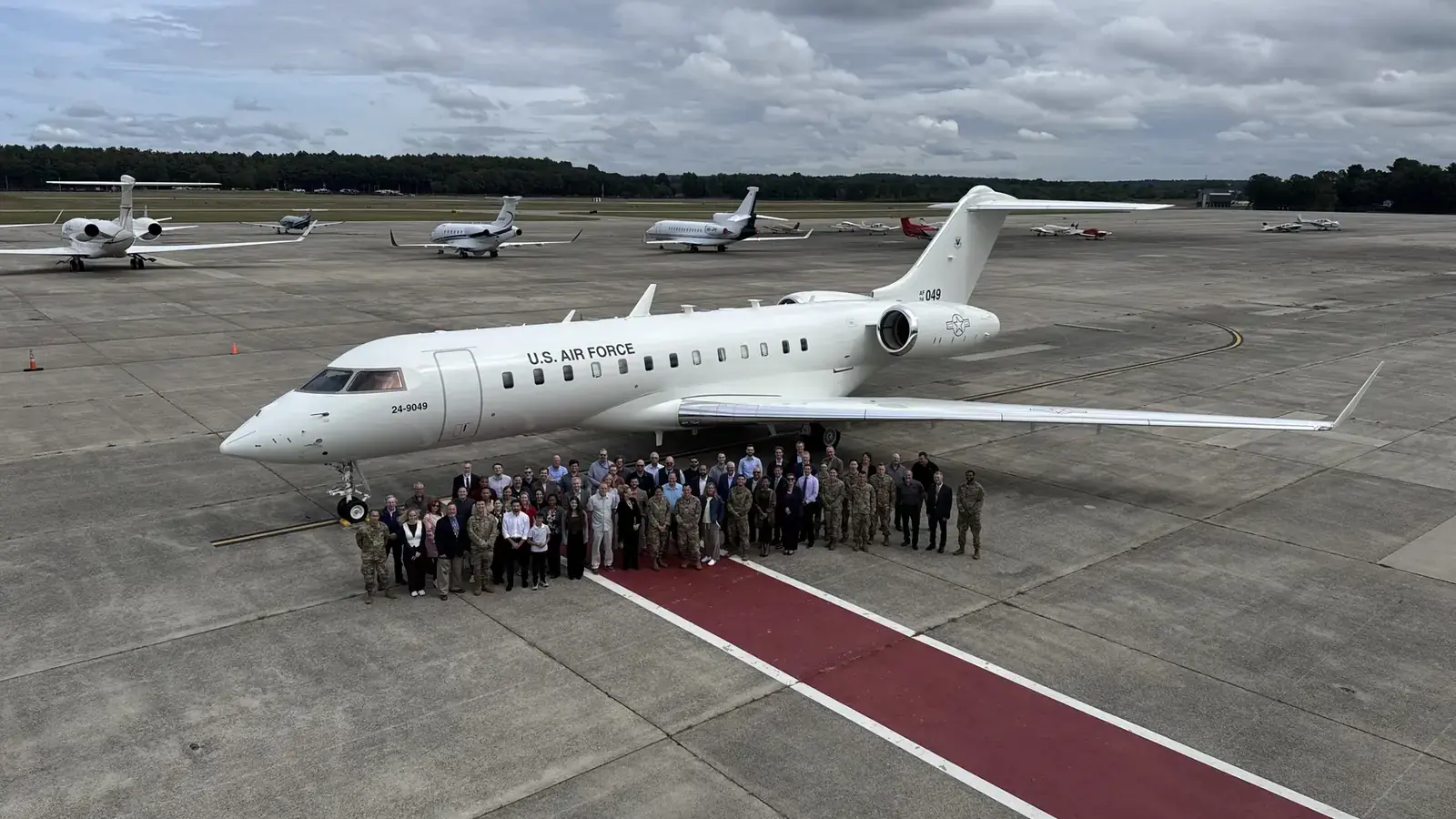
Bombardier BACN delivery — what does the ninth aircraft mean for the U.S. Air Force, for Bombardier’s defence business, and for airborne connectivity on contested battlefields?
On September 22, 2025, Bombardier confirmed that it had handed over a 9th Global‑series aircraft to the U.S. Air Force, registered 24-9049 (pre‑conversion civil registration N898M), to support the Battlefield Airborne Communications Node (BACN) mission, with a ceremony earlier in the month at Hanscom Air Force Base, Massachusetts. As a bridge between incompatible radios and data links, BACN turns a high‑altitude business jet into a universal translator—one that keeps joint and coalition forces speaking the same language when terrain, distance, and jamming conspire to cut the conversation short.
(Wonder why Northrop Grumman chose the Canadian Bombardier Global for military applications? Read why)
What happened at Hanscom—and why it matters
Moreover, Bombardier’s latest handover advances a long‑running defence partnership that began in Afghanistan and has since evolved into a standing U.S. Air Force capability. Notably, FlightGlobal’s Craig Hoyle reported that imagery released by Bombardier shows the new jet carrying USAF serial 24‑9049 and that the previous BACN airframe was delivered in October 2024. (FlightGlobal, Sept. 22, 2025.) (Flight Global)
In addition, The Aviationist adds a useful breadcrumb: the aircraft arrived under the civilian registration N898M before conversion, another reminder that these start life as long‑range executive jets before becoming E‑11As. “The new airframe, serial number 24‑9049, was delivered … under the civilian registration N898M.” (The Aviationist, Sept. 23, 2025.) (The Aviationist)
Additionally, trade titles that follow special‑mission platforms closely—Aviation International News among them—confirmed the handover and location, underscoring Hanscom AFB’s role as the heart of the BACN programme office. (AIN, Sept. 22, 2025.) (Aviation International News)
“An image released by Bombardier shows the recently transferred aircraft as being registered 24‑9049.” (FlightGlobal.) (Flight Global)
Quip: In a world of dropped calls, this is one fleet where “more bars” is a performance metric, not a cabin complaint.
What the aircraft does: BACN in one paragraph
In addition, Northrop Grumman describes BACN as “a high‑altitude, airborne communications gateway that translates and distributes imagery, voice and tactical data from disparate elements.” In plain terms, the payload hears on one net, speaks on another, and stitches everything together so air and ground can act as one team.
Therefore, the Bombardier BACN delivery deepens a network effect: each additional E‑11A increases coverage, dwell time, and resilience against disruptions. Bombardier summarised the mission this way: the aircraft “serve to bridge voice and tactical data between air and land forces … while surmounting obstacles such as mountains, rough terrain or distance.” (Bombardier press release.)
Quip: Think of BACN as an airborne group chat admin—except nobody gets muted at 51,000 feet.
Bombardier BACN delivery and the USAF order book
Context matters. Notably, in 2021, the Air Force’s BACN programme office at Hanscom awarded Northrop Grumman a US$3.6‑billion contract covering operations, sustainment, and support, locking in the backbone to keep the fleet flying and to integrate future increments.
Subsequently, in October 2023 Bombardier noted that its then‑recent seventh Global 6000 delivery formed part of a multi‑year deal “representing a potential total value of close to US$465 million,” with annual USAF purchase options running through 2026.
Separately, in January 2023, the Air Force awarded Northrop Grumman an IDIQ contract—widely reported at US$464.4 million—for E‑11A platform maintenance and main operating base contractor logistics support.
Quip: If BACN were spelled “bacon,” the budget lines would still sizzle.
Inside the jet: platform first, payload next
Firstly, Bombardier’s Global family is well suited to special‑mission conversions. The Global 6000 pairs long legs with an initial cruise at altitude, delivering range near 6,000 nm and a ceiling of 51,000 feet—ideal for high‑look communications.
Meanwhile, the newer Global 6500 couples aerodynamic tweaks with Rolls‑Royce Pearl 15 engines for a published range of 6,600 nm and top speed Mach 0.90.
However, variant nomenclature around the latest BACN airframes has sparked debate. AIN’s coverage mentions a Global 6500 “fitted as communications platform,” while The Aviationist calls the ninth aircraft a Global 6000. FlightGlobal threads the needle, referring to a “Global 6000‑derived” BACN platform and confirming the serial.
Consequently, readers should treat the exact suffix as fluid until the Air Force publishes a definitive block/variant note. What’s fixed is the mission: the Bombardier BACN delivery adds endurance and altitude to the communications gateway fleet, independent of whether the donor airframe is a 6000 or 6500 in marketing terms. You know the answer? Leave a comment below this page.
From Afghanistan to Hanscom: how BACN became indispensable
Initially, BACN’s origin story runs through the Hindu Kush. Early operations exposed how mountains and mixed radio inventories could isolate troops from air support. As a result, a high‑altitude gateway solved the basic physics, and the USAF fielded BACN first on manned E‑11A jets and also on unmanned EQ‑4B Global Hawks before retiring the latter in 2021.
Tragically, the fleet also absorbed lessons in loss. On January 27, 2020, an E‑11A crashed in Ghazni Province, Afghanistan, killing both pilots. Air Combat Command released the Accident Investigation Board report on January 21, 2021. (ACC AIB report.) (acc.af.mil)
Since then, the Air Force has institutionalised the capability. Hanscom’s programme office has purchased new aircraft, with publicly signposted options through 2026, while operational units have taken shape in the U.S. for training and surge.
“A Hanscom team awarded a $3.6 billion contract to Northrop Grumman Corp. for BACN operations, sustainment, and support.” (USAF Hanscom.) (hanscom.af.mil)
Quip: The lesson from Afghanistan was simple: mountains don’t move—so the relay had to.
Who flies it, and where?
Meanwhile, the E‑11A has moved beyond a deployed‑only posture. The 18th Airborne Command and Control Squadron at Robins AFB, Georgia, is building U.S.‑based capacity; USAF noted a plan for nine aircraft in service by the end of FY2027. Separately, the aircraft have forward‑operated from the Middle East, including out of Prince Sultan Air Base, Saudi Arabia, where their altitude and endurance let a small fleet cover multiple hotspots.
Additionally, Mil‑tech trade press also notes the 430th Expeditionary Electronic Combat Squadron association with BACN operations. “The aircraft are operated by the 430th Expeditionary Electronic Combat Squadron,” wrote Military Embedded Systems when covering the latest delivery. (Military Embedded Systems, Sept. 23, 2025.) (Military Embedded Systems)
Quip: For once, “out of office” in the duty schedule means “up at FL510.”
Bombardier BACN delivery: what exactly changed with jet number nine?
Firstly, coverage and persistence improve for gateway orbits. Each Bombardier BACN delivery increases the ability to keep a gateway on‑station for longer or to blanket two sectors at once. Secondly, training tempo rises at Robins AFB, building crews and maintainers without robbing operational hours from deployed jets. Thirdly, sustainment tail risk drops as spares pools and ground equipment scale with the fleet.
Technical context: the “universal translator” goes beyond voice
In addition, BACN doesn’t only forward voice; it also translates and bridges tactical data links and IP traffic. As L3Harris and other vendors explain in their Link 16 materials, link networks carry targeting, blue‑force location, and threat cues—data that joint forces cannot afford to drop.
Additionally, the Satellite Development Agency and Norwegian FFI demonstrated Link 16 via satellites in late 2024, hinting at a future where space relays extend the mesh even further. Airborne gateways like BACN complement that push by translating and fusing traffic among legacy radios, modern datalinks, and SATCOM paths.
“A high‑altitude, airborne communications gateway that translates and distributes imagery, voice and tactical data.” (Northrop Grumman.) (Northrop Grumman)
The platform debate: 6000 or 6500—and why it matters less than you think
The Bombardier BACN delivery spotlighted a minor nomenclature controversy. AIN’s report framed the aircraft as a Global 6500. FlightGlobal calls it “Global 6000‑derived.” The Aviationist says Global 6000. (AIN; FlightGlobal; The Aviationist.) (Aviation International News)
Moreover, the performance delta is modest but useful. The 6500’s Pearl 15 engines offer improved fuel burn and hot‑and‑high performance; the airframe also benefits from aerodynamic refinements, a touch more range, and better runway numbers.
However, payload integration and mission systems drive effectiveness far more than a few percentage points in fuel burn. Whether the donor jet is a late‑build 6000 or an early 6500, the BACN package, antennas, and power/cooling schemes define capability. The Bombardier BACN delivery remains about network effects and fleet resilience, not brochure stats.
Canada’s aerospace thread—and why readers here should care
Separately, for Canadian aerospace, Bombardier’s place in ISR/missionised platforms keeps deepening. The U.S. Army selected the Global 6500 as the platform for its HADES deep‑sensing programme and took delivery of its first 6500 airframe late in 2024 for modification.
Moreover, Bombardier and Leonardo signed an MoU to explore a Maritime Global 6500 variant, evidence that the platform is becoming a go‑to chassis for multi‑role missions beyond BACN.
For broader context on Bombardier’s large‑cabin road map and performance envelope, Fliegerfaust readers can revisit recent coverage of the Global 8000 and 7500 programmes, which show the company’s high‑end production, test, and completion muscle in Canada:
- Bombardier Global 8000: World’s Fastest Business Jet (May 20, 2025).
- Paris Air Show 2025: Airbus, Bombardier Reveal Big News (June 16, 2025).
Additionally, this site’s defence‑focused digest captured Bombardier Defence momentum across Global 6500 and Challenger lines: Bombardier Defence News: Saab orders Global 6500… (June 20, 2025).
Programme milestones, by the numbers
The USAF has flown E‑11As operationally for almost two decades, with the type now visible not only downrange but also stateside. In May 2025, an E‑11A made its first public airshow appearance at Seymour Johnson AFB, a rare look at an otherwise low‑profile capability.
Earlier, the Air Force retired its BACN‑equipped EQ-4B Global Hawk unmanned fleet in 2021, concentrating the mission on the manned jets.
Finally, the Bombardier BACN delivery covered here marks aircraft number nine in USAF service, aligning with a USAF planning figure of nine in service by FY2027.
Handover details: dates, place, identifiers
Specifically, Bombardier’s press release pins the announcement to September 22, 2025, with the delivery ceremony conducted earlier in September at Hanscom AFB.
Bombardier’s quote from Jean‑Christophe Gallagher, Executive Vice President, Aircraft Sales and Bombardier Defense captured the tone: “We are honored to see our reliable, high‑performing Global aircraft serve the United States Air Force … through the BACN program.” (Bombardier.) (Bombardier)
The money trail: who pays for what
Because the BACN mission sits at the intersection of aircraft ownership and payload integration, contracts split along predictable seams. Additionally, Bombardier provides the donor airframes and specialist support. Northrop Grumman integrates, sustains, and upgrades the BACN package, backed by the US$3.6‑billion 2021 Hanscom award and the US$464.4‑million IDIQ for E‑11A logistics and maintenance actioned in January 2023.
Furthermore, Bombardier’s 2023 messaging also flagged the US$465‑million potential value across options for additional airframes through 2026, a useful proxy for per‑aircraft procurement even if configuration detail remains proprietary.
Quip: In aviation acquisition land, the only thing more powerful than a jet engine is a multiyear option clause.
Beyond BACN: the Global platform’s special‑mission arc
Because the Global line has become the standard for several mission sets, the USAF’s adoption of BACN on Globals sits in a broader trend. The U.S. Army’s HADES ISR effort picked the Global 6500 as its prototype platform, with the first aircraft delivered for modification in November 2024.
Meanwhile, industry is exploring maritime patrol and anti‑submarine warfare derivatives, as seen in the Bombardier–Leonardo MoU on a 6500 variant for Italy’s requirement space.
Will the Canadian government buy a Made In Canada solution? Don’t hold your breath!
Therefore, the Bombardier BACN delivery is more than a headline; it’s an indicator of where Western ISR and C2 fleets are heading—toward agile, efficient, high‑altitude business‑jet platforms with room for power, cooling, and growth.
Quip: Who knew the best place to put a radio tower was a luxury jet?
Bombardier BACN delivery: What to watch next
Procurement cadence suggests the USAF is near its near‑term target. Robins AFB indicates nine aircraft by FY2027, a figure the latest delivery directly supports. At the same time, technology keeps evolving. The Air Force has flagged plans to add a High‑Capacity Backbone and navigation/self‑defence updates to E‑11A, which would sharpen resilience in contested airspace.
The bottom line—and a Canadian angle
Overall, Bombardier’s ninth aircraft for BACN is not just another airframe in a line of deliveries. It’s capacity the USAF can bank, training hours that don’t cannibalise deployments, and a signal that Bombardier Defence has carved out a durable niche in high‑altitude special missions. The Bombardier BACN delivery sits alongside HADES and emerging maritime concepts as proof that Canada’s flagship business‑jet platform is becoming a chassis of choice for next‑generation ISR and C2.
For readers who track Canadian industry strategy on this site, that arc matches the themes we’ve covered on Bombardier’s high‑end portfolio and defence ambitions. See our pieces on the Global 8000 programme and Paris Air Show announcements for context on engineering, completions, and supply‑chain reach: Global 8000; Paris Air Show 2025.
Quip: We used to say “Montreal builds jets.” Increasingly, the world says “Montreal builds platforms.”
Bombardier BACN delivery: a critical view, and a question
The Bombardier BACN delivery deserves applause, but scrutiny helps. The USAF has spread BACN across a small fleet of complex, specialised aircraft. That makes each jet disproportionately valuable—and potentially vulnerable to supply‑chain shocks or unexpected downtime. Moreover, variant ambiguity (6000 vs 6500) should not obscure the need for crystal‑clear, public configuration control, especially as the Air Force contemplates upgrades like a High‑Capacity Backbone and enhanced self‑protection. Conversely, the programme’s contracting fundamentals look sound: long‑term sustainment via Hanscom, ongoing integration with Northrop, and a stable donor airframe from a Canadian OEM that has doubled down on defence.
Therefore, the question is not whether airborne gateways are essential; they are. The real question is whether the USAF can scale and harden BACN fast enough to keep communications coherent in an era of jamming, spoofing, and long‑range fires—and whether industry, led here by Bombardier and Northrop, can keep the nodes aloft when the network is most at risk. If the next fight tries to sever the conversation, will nine aircraft be the start of a resilient constellation—or the minimum viable network for a maximum‑threat environment?
How integrators pick a jet for a mission like BACN
When a prime contractor evaluates an aircraft for a special‑mission role, the checklist starts with power, cooling, altitude and endurance. Those four basics determine what payloads you can carry, how long you can stay, and how reliably the system runs when the heat—literal and electronic—rises.
Electrical power – 6 generators on the Bombardier Global
First, electrical power. A BACN gateway is a flying server room: radios, datalinks, processors, recorders and antennas all draw steady current. The Global family brings built‑in redundancy here. As a training reference puts it, “AC power is normally supplied by four variable frequency generators, two on each engine.” (Scribd) For DC loads, “4 transformer rectifier units convert variable frequency AC power… to 28 VDC power.” (Scribd) In plain English: multiple independent sources and conversion paths mean the mission kit isn’t hanging off a single breaker. But with the Global aircraft you can also use the auxiliary power unit (APU) in flight, read below.
Cooling
Second, cooling and pressurisation. Mission computers and radio racks run cooler and more reliably when the environmental control system can move lots of air and keep temperatures stable. Bombardier’s own overview highlights “an advanced air management system [that] can quickly regulate the cabin temperature, providing 100 percent fresh air at all times.” (Bombardier) That helps the electronics and the crew.
Low cabin altitude
Third, crew physiology. Low cabin altitude matters on multi‑hour orbits. The Global pressurisation schedule is designed to reduce fatigue; as Aviation International News notes, “the cabin pressurization has been improved to permit a 4,500‑foot altitude equivalent at 45,000 feet and 5,700 feet at 51,000 feet.” (Aviation International News) Over long sorties, that lower cabin altitude translates into clearer heads and fewer headaches.
Endurance
Fourth, endurance. Airborne gateways do their best work when they can loiter. Bombardier Defence advertises the Global 6500’s “over 18 hours of endurance” in special‑mission service, which gives schedulers options—long single‑ship orbits or overlapping belts with hand‑offs.
How high
Finally, altitude. BACN is about line‑of‑sight. Operating in the high‑forties and low‑fifties lifts the “horizon” for every radio it bridges, smoothing the mesh over mountains and long distances. That ceiling is a design feature across the Global family.
Quip: Think of it as choosing a hilltop for your radio—only this hilltop climbs to FL510 (51,000 feet) and stays there for half a day.
Why BACN rides a Global: the practical advantages
A big reason this airframe suits BACN is electrical flexibility. In addition to the four engine‑driven generators, the Global’s auxiliary power unit (APU) can supply electrical power in flight, adding margin for hot‑day cooling spikes or heavy payload draws. The APU electrical power may be used in flight or on ground. The APU also provides bleed air for cabin cooling and heating—useful both on the ground and aloft when thermal loads climb.
Redundancy is the other quiet advantage. Multiple AC generators with DC conversion and independent buses create graceful degradation. A component failure does not automatically mean a mission scrub; the remaining sources can carry the essentials while crews manage loads. (Pilots live by that kind of reversion planning.)
Comfort links directly to performance. With a lower cabin altitude and a tightly regulated environment, crew members stay sharper over long missions. That’s not luxury; it’s operational safety. Prolonged vigilance, radio deconfliction and network management are cognitive tasks. Reducing hypoxia‑adjacent fatigue and heat stress helps the team make better calls.
Lastly, space and weight. The Global offers a large, flat‑floor cabin and robust structural margins, so integrators can install equipment racks, operator consoles, power distribution units and cooling ducting without exotic surgery. Bombardier Defence markets the type for special missions precisely because it combines power for mission equipment, long endurance and ample cabin space—a useful trio when the payload evolves over time.
Editor’s notes: key external sources cited inline
- Bombardier press release confirming the ninth aircraft and Hanscom ceremony, September 22, 2025. Link. (Bombardier)
- FlightGlobal confirming serial 24‑9049 and previous delivery in October 2024. Link. (Flight Global)
- The Aviationist confirming N898M and Hanscom details. Link. (The Aviationist)
- AIN coverage of the handover and variant reference. Link. (Aviation International News)
- Hanscom AFB release on the US$3.6B sustainment award to Northrop (2021). Link. (hanscom.af.mil)
- Bombardier note (Oct. 23, 2023) on US$465M potential value and annual options through 2026. Link. (Bombardier)
- Robins AFB on 18th ACCS and planned nine aircraft by FY2027. Link. (robins.af.mil)
- Northrop’s BACN mission description. Link. (Northrop Grumman)
- ACC Accident Investigation Board summary (Jan. 21, 2021). Link. (acc.af.mil)
- AIN on EQ‑4B retirement/repurposing. Link. (Aviation International News)
- FFI/SDA on Link 16 via space. Link. (sda.mil)
- Bombardier — Inside the Global 5000 and Global 6000 (fresh‑air and air management system claim). (Bombardier)
- AIN — Global 6000 Means Airborne Luxury (4,500‑ft/5,700‑ft cabin altitude figures). (Aviation International News)
- Bombardier Defence — Global 6500 (Defence page) (“over 18 hours of endurance,” power for mission equipment). (Bombardier)
- Global Express electrical/FCOM‑derived references (four VFGs; TRUs) — training summaries. (Scribd)
- Bombardier Global Express APU system brief (APU electrical power usable in flight; APU supplies bleed air). (jettairx.com.br)
Leave your comments below or on our Fliegerfaust Facebook page.
For full details, please refer to our Disclaimer page.