

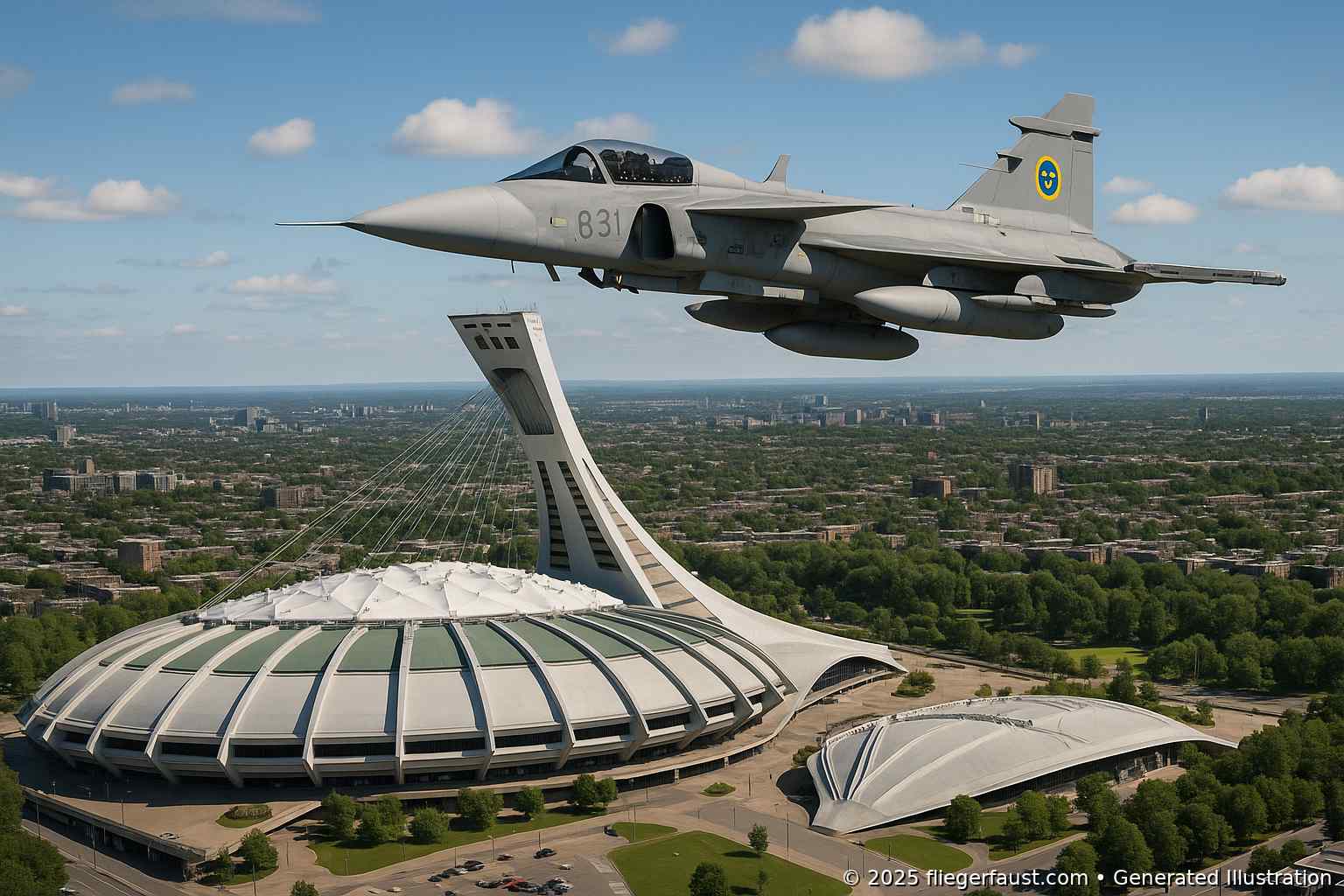
Bombardier Gripen Canada: is this the moment a Swedish‑Canadian fighter line becomes real?
On October 22, 2025, Sweden and Ukraine signed a letter of intent for up to 150 Gripen E fighters, instantly raising the stakes for Saab’s production capacity and vaulting Canada—through Bombardier—into the conversation about where new assembly lines could land. Two days later, Saab’s chief executive said the company could double output and is exploring additional sites “possibly elsewhere in Europe or in Canada” to meet demand.
ALSO READ THIS UPDATE: Bombardier Gripen Canada – What We Know Now After Ottawa’s New Signals
Meanwhile, the Globe and Mail reported that Saab and Bombardier are in talks about a joint venture to manufacture the fighter in Canada—a development echoed in market coverage and Swedish business press, even as the parties keep details close.
If industrial policy had a soundtrack, it would be set to a metronome: jobs, jobs, jobs.
Also read Air Force One fleet: USAF orders two more Boeing 747-8s – here’s why
What’s new, and why now
To summarise the week that jolted Ottawa’s aerospace scene: on October 22, 2025, Swedish Prime Minister Ulf Kristersson and Ukrainian President Volodymyr Zelenskyy announced a cooperation framework that includes a potential export of 100–150 Gripen E jets—Sweden’s largest-ever aircraft deal if it closes.
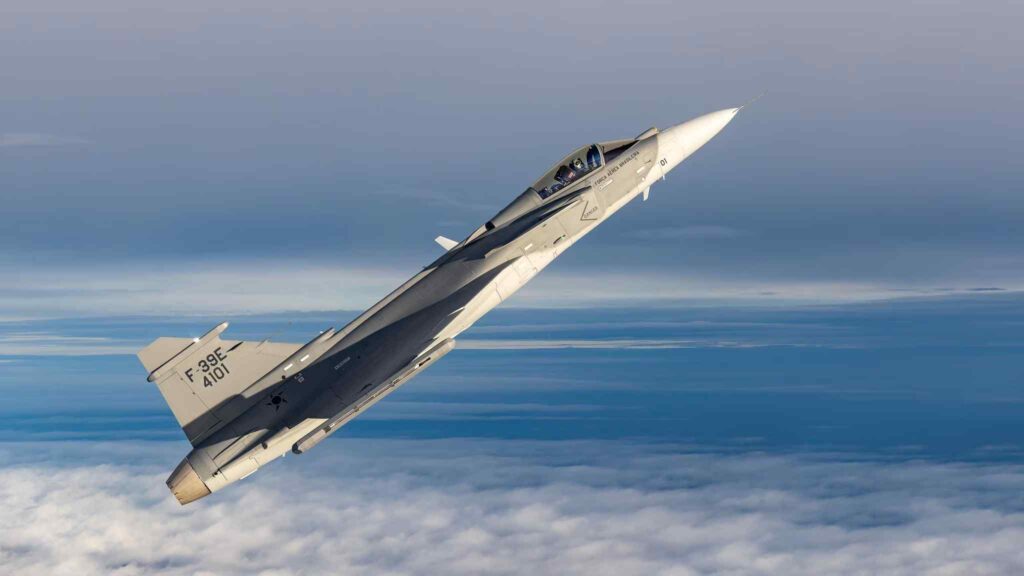
On October 24, Saab raised its sales outlook and said plainly that it would look at production beyond Sweden and Brazil in response to the Ukraine demand signal; Canada was explicitly mentioned. On November 6, Sweden’s defence minister Pål Jonson said Stockholm could contribute export credits or aid to help finance a Ukraine Gripen package and noted Saab is considering cooperation with Canada to expand production.
Concurrently, reporting in Canada pointed to exploratory talks between Saab and Bombardier to build Gripen here. The market brief that circulated October 31 cited the Globe and Mail’s weekend coverage, and Swedish financial outlets flagged the same scenario, albeit with the caveat that it remains unconfirmed by the companies.
Also read our analysis: F-35 Cancellation: Economic Risks & the Gripen Alternative for Canada
Moreover, Canadian ministers have been engaging Sweden on a broader, formalised framework to deepen defence-industrial ties. On August 19–20, 2025, Canada and Sweden announced they are working toward a strategic partnership that lists “defence industry” and “aerospace” as priority areas.
Canada and Sweden have a lot in common—forests, hockey, and now possibly a fighter line that prefers cold runways to hot air.
Bombardier Gripen Canada: the industrial logic and job impact
There is a blunt industrial logic to Bombardier Gripen Canada. First, Bombardier is already Saab’s strategic teammate on special‑mission aircraft: Saab’s GlobalEye surveillance system rides on Bombardier Global 6000/6500 airframes, which Bombardier Defence delivers “green” for conversion. That production relationship is current, proven, and physically rooted in Canada.
Second, Bombardier’s Canadian footprint is large and modern. The new Aerospace Campus at Toronto Pearson International Airport—Toronto Pearson International Airport (YYZ)—is a 750,000‑square‑foot final assembly centre for the Global family, purpose‑built for high‑precision work and instrumented for testing and flight operations on site. Interiors and completions work scale between Montréal–Trudeau International Airport (YUL) (Corporate Jet Investor).
Third, the economic uplift is meaningful. A PwC study published September 10, 2025, found Bombardier contributed $7.4 billion to Canada’s GDP in 2024 and supported roughly 48,500 jobs nationwide, with long‑term projections of $39.6 billion in GDP contributions between 2025 and 2030.
Finally, Ottawa knows how to mobilise capital for aerospace. Past support includes federal repayable loans to Bombardier in 2017 and Québec’s 2015 investment in the then‑CSeries—a reminder that public co‑investment in domestic aerospace is not new, though it must be transparent and disciplined.
If you’re looking for an aerospace workforce that can read a micrometer and a balance sheet, Québec and Ontario have you covered—bilingual torque wrenches included.
Bombardier Gripen Canada: what a final‑assembly flow could look like
A Bombardier Gripen Canada line would not start on a blank page. Saab already runs dual‑country production with Embraer in Gavião Peixoto, Brazil, where the Gripen E final assembly line opened on May 9, 2023. That template—OEM core with a local champion—maps well to a Saab‑Bombardier joint venture.
Practically, subassemblies and major components could be split among Canadian and Swedish suppliers, with avionics, flight‑control computers, and mission‑system items sequenced into stations at Toronto YYZ. Testing and acceptance could occur at the Toronto site, with periodic deployment to ranges for weapons and environmental certification. Montréal–Mirabel International Airport (YMX), under Aéroports de Montréal (ADM), has deep aerospace heritage and room to grow; specific work packages like composite structures or pylons could land there if the joint venture wanted a two‑site footprint in Québec and Ontario.
Space and less expensive – Mirabel, Quebec
But at the end of the day, with its dual 11,000‑foot runways, Montréal–Mirabel International Airport (YMX) has far more available space and is much less expensive to operate than the Toronto Pearson International Airport (YYZ) area, and is closer to Bombardier’s headquarters and to L3Harris, which maintains the current Canadian CF‑18 fleet.
Still, there is an immediate cross‑programme integration benefit: the same Bombardier manufacturing ecosystem that turns out Globals for GlobalEye can cross‑pollinate tooling, quality systems, and workforce skills if Gripen final assembly stands up nearby (Saab; Bombardier).
Ukraine demand as the catalyst
The immediate catalyst is Ukraine. Kyiv and Stockholm are exploring a 100–150‑aircraft Gripen E package. President Zelenskyy called Gripen jets a “priority” and said Ukraine aims to start using them next year if the deal moves ahead—contingent on financing and sequencing alongside ongoing F‑16 integration (Reuters). Sweden’s defence minister added on November 6 that financing options include export credits, frozen Russian assets, and Sweden’s Ukraine aid framework; he also flagged the role of countries with Gripen subcomponents—Canada is in that conversation (Reuters).
Saab’s production‑rate math now has urgency. Historically, Gripen output peaked below 20 jets per year. Saab is targeting 20–30 per year soon, but a Ukraine package could require roughly double that for a multi‑year window. That is the strategic opening Bombardier Gripen Canada would fill.
Nothing concentrates minds like a backlog with triple‑digit teeth.
The RCAF, a mixed fleet, and the F‑35 contract
For Canada’s own fighter recapitalisation, the facts are clear. Ottawa announced on January 9, 2023 that it would acquire 88 F‑35A fighters, the largest Royal Canadian Air Force (RCAF) investment in three decades (Government of Canada). Over the past year, however, the government commissioned an internal review of options and risks as costs, infrastructure, and pilot throughput sharpened the picture; reliable reporting indicated the review argued for sticking with the plan rather than splitting orders—though the final call remains political by nature.
Even so, Canada is not locked out of complementary force‑structure choices. The RCAF can field F‑35 squadrons for NORAD and expeditionary tasks while leveraging a Gripen industrial base for export programmes (Ukraine and beyond) and for Canada’s own sovereignty patrols using a dual engine fighter jet in the future if policy changes. That mixed‑fleet idea is controversial, but the industrial upside—jobs, tooling, and a sovereign fighter‑support community—is undeniable.
Given Canada’s vast northern approaches—reaching to the Russian frontier—dual‑engine fighters like the CF‑18 and the Gripen provide essential engine‑out redundancy over long Arctic legs with few diversion airfields, where search‑and‑rescue is distant and weather can abruptly close runways.
For readers who want a deep dive on the economics of cancelling or reallocating Canada’s F‑35 buy, see our prior analysis at Fliegerfaust, which modelled job impacts, supplier exposure, and potential offsets: F‑35 Cancellation in Canada: Gripen vs Economic Fallout.
Export controls, the engine, and sovereignty
There is an unavoidable sovereignty factor in Bombardier Gripen Canada: the engine. The Gripen E/F uses the General Electric F414 family (RM16 for Sweden), which is subject to U.S. International Traffic in Arms Regulations (ITAR). Canada benefits from the ITAR “Canadian Exemption” for many unclassified defence items, but exemptions have boundaries and do not nullify the U.S. government’s discretion over exports of sensitive components (U.S. DDTC; ECFR §126.5).
Therefore, any Saab–Bombardier joint venture must bake export‑control engineering into the design from day one: part numbering, data‑segmentation, secure development environments, and a licensing plan for every configuration that could be exported to Ukraine or other third countries. That is not hypothetical—the U.S. has proven willing to adjust licensing regimes, as seen with AUKUS streamlining for the UK and Australia. Canada will likely need a Gripen‑specific path that respects U.S. law while safeguarding timely deliveries.
Bombardier Gripen Canada: timelines, rates, and learning curves
What could a realistic ramp look like? Saab’s CEO said the company could build 20–30 aircraft annually soon and double if a Ukraine contract is finalised (Reuters). If Canada stood up final assembly and flight test at YMX with Bombardier as JV partner, a phased plan might target:
- Year 0–1: Lease and tool selected hangars; qualify suppliers; transfer work instructions; train crews with Saab mentors.
- Year 2: First Canadian‑assembled Gripen E to flight; concurrent acceptance workups; begin rate‑build to 1 jet/month.
- Year 3–4: Stable rate at 18–24 jets/year, depending on contract flow and test‑range availability.
- Year 5+: Surge to 30–36/year if Ukraine and a second export customer overlap—contingent on engines, avionics flow, and weapons integration windows.
Those rates assume the heavy lifting of avionics and mission‑system software remains centralised with Saab in Sweden, with Canadian teams integrated in hardware, structural assembly, systems installation, functional testing, and flight operations. Notably, this mirrors Saab–Embraer’s two‑nation model in Brazil.
Bombardier Gripen Canada: policy guardrails Canada must demand
Policy clarity is the difference between a good press release and a durable industry. Ottawa should insist on these guardrails in any Bombardier Gripen Canada agreement:
- Hard job numbers tied to milestones. Link Canadian hiring, apprenticeships, and supplier awards to concrete schedule gates and serial‑number batches. Bombardier’s proven economic footprint—$7.4 billion GDP in 2024, 48,500 jobs—is a baseline to grow (Bombardier; AIN).
- Export‑control architecture. Mandate an ITAR‑compliant “digital twin” of the bill of material and data flows from day one (see §126.5 requirements) (ECFR).
- Co‑investment with clawbacks. If public funds support tooling or training, set performance‑based tranches, independent audits, and clawbacks for missed milestones—lessons learned from 2015–2017 support packages (Reuters).
- Canadian supplier content. Require a minimum Canadian‑value‑add with ramped thresholds, avoiding brittle targets early while building a resilient chain later.
- Mission‑system participation. Carve out defined Canadian roles in testing, qualification, or specific subsystem integration to keep high‑value engineering in country.
- NORAD/NATO alignment. Ensure datalinks, Identification Friend or Foe (IFF), and Arctic sustainment patterns are aligned with RCAF needs—even if initial jets flow to Ukraine.
Bombardier Gripen Canada: how this fits Canada’s broader aerospace play
This is not a one‑off. Canada and Sweden are already framing a strategic partnership across defence industry, digital innovation, and the green transition (Government of Canada; Government of Sweden). Canada also has a thriving special‑mission jet niche that dovetails with Saab’s portfolio. Recent Fliegerfaust coverage explored Bombardier Defence’s momentum on Globals and Challengers in ISR (intelligence, surveillance and reconnaissance) roles, including GlobalEye and the U.S. Air Force’s BACN programme, which now fields nine Global‑series aircraft.
Catch up here:
- Bombardier Defence: Global 6500 & Challenger 3500.
- Bombardier BACN Delivery—Ninth Global Jet.
- South Korea Global 6500: Inside Seoul’s Phoenix AEW&C Decision.
Furthermore, Gripen’s road‑base and cold‑weather operating concept is arguably tailored to Canada’s geography. The RCAF (Royal Canadian Air Force) flies sovereignty patrols over the Arctic in harsh conditions. A fighter optimised for short, dispersed operations speaks directly to that mission set—even if the near‑term customer is Ukraine.
HUMOUR: Canada has two seasons—winter and construction—which happen to be exactly the Gripen’s favourite runway conditions.
Bombardier Gripen Canada: politics, pragmatism, and the “F‑35 question”
Let’s confront the politics head‑on. Canada’s F‑35 acquisition is a signed government‑to‑government deal, and the default path is to proceed. The internal review reported this summer supported that trajectory, according to credible reporting.
However, policymaking is not binary. Canada can honour current commitments while building a sovereign fighter‑assembly capability for allies and exports. If future governments ever consider augmenting the RCAF fleet with a second type,adding the Gripen to it’s fleet, having a mature Bombardier Gripen Canada line on home soil would de‑risk that option.
We explored this trade space earlier this year and the industrial “give‑gets” still apply: Fliegerfaust’s F‑35 cancellation deep dive.
In Ottawa, “never” means “until a committee says otherwise.”
Bombardier Gripen Canada: what the principals are saying
Saab’s position is unusually frank for an OEM. “It’s absolutely no impossibility to dramatically increase the pace if we need to,” said CEO Micael Johansson on October 24, referring to Gripen production rates as the Ukraine framework advanced. He added that Saab would explore producing at new sites, “possibly … in Canada” (Reuters).
On the Canadian side, Industry Minister Mélanie Joly called Saab’s interest “welcome news” and said she has been working with Saab on potential partnerships, building on GlobalEye collaboration with Bombardier.
Sweden’s defence minister, Pål Jonson, underlined on November 6 that financing options are advancing and that countries supplying subcomponents may have “extra incentives” to help fund the deal—again highlighting the merit of a Canadian industrial role.
Bombardier Gripen Canada: technical fit and mission overlap
The Gripen E’s GE‑F414‑based powerplant, advanced electronic warfare suite, IRST, and Meteor missile integration make it a high‑end “4.5‑generation” platform (Saab; Reuters). Its concept of operations—rapid turnaround on dispersed roads, cold‑weather hardening, and modest ground crew footprint—aligns with Canada’s sovereignty and NORAD tasks.
At the same time, Bombardier’s Global family underpins GlobalEye, which delivers airborne early warning and control (AEW&C) with Erieye ER radar. That pairing—GlobalEye + Gripen—offers a compelling operational “stack” for allies who need both sensing and shooters. Having both airframes’ industrial roots in Canada would anchor a domestic ISR (intelligence, surveillance and reconnaissance) and fighter ecosystem with export reach.
For readers tracking the special‑mission arc, see our Global 6500 AEW&C context here: South Korea Global 6500: Phoenix AEW&C.
Bombardier Gripen Canada: risks and how to de‑risk them
Supply chain fragility. Engines, radar modules, and seeker heads are the pacing items. Canada must align export licenses and long‑lead funding so the joint venture never starves the line.
Schedule realism. The Year‑2 first flight target is aggressive but credible if Saab embeds mentors in Canada from day one. Brazil’s E‑line is a case study in disciplined localisation.
Political overhang. If Ottawa’s internal review locks in the F‑35 path, Bombardier Gripen Canada must justify itself on export logic first, with a credible Ukraine pipeline and one additional customer in view (Canada?). The policy narrative should be “export engine + sovereign sustainment base,” not “choice against F‑35.”
Capital discipline. Public money should buy public goods—workforce, tooling, and dual‑use infrastructure. Clawbacks must be enforced if targets slip.
Ambition is essential; caffeine is optional; governance is non‑negotiable.
Bombardier Gripen Canada: the bigger picture—NORAD, NATO, and allies
A Canadian Gripen line would be bigger than Canada. For NORAD, it signals North American resiliency: Canada can host allied fighter production that supports European security without choking U.S. supply chains. With NATO, it diversifies a fighter industrial base that is currently tilted toward a single fifth‑gen programme. For Ukraine, it could accelerate deliveries while Saab maintains standards in Sweden and Brazil.
Critically, a domestic line reinforces Canada’s aerospace centre of gravity, anchored by Bombardier’s expertise. That is why this story is not only about fighters. It is also about a special‑mission jet powerhouse that already supports GlobalEye today (Saab) and a Canadian OEM that added $7.4 billion to GDP last year (Bombardier).
Conclusion
Canada should pursue Bombardier Gripen Canada, but only on rigorous terms. The industrial case is strong: Bombardier has the facilities, the workforce, and a running partnership with Saab on GlobalEye. The geopolitical case is stronger: Ukraine needs fighter jets, Europe needs diversified capacity, and Canada needs a sovereign aerospace engine that throws off high‑skill jobs and exports. The policy case hinges on execution: export‑control design from day one, milestone‑tied jobs, and discipline on public funds.
In our view, the right path is to move from “talks” to a formal joint‑venture framework with clear job numbers, a Year‑2 first‑flight target, and a balanced risk‑sharing model—without turning this into a referendum on the F‑35. Ottawa can honour its current commitments and build an export‑focused Gripen line that matures Canadian fighter‑production skills. The Arctic will thank you for the redundancy; Ukraine will thank you for the throughput. Canadian families will thank you for the jobs.
Final question
If Canada has the chance to anchor a fighter line that serves allies, strengthens NORAD, and deepens our aerospace economy, what are we waiting for?
Leave your answers and comments below and on our Fliegerfaust Facebook page.
For full details, please refer to our Disclaimer page.

Canadian Sovereignty is of the utmost importance in this matter, and cutting off the remaining F35 after 16 delivered is the way to sell this option of the Saab Gripen deal, to and for Canadians to and for Americans. Meeting NATO demands of 5% of GDP come at a cost for Americans not just benefits.