

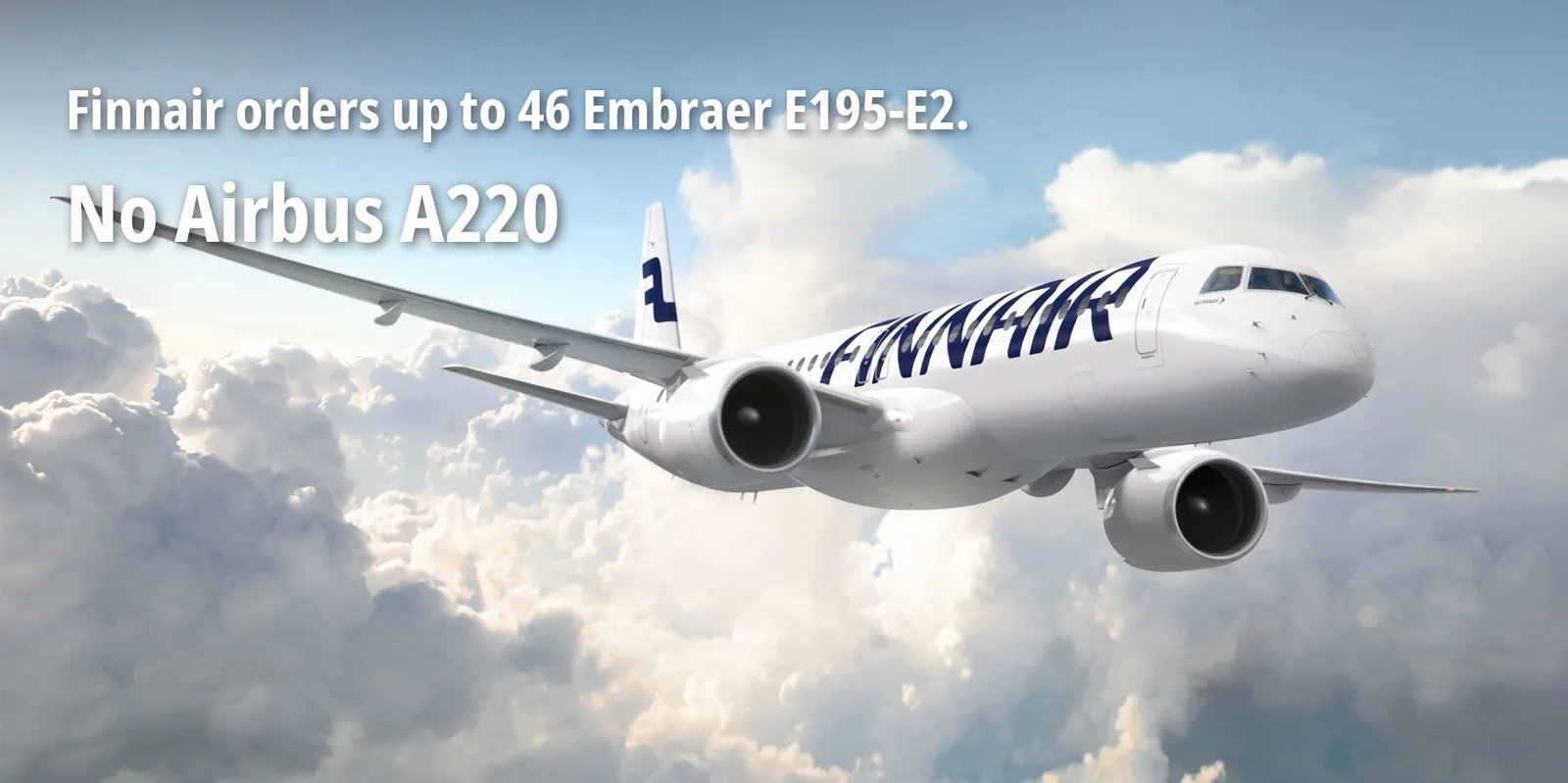
Finnair fleet renewal: why did Embraer’s E195-E2 beat the Airbus A220 in Europe’s sharpest small single-aisle contest on March 23, 2026?
Finnair fleet renewal: Overall, the answer matters far beyond Helsinki. Specifically, Finnair ordered 18 E195-E2s, plus 16 options and 12 purchase rights. Meanwhile, it also plans to source up to 12 used Airbus A320 or A321 current engine option (ceo) aircraft as a short-term bridge. Those order terms were set out in Reuters’ March 23, 2026 report and Embraer’s March 23, 2026 announcement.
Moreover, this was not a simple story of Finnair “leaving Airbus.” Meanwhile, the airline still runs a heavily Airbus-centred mainline fleet. Additionally, it also keeps Airbus in the picture through used A320/A321ceos. Instead, what changed was narrower. Finnair decided that the A220’s extra range and extra seats did not match its near-term network problem as neatly as Embraer’s 134-seat E195-E2. That network-fit logic became clearer in Aviation Week’s same-day analysis.
Finnair fleet renewal starts with network fit
Finnair narrowbody renewal is not a clean break from Airbus
First, Finnair fleet renewal is not an anti-Airbus manifesto. Specifically, Reuters’ March 23, 2026 report said Airbus declined to comment on customer fleet strategy. “Finnair remains a valued, long-term partner …” — Airbus spokeswoman, Reuters. Consequently, that context matters. It blocks the lazy idea that this was an all-or-nothing rejection.
Meanwhile, Finnair’s fleet page says most of its roughly 80 aircraft are still Airbuses. Additionally, the same page lists 5 Airbus A319s, 10 Airbus A320s and 14 Airbus A321s. Moreover, it also shows that the A319s date from 2000 to 2004. Meanwhile, the A320s date from 2001 to 2004. In other words, the replacement clock was already loud before this order arrived.
Notably, that age profile explains why Finnair paired the Embraer order with used Airbus jets. Separately, Reuters reported that the carrier plans to acquire up to 12 used A320 or A321 aircraft from the market. Moreover, Aviation Week added that these older Airbus jets are meant to replace the oldest A319s and A320s. Consequently, they buy time while the broader renewal unfolds. Therefore, Airbus did not vanish from the solution. Instead, it shifted from primary contender to tactical bridge.
Finnair narrowbody renewal puts Norra at the centre
However, the most important detail is where these E195-E2s will actually work. Specifically, in Aviation Week’s March 23, 2026 coverage, the aircraft are described as additions for Nordic Regional Airlines (Norra), Finnair’s regional partner. Separately, Finnair’s investor business-model page says Norra operates 24 aircraft, including ATR turboprops and Embraer 190s, under a purchase traffic agreement. Additionally, the same source says Danish Air Transport (DAT) owns 60%. Meanwhile, Finnair owns 40%.
Consequently, the decision sits as much in feeder strategy as in headline fleet renewal. Separately, Finnair’s Norra explainer says Norra operates many domestic and European routes under Finnair flight numbers. Moreover, Reuters added that the 18 new Embraers will double seat capacity on regional routes within Finland, the Nordic countries and Northern Europe. Consequently, that is a network move, not just a fleet move.
Embraer’s March 23, 2026 announcement said the agreement covers up to 46 aircraft in total. Additionally, it also said deliveries start in the second half of 2027. Notably, Aviation Week was even more specific. Specifically, it reported that the first 134-seat E195-E2 will join the fleet in the third quarter of 2027. Initially, three aircraft arrive in 2027. Next, six follow in 2028, another six in 2029, and the final three in 2030. “This is one of the largest investments in Finnair’s 102-year-old history …” — Turkka Kuusisto, CEO, Embraer release
Additionally, Kuusisto gave Reuters the short version of the operating case. “This is a highly versatile aircraft and one of the quietest on the market.” — Turkka Kuusisto, CEO, Reuters. Reuters also quoted him saying the aircraft would cut carbon dioxide (CO2) emissions by 30% per passenger carried. In a market where short sectors punish inefficient gauge, that is not decorative language. It is the heart of the investment case.
Finnair fleet renewal and the Airbus A220 question
Airbus A220 decision: the A220 was a real finalist
Still, the most consequential Airbus-side reporting came from Aviation Week. Christine Rovelli, Finnair’s chief revenue officer, said the A220 “was also in the mix,” but the E2 was ultimately the better fit. That matters because it moves the discussion from guesswork to a declared head-to-head comparison.
Moreover, Rovelli described the trade-off with unusual clarity. “The A220 has a longer range; it carries more people.” — Christine Rovelli, Chief Revenue Officer, Aviation Week. She then asked whether that was actually best suited to Finnair’s network. Finally, she concluded that “we really felt like the E2 is the best decision.” That is not Airbus bashing. It is mission selection.
Importantly, Finnair’s public remarks discussed “the A220” generically rather than naming a single variant. Even so, Airbus’s November 2025 A220 facts-and-figures sheet shows the likely paper comparison. Specifically, the A220-300 carries 120 to 150 passengers in a typical two-class layout. Moreover, it reaches 3,400 nautical miles. The aircraft uses Pratt & Whitney PW1500G engines. It also cruises at Mach 0.82.
Airbus A220 alternative still lost on fit
However, the E195-E2 that Finnair bought also makes a disciplined case. Embraer’s E195-E2 specification sheet lists 3,000 nautical miles of range with full passengers and typical reserves. It also lists Mach 0.82 cruise and a 62,500-kilogram maximum takeoff weight. Embraer’s March 23 release said Finnair’s aircraft will be configured with 134 seats. Aviation Week then added the passenger details: 134 reclining seats, 29-30 inch pitch, USB power, inflight connectivity, and even a third toilet. In airline planning, extra range is only clever if someone plans to use it.
Meanwhile, Airbus still has real selling points. Airbus also claims up to 25% lower CO2 emissions per seat than the previous generation and a noise footprint area up to 50% smaller. Those claims help explain why the A220 won LOT Polish Airlines’ June 16, 2025 order for 40 aircraft, with room to rise to 84. Read “Airbus LOT Deal and JetBlue Incident: Contrasting Fortunes for the A220 Jet“ from Fliegerfaust.
Yet Finnair’s decision implies those advantages were not decisive for its route map. Reuters reported that Kuusisto said the E195-E2’s 134-seat size tipped the scales. Aviation Week’s reporting makes the same point in different words. Finnair wanted smaller gauge, not maximum brochure range. That is the crux of the A220 loss. Airbus brought a stronger all-rounder. Finnair wanted the sharper tool.
Additionally, the cabin argument cuts both ways. The A220 offers the wider fuselage and broader cross-section. By contrast, the E195-E2 gives every passenger a two-by-two cabin with no middle seat. For a carrier selling frequency, convenience and clean Nordic branding, that is a persuasive comfort story of its own. One aircraft sells width; the other sells certainty that nobody lands in seat 14B.
Finnair fleet renewal collides with the delivery-slot crunch
A320ceo bridge strategy gives the game away
Notably, the real giveaway in Finnair fleet renewal is the used-Airbus bridge. If the airline could have secured perfect delivery timing for all-new aircraft in the exact sizes it wanted, it would not need second-hand A320/A321ceos. The fact that it does need them tells you the contest was shaped by calendar risk as much as by product merit.
According to Aviation Week, Finnair executives said larger Boeing 737 MAX and Airbus A320 new engine option (neo) delivery slots were unavailable until 2032 or 2033. That is years later than the airline’s own retirement pressure from older A319s and A320s. Finnair’s fleet page shows those A319s and A320s were built mostly between 2000 and 2004. Therefore, this was not a theoretical ageing issue. It was a dated metal issue. Delivery slots are rarely available when you want them.
Moreover, Finnair’s bridge plan reveals something subtle about Airbus’s narrow-body portfolio. The A220 may fit parts of the market below 160 seats. However, Airbus’s broader single-aisle production system remains dominated by the A320neo family. When those slots are scarce, and the A220 still sits in a slower industrial ramp, Airbus cannot always give airlines the answer they need at the moment they need it.
Finnair narrowbody renewal puts engine timing in play
Separately, engine maturity also mattered. Both the E195-E2 and the A220 rely on Pratt & Whitney geared turbofan (GTF) technology. However, they use different variants: the PW1900G for the Embraer and the PW1500G for the Airbus. Reuters reported that Finnair’s order also included spare engines and maintenance services from Pratt & Whitney. Aviation Week added that Finnair spent extensive time getting comfortable with where the engine build would be by delivery.
Moreover, Rovelli told Aviation Week that Pratt had been public about GTF Advantage and Hot Section Plus arriving by the third quarter of 2027. That matched Finnair’s first delivery window. Separately, in Pratt & Whitney’s June 16, 2025 Hot Section Plus announcement, the company said the upgrade would start installations in 2026. “Customers operating the current GTF engine model will have the opportunity to nearly double time on wing.” — Nick Tomassetti, vice president, Sales & Marketing, Pratt & Whitney. Then, in Pratt & Whitney’s October 16, 2025 GTF Advantage update, the company said EASA had validated the engine for entry into service in 2026.
However, the regulatory backdrop remains serious. In the Federal Register’s March 4, 2025 FAA directive, the Federal Aviation Administration (FAA) applied new requirements to multiple PW1500G and PW1900G models with a specified high-pressure compressor 7th-stage axial rotor. Those measures included ultrasonic inspections and replacement where necessary. The EASA listing for US-2025-04-13 gives the same effective date of April 8, 2025 for the U.S. action.
Consequently, Finnair did not buy into a carefree engine landscape. It bought into a managed-improvement landscape. That matters for the A220 angle because both finalists sat inside the same broader propulsion family story. The difference was not that one aircraft had no engine cloud. The difference was that Finnair judged the E2’s size and timing worth accepting that cloud.
Finnair fleet renewal in the wider small-jet market
Regional jet contest: Embraer has momentum, but Airbus is hardly absent
In market terms, Finnair fleet renewal arrived during a period of real Embraer momentum. In Reuters’ January 26, 2026 market report, Embraer’s E2 family is described as having outsold the Airbus A220 three to one in 2025, with 131 net orders. Reuters also quoted Arjan Meijer saying Embraer’s first target was getting commercial deliveries back to about 100 aircraft within two years. Order books do not vote, but they do leave fingerprints.
That does not make the E2 family a niche afterthought. It means Finnair was buying into a programme with rising commercial relevance. It also means Embraer was pushing hard to widen its lead in the sub-150-seat contest.
Still, Airbus is nowhere near absent from the fight. In Airbus’s January 12, 2026 deliveries update, the company said it delivered 93 A220s in 2025 and booked 49 A220 orders that year. Then, in Airbus’s February 19, 2026 full-year results, Airbus said the A220 ramp-up was still being paced by integration of Spirit AeroSystems work packages and supply-demand balance. It also said it now targets a production rate of 13 aircraft a month in 2028.
Additionally, Airbus completed the acquisition of Spirit AeroSystems sites on December 8, 2025, including A220 wing and mid-fuselage work in Belfast. That move was clearly about industrial control. It was also an admission that the A220’s next chapter depends on factory rhythm as much as on aerodynamic merit. For the deeper industrial backdrop, see our Fliegerfaust report on the Airbus–Spirit AeroSystems deal and its A220 implications.
Airbus A220 decision still leaves the programme strong
Equally important, the A220 continues to win major campaigns. In Airbus’s June 16, 2025 LOT announcement, the manufacturer said LOT ordered 20 A220-100s and 20 A220-300s, with a path to 84 aircraft. On the other side of the market, in Scandinavian Airlines (SAS)’s July 1, 2025 Embraer order announcement, the airline said it would take 45 E195-E2s with purchase rights for 10 more. One year handed Airbus a landmark A220 win in Poland and Embraer a giant E2 win in Scandinavia. That is not a knockout. It is a live rivalry.
Meanwhile, in Reuters’ January 29, 2026 A220-500 report, Airbus is described as preparing pre-sales for a roughly 180-seat A220-500 stretch. That matters because it suggests Airbus sees the need to move the programme upward on seat economics. Yet it is doing so while still battling slow production, high costs and engine durability questions. For more on that angle, see our Fliegerfaust update on the A220-500 stretch debate and our Fliegerfaust analysis of the A220 ramp-up and 93 deliveries in 2025.
Therefore, Airbus should not read Finnair as a verdict against the A220 itself. It should read it as a warning about fit, availability and industrial timing. The A220 remains attractive when airlines want more range, more cabin width and more seats in this size band. Finnair simply wanted less of each, and sooner.
Finnair fleet renewal and what Airbus should learn
Regional jet contest: a good aircraft can still lose the wrong contest
For Airbus, Finnair fleet renewal should be read less as a product embarrassment than as a market signal. The A220 may still be the more ambitious aircraft on paper in several areas. Yet airline purchases are made in a narrower frame: trip cost, route density, crew planning, timing, growth risk and what an airline can actually take into service without distorting the rest of its network.
Moreover, Finnair’s own logic was unusually coherent. The airline needed a regional growth tool for smaller Nordic markets. It also needed a bridge for older Airbus narrow-bodies. Finally, it needed enough confidence in engines by late 2027. The E195-E2 solved more of that total puzzle in one move than the A220 apparently did. A great aircraft can still lose when the calendar picks the winner.
Airbus A220 decision exposes an industrial warning
Yet the harder lesson for Airbus is industrial, not aerodynamic. Airbus has already acknowledged that A220 ramp-up is being paced by Spirit integration and by the balance between supply and demand. Reuters also reported on January 29, 2026 that Airbus is trying to start A220-500 pre-sales while the current A220 still faces cost and production pressure. That combination says the programme remains strategically important, but not yet strategically effortless
Additionally, the Finnair outcome shows the limits of brochure superiority in a delivery-constrained market. If Airbus cannot always offer the right A220 slot, at the right time, with enough industrial confidence, then airlines will continue to find answers elsewhere, even when they still admire the aircraft. For more recent programme context, our Fliegerfaust roundup on the latest A220 ramp and engine outlook tracks exactly that tension.
Conclusion: Finnair fleet renewal is rational, but it still stings Airbus
Overall, Finnair made a rational decision. It did not reject Airbus because the A220 is a weak aircraft. It rejected the A220 because, for this network, in this delivery window, with this fleet age profile, the Embraer E195-E2 offered the cleaner answer. Reuters, Embraer and Aviation Week all point to the same spine of reasoning: 134 seats, smaller-gauge Nordic routes, quieter operations, lower per-passenger emissions, and a better timetable fit.
Critically, Airbus should still be uncomfortable. The A220 has cabin, range and environmental strengths that airlines clearly value, and the programme remains alive in big campaigns such as LOT. But Finnair exposed a persistent Airbus vulnerability in the lower narrow-body segment: the best technical story does not always beat the best-timed one. If the A220 is truly central to Airbus’s future below the A320neo family, then Airbus must make the programme easier to buy, easier to deliver and easier to trust industrially.
What do you think?
Otherwise, how many more “good losses” can Airbus afford before the market decides they are not so good after all?
Leave your answers and comments below and on our Fliegerfaust Facebook page.
Sources
- Reuters — Finnair picks Embraer instead of Airbus for its narrow-body fleet renewal (March 23, 2026).
- Embraer — Finnair selects Embraer E195-E2, ordering up to 46 aircraft (March 23, 2026).
- Aviation Week — Finnair Orders Embraer E2s, Seeks Older A320s In Single-Aisle Refresh (March 23, 2026).
- Finnair — Finnair fleet (accessed March 27, 2026).
- Finnair — Business model (accessed March 27, 2026).
- Finnair — What is Norra? (accessed March 27, 2026).
- Airbus — A220 Facts & Figures (November 2025).
- Embraer — E195-E2 specifications (accessed March 27, 2026).
- Airbus — Airbus reports 793 commercial aircraft deliveries in 2025 (January 12, 2026).
- Airbus — Airbus reports Full-Year (FY) 2025 results (February 19, 2026).
- Airbus — Airbus completes acquisition of Spirit AeroSystems sites (December 8, 2025).
- Reuters — Embraer jetmaking CEO eyes higher output after order spree (January 26, 2026).
- Reuters — Airbus to kickstart pre-sales for a larger A220 jet, sources say (January 29, 2026).
- RTX — RTX’s Pratt & Whitney announces GTF Hot Section Plus (June 16, 2025).
- RTX — Type certification for RTX’s Pratt & Whitney GTF Advantage validated by EASA (October 16, 2025).
- Federal Register — Airworthiness Directives; Pratt & Whitney Engines (March 4, 2025).
- EASA — US-2025-04-13: Engine – High-Pressure Compressor 7th-Stage Axial Rotor (March 14, 2025 issue date).
- Airbus — LOT Polish Airlines places its first ever Airbus order for 40 A220s (June 16, 2025).
- SAS — SAS places record order for 55 Embraer aircraft to power future growth and regional connectivity (July 1, 2025).
For full details, please refer to our Disclaimer page.