
London City Airport A320neo flights — could a single degree of descent angle rewrite the future of Europe’s most singular commercial hub?
London City Airport A320neo: On March 2, 2026, London City Airport (LCY) launched a formal public consultation, seeking Civil Aviation Authority (CAA) approval for a shallower landing procedure. The goal is clear: unlock Airbus A320neo operations at a runway less than half the length of London Heathrow’s. This initiative builds on a CAA application filed on January 27, 2025. Moreover, it follows the airport’s landmark certification of the Airbus A220-100 (Bombardier CSeries CS100) for its famously steep approach nearly a decade earlier.
See below our updated section: “The A220-300 and London City: A Commercial Decision, Not a Technical Ruling”
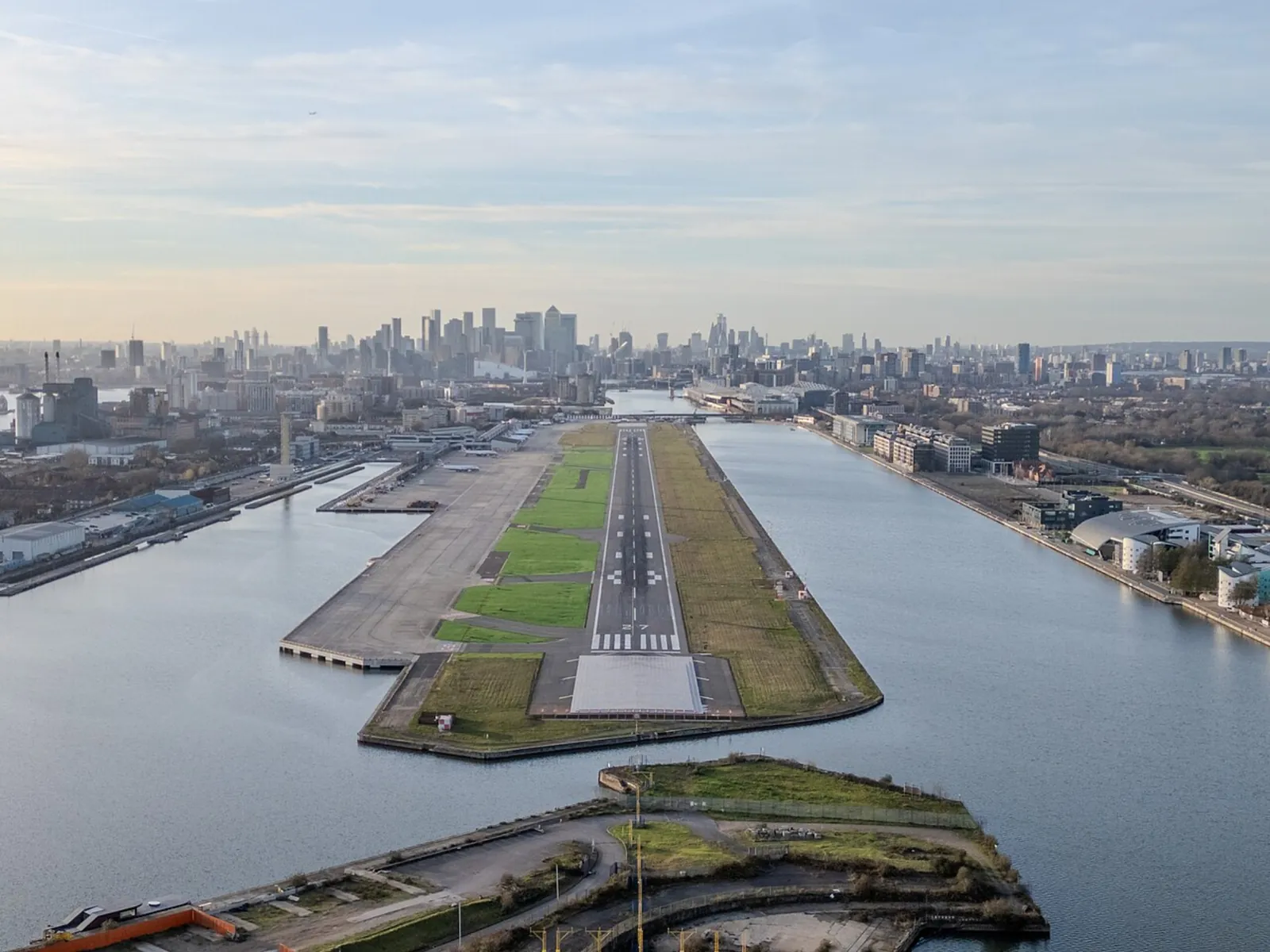
The context matters. LCY serves one of the world’s most valuable business travel markets. However, its 1,508-metre (4,948-foot) runway and demanding approach geometry have long limited aircraft size. Larger jets mean more passengers per movement — and at LCY, that equation drives every strategic decision. The airport’s annual flight movement cap sits at a fixed 111,000 movements per year. Meanwhile, the UK government raised the passenger allowance from 6.5 million to 9 million in August 2024.
Bridging that gap requires bigger aircraft, not more of them. The A320neo carries up to 194 passengers. Consequently, it is the logical next step beyond the Embraer E195-E2, currently LCY’s largest approved type at 146 seats. (A220-100 type is 135 seats). Nevertheless, the path to A320neo approval is neither technically simple nor politically uncontested. Both figures above reflect maximum type capacity. In practice, Helvetic Airways operates the E195-E2 at LCY in a 134-seat configuration. SWISS and ITA Airways both operate the A220-100 at LCY with 125 seats configuration.
London City Airport A320neo: A Proposal Born of Necessity
The numbers tell the story plainly. In 2024, LCY welcomed 3.57 million passengers against a newly permitted ceiling of 9 million. Consequently, filling that gap under a fixed movement cap demands a fundamental shift in fleet composition. Specifically, the airport must move away from smaller regional jets and toward narrowbodies. The A320neo is the obvious candidate. Its CFM LEAP-1A engines deliver substantial fuel and noise improvements over prior-generation types. Moreover, its ubiquity across European carriers ensures a ready supply of trained crews and maintenance networks.
On January 27, 2025, Alison FitzGerald, then-Chief Operating Officer of London City Airport, submitted LCY’s formal application to the CAA. She described the ambition clearly: “The potential introduction of the A320neo aircraft at London City Airport is incredibly exciting. It would broaden the range of leisure destinations for our passengers, enable growth without increasing the number of flight movements, deliver much needed economic growth and accelerate refleeting to cleaner, quieter, new generation aircraft.” — Alison FitzGerald, former COO, London City Airport, London City Airport, Aerospace Global News
Additionally, an airport spokesperson confirmed the change would allow LCY “to reach its permitted passenger capacity with fewer flight movements.” The CAA review process entered Stage 3 of the CAP1616 Airspace Change Process on March 2, 2026 — the formal public consultation phase. Stage 3 is arguably the most politically sensitive milestone to date. It is also where community voices carry formal regulatory weight — which is to say, where the paperwork finally meets the neighbours.
From 5.5 Degrees to 4.49: The A320neo Steep Approach Solution
The fundamental obstacle is geometry. LCY requires all aircraft to use a 5.5-degree glidepath — nearly double the standard 3-degree approach found at most commercial airports. That steep angle allows the airport to coexist with the Docklands skyline and Thames-side residential areas. However, Airbus documentation confirms that A320 family aircraft are certified only for flight path angles up to 4.5 degrees. Steeper profiles are explicitly excluded. Pursuing a 5.5-degree certification for the A320neo — as was done for the Airbus A318 in the early 2000s — would require costly modifications to flight management, flight control, and engine control systems.
The proposed solution is more elegant. Rather than certifying the A320neo for the steep approach, LCY proposes a new final approach angle of 4.49 degrees — exactly 1.01 degrees shallower than the current standard. Specifically, it uses Required Navigation Performance Authorization Required (RNP AR) satellite-based navigation. Only specifically authorised aircraft with full RNP AR capability would use this shallower profile. All other aircraft continue on the existing 5.5-degree approach. Precision Approach Path Indicator (PAPI) lights remain set at 5.5 degrees and are entirely unchanged.
Effectively, the result is a two-lane approach system. Furthermore, Embraer E2 variants could also qualify for the shallower procedure in future. That outcome would extend the benefit well beyond the A320neo family alone.
The A220 Blueprint: How London City Airport Paved the Way
The London City Airport A320neo story did not emerge in a vacuum. Nearly nine years earlier, the airport navigated a comparable — and now precedent-setting — certification process for the Bombardier CSeries CS100. That aircraft was later rebranded the Airbus A220-100, after Airbus acquired a majority stake in the programme in 2018.
On April 26, 2017, Bombardier received steep approach certification for the CSeries CS100 for operations at LCY. As FlightGlobal reported, Bombardier had to adapt several aircraft functions for LCY service, including flight-control behaviour, engine settings, and the ice-protection system. Crews then activate the airport-specific arrival mode through the aircraft’s onboard avionics before flying the approach. Consequently, on August 8, 2017, SWISS operated the first A220-100 revenue flight into London City Airport, per AIN Online — a milestone captured in our Fliegerfaust first-hand review of the inaugural SWISS CS100 service at London City.
The A220-100’s certification carried several important lessons. First, the aircraft tackled the full 5.5-degree approach natively after modification — without needing an alternative angle. Second, it proved that next-generation aircraft could operate at LCY without compromising safety or community noise standards. According to Airbus A320 Family Facts and Figures (November 2025), the A320neo delivers a 50% noise footprint reduction compared to previous generation aircraft. However, opponents dispute how that translates in practice at the specific approach angles relevant to LCY’s residential geography.
A220 and A320neo London City Fleet Transformation
Today, the A220-100 is one of only a handful of next-generation types at LCY. Using February 2026 Cirium schedule data, E190s still represented about 76% of LCY’s 450 weekly flights, while the A220-100 and Embraer’s re-engined E2 models together made up only 63 services, as reported by Aerospace Global News. SWISS operates the A220-100 in a 125-seat configuration. ITA Airways (Italia Trasporto Aereo) also flies the type into LCY, linking London with Rome and Milan.
Moreover, the E195-E2 reached its own landmark in March 2025 when it became the largest aircraft ever to land at LCY, as reported by Aerospace Global News. Its 146-seat capacity set a new ceiling. The A320neo would surpass it by up to 48 additional seats in a maximum single-class configuration. For context on the wider A220 programme trajectory, see our Fliegerfaust analysis of the A220 production ramp and fleet outlook.
The A220 precedent matters beyond sentiment. It proved that London City Airport can absorb a new aircraft type requiring unconventional certification work. Furthermore, it confirmed the process is achievable when engineering rigour is fully applied. The A320neo now seeks to follow that same path — via a different technical route, but with identical intent.
The A220-300 and London City: A Commercial Decision, Not a Technical Ruling
Why has the A220-300 never served London City Airport (LCY), given that its smaller sibling has flown there since 2017? The historical explanation, as Bombardier’s own programme leadership stated, was commercial rather than technical. Specifically, on August 8, 2017 — the very day SWISS completed the first revenue Airbus A220-100 (then Bombardier CS100) service into LCY — Rob Dewar, Vice President (VP) and General Manager of the CSeries programme, addressed the question directly: “There have as yet been no customer requests for the CS300 to be so certified, and there are currently no plans in place, given the large step change in size and range from existing smaller aircraft using LCY to the larger CS100.” — Rob Dewar, VP and GM CSeries Programme, Bombardier, AirInsight. That is a statement of market demand, not a technical verdict. The record shows the variant was not pursued — not that it was ruled out.
The platform itself offers context. The A220-100 and A220-300 share 99% parts commonality, the same PW1500G engine family, the same fly-by-wire architecture, and the same 35.1-metre wingspan. Additionally, the Transport Canada Operational Evaluation Report for the BD500 family documents A220-300 approach capability up to 4.1 degrees and a separate optional Required Navigation Performance Authorization Required (RNP AR) capability — though that same document explicitly states the A220-300 is not type-certified for steep approach operations at London City Airport (EGLC). The gap between the documented 4.1-degree capability and LCY’s proposed 4.49-degree RNP AR procedure places the variant within the same sub-4.5-degree regulatory neighbourhood, but the specific procedure is not yet cleared for the type. Furthermore, the A220-300’s higher operating and landing weights could tighten landing-distance margins on LCY’s 1,508-metre runway, particularly in wet conditions — a performance question that would require specific manufacturer landing data to resolve fully.
Consequently, the commercial picture shifted at the 2023 Dubai Airshow, when Aviation Week reported that Airbus Chief Commercial Officer (CCO) Christian Scherer confirmed active pursuit of A220-300 certification for London City: “We’re constantly trying to improve the operability of the airplane.” — Christian Scherer, CCO, Airbus, Aviation Week, November 13, 2023. airBaltic Chief Executive Officer (CEO) Martin Gauss reinforced the point: “The -300’s only restriction we have is London City, because there they would take a -100.” — Martin Gauss, CEO, airBaltic, Aviation Week, November 13, 2023. Should the Civil Aviation Authority (CAA) approve LCY’s proposed 4.49-degree RNP AR approach and Airbus complete the necessary certification work, the A220-300 could become a viable LCY candidate in configurations of up to 160 seats — a prospect that, at the time of writing, remains credible but unconfirmed.
How London City Airport A320neo Operations Would Work
Understanding the practical mechanics of London City Airport A320neo operations requires a brief primer on RNP AR. Required Navigation Performance Authorization Required is a precision satellite-navigation procedure that allows aircraft to fly highly accurate curved and segmented approaches. Unlike conventional Instrument Landing System (ILS) approaches, RNP AR does not depend on ground-based radio infrastructure. Instead, it uses onboard flight management computers and Global Positioning System (GPS) data to execute approaches with precision measured in fractions of a nautical mile. In short, it navigates by satellite rather than by antennae in the grass.
At LCY, the proposed RNP AR procedure would guide A320neo-family aircraft along a 4.49-degree descent in the final kilometres before touchdown. Only aircraft with full RNP AR capability and appropriate CAA authorisation would use this procedure. The steeper 5.5-degree approach remains unchanged for all currently certified types. Operationally, both profiles could be active simultaneously on alternating runway directions, managed through normal air traffic control sequencing.
LCY A320neo Operations: Beyond the Airspace Approval
Even with CAA airspace approval, the A320neo cannot immediately begin commercial operations at LCY. Airlines would still require separate aircraft-type certification for LCY-specific operations. Additionally, dedicated crew training for the RNP AR procedure would be mandatory before any revenue flights. These steps add time and cost — but they are standard regulatory requirements, not novel barriers invented for this airport.
The runway itself imposes further constraints. At 1,508 metres, LCY is dramatically shorter than a standard commercial runway, which typically exceeds 2,500 metres. Consequently, a heavily loaded A320neo would face weight restrictions, limiting practical range to approximately 1,000 kilometres — roughly 620 statute miles. Notably, that range covers most current LCY European destinations, including Amsterdam, Paris, Dublin, Frankfurt, Geneva, and Zurich. Longer sectors would require fuel trade-offs against passenger payload.
Airbus is also developing its Short Airfield Package (SHARP), originally conceived for Rio de Janeiro’s Santos Dumont Airport and its 1,323-metre runway. SHARP could potentially improve payload performance at constrained airports like LCY in future variants. Additionally, ground infrastructure questions remain open. Community discussions suggest only a portion of LCY’s stands can accommodate A320-size aircraft. Taxiway clearances may also require review before narrowbody operations become routine.
If everything proceeds on schedule — CAA approval, airline certification, crew training, and infrastructure readiness — the target implementation date is January 21, 2027, at the earliest, per The Engine Cowl. In aviation regulatory terms, that timeline is ambitious. In Docklands development terms, it is practically tomorrow.
The Numbers Behind the London City Airport A320neo Push
London City Airport has published detailed 12-year projections to support its A320neo business case. The figures are striking. Over the period from 2027 to 2038, the airport projects 76,500 fewer flight movements compared to the baseline of forgoing the A320neo. Simultaneously, 14 million additional passengers would travel through LCY during that same period. More passengers, fewer flights — it is the kind of arithmetic that makes Treasury officials and environmentalists briefly find common ground.
That combination forms the central economic and environmental argument for the change. The carbon savings figure further strengthens the case. LCY projects over 18,380 tonnes of CO ₂ saved across the 12-year horizon. That saving flows from replacing multiple smaller, older-generation aircraft movements with fewer, larger, and more efficient narrowbody operations. Additionally, the airport estimates up to 4,000 new jobs in the wider London economy. The net present value economic benefit ranges from £38.4 million to £97.4 million, per Aviation Source News.
Economic and Environmental Case for LCY A320neo Operations
The per-passenger efficiency argument is compelling in isolation. An A320neo carrying 180 passengers on a route to Barcelona burns considerably less fuel per seat than two E190s carrying 106 passengers each on the same corridor. Consequently, both emissions and per-seat operating costs decline. That efficiency advantage is precisely what enables carriers like easyJet to sustain commercially viable leisure networks at airports where a premium-only model would be economically unsustainable.
However, the noise picture is more contested than the headline figures suggest. LCY claims that over 110,000 people would experience less noise under the new arrangement. Approximately 10,000 fewer residents would encounter early-morning noise between 06:30 and 07:00. Those benefits flow from both the A320neo’s quieter engines and the reduced total number of daily movements. Andy Cliffe, CEO of London City Airport, stated at the March 2, 2026 consultation launch: “Our proposals would allow us to grow more sustainably by reducing the number of flights and the level of noise people would experience when compared with not making this change.” — Andy Cliffe, CEO, London City Airport, Aerospace Global News
Nevertheless, opponents directly challenge both the methodology and the conclusions. That debate is examined in full in the consultation section below.
Airlines in the Frame: Who Could Fly the A320neo at London City?
The London City Airport A320neo consultation is not an abstract regulatory exercise. Specific carriers stand to gain — or be disrupted — by its outcome. Understanding who is positioned to operate the type, and who has distanced themselves from the question, shapes any realistic commercial assessment of the proposal.
British Airways (BA) CityFlyer is the dominant force at LCY, accounting for 255 of 419 weekly departures — approximately 60.5 percent of the schedule, according to January 2025 Cirium data. BA CityFlyer currently operates 20 ageing Embraer E190s in a 106-seat configuration. Those aircraft are neither efficient nor competitive by modern standards. Replacing them with A320neo-family jets would deliver material unit cost improvements. It would also unlock a wider range of leisure destinations than the E190’s restricted range permits.
British Airways and the Transatlantic Question
Speculation has circled around a more ambitious possibility: the restoration of BA’s niche transatlantic service from London City. Between 2009 and 2020, BA operated its celebrated “Club World London City” product to New York John F. Kennedy International Airport (JFK), using Airbus A318s routed via Shannon, Ireland, for US Customs pre-clearance. The service attracted a devoted premium following before its retirement during the pandemic.
The A320neo’s improved range relative to the A318 could theoretically support a similar or enhanced product — potentially without the Shannon transit. Head for Points, the UK travel rewards publication, observed that “being able to operate A320neo flights would be a game-changer and offers the sort of flexibility that British Airways would be looking for.” However, caution is warranted. London Air Travel reported in November 2025 that “there are no indications that BA plans to order any more aircraft, or add any other aircraft types at London City.” BA’s parent, International Airlines Group (IAG), already operates 30 A320neo and 18 A321neo aircraft at Heathrow. Fleet availability is not the limiting factor; commercial intent is.
Low-Cost Carriers and the Wider A320neo Operator Picture
Beyond British Airways, airport leadership has been explicit about wider carrier ambitions. LCY’s CEO has publicly cited easyJet and Wizz Air as potential new entrants enabled by the A320neo approval. Both carriers operate all-A320neo-family fleets. Nevertheless, both airlines confirmed in January 2025 they had “no plans” to fly from London City Airport. Jet2 gave an identical response at the same time, per AeroTime — a trio of rejections so consistent, one suspects they share a publicist. These positions are not permanent, but they underscore that the business case for new entrants is not yet settled.
SWISS, Lufthansa CityLine, and ITA Airways all operate at LCY today. All three sit within parent groups that hold large Airbus narrowbody fleets. Consequently, they represent the most organic pathway to A320neo operations at the airport. As existing route frequencies grow and demand justifies larger equipment, those carriers are best positioned to scale first.
Noise Concerns and the London City Airport A320neo Consultation
No airspace change proposal at London City Airport proceeds without scrutiny from surrounding communities. The East London and Docklands neighbourhoods beneath the approach path have historically been vocal on aviation noise. Measuring aircraft noise is an exercise in competing certainties — everyone agrees the planes are audible; the disagreement begins the moment someone tries to put a number on it. The London City Airport A320neo consultation is no exception.
On December 19, 2025, the Aviation Environment Federation (AEF) published a noise analysis commissioned by Heathrow Association for the Control of Aircraft Noise (HACAN) East — the campaign group representing communities affected by LCY operations. The AEF’s findings were pointed. Its report suggested that “the A320neo will be louder than other new generation aircraft at the proposed angles.” Furthermore, it warned that implementing the airspace change “could risk increasing the noise impacts of the airport’s operations on the local area.”
HACAN East chair John Stewart reinforced the critique: “Although some of the new planes may be a little quieter, the fact that they will be lower and more of them will mean the overall noise climate becomes worse.” That concern carries real technical weight. The A320neo’s shallower 4.49-degree approach places it lower over residential areas in the final kilometres. Specifically, it flies closer to the ground than aircraft on the 5.5-degree profile — and even quieter engines cannot fully overcome reduced altitude.
What the Consultation Decides — and What It Cannot
The formal consultation period runs from March 2 to May 17, 2026. LCY has scheduled three in-person public drop-in events — on April 9, April 16, and April 21, 2026. These events allow residents, community groups, and interested parties to engage directly with the technical team. Following the close of consultation, LCY will publish a consultation response report in late 2026. Subsequently, it will submit its final case to the CAA for determination.
It is important to clarify the scope of the CAP1616 process. The CAA is evaluating the airspace change specifically — the introduction of the 4.49-degree RNP AR approach procedure. Separate regulatory processes govern the A320neo’s type certification for LCY operations and individual airline operating approvals. Therefore, approval of the airspace change is a necessary but not sufficient condition for A320neo commercial flights.
Furthermore, the CAA’s decision framework requires balancing economic benefits, environmental impacts, and community effects. The AEF report gives the CAA substantive grounds to examine the noise modelling closely. LCY’s projections show a net noise benefit — but the methodology, baseline assumptions, and geographic scope will face rigorous independent scrutiny before any determination is issued.
Conclusion: London City Airport A320neo at a Defining Crossroads
Weighing the London City Airport A320neo Case
The London City Airport A320neo consultation is more than an incremental regulatory process. It represents a strategic inflection point for an airport that has operated since 1987 at the intersection of audacious ambition and genuine physical constraint.
The A220’s journey — Transport Canada and EASA certification finalised on April 26, 2017, revenue service inaugurated on August 8, 2017 — demonstrated that LCY can adapt its operational envelope when the engineering, regulatory, and commercial case converges. That precedent is genuinely encouraging. The RNP AR solution proposed for the A320neo is technically credible. It avoids the costly full steep-approach certification that limited the commercial life of the A318 programme at this airport. Moreover, it opens a new chapter in what aircraft can realistically serve one of aviation’s most distinctive operating environments.
London City Airport A320neo consultation is the most substantive expansion bid LCY has advanced in a generation. The airport spent more than a year building its case: commissioning independent noise assessments, engineering a 4.49-degree RNP AR approach that sidesteps full manufacturer recertification, quantifying 12-year economic projections with notable specificity, and engaging affected communities through structured public events. The A220-100’s eight years of commercial service at LCY is the most credible supporting argument available — direct evidence that next-generation narrowbody jets can operate safely, commercially, and profitably from this runway.
However, the optimism embedded in LCY’s 12-year projections warrants measured scrutiny. Seventy-six thousand fewer flights and 14 million additional passengers are persuasive numbers. Nevertheless, they assume a swift fleet transition that no major airline has yet publicly committed to at LCY. British Airways operates nearly two-thirds of the airport’s weekly departures. Even so, it has offered no firm indication of A320neo plans for the base. easyJet and Wizz Air have both declined to confirm any London City plans. The economic projections hinge entirely on decisions within the commercial discretion of third parties who are watching, not yet committing.
Noise, Community Trust, and the CAA’s Deciding Role
The noise debate is equally unresolved. The airport and its opponents are working from different assumptions about what quieter engines mean in practice when an aircraft is lower over the same streets at higher frequencies. The CAA will need to adjudicate that disagreement with transparency and rigour. Community trust, once eroded, is difficult to rebuild. Furthermore, LCY’s long-term social licence to operate depends entirely on maintaining it.
Growing to 9 million passengers within 111,000 annual movements is mathematically impossible with a fleet dominated by 106-seat regional jets. Change is not optional at London City Airport — the airport equivalent of an irresistible force meeting an immovable runway.
Question for you
The question worth sitting with — as the consultation opens and the voices of East London multiply — is this: do the airport’s promised economic gains justify the risk of greater noise for the communities beneath its approach path, and will the CAA judge that trade-off with sufficient rigour?
Leave your answers and comments below and on our Fliegerfaust Facebook page.
Sources
- Bombardier — Bombardier (April 26, 2017)
- FlightGlobal — FlightGlobal (April 26, 2017)
- AIN Online — AIN Online (August 8, 2017)
- Aerospace Global News — London City looks to accommodate A320neo as application submitted (January 27, 2025)
- AeroTime — AeroTime (January 2025)
- Aerospace Global News — E195-E2 becomes biggest aircraft to land at London City Airport (March 26, 2025)
- Airbus — Airbus A320 Family Facts and Figures (November 2025) (November 2025)
- Aviation Environment Federation — Noise analysis: A320neo at London City Airport (commissioned by HACAN East) (December 19, 2025)
- HACAN East — HACAN East
- The Engine Cowl — The Engine Cowl (March 2, 2026)
- Aviation Source News — Aviation Source News (March 2026)
- Aerospace Global News — London City Airport seeks CAA approval for Airbus A320neo flights (March 3, 2026)
For full details, please refer to our Disclaimer page.
If, the 4.49 degree slope RNP AR approach gets approved, then the A220-300 would also be a contender to increase seat numbers in and out of LCY.
Especially once (if) the high density A220-300 with 160 seats gets certified.
Interesting point!
Indeed Ken, you’re right!
See the new section I added to the article “The A220-300 and London City: A Commercial Decision, Not a Technical Ruling”.