

Atlas Air A350F order: what happens when the world’s largest Boeing 747 operator decides its next major freighter move belongs to Airbus?
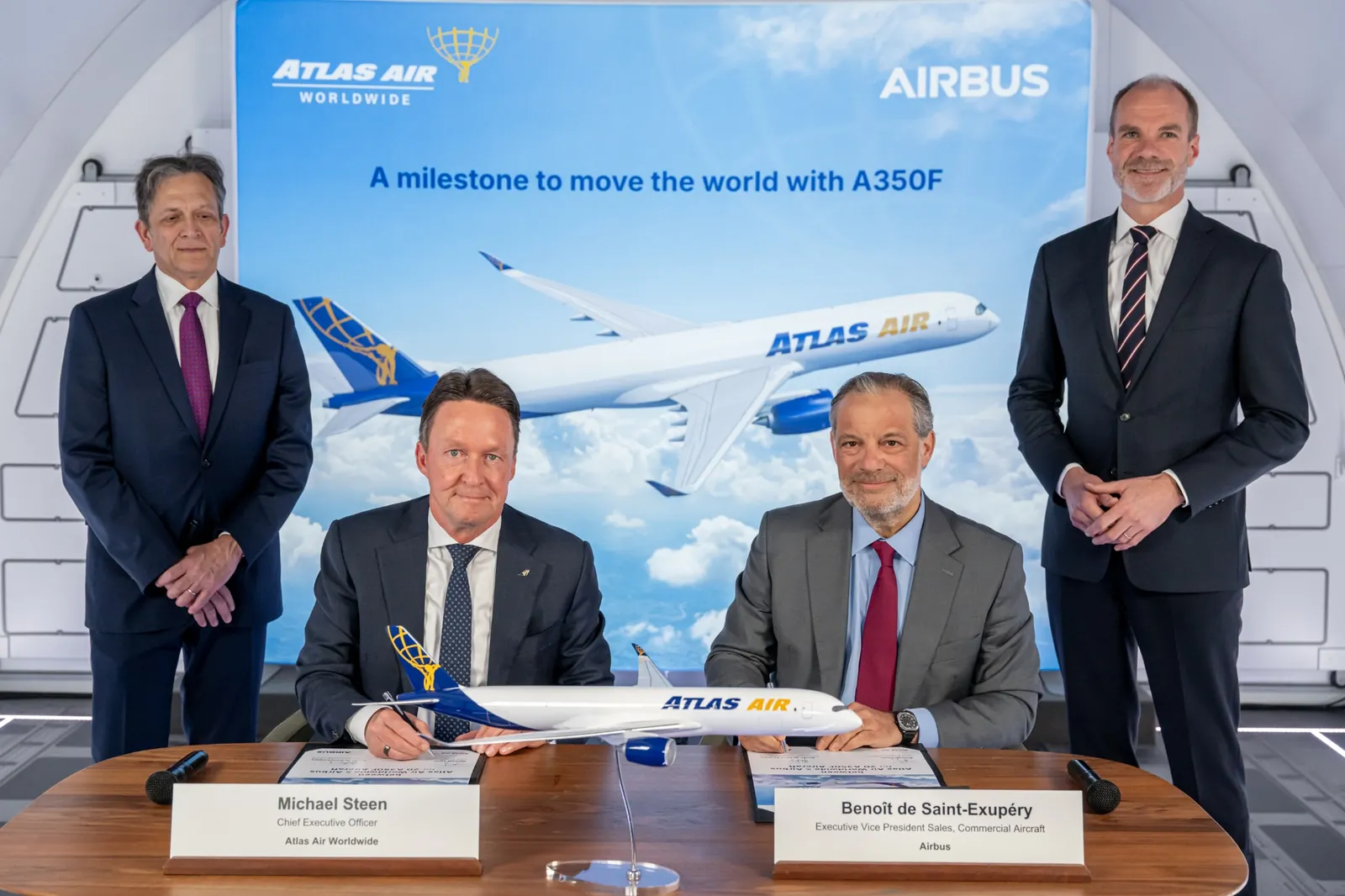
Atlas Air A350F order: On March 16, 2026, Airbus said Atlas Air Worldwide had placed a firm order for 20 A350F aircraft. Consequently, Atlas becomes the biggest customer for the type and the first customer in the United States. Moreover, the deal reaches far beyond one order line. It touches fleet renewal, production timing, emissions rules, and the future balance between Airbus and Boeing in heavy cargo.
Notably, Atlas is not a symbolic buyer. On its current Atlas Air Worldwide leadership page, the company says it serves more than 300 destinations in 90 countries, employs nearly 5,000 people, operates the world’s largest fleet of 747 freighter aircraft, and ranks as the second-largest airfreight operator measured by freight tonne kilometres. Therefore, when Atlas shifts part of its long-term growth toward Airbus, the industry has to read the move as strategy, not theatre.
Atlas Air A350F shifts the market
Atlas A350 freighter: what Airbus actually sold
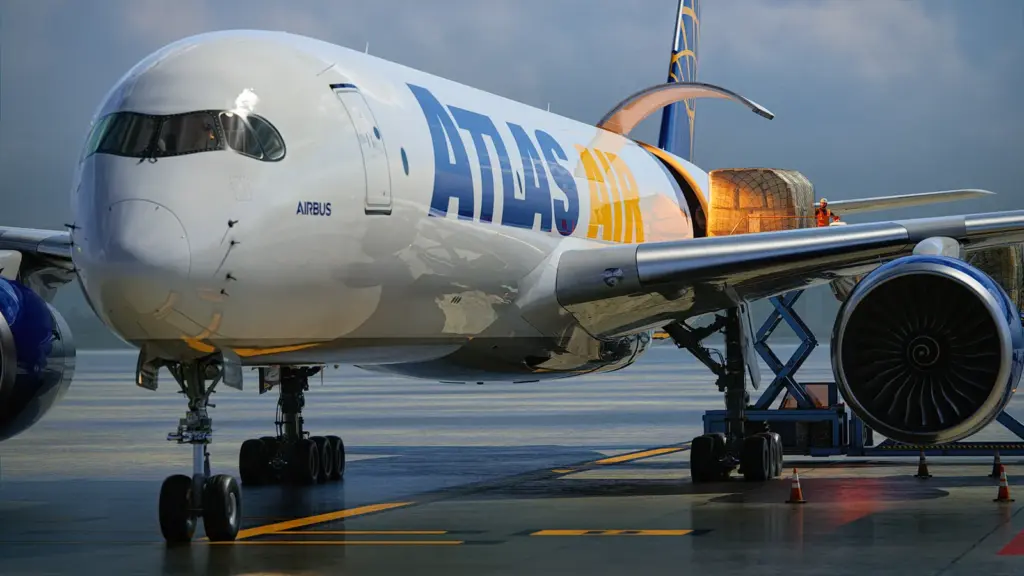
On March 16, 2026, Airbus described the deal in unusually forceful terms. The company said Atlas placed a landmark firm order for 20 A350F freighters and said those aircraft would be deployed for growth rather than only for replacement. Consequently, Atlas is not treating the A350F as a niche experiment. It is treating it as a growth platform with room across several operating models.
Moreover, Michael Steen said the quiet part out loud. “We are proud to become the largest customer for the Airbus A350F, securing early delivery positions for this next-generation widebody freighter platform.” — Michael Steen, Chief Executive Officer, Atlas Air Worldwide (Airbus). That phrase, “early delivery positions,” matters as much as the aircraft count. Cargo aviation rarely does drama unless a delivery slot disappears.
Additionally, Steen stressed why Atlas moved now. “The A350F is a highly capable, reliable platform, with incremental payload and range benefits, and a strong sustainability profile.” — Michael Steen, Chief Executive Officer, Atlas Air Worldwide (Airbus). He also said Atlas was pleased to add Airbus and Rolls-Royce to its supplier base. Therefore, the order is not simply about lift. It is also about optionality, supplier diversification, and leverage in a market where capacity arrives late and retires early.
Meanwhile, Airbus used equally deliberate language. “Atlas Air’s selection of the latest generation A350F – the first in the US – represents a pivotal moment, cementing the A350F’s position as the preferred true all new-generation freighter for the world’s most demanding cargo operators.” — Lars Wagner, CEO Commercial Aircraft at Airbus. That sounds like salesmanship, but it also signals something real. Airbus believes it has crossed from curiosity to credibility in the top tier of global freight.
Atlas freighter fleet: why the buyer matters
However, the buyer matters as much as the aircraft. Atlas says it is the world leader in outsourced aviation logistics and the largest 747 freighter operator. On January 1, 2025, in a year-opening message, Michael Steen wrote on Atlas Air Worldwide’s Tailwinds site that the company had brought its fleet to 121 aircraft and operated about 14% of all global widebody freighter capacity across the supply chain. Consequently, Atlas buys aircraft with a view across charter, aircraft, crew, maintenance and insurance (ACMI), leasing, express, e-commerce, and military demand.
Moreover, Atlas has kept signalling that cargo capacity will tighten. In an October 31, 2023 Cargo Facts Symposium recap on Atlas Air Worldwide’s Tailwinds site, Michael Steen said, “There are approximately 650 widebody freighters in the world today and approximately 125 of them are older than 30 years.” — Michael Steen, Chief Executive Officer, Atlas Air Worldwide. Atlas added that a large number of retirements would follow over the next five years and that planned new production and conversion capacity would not be enough to fill the gap.
Additionally, Atlas returned to the same theme on October 23, 2024. In another Cargo Facts Symposium recap on Atlas Air Worldwide’s Tailwinds site, Steen said, “Out of 633 aircraft in the world today, 107 have reached the 30-year mark. And that means that in the next five years or so, those aircraft will be retired. That will put even more pressure on the global wide body fleet.” — Michael Steen, Chief Executive Officer, Atlas Air Worldwide. In freight planning, the calendar often beats the brochure.
Therefore, the Atlas Air A350F decision is not a fashionable swing. It is a rational answer to a market that rewards timing, scale, and fleet flexibility. The company has enough 747 experience to know exactly what it is giving up and exactly what it is gaining.
Atlas Air A350F meets the 747 legacy
Atlas freighter fleet: the 747 still earns its place
Notably, this order does not cancel Atlas’s Boeing identity. On August 22, 2024, Atlas announced three more Boeing 747-8 Freighters to meet strong global demand for large widebody capacity. The company said those aircraft would enter service late in the third quarter of 2024 under long-term finance lease agreements with BOC Aviation.
Moreover, Steen defended the aircraft in direct terms. “Our growth in this aircraft type underscores Atlas’ commitment to the 747-freighter platform and the value it provides our customers, including significant payload capacity and unique nose-loading capability.” — Michael Steen, Chief Executive Officer, Atlas Air Worldwide. That matters because Atlas still sees real commercial value in the 747’s unmatched loading geometry.
Additionally, Atlas said in that same release that its 747 fleet included 65 aircraft: 17 747-8Fs, 39 747-400Fs, five passenger 747-400s, and four Large Cargo Freighters. Consequently, Atlas knows the platform at operating depth, not from a nostalgia file. Legends age well, but maintenance reserves age faster.
On January 31, 2023, Atlas made that identity even clearer when it took delivery of Boeing’s final 747 production aircraft. “As the world’s largest operator of 747 freighters, Atlas is especially proud to take the last 747 ever to be built.” — John Dietrich, President and Chief Executive Officer, Atlas Air Worldwide. That makes the current move more significant, not less. Atlas did not drift away from the 747 because it forgot what the aircraft can do.
For readers who want a wider 747 sustainment angle, see our Fliegerfaust analysis of why extra Boeing 747-8 airframes still matter for long-term support.
Next-generation cargo jet: why Atlas can want both aircraft families
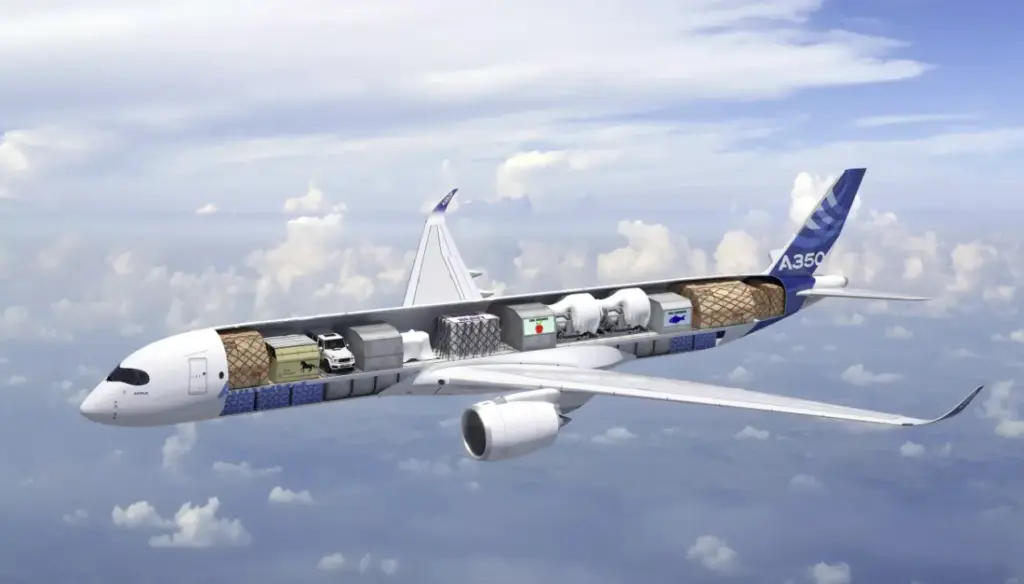
However, a 747 specialist can still want a next-generation twin. Airbus says the A350F can carry a 111-tonne payload, fly up to 4,700 nautical miles, use Rolls-Royce Trent XWB-97 engines, and deliver 40% lower fuel burn and carbon dioxide emissions versus the aircraft it is meant to replace, according to the official A350F programme page from Airbus. Airbus also says the aircraft’s main-deck cargo door has a 4.305-metre clear opening.
Specifically, a June 23, 2025 Airbus technical feature said the door is 15% wider than the Boeing 777 Freighter’s and allows large engines to enter in one go, which can cut loading time sharply on some missions, according to Airbus’s A350F cargo-door engineering story. Therefore, Airbus is not selling a generic “green” twin. It is selling a freighter tailored for heavy, high-value, standardised cargo flows.
Even so, the A350F does not replace every 747 mission. The 747-8F still offers nose-loading capability, which Atlas called unique in its August 2024 release. That makes the 747 unusually strong for outsized cargo, awkward industrial pieces, and missions where loading geometry matters more than trip cost. By contrast, the A350F looks ideal for dense mainstream flows where economics, emissions, and dispatch discipline matter more.
Consequently, the Atlas Air A350F order reads less like a renunciation of Boeing and more like segmentation. Atlas seems to be building a future in which the 747 keeps its special-mission aura while a new Airbus twin handles a growing share of standard long-haul freight. Mission matching beats brand loyalty every time.
Atlas Air A350F puts Boeing on the clock
Airbus freighter order: Boeing still fields a serious rival
Notably, Boeing still has a credible response. On the official Boeing Freighter Family page, the company says the 777-8 Freighter offers a 112.3-tonne net revenue payload, a range of 4,410 nautical miles, and room for 31 main-deck pallets. Boeing also calls it the world’s most capable and fuel-efficient twin-engine freighter for the future.
Moreover, Boeing moved that programme into major assembly on July 22, 2025. In a production update, Boeing said the 777-8 Freighter had entered production, that customers had ordered 59 aircraft since launch in 2022, and that the company was working toward first delivery in 2028. So the competitive picture is real, not hypothetical.
However, Boeing’s challenge now looks less like product design and more like timing. Atlas said it secured early delivery positions with Airbus. That phrasing would not matter if the freighter market were loose and predictable. In reality, it signals that Atlas values access to metal almost as much as the aircraft itself. Air cargo planners do not frame Gantt charts, but they probably should.
Freighter fleet renewal: industrial timing now decides campaigns
Meanwhile, Airbus has had its own timing problems. On February 20, 2025, in its full-year results, Airbus said that the A350 freighter’s entry into service had shifted to the second half of 2027 because of specific supply-chain challenges, notably involving Spirit AeroSystems. Reuters had reported three days earlier that the delay could reach up to a year, according to Reuters’s February 17, 2025 report.
Additionally, Airbus kept building programme evidence after that setback. On May 30, 2025, Airbus said it had completed the first A350F wingset at Broughton and said two test aircraft would undergo flight tests through 2026 and 2027. That does not erase delay risk, but it does show hardware moving rather than a paper schedule floating.
Separately, Airbus’s order trail has deepened. Airbus said at the end of October 2025 that the A350F had 74 orders from 12 customers in its Air China Cargo A350F announcement. Airbus then announced six A350Fs for Air China Cargo, three more for Etihad Airways in Etihad’s November 18, 2025 order disclosure, and two additional aircraft for Silk Way West in Airbus’s November 19, 2025 release. Consequently, Atlas’s 20-aircraft order pushes Airbus’s publicly disclosed A350F tally to at least 105 aircraft.
Therefore, the Atlas Air A350F win does not prove Boeing has lost the segment. It does prove Boeing cannot assume Atlas, or any other heavyweight cargo buyer, will wait patiently. In freighters, production calendars now shape competitive narratives as much as payload charts.
Atlas Air A350F tests Airbus execution
Airbus freighter order: the A350 family gives Airbus a deeper base
Notably, the freighter programme does not stand alone. On its Airbus orders and deliveries page, Airbus said that by the end of February 2026 the A350 family had won 1,529 total orders and delivered 702 aircraft. Consequently, the A350F grows from a mature widebody family with an established supply chain, a large operator base, and a cockpit philosophy airlines already know.
Moreover, Airbus has kept its wider A350 industrial ambition visible. On April 25, 2024, in its first-quarter results, Airbus said it would raise A350 production to 12 aircraft a month in 2028. Then, on February 19, 2026, in its latest annual results, Airbus said it still targeted rate 12 for the A350 programme in 2028. That continuity matters because Atlas is not buying into a freighter project detached from industrial scale.
Additionally, the same maturity affects maintenance, training, and residual-value logic. A freighter derived from a successful passenger family usually gives operators more confidence in parts support, engineering familiarity, and long-term market relevance. Atlas Air A350F fits that pattern. Engineers like clean-sheet purity. Chief financial officers usually prefer visible ecosystems.
Atlas A350 freighter: where Airbus still must deliver, not promise
However, industrial maturity does not guarantee execution. Airbus still has to translate family strength into a freighter that arrives on time and performs as sold. The February 2025 delay already proved the A350F is not immune to the same supply-chain pressures that have complicated much of the civil aerospace sector.
Moreover, Airbus’s own disclosures show why the market still watches closely. The company said in February 2025 that Spirit AeroSystems pressure was affecting the ramp-up of the A350 and the A220. Consequently, the A350F timeline now carries more scrutiny than a normal derivative would. Atlas Air A350F therefore doubles as a confidence vote and a test case.
Meanwhile, Airbus has given the market enough evidence to keep the programme credible. The wingset is complete. Test aircraft assembly has been under way in Toulouse, according to Airbus’s November 2025 A350F customer releases. The entry-into-service target now sits in the second half of 2027. That is a real industrial path, not a sketch. Still, the difference between a path and a delivered aircraft remains the most expensive distance in aerospace.
Therefore, Atlas has made a smart move only if Airbus executes. A late freighter is still a late freighter, however elegant the renderings may look. That is the hidden edge in this story.
Atlas Air A350F arrives as the cargo market tightens
Atlas freighter fleet: demand still supports the investment case
Notably, air freight demand still supports a long-range fleet bet. On January 29, 2026, the International Air Transport Association said global air cargo demand reached a record volume in 2025. Full-year demand, measured in cargo tonne-kilometres, rose 3.4%, while capacity rose 3.7%. IATA also said yields stayed 37.2% above 2019 levels despite a gradual return toward a more normal supply-demand balance.
Moreover, IATA added a sharper structural point on March 10, 2026. In a trade analysis, IATA said air cargo enabled US$157 billion in frontloaded United States imports during the first quarter of 2025 and carried more than two thirds of global artificial-intelligence-related goods in 2025. That matters because those flows favour aircraft that can move high-value cargo quickly, reliably, and with strong trip economics.
Additionally, Boeing’s long-range view points the same way. In its November 12, 2024 World Air Cargo Forecast release, Boeing said air cargo traffic should grow about 4% a year through 2043 and that the global freighter fleet should rise to 3,900 aircraft from 2,340 in 2023. Boeing also said nearly half of future production and conversion deliveries would replace retiring freighters. The demand case is clear. The execution case is harder.
Airbus freighter order: Atlas also buys flexibility, not only lift
However, the economics are not only about market demand. They are also about corporate flexibility. Atlas went private on March 17, 2023, when an Apollo-led investor group completed its acquisition of the company, according to Atlas Air Worldwide’s acquisition announcement. Consequently, this order does not produce a public share-price reaction. The more useful question is how Atlas intends to earn on the aircraft through long-term contracts, leasing structures, and network placement.
Moreover, Atlas had already taken a small step toward Airbus metal. On September 25, 2025, Titan Aviation Leasing, part of the Atlas group, acquired two Airbus A330-300 passenger-to-freighter aircraft. Atlas described them as Titan’s first Airbus freighters. That does not make the A350F order inevitable. Still, it means March 2026 did not represent a complete cultural cold start.
Additionally, Atlas sits in a business model that can magnify the order’s reach. Airbus said in its March 2026 release that Atlas is uniquely positioned to bring the A350F’s next-generation performance to global operators across a wide variety of business models and markets. Therefore, the order may influence customers that never own an A350F themselves. They may simply lease it, charter it, or buy capacity from Atlas. That is how one fleet decision can travel through a much larger logistics system.
Meanwhile, Airbus gains something money cannot buy quickly: endorsement. Atlas is not simply another customer on a slide deck. It is the operator most strongly associated with 747-scale freight in the contemporary market. A backlog can charm investors, but it still has to taxi.
For broader Airbus context, see our Fliegerfaust report on AviLease’s A350F order at the Paris Air Show 2025. For a wider industrial backdrop, see our Fliegerfaust analysis of Canada’s Airbus titanium waiver and why it matters to A350 supply.
Atlas A350 freighter: why Atlas customers should notice
Notably, Atlas seldom buys aircraft for a single narrow use case. Moreover, its network spans long-term charter, ACMI, leasing, and government work. Consequently, one fleet decision can ripple across several customer groups. Additionally, that makes the order more influential than a simple fleet total suggests.
Meanwhile, e-commerce clients want range, predictability, and lower unit costs. However, express customers also want dispatch reliability and slot discipline. Therefore, a modern twin can fit lanes where the 747’s special loading geometry adds little. Even so, Atlas can still keep the 747 for the jobs only a 747 does best.
Separately, sustainability pressure is changing procurement language. Moreover, shippers now ask harder questions about fuel burn, emissions, and future compliance. Consequently, Atlas can market the A350F as an operating tool and a contracting tool. In cargo, the airplane increasingly helps sell the contract before it flies the route.
Additionally, that matters for high-value sectors such as electronics, aerospace equipment, pharmaceuticals, and time-critical industrial parts. Meanwhile, Atlas can place capacity where yields justify it rather than where brand tradition points. Therefore, customers beyond Atlas should watch this order closely. Finally, the real impact may spread through contracts long before the first Atlas A350F enters service.
Conclusion: Atlas made a smart bet, but Airbus still has to prove it
Overall, Atlas appears to have made a disciplined and forward-looking choice. The company gains early access to a new widebody freighter family, broadens its supplier base, and positions itself for a market that still needs more modern lift. Airbus, meanwhile, gains a marquee United States cargo customer whose Boeing heritage gives the order unusual symbolic power.
However, this is not an automatic victory lap for Airbus. The 747-8F still keeps unique nose-loading capability. Boeing still fields a serious 777-8 Freighter proposition. Airbus also still needs to deliver the A350F on time after a public schedule reset in 2025. In cargo, romance ends where the dispatch sheet begins.
Moreover, the deeper lesson is about industrial power, not brand conversion. Atlas Air A350F is a story about calendar certainty, replacement pressure, emissions rules, and fleet optionality. Those forces now matter enough to pull the world’s largest 747 freighter operator into Airbus’s camp for part of its future growth. That is impressive. It is also a test.
Finally, my critical view is simple: Atlas has probably read the market correctly, but Airbus has not yet earned the right to declare the segment won. Orders matter. Reliable aircraft, delivered when promised, matter more.
What do you think?
If the most iconic 747 cargo operator now needs Airbus to secure its next growth chapter, who is really setting the pace for the long-haul freighter market of the 2030s?
Leave your answers and comments below and on our Fliegerfaust Facebook page.
Atlas Air A350F: Sources
Company and programme sources
- Airbus — Atlas Air Worldwide becomes Airbus’ largest A350F freighter customer with an order for 20 aircraft (March 16, 2026).
- Atlas Air Worldwide — Leadership Team (accessed March 16, 2026).
- Atlas Air Worldwide — It’s Our Time: A Message from Michael Steen, CEO, Atlas Air Worldwide (January 1, 2025).
- Atlas Air Worldwide — Atlas and Titan Join Industry Experts at Cargo Facts Symposium (October 31, 2023).
- Atlas Air Worldwide — Spotlight on Atlas and Titan at Cargo Facts Symposium (October 23, 2024).
- Atlas Air Worldwide — Atlas Air Worldwide to Add Three Boeing 747-8 Freighters to Fleet (August 22, 2024).
- Atlas Air Worldwide — Atlas Air Takes Delivery of Boeing’s Final 747 Production Aircraft (January 31, 2023).
- Airbus — A350F (accessed March 16, 2026).
- Airbus — A350F: what makes the world’s largest main-deck cargo door a special one (June 23, 2025).
- Boeing — Boeing Freighter Family (accessed March 16, 2026).
- Boeing — Spar power: Team kicks off 777-8 Freighter production (July 22, 2025).
- Airbus — Airbus reports Full-Year (FY) 2024 results (February 20, 2025).
- Reuters — Exclusive: Airbus to delay A350 freighter amid supply problems, sources say (February 17, 2025).
- Airbus — Airbus completes first A350F wingset in Broughton (June 2, 2025).
- Airbus — Orders and deliveries (February 2026 data).
- Airbus — Airbus reports First Quarter (Q1) 2024 results (April 25, 2024).
- Airbus — Airbus reports Full-Year (FY) 2025 results (February 19, 2026).
- Airbus — Air China Cargo becomes new Airbus A350F freighter customer (November 14, 2025).
- Airbus — Etihad Airways grows its Airbus widebody fleet becoming a new A330neo customer, adding A350-1000 and A350F aircraft (November 18, 2025).
- Airbus — Silk Way West Airlines orders two additional Airbus A350F freighters (November 19, 2025).
Market and industry sources
- IATA — Global Air Cargo Demand Achieved Record Volume in 2025 (January 29, 2026).
- IATA — Air Cargo Enabled $157 Billion in Frontloaded Trade and Supported AI Growth in 2025 (March 10, 2026).
- Boeing — Boeing: Air Cargo Traffic to Double by 2043 as Emerging Markets Drive Growth (November 12, 2024).
- Atlas Air Worldwide — Investor Group Led by Apollo, Together With J.F. Lehman & Company and Hill City Capital, Completes Acquisition of Atlas Air Worldwide (March 17, 2023).
- Atlas Air Worldwide — Titan Aviation Leasing Acquires Two Airbus A330-300P2F Freighters on Lease to mas (September 25, 2025).
For full details, please refer to our Disclaimer page.