

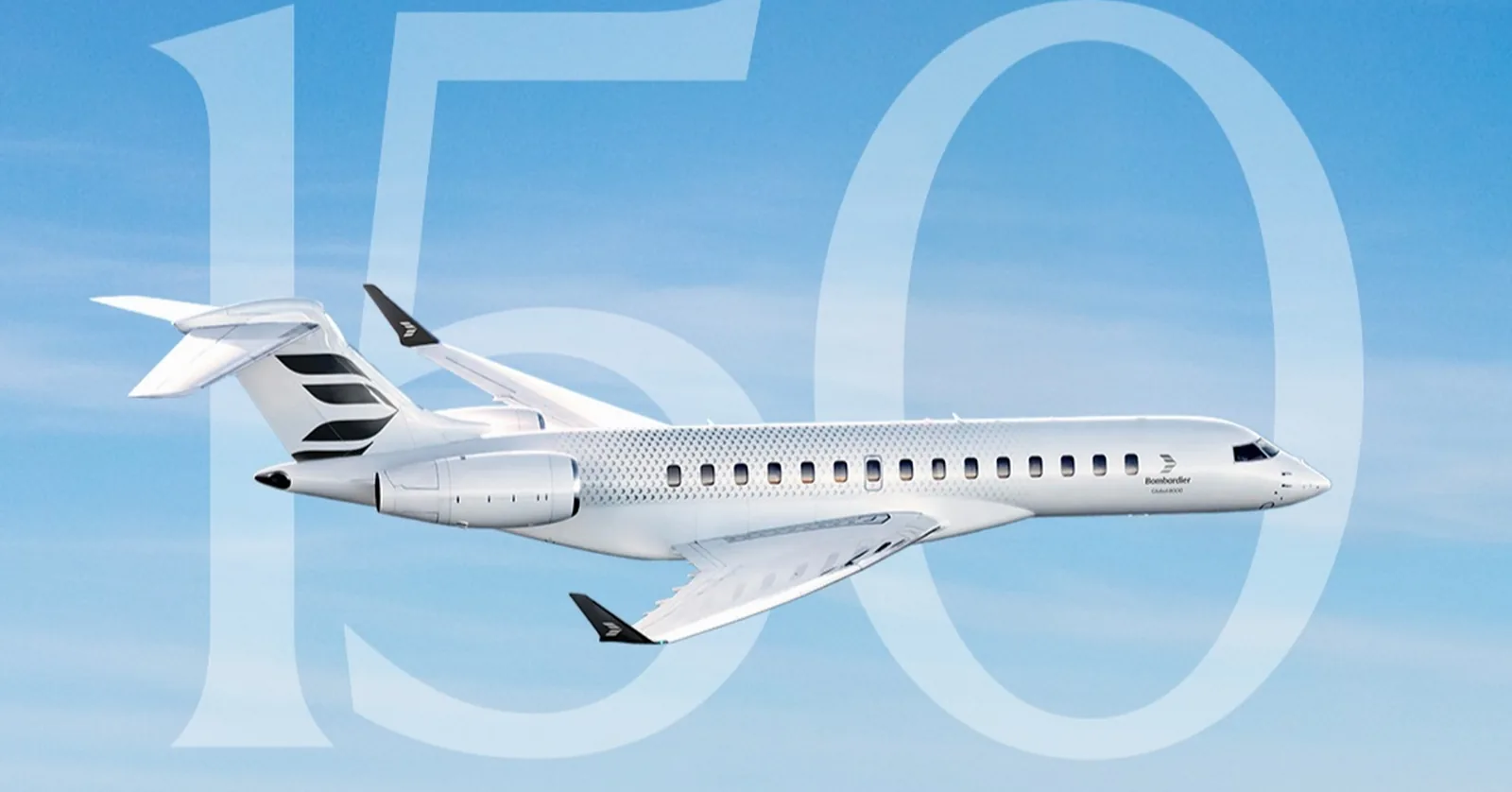
Global 7500 speed records — how did Bombardier reach 150, and what does that milestone mean for the next phase of ultra‑long‑range business aviation? Bombardier insists, the fastest civil aircraft since Concorde.
Bombardier set the tone on October 2, 2025, by announcing that its Global 7500 had achieved its 150th city‑pair speed record. The company also disclosed that the fleet has surpassed 200 deliveries and amassed more than 280,000 flying hours. Those numbers land at a pivotal moment, as the Global 8000 moves toward entry into service later this year. Notably, several of the newest records span marquee routes such as Tokyo–Los Angeles, Toronto–Paris, New York–London and Hong Kong–Montréal. Moreover, on 20 of those record missions the aircraft averaged more than 1,000 kilometres per hour.
Additionally, the 150‑record milestone sits within a broader narrative: a Canadian‑built jet that has changed how operators think about time, weather, runway length and passenger endurance. Consequently, today’s question is not simply whether the 7500 is fast. Rather, it is how that speed integrates with range, airport access and cabin health—and how those traits shape the market as Gulfstream and Dassault ready new flagships of their own.
Quip: A hundred and fifty records later, the 7500’s logbook is starting to look like a coffee‑table book.
Global 7500 speed records: what changed on October 2, 2025
Bombardier’s announcement on October 2 crystallised scattered headlines into a single tally: 150 city‑pair speed records, the most ever achieved by one business aircraft type. The manufacturer highlighted runs that matter to operators—Tokyo–Los Angeles, Toronto–Paris, New York–London, Hong Kong–Montréal—and underlined that, on 20 of those flights, average ground speeds topped 1,000 km/h.
Moreover, the company pointed to a record flight of 8,225 nautical miles (15,232.7 km) from Sydney to Detroit, framed as the longest mission ever recorded in business aviation. Additionally, it reiterated that the Global 7500’s baseline range remains 7,700 nautical miles (14,260 km), with a top speed of Mach 0.925 and runway performance that opens airports many rivals treat as aspirational.
“The Global 7500 continues to redefine what is possible in business aviation,” — Jean‑Christophe Gallagher, Executive Vice President, Aircraft Sales and Bombardier Defense.
Furthermore, Gallagher emphasised operational reality: “Many of these records have been set with passengers on board in varying conditions and airports.” — Jean‑Christophe Gallagher, Executive Vice President, Aircraft Sales and Bombardier Defense.
Quip: The stopwatch wasn’t the only thing on board—briefcases were, too.
Global 7500 speed records: the city‑pair stories behind the score
Specifically, records only matter when they map to travel patterns. Business aviation’s most valuable lanes connect financial centres, tech hubs and energy capitals. Therefore, a list featuring New York–London, Tokyo–San Francisco/Los Angeles, Montréal–Paris and Hartford–Dubai speaks to practical value.
Additionally, the 7500’s June 16, 2025 Montréal–Paris dash to the Paris Air Show in 5 hours 30 minutes underscored that point, as coverage framed it as “another record” in a growing catalogue. Notably, that record came amid a mid‑2025 cadence of announcements that took the type past 100 records on February 28 and past 135 by July 8—then to 150 by October 2.
Even so, a useful reminder applies: speed records are certified under FAI rules, and some are ratified after review. Consequently, operators and financiers should treat any “pending review” notation as normal, not as a red flag. Overall, the accumulation across multiple corridors and seasons tells the story more convincingly than any single sprint.
From “steep” to sweeping: London City proved the thesis
London City Airport (LCY) compresses everything that makes a pilot sweat—short runway, strict noise contours, and a 5.5‑degree glide path. Accordingly, winning at LCY is a signal of real‑world capability, not brochure cleverness. On May 11, 2019, Bombardier flew a Global 7500 from London City to Los Angeles non‑stop as part of steep‑approach certification tests.
“[It was] the longest flight ever out of London City,” — Gary Hodgetts, Director of Operations, London City Airport: Bombardier News.
Moreover, the LCY sortie came only weeks after back‑to‑back marks on the high‑traffic New York–London and Los Angeles–New York routes. Therefore, by the time the aircraft made its Paris Air Show debut in June 2019, the “steep approach” badge had morphed into a broader operating narrative: short fields and long legs can coexist without asterisks.
Quip: If you can make a 5.5‑degree approach look graceful, you’ve earned your croissant at Le Bourget.
The engine‑wing handshake: why the 7500 keeps winning time
The 7500’s speed records lean on physics meeting persistence. GE Aerospace’s Passport engines and Bombardier’s Smooth Flĕx Wing are the hardware pillars; the flight‑test grind and software refinements supply the rest.
Consequently, two points stand out. First, the Passport’s core—descended from CFM LEAP lineage—delivers thrust flat‑rated to hot‑and‑high conditions while claiming a fuel‑efficiency edge in its class. Additionally, GE highlights an integrated core‑nacelle design and high overall pressure ratio that help the engine sip less, not more, at long‑range cruise. Second, Bombardier’s wing pairs thin, highly swept aerodynamics with sophisticated slats, double‑slotted Fowler flaps and a high‑speed aileron. Thus, the wing behaves like two wings in one: high lift at low speed, efficiency at Mach.
Moreover, those traits show up in places that matter to dispatchers—initial cruise altitude at weight, climb gradients out of hot‑and‑high airfields, and the ability to fly at M 0.90–0.925 without punishing range. Therefore, the aircraft’s speed records feel less like outliers and more like what the airframe was designed to do.
Quip: Call it a handshake deal between physics and paperwork—the CFD meets the TCDS.
Global 7500 speed records: Timelines and tallies: deliveries, hours and support
As of October 2, 2025, the Global 7500 family has crossed 200 deliveries and 280,000 fleet hours. Additionally, Bombardier notes a support footprint of 10 service facilities across six countries, and a fleet of more than 5,100 aircraft supported worldwide across types.
Moreover, recent records cluster around showpiece moments that doubled as service‑network showcases, from Paris to the U.S. West Coast. Therefore, the records campaign functions as an operations demo: crews, line stations and parts pipelines get measured in the same breath as airspeed.
Notably, the cadence of records in 2025 also aligns with a broader maturity curve: avionics, maintenance prognostics, and cabin systems have now lived in the wild long enough to prove reliable at fleet scale. Consequently, operators who looked at the 7500 as a “first‑of‑type risk” in 2019–2020 now see a proven tool.
Market context: Gulfstream’s certifications and Dassault’s long game
Meanwhile, Savannah moved. The FAA certified Gulfstream’s G700 on March 29, 2024, followed by EASA on May 15, 2024, upgrading maximum Mach to 0.935 and range to 7,750 nm at M 0.85. “We have successfully completed the most rigorous certification program in company history with the G700,” — Mark Burns, President, Gulfstream: Reuters.
Additionally, the longer‑legged G800 clinched dual FAA/EASA approvals on April 16, 2025, with 8,200 nm range and the same 0.935 Mmo—a clear signal that Gulfstream intends to contest both speed and reach at the top of the segment.
Even so, Dassault is not standing still. The Falcon 10X remains on a 2027 entry‑into‑service trajectory, with Rolls‑Royce Pearl 10X engine certification data submitted in August 2025 and the first airframe well along. Therefore, customers now face a three‑way choice that splits along subtle lines: runway performance, cabin volume/altitude, and how each OEM packages support and upgrades.
Quip: In this bracket, arms races are measured in decimal points and door heights.
Sustainability and cabin health: beyond the stopwatch
Notably, Bombardier pairs the 7500’s performance story with sustainability and wellness claims. The company has pledged to cover its flight operations with a Sustainable Aviation Fuel blend via Book‑and‑Claim, and it has leaned into environmental product declarations in recent years for transparency. Additionally, Bombardier and other OEMs now measure cabin altitude as a proxy for passenger health on ultra‑long missions; the 8000, for example, will tout an ultra‑low cabin altitude. (What does having a ultra-low cabin altitude mean? Read about it here.)
Moreover, the Smooth Flĕx Wing’s efficiency and Passport’s fuel‑burn gains, while incremental, compound over intercontinental distances. Therefore, speed records do not need to conflict with emissions goals; flown at long‑range cruise, the same aerodynamics that enable records can also deliver lower fuel per kilometre compared with older‑generation large‑cabin types.
Quip: The best way to cut emissions is still to arrive early, shut down and skip a diversion.
The Paris signal: mid‑2025 records and momentum
On June 16, 2025, a Global 7500 set a Montréal–Paris time that doubled as an opening act for the Paris Air Show. Additionally, mid‑July coverage noted the 135th speed record and mapped a list of far‑flung city pairs already in the book. Consequently, by early October the jump to 150 felt less like a surprise and more like a planned crescendo.
Moreover, the February 28, 2025 mission from San Luis Obispo to London Biggin Hill—marking the 100th record—showed a different ingredient: smaller departure airports. That choice highlighted runway performance and dispatch flexibility, not only cruise speed. Therefore, the 2025 campaign showcased the whole profile: short‑field departures, high‑Mach cruise, and long‑range reserves.
Engineering to airport lists: how the 7500 makes records repeatable
Records often hinge on wind, routing and ATC flow. However, repeatability requires margin. The 7500’s combination of high‑lift devices and engine flat‑rating yields climb and approach profiles that place more airports “in bounds.” Additionally, Bombardier’s steep‑approach approval work, validated by the London City demonstration, connects the dots between certification language and operational practice.
Therefore, when an operator plans Toronto–Paris in winter or Tokyo–Los Angeles in summer, the aircraft’s envelope allows crews to pick altitudes and speeds that maintain schedule reliability without wasting fuel. Moreover, at the end of a 12‑hour leg, a four‑zone cabin and low cabin altitude mean the aircraft’s human factors support the timeline, not just the airframe.
The Global 8000 runway: faster again, and soon
Bombardier insists the Global 8000 will be the fastest civil aircraft since Concorde, with Mmo 0.94 and 8,000 nm range. Additionally, manufacturing for the first production jet began in late 2024, and initial certification agency flight tests have been conducted. The company has also offered an upgrade path for in‑service 7500s, signalling that early buyers won’t get marooned on the wrong side of the spec sheet.
Moreover, runway performance is slated to remain strong, with Bombardier highlighting access to smaller airports not normally associated with ultra‑long‑range types. Therefore, should the 8000 enter service as planned in 2025, the 7500’s record book may quickly see a sibling adding entries—or pushing speed marks still higher.
Quip: If the 7500 wrote the preface, the 8000 looks keen to write the sequel.
Global 7500 speed records: Verification, caveats and the FAI
Speed records are not press‑release decorations; they live or die via the Fédération Aéronautique Internationale (FAI). Accordingly, Bombardier flagged that some records are pending review, and the FAI database lists a growing set of ratified 7500 runs across recognised courses like Los Angeles–New York, New York–London and Montréal–Paris.
Additionally, FAI ratification times vary with documentation flows and category specifics. Even so, the pattern is consistent: a steady accumulation across a range of distances and geographies. Therefore, the “150” figure should be read not as a single day’s news but as the latest total in an ongoing ledger—one that independent bodies keep.
Quip: In aviation, bragging rights come with paperwork and a seal.
How to read the milestone if you’re buying, flying or financing
For buyers, the headline means the Global 7500 now carries a demonstrable margin on schedule integrity at high speed, across seasons and routes. Moreover, upgradeability to 8000‑level capabilities blunts obsolescence risk. For flight departments, it means crews can confidently plan at higher cruise Mach without taking a range penalty that triggers tech stops. Additionally, maintenance and parts networks have matured with volume.
For lenders and lessors, the milestone supports liquidity arguments; records do not repay loans, but fleet hours, dispatch records and a thick airport list do. Therefore, the 150‑record figure functions as a macro proxy for a maturing, global operator base.
Internal reading list (Fliegerfaust.com)
Additionally, for readers who want more Bombardier background and context around the Global 7500/8000 family and performance milestones, here are relevant pieces from our own coverage. Each link opens in a new tab.
- Bombardier Global 8000: World’s Fastest Business Jet
- Paris Air Show 2025: Airbus, Bombardier Reveal Big News
- Bombardier BACN delivery: 9th Global strengthens USAF’s network
Conclusion: a Canadian flagship at speed—what matters next
Overall, the 7500’s 150 speed records are more than a victory lap. They amount to a stress test of the airframe, engines, support system and flight‑ops playbook in real traffic, on real days. Consequently, customers can now bank on schedule integrity at high speed without surrendering range or runway flexibility.
However, a critical caveat belongs on the trophy shelf. Records must keep clearing the FAI gate, and competitors have closed the raw‑speed gap to Mach 0.935 on certified types. Additionally, the 8000’s promise will carry more weight when first customer aircraft prove their numbers in service. Therefore, the question for Bombardier is simple and hard: can the Global family keep converting headline records into quiet, repeatable hours over the next 280,000?
Quip: Speed is impressive; consistency pays the bills.
Finally, will the next 150 records arrive faster—and will they matter more to operators than the first 150?
Sources: Global 7500 Speed Records
- GlobeNewswire — Bombardier’s Global 7500 Jet Soars to New Heights With its 150th Speed Record (October 2, 2025).
- Bombardier — Bombardier’s Global 7500 Jet Demonstrates Unmatched Performance with Industry’s First Ever Non‑stop Mission from London City Airport to Los Angeles (May 16, 2019).
- Aviation International News — Bombardier Global 7500 Speeds to Paris With Another Record (June 16, 2025).
- Aviation International News — Bombardier’s Global 7500 Connects London City to LA (May 17, 2019)
- FlightGlobal — Global 7500 breaks business aircraft range record (October 9, 2019).
- Bombardier — Bombardier’s Blazing Fast Global 7500 Jet Sets its 135th City‑Pair Speed Record (July 8, 2025).
- Fédération Aéronautique Internationale — Record File: Speed over a Recognised Course, Los Angeles–New York (accessed October 2, 2025).
- Fédération Aéronautique Internationale — Record File: Speed over a Recognised Course, New York–London (accessed October 2, 2025).
- Fédération Aéronautique Internationale — Record File: Speed over a Recognised Course, Montréal–Paris (accessed October 2, 2025).
- GE Aerospace — Passport Engine Data Sheet (2021).
- Bombardier — Global 7500 (Product Page) (accessed October 2, 2025).
- Bombardier — Smooth Flĕx Wing (accessed October 2, 2025).
- Reuters — US FAA certifies Gulfstream G700 business jet (March 29, 2024).
- General Dynamics Investor Relations — Gulfstream G800 Earns FAA and EASA Certifications (April 16, 2025).
- Bombardier — Bombardier’s Global 8000, the World’s Fastest Business Jet, Speeds Forward as Manufacturing Begins (October 21, 2024).
- Transport Canada — Bombardier G7500 Operational Evaluation (May 15, 2025).
- London City Airport (backgrounder: runway length and steep approach) (accessed October 2, 2025).
- AIN — Rolls‑Royce Files Pearl 10X Engine Certification Data (August 5, 2025).
- FlightGlobal — Falcon 10X stays on track for 2027 service entry (March 5, 2025).
For full details, please refer to our Disclaimer page.