

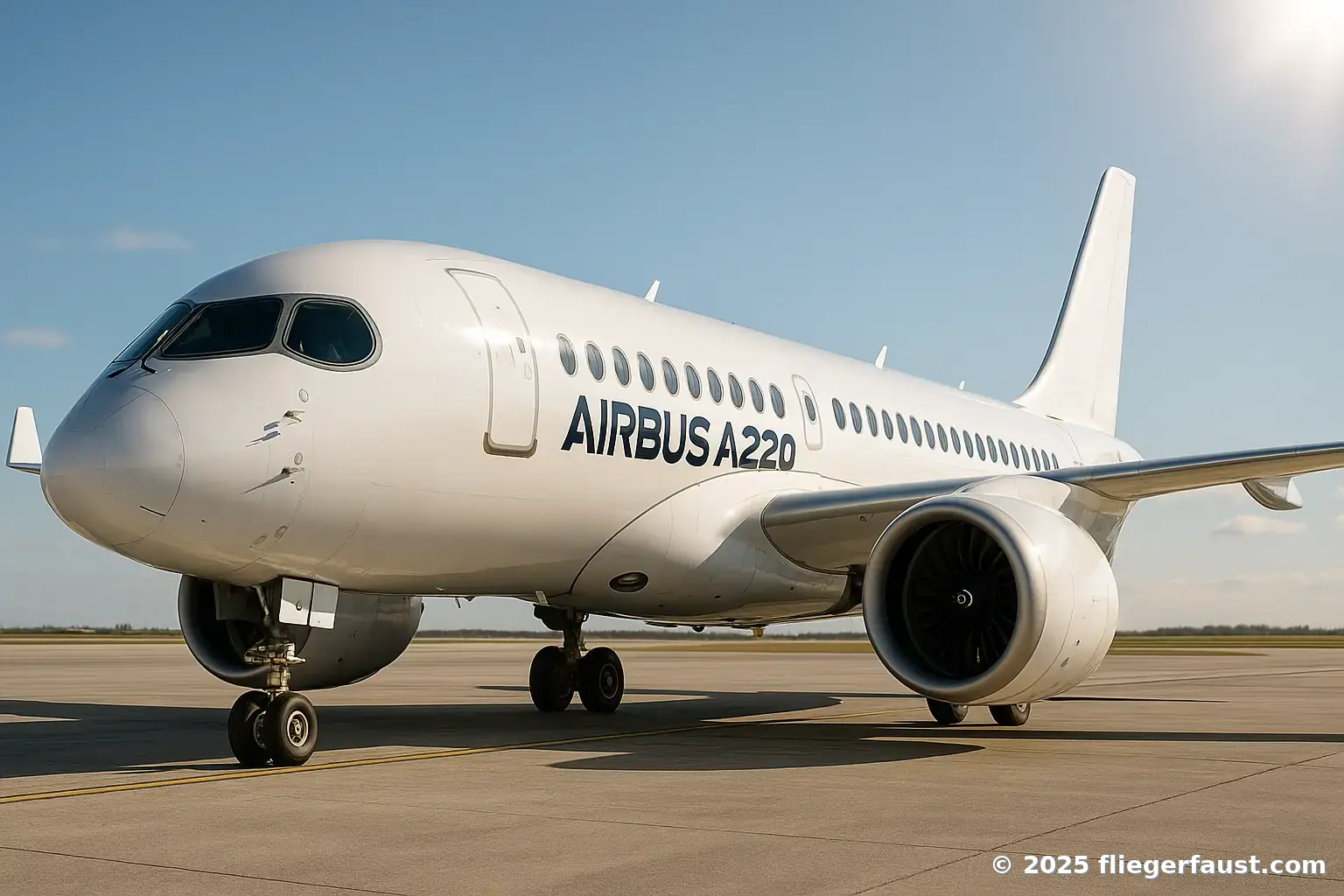
Latest A220 News — how do this week’s ramp decisions and fleet actions reshape the programme’s near‑term reality?
On October 29–30, 2025, Airbus and Swiss International Air Lines set the tone for the Airbus A220’s next chapter with a pair of consequential moves that will ripple through assembly halls, maintenance shops, and airline schedules.
SWISS Grounds All Its Airbus A220-100
Airbus trimmed its 2026 A220 production ambition to 12 aircraft per month and framed the shift around supply–demand balance and engine‑maturity timing, even as third‑quarter results beat expectations (Reuters; FlightGlobal). A day later, Swiss grounded all nine Airbus A220‑100s to use their Pratt & Whitney PW1500G engines to keep its A220‑300 fleet flying, a stark but calculated response to parts scarcity and turnaround times (FlightGlobal). Together, these moves ask a simple question: are we watching a controlled reset or the start of a longer detour?
Also read UPDATE: Bombardier Gripen Canada – What We Know Now After Ottawa’s New Signals
Moreover, both actions land in a market that still loves the A220’s economics and cabin but remains captive to the cadence of engine maturity and the tempo of the supply chain. Notably, Airbus’s message is not retreat but recalibration. Meanwhile, Swiss’s step shows how operators can trade fleet complexity for day‑to‑day reliability when spares are thin. Consequently, the storyline is not drama for its own sake; it’s a programme finding its balance while the Pratt & Whitney geared turbofan (GTF) recovery curve catches up.
Latest A220 News: Airbus dials the 2026 ramp to 12 per month
At its third‑quarter briefing on October 29, 2025, Airbus confirmed a revised A220 ramp target. It set 12 jets per month for 2026. The company linked the adjustment to the current balance between supply and demand (FlightGlobal). It also tied the timing to phased engine‑durability improvements for customers. However, it also stressed that the higher 14‑per‑month aspiration is not abandoned.
“We are not dropping the rate of 14 a month, but we will target 12 instead of 14 next year,” said Chief Executive Guillaume Faury – via Reuters.
Below 14/month, A220 loses money for Airbus and the government of Québec
Additionally, the context matters. On October 27, Reuters reported that Airbus had pushed some A220 assembly into later slots. (Reuters). It also set 12 per month as a mid‑2026 stepping stone from today’s roughly seven to eight per month. Notably, Airbus says the A220 must near 14 per month to break even (FlightGlobal). That threshold likely shifts with the integration of Spirit AeroSystems work packages. It also depends on the pace of engine upgrades.
The A220 began life as the Bombardier CSeries, designed and built in Montreal, Québec. In 2018, Airbus took a controlling stake and the jet became the A220. Production is now led by Airbus Canada in Mirabel, Québec near Montréal. The Québec government still holds a minority stake in Airbus Canada Limited Partnership, so the A220 remains partly owned in Canada.
On October 8, 2025, Québec booked a C$400 million write‑down on its 25% stake in Airbus Canada Limited Partnership, the A220 programme entity (Reuters). The government said the adjustment reflects ongoing programme losses and weaker near‑term returns tied to U.S. tariffs and supply‑chain delays (Journal de Montréal). A write‑down reduces the book value to what Québec expects to recover; it does not change the cash already invested or the 25% ownership.
Québec government’s A220 US‑tariff claim falls flat
Moreover, that “tariff” rationale reads like a political scapegoat. Airbus has already said it “will not cover tariffs applied to Airbus aircraft that are imported to the US for US customers” — Leeham News. For A220s and A320s built in Mobile, Alabama for U.S. airlines, tariffs would apply only to imported parts, and even then the impact is “less clear” as policies change — a point Airbus and the Québec government have not quantified for the A220’s U.S.‑bound production. In practical terms, U.S. final assembly already addresses the U.S. market; the province’s claim does not show how tariffs materially drive today’s programme economics. Is this, instead, a book write‑off to align carrying value with Airbus’s internal assumptions — perhaps also for Airbus tax reasons?
It is important to remember that the economic benefits of the A220 in Quebec amount to billions of dollars. Approximately 3,900 people work for Airbus in Mirabel.
Latest A220 News: A 12-per-month bridge while engines and Spirit align
Furthermore, the production‑rate change arrived alongside robust Q3 numbers (Reuters; Airbus). As noted earlier, adjusted operating profit rose 38% to €1.94 billion. Revenue rose 14% to €17.83 billion. Airbus also maintained its full‑year delivery target around 820 jets. Therefore, the A220 recalibration looks less like a retreat and more like a synchronisation with engines, wings, and cash.
Specifically, Airbus also pointed to progress on engine availability across programmes. Specifically, Airbus also pointed to progress on engine availability across programmes.
Could Airbus add a CFM LEAP option on a future A220‑500? In practice, it’s unlikely in the near term. It would require a new pylon and nacelle, a full certification programme, and unwinding Pratt & Whitney exclusivity. Meanwhile, a stretch remains plausible, but an “A220‑neo” label does not. For now, any near‑term gains are more likely to come from PW1500G durability upgrades than an engine switch. Who really knows?
The number of so‑called ‘gliders’ — aircraft awaiting engines — fell to 32 aircraft by the end of September (FlightGlobal). That was about half the level in June. Even so, deliveries remain backloaded. That amplifies the need for predictable maintenance, repair and overhaul slots and stable subassembly flow.
Backlog of 490 A220 aircraft
Meanwhile, the A220 backlog remains deep. FlightGlobal tallied 62 A220 deliveries in the first nine months (FlightGlobal). The backlog stood at 490 aircraft at the end of September. Consequently, demand is not the problem; synchronising engines and industrial integration is.
Importantly, for Canadian readers, this concerns the Mirabel‑centred final assembly system. That site must juggle rework resources, handover teams, and supplier timing. Therefore, the revised rate gives Airbus Canada breathing space to fortify quality gates before volume climbs again (Reuters).
Finally, the rate reset also harmonises with the Spirit AeroSystems transition. As Airbus absorbs A220 wing and pylon work, it will coordinate Belfast, Prestwick, and Wichita. That should smooth interfaces that once wobbled (Reuters; Airbus).
Latest A220 News: Engine maturity, PW1500G availability, and the GTF curve
The A220’s Pratt & Whitney PW1500G sits inside the broader geared turbofan (GTF) family, whose powder‑metal inspection cycle, premature wear findings, and shop‑visit bottlenecks have reverberated across the industry since 2023 (Reuters). Moreover, airlines continue to map their schedules around long turnaround times and staggered availability of upgraded hardware.
However, there is a roadmap. Wizz Air and Turkish Airlines executives have discussed 2027 as the year by which they expect to be largely clear of GTF‑driven groundings, while warning that the timeline is not guaranteed (Reuters; Reuters). Additionally, RTX’s Pratt & Whitney has introduced additive repair (3D printing) methods that it says can cut some processes by more than 60% (Reuters). This is meant to expand maintenance, repair and overhaul (MRO) capacity and accelerate parts recovery. Pratt & Whitney is owned by RTX Corporation, formerly Raytheon Technologies.
Notably, Airbus’s own framing of the A220 rate change includes “engine durability improvements” and the reality that some customers prefer to wait for mature configurations (FlightGlobal). Therefore, scheduling deliveries to coincide with improved time‑on‑wing protects airline fuel savings from being eroded by shop‑visit churn.
Latest A220 News: The A220’s physics remain compelling
The A220’s physics remain compelling: a low‑drag wing, a composite‑rich structure, and an efficient cabin yield real‑world savings. However, in practice, those gains are hostage to reliability until MRO throughput catches up. Consequently, the A220’s near‑term reputation hinges not on brochure performance, but on parts predictability and the steady decline of aircraft‑on‑ground figures.
For context within the Latest A220 News, engine “gliders” have already halved across Airbus programmes in recent months, yet 32 aircraft remained parked waiting for engines at the end of September (FlightGlobal). Consequently, every additional PW1500G module that flows aligns the ramp closer to plan.
Latest A220 News: Swiss parks the Airbus A220-100s to keep the A220-300s flying
On October 30, 2025, Swiss International Air Lines grounded all nine Airbus A220‑100s. It designated their Pratt & Whitney PW1500G engines as donor units to sustain its 21‑strong A220‑300 fleet (FlightGlobal). The airline expects the measure to last “about one and a half years,” said Chief Financial Officer Dennis Weber. London City operations will be covered by partner Helvetic Airways’ Embraer E2s. Therefore, the near‑term outcome is fewer aircraft types to manage and more engines available where seats matter most.
Latest A220 News: Concentrating scarce engines on the A220-300 fleet
“Swiss will now ground all nine A220‑100s immediately, using their engines as a spares pool to keep the A220‑300s flying … It will certainly last about one and a half years.” — “Previously, Swiss relied on the A220-100s to operate flights to London City airport, due to its steep approach constraints. However, wet-lease partner Helvetic Airways can now serve that airport with its Embraer 190-E2 and 195-E2 fleet.“, FlightGlobal October 30, 2025
Additionally, Swiss indicated that the change supports a gradual refocus on Zurich and a reduction of destinations from Geneva for summer 2026 owing to limited resources (SWI swissinfo.ch). Notably, Aviation Week also reported an “at least 18 months” horizon for the A220-100s to remain off the line (Aviation Week).
Consequently, the airline captures two benefits. First, it simplifies flight operations, training, and spares — fewer variant‑specific issues to juggle daily. Second, it concentrates scarce engines in the higher‑capacity A220-300s, protecting available seat kilometres while the MRO pipeline heals.
Cannibalisation sounds brutal. In fleet planning, it simply moves calories to the part of the body that must run today.
Frustration is running high among Airbus A220 operators
Moreover, Swiss was the launch customer of the then‑Bombardier CSeries CS100 in 2016. This is not a repudiation of the A220‑100. Rather, it is an operating‑theatre decision under resource constraints. Therefore, when PW1500G availability normalises, Swiss will have flexibility to restore the variant as network needs evolve. In other words, expect tense, no‑nonsense conversations between Swiss, Pratt & Whitney and Airbus. Frustration is running high among A220 operators.
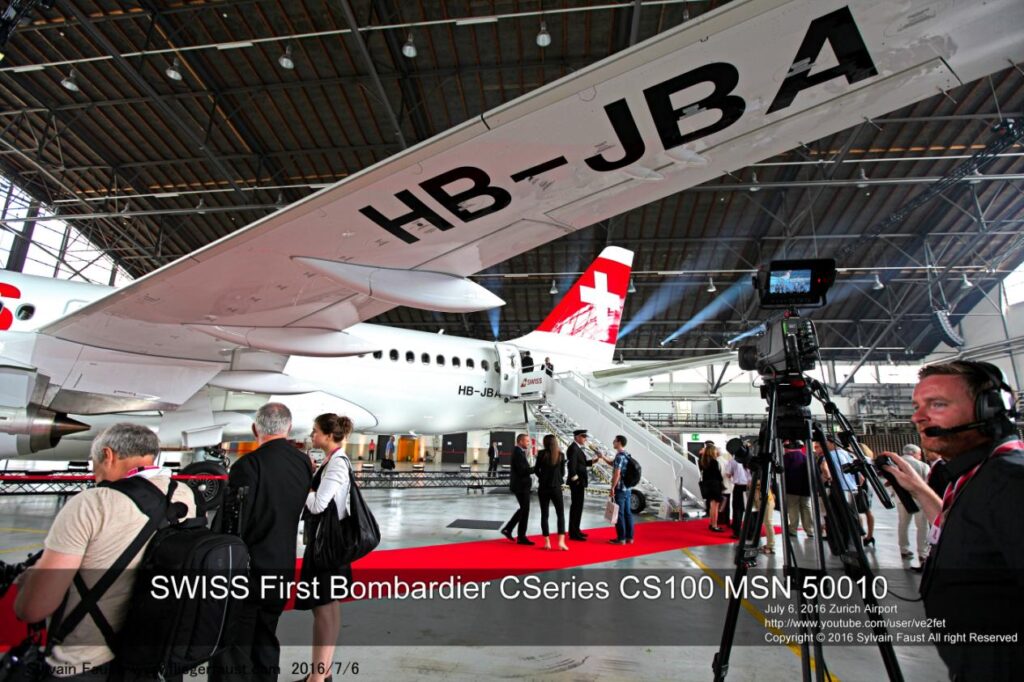
Swiss first A220, a Bombardier CSeries – July 2016
I was in Mirabel for the first delivery celebration by Bombardier. I was also in Zurich on July 6, 2016, for Swiss’s inauguration of its first CSeries (now A220).

Swiss invited me to cover the celebration. Also to join a flight over Switzerland on their first A220, Manufacturer’s Serial Number (MSN) 50010. It was an A220-100 then called the CSeries CS100. See the video and photo below and the full-flight video I shot—the first Swiss passenger flight with their newly delivered A220.
See below for the full flight video.
For readers tracking earlier A220 operator pivots, we have covered Air Austral’s path off the A220 amid GTF constraints. That background helps contextualise Swiss’s decision today. See our prior post here: Air Austral A220: Fleet Exit by Mid‑2026.
Latest A220 News: Supply‑chain chess — Belfast, Mirabel, Mobile and the Spirit hand‑off
Airbus’s stated rationale for the ramp reset explicitly mentioned the integration of Spirit AeroSystems work packages, including the advanced composite wing for the A220 produced in Belfast. Additionally, Reuters confirmed Airbus has finalised a deal to take over several Spirit assets, a split transaction alongside Boeing’s reacquisition of Spirit’s other businesses (Reuters). Therefore, the A220’s critical path now includes how quickly Airbus can harmonise quality, logistics, and cash at newly absorbed sites.
Moreover, Airbus’s own press release speaks to acquiring industrial assets tied to commercial programmes, including the A220 wing and pylon work. Notably, this should reduce interface risk and, in time, cut the variability that has whipsawed monthly output.
As per the Airbus press release: Airbus will take ownership of the following Spirit AeroSystems assets:
- the site of Kinston, North Carolina, U.S. (A350 fuselage sections);
- the site of St. Nazaire, France (A350 fuselage sections);
- the site of Casablanca, Morocco (A321 and A220 components);
- the production of A220 pylons in Wichita, Kansas, U.S.;
- the production of A220 wings in Belfast, Northern Ireland; and
- the production of the A220 mid-fuselage in Belfast, Northern Ireland, unless Spirit AeroSystems identifies a suitable buyer for the part of the site where these activities are located.
- Airbus will also acquire the production of wing components for A320 and A350 in Prestwick, Scotland.
- Spirit AeroSystems intends to sell the site of Subang, Malaysia to a third-party owner.
Source (Airbus)
Consequently, the A220’s geographic production triangle — Mirabel for final assembly, Belfast for wings, and Mobile for U.S. line work — Airbus stands to benefit from a single management spine. However, outcomes for unions and suppliers remain uncertain. Furthermore, bringing sub‑tier oversight under Airbus increases visibility into parts and rework queues, the very spots where “days” become “weeks.”
If vertical integration is a safety net, Airbus is trying to turn it into a trampoline — bounce high, land softly, I repeat, land softly.
For readers who want the deep background on why Spirit matters to the A220’s future, revisit our earlier feature: Airbus Spirit AeroSystems Deal: A220 Future and Aerospace Manufacturing.
The operator lens: rotations, resilience, and residuals
Airlines do not live in PowerPoint; they live in rotations. Moreover, when engines short‑cycle through shops or modules arrive late, schedule planners trade frequency, gauge, and stage length to defend revenue. Therefore, Swiss’s shift shows one version of resilience: cut the variant that carries the least daily utility and harvest its engines for the fleet that carries the most.
Additionally, other A220 operators will take notes. Notably, where a carrier runs thin fleets, the loss of a handful of airframes can spike cancellations or force expensive wet‑leases. Consequently, standardising on the A220-300, when possible, for a year or more can stabilise daily block hours even if it postpones niche missions like London City.
Furthermore, residual values interlock with utilisation. If time‑on‑wing improves through 2026 and 2027, the market will likely credit the A220 with restored reliability, and values should track upward as availability stabilises. However, if the 2027 clean‑up proves slippery, lessors will price that tail risk into lease rates and reserves for longer.
Quirk of airline life: the cheapest spare engine is always the one already hanging on your wing.
For a contrasting operator arc, compare Croatia Airlines’ A220 introduction, where the A220-100 brings right‑sized gauge into a European network built on frequency. Our recent coverage explores the timing and early utilisation logic: Croatia Airlines A220: First -100 Nears Delivery.
Market signals: orders, backlogs, and breathing space
Despite the week’s headlines, the A220 remains a scarce commodity against a backlog approaching 500 units (FlightGlobal). Moreover, Airbus’s nine‑month disclosure of 507 total jet deliveries and the reinforcement of its ~820‑deliveries target underline how strong the broader demand picture remains (Reuters; Airbus).
Also, trimming the A220 ramp in 2026 grants Airbus room to fold in Spirit’s assets and to tie the delivery pulse to maturing PW1500G kits. Therefore, the timing could yield a cleaner climb to higher rates when engines and wings are fully in phase.
Meanwhile, the A220‑500 debate inevitably bubbles back whenever market focus shifts to economics and gauge. We explored whether a stretch can soar without a new wing and how cabin density would interact with costs. Readers can revisit that context here: A220‑500: Can the Stretch Soar Without a New Wing?
What to watch through 2026: milestones and scenarios
Firstly, watch Mirabel and Mobile output against the revised monthly run‑rate. Additionally, track A220 handovers quarter by quarter. Airbus had delivered 62 A220s in the first nine months of 2025 and urged teams toward 100 for the year, with rework resources focused on handover punctuality (Reuters).
Secondly, monitor PW1500G shop‑visit durations and the availability of upgraded hardware packages. Moreover, institute a simple mental model: if turnaround times collapse from many months toward weeks and time‑on‑wing grows, the A220’s in‑service profile will normalise. Consequently, operators will reinstate thinner routes and lean on A220-100s where their niche makes sense again.
Thirdly, follow the Spirit integration checkpoints. Notably, Airbus’s ownership of Belfast’s A220 wing line and related assets should yield fewer interface delays. Therefore, supply‑chain risk ought to shrink as Airbus imposes its quality‑assurance architecture and logistics cadence (Reuters; Airbus).
Finally, keep an eye on Swiss’s timetable and whether other carriers adopt temporary “donor‑fleet” strategies. Additionally, Switzerland’s network choices around Zurich versus Geneva offer a live laboratory for how fleet simplification can shape profits and punctuality (SWI swissinfo.ch).
Aviation loves targets; mechanics love torque values. The A220’s next year needs both to line up.
Latest A220 News: The numbers beneath the narrative
Airbus: Adjusted operating profit rose 38% in Q3 to €1.94 billion; revenue rose 14% to €17.83 billion. Additionally, Airbus reaffirmed its ~820 deliveries target for 2025 and its A320neo family goal of 75 per month by 2027 (Reuters). Moreover, the number of “gliders” across programmes fell to 32 by end‑September, down from roughly 60 in June (FlightGlobal).
A220 specifics: Airbus adjusted the 2026 target to 12 per month, with the 14‑per‑month aspiration still on the horizon but off the detailed plan for now (Reuters; FlightGlobal). Additionally, the backlog sat near 490 at end‑September, with 62 deliveries in the first three quarters (FlightGlobal).
Swiss: Grounded nine A220‑100s to create an engine pool for the A220‑300 fleet. Notably, the measure is slated to last around 18 months, with Helvetic covering London City, and Geneva destinations set to be reduced in summer 2026 (FlightGlobal; SWI swissinfo.ch).
If you want an airline KPI that truly measures stress, try counting how many times a planner refreshes the MRO portal before lunch.
Outlook: a managed reset, not a pause button
Overall, the Latest A220 News points to a managed reset built around parts reality and smart integration. Moreover, Airbus’s choice to hold the 14‑per‑month ambition in reserve while committing to 12 in 2026 signals discipline. Consequently, investors, suppliers, and airlines can plan around achievable milestones rather than a stretch that drifts.
Additionally, Swiss has illustrated an operator‑level playbook that other carriers can adapt if shortages persist. Notably, the move concentrates capacity where it matters without torpedoing the brand story. Therefore, once engine maturity kits roll and MRO turn times compress, Swiss can bring the A220-100s back on its own timetable.
In the end, programmes succeed when engineering maturity, industrial cadence, and airline operations reach resonance. The coming four quarters are about getting all three to sing.
The smartest joke in aerospace is that “next year” is always when it all gets easier. The A220’s job in 2026 is to deliver on that punchline.
Reasons for the Airbus A220’s engine issues
Airbus A220 operators have faced several well‑documented issues with the Pratt & Whitney PW1500G geared‑turbofan, driven by manufacturing and durability findings and, earlier, a software‑related phenomenon:
- Powder‑metal anomaly (manufacturing): Regulators determined that a rare defect in nickel powdered metal used to make certain high‑pressure turbine and compressor parts can lead to premature cracking. A 2024 FAA directive requires angled‑ultrasonic inspections and accelerated replacement of affected hubs and disks across PW1500G/PW1900G engines. (Federal Register)
- Corrosion‑driven durability limits (HPC front hub): Excessive corrosion has been found on the high‑pressure compressor front hub, reducing its low‑cycle‑fatigue strength — a condition that can develop even while engines sit idle. Life limits were reduced and hardware replacements mandated to prevent cracking and potential uncontained failures. (Flight Global)
- 2019 IFSDs, acoustic resonance & software mitigation: A cluster of in‑flight shutdowns in 2019 was traced to an acoustic‑resonance condition that damaged the LPC stage‑1 rotor. The FAA ordered removal of earlier FADEC software and installation of updated logic; interim operating limits (e.g., capping N1 above FL290) were also imposed. (Federal Register)
- Operational environment & utilization: In practice, wear rates on GTF engines vary with how and where they’re flown. While regulators’ A220‑specific actions focus on corrosion and powder‑metal findings, operators have reported unscheduled removals and higher shop‑visit burdens consistent with demanding operations. (Context drawn from fleet‑wide GTF experience and airline statements.) (Reuters)
- Parts and MRO capacity constraints: Pratt & Whitney’s inspection/repair campaigns, coupled with supply‑chain bottlenecks, have stretched shop turnaround times and limited spare‑engine availability, forcing schedule cuts and aircraft groundings at several A220 operators. (Reuters)
Impact: The cumulative effect has been material operational disruption and added cost for airlines. Illustratively, in October 2025 SWISS grounded its entire A220‑100 sub‑fleet and repurposed those engines to keep its A220‑300s flying; other carriers (e.g., airBaltic) have canceled routes and flights while awaiting engine shop slots and parts. (Flight Global)
Latest A220 News: Conclusion
Airbus made a prudent call by aligning the A220’s 2026 pace with the engine‑maturity curve and the Spirit integration timetable. Moreover, the company preserved strategic flexibility by keeping the 14‑per‑month ambition alive without hard‑dating it. Conversely, Swiss’s engine‑donor strategy sacrifices near‑term variant flexibility to defend daily reliability where it counts. Consequently, both actions suggest confidence in the platform’s medium‑term economics paired with realism about 2026 bottlenecks.
Critically, the real test is execution. If PW1500G time‑on‑wing improves and shop‑visit times shrink, the A220’s daily narrative flips from scarcity management to schedule confidence. If not, 2026 risks becoming a bridging year that feels longer than twelve months.
So here is the honest, final question
How long will Airbus keep losing money on the A220 while producing fewer than 14 aircraft per month—and when will a credible path back to 14 emerge?
Please, leave your comments below this post or on our Fliegerfaust Facebook page.
Existing Fliegerfaust coverage
For additional Fliegerfaust context referenced in the article:
- Airbus Spirit AeroSystems Deal: A220 Future and Aerospace Manufacturing
- Air Austral A220: Reliability Pain: Airbus A220 Fleet Exit by Mid‑2026
- Croatia Airlines A220: First A220-100 Nears Delivery
- A220‑500: Can the Stretch Soar Without a New Wing?
Latest A220 News: Sources
Leeham News — Airbus 1Q2025 results: So far, so good, but US tariffs make future results unpredictable (May 1, 2025)
Reuters — Airbus cuts production rate target for its A220 jet (October 29, 2025).
Reuters — Exclusive: Airbus delays some A220 output, narrowing window to reach 2026 target (October 27, 2025).
FlightGlobal — Swiss cannibalises A220‑100s for engines to keep A220‑300 fleet flying (October 30, 2025).
FlightGlobal — Airbus halves number of parked ‘gliders’ as it strives to meet year‑end delivery target (October 29, 2025).
Airbus — Airbus reports Nine‑Month (9m) 2025 results (October 29, 2025).
Reuters — Airbus finalises deal to take over some Spirit Aero plants (April 28, 2025).
FlightGlobal — Airbus trims A220 production targets over supply and demand considerations (October 29, 2025).
Airbus — Airbus signs definitive agreement with Spirit AeroSystems (April 28, 2025).
Financial Times — Airbus sticks to jet delivery target despite supply chain disruptions (October 30, 2025).
Aviation Week — Swiss grounds Airbus A220‑100 fleet until at least 2027 (October 31, 2025).
SWI swissinfo.ch — SWISS grounds its Airbus A220‑100s (October 30, 2025).
For full details, please refer to our Disclaimer page.

This article gives us an excellent overview of the A220 situation, but something is missing. What’s needed is a more detailed overview of the ENGINE situation. What’s wrong with the PW1500G? Why is it spending more time in the shop than in the air? What corrective actions have been taken to fix the obvious weaknesses? What’s the plan for recovery? And more crucially, what is the expected time-on-wing for the coming months and years, as well as the entire operational life of the aircraft? As a reference the average time-on-wing for the CFM56 is 30 000 hours. It’s a sad situation for the A220 because what we have here is a very good airplane marred by a defective engine.
You are totally right. I updated the article, reload it and go to the section “Reasons for the Airbus A220’s engine issues”