

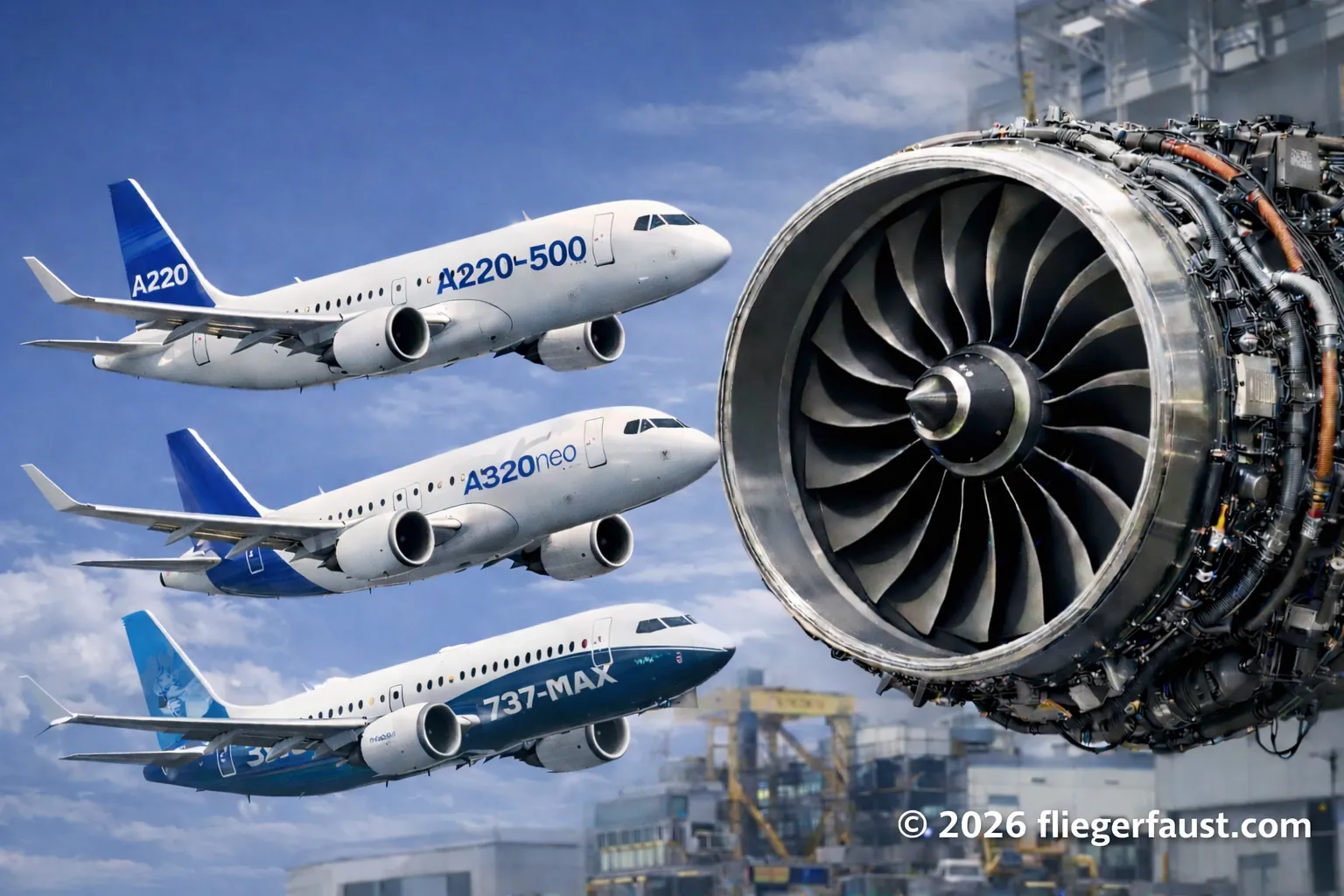
LEAP engine investment is suddenly the hinge of the narrowbody market, but what is GE Aerospace really buying with its new United States spending surge?
LEAP engine investment: On March 9, 2026, GE Aerospace said it would invest another $1 billion across United States manufacturing sites and suppliers. The company said the money would accelerate engine deliveries, raise output of durability parts, and strengthen defence production (GE Aerospace, March 9, 2026).
Moreover, the timing is sharp. Meanwhile, Boeing is trying to keep 737 MAX output moving despite fresh rework. Separately, Airbus is openly angry about Pratt & Whitney engine commitments. Additionally, Reuters reported on January 29, 2026 that the Airbus A220-500 has entered a pre-sales phase ahead of a possible Farnborough decision window (Reuters, March 10, 2026; Reuters, February 19, 2026; Reuters, January 29, 2026).
Additionally, Farnborough International Airshow 2026 runs from July 20 to July 24. Consequently, that date matters because Airbus now appears closer to a decision on a larger A220, even if the engine choice remains unsettled (Farnborough International Airshow FAQ).
LEAP engine investment starts on the factory floor
Overall, the first point is simple. Instead, GE Aerospace is not only spending for volume. Rather, it is spending for resilience. According to GE Aerospace’s March 9, 2026 manufacturing announcement, the company will spread the money across more than 30 communities in 17 states. Additionally, it plans to hire 5,000 workers in the United States in 2026, on top of the 5,000 it hired in 2025.
Moreover, GE Aerospace said this is its second consecutive $1 billion manufacturing commitment in the United States. The same release says the company has announced more than $2.5 billion of manufacturing and supplier investment in the United States since 2024. Additionally, it also says GE Aerospace still spends nearly $3 billion a year on research and development.
In aero-manufacturing, even a small tooling gap can become next quarter’s headline.
LEAP manufacturing expansion moves beyond the headline
That matters because this LEAP engine investment is not a generic capital programme. Reuters reported that more than $275 million will go to defence engine and component sites. Additionally, Reuters said more than $100 million will support outside suppliers with tooling and equipment to stabilise schedules (Reuters, March 9, 2026).
Additionally, GE Aerospace said $115 million will go to the Cincinnati, Ohio area. Specifically, the company said that money will modernise infrastructure, expand test-cell capacity, and increase advanced metal additive manufacturing (GE Aerospace’s investment breakdown).
“Maintaining U.S. aerospace leadership requires sustained investment in our people, our facilities, and the technologies that will define the future of flight.” — H. Lawrence Culp, Jr., Chairman and Chief Executive Officer, GE Aerospace
Notably, GE is framing the move in operational terms. Moreover, the company says the spending will help accelerate engine deliveries. Additionally, it also says it will raise output of parts that extend time between shop visits. Therefore, that distinction matters because the 2026 engine shortage is not only about new engines. Instead, it is also about keeping existing engines away from long queues.
CFM LEAP capacity push targets durability kits and supplier flow
Seen up close, the LEAP engine investment is aimed at durability hardware, supplier stability, and faster shop turns. Moreover, GE Aerospace said $200 million will expand capacity for LEAP high-pressure turbine durability kits. Additionally, the company said those kits can improve time on wing by more than two times in hot and harsh conditions. Separately, it also said the programme supports the reverse bleed system, which reduces on-wing maintenance needs (GE Aerospace, commercial investment details).
Meanwhile, Reuters reported on December 7, 2024 that regulators certified a more durable high-pressure turbine kit for LEAP-1A engines. Specifically, Reuters said the fix responded to wear in hot and dusty operating conditions. Additionally, Reuters noted that a similar fix for the Boeing 737 MAX’s LEAP-1B was being tested (Reuters, December 7, 2024).
Consequently, this LEAP engine investment is about more than more engines. More importantly, it is also about more durable engines. Moreover, GE Aerospace said supplier material input from priority suppliers improved by more than 40% in 2025. Additionally, the company said the improvement helped drive commercial engine deliveries up 25% and defence engine deliveries up 30% in the same year (GE Aerospace, March 9, 2026).
Therefore, GE is trying to buy time as well as output. In 2026, that may prove to be the smarter industrial bet.
LEAP engine investment meets Boeing’s 737 MAX reality
For Boeing, the LEAP engine investment lands at a sensitive moment. Specifically, every 737 MAX uses the LEAP-1B. Therefore, engine throughput matters directly to Boeing’s narrowbody recovery. Yet engine flow is useful only if the airframer keeps its own production discipline intact.
Narrowbody engine ramp-up meets Boeing’s line-rate ambitions
Reuters reported on March 10, 2026 that Boeing said 737 production continues at 42 aircraft a month. Additionally, Reuters said Boeing still plans to step up to 47 later in 2026. Moreover, the same report said Boeing wants to reach 63 a month in the next few years. In parallel, Boeing said it plans to open a fourth 737 assembly line at Everett, Washington, this summer and still wants to deliver about 500 737 jets in 2026 (Reuters, March 10, 2026).
Meanwhile, Reuters reported the same day that Boeing delivered 51 aircraft in February 2026. Specifically, that total included 43 737 MAX jets. Additionally, Reuters said that was Boeing’s best February delivery result since 2018 (Reuters, March 10, 2026).
That combination matters. Overall, Boeing is no longer speaking like a company stuck in pure crisis mode. Instead, it is speaking like a company trying to restore a steady factory rhythm. For the competitive backdrop, see our Fliegerfaust coverage of how the Airbus A320 race has been outpacing the 737.
A fourth line looks confident on a factory tour; missing engines still write the diary.
LEAP production surge still depends on rework-free airframes
However, Boeing’s latest warning was not about engines. Instead, it was about wiring. Reuters reported on March 10, 2026 that some first-quarter deliveries could slip because of scratched wires caused by a machining error. Additionally, Reuters said the issue required rework on a group of aircraft, though Boeing added that in-service jets remained safe and the full-year delivery target did not change (Reuters, March 10, 2026).
“Our 737 program is performing rework on a group of airplanes to fix wires that have small scratches due to a machining error.” — Boeing statement, Reuters
Even so, the LEAP engine investment can still remove one major constraint. If Boeing keeps climbing from 42 per month, the market will need a steadier stream of LEAP-1B engines. Additionally, it will also need more spare capacity and shorter repair turns. Therefore, GE Aerospace’s March 9 move looks designed for that exact demand curve.
Moreover, the political signal is clear. A manufacturing push in the United States linked to Boeing’s narrowbody franchise is easier to defend than a vague promise to support growth. Boeing needs engines. Moreover, GE has now made a very public point of saying it intends to deliver them.
LEAP engine investment collides with Airbus’s engine squeeze
If Boeing’s problem is rate execution, Airbus’s problem is sharper. Meanwhile, Airbus has effectively said one of its two narrowbody engine suppliers is constraining the ramp. Therefore, the LEAP engine investment is not only a Boeing story. It is also a pressure point inside Airbus’s production arithmetic.
Jet engine capacity build-out cannot erase Airbus’s contract dispute
On February 19, 2026, Airbus said in its full-year 2025 results that the A220 ramp-up now targets 13 aircraft a month in 2028. Additionally, Airbus said the A320 Family should reach between 70 and 75 aircraft a month by the end of 2027, then stabilise at 75 thereafter in Toulouse and Hamburg final assembly planning terms. Crucially, Airbus said Pratt & Whitney had failed to commit to the number of engines ordered by Airbus and that this was hurting 2026 guidance and the ramp-up path (Airbus, February 19, 2026).
Additionally, Airbus said it delivered 793 commercial aircraft in 2025. Specifically, that total included 93 A220s and 607 A320 Family aircraft. Additionally, Airbus then guided to about 870 commercial deliveries in 2026 (Airbus FY2025 results).
Meanwhile, Reuters reported the same day that Airbus had reduced its narrowbody goal from a firm 75 aircraft a month in 2027 to a range of 70 to 75. Additionally, Reuters said Chief Executive Officer Guillaume Faury warned that Airbus was prepared to enforce its contractual rights in its dispute with Pratt & Whitney over engine supply shortfalls, late deliveries, and the allocation of engines between Airbus assembly lines and maintenance shops (Reuters, February 19, 2026; Reuters, February 5, 2026).
“We are very dissatisfied and we don’t agree with it.” — Guillaume Faury, Airbus Chief Executive Officer, Reuters
In Toulouse, France, a glider is not a sailplane; it is a finished jet waiting for its heartbeat.
CFM LEAP capacity push has limits of its own
Reuters reported on February 5, 2026 that Airbus and Pratt & Whitney still had no supply agreement for 2026 and 2027. Additionally, Reuters said Pratt & Whitney supplies engines for about 40% of the benchmark A320neo-family jets being assembled. Moreover, the same report said Airbus described those engine arrivals as “very, very late”. (Reuters, February 5, 2026)
At first glance, that sounds like an obvious opening for CFM International, the 50-50 joint venture between GE Aerospace and Safran Aircraft Engines. However, the supply story is tighter than that. Reuters reported on February 13, 2026 that Safran’s Olivier Andriès said CFM’s forecast 15% rise in LEAP deliveries for 2026 did not assume a larger Airbus share. Additionally, Reuters said CFM’s agreed 2026 volumes with Airbus remained tied to its existing market share (Reuters, February 13, 2026).
“As with each year, if we can do more we will, but our commitment corresponds with our share of the market.” — Olivier Andriès, Safran Chief Executive Officer, Reuters
Separately, FlightGlobal reported on February 19, 2026 that Airbus did not expect to secure enough extra LEAP engines to offset the Pratt shortfall. That means GE’s spending may improve Airbus confidence over time, but it does not solve the near-term allocation problem (FlightGlobal, February 19, 2026).
Therefore, the engine market is not merely short. More importantly, it is short in ways that contracts, spare-engine needs, and market-share rules make hard to rebalance quickly.
Pratt & Whitney’s counter-move matters more than the rhetoric
A one-sided article would be a weak one. However, Pratt & Whitney is not standing still. Instead, both narrowbody engine ecosystems are spending hard to get ahead of durability, throughput, and overhaul delays. Instead, the difference is that Airbus has already told the market it does not yet trust Pratt’s timing.
A LEAP-powered A220-500 would shift industrial weight out of Canada
If Airbus ever chooses to also offer the CFM LEAP for the A220-500, that will not be a neutral technical upgrade for Canada; it will mean a Mirabel, Québec-anchored programme starts pulling more of its engine-side industrial weight from GE Aerospace’s newly expanded United States manufacturing chain instead of from the current Pratt & Whitney setup, whose PW1500G final assembly is in Mirabel, Québec, Canada.
GE Aerospace’s March 9, 2026 announcement is explicit that this latest$1 billion push is aimed at U.S. plants and suppliers, while Pratt & Whitney said the PW1500G’s final assembly is done in Mirabel, Quebéc, Canada and Québec’s 2024 extension of its A220 partnership with Airbus to 2035 makes the politics even sharper. In plain language, if Airbus ever puts an increasingly U.S.-weighted LEAP on the A220-500, Ottawa and Québec will be entitled to ask why public money is still backing a programme whose propulsion content is drifting away from Canada.
That question is sharper because Québec is not a bystander in the A220 programme: Airbus has held 75% of Airbus Canada since February 2020, while the Government of Québec holds the remaining 25%, giving the province a direct stake in how much of the aircraft’s industrial value stays anchored in Canada (Airbus, February 13, 2020; Government of Québec, July 23, 2024).
Narrowbody engine ramp-up is Pratt’s answer, too
On February 24, 2026, RTX Corporation (RTX) said Pratt & Whitney would invest $200 million to expand its Columbus, Georgia operations. Additionally, RTX said the project will add a seventh isothermal forging press. Moreover, RTX said the new press should raise output of rotating compressor and turbine disks by 30% and become operational in 2028 (RTX, February 24, 2026).
Moreover, RTX said a recent 81,000-square-foot geared turbofan (GTF) maintenance, repair and overhaul expansion at Columbus, Georgia lifted annual capacity by more than 25%. Additionally, RTX said Pratt & Whitney now employs more than 2,600 people at the site (RTX’s Columbus update).
“This latest investment will increase output of critical parts for our growing military and commercial engine programs and underscores our ongoing commitment to ramp industrial capacity to support our customers.” — Shane Eddy, President, Pratt & Whitney, RTX
Additionally, RTX said the geared turbofan (GTF) now powers more than 2,600 aircraft for over 90 customers. Even so, that does not erase the programme’s pain. However, it does underline the size of the installed base Airbus must live with.
LEAP manufacturing expansion gains a rival in Columbus and the shops
Pratt & Whitney’s most practical answer may be repair speed. Reuters reported on April 8, 2025 that Pratt had developed an additive repair method for GTF components. Additionally, Reuters said the process would cut repair time by more than 60% and recover $100 million of parts over five years. Meanwhile, RTX said the same day that the process was being industrialised across the global GTF maintenance, repair and overhaul network (Reuters, April 8, 2025; RTX, April 8, 2025).
Meanwhile, FlightGlobal reported on January 28, 2026 that Pratt & Whitney delivered 1,055 large commercial turbofans in 2025, up 6% from 2024. Additionally, FlightGlobal said the number of grounded aircraft tied to the recall had fallen 20% from 2025 highs. Moreover, the same report said PW1100G maintenance output rose 26% in 2025 and 39% in the fourth quarter (FlightGlobal, January 28, 2026).
“MRO output remains the key enabler, and that continues to improve.” — Christopher Calio, Chief Executive Officer, RTX, FlightGlobal
Yet Pratt’s response also explains why the LEAP engine investment does not equal an instant market-share transfer. Meanwhile, Airbus Aircraft published on August 4, 2025 that PW1500G improvements for the A220 were already improving durability, showing measurable results. Airbus Aircraft also said intervals were already more than double earlier configurations, with more gains expected over the next two to three years (Airbus Aircraft, August 4, 2025).
A faster repair is welcome, but physics still refuses to read investor slide decks.
LEAP engine investment: Jet engine capacity build-out still carries a cost shadow
Moreover, the cost of the bottleneck is no longer abstract. Reuters reported on January 20, 2026 that the International Air Transport Association said parts shortages and limited maintenance capacity had added almost $6 billion to airline costs in 2025. Additionally, Reuters said that figure included $3.1 billion in extra maintenance and $2.6 billion in leased spare engines (Reuters, January 20, 2026).
For a Canadian-flavoured view of how GTF disruption has already reshaped A220 operator decisions, see our Fliegerfaust analysis of Air Austral’s A220 fleet exit and the GTF squeeze.
The A220-500 engine question before Farnborough 2026
Overall, this is where the story becomes more delicate. Meanwhile, the A220-500 is no longer just speculative chat. However, the idea of a new engine option at Farnborough 2026 remains plausible only if one separates what Airbus appears ready to sell from what it may want over the longer run.
Jet engine capacity build-out reaches the A220-500 debate
Reuters reported on January 29, 2026 that Airbus is poised to begin offering airlines and lessors a larger A220 with roughly 180 seats. Additionally, Reuters said Airbus wants enough pre-orders to justify formal development later in 2026. Moreover, Reuters said a launch could come as early as Farnborough in July, subject to board approval and support from a small number of marquee customers (Reuters, January 29, 2026).
Meanwhile, Farnborough’s own site confirms that the 2026 airshow runs from July 20 to July 24. Therefore, the calendar is real. Instead, the remaining question is scope, not timing (Farnborough International Airshow FAQ).
“A lot of work is underway to accelerate our ability to make a decision on a stretch.” — Airbus spokesperson, Reuters
CFM LEAP capacity push is not the same as a new A220 engine launch
However, Reuters said the proposed A220-500 concept aims to lower cost per seat and improve programme economics by focusing on a longer fuselage. Reuters added that the upgrade would do so without redesigning the engines or wings (Reuters, January 29, 2026).
Consequently, that detail matters. Specifically, it points to a faster and cheaper stretch. However, it does not point to an immediate re-engining. The same direction appears in The Air Current’s November 21, 2025 reporting, which said customer feedback had pushed Airbus toward a more conservative A220-500 that favours time to market over full transcontinental performance (The Air Current, November 21, 2025).
However, that does not end the engine argument. A longer A220 can launch on today’s geared turbofan, but that does not make a LEAP option irrelevant. Instead, Airbus may want more production confidence, more supplier leverage, and a second source it can trust. Likewise, Pratt & Whitney could stay on the aircraft and offer the A220-500 a stronger or higher-thrust GTF option. Moreover, Pratt would also need to pair that with a more credible durability and delivery story. So the A220-500 engine debate is now about trust, industrial capacity, and bargaining power, not raw necessity.
Narrowbody engine ramp-up keeps the dual-source idea alive
Yet the longer-run engine politics have not gone away. Reuters reported on January 26, 2026 that Lars Wagner backed the idea of a bigger A220 while warning that the industry first needs to solve durability and delivery stress. Additionally, Reuters said Wagner spoke in his first public appearance as head of Airbus’ core commercial unit (Reuters, January 26, 2026).
Reuters quoted Lars Wagner warning that “The whole ecosystem is under pressure” and adding, “I think we need to solve the durability question first.” — Lars Wagner, head of Airbus Commercial Aircraft, Reuters
LEAP manufacturing expansion strengthens Airbus leverage
Moreover, the dual-source argument is older than this year’s headlines. FlightGlobal reported on June 15, 2023 that Airbus Chief Executive Officer Guillaume Faury said an A220-500 could spur Airbus to seek a second engine option. Moreover, FlightGlobal said he framed the issue in strategic and contractual terms rather than as a simple reaction to short-term disruption (FlightGlobal, June 15, 2023).
Similarly, The Air Current reported on June 19, 2023 that Larry Culp, GE Aerospace Chief Executive Officer, said a possible A220-500 engine offering through CFM was something GE Aerospace was actively considering. “I don’t think we would, at this point, rule anything in or anything out. I think all options are on the table.” — Larry Culp, GE Aerospace Chief Executive Officer, The Air Current
Additionally, The Air Current reported on July 21, 2022 that Christian Scherer, Airbus Chief Commercial Officer said both Pratt and CFM had acknowledged Airbus’s stretch requirement. “I’m happy to see that both engine manufacturers — Pratt and CFM — have acknowledged that requirement.” — Christian Scherer, Chief Commercial Officer, Airbus, The Air Current
Finally, The Air Current reported on November 21, 2025 that Scherer said in Dubai, “So far we have a Pratt engine, I’d love to have another one.” — Christian Scherer, Chief Executive Officer, Airbus Commercial Aviation, The Air Current
Therefore, the LEAP engine investment matters to the A220-500 debate mainly as leverage. However, it does not prove Airbus will announce a second engine option at Farnborough 2026. Instead, it improves GE Aerospace’s industrial credibility at the exact moment Airbus has fresh reason to value optionality.
For a deeper look at the stretch economics, see our Fliegerfaust analysis of whether the A220-500 can stretch without a new wing. For the current production backdrop, see our Fliegerfaust report on the A220 ramp-up to 93 deliveries.
Conclusion: GE’s move is smart, but it does not settle the A220 bet
Overall, the LEAP engine investment looks like the smartest narrowbody engine move announced in early 2026. It targets the right weaknesses. Moreover, supplier flow matters. Additionally, durability hardware matters. Meanwhile, test capacity matters. Finally, shop support matters. GE Aerospace chose all four.
However, it would be lazy to treat GE Aerospace’s $1 billion as an instant verdict on Pratt & Whitney. Moreover, Pratt is also spending. Additionally, Pratt is also adding capacity. Meanwhile, Pratt is also getting better repair output and better durability intervals into the market. The real problem is timing. Moreover, Airbus has already told investors that its ramp assumptions were hit by Pratt’s failure to commit on engines. Therefore, that public frustration carries more weight than another optimistic slide.
Moreover, the A220-500 should be read with equal discipline. A Farnborough 2026 development milestone now looks credible. A formal new engine option unveiled at the same moment looks far less certain. Reuters’ picture of a simple stretch without new engines or a new wing points one way. Airbus’s multi-year interest in dual-sourcing, and GE’s visible willingness to play, points another way.
My critical view is straightforward. If Airbus tries to launch an A220-500 without first locking down engine durability, delivery confidence, and a realistic industrial path, it risks stretching not only an aircraft but also the same bottleneck that has already bruised the programme. Meanwhile, GE Aerospace has made a serious move.
The harder question is what Airbus does with that leverage. Will it demand a better Pratt fix? Will it reopen the door to CFM? Or will it delay the hardest engine choice until after Farnborough?
What do you think?
Which path would actually produce the more reliable aircraft programme by 2030?
Leave your answers and comments below and on our Fliegerfaust Facebook page.
LEAP engine investment – Sources
- GE Aerospace — GE Aerospace to Invest Another $1B in U.S. Manufacturing (March 9, 2026).
- Reuters — GE Aerospace to invest $1 billion to boost US engine production (March 9, 2026).
- Reuters — Boeing says wiring flaws could delay first-quarter 737 MAX jet deliveries (March 10, 2026).
- Reuters — Boeing increases jet deliveries in February despite ongoing 787 seat headaches (March 10, 2026).
- Airbus — Airbus reports Full-Year (FY) 2025 results (February 19, 2026).
- Reuters — Airbus softens output target in engine row with Pratt & Whitney (February 19, 2026).
- Reuters — Pratt engine supply doubts weigh on Airbus output goal, sources say (February 5, 2026).
- Reuters — Safran cautious over stepping into Airbus engine dispute with Pratt (February 13, 2026).
- FlightGlobal — Airbus unlikely to obtain more Leap engines to offset shortage of P&W powerplants: Faury (February 19, 2026).
- RTX — RTX’s Pratt & Whitney broadens manufacturing capabilities with $200 million investment in Columbus, Georgia (February 24, 2026).
- Reuters — RTX’s Pratt & Whitney develops additive manufacturing to reduce engine repair time (April 8, 2025).
- RTX — RTX’s Pratt & Whitney launches additive GTF repair solution to improve turnaround time (April 8, 2025).
- FlightGlobal — Pratt & Whitney’s GTF deliveries increased 6% in 2025, while recall recovery progresses (January 28, 2026).
- Reuters — IATA says CFM jet engine maintenance pact extended to 2033 (January 20, 2026).
- Reuters — CFM secures regulatory certification for LEAP-1A engine’s durability fixes (December 7, 2024).
- Reuters — New Airbus commercial CEO signals production focus, backs bigger A220 (January 26, 2026).
- Reuters — Exclusive: Airbus to kickstart pre-sales for a larger A220 jet, sources say (January 29, 2026).
- FlightGlobal — A220-500 could spur Airbus to seek second engine option (June 15, 2023).
- The Air Current — GE signals interest in providing second engine for A220-500 (June 19, 2023).
- The Air Current — Airbus advances A220-500 strategy around transcon and possible second engine (July 21, 2022).
- The Air Current — Customer consensus pushes Airbus toward shorter legs for A220 stretch (November 21, 2025).
- Airbus Aircraft — A geared propulsion system to deliver industry-leading efficiency (August 4, 2025).
- Farnborough International Airshow — Farnborough International Airshow FAQs (accessed March 13, 2026).
For full details, please refer to our Disclaimer page.