
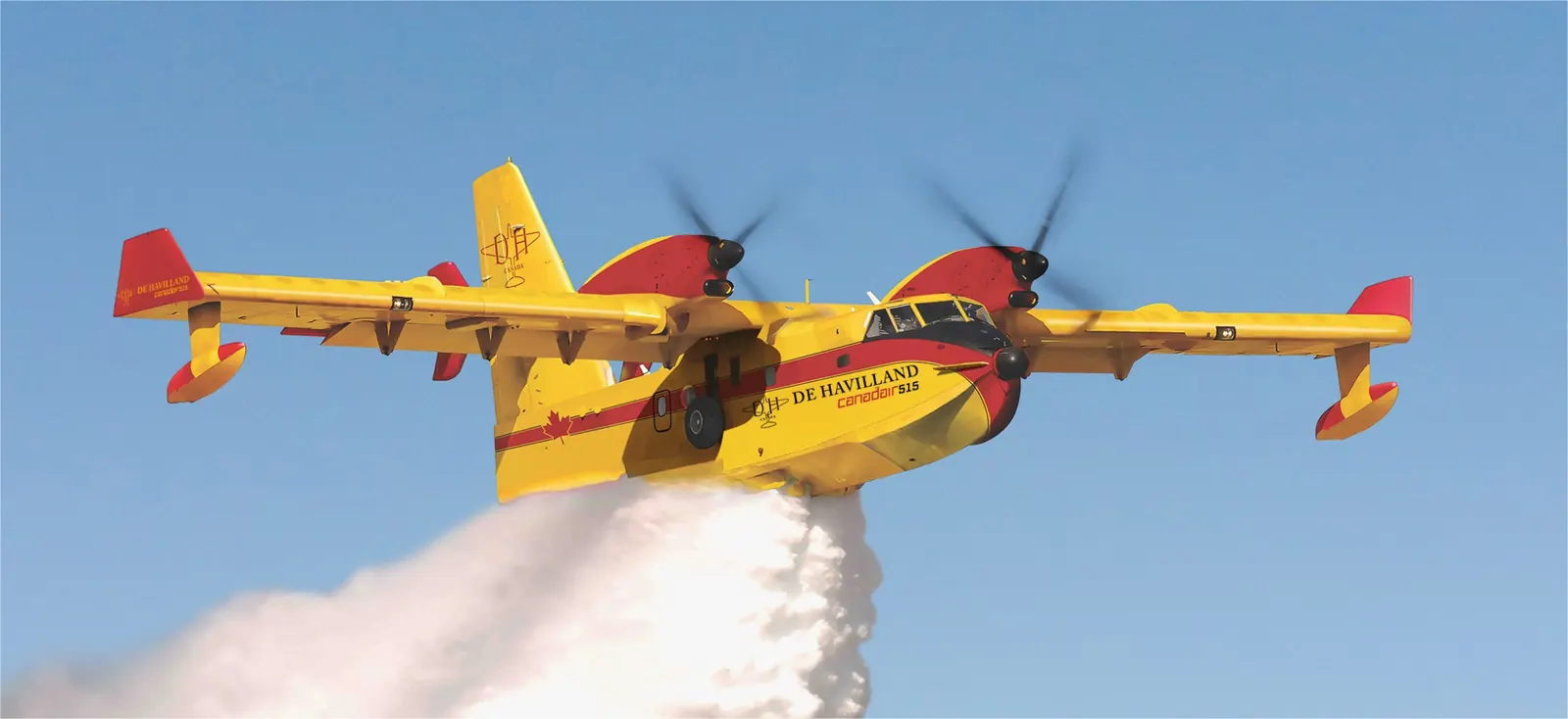
Could Alberta DHC-515 waterbombers finally give one of Canada’s most wildfire-prone provinces the aerial firepower it has long needed?
On February 17, 2026, Premier Danielle Smith stood before cameras at De Havilland Aircraft of Canada‘s Calgary offices. She announced a $400-million contract — what the province calls a major step forward in strengthening wildfire protection for Alberta communities.
Five next-generation De Havilland Canadair DHC-515 Firefighter aircraft will join the provincial fleet. They arrive from spring 2031 and promise a nearly 60 per cent surge in total drop capacity. For aerospace enthusiasts and anyone who has watched helplessly as a wildfire consumed another Canadian community, this announcement warrants a close look.
Understanding the 60 Per Cent Capacity Figure
Alberta’s government cites a nearly 60 per cent increase in total drop capacity. That figure deserves a closer look, because the baseline matters enormously.
The province does not calculate that number against its four owned CL-215s alone. Instead, it measures the increase against Alberta’s full operational airtanker fleet — which in 2025 included 18 contracted and provincially owned aircraft combined. Adding five DHC-515s to that larger baseline, each carrying approximately 15 per cent more water per drop than a CL-215, produces a figure in the range of 60 per cent. That is the correct way to read the statistic.
However, if you measure only the provincially owned aircraft, the picture looks very different. Four CL-215s carry roughly 5,346 litres each — approximately 21,384 litres in total. Five DHC-515s add 6,137 litres each — another 30,685 litres. Together, the nine provincially owned aircraft would carry over 52,000 litres per simultaneous drop. Against that owned-fleet baseline alone, the capacity increase exceeds 140 per cent.
Neither figure is wrong. They simply answer different questions. The 60 per cent reflects the operational reality of a mixed fleet that relies on contracted aircraft. The 140-plus per cent reflects the leap in provincial ownership capacity specifically. For readers trying to gauge how much stronger Alberta’s firefighting response will actually be, both numbers are worth keeping in mind.
Alberta DHC-515 Waterbombers: What Was Actually Announced
Alberta signed the contract with De Havilland Aircraft of Canada Limited. Specifically, it commits the province to purchasing five DHC-515 Firefighter amphibious aircraft at a combined cost of $400 million. Alberta Forestry and Parks Minister Todd Loewen joined Premier Smith at the announcement. Both framed the deal as a safety investment and an economic statement.
“Albertans expect their government to be ready when wildfire season hits, and that is exactly what we are doing. Our first responsibility is to keep Albertans safe. These Alberta-built waterbombers will strengthen our wildfire response, protect our communities and create hundreds of skilled jobs right here at home.” — Premier Danielle Smith, Province of Alberta, Red Deer Advocate
The $400 million comes from the provincial budget. Alberta already spends $160 million annually on wildfire response. It also maintains a contingency fund for costs that exceed that baseline. Separately, the federal government’s Budget 2025 earmarked $255 million for leasing additional water bombers to boost national capacity. That federal measure is complementary — not a substitute for provincial ownership (CP24, 2026).
Delivery Timeline: Alberta’s New Waterbombers Arrive from 2031
The first aircraft is expected by spring 2031. Additionally, the remaining four are delivered over the following two years. Alberta currently owns four De Havilland CL-215 waterbombers — all manufactured between 1986 and 1988. Those aircraft remain in service alongside the incoming DHC-515s. Furthermore, the province contracts airtankers seasonally. In 2025, Alberta had 18 airtankers ready to respond to wildfires. Four were Alberta-owned; the rest were contracted (Stettler Independent, 2026).
Adding five DHC-515s to four CL-215s represents a fundamental shift in provincial capability. Officials describe the result as a nearly 60 per cent increase in total drop capacity. That means more water per sortie, faster cycle times between the fire and the nearest lake, and more resilience across Alberta’s 13 airtanker bases. Moreover, Alberta’s government calls the purchase forward planning — not a crisis response.
“Investing in these waterbombers is an investment in the safety of all Albertans. These planes are critical for battling wildfire, and protecting our communities, economy and natural resources.” — Minister Todd Loewen, Alberta Forestry and Parks, Todayville
Alberta DHC-515 waterbombers: Why the Announcement Happened in Calgary
The choice of De Havilland’s Calgary office was deliberate. De Havilland shifted its headquarters from the Toronto area to Alberta in 2022. That followed the closure of the Downsview plant, which had assembled Dash 8-400 turboprops for Bombardier. The relocation brought De Havilland’s operations closer to its Calgary manufacturing base. It also aligned the company with plans for a new aerospace campus in Wheatland County. Of all the places to announce five new aircraft bound for Calgary production lines, De Havilland’s Calgary office was, fittingly, the most logical — no aircraft required.
Inside the DHC-515 Firefighter: Power, Performance, and Precision
The Alberta DHC-515 waterbombers ordered by the province belong to an aircraft lineage stretching back more than half a century. Canadair launched the piston-powered CL-215 in 1966 — a purpose-built amphibious water bomber that helped define modern aerial firefighting. Bombardier later acquired the programme. Subsequently, it produced the turboprop-powered CL-415 until 2015. Viking Air purchased the type certificate in 2016 and later merged with De Havilland Canada. Together, they relaunched a modernised version. Specifically, the aircraft received the official DHC-515 designation in March 2022 (FlightGlobal, 2024). Production moved entirely to Calgary.
Compared to Alberta’s four-decade-old CL-215s, the DHC-515 Firefighter is a generational leap. The aircraft flies at up to 330 kilometres per hour — roughly 15 per cent faster than the CL-215. Shorter cycle times between the fire front and the nearest lake follow directly. Consequently, that speed advantage is critical when a crown fire is moving fast.
DHC-515 Firefighter: Power, Water Capacity, and Scooping Performance
Twin Pratt & Whitney Canada PW123AF turboprop engines power the DHC-515 Firefighter. Specifically, each engine delivers up to 2,380 horsepower. Together, they enable the aircraft’s defining capability: filling its entire tank in just 12 seconds. That scoop happens at 70 knots across the water surface. It works in waves up to two metres high. Pilots call the manoeuvre “skimming.” Each pass covers a 410-metre run.
Each DHC-515 carries up to 6,137 litres of water per drop — approximately 15 per cent more than the province’s CL-215s. Overall design capacity reaches 7,000 litres, depending on the operational configuration. For reference, the CL-415 — the generation between the CL-215 and DHC-515 — carried 6,000 litres. De Havilland states the DHC-515 can deliver up to 690,000 litres per day at peak continuous cycling (Skies Magazine, 2026).
Low-altitude performance is equally significant. The aircraft operates as low as 100 metres above an active fire. Its high-lift wing and large control surfaces give pilots precise authority at those margins. Furthermore, De Havilland notes that turboprop engines produce up to 50 per cent lower carbon dioxide emissions compared to jet-engine equivalents — a meaningful efficiency gain over older-generation aerial firefighting platforms.
Avionics: From Collins Aerospace to Universal InSight
Early programme plans specified Collins Aerospace’s Pro Line Fusion avionics suite. However, De Havilland ultimately chose a different path. Integration challenges with the Collins system proved difficult to resolve. Designed for large commercial jets, it was simply too complex for the DHC-515 platform.
“We were looking at Collins… and we just couldn’t find a way to make it work. The Collins suite is a very good suite, but probably too robust for the aircraft.” — Neil Sweeney, VP Corporate Affairs, De Havilland Canada, FlightGlobal
De Havilland selected Universal Avionics’ InSight glass cockpit instead. Sweeney described the outcome simply: “Universal is a little bit more flexible… and the integration has been easier.” — Neil Sweeney, VP Corporate Affairs, De Havilland Canada, FlightGlobal
The InSight cockpit uses touchscreen displays throughout. It includes synthetic vision, advanced weather awareness, terrain avoidance, and traffic alerts. Notably, its modular architecture integrated more cleanly with existing DHC-515 systems. The result is a genuinely modern flight deck — inside an airframe that, from the outside, still clearly echoes its 1960s ancestor. A classic Canadian story of evolutionary engineering.
DHC-515 Firefighter Multi-Mission Potential
De Havilland currently focuses production exclusively on the firefighting variant. Even so, the DHC-515 Firefighter airframe supports several other configurations. Options include a spray boom for insect control or oil-spill response. A cargo and disaster-relief interior is also available. A medevac layout carries up to three stretchers. A maritime patrol and search and rescue (SAR) sensor suite rounds out the options. Alberta’s immediate requirement is aerial firefighting. However, that multi-mission flexibility adds long-term operational value that no single-role aircraft can offer.
Alberta DHC-515 Waterbombers and the Wildfire Crisis Driving the Purchase
No procurement of this scale happens without context. Alberta DHC-515 waterbombers are a direct response to a wildfire threat that has grown measurably worse over the past decade. The statistics, for once, do not require any spin.
The 2016 Horse River wildfire at Fort McMurray remains Canada’s costliest insured natural disaster, with insured losses estimated at about $4.5 billion. The fires forced 88,000 people to evacuate. Barely eight years later, the July 2024 Jasper wildfire eclipsed almost every comparable precedent. The fires started north and south of Jasper on July 19, 2024. By July 22, authorities had evacuated some 25,000 residents, workers, and visitors. Parks Canada declared the fire extinguished on April 1, 2025. By then, it had consumed 32,722 hectares. It also destroyed 358 of Jasper’s 1,113 structures — roughly one-third of the entire townsite. Insured damages were later estimated at roughly $1.3 billion, making it the second-costliest fire event in Canadian history. (Wikipedia, 2024 Jasper wildfire).
Alberta Wildfire Aircraft Fleet: A Pattern, Not an Anomaly
“Increasingly, we are seeing [fire] season become more volatile here in Alberta and across Canada.” — Premier Danielle Smith, FlightGlobal
Alberta’s 2023 wildfire season was the worst on provincial record. Nearly 1,090 fires burned more than 2.2 million hectares. Nationally, 2023 was the most destructive wildfire year in Canadian recorded history. The 2024 season burned 775,000 hectares across Alberta. Fewer overall, but the Jasper disaster and renewed threats near Fort McMurray confirmed a hard truth. Extreme fire behaviour is no longer exceptional. It is the new baseline.
Researchers point to warmer temperatures and earlier spring thaws. Prolonged droughts and accumulated dry fuel in boreal forests compound the risk. Alberta’s 13 airtanker bases form the province’s first aerial line of defence. Furthermore, that fleet has been stretched thin for years. Consequently, the case for expanding the Alberta wildfire aircraft fleet has been building well before the 2026 announcement.
What a 60 Per Cent Capacity Boost Actually Means
Translated into operations, a 60 per cent drop capacity increase is substantial. Alberta can deliver far more water to active fires on any peak demand day. The DHC-515’s faster speed shortens turnaround between the water source and the fire front. Consequently, the same number of pilots completes more cycles per shift. Additionally, the aircraft operates effectively in two-metre waves. That expands the range of usable water sources across Alberta’s boreal lakes. Volume, tempo, and geographic reach all improve together.
Federal Emergency Preparedness Minister Olszewski acknowledged the federal leasing programme as supplementary. “What we’ll be able to do is add extra capacity. If provinces are short in terms of aerial wildfire fighting ability, they’ll be able to use those leased assets.” — Minister Olszewski, CP24, 2026
Alberta chose ownership over reliance on federal leasing. Owning aircraft means the province controls maintenance cycles, crew training, and deployment decisions. Indeed, those advantages are critical when a provincial fire emergency competes with national resource-sharing priorities.
De Havilland Field: Building the Factory to Build Alberta’s Waterbombers
Alberta DHC-515 waterbombers will eventually be manufactured at De Havilland Field. At the time of writing, that campus remains under active development. Specifically, the 1,500-acre site sits in Wheatland County, approximately 30 kilometres east of Calgary. De Havilland announced the location on September 21, 2022. The planned campus includes a dedicated runway and state-of-the-art assembly buildings. Parts manufacturing, distribution, and a maintenance, repair and overhaul (MRO) facility are also planned. Educational facilities and a De Havilland Canada aircraft museum round out the vision. De Havilland Field — like all great ambitions — is being built methodically in stages; notably, the aircraft have been ordered before the factory that will build them is complete.
Construction has advanced in stages. Ground preparation began in autumn 2025, once the surrounding canola harvest concluded. Neil Sweeney, De Havilland’s vice-president of corporate affairs, confirmed in September 2025 that full construction would begin in spring 2026. Subsequently, De Havilland expects the first buildings to open in spring 2028 (Wings Magazine, 2025). By 2030, De Havilland aims to have parts distribution, parts manufacturing, and final assembly all operating on the campus.
Current Production: Alberta’s DHC-515 Waterbombers in the Pipeline
In the meantime, DHC-515 production continues at De Havilland’s existing Calgary facility. Three aircraft are currently in production. The first is destined for Greece and is the most advanced. Two additional airframes are in early stages for France. De Havilland manufactures airframes, wings, cockpits, and aero-structures in house. Additionally, the company recently acquired Fleet Canada Inc. of Fort Erie, Ontario, adding metal-to-metal bonding and advanced composites capability to its supply chain (Wings Magazine, 2025).
“Getting the supply chain back into fighting shape was the first job. The team worked really hard to reassemble the supply chain. We are in really good shape. The first [DHC-515] is actually in assembly right now in Calgary.” — Neil Sweeney, VP Corporate Affairs, De Havilland Canada, FlightGlobal
De Havilland aims to roll out its first DHC-515 in late 2027 or early 2028. That puts the type in service for the 2028 fire season. Alberta’s aircraft arrive from spring 2031. That gap gives De Havilland time to work through early-production learning curves. Other customers’ aircraft reach the floor first. Alberta’s order accordingly benefits from that experience.
De Havilland Field Production Rate Ambitions
De Havilland targets between nine and twelve aircraft per year at full production maturity. Reaching that rate requires the complete De Havilland Field campus to be operational. Phase 1 construction is expected to create between 500 and 750 jobs per year during the build period (Alberta Major Projects, 2025). Once fully operational, the campus is projected to sustain 1,500 permanent positions. Those numbers explain why the Wheatland County timeline is so closely watched by Canada’s aerospace community. “We really are looking at De Havilland Field being our home for the next hundred years,” Sweeney told Wings Magazine. — Neil Sweeney, VP Corporate Affairs, De Havilland Canada, Wings Magazine
Alberta DHC-515 Waterbombers in Global Context: A Crowded Order Book
Alberta’s purchase does not arrive in isolation. Before February 17, 2026, De Havilland already held firm orders for roughly 20 DHC-515s. Its customer list spans three continents — and the DHC-515 order book now reads like a wildfire atlas of the northern hemisphere, with ink barely dry on several recent agreements.
Greece signed a contract worth approximately 360 million euros for seven DHC-515s on March 25, 2024. The deal was announced jointly by Greek Prime Minister Kyriakos Mitsotakis and Canadian Prime Minister Justin Trudeau. Two of those aircraft are European Union (EU)-financed. Croatia simultaneously contracted for two aircraft, fully EU-funded at approximately 105 million euros. France has two early-production airframes in progress. Indonesia was the programme’s original customer, signing for six aircraft in June 2019. Spain and additional EU member states have also committed to the type. All fall within the rescEU collective civil protection reserve programme. That initiative targets 24 DHC-515s in total, with 12 EU-financed for pooled European deployment.
Manitoba’s Canadian Waterbombers Precedent
Closer to home, Manitoba committed to three DHC-515 waterbombers in April 2025. Manitoba is a long-standing operator of CL-215 and CL-415 aircraft. Notably, its purchase established that Canadian provinces — not just European governments — would buy the new generation. Alberta’s five-aircraft order now confirms that provincial pattern at a larger scale.
“We are proud to be working with the Province of Manitoba, a long-term operator of CL-215 and CL-415 aerial firefighting aircraft, for the renewal of its fleet. The De Havilland Canadair 515 represents the future of wildfire suppression.” — Jean-Philippe Côté, VP Programs, De Havilland Canada, Wings Magazine
With Alberta’s five aircraft added, De Havilland’s total committed DHC-515 order book now exceeds 25 aircraft. That represents several years of work at the projected production rate. Furthermore, it provides the revenue visibility needed to justify the capital investment in De Havilland Field.
Quebec: Capable Fleet, Ageing Aircraft, and a Missing Order
Quebec coordinates one of Canada’s largest provincial aerial firefighting operations. The Société de protection des forêts contre le feu (SOPFEU) manages a fleet of 14 fixed-wing water bombers — eight CL‑415s, four CL‑215s and two CL‑215Ts — protecting more than 52 million hectares of boreal forest. SOPFEU deploys internationally.
In January 2025, Quebec sent two CL-415s and a team of 25 pilots and 20 technicians to assist with the catastrophic Los Angeles wildfires. One of those aircraft sustained wing damage after a mid-air collision with an illegally operated drone over the Palisades fire. That international deployment speaks to real capability and operational credibility.
However, the fleet’s age tells a different story. Quebec’s CL-415s were built between 1995 and 1996 — making them nearly 30 years old. Its CL-215s are older still. CBC News reported in August 2023 that Quebec operated CL-215s built as far back as 1970 — aircraft more than 53 years old at the time of writing. SOPFEU itself acknowledged the challenge of modernising that ageing CL-215 fleet ahead of the 2024 fire season, supported by a provincial commitment of $29 million over five years for operational enhancements (Working Forest, 2024). Notably, $29 million over five years for a province of Quebec’s size and forest coverage is a modest sum — roughly the cost of half a single DHC-515.
Quebec is not buying the DHC-515
Meanwhile, Quebec does not appear among confirmed DHC-515 buyers. That absence is not proof of indifference. Procurement decisions involve budgets, political timelines, and institutional inertia. Nevertheless, the absence is worth noting — particularly given that Quebec’s government has publicly framed stronger wildfire response as a priority, both for the protection of its vast timber resources and for reducing the smoke pollution that increasingly affects urban populations downwind.
Consequently, a fair question emerges. Quebec talks about stronger wildfire protection with genuine authority — SOPFEU is a world-class operation and its international deployments prove it. Yet the province has not committed to replacing aircraft that in some cases predate the microwave oven. The better question is not whether Quebec cares. It is whether Quebec’s renewal timeline is compatible with its fleet’s age, its fire risk, and its stated environmental commitments. When a government says it takes forest fires seriously, the aircraft budget is where that claim either holds — or does not.
Type Certification and DHC-515 Firefighter Delivery Milestones
Transport Canada is expected to certify the DHC-515 Firefighter in time for Greece’s first delivery in 2028. Specifically, De Havilland rebooted an entire production system dormant since 2015. De Havilland rebuilt supply chain relationships across Canada and internationally. Indeed, many suppliers had moved on to other programmes during the nearly decade-long gap. Nevertheless, first-aircraft assembly is underway in Calgary and a 2027–2028 roll-out remains on track. By aerospace programme standards, that recovery pace is creditable.
Alberta DHC-515 Waterbombers as an Economic Catalyst
Alberta’s government has been explicit: this contract is an economic investment as much as a firefighting one. The deal is projected to create and sustain approximately 1,000 jobs. Those positions span engineering, skilled manufacturing, supply chain, and MRO. They represent exactly the high-wage, technical employment that Alberta’s diversification strategy seeks beyond oil and gas. Moreover, with Alberta DHC-515 waterbombers built in Wheatland County and deployed across the province, the entire economic loop stays within Alberta.
De Havilland chief executive Brian Chafe framed the contract in terms of both commercial scale and national symbolism. “It’s a big deal when you get an order this size. But also it says a lot, where you set up a large part of your business in a province, and that province backs you with an order like this — not only to Albertans, but to Canadians and people around the world.” — Brian Chafe, CEO, De Havilland Canada, Skies Magazine
Chafe also noted De Havilland’s supply chain credentials. “Our owners were pro-Canadian before it was cool to be pro-Canadian. Today, we have over 80 percent of our airplanes either made by us or sourced by Canadian companies — unheard of in this kind of sector, in aerospace.” — Brian Chafe, CEO, De Havilland Canada, Skies Magazine
SAIT and the Alberta Wildfire Aircraft Fleet Workforce Pipeline
The Southern Alberta Institute of Technology (SAIT) responded quickly to the February 17 announcement. It called the deal “exciting news for Alberta’s aviation industry and job creation in the field.” SAIT also reported that enrolment in its aviation programmes has nearly doubled training capacity in recent years. That growth reflects rising demand for skilled trades and aircraft technicians. Building aircraft requires people. People require programmes. Programmes require sustained investment — and SAIT has apparently grasped that supply chain logic before the canola was even off the field at Wheatland County.
Sweeney noted De Havilland’s intention to recruit directly from institutions like SAIT. “We will be looking to hire students straight out of their post-secondary education,” he told Wings Magazine, “to occupy the campus and support our team once the campus is operational.” — Neil Sweeney, VP Corporate Affairs, De Havilland Canada, Wings Magazine
Alberta as a Growing Aerospace Hub
Jobs, Economy and Trade Minister Joseph Schow linked the DHC-515 deal directly to provincial strategy at the February 17 announcement. Moving De Havilland’s headquarters to Alberta and developing De Havilland Field are sequential steps in a deliberate plan. The goal is to position the province as a serious aerospace manufacturing hub. This complements Calgary’s existing base of MRO, avionics, and related services.
Taken together, the DHC-515 programme, De Havilland Field, and the SAIT workforce pipeline represent a major aerospace investment for Alberta. Furthermore, committing $400 million as an anchor customer — rather than relying on export sales alone — signals genuine confidence in the programme’s future. Anchor customers matter in aerospace. They de-risk programmes and accelerate production ramp-up. They also give manufacturers the credibility needed to close additional deals internationally.
Alberta DHC-515 Waterbombers: The Broader Wildfire-Aviation Nexus
Alberta’s procurement sits within a fast-evolving global market for aerial firefighting assets. The worldwide in-service fleet of CL-series water bombers stands at approximately 150 aircraft across 11 countries. Of those, 33 are the older CL-215 and 117 are CL-415s. Many are ageing. Alberta’s own CL-215s are nearly 40 years old. Replacement demand alone will drive DHC-515 orders for years to come — quite apart from any new capacity requirements driven by worsening fire seasons.
European demand is particularly intense. The rescEU civil protection reserve was launched partly in response to devastating fire seasons in Greece, Portugal, and Croatia. Its planned 24-aircraft DHC-515 block is a major coordinated procurement under the rescEU program. Importantly, EU involvement validates De Havilland’s production restart. Political buyers in Brussels do not commit hundreds of millions of euros without confidence in a manufacturer’s long-term viability.
The North American Gap in Amphibious Firefighting Aircraft
In North America, the contrast with the United States is instructive. The US aerial firefighting fleet relies heavily on converted fixed-wing airtankers and helicopters. True amphibious scooping aircraft like the DHC-515 are relatively rare in the American inventory. Western US terrain often lacks sufficient scoopable water bodies. Canada’s boreal regions, by contrast, are studded with lakes — and that lake-studded boreal geography, so often described as a logistical challenge, turns out to be one of the country’s most underrated aerial firefighting assets.
That geographic advantage is also a strategic export one. Canada’s expertise in amphibious aerial firefighting — embodied in the CL-215, CL-415, and DHC-515 lineage — is a proven global asset. Moreover, every new operator that takes delivery of a DHC-515 adds to an international operational data set. That data improves performance and informs future aircraft development. Additionally, Alberta’s purchase adds credibility that European and Asian buyers notice.
For more background on Canadian aerospace procurement and the case for building at home, see our earlier coverage of Canada’s build-it-here aerospace debate and our latest analysis on Canada’s Gripen deal and the 85% odds of a GlobalEye agreement.
What Alberta’s Existing Fleet Tells Us About Alberta DHC-515 Waterbombers
Alberta’s four CL-215s remain airworthy and will continue flying alongside the incoming DHC-515s. Their age, however, underscores why this purchase was overdue. Airframe life extension programmes carry cost and risk. Avionics retrofits can only go so far. The CL-215 was designed before GPS, digital flight management systems, and the fire behaviour modelling tools that modern aerial attack supervisors rely on. The DHC-515 Firefighter’s Universal Avionics InSight cockpit integrates those tools natively. Consequently, the new amphibious firefighting aircraft is faster, safer, better-informed, and more effective — not merely larger.
Alberta DHC-515 Waterbombers: What Remains Unclear
The announcement was compelling. However, several important questions remain open — and they are worth asking before the contract ink is fully dry. Five years is a long time in wildfire suppression, as anyone who lived through Jasper’s summer of 2024 can confirm.
Training, Basing, and Crew Capacity for Alberta Waterbombers
Five new aircraft require five new crews, at minimum. Amphibious waterbomber operations rank among the most specialised disciplines in civil aviation. Scooping a lake at 70 knots — in turbulent, fire-heated air, at 100 metres above terrain, with degraded visibility — demands exceptional skill. That skill does not transfer easily from conventional airtanker operations. Notably, Alberta has not yet detailed crew recruitment or training timelines. It has also not specified which of its 13 bases will receive the new aircraft. Those decisions will significantly shape how the capacity boost is realised in practice. In wildfire suppression, a waterbomber in the wrong region adds response time — not capability.
The Five-Year Wait
The spring 2031 delivery date is five full wildfire seasons away. Meanwhile, Alberta faces those seasons with its current fleet and contracted capacity. The provincial contingency fund and the federal leasing programme provide some buffer. Nevertheless, a major fire event in 2027 or 2028 would test that buffer hard. The five-year lead time is not unreasonable for a new-production type still in certification. It is simply a reality the province must plan around carefully.
Programme Risk: DHC-515 Firefighter Supply Chain and Certification
De Havilland is rebooting a supply chain that was dormant for nearly a decade. Notably, supplier and quality issues from the COVID-19 pandemic continue to affect aerospace programmes globally. Sweeney has stated the supply chain is in “really good shape.” Current production progress supports that assessment. Nevertheless, programmes of this complexity regularly encounter certification delays or supplier bottlenecks. Alberta’s government would be prudent to ensure contractual provisions address delivery delays and performance guarantees. That is standard practice in government aircraft procurement — and worth stating explicitly.
Conclusion: A Bold Commitment With Questions Still to Answer
Alberta’s $400-million commitment to Alberta DHC-515 waterbombers is a serious and overdue investment in provincial wildfire preparedness. The scale of recent disasters — Fort McMurray’s $3.64-billion insured loss in 2016, Jasper’s $1.23 billion in 2024 — makes the case almost self-evidently. Indeed, the DHC-515 Firefighter is the right aircraft for the mission. It is purpose-built, technologically current, and will be manufactured on Alberta soil.
The dual rationale — more wildfire capacity and more aerospace jobs — is also legitimate. De Havilland Field, when operational, will anchor a manufacturing ecosystem the province has deliberately cultivated. Alberta DHC-515 waterbombers, built in Wheatland County and protecting Alberta communities: that is a coherent industrial policy story as much as a firefighting one. Additionally, the anchor-customer dynamic strengthens De Havilland’s position internationally — a benefit that extends well beyond Alberta’s borders.
Even so, the deal raises questions neither the government nor De Havilland has fully answered. The five-year delivery window leaves the province exposed during wildfire seasons that show no sign of moderating. The government has not yet announced the crew training and basing strategy. Production restart risks remain real, however well-managed. Procurement without a complete operational readiness plan is an expensive half-measure.
Canada’s wildfire seasons are no longer anomalies. They are annual crises to be anticipated, resourced, and fought with the best tools available. Alberta has made a substantial down payment on that future. The harder question — and the one that will determine whether this $400 million delivers what Albertans deserve — is whether the aircraft, the crews, the bases, and the broader national response architecture will all be ready when the next Jasper-scale fire ignites. Will this investment arrive in time, and will it come with the full operational ecosystem it needs to matter?
Leave your answers and comments below and on our Fliegerfaust Facebook page.
Alberta DHC-515 waterbombers – Sources
- Global News — Alberta government announces purchase of new waterbombers to fight wildfires (February 17, 2026).
- FlightGlobal — Alberta orders five De Havilland DHC-515 water bombers in C$400m deal (February 17, 2026). Subscription may be required.
- FlightGlobal — De Havilland now producing first DHC-515 with 2028 in-service goal (September 19, 2024). Subscription may be required.
- Skies Magazine — De Havilland Canada to build 5 new CL-515 water bombers for Alberta government (February 17, 2026).
- CP24 — Alberta spending $400M for new water bombers amid growing wildfire risk, demand for aircraft (February 18, 2026).
- Red Deer Advocate — Province set to purchase five Alberta-built waterbombers to fight wildfires (February 17, 2026).
- Stettler Independent — Province set to purchase five Alberta-built waterbombers to fight wildfires (February 17, 2026).
- Todayville — New Waterbombers for Provincial Fleet will be built in Alberta — New De Havilland Canada facility in Wheatland County (February 17, 2026).
- Wings Magazine — De Havilland preparing to begin aerospace campus construction this fall (September 2025).
- Wings Magazine — Manitoba confirms intent to purchase De Havilland Canadair 515 waterbombers (June 16, 2025).
- Alberta Major Projects — De Havilland Field Aircraft Manufacturing and Operations Centre (2025).
- De Havilland Aircraft of Canada — De Havilland Canada corporate site.
- Wikipedia — Canadair CL-415 (programme history reference).
- Wikipedia — 2024 Jasper wildfire (fire statistics reference).
- rescEU — rescEU civil protection reserve programme (European Commission).
- Pratt & Whitney Canada — PW123AF engine programme.
- Southern Alberta Institute of Technology — SAIT aviation programmes.
- CBC News — Is Canada ready for a fiery future? We tallied up all of its water bomber planes to find out (August 29, 2023).
- Working Forest — Quebec and SOPFEU Prep for Daunting 2024 Fire Season (April 16, 2024).
For full details, please refer to our Disclaimer page.
Thank you for the excellent, detailed and highly readable reports on these crucial issues for Canada. MSM reports tend to be superficial and lacking in deep research in a highly technical field, often leaving to the public confused and supporting incorrect government and corporate policies.
Thank you! Very appreciated.