

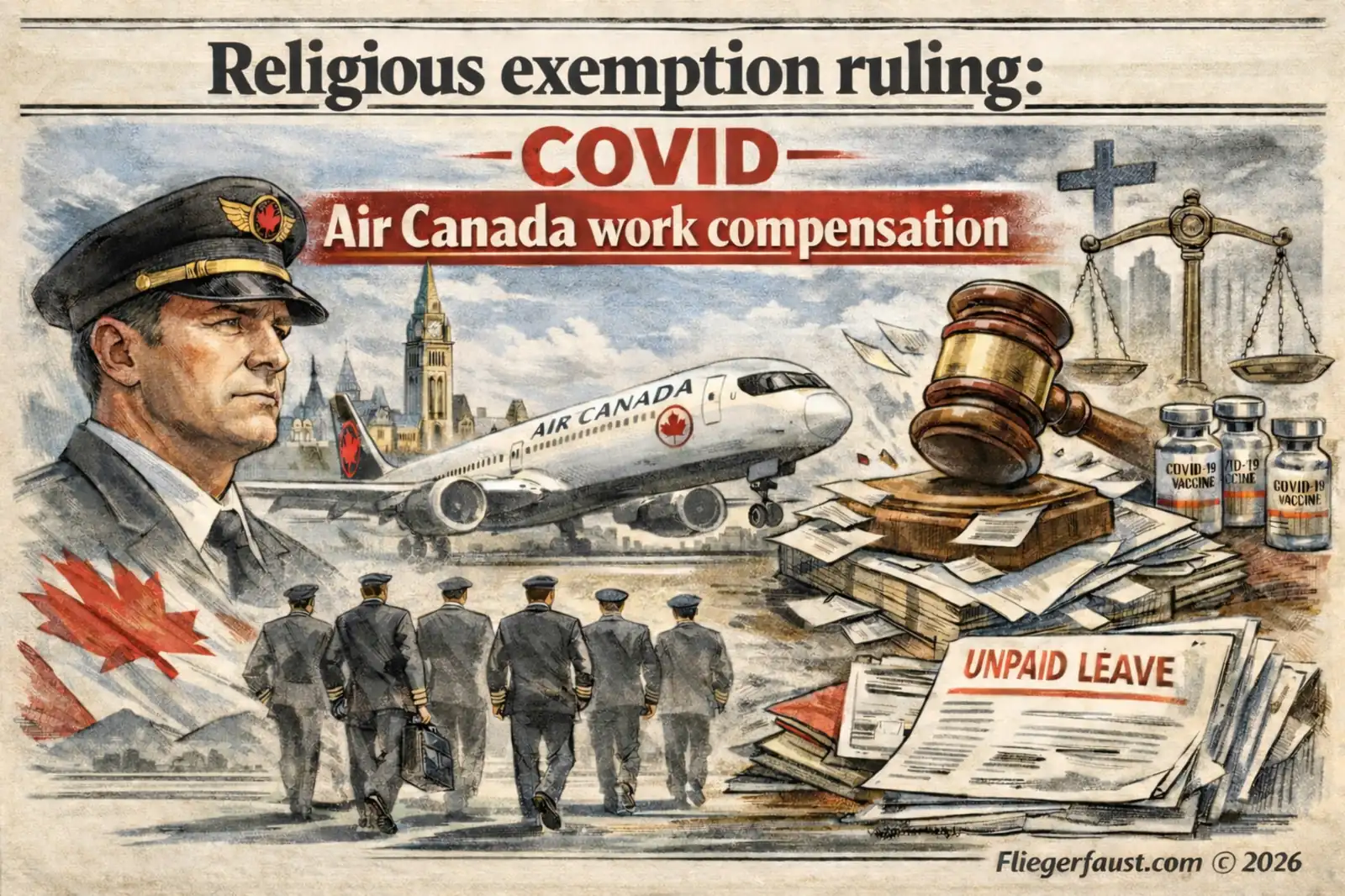
Religious exemption ruling: what does the March 3, 2026 pilot compensation ruling really change for Canadian aviation labour?
Religious exemption ruling: However, the answer is more precise than the first wave of headlines suggested. According to HRD Canada’s March 6, 2026 report, the case centred on seven Air Canada pilots whose religious accommodation requests were denied. Subsequently, those pilots went on unpaid leave on October 31, 2021. Later, their exemptions were granted on May 9, 2022.
Moreover, Juno News reported the ruling on March 6, 2026 as compensation for pilots fired for refusing the coronavirus disease 2019 (COVID-19) shot. Yet the wider record points to a narrower, and legally sharper, issue. Instead, the dispute turned on religious accommodation, comparative treatment, and lost income under the Canadian Human Rights Act (CHRA). That distinction matters because the case now sits at the centre of a larger Canadian aviation labour story. Overall, the religious exemption ruling reaches beyond one grievance file.
Religious exemption ruling moves from headline to legal record
Pilot exemption ruling after the March 3, 2026 award
According to the public reporting now available, arbitrator James Hayes found that Air Canada mishandled seven grievances tied to religious exemption requests. Notably, the published accounts say the pilots described themselves as committed Christians. Moreover, they linked their objections to Scripture, conscience, fetal cell lines in vaccine development, and the belief that the body is a temple of the Holy Spirit.
However, the most consequential detail was procedural. Specifically, Air Canada required workers seeking a religious exemption to supply a letter from a religious leader. Consequently, that requirement became one of the key legal faults in the case. In labour law, a checkbox can cause more turbulence than a missed slot time.
Notably, Hayes’ reasoning, as summarized by HRD Canada, was direct and damaging for the carrier. “Acceptance of an individual affirmation of religious belief is not dependent upon production of endorsement from someone else.” — James Hayes, arbitrator, via HRD Canada
Additionally, the same coverage says Hayes faulted Air Canada for denying the requests without first seeking clarification. Consequently, the religious exemption ruling is about process, not only policy. Instead, the company rejected them, placed the pilots on unpaid leave, and only later granted the exemptions. By then, the income loss had already accumulated.
Religious accommodation disputes and the unpaid leave gap
The case did not declare every pandemic-era rule unlawful. Nor did it erase the federal public-health context of late 2021. Instead, the record turned on how exemptions were assessed and how similarly situated workers were treated.
According to The Democracy Fund’s March 6, 2026 summary, the grievances alleged workplace religious discrimination under both the collective agreement and the CHRA. Moreover, that summary said the pilots were placed on unpaid leaves after their requests were denied. It also highlighted the same religious-leader letter requirement.
Meanwhile, the financial contrast is hard to ignore. Likewise, pilots who had obtained exemptions earlier were placed on paid leave while accommodation options were considered. The seven grievors were not. Consequently, the gap ran from October 31, 2021 until May 9, 2022, when Air Canada granted the exemptions.
Notably, Hayes’ credibility finding appears in more than one public account. “All of the grievors testified honestly and the substantive nexus between their religious beliefs and objections to the employer mandatory vaccination policy was manifest.” — James Hayes, arbitrator, via HRD Canada
Consequently, the reported remedy was compensation within 60 days, with the arbitrator remaining seized if the parties fought over the damages calculation. Even so, one important part of the case remained open in public reporting: the broader duty-to-accommodate issue could still continue on request.
What the pilot ruling did not decide
The March 2026 award also matters because of what it did not say. It did not say airlines lacked the right to respond to a serious public-health emergency. Nor did it say every unvaccinated employee had a winning claim. Still less did it say federal policy itself was unlawful.
Instead, the ruling appears to say something narrower and more operational. When an airline opens an accommodation channel, it must apply the right legal test. Moreover, it must distinguish sincerity from orthodoxy. Additionally, it must compare like cases with care. When it misses those basics, a broadly defensible policy can still fail at the point of execution.
That distinction is not academic. Airlines run on manuals, checklists, and repeatable process. Therefore, when a human-rights issue lands on a carrier’s desk, management tends to turn it into another process flow. Sometimes that works. Sometimes it produces a paper trail that reads well in an internal memo and badly in arbitration.
Overall, the first lesson from the ruling is simple. Emergency authority did not erase the duty to handle exemption requests lawfully. Moreover, the March 2026 ruling suggests that poor process, not only hard policy, generated the liability.
Religious exemption ruling sits inside Ottawa’s pandemic timetable
Air Canada COVID mandate followed federal deadlines
That history matters because Air Canada’s vaccination policy was never only an internal company policy. Instead, it sat inside a fast-moving federal timetable that began in August 2021 and hardened in October 2021.
On August 13, 2021, the Treasury Board of Canada Secretariat announced that employees in federally regulated air, rail, and marine transportation would be required to vaccinate no later than the end of October. Then, on October 6, 2021, the Prime Minister’s Office said those employers had until October 30, 2021 to establish vaccination policies.
Meanwhile, Air Canada had already acted. According to Emond Harnden’s summary of a Canada Industrial Relations Board (CIRB) decision, Air Canada announced its own mandatory policy on August 25, 2021. It required vaccination by October 31, 2021, subject to accommodation. Ottawa set the weather; airlines still chose the route.
In other words, the company policy cannot be understood as a free-standing corporate experiment. Consequently, later arbitrators and unions often treated Ottawa’s direction as a major part of the legal background. That did not guarantee employer victory. It did, however, explain why many policy-level challenges faced a steeper climb. Moreover, the religious exemption ruling cannot be detached from Ottawa’s deadlines.
Airline vaccine policy and Interim Order No. 43
Notably, the most overlooked detail in the public debate is that Ottawa’s aviation order itself contemplated exemptions. On October 29, 2021, the Minister of Transport issued Interim Order Respecting Certain Requirements for Civil Aviation Due to COVID-19, No. 43. The order required covered aviation entities to adopt vaccination policies. However, it also required procedures for medical contraindications and sincerely held religious beliefs.
Moreover, the order stated that an exemption for a medical contraindication required a medical certificate. Likewise, it said an exemption for sincerely held religious beliefs would depend on whether the entity had a duty to accommodate under the CHRA or other applicable legislation. Consequently, the federal framework did not imagine vaccination as the only possible path in every case. It imagined vaccination as the baseline and accommodation as a tightly defined exception.
That federal design matters for two reasons. First, it weakens any claim that airlines invented the whole policy environment on their own. Second, it strengthens scrutiny of how airlines handled exemption files once the law recognized they could exist. If the federal rulebook allowed limited relief, the next question was whether employers assessed that relief correctly. Therefore, the religious exemption ruling outlived the mandate that triggered it.
Air Canada COVID mandate ended, but the grievances did not
The policy then reversed. On June 14, 2022, Transport Canada announced that the requirement for domestic travellers and federally regulated transportation workers would be suspended as of June 20, 2022 at 00:01 Eastern Daylight Time. Similarly, Treasury Board said employees on administrative leave without pay for non-compliance would be contacted to arrange their return.
However, the grievances survived the policy. That is the key point. The suspension ended the live mandate. It did not erase lost wages, denied accommodations, or disputes over how airlines and unions had acted during the period when the rules were in force.
Therefore, the policy became something more than a COVID-era operational rule. It became a litigation archive. Additionally, it became a test of how federal direction, employer discretion, and human-rights law interact when time pressure is high and public anxiety is higher.
Religious exemption ruling split pilots, cabin crew, and unions into different legal lanes
Pilot exemption ruling after the failed IAMAW policy grievance
The dispute then fractured into several parallel disputes. One track asked whether the company’s policy was broadly reasonable. Another asked whether specific workers had been lawfully accommodated. Overall, those were not the same fight, and Canadian labour law treated them differently.
On August 30, 2021, the International Association of Machinists and Aerospace Workers (IAMAW) filed a national policy grievance challenging Air Canada’s vaccination policy. In a May 15, 2023 IAMAW bulletin, the union said arbitrator Vince Ready had dismissed that grievance after rendering his decision on May 11, 2023.
However, the same bulletin made clear that the matter did not end there. Instead, the union said it would review outstanding individual vaccine, medical accommodation, and religious accommodation grievances. Consequently, a union could lose the sweeping challenge and still press narrower cases tied to the way the policy was applied. Case law rarely taxis in a straight line.
That distinction became more important in 2025. In a September 5, 2025 IAMAW update, the union said an arbitrator had awarded human-rights damages to members who held valid exemptions but were not accommodated back into the workplace. Moreover, the same update said a final stage still remained for members whose exemption requests had been denied outright.
Consequently, the March 2026 pilot compensation ruling looks less like an isolated surprise and more like the next station on a longer grievance line. First came the failed policy grievance. Next came relief for members with valid exemptions who were not returned to work. Then came the March 2026 ruling for pilots whose religious requests had been denied at the start.
Cabin crew vaccination policy and the CUPE strategy
For cabin crew, Air Canada’s COVID policy produced a different legal route. The public record shows early union caution, legal consultation, and a deliberate choice to back individual grievances instead of launching a broad policy attack.
According to Emond Harnden’s summary of the CIRB decision, an Air Canada flight attendant argued that the Canadian Union of Public Employees (CUPE) Air Canada Component had breached its duty of fair representation by refusing to pursue a policy grievance in September 2021. The Board rejected the complaint. Moreover, it said unions retain wide discretion when they balance competing interests across a bargaining unit.
Notably, the Board’s account is rich in timeline detail. It says the union sought one legal opinion after Ottawa’s August 13, 2021 announcement. Then it sought a second opinion after Air Canada’s August 25, 2021 policy. Both opinions reportedly said a policy grievance was unlikely to succeed. Consequently, the union told members on September 3, 2021 that it would challenge discipline case by case rather than attack the policy itself.
Additionally, the Board said only about 10 per cent of the bargaining unit would bear the consequences of the policy, while a large majority supported vaccination and were fully vaccinated. That does not settle the moral debate. It does explain the union’s strategic calculus. A bargaining agent is not a mirror for every member. Sometimes it is a traffic controller for conflicting interests. Meanwhile, the religious exemption ruling sits beside a separate cabin-crew record.
Religious accommodation disputes for flight attendants did not stay theoretical
Even so, the cabin crew story did not stay confined to legal theory. In an Air Canada Component update on vaccination-status terminations, the union said there had been a company-wide decision to terminate members who were not vaccinated and had not received an exemption. Additionally, it said policy grievances had been filed for both Rouge and Mainline (Air Canada).
Separately, in a later Component Officers’ Update to the Membership, CUPE said some members had been removed from flying because of their vaccination status. It also said the union had moved those grievances from Level 1 to Level 2 and secured an April review date for mediation.
That matters because the policy did not affect only pilots. It also affected flight attendants’ flying status, earnings, and scheduling security. Moreover, it shows how fast a policy dispute can become an operational labour problem inside a cabin-crew bargaining unit.
When the federal rule changed in June 2022, the questions did not vanish overnight. In a CUPE Air Canada Component Q-and-A on the repeal, the union told members that unvaccinated Canadian crew operating inbound international flights remained exempt from most border requirements while acting in the course of duty. However, foreign crew still generally had to be fully vaccinated unless they fit a limited exception. Consequently, the rulebook became looser, not simpler.
Religious exemption ruling and the split record in Canadian airline case law
Religious accommodation disputes at WestJet show the implementation risk
The easiest way to misread the pandemic-era cases is to assume they all moved in one direction. They did not. Some rulings accepted airline policy logic. Others punished airlines for the way they handled accommodation requests. Consequently, the Canadian record is mixed in a way that matters for future crises.
A strong comparator came from WestJet. In HRD Canada’s May 16, 2025 report on Yee v WestJet, an Alberta court held that WestJet had wrongfully dismissed a long-serving employee after mishandling her religious exemption request.
Importantly, the court did not say a vaccination policy was always unreasonable. Instead, it said WestJet had applied its policy improperly in that case. The employee had worked from home after maternity leave. Nevertheless, WestJet denied the exemption, placed her on unpaid leave on November 1, 2021, and terminated her on December 1, 2021.
Justice A.P. Argento’s key passage tracks the same weakness now visible in the Air Canada pilots dispute. “The accommodation request form effectively prevented the plaintiff from relying on this sincerely held religious belief in support of an exemption once she also expressed a safety concern.” — Justice A.P. Argento, via HRD Canada
Moreover, the court said WestJet could have kept her working from home, as it had already done for months. She received 11 months of salary, totalling C$65,587.72 before taxes. For employers, the lesson was plain. A reasonable policy is not a blank cheque.
Airline vaccine policy still survived in other crew disputes
Still, not every accommodation grievance produced compensation. In HRD Canada’s May 23, 2023 report on a Swoop pilot grievance, an arbitrator held that unpaid leave was a reasonable accommodation for a pilot whose sincerely held religious beliefs prevented vaccination.
In that case, the airline accepted the religious exemption. The real dispute concerned the accommodation that followed. The pilot wanted to keep flying with testing or move into alternate work. However, the airline said those options still created unacceptable health and safety exposure under the operating conditions of the time.
Notably, the arbitrator criticized the process even while dismissing the grievance. “Accommodation is a ‘collaborative multi-party process involving the employee, the employer, and the union.’” — arbitrator summary, via HRD Canada
Yet the arbitrator still concluded that Swoop had met its substantive duty to accommodate. Consequently, unpaid leave survived scrutiny there, even though other airlines lost when their exemption analysis or comparative treatment failed. The message is not contradictory. It is conditional. Notably, the religious exemption ruling fits a Canadian pattern of split outcomes. Canadian tribunals often accepted strong pandemic justifications, but they still examined whether employers applied their rules carefully.
Religious exemption ruling now matters as aviation governance, not memory
Airline vaccine policy and the next emergency playbook
By March 2026, the direct health emergency that drove these rules has largely receded. The legal and managerial consequences have not. Collectively, the March 2026 pilot award, the 2025 IAMAW damages update, the WestJet wrongful dismissal ruling, and the Swoop pilot decision all ask the same question: when the next emergency hits aviation, who will remember that process is part of safety too?
Moreover, the answer does not rest with employers alone. Airlines must build accommodation systems that can survive legal review. Meanwhile, unions must decide when to challenge a rule broadly and when to defend members one file at a time. Arbitrators then decide whether the emergency justified the standard and whether the employer applied that standard with discipline.
That future relevance is why the March 2026 ruling still deserves attention in 2026. The next trigger may not be another virus. It could be a security credential, a biometric access rule, a public-health order, or a border-control directive that lands with similar speed. Therefore, the real precedent lies in the method, not only the medicine.
Additionally, the rulings suggest that a lawful emergency framework still needs three ordinary virtues: clarity, consistency, and comparison. Finally, the religious exemption ruling now serves as a playbook warning. If carriers skip any of those steps, they create avoidable legal exposure. Yesterday’s emergency memo has a habit of returning as tomorrow’s exhibit list.
Pilot exemption ruling and labour peace at a growing airline
This entire debate also sits inside a live commercial airline, not a law-school hypothetical. Air Canada is still expanding routes, renewing fleet plans, and managing labour relations across multiple groups. For broader company context, see our Fliegerfaust post on the A220 ramp-up and delivery picture, our Fliegerfaust analysis of the A220 160-seat configuration, and our Fliegerfaust A220 ramp and engine outlook.
Additionally, the pilot relationship itself has moved forward in other areas. In an October 10, 2024 ALPA release, Air Line Pilots Association (ALPA) pilots at Air Canada ratified a new four-year collective agreement with major pay gains and improved quality-of-life provisions.
However, contract progress does not erase earlier grievance history. It simply means the airline now carries both realities at once: a modernized bargaining relationship and a lingering archive of COVID-era disputes. Likewise, flight attendants remain engaged in post-pandemic labour conflicts over unpaid work, scheduling, and compensation. In aviation, labour peace is not a static badge. It is a performance figure.
Overall, that is why this story travels beyond March 2026. The Air Canada case is now part of a broader Canadian aerospace record on crisis governance. It shows where federal direction helped employers. It shows where employer process failed them. And it shows how unions split broad policy challenges from member-by-member relief.
Conclusion: Religious exemption ruling leaves a harder lesson
The hardest lesson from the ruling is not ideological. It is managerial. Canadian airlines had room to impose strict temporary rules during the worst phase of the pandemic. What they did not have was room to improvise human-rights analysis, to confuse sincerity with outside endorsement, or to treat comparable employees differently without a reason that could survive review.
Moreover, the March 2026 pilot ruling matters because it narrows the debate. It does not prove that every airline mandate was wrong. Nor does it prove that every refusal deserved protection. Instead, it shows that crisis management still requires lawful process, disciplined documentation, and careful comparison between cases.
Finally, airlines should read these rulings as a warning against lazy administration dressed up as safety policy. Governments may set the ceiling. Meanwhile, arbitrators still inspect the floor.
What do you think?
If the next emergency reaches aviation with the same speed as COVID-19, will carriers build faster rules, or better ones?
Leave your answers and comments below and on our Fliegerfaust Facebook page.
Sources
- Treasury Board of Canada Secretariat — Government of Canada to require vaccination of federal workforce and federally regulated transportation sector (August 13, 2021).
- Prime Minister of Canada — Prime Minister announces mandatory vaccination for the federal workforce and federally regulated transportation sectors (October 6, 2021).
- Transport Canada — Repealed – Interim Order Respecting Certain Requirements for Civil Aviation Due to COVID-19, No. 43 (October 29, 2021).
- Transport Canada — Suspension of the mandatory vaccination requirement for domestic travellers and federally regulated transportation workers (June 14, 2022).
- Treasury Board of Canada Secretariat — Suspension of the vaccine mandates for domestic travellers, transportation workers and federal employees (June 14, 2022).
- HRD Canada — Air Canada ordered to pay pilots after religious vaccine exemption denials (March 6, 2026).
- HR Law Canada — Air Canada ordered to compensate pilots denied religious exemptions from COVID-19 vaccine policy (March 5, 2026).
- Juno News — BREAKING: Air Canada ordered to compensate pilots fired for refusing Covid jab (March 6, 2026).
- The Democracy Fund — Arbitration victory for workers denied COVID-19 vaccine exemptions (March 6, 2026).
- Emond Harnden — Union refusing to pursue mandatory vaccination policy grievance did not violate duty of fair representation: CIRB (February 16, 2022).
- IAMAW Local 2323 — AIR CANADA NATIONAL VACCINE POLICY GRIEVANCE ARBITRATION AWARD (May 15, 2023).
- IAMAW Local 2323 — TO ALL IAM UNION MEMBERS AIR CANADA ARBITRATION VICTORY: VACCINE POLICY GRIEVANCE (September 5, 2025).
- AC Component — Update – Air Canada Decision Regarding Vaccination Status-Termination (2022).
- AC Component — Component Officers’ Update to the Membership (2022).
- AC Component — Repeal of the COVID-19 Vaccination Mandate (June 2022).
- HRD Canada — Terminated WestJet employee wins wrongful dismissal case against employer (May 16, 2025).
- HRD Canada — Unpaid leave of absence for unvaccinated pilot reasonable accommodation, says arbitrator (May 23, 2023).
- ALPA — Air Canada Pilots Vote to Ratify Collective Agreement (October 10, 2024).
For full details, please refer to our Disclaimer page.