

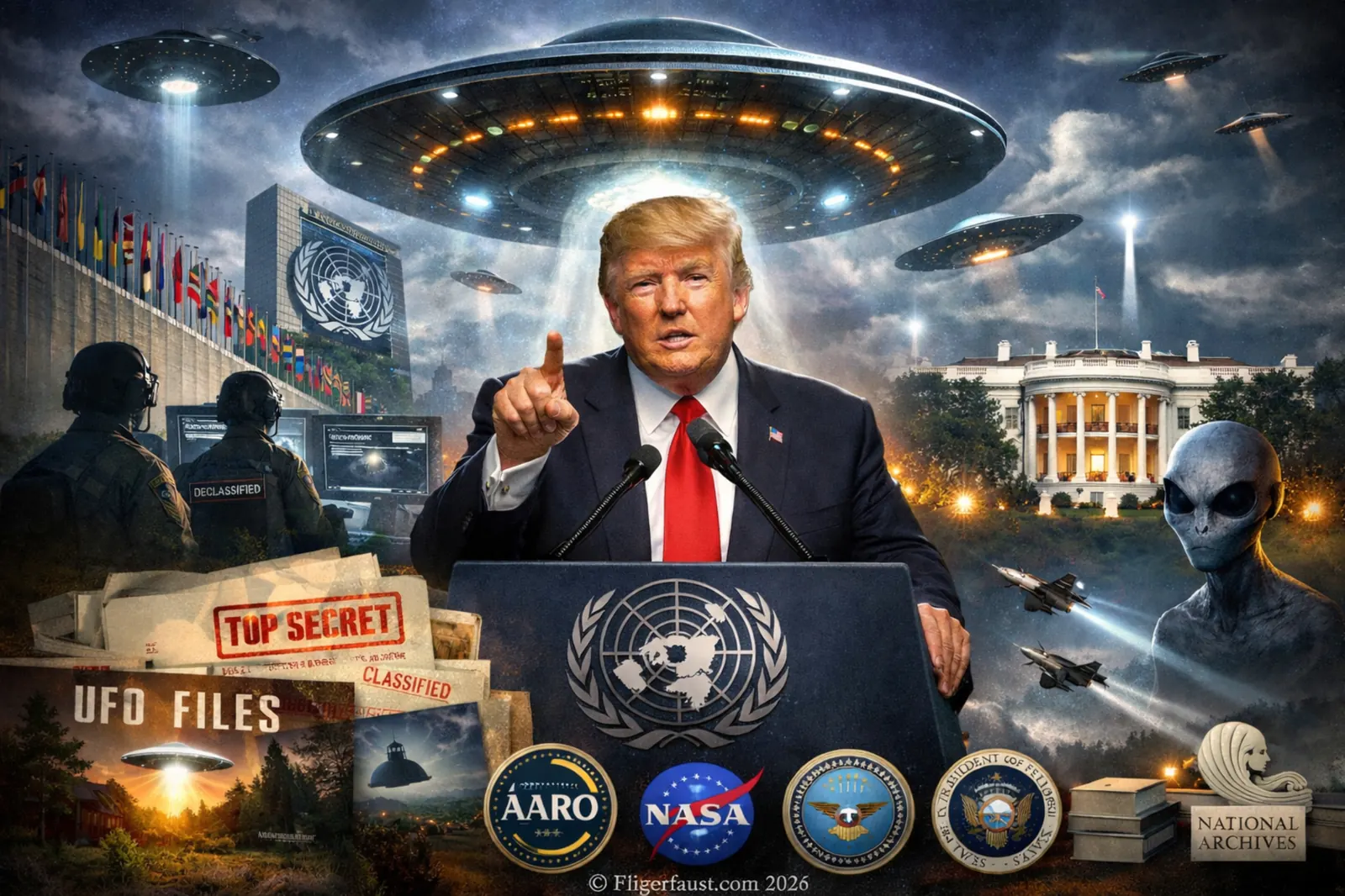
Trump UFO disclosure: Is President Donald Trump really preparing a “ready-to-go” speech that confirms alien life on July 8, 2026?
The practical question for aerospace readers is simpler. What evidence, if any, is moving through the systems that pilots, controllers, and defence analysts actually use?
Moreover, the rumour matters even if the “aliens” angle collapses. It is a live test of how UAP (Unidentified Anomalous Phenomena) narratives jump from fringe channels into mainstream conversation, often faster than facts can taxi to the runway.
Additionally, this report treats aviation safety as the baseline. In flight operations, the unknown is managed with procedures, not vibes.
Notably, the story is framed as a pre-announcement. The date being floated is July 8, 2026. That matters, because pre-announcements are where weak claims usually hide.
Therefore, the goal here is disciplined coverage. We map the sourcing chain, cross-check it against official reporting systems, and spell out what would count as confirmation.
And yes, we will keep our feet on the ground. The sky is busy enough already.
Trump UFO disclosure: what is being claimed
UFO disclosure speech: the claim in one paragraph
First, several outlets say a disclosure speech exists in draft form. The speech is described as “ready,” “historic,” and intended to confirm that humanity is not alone.
Meanwhile, Vision Times News reported on February 2, 2026 that Trump is “reportedly preparing” such a speech, based on reporting it attributes to a British tabloid.
Similarly, GB News published on February 2, 2026 that a bombshell speech is “ready to go,” and it attributes the claim to UK filmmaker Mark Christopher Lee.
Even so, no official document has been produced for public inspection. There is no verified draft, no White House statement, and no publicly authenticated schedule entry.
Consequently, the “speech” is currently a claim about a claim. That is a shaky foundation for any aerospace story.
Also, the narrative is built to be shareable. It has a famous name, a famous date, and a promise of history.
July 8 disclosure claim: why that date is doing heavy lifting
Next, the rumour often locks onto July 8, 2026. That date mirrors July 8, 1947, when the U.S. Army Air Forces issued the first press release that seeded the Roswell legend.
Notably, the Roswell story matters in UAP/UFO culture because it includes a public claim, a rapid walk-back, and decades of distrust.
Therefore, choosing that anniversary functions like a branding move. It implies continuity: “we told you once, we lied after, and now we return.”
However, branding is not validation. In engineering terms, a symbolic date is not a datapoint.
And if a disclosure prediction has to lean on symbolism, it is already leaning away from evidence.
Trump UAP speech: who is making the allegation
Meanwhile, the individual attached to the claim is Mark Christopher Lee, described as a filmmaker and musician. International Business Times UK reported on January 29, 2026 that Lee says Trump has already written a disclosure speech, allegedly timed to July 2026.
Additionally, Lee has promoted work connected to the Rendlesham Forest incident, sometimes called “Britain’s Roswell.” A press release distributed on October 31, 2025 describes The Rendlesham UFO: The British Roswell as streaming on Amazon Prime and Apple TV, and identifies Lee as a director.
However, being a documentary director is not the same as having access to national security decision-making.
Moreover, the sourcing is consistently described as an unnamed person close to the administration. That is a major limitation, because readers cannot evaluate motive or proximity.
In other words, the claim does not yet clear the first hurdle of credible sourcing.
Trump UFO disclosure: what is said to be inside the speech
Separately, the rumour’s contents vary. Some versions claim the speech will confirm extraterrestrial life, while others hint at recovered technology.
Moreover, a bolder version says Trump has been “given authority” by other leaders to make the announcement.
“has been given authority by the other major world leaders to make this announcement” — Mark Christopher Lee, filmmaker, quoted by GB News
However, extraordinary claims do not become operationally meaningful until they carry artefacts that other people can inspect.
Therefore, for aerospace readers, the “content” of the speech is less important than the evidence package behind it.
From tabloid to TikTok: how the claim travelled
Presidential UAP announcement: the viral pipeline
First, the rumour follows a familiar path. It begins in a tabloid ecosystem, migrates into social video, and then returns to news sites as a “story people are talking about.”
Meanwhile, each hop changes the framing. One outlet says “reportedly preparing,” another says “ready to go,” and reposts treat the date as if it were scheduled.
Consequently, repetition produces a false sense of confirmation. In aerospace terms, this is like mistaking multiple radio calls for multiple targets.
However, an actual presidential address normally leaves pre-traces. You would expect guidance to the press pool, a briefing calendar, and at least a measurable increase in official comms.
Therefore, the absence of those traces is itself a signal. It does not prove the rumour is false, but it does lower its probability.
Also, if you are wondering why this keeps happening, remember that “maybe” content monetizes better than “no.”
Roswell disclosure rumour: sceptical pushback and why it matters
Next, some outlets have already framed the story as thinly sourced. In a February 2026 commentary, The Confessionals lists red flags, including the idea that a world-changing speech would leak to a filmmaker.
Similarly, Universe Magazine published on January 24, 2026 that related online claims are “nonsense,” and it outlines why Roswell narratives tend to recycle.
Even so, scepticism alone does not resolve the question. A rumour can be flimsy and still point at a real political temptation to “say something” about UAP.
Moreover, aviation history includes plenty of programmes that sounded implausible until they were declassified.
Still, in those cases, the evidence eventually arrived. It arrived as aircraft, paperwork, and budgets, not as a countdown clock.
July 8 disclosure claim: replication without verification
Additionally, the rumour has spread through international republishers, often citing a tabloid as the origin. For example, the Uzbekistan-based site Zamin posted on January 18, 2026 that Trump would make a statement about aliens on July 8, citing a Daily Star report.
Consequently, by the time this reaches professionals, it can look “confirmed” simply because it appears in many places.
However, syndication is not evidence. It is multiplication, not measurement.
And if you need a mental check, ask a blunt question: who has the original document?
Trump UFO disclosure: a timeline of the public record so far
The easiest way to stay honest is to anchor the story in dates.
First, Zamin published its republished claim on January 18, 2026.
Next, Universe Magazine published a sceptical rebuttal on January 24, 2026.
Then, International Business Times UK amplified Lee’s claim on January 29, 2026.
Meanwhile, Vision Times and GB News both ran their versions on February 2, 2026.
Finally, The Confessionals published its critique on February 4, 2026.
That chain is not “proof.” Still, it is the minimum scaffolding a responsible news post should show.
The disclosure business: films, press releases, and incentives
UFO disclosure speech: why documentary ecosystems shape expectations
First, it is worth acknowledging the incentive structure. UAP stories sit at the intersection of public curiosity and limited official data.
Moreover, that scarcity creates space for filmmakers, podcasts, and self-published commentators to fill the gap.
Additionally, press releases make those projects look official, even when they are simply marketing documents.
For example, the Rendlesham documentary press release leans into the “Britain’s Roswell” framing, and it foregrounds streaming distribution on major platforms.
However, a streaming release is not a declassification event. It is a content release.
Consequently, when a filmmaker claims proximity to a historic political announcement, the audience is already primed to believe the reveal is part of the show.
And yes, if your disclosure is packaged like a trailer, treat it like a trailer.
Presidential UAP announcement: how “stage effects” work
Meanwhile, UAP culture has a recurring pattern: conferences, “briefings,” and carefully framed media events that feel official without being official.
Notably, the stage effect matters because it creates perceived authority. A lectern, a backdrop, and a crowded room can make weak claims feel stronger.
Therefore, aerospace readers should separate venue from verification. The address does not make the data better.
If you want a local example of that tension, compare claims made on stages to documents released by institutions, as explored on Fliegerfaust in Varginha UFO press conference: Fox witnesses vs Brazil files.
However, “stage versus records” is not a moral judgement. It is a method.
And if you are smiling at this, good. You have just rediscovered peer review, only with better lighting.
Roswell disclosure rumour: deadlines as a revenue model
Additionally, fixed dates solve a business problem. They give audiences a reason to return and they discourage careful scepticism.
Moreover, the date becomes a product. People book interviews, plan content, and sell subscriptions around the countdown.
Consequently, even a false deadline can still be profitable.
However, for aviation reporting, deadlines should be treated as hypotheses. They require preconditions, and those preconditions should be observable.
So, when you see a date, look for the operational trail. If there is no trail, treat the date as marketing.
Trump UFO disclosure: what official UAP processes actually say
UAP reporting framework: what the Federal Aviation Administration actually instructs
First, it helps to separate “UFO disclosure” from “UAP reporting.” The U.S. Federal Aviation Administration (FAA) already treats UAP as a reporting category, even if it does not endorse extraterrestrial interpretations.
Specifically, the FAA’s air traffic control manual includes a short section on UAP reports, instructing controllers to notify supervision when pilots report or staff observe UAP activity. See FAA Order JO 7110.65, Section 9-8.
Additionally, the FAA’s facility order describes what should be captured in those reports, including aircraft callsign, location, altitude, direction of flight, a general description, and whether radar showed the object. See FAA Order JO 7210.3, Section 4-7-4.
However, these instructions are not an “aliens policy.” They are a safety and security policy, built around uncertainty.
Moreover, the FAA order points “other persons” to the Pentagon’s All-domain Anomaly Resolution Office (AARO) for reporting, linking civil aviation to defence intake.
Also, this is the part that matters to pilots. A structured report gives investigators something to analyse later. A viral story does not.
All-domain Anomaly Resolution Office: the defence posture in plain language
Next, the U.S. Department of Defense’s AARO Historical Record Report, Volume I (released March 8, 2024) lays out how the U.S. government describes its historical posture since 1945.
Notably, the report frames the core mission as risk and intelligence work, not cosmic revelation.
“…determining whether UAP represented a flight safety risk” is explicitly named as a long-running goal. — AARO Historical Record Report, Volume I
Therefore, even when people argue about extraterrestrials, the formal machinery still points to flight safety, foreign capability, and analytic uncertainty.
However, the report also argues that many unresolved cases could likely be resolved with additional quality data. That is the opposite of a “secretly confirmed” narrative.
And yes, “we need better data” is not as thrilling as “we found a saucer.” Still, it is how aviation actually works.
NASA and scientific standards: what counts as evidence
Meanwhile, NASA’s Unidentified Anomalous Phenomena Independent Study Team Final Report (September 2023) pushes for a rigorous, evidence-based approach and improved data collection.
Specifically, the report states: “The study of Unidentified Anomalous Phenomena (UAP) presents a unique scientific opportunity that demands a rigorous, evidence-based approach.” — NASA UAP Independent Study Team
Additionally, NASA points out a practical limit that aerospace readers will recognize. Many sensors are not designed for small objects, and many datasets were not built for systematic scientific analysis.
Consequently, “disclosure” that does not include structured datasets is mostly theatre.
Records and transparency: the National Archives collection
Separately, recordkeeping has become a formal policy lane. The U.S. National Archives has established an Unidentified Anomalous Phenomena Records Collection under the 2024 National Defense Authorization Act.
Moreover, the National Archives says it will continue adding UAP records to its UAP Records Collection. It also says it will “make them available online through the National Archives Catalog on an ongoing, rolling basis as they are received from federal agencies.” — National Archives and Records Administration. — National Archives and Records Administration
However, a records programme is not the same as a presidential speech. It is slower, duller, and more credible, which is why it rarely trends.
Trump UFO disclosure: what the official pipeline implies about the rumour
Overall, the official pipeline suggests a simple reality. If something truly anomalous is being handled, it is being handled through reporting, analysis, and controlled release.
Therefore, a genuine historic address would likely be an output of that pipeline, not a leak that bypasses it.
Additionally, a real disclosure push would almost certainly trigger visible coordination. Airlines would ask for messaging guidance. Regulators would prepare crew-facing language. Defence organizations would run declassification reviews that take time, even when they end in redactions.
Meanwhile, the absence of those signals does not prove nothing is happening. It does mean there is no observable trail for journalists to follow, which makes the rumour weak material for confident headlines.
Notably, the most useful reporting move right now is to watch for process outputs. That includes updates to FAA UAP guidance, new public releases from AARO, or new additions to the National Archives collection.
In short, treat bureaucracy like a sensor. It is slow, but it is hard to spoof.
However, the rumour has not yet provided any artefact that connects it to that pipeline.
Consequently, the responsible position is to treat the claim as unverified until primary documentation appears.
Trump UFO disclosure: aviation and defence implications
Trump UAP speech: why pilots care even without aliens
First, pilots care about UAP because the term often functions as a placeholder for “unknown object near my aircraft.”
Additionally, unknown objects can be drones, balloons, birds, debris, or optical illusions. In every case, they can still drive cockpit workload and risk perception.
However, the fastest way to reduce that risk is not a speech. It is a reporting system that produces pattern recognition, advisories, and mitigation.
Moreover, if a high-profile political event triggers more reporting, that can be good. It can also be messy, because attention increases noise alongside signal.
So yes, a disclosure rumour can create more safety reports. It can also create more nonsense reports, which is the aviation equivalent of clogging the emergency frequency with memes.
UFO disclosure speech: sensors, parallax, and the “unexplained” gradient
Meanwhile, modern aviation is instrumented. Crews fly with radar, collision avoidance, satellite navigation, and an air traffic control ecosystem that sees different slices of the sky.
Notably, many high-profile UAP videos have been explained as sensor artefacts, parallax, or misidentified conventional objects. That does not mean every case is solved, but it does mean “unexplained” has layers.
Additionally, NASA’s report underscores the limits of many existing datasets for small objects, and it points to environmental context as part of the analytic toolkit.
Consequently, if a future speech claims recovered craft, the aerospace follow-up is straightforward. Show the chain of custody, then let independent labs test materials.
However, until that happens, the more plausible aerospace interpretation is that reporting systems are catching up to a sky crowded with new technology.
White House UAP disclosure: classification, signalling, and defence risk
Separately, there is a national security dimension. Some UAP reports likely involve foreign platforms, test articles, or classified domestic programmes.
Moreover, classification creates a communication trap. Officials can neither confirm nor deny sensitive systems, so they speak in abstractions.
Therefore, a dramatic “we are not alone” address would be a radical departure from how defence messaging normally works.
However, it is not impossible. It would simply require a deliberate policy choice, coordinated across allies, and shaped to avoid exposing collection methods.
In other words, it would look less like a surprise and more like a rollout. Think Apollo-era comms, not a midnight rumour.
Airspace reality in 2026: drones, balloons, and small-object detection
Additionally, the civil aviation environment has changed. Uncrewed aerial systems and cheap high-altitude balloons create more “unknowns” in more places.
Moreover, small-object detection is hard. Radar is optimized for certain target sizes and velocities, and many objects sit below practical detection thresholds at useful ranges.
Consequently, pilots will keep seeing odd things, and controllers will keep receiving reports that lack enough data for a clean conclusion.
However, that reality does not make those reports trivial. It makes them a systems problem that deserves investment in sensing, analytics, and reporting discipline.
And if you want a practical takeaway, it is this: better inputs beat bigger headlines.
Additionally, if you want the Fliegerfaust aviation-safety angle without the political theatre, start with UAP/UFO aviation safety: what pilots and air traffic control need in 2026.
If you want to compare “stage-driven disclosure” versus “document-driven disclosure,” read Varginha UFO press conference: Fox witnesses vs Brazil files.
Finally, for a hearing-focused lens on what witnesses actually said, revisit UAP transparency hearing: Yemen orb and evidence.
What a real disclosure package would need
Presidential UAP announcement: the minimum viable evidence for aerospace readers
First, if an administration wanted to convince aerospace professionals, it would not begin with poetry. It would begin with artefacts.
Specifically, the minimum viable evidence package would include sensor logs with metadata, calibrated imaging, and independent replication.
Additionally, if physical materials exist, they would need documented chain of custody, contamination controls, and lab protocols that outside experts can audit.
However, the most common public failure mode in UAP discourse is the “trust me, I saw it” problem. That is compelling as testimony, but weak as engineering input.
Moreover, this is where the National Archives collection matters. Centralised records create a path toward public auditability, even if it moves at the pace of paperwork.
Trump UAP speech: the international coordination problem
Meanwhile, some versions of the rumour place the speech at the United Nations (UN). That detail raises practical questions.
Notably, true international disclosure would require coordinated messaging across defence ministries, science agencies, and financial regulators.
Additionally, it would require a plan for aviation operations. Airspace does not pause for ontological shock.
Therefore, you would expect to see preparatory work: interagency memos, briefing schedules, and pre-coordination with allies.
However, none of that preparatory scaffolding has been presented publicly in connection with this specific July 8 claim.
So, at minimum, treat the UN framing as an unverified embellishment.
UFO disclosure speech: why “central bank panic” claims are a tell
Separately, some online narratives claim central banks are already preparing for disclosure-induced market turbulence—and quietly accumulating gold.
Moreover, Universe Magazine specifically pushes back on this theme, describing it as baseless.
Consequently, when financial institutions are used as props in a disclosure story, it often signals a meme spreading faster than a document.
However, there is a real economic angle. If UAP events drive airspace restrictions, that can affect airlines, insurers, and defence procurement.
Still, that is a second-order effect, and it does not require aliens. It only requires uncertainty.
UAP reporting framework: what a post-disclosure aviation bulletin might include
Additionally, if a disclosure event ever occurred, the aviation community would immediately need guidance.
Notably, the FAA already has a reporting lane, but disclosure would likely require more. Crews would want standardized descriptors, suggested manoeuvres, and a clear escalation path.
Moreover, airlines would want stable language for safety management systems, because passengers will ask questions before the aircraft reaches cruise.
Therefore, a real disclosure package would include a “what changes tomorrow” appendix for operations, not just a speech for history books.
And if your disclosure plan forgets operators, it is not a plan. It is a press conference.
Trump UFO disclosure: a checklist for July 8, 2026
July 8 disclosure claim: what would count as confirmation
First, confirmation would not be a repost of a repost. It would be primary evidence.
Specifically, watch for an official White House schedule entry, a press pool advisory, or a formal United Nations agenda item with Trump listed.
Additionally, watch for coordinated statements from U.S. agencies that already own the UAP lane, including the Pentagon’s All-domain Anomaly Resolution Office.
Moreover, credible confirmation would likely involve pre-briefing to Congress, because UAP has become an oversight topic, not just a curiosity.
Therefore, a public hint from relevant committee leadership would be meaningful.
Trump UAP speech: what would count as disconfirmation
Meanwhile, disconfirmation is also measurable. If July 8, 2026 passes with no scheduled address, the claim fails as stated.
Additionally, if the story continues to “move the goalposts” by adding vague qualifiers, treat it as content, not intelligence.
However, a failed prediction can still leave a useful residue. It can highlight gaps in public communication and gaps in data transparency.
So, if nothing happens, the lesson is not “stop caring.” The lesson is “raise your evidentiary bar.”
Trump UFO disclosure: how to cover this responsibly
Finally, if you are writing about this, separate three layers.
First, report the claim and its sourcing chain. Use absolute dates, and link original articles.
Next, describe the official context: FAA reporting, AARO investigations, and NASA’s data-first posture.
Then, state what is not known. Avoid declaring conclusions that the evidence does not support.
In other words, treat this like an aircraft incident. You publish the preliminary report, not the final verdict, until the record is complete.
UFO disclosure speech: the day-after angle editors forget
Additionally, plan for July 9, 2026. If the speech does not happen, readers will still want an explanation.
Moreover, that is where aviation journalism can add value. A follow-up can explain how UAP reporting systems work, what data gets captured, and why many cases remain unresolved.
Specifically, the follow-up should walk readers through operational reality. A visual report without sensor context is hard to analyse. A sensor hit without metadata can be equally frustrating. In both cases, “unresolved” often means “insufficient data,” not “impossible physics.”
Meanwhile, transparency about verification steps builds trust. The story can state what was checked—official schedule entries, agency statements, and document releases—and what was not found.
Consequently, a follow-up story can be better than the rumour, because it can be true.
Finally, it still helps to keep a measured line of curiosity. If an actual disclosure event ever comes, disciplined coverage makes it easier to recognize.
And yes, “nothing happened” is not a sexy headline. Still, it is occasionally the correct one.
Finally, keep one line of curiosity alive. If an actual disclosure event ever comes, disciplined coverage will make it easier to recognize.
And yes, “nothing happened” is not a sexy headline. Still, it is occasionally the correct one.
Trump UFO disclosure: Conclusion
Overall, the July 8, 2026 disclosure rumour is a story about evidence discipline. It is not yet a story about extraterrestrials.
Moreover, the most credible “disclosure” work is already happening in slow motion, inside reporting procedures, archives, and scientific standards. That work is less cinematic, but it is more real.
However, my critical view is this. When a claim depends on anonymous sourcing and a countdown clock, it is usually selling attention, not truth.
Notably, the internet can schedule a “historic” address faster than it can verify a document.
Therefore, the responsible stance is open-minded scepticism. Keep your curiosity, keep your professionalism, and keep asking for the underlying data.
Finally, if July 8 arrives with nothing but recycled headlines, will we demand better evidence next time—or will we let the hype fly another circuit?
Leave your answers and comments below and on our Fliegerfaust Facebook page.
Trump UFO disclosure: Sources
- Vision Times — Trump is Reportedly Preparing Historic UFO Disclosure Speech (February 2, 2026).
- GB News — Donald Trump ‘set to reveal UFO secrets’ in bombshell speech ‘ready to go’ (February 2, 2026).
- International Business Times UK — Trump ‘Set to Reveal Aliens Exist’ in Historic UN Speech for July, Claims UK Filmmaker (January 29, 2026).
- Universe Magazine — Will Trump reveal anything new about aliens? (January 24, 2026).
- The Confessionals — READ: Questions Raised Over Filmmaker’s Claims of a Trump UFO Disclosure Speech (February 4, 2026).
- Zamin — It was revealed that Trump will make a statement about aliens on July 8th (January 18, 2026).
- Federal Aviation Administration — Section 8. Unidentified Anomalous Phenomena (UAP) Reports (FAA Order JO 7110.65) (Accessed February 2026).
- Federal Aviation Administration — 4-7-4. Unidentified Anomalous Phenomena (UAP) Reports (FAA Order JO 7210.3) (Accessed February 2026).
- All-domain Anomaly Resolution Office — AARO official website (Accessed February 2026).
- NASA — Unidentified Anomalous Phenomena Independent Study Team Final Report (September 2023).
- U.S. Department of Defense / AARO — AARO Historical Record Report Volume 1 (March 8, 2024).
- National Archives and Records Administration — Records Related to UFOs and UAPs at the National Archives (Last reviewed April 24, 2025).
- ResponseSource Press Release Wire — “BRITAIN’S ROSWELL” GOES GLOBAL — THE RENDLESHAM UFO DOCUMENTARY NOW STREAMING ON AMAZON PRIME & APPLE TV (October 31, 2025).
For full details, please refer to our Disclaimer page.