

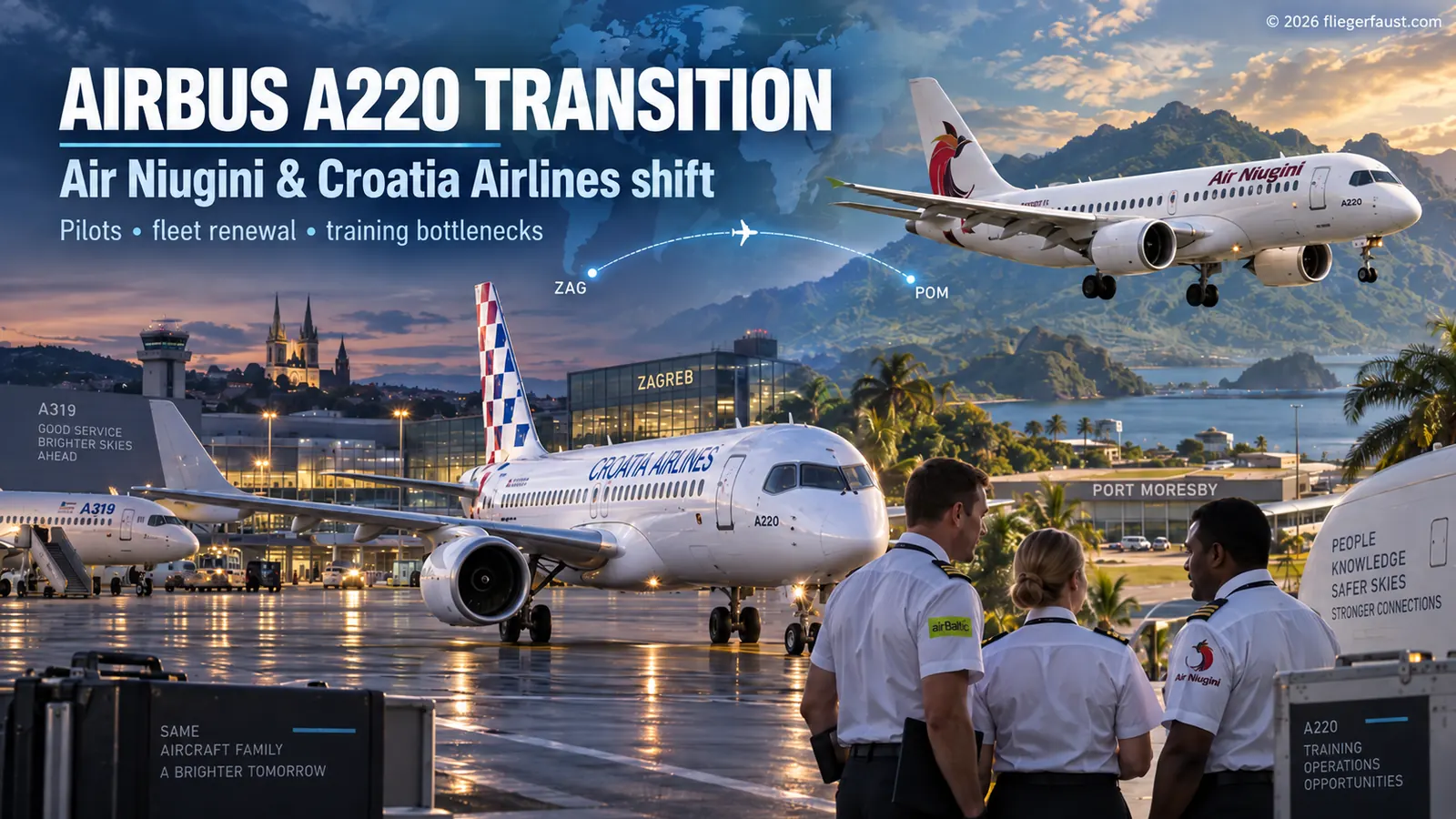
Airbus A220 transition: why are experienced airBaltic pilots preparing to fly in Papua New Guinea just as Croatia Airlines prepares to retire its final A319s? On September 18, 2026, ch-aviation reported that up to 45 airBaltic pilots may voluntarily operate Air Niugini A220s from 2027. The same day, EX-YU Aviation News detailed Croatia Airlines’ tentative plan to end A319 service on October 11.
The two developments look unrelated. One concerns people crossing continents, while the other concerns aircraft leaving a fleet. Together, however, they show that modernisation depends on qualified crews, training capacity and carefully timed retirements as much as new jets.
Airbus A220 transition moves pilots across continents
Airbus A220 transition: sources report 44 or up to 45 pilots
Air Niugini’s September 10 announcement says 44 experienced airBaltic pilots will support its A220 operations from 2027. Separately, ch-aviation reports that the cooperation agreement permits up to 45 pilots to participate voluntarily. Neither source explains the one-pilot difference, so the discrepancy remains unresolved.
The sources report slightly different totals. Air Niugini says 44 experienced airBaltic pilots will support its A220 operations from 2027, while ch-aviation says the agreement permits up to 45 pilots to participate voluntarily. Neither source explains the one-pilot difference, so the discrepancy should remain explicit.
Chief Executive Officer Alan Milne placed the arrangement inside a wider labour requirement. Air Niugini says it needs approximately 100 pilots for future growth while continuing to train Papua New Guinean personnel.
“Air Niugini is growing faster than the pilots and technical workforce required to operate these new-generation aircraft.” — Alan Milne, Chief Executive Officer, Air Niugini.
Notably, the 44-pilot figure is substantial relative to that stated requirement. However, Air Niugini did not say that all 100 positions relate exclusively to A220 operations. The agreement should therefore be viewed as one component of a broader workforce plan.
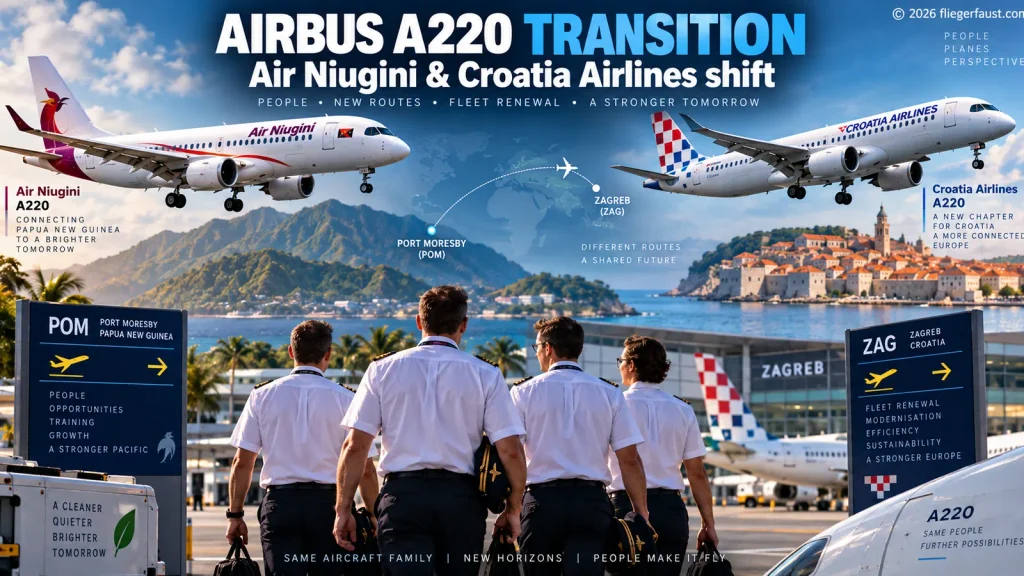
The agreement landed just before airBaltic entered Chapter 11
Timing adds a second layer. Air Niugini disclosed the cooperation on September 10, four days before airBaltic filed for Chapter 11 protection in New York. airBaltic then confirmed the agreement to ch-aviation after the filing.
However, the Latvian carrier did not clarify whether its restructuring changed the deployment’s terms. Our Fliegerfaust report on airBaltic’s Chapter 11 restructuring explains the broader fleet, contract and workforce pressures.
Reuters reported on September 14 that airBaltic was consulting unions about workforce adjustments. Chief Executive Officer Erno Hildén also said the largest operating changes would involve its wet-lease business. Neither airline has linked the cooperation to the restructuring, so it should not be presented as a bankruptcy measure.
A common type rating gives the pilot deal technical logic
Air Niugini currently operates three dry-leased A220-300s and has eight A220-100s on firm order. ch-aviation reports that the smaller aircraft should arrive between 2027 and 2029, replacing Fokker 70s and Fokker 100s.
Notably, Air Niugini says its three delivered A220s are already operating scheduled revenue services across its network. The airline says the type can serve six domestic destinations, currently operates to Cairns and Sydney, and will have the capability to supplement services to Brisbane, Tokyo and Auckland. That broader mission potential increases the training task because crews must prepare for domestic sectors and longer international flying.
Airbus confirms the eleven-aircraft structure: three leased A220-300s and eight directly ordered A220-100s. On its A220-100 product page, Airbus says the variants share 99% commonality and a common pilot type rating.
Therefore, pilots experienced on airBaltic’s A220-300s bring knowledge relevant to both Air Niugini variants. Common type rating does not remove operator-specific procedures, regulatory validation, route preparation or supervised line flying where required.
Moreover, Airbus plans an A220 full-flight simulator in Singapore for the fourth quarter of 2027. The timing shows why qualified crews remain scarce while Asia-Pacific training infrastructure expands.
Aircraft can cross oceans faster than training pipelines.
Airbus A220 transition accelerates at Croatia Airlines
Airbus A220 transition: the A319 exit remains tentative
Croatia Airlines has tentatively scheduled its last Airbus A319 commercial service for October 11, 2026. The current plan sends the type from Zagreb to Dubrovnik, onward to Rome, back to Dubrovnik and finally home to Zagreb.
However, EX-YU Aviation stresses that the allocation is likely to change. The filing indicates strategic intent, not an irreversible operating decision. Delivery timing, maintenance needs or last-minute substitutions could move the final flight.
The airline still has four active 144-seat A319s. The type entered Croatia Airlines service in 1998 and has supported domestic and European routes for almost three decades.
Its departure follows the final A320, which operated Amsterdam–Zagreb on January 26, 2026. Consequently, the October schedule could close the carrier’s long-running in-house A320-family chapter within one year.
A schedule can plan a farewell, but operations retain veto power.
Eleven A220s are already replacing the legacy jets
The carrier now operates eleven A220s: nine A220-300s and two A220-100s. It expects three more deliveries by December 31, subject to the manufacturer’s schedule, with the fifteenth and final aircraft from the current commitment due in 2027.
Airbus identifies the full commitment as thirteen A220-300s and two A220-100s. EX-YU Aviation’s fleet-transition reporting gives the smaller variant 127 seats and the larger aircraft 149.
In Croatia Airlines’ configurations, that creates a useful gauge spread around the outgoing 144-seat A319. The 127-seat A220-100 reduces capacity for thinner demand, while the 149-seat A220-300 adds five seats.
Meanwhile, A319 replacement is not a like-for-like swap on every route. The two A220 variants let Croatia Airlines adjust seat supply within one family, but the spread is narrower than the gap between an A220 and a Dash 8. That explains why turboprop wet-leasing remains part of the network.
For Croatia Airlines, the Airbus A220 transition changes capacity as well as aircraft age. Airbus says the A220-100 and A220-300 share a common pilot type rating, while the A319 and A320 belong to the separate A320-family type-rating system. The relevant benefit is commonality within the A220 family, not cockpit continuity with the outgoing A319s and A320s.
Our Fliegerfaust coverage of Croatia Airlines’ first A220-100 examined how the shorter variant fits Zagreb’s short-haul network.
“All-A220” applies to the in-house fleet, not every flight
The wording requires precision. Croatia Airlines plans an all-A220 internally operated fleet, but its broader network will not use only A220s.
Three remaining Dash 8 Q400 turboprops should continue through the 2026–27 winter season. EX-YU Aviation expects their retirement near the end of March 2027.
Meanwhile, wet-leased ATR 72 capacity will cover thinner regional routes. A separate EX-YU schedule analysis says a second ATR is planned for summer 2027.
That analysis counts 544 ATR-operated flights and 38,080 seats in July 2027, twice the previous July’s flight count. Therefore, fleet simplification inside Croatia Airlines coincides with greater reliance on external turboprop capacity.
The distinction is important. “One in-house type” describes Croatia Airlines’ internally operated fleet and staffing strategy; it does not mean every passenger will board an A220.
Airbus A220 transition exposes the workforce bottleneck
Airbus A220 transition: commonality meets training reality
Single-family operations can simplify recurrent training, crew rostering, spares and maintenance planning. However, airlines must first absorb the cost of moving people from legacy types to the new fleet.
During the earlier phase of Croatia Airlines’ programme, Chief Executive Officer Jasmin Bajić said pilots were removed from normal duties for about two months to complete training, while the airline hired 15 pilots. The A319 exit therefore follows a costly crew-conversion phase, not merely an aircraft swap.
Air Niugini faces the opposite timing problem. Aircraft are arriving faster than its locally developed pilot and technical workforce can expand. Experienced airBaltic crews offer a bridge while national capability grows.
A single-type fleet still arrives one syllabus at a time.
Air Niugini is also building local technical capability
The imported-pilot arrangement should not be mistaken for abandonment of local training. Air Niugini says it is investing heavily in a sustainable Papua New Guinean workforce.
Four Air Niugini maintenance engineers have already received local A220 type endorsements from Papua New Guinea’s Civil Aviation Safety Authority. A second engineering group began training in October 2025.
Additionally, Air Niugini signed an Airbus Flight Hour Services agreement covering its planned eleven-aircraft fleet. The contract provides component support, local stock, pool access and repairs.
The pilot arrangement still leaves material questions
The reports reviewed do not specify the deployment’s duration, basing pattern, command mix or commercial terms. They also do not identify how many participants would serve as captains or first officers.
Furthermore, airBaltic’s Chapter 11 process could change its fleet, workforce and wet-lease priorities. ch-aviation says the carrier confirmed the agreement after filing, but did not explain whether restructuring altered it.
Accordingly, the public record supports a voluntary operating arrangement from 2027—not a permanent transfer of 45 pilots.
Airbus A220 transition keeps the smaller variant relevant
Air Niugini and Croatia Airlines define two roles for the A220-100
The A220-300 dominates many fleet headlines, yet both carriers give the shorter A220-100 a defined role. Air Niugini has eight on firm order, while Croatia Airlines already operates two.
Air Niugini plans to use the type as a direct replacement for ageing Fokker 70s and Fokker 100s. Croatia Airlines uses its 127-seat version beneath the 149-seat A220-300.
That matters because the Airbus A220 transition is not simply a move toward larger jets. Both airlines are using family commonality to retain a lower-capacity option for markets that may not support the larger variant every day.
Our Fliegerfaust analysis of Air Niugini’s Pacific A220 expansion detailed how the aircraft is already reshaping domestic and international routes.
Training infrastructure is becoming part of aircraft value
Airbus says the A220-100 and A220-300 share 99% commonality and a common pilot type rating. Those attributes turn trained crews into assets that can move between variants and, with additional approvals, between operators.
As of July 31, 2026, Airbus had delivered 532 A220s to more than 25 operators, while programme orders exceeded 1,100 aircraft. The expanding fleet creates demand not only for jets, but also for simulators, instructors, engineers and line captains.
Consequently, the Air Niugini–airBaltic agreement is more than a staffing footnote. It illustrates how a growing aircraft programme creates an international market for type-specific experience.
Backlogs are counted in aircraft; bottlenecks often wear epaulettes.
Fleet commonality remains a tool, not a guarantee
Croatia Airlines expects commonality to lower complexity after its transition. Air Niugini expects experienced crews to support growth while local training catches up.
However, Croatia Airlines will still purchase wet-leased turboprop capacity. Air Niugini will still operate a wider mixed fleet beyond its A220s. airBaltic’s own all-A220 operation did not protect it from financial restructuring.
Therefore, Airbus A220 transition benefits depend on network design, financing, utilisation and workforce execution. Commonality removes some variables; it does not remove airline economics.
The most valuable asset may not be the newest aircraft on the ramp. It may be the qualified person who can safely put it into service tomorrow morning.
Conclusion: Airbus A220 transition is a people story
Air Niugini and Croatia Airlines are approaching the same aircraft family from different directions. One needs experienced pilots to support rapid expansion. The other is retiring legacy jets after investing years in fleet and crew conversion.
The airBaltic agreement is pragmatic because it connects available expertise with immediate demand. However, it should support—not replace—Air Niugini’s stated objective of developing local pilots and engineers.
Croatia Airlines’ progress is also real, but the phrase “all-A220 fleet” needs its in-house qualifier. Wet-leased ATR operations will remain part of the practical network solution after the Dash 8s leave.
My critical view is that manufacturers and airlines must treat training capacity as part of fleet planning, not a support item added after delivery. Metal gets the order-book headline; qualified people make the timetable.
What do you think?
Ultimately, the Airbus A220 transition will be judged by how effectively airlines align aircraft, crews and routes. Can the industry train people as quickly as it delivers the jets they are expected to fly?
Leave your comments below and on our Fliegerfaust Facebook page.
Sources
- ch-aviation — PNG’s Air Niugini turns to airBaltic for A220 pilots (September 18, 2026).
- Air Niugini — Air Niugini CEO Highlights Growth, Fleet Modernisation and Customer Transformation at POMCCI Breakfast (September 10, 2026).
- Reuters — AirBaltic in talks with unions to cut workers amid restructuring, CEO says (September 14, 2026).
- Airbus — Air Niugini takes delivery of first Airbus A220 (September 11, 2025).
- Airbus — A220 training simulator to arrive at Airbus Asia Training Centre (September 1, 2026).
- EX-YU Aviation News — Croatia Airlines schedules A319 retirement within weeks (September 18, 2026).
- Airbus — Croatia Airlines takes delivery of its first A220 in new livery (July 29, 2024).
- EX-YU Aviation News — Croatia Airlines to grow ATR wet-lease fleet (September 8, 2026).
- EX-YU Aviation News — Croatia Airlines to select turboprop provider by 2026 (July 31, 2024).
- Air Niugini — Air Niugini Engineers Achieve Historic Airbus A220 Certification Milestone (accessed September 18, 2026).
- Airbus — Air Niugini signs Flight Hour Services contract for A220 fleet (September 15, 2025).
- Airbus — A220-100 (accessed September 18, 2026).
- Airbus — Cockpits (accessed September 20, 2026).
For full details, please refer to our Disclaimer page.