


Can Washington exclude a Canadian aircraft manufacturer from the United States (U.S.) without harming American workers?
Bombardier Trade War: President Donald Trump raised that question on September 7, 2026. He said Bombardier should lose U.S. market access unless it manufactured aircraft there.
However, no Bombardier-specific sales prohibition had appeared by 12:45 p.m. Eastern Time on September 9, 2026. A September 9 Reuters update reported that Bombardier aircraft remained deliverable to U.S. customers. It also said the latest American retaliatory measures had not affected the aerospace sector. Nevertheless, a White House official said the administration was preparing options and actions concerning Bombardier.
Fliegerfaust News Analysis: Presidential intent, enforceable government action and their aerospace consequences require separate examination.
Reporting cutoff: Public information was rechecked through 3:35 p.m. Eastern Time on September 9, 2026. Later executive orders, tariff notices, procurement instructions or aviation actions are not included.
Meanwhile, the company’s Federal Aviation Administration (FAA) approvals remained in force. Its American factories, suppliers and defence programmes complicated the political calculation.
Bombardier Trade War: What Trump Actually Announced
The Bombardier U.S. sales threat takes shape
Trump published his warning on Truth Social during an escalating bilateral tariff dispute. His post attacked Bombardier’s products and demanded more production inside the United States.
“NO MORE SELLING BOMBARDIER IN THE UNITED STATES! Their products aren’t good enough!” — President Donald Trump, Truth Social
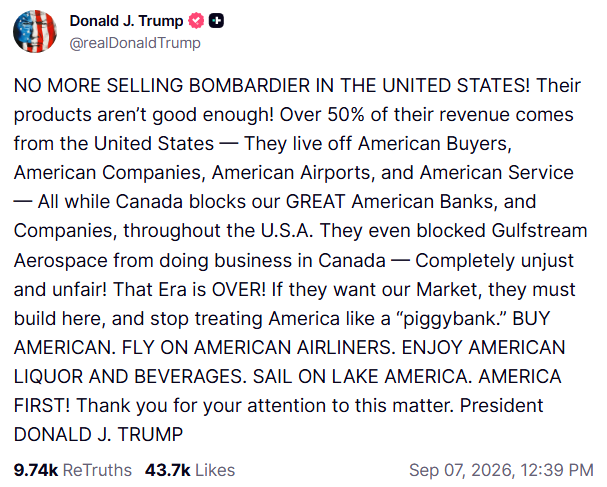
Yet the declaration did not identify a statute, agency process or effective date. It also did not explain how officials would stop deliveries of aircraft already approved for American operation. A September 7 Reuters report said the White House supplied no enforcement details.
Therefore, the accurate description is a presidential market-access threat. It was not an operative aviation ban. That distinction matters for buyers, lenders, operators and suppliers planning around signed contracts.
The loudest instrument arrived without a docket number.
Bombardier answers with American industrial facts
Bombardier responded at 8:43 p.m. Eastern Time on September 7. Its corporate statement distributed through GlobeNewswire avoided a legal argument. Instead, the manufacturer described its American economic footprint.
The company said it works with about 2,800 American suppliers across 47 states. Moreover, it reported annual spending above US$2.5 billion with those suppliers. Bombardier also listed direct employment across more than 20 states.
Additionally, the statement highlighted Global 8000 wing production in Red Oak, Texas. It cited flight-control work near Los Angeles and an expanding service network. A new service centre in Fort Wayne, Indiana, is scheduled to open in mid-November. On September 9, the company said it was recruiting for 500 open U.S. positions, including some at the new facility.
“Our plan is to continue to invest in our people, our customers and the communities in which we operate across the country.” — Bombardier Inc.
Notably, the message was carefully chosen. Bombardier may be Canadian-headquartered, but its aircraft contain substantial American labour and equipment. Consequently, the Bombardier Trade War immediately became an American industrial story as well.
Bombardier Trade War: Threat Is Not Yet a Ban
No implementing order has appeared
By September 9, the reviewed public record contained no Bombardier-specific executive order, customs notice or tariff schedule. It also contained no FAA action suspending a Bombardier type certificate for trade reasons.
An AeroTime specialist review likewise found no accompanying executive order, tariff schedule or regulatory action. Separately, a September 8 Reuters follow-up reported that three aviation lawyers could not identify an immediate delivery-blocking mechanism.
This absence does not make the threat commercially harmless. Customers can delay orders before any rule changes. Financiers can adjust residual-value assumptions, while insurers can demand greater certainty about registration and operation.
Indeed, one lawyer told Reuters that a client expected a Bombardier delivery near October’s end. The customer asked whether Trump’s statement endangered the transaction. Such questions can slow business even when the legal status remains unchanged.
A social-media post can move a share price. It still cannot amend a type certificate.
The political intent is real and consequential. However, the implementing instrument remains unidentified.
Section 232 supplies a possible legal runway
Washington already has a broader aircraft trade process in motion. On July 9, the White House issued a Section 232 aircraft proclamation covering commercial aircraft, jet engines and associated parts.
The Commerce Department had concluded that aircraft-related imports threatened to impair national security. However, the department recommended negotiations instead of immediate tariffs. Trump then directed officials to pursue agreements with trading partners.
The proclamation requires an update within 180 days. It also preserves the possibility of tariffs or other remedies if negotiations fail. Therefore, it provides a conceivable future pathway for broader aviation trade action.
Still, the July proclamation did not name Bombardier. It also did not transform the September 7 post into an enforceable sales restriction. Any later measure would need its own scope, dates and implementation instructions.
The Bombardier Trade War now sits beside that statutory process, not conclusively inside it. Operators should watch the official record rather than assume the president has selected a legal route.
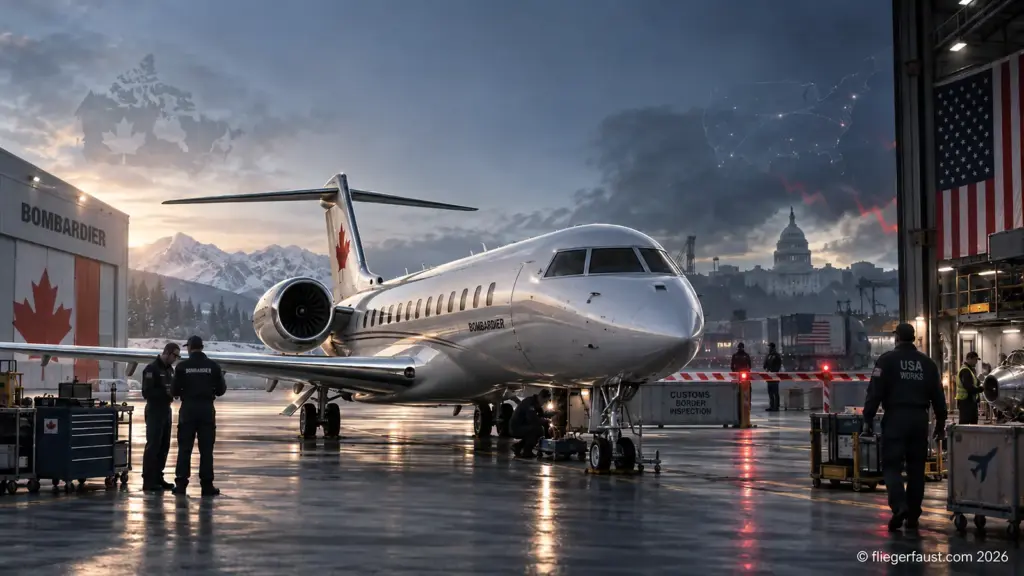
The Canada-U.S. Aerospace Dispute Widens
Section 338 and federal procurement add real pressure
On September 8, the administration announced broader action against Canadian trade. The Office of the United States Trade Representative statement said Trump used Section 338 against selected Canadian goods.
Those import bans targeted specified motor vehicles, dairy products and alcoholic beverages. They were not Bombardier measures.
Separately, the same statement said Trump had directed the Office of the United States Trade Representative (USTR) and the General Services Administration (GSA) to remove US$50 billion worth of Canadian-origin products from GSA’s Multiple Award Schedules. The public statement announced the intended action. However, it did not identify the affected schedule entries, implementation date, origin methodology or treatment of existing orders.
Therefore, the directive could affect Bombardier only where a relevant product or service appears on those schedules and falls within the eventual origin rules. It cannot yet be described as cancelling Bombardier’s existing federal or military contracts.
Crucially, GSA’s Multiple Award Schedules are one federal purchasing channel, not the entire federal acquisition system. The cited U.S. military aircraft acquisitions used separate contract vehicles.
An Air Force Materiel Command award notice describes a US$464.8-million indefinite-delivery, indefinite-quantity contract with Learjet, Inc., a U.S. Bombardier subsidiary, in support of the Battlefield Airborne Communications Node (BACN) programme. A separate U.S. Army award notice describes a firm-fixed-price contract with Bombardier Defense (Learjet, Inc.) for one Global 6500 aircraft, with options for two more, to support High Accuracy Detection and Exploitation System prototyping. Neither notice identifies GSA’s Multiple Award Schedules as the purchasing vehicle.
Accordingly, the September 8 directive does not, by itself, cancel the cited BACN or HADES awards. Later implementing rules, funding decisions, contract clauses or new executive action could still affect deliveries, modifications or support. The use of Bombardier’s U.S. subsidiary could also complicate any future Canadian-origin determination.
Nor does the procurement directive automatically govern private buyers or revoke an aircraft’s certification. A schedule restriction and a nationwide private-sales ban are different legal machines.
Trade lawyers may need a longer checklist than the pilots.
Consequently, the Canada-U.S. aerospace dispute now has several distinct tracks. They include targeted import bans, federal procurement, aircraft trade negotiations and Trump’s Bombardier statement.
The aviation trade conflict meets Canadian retaliation
Canada’s countermeasures took effect on September 8. The Department of Finance Canada announcement applied rates of 15, 25 and 50 per cent.
Ottawa said the tariffs covered C$27.6 billion of imports from the United States. The list focused on steel, dairy, appliances, agricultural equipment, pulp and paper, and electronics. Canada also announced C$7.5 billion in worker and business support.
Trump’s Bombardier post landed hours before those measures started. Accordingly, most news organisations treated it as part of the wider trade confrontation. That timing supports a political connection, but it does not establish a Bombardier enforcement mechanism.
Meanwhile, Quebec Premier Christine Fréchette defended the manufacturer and its workers. Her response framed production location as a decision for Canadian companies.
“Quebec will not allow anyone to dictate where our companies must produce in order to access a market.” — Quebec Premier Christine Fréchette, quoted by CityNews
Even so, Bombardier’s supplier data presents the stronger cross-border argument. Industrial integration gives Washington a stake in the company’s continued sales. The aviation trade conflict is therefore less bilateral than its rhetoric suggests.
Bombardier Trade War Runs Through U.S. Factories
A supply chain spanning 47 states
Reuters reported that Bombardier directly employs about 3,500 people in the United States. The manufacturer’s broader employment claim includes direct and supply-chain effects. Those categories should not be confused.
The Associated Press review of Bombardier’s American footprint identified several important production links. Honeywell makes Challenger engines in Phoenix, Arizona. Collins Aerospace supplies avionics and communications equipment from Cedar Rapids, Iowa.
Moreover, Red Oak workers build wings for Bombardier’s flagship large-cabin programme. California employees produce flight-control components. Wichita supports engineering, maintenance, modification and defence activity.
The border is easier to draw on a map than through a wing assembly.
Reuters also cited a US$109.2 billion American aerospace and defence trade surplus for 2025. Sector exports rose 25 per cent from 2024, according to the Aerospace Industries Association data it reported.
Therefore, reduced Bombardier output could lower demand for American engines, avionics and structures. The Bombardier Trade War could punish domestic aerospace suppliers while seeking to strengthen domestic industry.
That does not eliminate Washington’s leverage. The United States remains Bombardier’s largest market. It does show why any remedy needs a detailed content and employment analysis.
The Bombardier market-access fight reaches operators
The United States accounts for roughly half of Bombardier’s business-aircraft sales and about half of its installed fleet. Consequently, even an unimplemented threat can affect order timing and asset values.
A CBS News market analysis cited Stifel analysts who described the business-jet market as historically tight. They warned that a Bombardier prohibition would severely disrupt American customers already facing long waits.
Substitution would not happen instantly. Gulfstream and other manufacturers cannot create replacement delivery positions on command. Operators also carry training, maintenance and fleet-commonality investments that favour existing aircraft families.
Bombardier shares reflected that uncertainty on September 8. Reuters reported an opening decline of about 6.4 per cent. The loss later narrowed to roughly 3.6 per cent in midday trading.
That partial recovery suggests investors did not price Trump’s statement as a completed exclusion. However, this interpretation remains an inference from the reported market movement.
Meanwhile, the Bombardier Trade War could alter financing before deliveries. Lenders may revisit residual values, registry plans and default clauses. Operators may also seek contractual protection against government action.
Aircraft markets respond quickly when political risk clouds delivery planning.
Bombardier Defence Ties Complicate Retaliation
Bombardier platforms support U.S. military missions
The Bombardier airframes already support important American military missions. The United States Air Force uses Bombardier Global-derived E-11A aircraft for the Battlefield Airborne Communications Node (BACN).
A U.S. Air Force Materiel Command release documented a US$464.8 million contract for up to six Global 6000 aircraft. Once equipped with BACN technology, those aircraft become E-11As.
BACN relays, bridges and translates tactical data and voice links. It helps forces communicate across distance, terrain and incompatible systems. Our Fliegerfaust coverage of Bombardier’s ninth BACN aircraft explains the operational role.
Meanwhile, the United States Army selected the Global 6500 for the High Accuracy Detection and Exploitation System (HADES). A U.S. Army contract announcement covered one aircraft with options for two more.
HADES supports aerial intelligence, surveillance and reconnaissance (ISR). The Army expects greater range, altitude and endurance than legacy turboprop platforms.
It is difficult for Washington to blacklist an airframe supporting its own airborne network.
Kansas Republicans defend local aerospace jobs
Bombardier employs about 1,500 people in Wichita. That concentration quickly turned a foreign-trade threat into a Kansas employment issue.
Republican Senators Jerry Moran and Roger Marshall contacted the administration. Moran stressed Bombardier’s contributions to Kansas. Marshall said he had taken the employment concern into the Oval Office.
Representative Ron Estes also defended the company’s American role. He highlighted its supply chain, maintenance capacity and military work.
“Bombardier supports an extensive American supply chain … and is trusted by our military for critical national security missions.” — Representative Ron Estes, quoted by Reuters
Additionally, the International Association of Machinists and Aerospace Workers opposed barring Bombardier aircraft. The union argued that undermining aerospace job stability would hurt workers on both sides of the border.
The Bombardier Trade War therefore crosses party and national lines. Kansas Republicans, Canadian officials, aerospace workers and Bombardier management share an interest in preserving American jobs.
Washington could eventually create exemptions for military programmes, maintenance or existing contracts. However, no Bombardier-specific carve-outs had appeared by September 9. Each exemption would also make a broad prohibition harder to administer.
The Bombardier Trade War strengthens Ottawa’s defence case
Washington may also be handing Ottawa political ammunition for a larger Bombardier role in Canadian defence. As our Fliegerfaust analysis of Bombardier’s expanding defence strategy documented, the company is moving beyond airframe supply toward Canadian mission integration, modification, sustainment and export support. The related GlobalEye, Gripen, Mirabel and autonomous combat-air proposals reinforce the same sovereignty argument.
A direct U.S. threat against Bombardier now makes domestic control and supplier diversification easier for Ottawa to defend. It also strengthens the case for locating military modifications, software, training, upgrades and lifecycle support in Canada. That does not justify an untendered contract or a blank cheque. However, it gives Ottawa a stronger strategic basis for expanding Bombardier’s role through competitive procurement, targeted industrial investment and long-term defence planning.
The Canadian Aerospace Trade Dispute Returns to Gulfstream
The Canadian aerospace trade dispute set the pattern
Trump linked his September statement to Canada’s treatment of Gulfstream Aerospace. He claimed Canada had blocked the American manufacturer from doing business there.
The underlying disagreement concerned delayed Canadian validation for four newer models. They were the Gulfstream G500, G600, G700 and G800. Older Gulfstream aircraft already held Canadian approvals.
On January 29, Trump threatened to decertify Canadian-made Bombardier Global Express aircraft. He also threatened 50 per cent tariffs on Canadian-built aircraft until Canada approved the Gulfstream models.
Our Fliegerfaust analysis of the earlier Canadian aircraft decertification threat examined the legal and safety distinction. Certification concerns airworthiness. Tariffs and market access concern trade policy.
The January measures never materialised as announced. Nonetheless, they created uncertainty for operators and exposed certification to political pressure.
A type-certificate data sheet is dull, but dull paperwork often prevents expensive arguments.
This history matters because the Canadian aerospace trade dispute now follows a familiar pattern. A regulatory grievance becomes leverage against Bombardier, even when the company did not control Transport Canada’s validation schedule.
February approvals undercut the blanket-ban claim
Transport Canada later completed the disputed validations. A February 20 Reuters report confirmed G500 and G600 approval through a data sheet dated February 15.
Then, a February 24 Reuters follow-up confirmed G700 and G800 approval. The related government document was issued on February 23.
Our Fliegerfaust report on Transport Canada’s G500 and G600 approvals provides the immediate background.
Therefore, Canadian validation remained pending for those models until February. However, the record does not support describing Gulfstream as permanently barred from the Canadian market.
That distinction does not excuse opaque certification timelines. Transport Canada should publish clear expectations and decision milestones for sensitive validation files. Transparency would reduce claims of disguised protectionism.
Likewise, Washington should keep airworthiness decisions separate from commercial retaliation. Regulators can challenge technical findings through established bilateral channels. Political leaders can pursue trade disputes through published trade authorities.
The Bombardier Trade War becomes more dangerous when those channels blur. Once certification becomes leverage, every trading partner learns the same tactic.
Bombardier Trade War and the Separate FAA Rule
The safety proposal predates Trump’s threat
On September 9, the FAA published a Federal Register notice of proposed rulemaking covering 13 U.S.-registered BD-700-2A12 (Global 7500) aircraft. The proposed airworthiness directive addresses oversized fastener holes near wing rib 6, where cracking could threaten structural integrity.
The proposal would require operators to inspect the affected fasteners and holes and complete repairs where required. Public comments are due by October 26, 2026. The action is a safety proposal, not a sales restriction.
More importantly, the chronology rules out a credible retaliation theory. The FAA issued the proposal on September 3, four days before Trump’s statement. It also derives from Transport Canada Airworthiness Directive CF-2025-39, issued on August 7, 2025. Therefore, no evidence links the proceeding to the trade dispute.
Unlike a social-media threat, a rulemaking arrives with a docket and a comment deadline.
Conclusion: Bombardier Trade War Needs Regulatory Discipline
The Bombardier Trade War has produced a serious presidential threat, but not a completed private-market prohibition. Washington has several trade tools available. Yet each tool requires published scope, authority and implementation.
Meanwhile, Bombardier’s American footprint complicates every punitive option. About 3,500 direct employees, thousands of suppliers and two military programmes sit inside its cross-border network.
Canada should not dismiss American concerns about transparent certification timelines. Likewise, Washington should not disguise trade retaliation as aviation safety. Both governments gain when regulators remain technically credible.
A tariff boomerang remains a boomerang, even when painted in national colours.
Critically, the present strategy risks weakening the integrated industrial base it claims to defend. Will Canada and the United States protect that shared aerospace system before political threats become expensive operational facts?
What do you think?
Leave your answers and comments below and on our Fliegerfaust Facebook page.
Bombardier Trade War – Sources
- Truth Social — President Donald Trump’s Bombardier statement (September 7, 2026).
- Reuters — Trump says Canada’s Bombardier must build jets in US or lose market access (September 7, 2026).
- Bombardier Inc. / GlobeNewswire — Bombardier Statement (September 7, 2026).
- Reuters — Kansas Republicans throw weight behind Bombardier jobs after Trump threat (September 8, 2026).
- Reuters — Bombardier says it wants to fill 500 open US jobs despite Trump’s threats (September 9, 2026).
- Department of Finance Canada — Canada announces targeted countermeasures and substantive support for workers and businesses in response to U.S. tariffs (August 25, 2026).
- The White House — Adjusting Imports of Commercial Aircraft, Jet Engines, and Aircraft and Engine Parts into the United States (July 9, 2026).
- Office of the United States Trade Representative — Ambassador Greer Issues Statement on President Trump’s Response to Canada’s Continued Retaliation Against the United States (September 8, 2026).
- Associated Press — Trump threatens Canadian jetmaker Bombardier, which has an extensive US footprint (September 8, 2026).
- CBS News — Bombardier caught in the crossfire of escalating U.S.-Canada trade feud (September 8, 2026).
- CityNews — Bombardier says it creates ‘tens of thousands’ of U.S. jobs in response to Trump’s threats (September 7, 2026).
- AeroTime — Trump threatens to ban Bombardier jet sales unless production moves to US (September 8, 2026).
- Federal Register — Airworthiness Directives; Bombardier, Inc. Airplanes (September 9, 2026).
- Reuters — Transport Canada has certified Gulfstream G500 and G600 jets, document says (February 20, 2026).
- Reuters — Transport Canada certifies Gulfstream G700 and G800 jets after Trump spat (February 24, 2026).
- U.S. Air Force Materiel Command — Hanscom team awards contract for up to six aircraft (June 1, 2021).
- U.S. Army — Army awards contract for HADES prototyping efforts (January 3, 2024).
For full details, please refer to our Disclaimer page.