
Could A3-001 become Bombardier’s next military-aircraft opportunity?
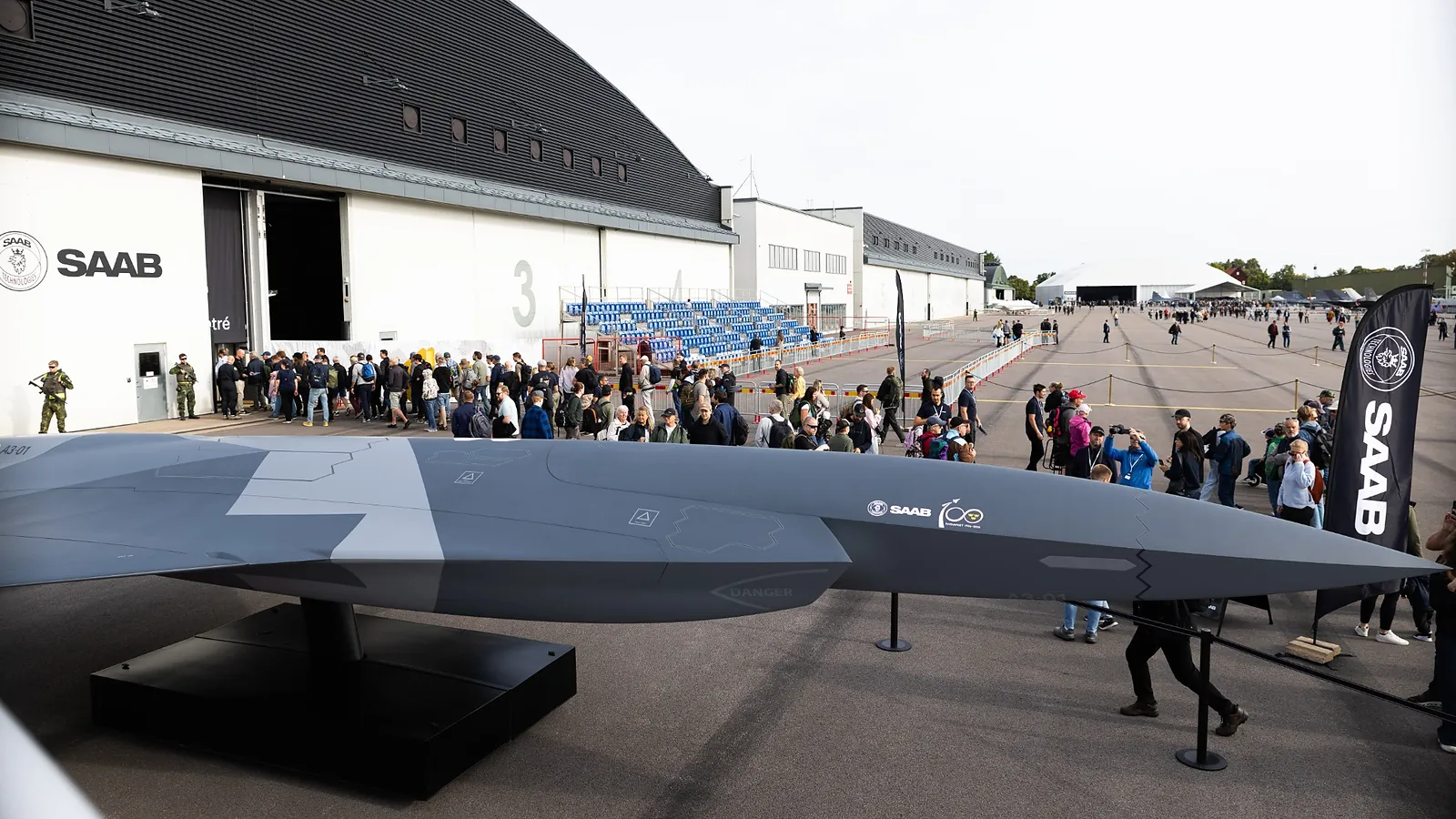
Saab fighter drone: According to The Aviationist’s report, Saab unveiled A3-001, a full-scale model of a low-observable autonomous combat aircraft, to media on August 21, 2026. Then Saab placed the concept on public display at Malmen Air Base in Linköping, Sweden, on August 22. No Canadian company is attached to the aircraft today. However, the reveal arrives as Saab and Bombardier are building a much deeper Canadian defence relationship.
That timing changes the story. Bombardier already supplies Saab’s GlobalEye platform, wants to establish military-modification work in Canada, and has discussed Canadian Gripen production. Meanwhile, Ottawa is reviewing its F-35 plan, considering far more domestic defence content, and confronting a severe trade rupture with the United States.
The Saab fighter drone is therefore more than a Swedish air-show exhibit for Canadian readers. It raises a practical question about the next rung of Bombardier’s military ambitions. Could today’s GlobalEye and Gripen relationships give Canada a credible route into tomorrow’s autonomous combat-air programmes?
Saab fighter drone: A3-001 reveals the destination
Saab A3 is a concept, not an order
Officially, Saab calls the aircraft A3-001. Its August 22 announcement describes a full-scale concept model, not a flying prototype. Sweden has not ordered it, and Saab has not announced an operational development contract.
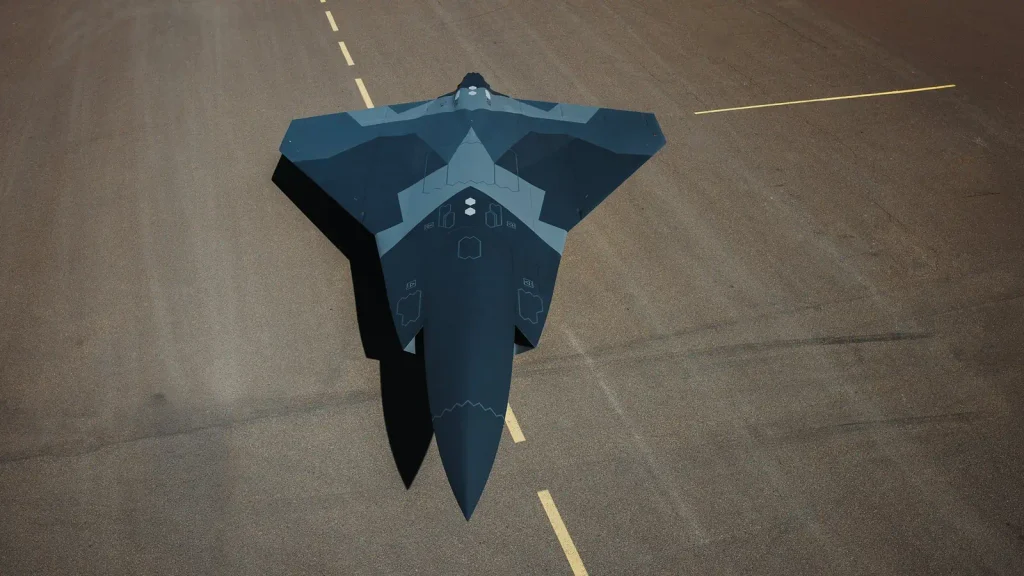
Even so, the model shows where Swedish-funded work could lead during the mid-2030s. Specifically, Saab identifies electronic warfare, suppression of enemy air defences, and precision strike as core missions. It also emphasizes low observability, considerable autonomy, and operations across several military domains.
“… we intend to fly uncrewed demonstrators with fighter-like characteristics before 2030 …” — Peter Nilsson, Head of Business Unit Advanced Programs at Saab
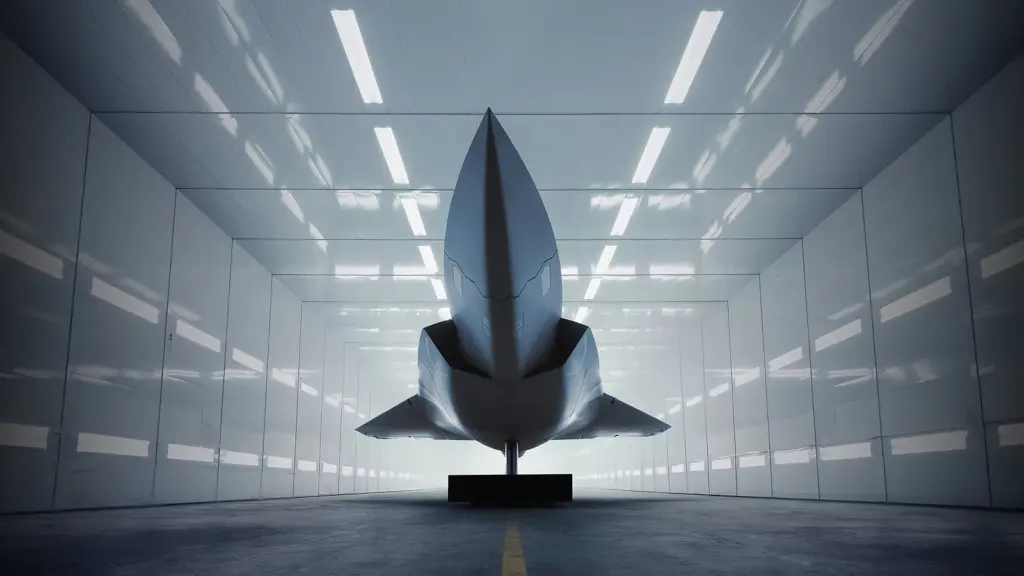
Independent reporting adds useful technical detail. The War Zone’s Malmen report describes a tailless blended wing-body, cropped swept wings, a pronounced chine, stealth-oriented side intakes, and internal volume for fuel and stores.
Moreover, The Aviationist’s independent analysis notes the compound-delta planform and serrated exhaust treatment. Those features are consistent with reduced radar and infrared signatures, although Saab has published neither a radar cross-section nor a maximum speed for A3-001.
Consequently, the precise description is Saab’s supersonic Autonomous Collaborative Platform (ACP) vision. It is not a declared Mach number for the displayed A3. A mock-up can start a policy debate, but it cannot log a flight hour.
A1 and A2 are the real hardware programme
A3-001 is Saab’s full-scale concept of a possible operational aircraft for the mid-2030s. A1 and A2 are separate Swedish-funded flying technology demonstrators, not earlier production versions of A3. Saab will use them to test technologies that could later support an operational aircraft resembling A3.
A1 is the first demonstrator, while A2 will examine additional materials, sensors, and other advanced systems. Together, they reduce technical risk before Sweden decides whether to proceed with an operational Autonomous Collaborative Platform.
Meanwhile, A1 should fly roughly 15 months after the August 21 media briefing, which points to late 2027. It uses the GE Aerospace F414 afterburning turbofan found in Gripen E/F. That engine gives A1 confirmed supersonic performance and reduces propulsion risk.
Additionally, A1 has an internal weapons bay, although Saab does not plan weapons-release trials from it. A2 will also use an F414 and test other advanced technologies, including new materials and sensors. Public reporting has not confirmed weapons-release testing from A2.
Notably, the programme grew from formal Swedish studies. Saab announced an initial future-fighter study order on March 22, 2024. Then, on October 14, 2025, the company disclosed a 2.6-billion-krona follow-on order covering 2025 through 2027.
However, The War Zone reports that Saab described A1 and A2 work continuing through 2030. The public contract release does not explain that difference. It may reflect later increments or a broader programme horizon, but the published record remains incomplete.
Saab also presents ACP as a high-end aircraft, not an expendable swarm. Nilsson reportedly estimated lifecycle cost near one-third of Gripen’s and acquisition cost near one-half. He suggested two or three ACP aircraft per Gripen, rather than ten inexpensive drones.
Those are planning assumptions, not validated programme costs. Still, they reveal the ambition. The Saab fighter drone aims to distribute fighter-like combat power without placing another pilot inside the threat envelope.
Saab fighter drone: the architecture matters more
Gripen loyal wingman command model
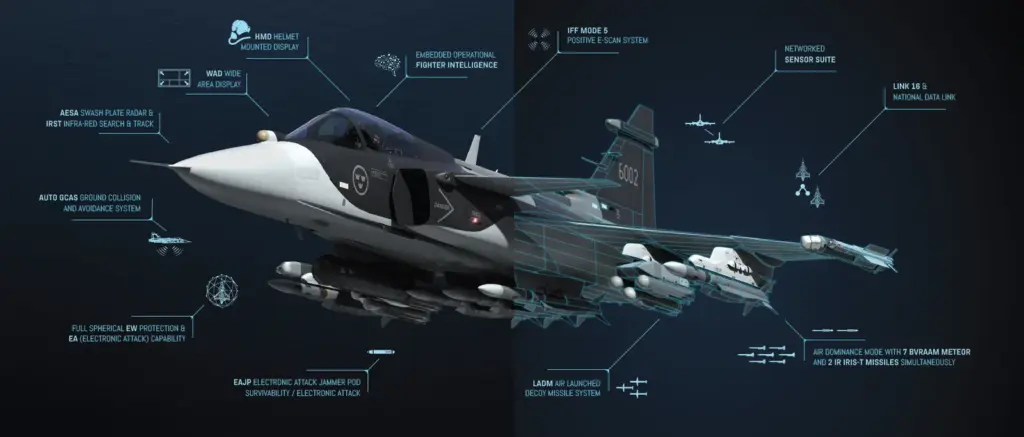
The strongest part of Saab’s proposition is not the A3 silhouette. It is the combat architecture around it. GlobalEye would create the wide-area picture, Gripen E would direct the tactical fight, and ACP aircraft would carry sensors, jammers, or weapons farther forward.
“We have floated the view that this would be a great asset to the Gripen E, but right now there is no commitment.” — Peter Nilsson, Head of Saab’s Advanced Programs Business Unit, quoted by The War Zone
Crucially, that qualification matters. Saab has an architecture and demonstrator path, but no operational A3 commitment. Nevertheless, the design gives Sweden useful technology whether it later builds A3, joins another programme, or develops a crewed Gripen successor.
Moreover, Saab says ACP could work with aircraft other than Gripen. That widens the export case, but interoperability will demand resilient data links, secure interfaces, and clear human authority over lethal decisions.
The Saab fighter drone may eventually carry missiles. Yet its decisive feature could be the network diagram, not the wing sweep.
Autonomous combat aircraft depend on software
Saab has already moved artificial intelligence (AI) into Gripen. On June 11, 2025, the company reported three Gripen E flights with Helsing’s Centaur AI agent. The first occurred on May 28, 2025.
During the trials, Centaur controlled the aircraft in a beyond-visual-range combat environment and cued the pilot to fire. The tests did not create an autonomous operational fighter. However, they showed that Saab can integrate new AI functions quickly within a safety-critical aircraft.
Separately, Canada already has a small place in that software story. On March 23, 2026, Saab and Toronto-based Cohere announced a GlobalEye AI collaboration. Their work covers mission support, information processing, and maintenance applications.
That agreement does not involve A1, A2, or A3. Even so, it demonstrates that Saab will place selected advanced software work in Canada when a programme supports it. Could Canada’s first contribution to a future ACP be software assurance, simulation, secure mission systems, or flight-test infrastructure rather than final assembly?

Bombardier and Saab already have Canadian foundations
GlobalEye moves Bombardier up the military value chain
Saab integrates its Erieye Extended Range radar and mission system onto Bombardier’s Global 6500. On June 20, 2025, Bombardier announced a firm Saab order for two Global 6500 aircraft.
Then, on May 27, 2026, Canada selected Saab for preferred-supplier discussions covering an Airborne Early Warning and Control (AEW&C) capability. The Government of Canada announcement stresses Canadian production, mission integration, specialized employment, technology transfer, and participation in export supply chains.
Crucially, preferred-supplier status is not a contract, and Saab has received no order. However, Ottawa’s industrial language is unusually specific, and the proposed aircraft rests on a Canadian-built Bombardier platform.
“GlobalEye offers proven capability for the Royal Canadian Air Force, sovereign ownership for Canada and comprehensive and skilled work for Canadian industry.” — Micael Johansson, President and Chief Executive Officer, Saab
Our Fliegerfaust coverage of Canada’s GlobalEye and Arctic-surveillance decision examined the operational case and the gap between selection and contract.
Bombardier now wants to capture more of the military conversion work. On July 30, 2026, Reuters reported that the company expects to choose a Canadian special-mission site by late 2026 or early 2027.
“There is an opportunity now to start this operation with the GlobalEye.” — Éric Martel, President and Chief Executive Officer, Bombardier, quoted by Reuters
The centre could perform wiring, structural modification, sensor preparation, testing, certification, upgrades, and long-term support. GlobalEye would launch the facility, which could later support other missions.
Moreover, 11 North Atlantic Treaty Organization (NATO) Allies, including Canada, announced plans to jointly procure up to ten GlobalEye aircraft on July 7, 2026. The NATO Support and Procurement Agency will negotiate the contract with Saab, which had not yet received an order when the selection was announced. This programme is separate from France’s firm order for two GlobalEye aircraft, with options for two more. Together, the two programmes enlarge the industrial opportunity around Bombardier’s Global 6500 platform.
Our Fliegerfaust analysis of Bombardier’s expanding Canadian defence strategy explored that value-chain shift and potential Canadian locations. The distance from executive cabin to mission bay is shorter than it looks.
Saab is assembling a permanent Canadian network
The relationship now extends beyond Bombardier airframes. On May 27, 2026, Saab and Canadian Aviation Electronics, now known as CAE Inc., expanded their GlobalEye partnership. CAE would provide Canadian training and simulation support if Ottawa completes the acquisition.
Separately, Saab and CAE signed a Gripen memorandum on July 17, 2026. The proposed Canadian work includes simulators, training, software development, mission-system design, verification, integration, and sustainment.
Notably, Saab says sensitive Canadian and North American Aerospace Defence Command (NORAD) information would remain under Canadian control. Those capabilities would also be relevant to any future crewed-uncrewed combat architecture.
Finally, Saab appointed Cara Salci as president of Saab Canada on July 29, 2026, effective September 8. The move strengthens a domestic organisation already pursuing GlobalEye, Gripen, training, software, research, and industrial partnerships.
“Canada represents an important strategic market for Saab, and we are pleased to welcome Cara to lead our Canadian business.” — Micael Johansson, President and Chief Executive Officer, Saab
That is why the Saab fighter drone has Canadian relevance despite Canada’s absence from A3. Saab is building the industrial, software, training, and mission-system relationships that could support participation in a later combat-air programme.
Bombardier remains the pivotal Canadian airframer. CAE and Cohere broaden the possible workshare beyond metal and wiring. Together, they form the outline of a Canadian Saab ecosystem rather than a single aircraft sale.
Saab fighter drone: Canada’s mixed-fleet opening
Gripen remains inside the F-35 review
Canada remains committed to its first 16 Lockheed Martin F-35A aircraft. However, Ottawa continues reviewing the balance of the planned 88-aircraft purchase. Reuters reported on April 27, 2026 that other foreign aircraft remained under consideration.
The most ambitious scenario surfaced through Canadian Broadcasting Corporation reporting summarized by Defence Nordic on June 8, 2026. It described options involving 72 to 88 F-35As alongside as many as 72 Canadian-assembled Gripen E fighters.
That is a reported planning scenario, not a government decision. Nevertheless, it places the mixed-fleet idea inside a much larger force expansion than a simple substitution of Gripen for F-35.
The industrial groundwork also predates the report. In November 2025, Reuters confirmed discussions among Saab, Ottawa, and Bombardier concerning possible Canadian Gripen production.
“… Bombardier is open to engage in providing local expertise for the program if the Government of Canada decides to go this route.” — Bombardier statement quoted by Reuters
Our Fliegerfaust assessment of the Bombardier-Gripen discussions separates announced industrial proposals from unresolved procurement choices.
A mixed fleet would create costs and complexity. Canada would need two training systems, two sustainment chains, separate software baselines, and carefully designed mission integration. Yet it could also provide more aircraft, dispersed operating options, and a substantially larger Canadian industrial role.
For the Saab fighter drone angle, Gripen matters because it is Saab’s proposed tactical commander for ACP aircraft. A Canadian Gripen fleet would not automatically include A3, but it would make future participation technically and politically easier to discuss.
Trade conflict makes Canadian content strategic
The political climate has also changed sharply. The United States imposed 50 per cent tariffs on roughly US$20 billion of Canadian goods just after midnight on August 22, 2026, Reuters reported. Later that day, Reuters reported Canada’s retaliatory tariffs on American goods, effective September 8.
Those measures do not determine fighter procurement. However, they increase the political value of domestic production, diversified suppliers, and sovereign control over upgrades and sustainment.
Ottawa’s Defence Industrial Strategy already points in that direction. The February 17, 2026 strategy identifies C$180 billion in procurement opportunities and C$290 billion in defence-related capital opportunities over ten years. It also targets 70 per cent of defence acquisitions for Canadian firms.
Our Fliegerfaust analysis of Canada’s unpaid rearmament bill shows why industrial terms matter as much as headline purchase prices. Canada can spend historic sums and still finish with limited design authority, export rights, or upgrade control while increasing its national debt to record levels.
A Saab-Bombardier partnership offers more Canadian content than importing completed aircraft. Yet it would not create complete independence from the United States. Gripen E uses the American F414 engine, while GlobalEye also contains international technology.
Therefore, the realistic objective is leverage and resilience, not autarky. Canada should seek Canadian engineering authority, classified mission-system control, local modification capacity, long-term sustainment, and access to export work.
A maple leaf on the invoice is not sovereignty, although a Canadian software key might be.
Bombardier’s most plausible entry into a future ACP would not begin with an immediate Canadian A3 assembly line. It could begin with structures, flight controls, test engineering, certification, missionization, secure integration, and support.
Those are credible extensions of work Bombardier already performs. The open question is whether Ottawa and industry would negotiate that role early, before Saab’s architecture and workshare harden around other partners.
Conclusion: Saab fighter drone tests Bombardier’s ambition
The A3-001 reveal does not establish a Canadian programme. It establishes a direction. Saab is combining GlobalEye sensing, Gripen command, AI-enabled mission systems, and autonomous low-observable aircraft into one combat-air architecture.
Canada already touches several parts of that architecture. Bombardier supplies the Global 6500, is considering Canadian military-modification work, and has discussed Gripen production. CAE is positioned for training and mission systems, while Cohere adds a Canadian AI relationship.
The Saab fighter drone could become Bombardier’s next defence opportunity, but only after several prior steps succeed. Canada would first need a GlobalEye agreement, a defined Gripen decision, or another funded requirement that creates durable Canadian engineering capacity.
Moreover, Ottawa would need to decide what it actually wants from record defence spending. Jobs matter, but design authority matters longer. Assembly matters, but control over software, upgrades, testing, and exports determines whether Canada owns capability or merely hosts production.
Industrial sovereignty reveals itself after the ribbon is cut, when the first classified upgrade arrives.
The strongest opportunity may therefore be larger than A3 itself. Canada could use Saab’s expanding ecosystem to build a domestic centre for special-mission aircraft, combat-air software, certification, training, and autonomous-system integration. That foundation would remain useful even if A3 changes shape or never enters production.
Conversely, a mixed fighter fleet and another advanced uncrewed programme could add cost without enough operational coherence. Canada must demand a clear force design, enforceable workshare, and sovereign mission-system rights before accepting the industrial promise.
The Saab fighter drone has opened a credible strategic question, not answered it: will Canada and Bombardier secure a place inside Saab’s future combat-air architecture while the design is still open, or arrive after the valuable work has already been assigned?
What do you think?
Leave your answers and comments below and on our Fliegerfaust Facebook page.
Saab fighter drone – Sources
- Saab — Saab showcases full-scale uncrewed aircraft concept (August 22, 2026).
- The War Zone — Saab Unveils Stealthy Supersonic ‘Fighter Drone’ Concept (August 21, 2026).
- The Aviationist — Saab Unveils A3-001 Collaborative Combat Aircraft Concept (August 22, 2026).
- Saab — Saab receives order for Swedish future fighter concept studies (March 22, 2024).
- Saab — Saab receives order from FMV for continued future fighter concept studies (October 14, 2025).
- Saab — Saab achieves AI milestone with Gripen E (June 11, 2025).
- Bombardier — Bombardier Defense Receives Firm Order for Two Global 6500 Aircraft from Saab (June 20, 2025).
- Government of Canada — The Government of Canada selects preferred supplier for Airborne Early Warning and Control discussions (May 27, 2026).
- Saab — Canada engages Saab as preferred supplier of future AEW&C capability (May 27, 2026).
- Reuters — Bombardier CEO expects to decide by early 2027 on Canadian site to militarize private jets (July 30, 2026).
- Saab — NATO selects Saab’s GlobalEye (July 7, 2026).
- Saab — Saab and CAE expand strategic partnership in support of Canada’s AEW&C programme (May 27, 2026).
- Saab — Saab and Cohere sign memorandum of understanding on advanced AI collaboration (March 23, 2026).
- Saab — Saab and CAE Sign MOU for Gripen in Canada (July 17, 2026).
- Saab — Saab appoints President of Saab Canada (July 29, 2026).
- Reuters — Canada is still reviewing plan to buy US fighter jets, defense minister says (April 27, 2026).
- Defence Nordic — Canada explores expanded fighter fleet with Saab production option (June 8, 2026).
- Reuters — Saab in talks with Canada, Bombardier to build Gripen fighter jets, Globe and Mail reports (November 14, 2025).
- Prime Minister of Canada — Prime Minister Carney launches Canada’s first Defence Industrial Strategy to strengthen security, create prosperity, and reinforce strategic autonomy (February 17, 2026).
- Reuters — US hits Canadian goods with 50% tariffs after trade talks fail (August 21, 2026).
- Reuters — Canada to impose retaliatory tariffs across a raft of US sectors, Carney says (August 22, 2026).
For full details, please refer to our Disclaimer page.
Saab is building a combat air ecosystem that redefines what a small nation can achieve. With GlobalEye + Gripen + A3, Saab is creating one of the world’s most advanced and tightly integrated air‑power chains: GlobalEye delivers unmatched sensor supremacy, Gripen provides precision, agility and cost‑efficient lethality, and A3 adds fearless autonomous strike capability for the missions no human should fly.
This triad is pure Saab — disruptive innovation, smart engineering, and a system‑of‑systems philosophy that outperforms competitors who spend ten times more. Sweden, through Saab, isn’t just keeping pace with the future of air combat; it’s shaping it.