

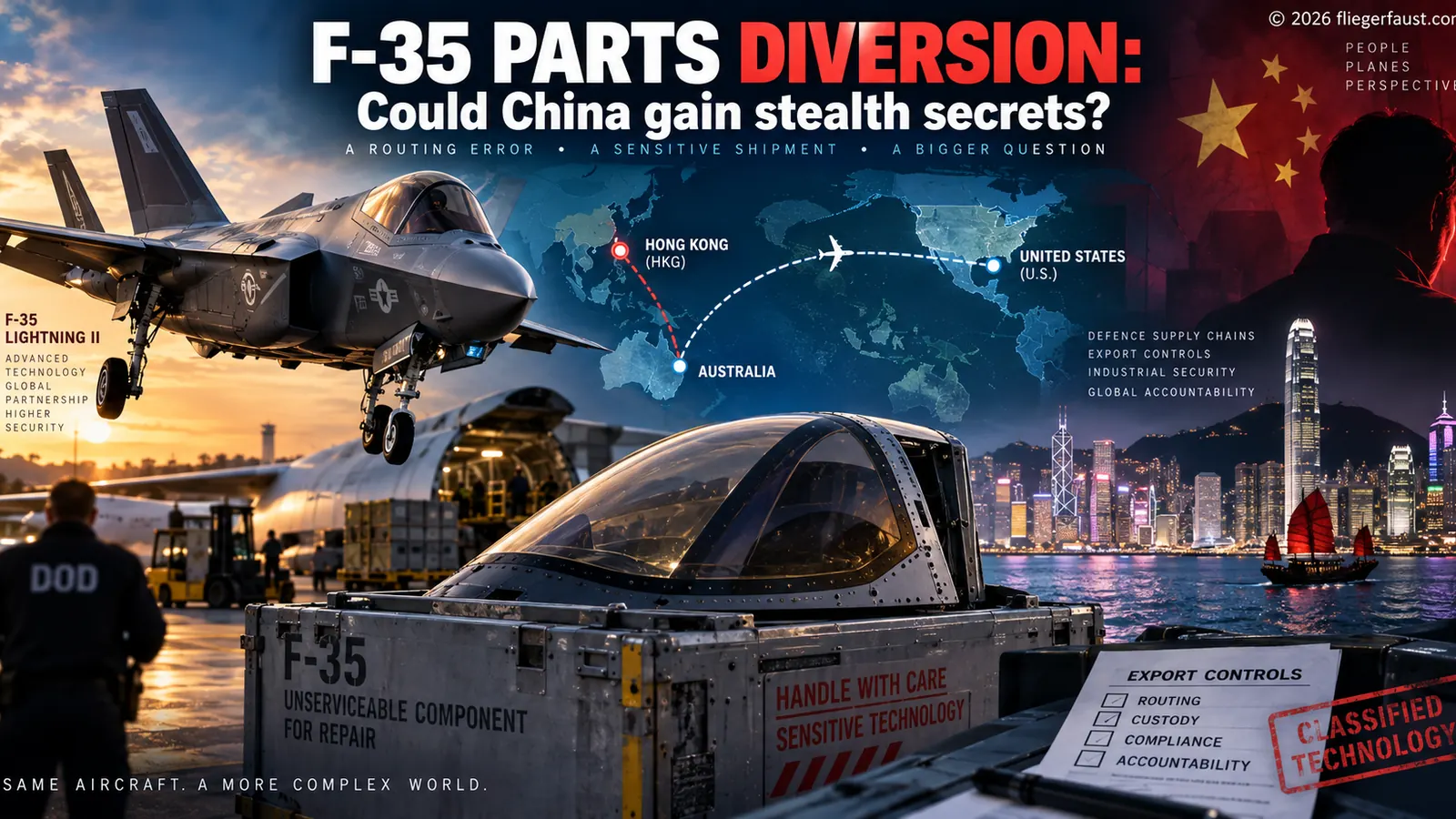
Could China gain valuable stealth knowledge from a repair shipment rerouted to Hong Kong?
F-35 parts diversion: On September 18, 2026, POLITICO reported that an F-35 repair shipment had been rerouted to Hong Kong. According to FreightWaves’ account of that reporting, an intermediary was transporting the components for Lockheed Martin from Australia to the United States (U.S.) for repair. Reportedly, the cargo included a cockpit canopy incorporating sensitive stealth technology.
Meanwhile, the Pentagon acknowledged a retrieval effort. Congressional staff had received briefings beginning in June. Yet the public account still lacks the information that matters most: a complete custody history and an explanation of the diversion.
The stakes extend beyond recovering valuable hardware. Chinese aerospace espionage cases have already demonstrated the pursuit of military data and manufacturing knowledge. Against that record, could an interrupted repair journey create an intelligence opportunity that returning the equipment would not reverse?
F-35 parts diversion: follow the handovers
The Department of Defense (DOD) acknowledged the problem through its F-35 Joint Program Office (JPO). Its public description was “a shipment issue of unserviceable F-35 Lightning II components.” — F-35 Joint Program Office, quoted by FreightWaves, September 18, 2026.
Additionally, the JPO said it was working with American authorities and industry to retrieve the equipment, investigate and introduce safeguards. The statement names neither the carrier nor the custodian. It leaves the route change unexplained.
First, identify the intermediary. Who selected it, what instructions did it receive, and could it subcontract any part of the journey? Investigators need to distinguish the company arranging transport from the organisations physically handling the cargo.
Consequently, responsibility cannot end at an unnamed link in the chain. A component should have a traceable custodian at each handover. Even a stealth program needs a delivery receipt.
The F-35 shipment diversion timeline starts before publication
According to POLITICO’s reporting, Pentagon and State Department officials began briefing congressional national-security staff in June 2026. Further briefings were expected after publication. However, the accessible accounts provide neither an exact dispatch date nor a complete sequence of subsequent movements.
Descriptions of a summer shipment cannot substitute for dated records. The originating Australian facility, intended American repair destination and transport mode remain publicly unidentified. So do the carrier, complete manifest and named custodian in Hong Kong.
The F-35 parts diversion inquiry should establish when the first discrepancy appeared and who received the alert. Did a system flag an unauthorised destination, or did somebody discover that expected equipment had failed to arrive?
More importantly, what happened between that discovery and the congressional briefings? A dated response record would establish the pace of retrieval, the initial security assessment and any continuing exposure.
Meanwhile, Australia’s role needs a documented account. Which organisation released the parts, and what dispatch records can Australian authorities supply? The reviewed reporting contains no detailed Australian government explanation.
F-35 parts diversion puts corporate safeguards to the test
Lockheed declined to discuss individual shipments, citing security, and said it followed American transport regulations. Its statement added: “Our teams handle every shipment with the utmost diligence and safeguards…” — Lockheed Martin, quoted by The Times of India, September 19, 2026.
That assurance invites a straightforward test: compare the required procedures with the actual handovers. Specifically, which organisation could approve a routing change, and which organisation had to verify delivery? Compliance should leave records that investigators can examine.
China’s aerospace espionage record is documented
Importantly, the concern about Chinese technical exploitation rests on more than speculation about a destination. Two completed American prosecutions document efforts involving Chinese military personnel or intelligence officers to acquire aerospace information. Their methods explain why investigators must examine access as closely as routing.
Su Bin helped select the information to steal
On July 13, 2016, a federal court sentenced aviation businessman Su Bin to 46 months in prison. The U.S. Department of Justice’s account of Su Bin’s guilty plea and sentencing describes a conspiracy spanning October 2008 to March 2014.
Su admitted helping conspirators in China obtain sensitive military information through unauthorised access to American computer networks. The department identified his collaborators as Chinese military officers. The case concerned technical data involving the C-17 transport and military fighter aircraft.
Moreover, Su guided the targeting. He identified useful companies and technologies, selected files for theft and translated material into Chinese. According to his admissions and sentencing documents, the conspirators prepared reports for the Chinese People’s Liberation Army’s General Staff Headquarters.
That record shows a directed acquisition process, not indiscriminate copying. For the F-35 parts diversion investigation, the corresponding question is whether anyone identified the cargo’s value and acted on it.
Yanjun Xu targeted manufacturing knowledge
Meanwhile, a second case exposed a different approach. On November 5, 2021, a federal jury convicted Chinese intelligence officer Yanjun Xu of espionage and trade-secret offences. A court sentenced him to 20 years in November 2022.
The Justice Department’s account of Xu’s trial and sentencing identifies him as a Chinese Ministry of State Security deputy division director. His targets included proprietary composite aircraft-engine fan technology at General Electric’s aviation business.
Specifically, trial evidence described aliases, front companies and university invitations used to approach aerospace employees. Xu’s organisation also copied or hacked computers in hotel rooms while employees attended dinners. In that operation, dinner was not the only thing on the menu.
Together, these cases establish an important investigative premise: commercially presented interactions can conceal organised technology acquisition. Therefore, examining the Hong Kong shipment means testing not only who moved it, but who recognised and potentially exploited it.
F-35 parts diversion: why the canopy matters
The canopy brings the investigation directly into the aircraft’s low-observable design. POLITICO’s sources described a thin, transparent treatment that contributes to reducing the aircraft’s radar signature. The concern is the engineering embodied in that physical article, not merely its replacement price.
For context, Lockheed Martin’s explanation of F-35 stealth describes a combination of aircraft shaping, signature-reducing materials and internal equipment carriage. Together, these features make detection and targeting harder.
An adversary does not need the entire aircraft to gain useful knowledge. The F-35 parts diversion raises a narrower, technically consequential possibility: physical examination could clarify how one sensitive design element actually works in manufactured form.
A canopy is a window for the pilot. In the wrong laboratory, it could become a window into the engineering.
What diverted F-35 components could disclose
Specifically, former congressional aviation specialist J.J. Gertler identified the value of comparing hardware with previously acquired information. In comments to POLITICO reproduced by The Times of India, he said an actual component could help verify or refine existing knowledge. He also noted China’s efforts to obtain F-35 information through espionage.
Similarly, a physical sample could help analysts examine material characteristics, construction and manufacturing tolerances. The useful tests would depend on the particular component and its condition. Officials have not publicly supplied that technical assessment.
In particular, the distinction between design information and manufactured hardware matters. A drawing describes an intended result. A finished component may help an analyst determine how closely production matches that description, or whether an earlier interpretation was wrong.
Consequently, investigators should assess the value of incremental knowledge, not just whether somebody could reproduce the entire aircraft. Confirming one uncertain detail could still have value to an organisation already studying the technology.
F-35 parts diversion: recovery is not the end
The JPO’s description of the equipment as unserviceable concerns its maintenance status. It does not establish that the component has lost every sensitive characteristic. A repair requirement and an intelligence assessment answer different questions.
Equally, recovering equipment would establish possession at the time of recovery, not necessarily uninterrupted protection beforehand. An investigation must address whether anyone opened, examined or otherwise accessed it during the missing interval.
The F-35 parts diversion therefore presents two separate objectives: recover the property and assess possible technical exposure. Achieving the first would not automatically complete the second. Hardware can return to its owner; information already extracted cannot return in the same shipment.
Hong Kong cargo diversion: the restrictions were already there
Hong Kong is a Chinese special administrative region, and American export policy already recognised the technology-transfer risk. On June 29, 2020, the U.S. State Department announced an end to controlled defence exports to Hong Kong.
Additionally, Washington announced comparable restrictions on sensitive defence and dual-use technologies to those applying to mainland China. The stated concern included potential access by Chinese security and military institutions. That policy predates this shipment by six years.
A stopover is not an export-control holiday
The F-35 parts diversion thus raises a concrete control question: how did a journey intended for an American repair destination reach that jurisdiction? A freight-routing decision cannot make an export-control restriction disappear. A stopover is not an export-control holiday.
Which controls applied to the Hong Kong cargo diversion?
The State Department’s International Traffic in Arms Regulations, section 126.1 maintain a policy of denial for defence exports to China. They also restrict use of aircraft and vessels owned, operated or leased by proscribed parties. Applying those rules requires the actual component controls, authorisations, carrier identities and movement records.
Accordingly, investigators need to establish whether Hong Kong appeared as a transit point, delivery destination or location of subsequent transfer. Those distinctions determine which instructions and authorisations require examination. They should also identify when responsible parties notified export-control authorities.
Meanwhile, The Times of India’s account reports that the State Department declined comment and the Chinese embassy expressed unfamiliarity with the incident. On September 20, the South China Morning Post reported that Hong Kong’s government would not comment on individual cases.
Nevertheless, those responses identify no custodian and provide no recovery announcement. As of September 20, the reviewed public record establishes the reported diversion and retrieval effort, but not Chinese-government possession. Establishing who accessed the cargo remains the central counterintelligence question.
F-35 parts diversion: warnings still unresolved
Long before this shipment became public, government auditors had identified weaknesses in the program’s property controls. The relevant history begins with a Government Accountability Office (GAO) investigation published on May 23, 2023.
GAO found that one prime contractor had incurred losses involving more than one million spare parts since May 2018. Their value exceeded $85 million, and the JPO had reviewed fewer than two per cent of those losses. All financial amounts here use U.S. dollars.
Importantly, the loss category included damaged and destroyed property, not just missing items. The finding concerned deficient accountability across a government-owned, contractor-managed pool. Its seriousness lies in the government’s limited ability to reconcile what happened to its property.
For the F-35 parts diversion, that distinction sharpens the problem. Without reliable records, how quickly can officials separate an administrative discrepancy from equipment genuinely outside authorised custody? A spreadsheet cannot guard a warehouse, but it should at least agree with one.
A rejected contract change appears in the audit trail
Notably, GAO’s follow-up record contains a revealing contractual episode. On March 10, 2023, the government sent a supplier a modification identifying government-furnished spare parts. The supplier, identified only as Vendor 1, rejected it on March 23.
Moreover, DOD acknowledged that existing property clauses had suffered inconsistent implementation: “adherence and enforcement has been inconsistent.” — Department of Defense response recorded by GAO.
That is a specific weakness to investigate, rather than a general complaint about complexity. What practical control covered the property while contractual disagreements continued? Who verified that the interim arrangements actually worked?
The audit page does not identify Vendor 1 by company name. The consequential point is the documented disagreement over accountability for government-owned equipment. Resolving such disagreements should be part of securing the support system, not an optional administrative improvement.
Missing F-35 parts and unfinished corrective work
DOD had projected completion of the contractual corrective action by June 2024. Yet in September 2026, GAO still listed all four recommendations as open. Its latest follow-up recorded officials seeking updated information.
The F-35 parts diversion became public against that unfinished record. The recommendations addressed contractual accountability, property-policy clarity, loss reporting and disposal. These are basic controls for identifying what exists, where it belongs and what should happen when it disappears.
The investigation should test whether any previously identified weakness contributed to this shipment’s problems. The chronology makes that a necessary line of inquiry. Establishing the connection requires evidence from the actual shipment, not merely matching two troubling headlines.
A repair network cannot outsource visibility
The more recent audit brings the concern into 2026. On June 11, GAO published its investigation into persistent F-35 sustainment challenges. According to JPO officials cited in the report, the inventory effort through fiscal 2025 covered F-35 parts and equipment. However, the equipment included in that effort was limited to items valued above $1 million.
Furthermore, the JPO was not verifying every property record’s accuracy and completeness. Information systems remained unfinished, while some fiscal-2026 inventory work relied on contractor information gathered during site visits. These limitations affected the government’s ability to maintain a complete, timely inventory.
That financial threshold invites a security question. How did the wider control system account for items whose intelligence value might exceed their replacement cost? Financial materiality and technology sensitivity measure different risks.
The F-35 parts diversion should force investigators to examine both. Buying a sophisticated aircraft does not remove the need for ordinary custody discipline. The barcode deserves a place beside the brochure.
Readiness pressures make dependable control more important
Meanwhile, GAO reported declining American fleet readiness. Mission-capable performance fell from 67 per cent in fiscal 2021 to 44 per cent in fiscal 2025. Full-mission-capable performance dropped from 38 to 25 per cent.
The first measure tracks time available for at least one assigned mission; the second covers all assigned missions. The JPO’s global support reset targets 80 per cent mission-capable and 65 per cent full-mission-capable performance by 2030.
The JPO estimated a $13.7-billion American sustainment funding increase for fiscal 2026–2031 over previous plans. Only about $2.2 billion represented designated reset funding. The JPO planned to invest that amount primarily during fiscal 2026 and 2027. The larger requirement also addressed broader sustainment shortfalls.
However, additional stock and faster repairs will not themselves establish secure custody. Performance measures should test delivery accuracy and traceability alongside speed. Otherwise, a program can measure its repair backlog more precisely than its exposure to unauthorised access.
What the F-35 shipment diversion means for partners
For Canada, these questions reach beyond aircraft selection into the support arrangements examined in our Fliegerfaust analysis of Canada’s F-35 industrial and sustainment choices. Operators need to know which sensitive components must travel abroad and what visibility they retain during transit.
Similarly, our Fliegerfaust coverage of Mirabel’s proposed F-35 maintenance role examines the domestic-support dimension. The relevant question is not simply whether a country has a depot, but which repairs it can perform.
Ultimately, a partner’s maintenance agreement should make custody obligations explicit wherever the work occurs. Specifically, who can change the destination, who receives movement alerts, and who must prove receipt? Those answers matter before the next component leaves its home base.
The records that could settle the investigation
The F-35 parts diversion investigation needs to reconstruct events, not select an explanation first. An incorrect instruction, an unauthorised commercial decision and deliberate interference would each leave different evidence. Investigators should test each possibility against the original records.
First, compare the approved destination with every later routing instruction. Identify who issued each change and what authority supported it. Then match those instructions to physical handovers, timestamps and receiving organisations.
Next, establish the complete cargo inventory and the status of each component. A reported canopy in the consignment does not supply a complete list of recovered or unrecovered equipment. That requires a component-by-component reconciliation.
A tracking number is useful. A tracking number with an unexplained ending is a plot device.
Diverted F-35 components require an exposure assessment
Crucially, investigators should test an additional scenario: an accidental diversion followed by opportunistic access. Error and espionage are not mutually exclusive possibilities. Exploitation could occur after a logistics mistake, without an intelligence service having engineered the original route change.
That possibility makes the custody gap important in its own right. Investigators need to determine who could enter the storage location and whether anyone inspected the equipment. Packaging records, access logs and available handling evidence could help reconstruct that interval.
Equally, officials should distinguish a confirmed recovery from a finding about possible compromise. Which organisation conducted the technical assessment? What evidence supports its conclusion, and what uncertainty remains?
Finally, the public response should identify the failed control and the corrective action. Sensitive technical findings may need protection, but officials can explain accountability without publishing material specifications. Partners need evidence that the repair network has changed, not simply another promise that it will.
Conclusion: F-35 parts diversion demands more than assurances
This investigation concerns three things that must connect: physical custody, technical security and enforceable responsibility. The documented espionage cases show why access matters. The audit record shows why assurances about control deserve examination rather than automatic acceptance.
In our assessment, the unacceptable outcome would be closing the case as a recovered shipment without explaining the exposure. A retrieval announcement cannot establish who handled the cargo beforehand. Nor can a new procedure demonstrate that anyone will enforce it.
The F-35 parts diversion requires a documented account of what failed, who held responsibility and how investigators assessed possible compromise. Stealth should obscure an aircraft from an adversary, not accountability from its customers.
After years of warnings about property controls, what evidence will demonstrate that the next sensitive shipment is genuinely secure?
Leave your comments below and on our Fliegerfaust Facebook page.
Sources
- POLITICO — Hill investigates after F-35 parts diverted to Hong Kong (September 18, 2026).
- FreightWaves — Federal probe into diversion of F-35 parts to Hong Kong (September 18, 2026).
- The Times of India — F-35 parts diverted to Hong Kong: Has China gained access to US stealth tech? (September 19, 2026).
- U.S. Department of Justice — Chinese National Who Conspired to Hack into U.S. Defense Contractors’ Computer Systems Sentenced to 46 Months in Prison (July 13, 2016).
- U.S. Department of Justice — Chinese Government Intelligence Officer Sentenced to 20 Years in Prison for Espionage Crimes, Attempting to Steal Trade Secrets From Cincinnati Company (November 16, 2022).
- Lockheed Martin — Made to Evade: The F-35’s Unrivaled Stealth (February 12, 2024).
- U.S. State Department — U.S. Government Ending Controlled Defense Exports to Hong Kong (June 29, 2020).
- Electronic Code of Federal Regulations — Title 22, section 126.1: Prohibited exports, imports, and sales to or from certain countries (Current text consulted September 20, 2026).
- South China Morning Post — US Congress investigates diversion of sensitive F-35 parts to Hong Kong: report (September 20, 2026).
- Government Accountability Office — F-35 Program: DOD Needs Better Accountability for Global Spare Parts and Reporting of Losses Worth Millions (May 23, 2023; recommendation status checked September 20, 2026).
- Government Accountability Office — F-35 Sustainment: Actions Needed to Ensure Updated Strategy Improves Persistent Readiness Challenges (June 11, 2026).
For full details, please refer to our Disclaimer page.