

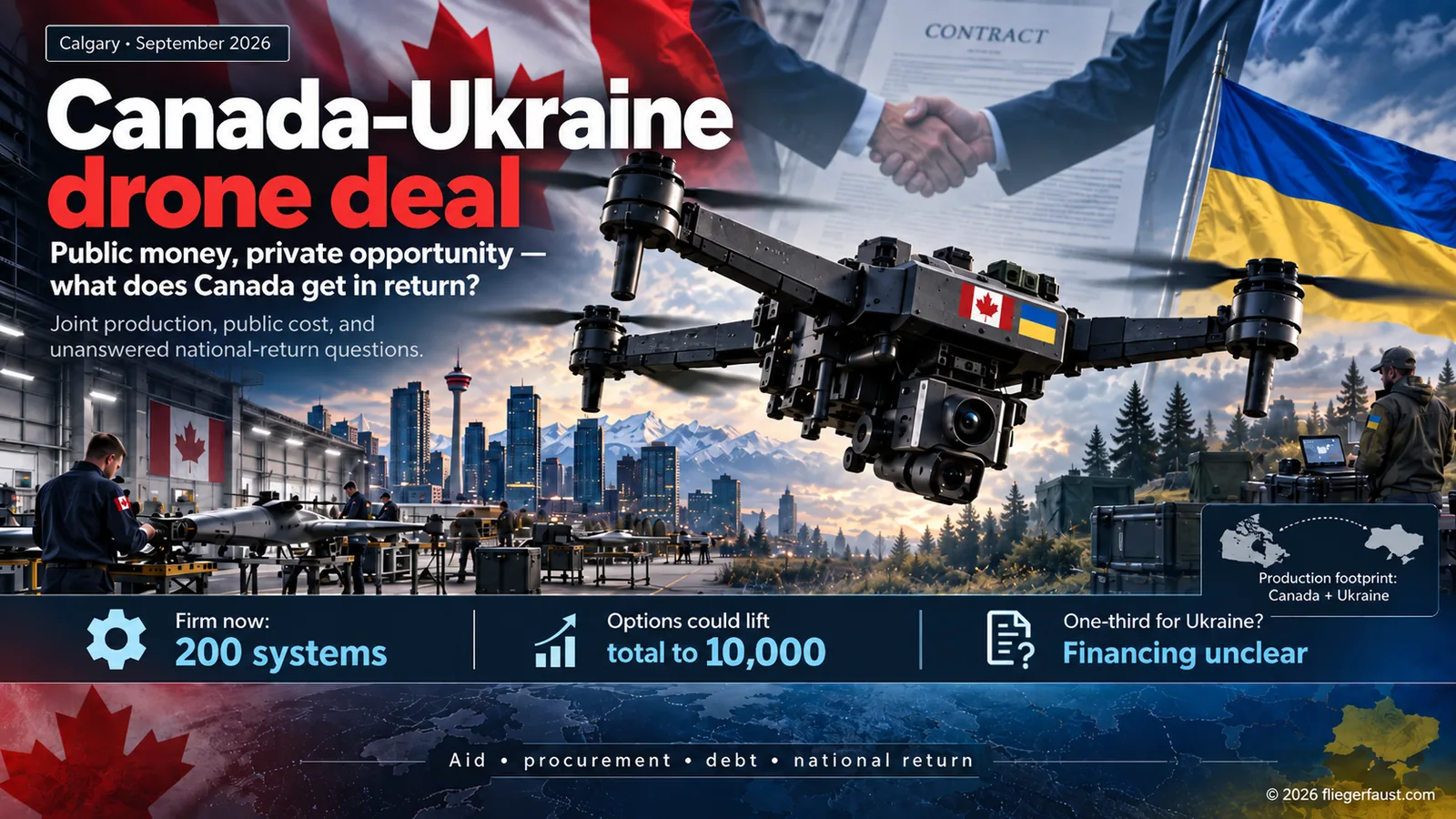
Why should Canadians accept another industrial success story before Ottawa demonstrates the cost and national return?
Ukraine drone deal: Canada is committing public resources while contractors gain business opportunities. Those are not equivalent benefits.
On September 10, 2026, Prime Minister Mark Carney and President Volodymyr Zelenskyy signed new declarations in Calgary, Alberta. Breaking Defense reported the defence-production initiative the following day.
However, the declaration published by Global Affairs Canada remains a political framework. The governments intend to conclude their comprehensive century-long agreement by December 2026.
The announcements establish spending commitments and industrial ambitions. They do not establish a net economic gain for Canada. Debt, procurement integrity and financial interests belong at the centre of this story—not in its footnotes.
Ukraine drone deal: Separate Canadian procurement from aid
The destination of the drones is not a minor detail. Carney explicitly committed part of future manufacturing to Ukraine.
“Importantly, one-third of all the drones we manufacture will go to support Ukraine’s defence of its homeland.” — Mark Carney, Prime Minister of Canada, September 10, 2026.
Meanwhile, Ukraine’s presidential office specifies 30 per cent of production under the joint programme. That differs from Carney’s one-third figure. Both statements concern production, not a specified share of all Canadian government purchases.
Will Canadian taxpayers finance drones supplied to Ukraine free of charge?
Neither statement explains whether Ukraine will pay for its allocation. Will Canadian taxpayers finance drones supplied to Ukraine free of charge? Who pays, how much, and what does Canada receive in return? Ottawa should disclose the financing terms and any Ukrainian contribution. Announcing where drones will go is not an accounting of who bears their cost.
Importantly, neither statement establishes that every Canadian drone purchase will leave Canada. Nor does either establish that Canada keeps all remaining production.
Specifically, Draganfly’s September 11 announcement identifies an initial 100 surveillance systems for the Canadian Armed Forces (CAF). Options cover another 4,900 systems. The initial price remains undisclosed, while exercising all options would require additional authorisation.
The Ukraine drone deal combines domestic procurement with assistance and prospective joint production. Treating everything as a donation would be premature. Treating everything as a Canadian military asset would be equally misleading.
The manufacturing footprint also extends beyond Canada. Ukraine’s presidential office says the framework envisages defence production in both Canada and Ukraine. It is therefore not an exclusively Canadian manufacturing programme. Production location, equipment ownership and payment obligations are separate questions.
Volatus: A Canadian contract with questions about manufacturing
Volatus Aerospace received a separate contract under the same Defence Drone Initiative Marketplace used for the Draganfly award. The structure is strikingly similar: Volatus disclosed a firm initial purchase of 100 tactical ISR systems, with Canada retaining options for another 4,900. That creates a potential ceiling of 5,000 Volatus systems, while Draganfly separately has its own 100-system firm award and 4,900-system option.
Canada has therefore committed to 200 systems across the two companies—not 10,000. Exercising every available option could theoretically raise the combined total to 10,000, but no public announcement says Ottawa intends to do so. The matching contract structures appear designed to give Canada scalable access to competing platforms rather than constitute firm orders for their maximum quantities.
For context, our Fliegerfaust follow-up on Volatus Aerospace’s Mirabel drone hub tracked the company’s push toward Canadian manufacturing, integration and NATO-oriented defence work. That earlier analysis also raised the same question this new contract now makes more important: how much sovereign Canadian capability will remain here when the underlying technology, partners and supply chain cross national borders?
The procurement framework allows up to C$25 million. That is a ceiling, not a C$25 million firm purchase. Volatus has not disclosed its contracted prices. Optional quantities are not committed purchases or revenue.
Meanwhile, the Prime Minister’s Office backgrounder identifies the system as the Huntsman X6, manufactured in the United Kingdom with Canadian support and sustainment. However, the accompanying government news release describes manufacturing in Montréal. Ottawa should clarify where manufacturing, assembly and integration occur—and how much contract value remains in Canada.
The company names the CAF as its customer. Its announcement does not designate these 100 systems for Ukraine or establish that the one-third production allocation applies to this contract.
Defence procurement has several different price tags
The Prime Minister’s Office announced initial drone contracts worth up to C$50 million. Separately, it committed approximately C$350 million for Ukrainian air-defence interceptors through an American-led mechanism.
The package also includes nearly C$435 million in energy-related loan guarantees and C$200 million in concessional reconstruction loans. These are not interchangeable expenditures. Guarantees create contingent exposure; loans create assets whose value depends on repayment.
Therefore, adding their face values and calling the result money already donated would distort the accounts. Equally, excluding guarantees because no immediate cheque clears would conceal an important financial risk.
A century-long declaration still needs an annual ledger.
Ukraine drone deal meets Canada’s existing debt burden
Our Fliegerfaust investigation into Canada’s unpaid rearmament bill places these commitments within a much larger fiscal problem. Canada is rebuilding military capacity while carrying substantial public liabilities and financing continuing deficits.
Statistics Canada’s consolidated government accounts for 2024 report C$3.3852 trillion in gross debt. That measure combines federal, provincial, territorial and local governments. After deducting financial assets, net debt was C$1.6052 trillion.
Importantly, these are dated public-sector measures—not household borrowing and not today’s federal debt alone. Nevertheless, their scale is serious enough without relabelling them or adding incompatible figures.
The Ukraine drone deal enters this balance sheet as another policy choice requiring funding. Canadian production does not erase that obligation. A contractor’s revenue is an expense to its customer, even when both operate under the same flag.
Canadian defence spending carries financing costs
The Department of Finance’s Spring Economic Update 2026 projects federal debt alone of C$1.3339 trillion in 2025–2026. It projects C$1.6294 trillion by 2030–2031: an increase of C$295.5 billion.
Moreover, annual federal debt charges rise from C$54 billion to C$80.9 billion across those same projected years. These are forecasts, not completed spending.
It does mean borrowing has a continuing price. Additional expenditure without offsetting revenue or savings increases financing needs and competes with other priorities.
Nevertheless, military spending need not produce a financial profit to be necessary. Equipment, readiness and deterrence are public services. The separate claim that procurement generates an economic windfall requires evidence beyond company sales and employment announcements.
For the Ukraine drone deal, Ottawa should disclose the subsidy, imported content, support costs and expected Canadian work. It should compare those costs with alternative ways of obtaining the same military capability.
Jobs are a benefit. They are not proof that a programme pays for itself. Interest, meanwhile, does not accept press releases as payment.
Corruption investigations demand stronger safeguards
The procurement risk is concrete. On August 13, 2026, the National Anti-Corruption Bureau of Ukraine reported new findings in a drone-purchasing investigation. It acted with the Specialized Anti-Corruption Prosecutor’s Office.
Investigators alleged state losses of 254 million hryvnias—approximately C$7.7 million (US$5.5 million) at August 13, 2026 exchange rates—from procurements in 2023. They described prices 60–90 per cent above market, predetermined winners and competing companies under common control. The release states that the pre-trial investigation remained ongoing.
Separately, the National Anti-Corruption Bureau’s April 17, 2026 announcement reported completion of another drone and electronic-warfare procurement investigation. Allegations included kickbacks reaching 30 per cent of contract value. Suspects included public officials, a military commander and representatives of a drone manufacturer.
Furthermore, these concern other procurements and do not establish misconduct by the Canada–Ukraine programme’s named suppliers. However, they identify specific procurement failures against which Canadian arrangements should protect.
Defence procurement needs enforceable checks
These investigations show that Ukrainian anti-corruption bodies are detecting and pursuing some alleged abuses. That is evidence of enforcement activity, not proof that the procurement system is effective or secure. The cases themselves expose weaknesses serious enough to justify tighter safeguards around any Canadian-funded programme. They also raise an uncomfortable question: are the cases that have surfaced only the tip of the iceberg, given Ukraine’s long-documented corruption problems?
The Ukraine drone deal should therefore require independent price benchmarking and disclosure of suppliers’ ultimate owners. Canadian auditors need access to contracts, subcontractors, payment records and delivery evidence. Recovery provisions and suspension rights must survive political pressure to keep funds moving.
Moreover, safeguards must cover intermediaries and related companies, not simply the supplier signing the first contract. Competing letterheads do not necessarily mean competing owners.
Urgency strengthens the case for fast verification. It does not justify abandoning verification. Ottawa should show how its contracts address these documented risks before promising that industrial cooperation guarantees good governance.
Carney and Brookfield: The documented financial interests
The conflict-of-interest question deserves precision. Brookfield and BlackRock are separate companies. Combining their names into one allegation obscures the relationships that public documents actually establish.
At House of Commons hearings on November 24, 2025, Brookfield chief operating officer Justin Beber addressed Carney’s compensation interests. The evidence identified carried-interest entitlements connected to Brookfield Global Transition Fund I.
Carried interest is a share of fund profits, subject to performance conditions. Beber distinguished the first fund from later funds for which Carney had received no allocation. The testimony therefore identifies an economic interest, not merely a former employer.
However, a historical disclosure does not reveal the complete present contents of a blind trust. Consequently, reporting those interests requires their dates and the safeguards established around them.
Private financial interests do not disappear inside a blind trust
The Commons ethics committee’s April 2026 report records that Carney placed controlled assets, including Brookfield-related interests, in a blind trust. That complied with the available statutory mechanism.
The Ethics Commissioner explained that Carney does not direct the trust. He also acknowledged that decisions affecting previously held companies could benefit him financially. That is why a separate conflict-of-interest screen exists.
Nevertheless, the committee recommended requiring prime ministers to sell controlled assets rather than rely on a blind trust. That is a recommendation for stronger rules, not a finding that the September partnership breached existing law.
A blind trust changes who manages the assets. It does not necessarily extinguish the beneficiary’s financial interest.
The Westinghouse connection is real—and distinct from drones
Moreover, the investment chain extends into Ukraine’s energy business. Cameco’s October 11, 2022 announcement identified Brookfield Global Transition Fund I as the vehicle for Brookfield Renewable’s Westinghouse investment.
Subsequently, Cameco confirmed completion on November 7, 2023. Cameco acquired 49 per cent; Brookfield and its partners acquired 51 per cent.
Meanwhile, Westinghouse’s June 30, 2026 account of its Ukrainian activities describes nuclear-fuel supply and reconstruction opportunities. This establishes Ukrainian commercial exposure within the investment chain.
The proper demand is specific: identify which relevant decisions required screening, who took them and what independent review occurred. Ultimately, public assurance should rest on auditable safeguards, not an expectation that Canadians ignore financial connections.
BlackRock and General Dynamics: Follow the disclosed relationship
Separately, Ottawa’s September announcement identifies General Dynamics Mission Systems-Canada and Ukraine’s Green Tech Harvest as drone-development partners. That makes the parent company’s disclosed financial relationships relevant to understanding the commercial interests.
General Dynamics’ 2026 proxy statement, filed with the Securities and Exchange Commission, reports BlackRock’s beneficial ownership above five per cent. The statement dates that disclosure to December 31, 2025.
It also reports approximately US$8 million in 2025 fees for a BlackRock affiliate’s management of certain employee-benefit investments. General Dynamics describes these arrangements as arm’s-length and unrelated to BlackRock’s shareholding.
Those are established financial relationships. Scrutiny of the Ukraine drone deal should distinguish contractor revenue, shareholder exposure and a politician’s personal interests. A shareholding is not a procurement signature.
Bombardier shows what Canada should demand from industry
The Defence Industrial Strategy published by National Defence assigns C$6.6 billion from Budget 2025’s defence funding to industrial development. Ottawa wants Canadian firms to receive 70 per cent of defence acquisitions over the following decade.
However, a domestic purchasing target does not establish domestic technological control. The Ukraine drone deal must demonstrate more than a Canadian production address.
A parallel aerospace investment illustrates the distinction. On March 9, 2026, the National Research Council of Canada announced more than C$900 million in defence-related programmes.
More than C$500 million supports aerospace capabilities, including a Bombardier Global 6500 research aircraft and an Ottawa–Mirabel Drone Innovation Hub. The C$500 million is not the aircraft price. Nor does this separate announcement make Bombardier an aircraft supplier under the bilateral drone arrangement.
Our Fliegerfaust coverage of Bombardier’s defence expansion examines the opportunity to retain modification, integration and support work. That is where a Canadian aircraft platform can support deeper industrial capability.
Sovereign drone capability requires usable technical rights
Likewise, our Fliegerfaust analysis of Canada’s GlobalEye discussions considers the relationship between Bombardier aircraft and Saab mission systems. Supplying an airframe and controlling an integrated military capability are different responsibilities.
The same applies to drones. The Prime Minister’s Office supplier backgrounder describes Draganfly’s proposed platform as Australian technology produced under licence in Canada. Twenty20 Insight provides Canadian services around a British-designed and manufactured platform.
Licensing foreign technology can be sensible. But the Ukraine drone deal needs enforceable repair, modification and support rights. Canadian forces must also test equipment against their own weather, communications and operational requirements.
Moreover, subsidies should buy measurable capability rather than permanent dependence on further subsidies. Export forecasts require actual customers, not the assumption that emergency wartime demand lasts indefinitely.
Final assembly is not the final word on sovereignty.
The strategic question: What outcome is Canada financing?
Weakening Russia’s military capacity has been an openly stated objective not only in Washington, but across the broader NATO strategy supporting Ukraine. On April 25, 2022, then-U.S. defence secretary Lloyd Austin said Washington wanted to see Russia weakened to the point that it could not repeat such an invasion. NATO leaders have since made the same logic explicit: allied support has helped destroy a substantial part of Russia’s combat capacity, while sanctions are intended to weaken Russia’s economy and limit its ability to rebuild its armed forces.
“We want to see Russia weakened…” — Lloyd Austin, then United States Secretary of Defense, official transcript.
That does not establish the sole purpose of Canadian policy today. It does establish why military assistance should face strategic scrutiny as well as financial scrutiny.
Degrading Russian military power, protecting Ukrainians and expanding contractor revenue are three different outcomes. None automatically proves the others. Governments should explain the achievable objective, the risks and the diplomatic path alongside their purchasing plans.
Ukraine drone deal: Who bears the combat risk?
“Ukraine’s fight is our fight…” — Mark Carney, Prime Minister of Canada, September 10, 2026.
If this is truly our fight, why does the commitment stop short of sending our own combat forces? That is the contradiction Fliegerfaust challenges: governments describe a shared struggle without accepting a shared commitment to fight.
The North Atlantic Treaty Organization (NATO) states that alliance combat troops will not be deployed against Russia in Ukraine. Meanwhile, National Defence describes Operation UNIFIER as training and capacity-building. Training Ukrainian soldiers is not the same commitment as sending Canadian forces to fight alongside them. The same distinction applies to the United States and European NATO members.
No NATO country has openly committed its national combat forces to fight Russia in Ukraine. Governments call Ukraine’s struggle a shared fight, but the battlefield burden remains overwhelmingly Ukrainian. Money, weapons, training and industrial contracts are another matter: those commitments continue to grow.
Similarly, the January 6, 2026 Paris Declaration envisages a multinational force AFTER a credible cessation of hostilities. A promise concerning the period after the fighting stops does not answer who bears the combat burden now.
Fliegerfaust rejects the suggestion that expanding weapons production is, by itself, evidence of a policy that puts Ukrainians first. Weakening Russia, increasing defence-company revenue and protecting Ukrainian lives are different objectives. Success in one does not establish success in the others.
Where are corporate taxes paid?
Moreover, Canadian taxpayers should not accept contractor revenue as proof of a national return. Ottawa should disclose which corporate entities receive the revenue, where the resulting profits are recognized, how much value actually remains in Canada and where corporate taxes are ultimately paid. Governments seeking further funding must explain what their chosen level of involvement can achieve—not simply announce another purchasing commitment.
The test is not whether Ukraine can keep fighting while factories keep producing. It is whether the policy offers Ukrainians a credible route out of the war—and Canadians a defensible reason for the bill.
Defence procurement cannot guarantee a political endgame
The bilateral declaration supports Ukraine’s territorial integrity within its internationally recognised borders. That is a political objective, not a forecast that additional drone production will recover every occupied territory.
Equally, declaring Ukraine’s future borders permanently settled would turn a prediction into fact. The Ukraine drone deal should stand on demonstrable military utility, not promises of a guaranteed outcome.
Ukrainian lives are not an industrial-policy performance measure. Canada should assess whether each commitment improves protection, resilience and the prospects for a durable settlement. A larger orderbook cannot answer those questions.
The most important exit strategy should concern the war, not an investor’s portfolio.
Ukrainian military deaths: Historical monthly, weekly and daily averages
The Center for Strategic and International Studies (CSIS) estimates 125,000–150,000 Ukrainian military deaths between February 2022 and June 2026. Dividing that estimate across the 1,588 calendar days from February 24, 2022 through June 30, 2026, including both dates, produces the following historical averages.
| Historical military-death average | Calculated range |
|---|---|
| Per 30 days | Approximately 2,360–2,830 deaths |
| Per week | Approximately 550–660 deaths |
| Per day | Approximately 79–94 deaths |
These are calculated averages across the full period—not estimates of the current daily rate or the rate since January 2026. They concern military deaths only and exclude civilian deaths.
How many have died since the full-scale invasion?
These figures cover the period beginning February 24, 2022. They do not include the earlier 2014–2021 conflict.
| Category | Death toll | Period covered | What the number represents |
|---|---|---|---|
| Ukrainian military personnel | 125,000–150,000 | February 2022–June 2026 | Military fatalities estimated by CSIS in its July 1, 2026 analysis. |
| Civilians in Ukraine | At least 16,874 | February 24, 2022–July 31, 2026 | Civilian deaths individually verified by United Nations human-rights monitors. |
The civilian figure comes from the United Nations’ July 2026 civilian-protection report. It is a verified minimum, not a complete death toll. The report states that the actual extent of civilian harm is likely considerably higher.
The military and civilian figures use different methods and cut-off dates. They should not be presented as one exact, independently verified total.
Conclusion: Ukraine drone deal leaves Canadians with unanswered questions
On the evidence now public, the benefit to Ukraine and participating defence companies is easier to identify than the benefit to Canadian taxpayers. Ottawa has announced Canadian military purchases, industrial opportunities and substantial support for Ukraine. It has not demonstrated that those commitments produce an equivalent economic return for Canada.
Canadian companies may gain contracts, jobs and production experience. The Canadian Armed Forces will receive some equipment. However, contractor revenue is not government revenue, employment does not erase public expenditure, and domestic assembly does not automatically create sovereign Canadian technology. Ottawa still has to show what Canada owns, what Canada controls and what capability remains here after the contracts end.
The unanswered financing question is fundamental. Carney says one-third of drone production will support Ukraine, while Ukraine’s presidency cites 30 per cent under the joint programme. The public documents still do not explain who pays for that share. Until Ottawa discloses those terms, Canadians cannot determine how much of the programme is national procurement, industrial subsidy or military assistance.
The corruption issue also cannot be dismissed as background noise. Ukrainian anti-corruption investigators have documented alleged overpricing, predetermined bidders and kickback schemes in other drone procurements. Those cases do not prove wrongdoing in this programme. They do prove why Canadian money requires independent pricing, ownership disclosure, delivery verification and enforceable audit rights.
Likewise, Carney’s disclosed financial interests and the corporate relationships examined in this article do establish why conflict-of-interest screens and independent oversight must be visible and auditable. Canadians should not be asked to substitute trust for disclosure when billions of public dollars and private commercial interests intersect.
The human cost makes the debate considerably harder to reduce to jobs and factories. Independent estimates put Ukrainian military deaths at roughly 125,000–150,000 through June 2026, while United Nations monitors had verified at least 16,874 civilian deaths by the end of July. Those numbers continue to rise.
At the same time, governments describe Ukraine’s fight as a shared struggle while stopping short of sending their own combat forces to fight Russia. That leaves Ukrainians carrying the battlefield risk while allied taxpayers finance weapons, training and industrial expansion. If that is the chosen strategy, governments owe the public a credible explanation of what outcome it can realistically achieve.
Weakening Russia, supporting Ukraine, creating Canadian defence jobs and generating contractor revenue are not the same objective. Success in one does not prove success in another.
Fliegerfaust’s conclusion is therefore straightforward: this should not be presented as a good deal for Canada until Ottawa proves that it is one. The government should disclose who pays for Ukraine’s production share, what intellectual property and technical rights Canada retains, how much Canadian content is actually involved, what safeguards protect public money and what military end state this continuing expenditure is intended to achieve.
Canada already carries substantial public debt and rising debt-service costs. A hundred-year partnership does not make those obligations disappear, and another defence announcement does not answer the most basic question.
Before Canadians are asked to finance the next expansion, what exactly does Canada receive in return—and what is the strategy for ending a war Canadians are funding but are not being asked to fight?
What do you think?
The Ukraine drone deal must earn further commitments through verified results. A hundred-year partnership is no reason to postpone next year’s audit. Before taxpayers finance another expansion, will Ottawa show what Canada receives, what it retains and what the full bill will be?
Leave your comments below and on our Fliegerfaust Facebook page.
Sources
Canada–Ukraine commitments and drone procurement
- Breaking Defense — Canada, Ukraine to jointly produce defense tech, part of ‘100-year partnership’ (September 11, 2026).
- Global Affairs Canada — Canada-Ukraine declaration for a 100-year partnership (September 10, 2026).
- Prime Minister of Canada — Canada and Ukraine to scale up drone production, build up Canada’s defence industries, and achieve a just and lasting peace in Ukraine (September 10, 2026; speech).
- Office of the President of Ukraine — In Canada, Volodymyr Zelenskyy and Mark Carney Took Part in a Drone Presentation (September 11, 2026).
- Draganfly — Draganfly Selected by Government of Canada to Supply Low-Cost Tactical ISR UAS to the Canadian Armed Forces (September 11, 2026).
- Prime Minister of Canada — Canada and Ukraine to scale up drone production, build up Canada’s defence industries, and achieve a just and lasting peace in Ukraine (September 10, 2026; news release).
- Prime Minister of Canada — Canada and Ukraine to scale up drone production, build up Canada’s defence industries, and achieve a just and lasting peace in Ukraine (September 10, 2026; backgrounder).
- Office of the President of Ukraine — Ukraine and Canada signed documents on a century-long partnership and bilateral cooperation in defence and energy (September 10, 2026; translated title).
- Volatus Aerospace / GlobeNewswire — Volatus Aerospace Awarded Canadian Defence Contract for Tactical ISR Uncrewed Aircraft Systems for up to 5,000 systems (September 10, 2026).
Public finances and procurement investigations
- Statistics Canada — Consolidated Canadian Government Finance Statistics, 2024 (November 21, 2025).
- Department of Finance Canada — Annex 1: Details of economic and fiscal projections, Spring Economic Update 2026 (April 28, 2026).
- National Anti-Corruption Bureau of Ukraine — UAH 254M drone procurement scheme: new facts disclosed (August 13, 2026).
- National Anti-Corruption Bureau of Ukraine — Corruption in procurement of UAVs and electronic warfare systems: investigation completed (April 17, 2026).
Financial interests and corporate disclosures
- House of Commons — Standing Committee on Access to Information, Privacy and Ethics: Evidence, Meeting 18 (November 24, 2025).
- House of Commons — Review of the Conflict of Interest Act (April 2026).
- Cameco — Cameco and Brookfield Renewable Form Strategic Partnership to Acquire Westinghouse Electric Company (October 11, 2022).
- Cameco — Cameco and Brookfield Complete Acquisition of Westinghouse Electric Company (November 7, 2023).
- Westinghouse Electric Company — Westinghouse Reaffirms Its Long-Term Commitment to Ukraine’s Energy Future (June 30, 2026).
- General Dynamics — 2026 Proxy Statement (2026).
Defence policy, aerospace and strategic objectives
- National Defence — Canada’s Defence Industrial Strategy (page dated February 26, 2026).
- National Research Council Canada — New programs to support Canada’s Defence Industrial Strategy (March 9, 2026).
- United States defence transcript — Secretary of State Antony J. Blinken and Secretary of Defense Lloyd J. Austin III Remarks to Traveling Press (April 25, 2022).
Combat deployments and casualty estimates
- North Atlantic Treaty Organization — NATO’s support for Ukraine (accessed September 12, 2026).
- National Defence — Operation UNIFIER (page updated September 8, 2026).
- Prime Minister of Canada — Paris Declaration – Robust security guarantees for a solid and lasting peace in Ukraine (January 6, 2026).
- Center for Strategic and International Studies — Russian Blood and Treasure: The Ballooning Costs of Putin’s War, by Seth G. Jones and Riley McCabe (July 1, 2026).
- United Nations Human Rights Monitoring Mission in Ukraine — Protection of Civilians in Armed Conflict — July 2026 (August 12, 2026).
For full details, please refer to our Disclaimer page.