

Can Éric Martel turn a Canadian business-jet leader into a larger military integrator as allied governments open their treasuries?
Bombardier defence expansion: On July 30, 2026, Éric Martel, Bombardier Inc.’s president and chief executive officer (CEO) linked acquisitions, aircraft maintenance, and a Canadian military-modification site during the company’s post-results media cycle.
Crucially, the immediate development was strategic, not contractual. Reuters reported on July 30, 2026 that Bombardier expects to choose a Canadian location by late 2026 or early 2027. The proposed operation would prepare Bombardier Global business jets for special missions with Sweden’s Saab.
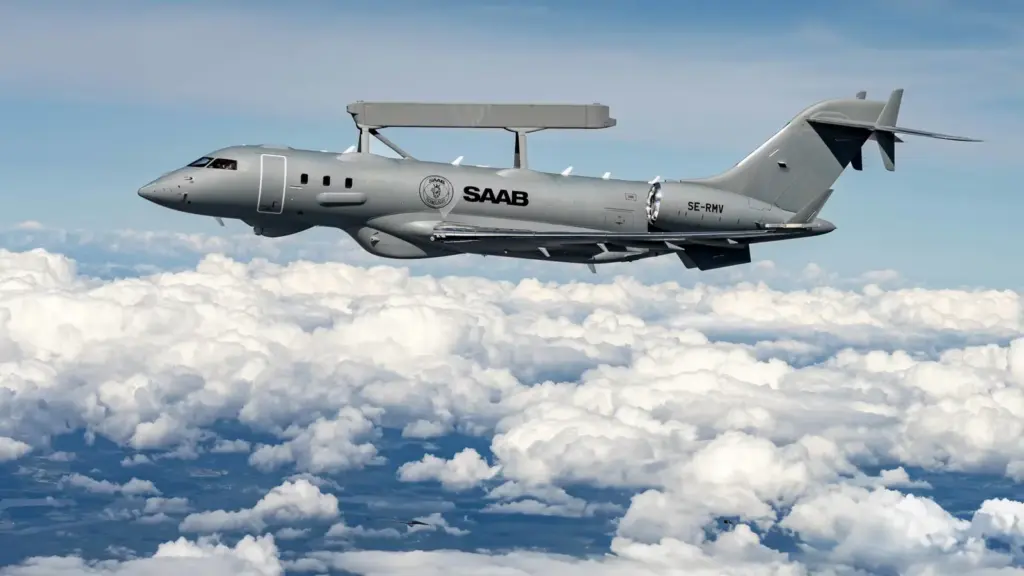
Saab GlobalEye Airborne Early Warning and Control aircraft – Source Saab saab.com
However, Bombardier did not announce a merger, identify an acquisition target, or select a factory location. Canada has not signed a GlobalEye purchase contract, while Saab has not booked the prospective North Atlantic Treaty Organization (NATO) order. Even so, Bombardier is positioning itself to capture more value from military aircraft, modifications, maintenance, upgrades, and long-term support.
Meanwhile, Canada and European allies are accelerating defence investment on a scale rarely seen outside wartime mobilisation. Consequently, contractors see larger addressable markets and longer order books. Taxpayers may see higher deficits, more borrowing, and decades of sustainment costs.
Overall, that contrast gives the Bombardier defence expansion its central tension. Bombardier has spent years reducing its own leverage. Ottawa will now increase public leverage to finance the procurement wave that Bombardier and its competitors intend to serve.
Bombardier defence expansion becomes an operating plan
Bombardier military growth links three revenue streams
First, Martel connected three businesses that can reinforce each other. Bombardier can sell the aircraft, modify it for a military mission, and support it throughout service. Therefore, each additional role extends the company’s share of the aircraft’s economic life.
Moreover, The Canadian Press reported that Martel is examining acquisitions in aircraft services and defence. He said Bombardier could buy capabilities it does not presently offer on its aircraft.
“The best way for us to get there could be by acquisition …” — Éric Martel, President and CEO of Bombardier, The Canadian Press
Martel then applied the same mergers and acquisitions (M&A) logic to the military business.
“We’ll look at M&A opportunities.” — Éric Martel, President and CEO of Bombardier, The Canadian Press
Consequently, the Bombardier defence expansion appears more likely to use focused purchases than a transformational merger. Suitable targets could add engineering approvals, specialist technicians, secure facilities, component repair, mission integration, or regional maintenance coverage. Bombardier has not identified any target, so those categories remain analysis rather than disclosed plans.
Aerospace strategy often begins with a hangar and ends with a procurement lawyer.
PEGASUS shows military aircraft modification in practice
The Persistent German Airborne Surveillance System (PEGASUS) shows how the current value chain works. Germany is converting three Bombardier Global 6000 aircraft into airborne signals-intelligence platforms for the German Armed Forces.
Bombardier already performs foundational military modification work in Wichita, Kansas. The Globe and Mail reported that Bombardier dispatched a team during the week of July 27, 2026, to scout Canadian sites for a plant modelled on that operation. Martel was also discussing a larger GlobalEye production role with Saab.
A joint programme release from Hensoldt, Lufthansa Technik Defense, and Bombardier Defense says Bombardier performs extensive structural modification, ground testing, and flight testing in Wichita, Kansas, in the United States. Each aircraft then moves to Lufthansa Technik Defense in Hamburg, Germany.
The first aircraft reached Hamburg in December 2025. There, Lufthansa Technik Defense integrates Hensoldt’s Kalaetron Integral signals-intelligence system, the mission cabin, and additional military and communications systems. It also handles civil and military certification, while Hensoldt remains the general contractor.
The HENSOLDT Kalaetron Integral is…
The HENSOLDT Kalaetron Integral is a fully digital, wideband airborne signals intelligence (SIGINT) system that merges communications intelligence (COMINT) and electronic intelligence (ELINT) into a single platform. It operates across a frequency range of 20 MHz to 40 GHz, utilizes artificial intelligence (AI) to identify threat patterns, and serves as the core sensor suite for systems like the German Air Force’s PEGASUS reconnaissance jets.
The military value-chain gap Bombardier wants to close
In my assessment, PEGASUS reveals the value-chain gap behind the Bombardier defence expansion. A Canadian facility could allow Bombardier to retain more integration, certification, and lifecycle work on GlobalEye and later programmes.
Martel said workforce availability would influence the site decision. In my view, that criterion may matter more than simple proximity to final assembly. Bombardier already accepts a ferry stage in its Global production flow: “green” aircraft leave the Toronto area for Montréal-area interior completion. GlobalEye would provide the opening workload, although the facility could later support other military missions.
That existing production flow shows the defence operation does not have to sit beside the final assembly line. However, military missionisation is not cabin completion. It can involve structural reinforcement, external radar or sensor provisions, extensive mission wiring, additional power and cooling, secure systems integration, flight testing, and military certification.
Consequently, the decisive variables may be qualified labour, suitable facilities, and the location of any acquisition or industrial partner. The aircraft can fly to the work. The scarcer asset is the team qualified to perform it.
“There is an opportunity now to start this operation with the GlobalEye.” — Éric Martel, President and CEO of Bombardier, Reuters
That statement turns Bombardier defence expansion from a broad aspiration into an operating concept. A Canadian site could combine modification, inspection, ground testing, documentation, later upgrade work and certification. Those skills would remain useful after the first aircraft entered service.
Still, Bombardier has not released a location shortlist, capital budget, construction schedule, or employment estimate. It has not said whether it will construct a new centre or adapt an existing facility. Any claim that Toronto, Montréal, Dorval, Mirabel, or Halifax has already won the project would therefore exceed the evidence. In my assessment, Mirabel would likely offer the most space and could prove the least expensive option for a purpose-built, expandable defence operation (read section Where Bombardier could build its Canadian defence centre lower).
The announcement remains short of a commitment
Meanwhile, the July 30 comments produced immediate follow-up coverage. Defense Watch’s July 31 report usefully described the work that a Canadian modification centre could perform. However, it called NATO’s planned acquisition an approved contract worth about US$4.5 billion.
That wording goes beyond the primary record. Saab’s official release says formal negotiations remain ahead and no order has been received. NATO announced joint procurement of up to ten aircraft, but quantity, price, support, training, and delivery terms still require agreement.
Therefore, the Bombardier defence expansion has crossed a strategic threshold without crossing the contractual one. Management has now explained where it wants to add value and how acquisitions could accelerate that move. The next evidence must come from signed orders, a site commitment, funded work packages, and completed transactions.
This distinction matters for investors and taxpayers. A prospective programme can justify planning and recruitment. It cannot yet justify treating projected aircraft, jobs, or revenue as booked business.
Where Bombardier could build its Canadian defence centre
Bombardier has not disclosed a shortlist, and the following ranking is my assessment rather than reported company guidance. I considered workforce depth, industrial space, aircraft flow, security requirements, flight-test access, expansion potential, and the possibility that an acquisition or partnership could determine the location.
1. Montréal–Mirabel: the strongest long-term military aircraft modification site
Montréal–Mirabel International Airport (YMX) remains my leading candidate. It offers the best overall combination of industrial space, airport access, expansion potential, and proximity to Greater Montréal’s aerospace workforce.
- Access to engineers and technicians experienced in structures, avionics, manufacturing, quality control, testing, and aircraft certification.
- More room for dedicated military hangars, secure programme areas, flight-test operations, and future expansion than denser airport locations.
- Proximity to Bombardier’s Montréal-area engineering, completion, customer-support, and supplier network.
- Enough physical separation to establish a distinct defence operation without placing it directly inside the civil final-assembly flow.
- Potential to support GlobalEye first, then expand into communications, intelligence, surveillance, electronic-warfare, and government-aircraft programmes.
The ferry flight from Toronto should not disqualify Mirabel. Bombardier already moves green Global aircraft to Montréal for completion. A military aircraft can also move between specialised production stages when the workforce and facilities justify the transfer.
However, Mirabel does not automatically solve the labour problem. Skilled mission-integration and certification personnel remain scarce. Bombardier would still need to recruit them, transfer them, develop them internally, or obtain them through an acquisition.
2. Toronto Pearson–Mississauga: the shortest route from Global final assembly
Toronto Pearson International Airport (YYZ) in Mississauga presents the strongest production-flow argument. Bombardier already assembles Global-family aircraft there, including the Global 6500 platform used by GlobalEye.
- Direct access to the Global aircraft final-assembly operation and its specialised workforce.
- Fewer production hand-offs between civil assembly and military modification.
- Simpler configuration control, documentation, inspection, and aircraft movement.
- Immediate access to Global-family tooling, manufacturing knowledge, and suppliers.
- The most efficient location for moving a green Global 6500 directly into its military-modification stage.
If Bombardier prioritises the simplest GlobalEye production flow, Pearson may be the logical winner. It would allow the company to move an aircraft from final assembly into military work without an initial ferry flight.
However, Pearson-area land is expensive and constrained. Bombardier also needs its existing workforce to support civil Global production. A defence operation could compete with the company’s own delivery ramp for technicians, engineers, tooling, and hangar space.
Secure military activity may also require greater physical separation than the existing civil-production campus can provide. The shortest route between two production stages is not always the easiest place to build a larger defence business.
3. Dorval–Montréal–Trudeau: the engineering and completion centre
Montréal–Trudeau International Airport (YUL) in Dorval (formerly Montréal–Dorval International Airport) offers Bombardier’s deepest concentration of corporate knowledge, engineering support, aircraft completion, customer response, quality control, and programme-management experience.
- Existing experience receiving and completing green Global aircraft from Toronto.
- Access to engineering, manufacturing-support, pre-flight, quality, and customer-delivery personnel.
- Proximity to Bombardier management and a mature aerospace supplier network.
- A strong base for programme management, systems engineering, certification support, and long-term fleet services.
- Potential to coordinate Canadian and international partners from an established Bombardier location.
The existing completion flow makes Dorval highly relevant, but it should not be confused with the proposed military operation. Installing a business-jet interior is different from cutting or reinforcing aircraft structure, adding dorsal radar supports or external sensor fairings, routing mission wiring, supplying additional electrical power and cooling, and certifying a military configuration.
Dorval may therefore be more suitable as the programme’s engineering and support nucleus than as its main heavy-modification plant. Dorval could become the brain of the operation even if Mirabel becomes its industrial muscle.
4. Halifax Stanfield–Enfield: the acquisition-driven wildcard
Halifax Stanfield International Airport (YHZ) near Enfield ranks fourth, but it could rise quickly if Bombardier acquires or partners with an established military-aircraft specialist in Atlantic Canada.
- An established regional culture of military-aircraft maintenance, modification, engineering, and fleet support.
- Personnel accustomed to government contracts, controlled programmes, military quality requirements, and long-term sustainment.
- Airport infrastructure suitable for large aircraft, dedicated hangars, testing, and secure work.
- A geographic position oriented toward European and NATO customers.
- The possibility of obtaining qualified personnel and existing approvals through a partnership, merger, or acquisition.
While Halifax lacks the direct connection to Global final assembly that Pearson offers, it also sits outside Bombardier’s main Montréal engineering and management concentration. Every aircraft would require a ferry flight, while parts, technical data, and personnel would have to move through a more distributed industrial system.
Nevertheless, an established military-modification workforce could outweigh those disadvantages. If Bombardier acquires a company with the required people, approvals, facilities, and government experience, the location may follow the acquired capability rather than Bombardier’s existing map.
My location ranking and the factor that could change it
- Montréal–Mirabel International Airport
- Toronto Pearson–Mississauga
- Dorval–Montréal–Trudeau
- Halifax Stanfield–Enfield (merger / acquisition would make it the winner).
Mirabel remains my first choice because it offers the best platform for a scalable, secure, multi-programme defence operation. It combines access to Greater Montréal’s aerospace cluster with the physical room needed for structural modification, systems installation, flight testing, and future expansion.
However, geography alone will not settle the decision. The availability of qualified personnel could outweigh every other factor and even tilt the choice toward Halifax, where IMP Aerospace & Defence and L3Harris Technologies already support military aircraft, avionics, and mission systems. Equally, the company Bombardier ultimately acquires, merges with, or selects as its principal industrial partner could determine where the operation belongs.
Mirabel nevertheless has a powerful workforce and infrastructure case. The Government of Canada identifies L3Harris MAS at Mirabel as the country’s only supplier performing the full range of maintenance, repair, and overhaul work on Royal Canadian Air Force (RCAF) CF-188 Hornet airframes, commonly called the CF-18. Ottawa also selected the company as its strategic partner for the proposed Canadian CF-35A airframe depot.
Moreover, L3Harris MAS and Lockheed Martin announced a framework in April 2026 to establish that future sustainment capability. The work will define depot requirements, workforce training, and maintenance solutions rather than support an operational Canadian CF-35A fleet immediately.
The Mirabel operation is also expanding beyond fighters. L3Harris announced in March 2026 that its Mirabel team would support the RCAF’s nine CC-330 Husky tanker and transport aircraft. Those two L3Harris contracts carry an initial combined value of approximately C$1.1 billion.
Mirabel also has relevant special-mission aircraft history. Bombardier supplied two specialised Challenger 605 aircraft to the Hong Kong Government Flying Service. The aircraft were intended primarily for long-range search and rescue and could also perform maritime surveillance, medical evacuation, VIP transport, and other special missions. I personally photographed one of those aircraft during its test programme at Mirabel, where L-3 MAS and Bombardier conducted at least part of the aircraft’s mission-integration and flight-test work.
If Bombardier builds the capability largely from the ground up, Mirabel offers the strongest long-term case. If it prioritises the shortest possible GlobalEye production flow, Pearson could win. Dorval is likely to remain central to engineering, completion, certification support, and programme management. Halifax remains the wildcard if Bombardier obtains an existing military workforce and facility there.
In the end, the aircraft can be ferried from one airport to another. Experienced people, military approvals, secure infrastructure, and integration authority are much harder to move. Those assets—not the shortest line on the map—may decide the location, along with the financing, tax incentives, infrastructure support, and other commitments offered by competing provincial governments.
Bombardier defence expansion rests on stronger finances
Second-quarter results create strategic room
Bombardier generated United States dollars (US$) 2.15 billion of revenue. That represented 6% growth from the same quarter of 2025.
Additionally, free cash flow reached US$228 million, compared with negative US$164 million one year earlier. The backlog stood at US$21.8 billion on June 30, up US$4.3 billion from December 31, 2025. That figure covers Bombardier’s wider aircraft and services business, not a dedicated defence backlog.
Aftermarket revenue reached a quarterly record of US$674 million, up 14%. Services therefore grew more than twice as quickly as total revenue. This performance supports the commercial case for buying maintenance capabilities.
However, Bombardier delivered 32 aircraft, down from 36 during the prior-year quarter. Supply constraints involving windows and some engine groups continued to affect output. The company’s shares fell almost nine per cent during midday trading as investors weighed stronger cash flow against delivery risk.
A balance sheet cannot fly, but it decides which programmes leave the hangar.
Debt reduction changes the acquisition equation
Bombardier’s ability to consider acquisitions follows a difficult financial repair. The Globe and Mail’s July 30 coverage framed long-term debt as reaching its lowest level in more than 15 years.
More precise figures appear in Bombardier’s June 26 debt-redemption release. The company redeemed Canadian dollars C$150 million of 7.35% debentures due in 2026.
Moreover, Bombardier said it had reduced long-term debt by about US$6.1 billion since 2020. That work lowered annualised interest payments by more than US$460 million. The company had reduced debt by over US$1.1 billion during 2026 and reported no maturities until November 2030.
Separately, The Canadian Press said Bombardier cut net debt by more than US$350 million during the second quarter. Net leverage fell to about 1.6 times its adjusted earnings measure. Consequently, management can consider acquisitions without immediately reviving the pressures that once constrained the company (remember the CSeries? Now named A220, it is still not profitable under Airbus’s management. Read our Fliegerfaust “Airbus A220-500 update“).
Even so, Bombardier has not disclosed an acquisition budget. Every transaction must still compete with debt reduction, product investment, working capital, and supply-chain requirements.
Defence M&A strategy already has executive ownership
Bombardier prepared its organisation before Martel discussed targets publicly. On January 20, 2026, the company appointed Sandra Hodgkinson as Senior Vice-President, Strategy and M&A.
Her mandate includes strategic growth across Bombardier Defense and Services. Hodgkinson previously spent 14 years leading strategy and corporate development at Leonardo DRS. She also held roles connected to the United States Navy and federal government.
Bombardier has already demonstrated the acquisition playbook. On February 9, 2026, it acquired Velocity Maintenance Solutions through its United States subsidiary.
Velocity added a 35,000-square-foot Delaware hangar, trained personnel, and 14 mobile repair trucks. Bombardier did not disclose the transaction terms. Nevertheless, the purchase shows how a focused acquisition can add facilities, technicians, customer reach, and response capability.
Consequently, Bombardier defence expansion will probably favour capability purchases over corporate spectacle. Buying an established team can compress years of recruitment, approval, and customer-qualification work.
Bombardier services growth becomes a military multiplier
Maintenance is not a side project. Bombardier’s record US$674-million quarterly services result represented almost one-third of company revenue. Military fleets can extend that model through longer support contracts and stricter availability requirements.
Earlier, Bombardier’s May 2024 Investor Day release said its defence portfolio had the potential to reach US$1 billion to US$1.5 billion in annual revenue by 2030. It paired that ambition with services growth and disciplined capital allocation.
An outside market assessment points in the same direction, although it is explicitly bullish. Bombardier is “poised to benefit from the generational shift in defence spending,” according to Daryl Young, Stifel analyst, Cantech Letter. Young initiated coverage with a Buy rating. Even so, his view independently supports the Bombardier defence expansion thesis.
Moreover, a current contract already demonstrates the lifecycle opportunity. On July 22, 2026, Bombardier announced a ten-year support agreement with the Swedish Armed Forces for two Global 6500 aircraft.
The agreement covers parts, labour, engineering, technical help, mobile response, and scheduled or unscheduled maintenance. It connects aircraft delivery with continuing readiness revenue.
An aircraft sale creates one delivery event. A successful support relationship can create decades of invoices.
GlobalEye anchors Bombardier military growth
Military aircraft modification captures more value
GlobalEye combines Bombardier’s Global 6500 airframe with Saab’s Erieye Extended Range radar. It also carries additional sensors and a multi-domain command-and-control system. The aircraft monitors air, maritime, and land activity while distributing information to military networks.
The Global 6500 offers long range, high-altitude performance, and an established civil support base. Those characteristics can reduce development time compared with a clean-sheet military aircraft. They do not remove the costly work of integration, testing, electromagnetic compatibility, software assurance, or military certification.
Currently, Bombardier captures the value of producing the underlying aircraft and some modification work. Saab captures mission-system value through sensors, software, integration, and operational capability. A Canadian military-modification centre could move Bombardier further into that higher-value chain.
The Bombardier defence expansion seeks vertical depth rather than airframe volume alone. It can create revenue from production, structural preparation, wiring, testing, documentation, maintenance, and upgrades. Bombardier does not need to manufacture every radar component to capture more lifecycle value.
Radar can see beyond the horizon; procurement status still hides in the footnotes.
Canada selected negotiations, not a signed cheque
On May 27, 2026, the Government of Canada selected Saab for preferred-supplier discussions. The project concerns an airborne early warning and control capability for the Royal Canadian Air Force (RCAF).
Independent defence-policy analysis places the preferred-supplier selection within Canada’s wider strategic shift. Philippe Lagassé called the choice “an important test case for the Carney government’s policy of pivoting away from American military capability.” — Philippe Lagassé, Barton Chair in International Affairs at Carleton University, Reuters
Ottawa linked the capability to Arctic surveillance, long-range command and control, and the North American Aerospace Defense Command. The official release also stressed that engagement with Saab does not constitute a procurement commitment. Read Fliegerfaust “Arctic defence plan: Canada’s overdue bill“
Saab offered Canadian production, mission integration, workforce development, technology transfer, and participation in global supply chains. Stephen Fuhr described the intended industrial opportunity in direct terms.
“… advanced manufacturing, mission integration, and future exports.” — The Honourable Stephen Fuhr, Secretary of State (Defence Procurement), Government of Canada
Similarly, Saab’s May 27 statement said detailed discussions and formal negotiations would follow. It explicitly said Saab had neither signed a contract nor received an order.
For wider operational context, see my Fliegerfaust analysis of Canada’s GlobalEye Arctic surveillance pivot.
NATO creates scale while negotiations continue
On July 7, 2026, NATO announced a joint GlobalEye initiative at its summit in Ankara. The alliance wants to replace its ageing Boeing E-3 airborne warning fleet with a modern, multinational capability.
“Today, several Allies are announcing the joint procurement of up to 10 SAAB GlobalEye aircraft to replace them.” — Mark Rutte, NATO Secretary General
Reuters placed the prospective programme at roughly US$4.5 billion. That estimate describes an anticipated plan, not a signed contract value. Aircraft quantity, configuration, support, training, basing, price, and delivery schedules still require negotiation.
Crucially, Saab’s July 7 release says the company will begin formal negotiations with the NATO Support and Procurement Agency. Saab had not signed a contract or received an order when it published the announcement.
The Bombardier defence expansion could gain scale if those talks close successfully. A multinational fleet can create common requirements for training, spares, upgrades, maintenance, and fleet availability. Yet Bombardier must still secure a binding Canadian workshare.
For the alliance background, see my Fliegerfaust coverage of NATO’s developing GlobalEye procurement.
Saab GlobalEye Airborne Early Warning and Control aircraft – Source Saab saab.com
Firm export orders provide stronger evidence
Confirmed export business provides firmer evidence than preferred-supplier status. On July 27, 2026, Saab announced a two-aircraft GlobalEye order from an undisclosed Middle Eastern country.
The order carries a value of 10.1 billion Swedish kronor. Saab plans deliveries during 2030. Unlike the Canadian and NATO processes, this transaction is a booked order.
“The increasing international interest in GlobalEye reflects its effectiveness and reliability …” — Micael Johansson, President and CEO of Saab
Additionally, Saab’s December 30, 2025 France announcement confirmed two aircraft, ground equipment, training, and support. That contract is worth about 12.3 billion Swedish kronor and includes options for two more aircraft.
These orders broaden the production base beyond Canada and NATO. They support Global 6500 demand and strengthen the programme’s industrial continuity. However, export orders do not automatically place military modification work in Canada.
Bombardier military growth could extend beyond its current aircraft
GlobalEye is the immediate opportunity, but Bombardier’s defence ambitions may not stop at missionised versions of its existing business jets. Reuters reported in November 2025 that Saab, the Canadian government, and Bombardier were discussing licensed Canadian production of the Gripen fighter. Bombardier confirmed the discussions and said it was open to providing Canadian expertise if Ottawa selected that route. No fighter order or production agreement has been announced.
Moreover, Reuters reported on July 30 that Martel welcomed Canada’s decision to join the Global Combat Air Programme (GCAP). Canada became the programme’s first observer nation on July 21, 2026 after I started to address the subject (see next paragraph). Observer status gives Canada insight into GCAP’s capabilities, governance, industrial framework, security requirements, and future partnership opportunities, but it guarantees no Bombardier workshare.
In my assessment, the direction matters as much as the immediate programme. Bombardier could enter future military aircraft projects through assembly, advanced manufacturing, systems integration, sustainment, partnerships, or acquired capabilities that extend “beyond” the Global and Challenger families. The wider competition between Europe’s future combat-air programmes is examined in my Fliegerfaust analysis of the FCAS crisis and the competing GCAP programme.
Bombardier defence expansion meets the public debt ledger
My earlier Fliegerfaust analysis reconciles the programme totals
Canada’s industrial opportunity sits inside a much larger rearmament programme. In my July 23, 2026 Fliegerfaust analysis of Canada’s unpaid rearmament bill, I reconciled public programme figures that Ottawa presents across separate documents.
The analysis calculated at least C$91.3 billion in core priced programmes. Its priced and provisionally priced catalogue reached C$129.0 billion after adding northern basing, military housing, and additional armoured vehicles.
Next, the analysis constructed an approximately C$229.0-billion mixed-source acquisition-and-planning scenario. It substituted a full-fleet estimate for the River-class destroyers and added cited provisions for submarines, airborne warning, and worldwide military satellite communications.
Finally, replacing selected acquisition values with published lifecycle estimates produced a partial lifecycle scenario reaching up to C$527.2 billion. Neither combined figure is an official government total or a present contractual obligation. The accounting boundaries cannot be ignored.
That same Fliegerfaust report placed the programme against C$3.3852 trillion of consolidated federal, provincial, territorial, and local gross debt during 2024. Governments paid C$102.4 billion in interest that year. Read all of it here: “Canada Defence Spending: $229 Billion Amid $3.385 TRILLION Public Debt“.
What is a trillion? It is one thousand billion (en français, c’est mille milliards), or 1,000,000,000,000 = 1 trillion.
The Parliamentary Budget Officer quantifies a debt-financed path
The Parliamentary Budget Officer’s February 5 report examined the fiscal implications of Canada’s NATO commitment. The NATO framework calls for 5% of gross domestic product (GDP) by 2035.
Specifically, at least 3.5% supports core defence requirements. Up to 1.5 per cent can cover broader security, infrastructure, resilience, innovation, and industrial-base spending. NATO’s updated spending framework confirms that structure. Going from 2% of GDP to 3.5% is an increase in spending of 75% and from 2% to 5% of GDP is an increase in Ottawa military spending of 150% over the current spending goal.
Because Ottawa had not published a detailed annual path, the Parliamentary Budget Officer (PBO) built a scenario. It gradually raises core spending from 2% of GDP in 2025 to 3.5% in 2035, still short of NATO members target of 5%.
Under that scenario, additional cash spending averages about C$33.5 billion annually for ten years. Core defence reaches C$159.1 billion in 2035–36, or C$68.2 billion above a two-per-cent reference case.
Importantly, the PBO assumes the extra spending is financed through market debt at a fixed three-per-cent annual rate. The scenario increases the 2035–36 deficit by C$63.0 billion and raises the federal debt-to-GDP ratio by 6.3 percentage points.
Those results are scenario estimates, not an announced borrowing schedule. Nevertheless, they show the possible public cost behind Bombardier defence expansion and the wider contractor opportunity.
Ottawa is offering industry a vast opportunity pipeline
The federal government is encouraging companies to prepare early. The Prime Minister’s February 17 Defence Industrial Strategy release identified C$180 billion in procurement opportunities and C$290 billion in defence-related capital opportunities over ten years.
Ottawa also set ambitious industrial targets. It wants Canadian companies to receive 70 per cent of defence acquisitions. The strategy seeks 125,000 careers, 50-per-cent export growth, and an 85-per-cent serviceability rate for aerospace fleets.
However, those figures describe policy ambitions and opportunity pipelines. They are not two appropriated cheques, and they should not be added mechanically to programme totals from other accounting bases.
For Bombardier, the policy creates a favourable demand signal. The company can offer a Canadian airframe, domestic modification, military support, and export participation with Saab. That package aligns closely with Ottawa’s stated preference for Canadian production and sovereign sustainment.
The Bombardier defence expansion responds rationally to government policy. The harder question concerns public value. Taxpayers need operational capability, durable industrial authority, and disciplined lifecycle pricing in exchange for the debt they may assume.
Europe accelerates special-mission aircraft expansion
European spending is moving from pledges to procurement
The market extends far beyond Canada. According to the European Defence Agency’s July 16 report, European Union members spent €418 billion on defence during 2025. That total rose 20 per cent from 2024.
Moreover, the agency projects €454 billion during 2026. Equipment procurement reached €115 billion in 2025, while defence research and development reached €17 billion. The latter figure could rise to €20 billion in 2026.
The agency also said current trends could lift annual defence spending to €547 billion by 2029. Surveillance aircraft, sensors, secure networks, electronic warfare, maintenance, and fleet upgrades all compete for that money.
Bombardier defence expansion can address both Canadian and European demand. GlobalEye provides the clearest route, but other Global-based special missions could follow. Existing Bombardier operators may also require military or government support across the region.
Europe now has more fiscal runway than some of its airfields.
Security Action for Europe opens another financing channel
The European Commission’s Readiness 2030 framework aims to mobilise up to €800 billion. It includes nearly €650 billion of possible national fiscal space over four years.
Additionally, the plan created a €150-billion Security Action for Europe (SAFE) loan instrument. The European Commission says funds will be raised in capital markets and lent to participating states for defence investment.
Canada gained direct access to that framework. On June 15, 2026, the Council of the European Union formally concluded Canada’s SAFE agreement. Canada became the first non-European participant.
Canadian companies and Canadian-origin products can participate in eligible common procurement. A Canadian Bombardier airframe, Swedish radar, allied mission systems, and multinational support plan fit the collaborative model.
Still, SAFE does not remove fiscal exposure. Capital-market borrowing shifts the timing and location of the liability. It does not make aircraft, factories, or interest payments free.
Other contractors already show the spending effect
Recent company results show how public commitments become private backlogs. On July 31, 2026, Reuters reported that Hensoldt’s first-half order intake more than doubled. The German sensor company’s backlog topped €10 billion for the first time.
Separately, Reuters reported on July 30 that BAE Systems raised its 2026 outlook. Its order book has almost doubled since Russia invaded Ukraine in 2022. War is a human catastrophe. For BAE and other defence contractors, it is also a powerful commercial tailwind.
Saab presents an even closer comparison. GlobalEye orders, Canadian negotiations, NATO selection, and rising sensor demand create work across aircraft, radar, software, integration, and support. Bombardier wants a larger share of that chain.
Meanwhile, companies are hiring, expanding facilities, reserving supplier capacity, and acquiring specialist businesses. They are positioning before every public dollar arrives because aerospace capacity requires years to develop.
The Bombardier defence expansion belongs to that wider mobilisation. It is not an isolated Canadian experiment. It is one corporate response to a structural allied spending cycle.
Military aircraft modification needs enforceable Canadian workshare
Special-mission aircraft expansion depends on skilled labour
Martel’s emphasis on workforce availability deserves more attention than location speculation. Military modification needs electrical designers, structural engineers, avionics specialists, software teams, installers, inspectors, test crews, and airworthiness professionals.
Defence work also adds security clearances, export controls, classified systems, and government quality requirements. Those capabilities cannot be created by announcing an empty building. A suitable hangar without qualified people remains an expensive echo chamber.
Moreover, workforce depth will determine how much authority Canada retains. Installation labour creates value, but engineering ownership creates more. Certification authority, technical data, software access, upgrade rights, and export participation can sustain work for decades.
Therefore, the Bombardier defence expansion should not be measured only by jobs or floor space. Ottawa should measure Canadian responsibility for design, integration, testing, certification, maintenance, and future modification.
A maple leaf on a hangar is not the same as design authority.
Acquisitions should buy capability rather than prestige
Bombardier’s strongest acquisition targets would add missing capabilities or shorten qualification timelines. A maintenance business could provide technicians, approvals, mobile response, component shops, and regional customer access.
Alternatively, a defence specialist could add secure mission engineering, certification experience, classified infrastructure, test equipment, or government-contract history. These assets may take years to reproduce organically.
Bombardier must avoid paying peak defence-cycle valuations for capabilities it can build economically. It must also retain key employees after closing and protect existing customer service. A bargain becomes expensive when the specialists leave with the passwords.
Selective transactions would fit Bombardier’s improved but still disciplined capital structure. The Velocity purchase provides a practical precedent because it added identifiable operating assets without becoming a company-defining merger.
Consequently, the Bombardier defence expansion should favour control points in the value chain. Mission interfaces, engineering authority, support relationships, and recurring upgrade work matter more than headline revenue alone.
Public support needs contractual safeguards
Canada has legitimate reasons to support domestic military aerospace. The country needs better Arctic surveillance, reliable aircraft, resilient supply chains, skilled workers, and the ability to sustain equipment during crises.
Yet public financing requires enforceable returns. Contracts should define Canadian workshare, technology transfer, intellectual-property access, export participation, data rights, delivery milestones, and remedies for missed commitments.
Moreover, maintenance agreements should reward fleet availability rather than activity alone. Taxpayers need mission-ready aircraft, not simply billed labour hours. Performance incentives and transparent lifecycle pricing can align suppliers with operational needs.
Preferred-supplier negotiations also require independent cost review. Direct talks can shorten procurement, but they reduce competitive price discovery. Ottawa should publish enough information to demonstrate value without exposing protected technical data.
Bombardier defence expansion can justify public support when it leaves Canada with enduring capability. A temporary production surge offers less strategic value than lasting authority to modify, certify, sustain, and export.
Conclusion: Bombardier defence expansion needs a public return
A credible opportunity still requires signed commitments
Overall, Bombardier has assembled a coherent opportunity. It repaired its finances, expanded services, appointed experienced M&A leadership, completed a maintenance acquisition, and secured military support work.
Martel’s July 30 comments connected those actions to a Canadian modification centre and further acquisitions. GlobalEye provides the first visible programme, while the Gripen discussions and Martel’s positive response to Canada joining GCAP show that Bombardier is also assessing opportunities beyond its existing aircraft platforms.
Demand has credible foundations. France and a Middle Eastern customer placed firm GlobalEye orders. Canada selected Saab for negotiations, and NATO selected the system for formal talks covering up to ten aircraft.
Nevertheless, critical commitments remain unsigned. Bombardier has not selected a site or disclosed a target. Canada has not awarded a GlobalEye contract, and Saab has not booked the NATO order.
The taxpayer should not be the only passenger without a confirmed seat.
Both balance sheets deserve equal discipline
Bombardier should earn attractive returns when it delivers aircraft, readiness, technology, and exports. Its decision to reduce corporate debt before expanding deserves credit. Management is responding rationally to an exceptional allied military spending cycle.
However, Ottawa must negotiate with the same discipline. My earlier Fliegerfaust calculations show how visible programme exposure can approach C$229.0 billion under a mixed-source scenario. Selected lifecycle estimates push the partial scenario to C$527.2 billion.
Meanwhile, the PBO shows how a debt-financed NATO path could raise deficits and the federal debt ratio. Those public costs continue long after a factory opening or aircraft delivery.
Corporate deleveraging should not depend on careless public releveraging. Canada must secure engineering authority, transparent lifecycle costs, export rights, and measurable operational readiness.
Finally, the Bombardier defence expansion can strengthen sovereignty and build a durable aerospace franchise in Canada. It can also become another channel through which borrowed public money enlarges private backlogs without creating enough national capability.
Will Ottawa ensure that the strategic return matches the debt Canadians assume?
What do you think?
Leave your answers and comments below and on our Fliegerfaust Facebook page.
Sources
Bombardier strategy, finances, and services
- Reuters — Bombardier CEO expects to decide by early 2027 on Canadian site to militarize private jets (July 30, 2026).
- Reuters — Bombardier free cash turns positive on private jet order boom but fewer deliveries hit shares (July 30, 2026).
- The Canadian Press via Castanet — Bombardier CEO mulls mergers as business jet demand surges, debt recedes (July 30, 2026).
- The Globe and Mail — Bombardier brings long-term debt down to 15-year low amid strong demand (July 30, 2026).
- Defense Watch — Bombardier moves to expand Canadian military aircraft production as GlobalEye demand grows (July 31, 2026).
- Bombardier Inc. — Bombardier completes redemption of all outstanding 7.35% debentures due 2026 (June 26, 2026).
- Bombardier Inc. — Bombardier announces leadership appointments geared toward long-term strategic growth (January 20, 2026).
Bombardier Inc. — Bombardier Acquires Velocity Maintenance Solutions and Expands its Top-Ranked Service Network (February 9, 2026).
Bombardier Inc. — Bombardier to Confirm 2025 Objectives Are on Track and Will Further Detail Growth Levers Through 2030 as Part of Investor Day 2024 (May 1, 2024). - Bombardier Inc. — Bombardier Defense Announces 10-Year Services Support Agreement with Swedish Armed Forces for Fleet Modernization Initiative (July 22, 2026).
- Cantech Letter — Bombardier will benefit from this “generational shift”, Stifel says (July 6, 2026).
- Lufthansa Technik — HENSOLDT, Lufthansa Technik Defense and Bombardier Defense Announce Significant Progress on Global Aircraft Modification for German PEGASUS Program (June 4, 2024).
- Lufthansa Technik — PEGASUS takes the next step: First aircraft lands in Germany (December 11, 2025).
- HENSOLDT — Kalaetron Integral (accessed August 1, 2026).
- Government of Canada — Government of Canada announces strategic partner for its CF-35A fighter jet airframe maintenance depot (November 25, 2024).
- L3Harris Technologies — MAS and Lockheed Martin Announce F-35 Sustainment Partnership in Quebec (April 21, 2026).
- L3Harris Technologies — Government of Canada Selects MAS for Strategic Tanker Fleet Sustainment (March 30, 2026).
- Bombardier Aerospace — Bombardier Delivers Specialized Challenger 605 Aircraft to the Hong Kong Government Flying Service (December 3, 2015).
GlobalEye and procurement status
- Government of Canada — The Government of Canada selects preferred supplier for Airborne Early Warning and Control discussions (May 27, 2026).
- Saab — Canada engages Saab as preferred supplier of future AEW&C capability (May 27, 2026).
- NATO — Remarks on major capability announcements at the NATO Summit Defence Industry Forum (July 7, 2026).
- Saab — NATO selects Saab’s GlobalEye (July 7, 2026).
- Saab — Saab receives order for GlobalEye (July 27, 2026).
- Saab — Saab receives order for GlobalEye from France (December 30, 2025).
- Reuters — Canada to buy Swedish early warning planes rather than US model (May 27, 2026).
- Reuters — Saab in talks with Canada, Bombardier to build Gripen fighter jets, Globe and Mail reports (November 13, 2025).
- Government of Canada — QUADRILATERAL Joint Statement on Canada becoming an Observer to GCAP (Global Combat Air Programme) (July 21, 2026).
Public finance, NATO, and European demand
- Parliamentary Budget Officer — Fiscal implications of meeting NATO’s 5% commitment (February 5, 2026).
- Prime Minister of Canada — Prime Minister Carney launches Canada’s first Defence Industrial Strategy to strengthen security, create prosperity, and reinforce strategic autonomy (February 17, 2026).
- NATO — Defence investment and NATO’s 5% commitment (updated June 29, 2026).
- European Defence Agency — EU defence spending: €418 billion in 2025, projected to €454 billion in 2026 (July 16, 2026).
- European Commission — Acting on defence to protect Europeans (updated November 19, 2025).
- Council of the European Union — SAFE: Council concludes agreement with Canada (June 15, 2026).
- Reuters — Hensoldt backs 2026 targets as order intake doubles, backlog tops €10 billion (July 31, 2026).
- Reuters — Britain’s BAE Systems lifts 2026 outlook as defence orders soar (July 30, 2026).
For full details, please refer to our Disclaimer page.